Where to buy
Check the latest price, availability and delivery on Amazon. Orders are placed on Amazon. We may earn a commission from qualifying purchases.
- Hiland HLDS01-SSHST — Check on Amazon
- EAST OAK 50,000 BTU — Check on Amazon
- Nexgrill Sundara — Check on Amazon
- EAST OAK Pyramid 48,000 BTU — Check on Amazon
See 2 more Amazon options
- Amazon Basics 46,000 BTU — Check on Amazon
- Hykolity Pyramid 48,000 BTU — Check on Amazon
Read the full guide ↓
Disclosure: As an Amazon Associate, dailyhomedecorating.com earns from qualifying purchases. Links to Amazon on this page are affiliate links; they cost you nothing extra. Listing details such as price and availability change often, so check the current Amazon listing before you buy.
The best patio heater for backyards under $500 is a different purchase from the best patio heater for a patio, and the difference is scale. A backyard is bigger, more exposed and less sheltered than the slab beside the house: the seating might be a dining set on a lower terrace, a fire-side circle of chairs on the lawn’s edge, or a poolside lounger arrangement, and the wind crosses open ground before it reaches any of them. Under $500 still covers the strongest residential heaters made — every pick in this guide is a full-height propane model at 46,000 BTU or above, or a pyramid heater built to anchor a seating circle — so the budget question answers itself, and the real work is matching output, durability and placement to a yard that will test all three. Check the current price on Amazon for each model; all six sit inside the ceiling with room to spare for a cover and a spare tank.
Backyard heating obeys one law above all: distance is the enemy and wind is its accomplice. A mushroom heater warms a circle roughly the size of a large dining setup; beyond that circle it is decoration. In a backyard, the discipline is therefore to heat the place, not the property — choose the one spot where people actually gather, put the heater inside that gathering, and let the rest of the yard be dark and cold. Two heaters serving two defined circles beat one heater straining at a whole lawn, and at this budget two of the value picks in this guide can cost less than one premium unit elsewhere. The pyramid picks follow the same law in a different shape: their flame gathers people the way a campfire does, and the warmth is for the circle that gathers.
Durability also weighs more heavily here than on a covered patio. Backyard heaters live further from the house’s shelter, take more weather, and get moved across paving, decking and sometimes grass to follow the season’s seating. Stainless construction, finishes that hide dust, covers included or bought on day one, and brands with parts support all matter more with every metre between the heater and the garage. The reviews below call out, for each model, how it handles that outdoor life — and the honest limitation that its brochure would prefer you not to dwell on.
Finally, a word about the yard itself. Level, hard standing is a safety requirement, not a preference: a tall heater on sloping grass is a tip-over waiting for a gust. If your gathering spot is the lawn, the answer is a paved or decked pad at that spot, or a heater positioned on the nearest hard surface with the seating arranged to meet it. The safety section sets out the clearances — from fences, hedges, play equipment, overhanging trees and the house itself — that a backyard’s clutter makes easy to violate by accident. Read it before you fall for a model.
In this guide
Quick picks: best patio heater for backyards under $500
Six full-size propane heaters, chosen for open ground: five mushroom heaters at 46,000–50,000 BTU and two pyramid flame features among them. The table sorts them by the job each does best in a yard; the reviews carry the detail on build, placement and ownership.
| Pick | Type | Output | Best for | |
|---|---|---|---|---|
| Hiland HLDS01-SSHST | Propane mushroom heater | 48,000 BTU | large yards and long evenings | Check on Amazon |
| EAST OAK 50,000 BTU | Propane mushroom heater | 50,000 BTU | maximum output for exposed yards | Check on Amazon |
| Nexgrill Sundara | Propane mushroom heater | 48,000 BTU | stainless durability for outdoor living | Check on Amazon |
| EAST OAK Pyramid 48,000 BTU | Propane pyramid heater | 48,000 BTU | a fire feature for a garden seating circle | Check on Amazon |
| Amazon Basics 46,000 BTU | Propane mushroom heater | 46,000 BTU | the reliable all-rounder for family yards | Check on Amazon |
| Hykolity Pyramid 48,000 BTU | Propane pyramid heater | 48,000 BTU | the flame feature at a friendlier spend | Check on Amazon |
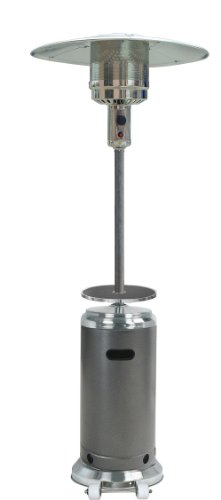
Hiland HLDS01-SSHST — best for large yards and long evenings. The backyard traditionalist: 48,000 BTU, a table ring for the drinks, and a model history long enough that parts will outlast the patio furniture.
EAST OAK 50,000 BTU — best for maximum output for exposed yards. The output pick for exposed yards: 50,000 BTU and one-hand ignition, for the seating circle at the far end of the garden.
Nexgrill Sundara — best for stainless durability for outdoor living. The durability pick: full stainless construction, electronic ignition and anti-tip shut-off, built to live outdoors and wipe clean.
EAST OAK Pyramid 48,000 BTU — best for a fire feature for a garden seating circle. The gathering pick: an all-stainless pyramid whose flame pulls a circle of chairs around it like a campfire does.
Amazon Basics 46,000 BTU — best for the reliable all-rounder for family yards. The family pick: the proven 46,000 BTU all-rounder with a water-fillable base — buy two for two seating zones and stay under budget.
Hykolity Pyramid 48,000 BTU — best for the flame feature at a friendlier spend. The feature pick on a budget: pyramid flame, bronze finish and a cover in the box, for the garden corner that hosts the evening.
How these picks were chosen
Backyard duty set the filters for this guide. Every pick is a full-height propane heater — electric infrared cannot throw heat across open ground, and tabletop units cannot warm a yard circle — and every pick was verified against its manufacturer’s published specifications for output, construction and safety systems, then cross-checked through Amazon’s Creators API, which confirmed the exact model behind every link in this article. Output below 46,000 BTU was excluded: in open air, weaker heaters produce the category’s characteristic disappointment, a warm pole and cold guests.
We checked U.S. Consumer Product Safety Commission recall records for every brand and model considered for this guide. Any heater with an active recall was excluded entirely and is not named in this article. Construction quality was weighted for outdoor exposure: stainless burners and reflectors, finishes that tolerate dust and weather, and designs whose bases can be ballasted against wind. Brands with documentation and parts support were preferred over anonymous listings with inflated claims, because a backyard heater is a multi-year appliance that will need an igniter, a thermocouple or a reflector eventually.
Two pyramid heaters are included deliberately. In a backyard, the seating circle around a flame is a real heating strategy — people move toward it and stay in its warmth — and both pyramid picks were chosen in stainless or covered configurations that tolerate garden life. What was excluded: natural gas models (few backyards have a gas point where the seating is), commercial radiant heaters above the budget ceiling, and any model whose specifications could not be verified from the maker.
Safety first: fire, carbon monoxide and tip-over
No heater in this guide is safe on autopilot, and the safety rules are not fine print — they decide where a heater may stand, what it may stand near, and whether it may be used at all. Read this section before the reviews, and read your chosen model’s manual after them; where the two differ, the manual and your local fire code win.
Clearance from anything that can burn. Mushroom and pyramid propane heaters need generous clear space above and around them — as a working rule, keep at least 3 feet from walls, furniture, curtains, umbrellas and overhanging branches on every side, and several feet of open air above the reflector, following the greater distance whenever the manual demands more. Never run a full-height propane heater under a low roof, tent, gazebo canopy or patio umbrella unless the manual explicitly allows the configuration and the clearances still fit. Tabletop units need a stable, heat-tolerant table and open air above them. Electric infrared heaters need the clearance their manuals specify from ceilings, walls and soft furnishings — radiant elements run far hotter than they look.
Carbon monoxide. Every propane heater in this guide burns fuel and produces carbon monoxide. That is why they are outdoor-only appliances: never use one in a garage, tent, enclosed porch, sunroom or any space with a roof and walls that trap air, and never use one indoors for any reason. A covered patio with open sides is the grey zone — if air cannot move freely through the space, treat it as enclosed and choose an electric heater instead. Know the early signs of carbon monoxide exposure — headache, dizziness, nausea, unusual tiredness — and if anyone feels them near a running heater, turn it off if you can do so safely, move everyone to fresh air and seek help. A battery carbon monoxide alarm in any semi-enclosed outdoor room is cheap insurance.
Tip-over and stability. Full-height heaters are tall, top-heavy machines standing in weather. Fill water-ballast bases, use sand or weights where the design allows, stand the heater on level paving rather than grass or decking boards that rock, and move it out of forecast storm winds. Tip-over shut-off switches and anti-tilt valves are backstops, not permissions: they cut the gas when a heater falls, but a falling heater is already an accident in progress. Keep children and pets from leaning, climbing or playing around the pole, and never leave a running heater unattended.
Fuel discipline. Check the hose and regulator for cracks and the connections for leaks with soapy water whenever you change a tank — bubbles mean gas is escaping, and the heater stays off until the connection is fixed. Store spare propane cylinders outdoors, upright, away from the heater and from ignition sources, never indoors and never in a hot car. Turn the cylinder valve off first when you finish for the night, let the burner consume the line gas, then turn the control off. Electric heaters have their own discipline: plug directly into a properly rated outlet, never run one from a lightweight indoor extension cord, keep cords dry and out of walkways, and give a 1,500 W heater a circuit that is not already feeding another heavy load.
Backyard-specific safety: wind, ground and the far end of the garden
Everything in the main safety section applies in a backyard, and three backyard conditions deserve their own emphasis. The first is wind. Open ground gives gusts a run-up, and a full-height heater is a sail on a pole: ballast the base as the design allows — fill the water base, add the sand or weights the maker provides for — and take the heater down or into shelter ahead of forecast storms rather than after them. A heater that falls on paving is a repair bill; a heater that falls while lit, even with its tip-over valve working, is an incident.
The second is ground. Stand the heater on level paving, decking or a purpose-laid pad — never on sloping or soft grass, never on gravel that shifts under the base, and never where a sprinkler will soak it nightly. Keep the area beneath and around it clear of leaf litter, mulch heaps and dry grass, all of which a backyard accumulates exactly where a heater wants to stand. The third is distance from the house’s supervision: a heater at the far end of the garden is out of earshot of a carbon monoxide alarm and out of sight of the kitchen window, which raises the discipline bar — never leave it running while everyone has gone inside, keep children from treating the warm circle as a play zone unsupervised, and site it away from play equipment, trampolines and the dog’s racing line. Propane cylinders, including the spare, store outdoors in the yard — upright, shaded, disconnected — never in the house or garage.
The six best patio heaters in detail
1. Hiland HLDS01-SSHST
Who it suits. established households with a defined dining terrace or seating pad, who keep a heater for years and value the table ring, the proven design and the parts trail. It suits the main seating zone of a medium-to-large yard.
Hiland, sold under the AZ Patio Heaters umbrella, has made this pattern of heater for years, and the HLDS01-SSHST is its 48,000 BTU version with a hammered silver and stainless finish, a small built-in table ring around the pole, and wheels on the base. The extra output over 46,000 BTU models is modest but real at the edge of the seating circle on a cold night. The table ring is genuinely useful: it gives seated guests somewhere to set a drink that is not the ground, and it keeps people from leaning against the pole. The base is a standard tank housing for a 20 lb propane cylinder, hidden behind a door panel.
Living with the Hiland means living with the classic mushroom-heater routine: roll it out, open the tank door, light it, and give the reflector a few minutes to start throwing heat sideways and down. The hammered finish is forgiving of the dust and pollen that settle on any heater stored outdoors. Hiland’s long model history matters here — manuals, emitter screens and regulator hoses for this heater pattern are easy to source years later, which is more than can be said for short-lived marketplace brands.
Pros
- 48,000 BTU is at the top of the residential mushroom-heater class
- Built-in table ring adds function without extra furniture
- Hammered finish hides dust and minor scuffs well
- Long-running model with widely available replacement parts
Honest limitation. Assembly is the weak point: the reflector ships in sections and the fasteners are small, so budget unhurried time and a second pair of hands for the top assembly.
Choose it if you want the proven design, the table ring and the parts support for the long term. Skip it if your yard is very exposed and you need the outright maximum output instead.
2. EAST OAK 50,000 BTU
Who it suits. owners of big or exposed yards whose seating sits away from the house’s shelter, and who have felt lesser heaters lose the fight against open air. It suits the primary gathering spot where maximum throw matters.
EAST OAK’s current mushroom heater pushes output to 50,000 BTU, the highest figure in this guide, and adds a one-hand ignition control that combines the gas valve and the spark in a single knob motion. The round table design around the pole gives guests a drink ledge, and the maker emphasises a simplified assembly that one person can complete. The grey finish is neutral and modern. As with every heater here, treat the headline BTU figure as a ceiling rather than a promise: placement, wind and seating distance decide how warm people actually feel.
EAST OAK has built its name on heaters that assemble quickly and light easily, and the one-hand ignition is the clearest example: a single control motion opens the gas and sparks the burner. The grey finish pairs with the grey-and-charcoal furniture that dominates current patio sets. At full output the 50,000 BTU burner is thirsty, so the sensible routine is to light it early, warm the seating zone, then turn it down once people are settled and blanketed by the initial warmth.
Pros
- 50,000 BTU is the strongest output in this guide
- One-hand ignition simplifies the lighting routine
- Round table ledge built into the pole
- Assembly is designed for one person
Honest limitation. Higher output burns through a 20 lb tank faster at full setting; heavy users should keep a spare tank or choose a mid setting for long evenings.
Choose it if your yard is exposed and you need every BTU of throw you can buy. Skip it if your seating is a small sheltered terrace, where its output is wasted.
3. Nexgrill Sundara
Who it suits. buyers who leave the heater outdoors through the season and want stainless surfaces that wipe down after weather. It suits grill-minded owners who like proper controls and easy tank swaps.
The Nexgrill Sundara is a 92-inch stainless steel mushroom heater rated at 48,000 BTU, with anti-tip shut-off, electronic ignition and a temperature control, plus a tank-access design intended to make cylinder swaps less of a struggle. Nexgrill is better known for grills, and the Sundara borrows that world’s priorities: stainless surfaces that wipe down easily and controls that feel familiar to anyone who has lit a gas grill. At 92 inches it is the tallest heater in this guide, so measure your overhead clearance before it makes your shortlist.
The Sundara’s grill DNA shows in the details: electronic ignition, a temperature control that behaves like a grill knob, and a tank compartment designed for the swap you will actually perform in the dark with cold hands. Stainless steel at this size needs a wipe-down habit to look its best, especially in coastal air. The anti-tip shut-off is a genuine safety system, not a marketing line — if the heater is knocked beyond its threshold, the gas cuts.
Pros
- Full stainless steel construction at a mid-range position
- Anti-tip shut-off and electronic ignition fitted as standard
- Temperature control gives finer adjustment than a basic knob
- Easy tank access simplifies cylinder swaps
Honest limitation. At 92 inches tall it needs the most overhead clearance in this guide, and stainless shows fingerprints and water spots without regular wiping.
Choose it if the heater will live outdoors and stainless durability tops your list. Skip it if your overhead clearance is limited — at 92 inches this is the tallest pick here.
4. EAST OAK Pyramid 48,000 BTU
Who it suits. hosts whose backyard evenings centre on a fire-side circle — chairs drawn up, drinks in hand, nowhere else to be. It suits a defined garden room or terrace corner arranged around the flame.
Pyramid heaters trade the mushroom heater’s reflected heat for a visible flame column inside a quartz glass tube, and EAST OAK’s version is built in all stainless steel with a 48,000 BTU rating and a triple protection system that covers tip-over and flame-out shutoff. The flame is the point: it turns the heater into a light source and a focal point, which is why restaurants and event patios use this format. The honest trade is physics — a pyramid heats the people immediately around it well, but its warmth falls off faster with distance than a reflector heater’s does, because much of the energy goes into the spectacle. Wheels are included for moving it on hard surfaces.
A pyramid heater is partly furniture, and the EAST OAK’s all-stainless body is built for that role: it wipes clean, shrugs off weather that would freckle painted steel, and keeps the flame column as the visual centre of the patio. Lighting follows the standard pilot routine, after which the flame settles into the tube. Owners should expect the glass to need an occasional careful clean, and should move the unit by its wheels on paving rather than dragging it across decking.
Pros
- Visible flame column doubles as patio lighting and a focal point
- All-stainless construction resists weather better than painted steel
- Triple protection system with tip-over and flame-out shutoff
- 48,000 BTU rating matches mushroom heaters on paper
Honest limitation. Heat reach is shorter than the BTU figure suggests; plan seating within a few feet, and expect the quartz tube to need careful handling during moves.
Choose it if your evenings gather around a flame and the seating sits close. Skip it if you need heat across a wide dining terrace rather than a close circle.
5. Amazon Basics 46,000 BTU
Who it suits. families who want dependable warmth at the main dining set without overthinking the purchase — and yards with two gathering spots, where a pair of these covers both inside the budget.
The Amazon Basics heater is the reference point for this entire category: a full-height mushroom-style propane heater with a 46,000 BTU burner, a reflector dome on top, wheels for moving it around the patio, and a base that can be filled with water to add ballast. Heat output is adjustable at the control knob, and the maker rates the warm zone at roughly a 9-foot radius around the pole, which in practice means a dining table for four to six people sitting close rather than a whole deck. The Havana Bronze finish is a powder coat over steel, and at just over 91 inches tall the heater needs real vertical clearance and a level surface to stand safely.
Ownership is deliberately ordinary. A standard 20 lb propane tank sits inside the base, the water-fillable base adds ballast once filled, and the whole unit rolls on its wheels for storage. On a full tank, a 46,000 BTU burner run at a moderate setting covers many evenings of typical use; run flat out, it empties noticeably faster, which is why experienced owners keep the knob at the lowest comfortable setting and sit closer rather than heating the whole garden. Spare parts such as thermocouples and igniters for this pattern of heater are generic and widely stocked.
Pros
- 46,000 BTU output covers a standard dining-table seating zone
- Water-fillable base adds stability without permanent anchoring
- Wheels make seasonal repositioning a one-person job
- Simple piezo-style ignition and a single control knob
Honest limitation. The powder-coated steel reflector and pole need a cover in wet climates; left uncovered, surface rust on the reflector edge is the most common long-term complaint about heaters in this class.
Choose it if you want the sensible all-rounder — possibly two of them for two zones. Skip it if you want a fire feature or maximum output for an exposed site.
6. Hykolity Pyramid 48,000 BTU
Who it suits. garden hosts who want the pyramid atmosphere for a terrace corner or garden room, at a spend that leaves money for the seating that goes around it.
Hykolity’s pyramid heater brings the glass-tube flame format down to a friendlier position in the budget, and it includes a fitted cover in the box — a small thing that matters, because pyramid heaters live outdoors and the quartz tube and pilot assembly last longer when they are kept dry and dust-free between uses. Output is rated at 48,000 BTU, the bronze finish warms up the look, and wheels are fitted for repositioning on paving. As with all pyramids, seat guests close: the flame show is generous, the heat radius is not.
The Hykolity pyramid is the accessible route into the flame-tube format, and the included cover removes the usual first accessory purchase. Assembly involves the glass tube, so work on a soft surface and keep the packaging until the unit is standing. Once lit, the bronze frame and the flame column do the entertaining; your job is seating placement, because guests beyond a few feet are watching the fire more than feeling it.
Pros
- Pyramid flame format at a value position in the range
- Fitted cover included in the box
- 48,000 BTU rating with wheels for repositioning
- Bronze finish suits warm-toned outdoor rooms
Honest limitation. The included cover is a basic one; in harsh winters the heater still belongs under a roof or in a shed, and the glass tube is the fragile part in any move.
Choose it if you want the flame feature and the included cover at a friendlier spend. Skip it if your circle sits in real wind, where flame heat struggles most.
Comparison table
All six picks burn propane and stand full-height, so the comparison turns on output, construction and the kind of evening each is built for. Read the pyramid rows differently from the mushroom rows: their ratings describe close-range flame heat, not thrown heat.
| Model | Type | Output | Standout feature | Main trade-off |
|---|---|---|---|---|
| Hiland HLDS01-SSHST | Propane mushroom heater | 48,000 BTU | Table ring and long parts trail | Assembly is fiddly; reflector ships in sections |
| EAST OAK 50,000 BTU | Propane mushroom heater | 50,000 BTU | 50,000 BTU, one-hand ignition | Thirsty at full output — keep a spare tank |
| Nexgrill Sundara | Propane mushroom heater | 48,000 BTU | Full stainless build, anti-tip shut-off | Tallest pick; stainless shows marks |
| EAST OAK Pyramid 48,000 BTU | Propane pyramid heater | 48,000 BTU | All-stainless pyramid flame | Heat is close-range despite the rating |
| Amazon Basics 46,000 BTU | Propane mushroom heater | 46,000 BTU | Water-fillable base, proven all-rounder | Painted finish needs its cover |
| Hykolity Pyramid 48,000 BTU | Propane pyramid heater | 48,000 BTU | Pyramid flame with cover included | Glass tube is fragile in moves |
How to choose: best patio heater for backyards under $500 explained
Step one: zone the yard. Walk the backyard and name the places people actually sit — the dining terrace, the fire circle, the loungers. Each zone is a heating problem of its own, and a heater serves one zone. Most yards need one zone heated well; large yards with two gathering spots should plan on two heaters rather than one heroic one, which this budget can accommodate with the value picks.
Step two: pick the format per zone. Dining zones want mushroom heaters: thrown heat over a table and chairs. Social circles want pyramids: a flame to gather around, with chairs pulled close. Mixed zones — dinner first, fire circle after — are the honest case for one of each, bought in the order you use them.
Step three: respect output, then discount it for exposure. In open air, treat the maker’s coverage claims as fair-weather numbers. A 46,000–50,000 BTU mushroom heater genuinely serves a dining set in a sheltered yard; on an exposed rise, the same heater serves the half of the table on its sheltered side. Windbreaks — the house wall, a fence, a hedge — are worth more than the difference between any two models in this guide, so place the zone first and the heater second.
Step four: give it ground and clearance. The heater needs a level, hard pad and the clearances in the safety section: several feet from fences, hedges, play equipment and furniture on all sides, and open sky or high clearance above — watch for tree canopies, which creep lower in leaf than you remember. Check the route to storage as well; wheels help on paving, not across lawns.
Step five: plan fuel for distance. The far end of the garden is a long way to carry a tank in the dark. Keep the spare cylinder stored outdoors near the seating zone, upright and shaded, and swap tanks in daylight. If you entertain often, two tanks in rotation end the mid-party outage permanently.
Step six: buy the weather kit with the heater. Cover, and for painted models a cover without exception. Backyard exposure ages heaters faster than patio exposure; the stainless picks forgive more, but every model in this guide lasts longer dry. Total the heater, cover and spare tank together — under $500 for the heater itself leaves the budget to do the whole job properly.
Common mistakes to avoid
Trying to heat the whole yard. No residential heater does this, and the attempt produces one hot pole and a ring of cold guests. Heat a zone, seat people in it, and let the rest of the garden be scenery.
Standing the heater on grass. Soft, sloping ground plus a tall, top-heavy appliance plus a gust is the backyard accident recipe. Paving, decking or a laid pad — level and firm — every time.
Forgetting the trees. Overhead clearance is not only about roofs. A heater placed for winter branches can sit under summer canopy, and reflector heat rises straight into it. Check the spot in the season you will use it.
Leaving the far heater running. The gathering ends, people drift inside, and the heater at the garden’s end burns on alone. Make switching it off part of the closing ritual, like locking the shed — or better, assign it to the host.
Storing the spare tank in the garage. Propane cylinders live outdoors: upright, shaded, away from ignition sources. The garage, basement and house are never cylinder storage, however tidy they look.
Skipping the cover because the heater ‘looks tough’. Backyard weather is undefeated. Painted finishes freckle, reflectors dull, igniters sulk. The cover is the cheapest longevity in the entire purchase — buy it with the heater, not after the first season’s damage.
Two zones, one yard: planning a backyard heating system over time
Most backyards are not heated in a single purchase; they are heated in stages, and planning the stages saves buying the wrong first heater. Stage one is the primary zone — the dining terrace or the chairs by the house — served by the strongest, most versatile heater the budget allows, which in this guide means a 48,000–50,000 BTU mushroom heater placed inside the seating. Stage two, often a season later, is the secondary zone: the fire circle, the far terrace, the poolside loungers. That zone usually wants a different format — a pyramid where people gather socially, or a second mushroom heater where they dine — and the mistake to avoid is buying stage one’s heater so expensively that stage two never happens, or buying a stage-one heater in a format that duplicates badly.
The arithmetic of this budget supports the staged plan. One premium mushroom heater now, or a value mushroom heater now and a pyramid next season, can land at similar total spend with very different yards at the end: the second path finishes with two zones heated and two kinds of evening served. The picks in this guide were chosen partly for how they combine — the Amazon Basics and Hykolity as value anchors that leave room for a second unit, the EAST OAK Pyramid and its Hykolity counterpart as the classic second purchase, the Hiland and Nexgrill as the buy-once anchors for owners who know their yard needs one zone done properly.
Shared infrastructure makes stages cheaper. Two heaters want two tanks in rotation plus a spare — buy cylinders when you see exchange cages rather than at the party’s eleventh hour, and store them together, outdoors, upright and shaded, in one designated spot near the seating rather than scattered around the yard. Covers bought in pairs, a single cleaning kit, and one seasonal routine — light both heaters on the first cool evening of autumn, clean, leak-check, and burn off the summer’s dust before the first real gathering — keep a two-heater yard at barely more effort than a one-heater yard.
Think, finally, about the yard’s other systems. Lighting and heating plan together: a pyramid’s flame is a light source, and string lights over a dining zone change where people linger and therefore where heat should be. Seating is part of the system too — chairs with arms and cushions hold people in the warm circle longer than bare benches at its edge. And the windbreak you plant or build for the seating zone pays its dividend every single evening, in every heater’s performance, for as long as the yard exists. A backyard heating system, assembled in that order — zone, heater, fuel, shelter — is what the $500 ceiling in this guide is really buying, one stage at a time.
One last planning habit separates yards that feel warm from yards that merely own heaters: a five-minute walk at dusk, early in the season, with the heater lit and a chair in hand. Sit where you plan to seat people. Notice where the breeze actually comes from once the sun drops — it is often not the direction the daytime wind suggests — and where the cold pools at the yard’s low end. Move the chair, then move the heater, until the seat, the shelter and the heat agree. That small rehearsal, done once, quietly corrects most of the placement guesses that spec sheets cannot make for you, and it costs nothing but an evening you were probably going to spend outside anyway.
Final recommendation
For the main seating zone of most backyards, buy the Hiland HLDS01-SSHST: proven, powerful, table-ringed, and supportable for years. Exposed yards and far-end terraces should take the EAST OAK 50,000 BTU for its maximum throw, and owners who leave a heater outdoors should look hard at the stainless Nexgrill Sundara. If your backyard evenings gather around a flame, the EAST OAK Pyramid is the centrepiece pick and the Hykolity Pyramid its budget counterpart, while the Amazon Basics remains the family all-rounder — two of which zone a large yard better than any single heater here. All six sit under the $500 ceiling; check the current price on Amazon, order the cover in the same basket, and give the heater a level pad and a fair windbreak. That combination, not any specification, is what a warm backyard is made of.
Frequently asked questions
How many patio heaters does a large backyard need?
One per seating zone, not one per yard. A heater warms the circle around it — roughly a dining set or a ring of chairs. A yard with a dining terrace and a separate fire circle has two zones and, if both are used at once, wants two heaters. At this budget, pairing two value picks is a legitimate strategy and usually beats one premium heater straining at both jobs.
Can a patio heater stand on grass?
No — not safely. A tall heater needs level, firm, hard standing: paving, decking or a laid pad. Grass is soft, often sloped, and lets a base rock in gusts; it is also combustible when dry, as is the leaf litter and mulch that accumulate on it. If your gathering spot is the lawn, put a pad at its edge and arrange the seating to meet the heater there.
Will a backyard patio heater keep mosquitoes away?
No. Patio heaters are not insect control; warmth and carbon dioxide can, if anything, interest the local mosquitoes. Citronella, fans — moving air genuinely discourages mosquitoes — and screens do that job. Buy the heater for warmth and let other tools handle the insects.
How far from a fence or hedge should a patio heater stand?
Keep at least 3 feet of clear space from fences, hedges, furniture and other combustibles on every side, and more where the model’s manual demands it — several feet of open air above the reflector as well. Hedges deserve special care: dry, dense foliage close to a reflector is a genuine fire risk, and ‘it has been fine so far’ is not a clearance standard.
Can I leave a backyard patio heater out in the rain?
It will survive weather better with a cover, and best under a roof. Stainless models tolerate exposure best; painted finishes degrade fastest. Never operate a heater in rain or storms — the issue is not only the appliance but wind, lightning and people moving on wet ground around a tall, hot object. Light it when the evening is fair and store it dry when it is not.
Is a pyramid heater a good choice for a backyard?
For the right backyard pattern, yes: a defined social circle — chairs around a focal point on a terrace or garden room — is exactly what a pyramid serves, and its flame makes the gathering. For heating a spread-out dining terrace or warming people at distance, a mushroom heater throws heat further and is the better tool. Many yards eventually own one of each, for two different kinds of evening.


