Where to buy
Check the latest price, availability and delivery on Amazon. Orders are placed on Amazon. We may earn a commission from qualifying purchases.
- Best tall store: Keter Premier Tall Resin Outdoor Storage Shed, 62 Cu. Ft. — Check on Amazon
- Suncast 54 Cu. Ft. Vertical Storage Shed — Check on Amazon
- Keter Kentwood 50 Gal Outdoor Storage Box — Check on Amazon
- Keter City 30 Gal Outdoor Storage Box and Patio Side Table — Check on Amazon
See 2 more Amazon options
- Devoko 30 Gallon Resin Deck Box, Black — Check on Amazon
- Suncast 22 Gallon Small Deck Box with Seat, Java — Check on Amazon
Read the full guide ↓
Disclosure: As an Amazon Associate, dailyhomedecorating.com earns from qualifying purchases. Links to Amazon on this page are affiliate links; they cost you nothing extra. Listing details such as price and availability change often, so check the current Amazon listing before you buy.
The best outdoor storage box for small patios under $1500 is a contest the budget barely gets to vote in — because on a small patio, the scarce currency is not money, it is inches. A $1,500 allowance could buy a walk-in shed; a small patio cannot hold one, and the honest shape of this guide follows from that: the money buys quality, fit and dual-purpose design at small scale, not size. We verified every pick against Amazon’s own catalog data through the Amazon Creators API while researching this guide, matched each model to its confirmed listing, and screened the category against CPSC recall records in the same pass. The six picks that survived are the ones that respect a small patio’s geometry: two tall, slim vertical stores that trade depth for height; a 50-gallon box that seats; a 30-gallon box that is secretly a side table; the lightest 30-gallon box in the category for patios that rearrange often; and a 22-gallon corner seat that uses the one space every small patio wastes.
The principle running through all six is that on a small patio, storage must pay rent. A box that only stores is a tenant that does not work; a box that seats, serves as a table, or stands in the dead vertical strip along the wall is a member of the household. That is why this guide contains no merely-large boxes and no bargain-bin plastic: at small scale, the difference between a patio that feels furnished and one that feels like a storage unit with chairs is entirely a matter of which objects you allow in. Bought together, the whole six-pick system still uses only a fraction of this budget — we will say so plainly rather than dress small boxes in big prices — and the correct use of the remainder is the rest of the patio: the chairs, the shade, the light.
Most small-patio readers should start by deciding between the two shapes: if your patio has a wall strip and tall things to store, start with the Keter Premier Tall; if your storage is cushions and your patio needs the seating, start with the Kentwood. The tiny picks at the end of the guide are not afterthoughts — on the smallest patios, the City table and the Suncast corner seat are frequently the entire correct answer. Below: quick picks, how they were chosen, full notes on all six, a comparison table, a measuring-first guide to small-patio geometry, the mistakes that shrink a small patio further, and the questions that come up again and again.
In this guide
Quick Picks
Short on time, or comparing several options at once? Each row below names a buyer type and the product that suits it, with a link to the listing.
| Buyer type | Pick | Why it stands out | Link |
|---|---|---|---|
| Best tall store | Keter Premier Tall Resin Outdoor Storage Shed, 62 Cu. Ft. | Vertical storage about 29 in. deep, with brackets for up to two shelves | Check on Amazon |
| Best slim tool store | Suncast 54 Cu. Ft. Vertical Storage Shed | Long tools upright, shelf notches in 16 in. steps, floor included | Check on Amazon |
| Best seat-and-store box | Keter Kentwood 50 Gal Outdoor Storage Box | 50 gallons that double as seating, up in minutes without tools | Check on Amazon |
| Best table in disguise | Keter City 30 Gal Outdoor Storage Box and Patio Side Table | A working side table hiding 30 lockable gallons | Check on Amazon |
| Best featherweight box | Devoko 30 Gallon Resin Deck Box, Black | About 8.8 lb — the box you can carry around the patio one-handed | Check on Amazon |
| Best corner seat | Suncast 22 Gallon Small Deck Box with Seat, Java | 22 dry gallons under a 200 lb seat lid, in the corner nothing else uses | Check on Amazon |
How These Picks Were Chosen
Small patios invert the usual filters, so we inverted them. Depth came before capacity: every pick’s exterior depth was checked against the reality that a patio must keep a walkway, and anything that eats the passage between door and chairs was excluded however many gallons it boasted. Height was treated as free storage — the vertical strip along a wall or fence is the one volume a small patio has in surplus — which is why two tall stores lead the guide. Dual duty was mandatory rather than preferred: seats, tables and corners that work twice. And assembly and weight were judged by small-space logistics, where the build happens in the same few square feet the box will occupy and a one-person carry is the norm.
Verification followed the standard of this series. Each pick was cross-checked through the Amazon Creators API — the catalog data Amazon itself serves — and the brand, model, capacity and dimensions printed here are the ones the API returned for that exact listing; products whose records did not match were dropped, and the category was screened against CPSC recall records, with no recalled product among the picks. Prices in this category move constantly, so the guide prints no static figures: positions are described in words, and the live number is the one showing when you check the current price on Amazon. The budget finding bears repeating in plain language: small-patio storage, done properly with quality pieces, costs a fraction of $1,500. Any guide at this tier that implies otherwise is selling you the price, not the patio.
We did not test these boxes on a model patio. We worked from maker listings and specification data — exterior and interior dimensions above all, capacities, seat and load ratings as the makers state them, assembly and weight figures — and we weighted the failure modes small-patio owners actually report: the box that fits the spot but whose lid cannot open under the railing, the capacity that sounds ample until a folded cushion defeats it, and the finish that turns a furnished patio into a storage yard at a glance.
Best Outdoor Storage Box for Small Patios Under $1500: The 6 Picks in Detail
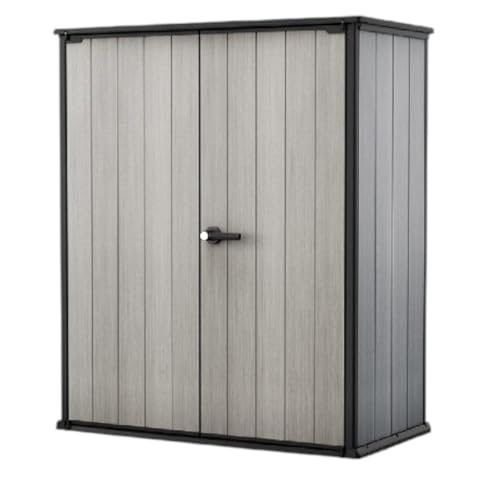
Keter Premier Tall Resin Outdoor Storage Shed, 62 Cu. Ft., Grey & Black
Who it suits: Small patios with one wall strip and a tall inventory — tools, a folded umbrella, sports gear, the broom-and-bucket army — that currently leans in a corner pretending not to be clutter.
The Premier Tall is the small patio’s vertical argument: about 55.1 inches long, 29 wide and 67.1 high, which means it takes a strip of wall roughly twenty-nine inches deep and returns 62 cubic feet of standing storage. That trade — depth for height — is the only honest way to add real capacity to a small patio, because depth is what the patio cannot spare and height is what it is not using. Inside, the maker includes brackets to support up to two shelves (shelves themselves not included), so the interior can be tailored: long tools standing one side, shelved smalls the other, rather than the single tangled column that door-less boxes impose. The construction is heavy-duty polypropylene resin reinforced with steel, weather-resistant and UV-protected, with metal hinges on the door — a real door, that opens like one — and a padlock-compatible latch for the patios that double as thoroughfares. Against a house wall or fence it reads as a slim cabinet, and that discretion is a small-patio feature in itself: the storage should be the least interesting object in the view.
It sits at the top of this guide’s small-scale range — check the current price on Amazon — and even so it is a modest slice of the $1,500 budget, which is this guide’s recurring, honest theme. Against the Suncast vertical below, the trade is shape and system: the Premier Tall is the wider, shelf-bracketed cabinet for mixed tall-and-small loads; the Suncast is the slimmer tool tower with its own shelf-notch system. Measure your strip and your inventory and the choice makes itself. Its limits are a cabinet’s limits: it will not take a bike flat or a cushion set with any grace, the shelves you will want are a separate purchase, and at sixty-seven inches it wants a wall or fence at its back for both looks and stability. Apartment balconies with the same geometry will find its cousins in Best Outdoor Storage Box For Apartments Under $1500.
- 62 cu. ft. standing up in about 29 in. of depth — height traded for footprint.
- Shelf brackets for up to two shelves: tall gear and smalls in one cabinet.
- Steel-reinforced resin, metal-hinged door, padlock-compatible latch.
Honest limitation: Shelves are not included, wide or soft loads do not suit it, and it wants a wall at its back.
Choose it if your patio has a wall strip and a tall, mixed inventory. Skip it if your load is cushions — the boxes below are built for soft geometry.
Suncast 54 Cu. Ft. Vertical Storage Shed
Who it suits: Tool-owning small patios — the gardener whose long-handled tools, umbrella and supplies need to stand upright behind a lockable door on the slimmest footprint in this guide’s shed class.
Where the Premier Tall is a cabinet, this Suncast is a tower: 54 cubic feet of vertical storage designed around the long-handled tool, the single most awkward object in small-space life. Shovels, rakes, the patio umbrella, the broom — they stand upright, reachable in one motion, instead of leaning in the corner fan that collapses theatrically whenever one is withdrawn. The interior has three sets of notches in 16-inch increments that accept up to three shelves (not included), so the tower adapts as the inventory changes — shelves low for pots and chemicals, open height above for the tools. Construction is multi-wall resin with a reinforced floor included — a detail small sheds often skip and tool loads punish — plus padlock-ready lockable handles and a lower latch that keeps the door seated. It is made in the USA, and the all-weather resin brings the category’s standard water resistance and UV protection in a Stoney finish that disappears against a wall.
Its position is the middle band of this guide — check price on Amazon — and its role is the garden end of a small patio: pair it with the Kentwood for the cushions and the patio has a complete, two-piece system for a fraction of the budget. The honest trade against the Premier Tall is width for slimness and the maker’s ecosystem for Suncast’s; both are legitimate, and the tape measure is the referee. Its limits are a tower’s: nothing wide, nothing that must lie flat and long, and the shelves are again an extra. Households whose small space is a yard rather than a patio will find the vertical idea at larger scale in the backyard guides, and the pure deck-box alternatives at this tier in Best Deck Box For Small Patios Under $1500.
- 54 cu. ft. of upright storage — long tools standing, not leaning.
- Shelf notches in 16 in. steps for up to three shelves; reinforced floor included.
- Multi-wall resin, padlock-ready handles, made in the USA.
Honest limitation: A tower’s width excludes bikes and bulky gear, and the adaptable shelves are sold separately.
Choose it if your small patio’s clutter is tall and tool-shaped. Skip it if your inventory is mixed-width — the Premier Tall’s cabinet swallows more shapes.
Keter Kentwood 50 Gal Outdoor Storage Box, Grey
Who it suits: The small patio’s center of gravity — households whose main load is a dining set’s cushions and whose patio needs the box to be a seat when it is not being a box.
Fifty gallons is the small patio’s honest capacity: a four-chair dining set’s cushions, the throws, the pool or beach layer, without the footprint ambition of the big boxes. The Kentwood’s maker aims it explicitly at balconies, porches and compact patios, and the design follows the brief — a compact footprint, a wood-look texture that keeps it in furniture territory, a lock-ready lid for security, and a top that doubles as extra seating, which on a small patio is not a bonus but the entire business model: the box earns its square feet twice or it does not deserve them. Assembly is tool-free and, by the maker’s account, done in under ten minutes, which matters on a patio where the assembly area and the living area are the same area. The resin is the all-weather, won’t-rust-peel-or-dent kind, and the whole piece can be hosed down in place when the season turns.
At the value end of this guide — check the current price on Amazon — the Kentwood is the pick that lets a small-patio budget stay small where it should: buy this, add the City table if the patio wants one, and the storage line of the project is closed for a sliver of the $1,500. Its limits are the middle size’s: a six-seat cushion set will defeat it, it is a seat for perching and overflow rather than for the evening’s main guest, and households with tall gear need one of the towers above as a partner. Readers working the small-space tiers will find it compared at a stricter allowance in Best Outdoor Storage Box For Small Patios Under $500, and in the base guide it is the size class we recommend when the patio’s tape measure says no to everything larger — see Best Outdoor Storage Box Under $1500 for how it sits in the full system.
- 50 gallons in a compact, furniture-finish footprint made for small patios.
- Doubles as seating; lock-ready lid; tool-free assembly in minutes.
- All-weather resin — hose it down where it stands.
Honest limitation: Mid-size in everything: big cushion sets overflow it, and tall gear needs a tower partner.
Choose it if you need one box that stores the dining set and seats the overflow. Skip it if your load is tall (towers above) or tiny (table and corner picks below).
Keter City 30 Gal Outdoor Storage Box and Patio Side Table, Grey
Who it suits: The smallest patios and the smartest use of a square foot in this guide: a side table that stores, for patios where a dedicated box is a luxury the floor plan forbids.
The City’s exterior is about 22.75 inches long, 17.3 wide and 21.7 high — which is to say, it is the size of the side table your patio already needs, standing at drink height beside the chairs. The disguise holds 30 gallons: cushions for a chair pair, the gardening smalls, pool essentials, the string lights and the throw. On a small patio this is not a compromise pick; it is the only form of storage that costs zero additional floor, because the table was always going to be there. The resin carries a wood-look texture, the lid is lockable, assembly is the brand’s tool-free minutes-long exercise, and the whole object can be carried to its spot by one person without a plan. In the small-patio system it is the daily layer — the things you touch every day, stored at the exact point of touch — while the towers and the Kentwood handle the bulky and the seasonal.
It is the lowest-priced pick in this guide — check the current price on Amazon — and at a $1,500 budget the sophisticated move is often two small pieces instead of one large one: the City beside the chairs, the Suncast seat in the corner, and the patio is furnished and stored while the budget’s bulk goes to shade, light and chairs. Its limits are arithmetic: 30 gallons takes no sofa cushions and nothing long, and the top, while a perfectly serviceable table, is resin — handsome and wipeable, not stone. Buy it as the hardest-working side table in the category and it will be exactly that for years.
- A true side table — about 21.7 in. high — hiding 30 lockable gallons.
- Zero extra floor: it replaces a table the patio already needed.
- Wood-look resin, tool-free assembly, one-person carry.
Honest limitation: Table-scale storage only — no long items, no cushion sets — and a resin top that is practical rather than luxurious.
Choose it if your patio is truly small and every object must hold two jobs. Skip it if you have room and need for the Kentwood’s capacity instead.
Devoko 30 Gallon Resin Deck Box, Black
Who it suits: Rearrangers — small patios that change layout with the season or the guests, renters of patio space, and anyone who wants a box that moves as easily as the chairs do.
The Devoko’s headline is a number: about 8.8 pounds. That is the whole product, in a sense — a 30-gallon resin box (interior roughly 22 x 16 x 20 inches) light enough to carry around the patio one-handed, repositioned for the sun, the party or the season without a second person or a plan. On small patios, where the furniture migrates constantly and storage must migrate with it, that lightness is a genuine capability the heavier, better-built boxes cannot match. The maker rates the lid as an extra seat at up to 220 pounds, the resin is waterproof and UV-resistant, the built-in handles help the carry, the lid can be locked, and assembly is six panels fitted together in about five minutes by the maker’s account. In black, it is the most neutral object in this guide — it disappears against shadows and railings, which on a small patio is a visual virtue.
At the value end of the guide — check the current price on Amazon — it is the flexibility pick: buy it for the season’s layout, move it when the layout changes, and never feel the sunk-cost drag of a heavy installation. The honest trade is substance: at under nine pounds this is light-gauge resin, and it feels it — the lid, the panels and the seat rating are a light box’s, not the Kentwood’s, and a household wanting a decade of daily service in one spot should buy the heavier pick and place it once. The Devoko is for the patio that has not finished becoming itself yet, and there are more of those than any other kind.
- About 8.8 lb — a 30-gallon box you can carry one-handed to its new spot.
- Seat-rated lid by the maker at 220 lb; lockable; handles built in.
- Six-panel assembly in minutes; waterproof, UV-resistant resin.
Honest limitation: Light-gauge construction that feels light — the trade for its weight — and a seat and lid sized for occasional rather than daily duty.
Choose it if your patio layout changes and your storage must change with it. Skip it if you want one heavy box placed once for a decade — that is the Kentwood.
Suncast 22 Gallon Small Deck Box with Seat, Java
Who it suits: The corner — every small patio has one dead corner, and this is the pick that turns it into a seat with 22 dry gallons underneath.
Twenty-two gallons is the smallest capacity in this guide and, on a small patio, potentially the best-used: the interior (about 20.5 x 15.5 x 17 inches) takes the stratum of small daily things — the watering can, the throws, the towels, the winter accessories in summer — that otherwise live on the patio floor making the space feel smaller than it is. The reinforced lid is maker-rated to hold up to 200 pounds, so the corner becomes a seat: for shoes, for coffee, for the extra guest. The wicker-pattern Java finish is the warmest look here and the natural partner to the rattan and teak furniture small patios favor, where the greys can read as appliances. It is made in the USA, assembles by hand in minutes with no tools, and the maker notes its indoor second life — entryway, sunroom, seasonal storage — which gives it an afterlife most patio boxes never get. Placed with the City table, it completes the smallest patios entirely: table-storage by the chairs, seat-storage in the corner, and not one square foot spent on a box that only boxes.
At the accessible end of the guide — check price on Amazon — it is proof of this article’s thesis: small-patio storage is a fit discipline, and the $1,500 budget’s best use is a few right small things, beautifully placed. Its limits are pure scale — nothing long, nothing bulky, one sitter at a time — and within those limits it has no real rival for its corner.
- 22 gallons fitted into the corner every small patio wastes.
- Seat lid maker-rated at 200 lb — the corner becomes furniture.
- Wicker-pattern Java finish; made in the USA; hand assembly in minutes.
Honest limitation: Small-load only — no long items, no cushion sets — and seating for one.
Choose it if you have a corner and a pile of small things that need to vanish into it. Skip it if your one purchase must cover cushions — start at the Kentwood.
Comparison Table
| Product | Type | Best use | Link |
|---|---|---|---|
| Keter Premier Tall, 62 Cu. Ft. | Vertical cabinet, shelf brackets | Mixed tall storage on a wall strip | Check on Amazon |
| Suncast 54 Cu. Ft. Vertical | Vertical tool tower, floor included | Long tools upright on a slim footprint | Check on Amazon |
| Keter Kentwood 50 Gallon | Deck box, seats | Dining cushions plus overflow seating | Check on Amazon |
| Keter City 30 Gallon | Side-table box | Daily smalls stored inside the table | Check on Amazon |
| Devoko 30 Gallon | Featherweight deck box | Storage that moves with the layout | Check on Amazon |
| Suncast 22 Gallon, Java | Corner seat box | The dead corner, converted to a seat | Check on Amazon |
How to Choose: Small-Patio Geometry, Measured First
Measure before you shop, and measure the right things. The governing dimension on a small patio is depth — from the wall or railing to the edge of the walkway you must keep — because a box consumes the patio in depth and merely occupies it in length. Write down three numbers: the depth of your wall strip (the towers live there, at about 29 inches and less), the length of your longest free run (the boxes live there), and the diagonal of your dead corner (the Suncast’s home). Then measure the load, not the hope: your cushions folded, your longest tool, your tallest bottle. Small-patio storage fails almost exclusively as a mismatch between one of those six numbers and a listing’s dimensions, and every one of those failures is visible in advance with a tape measure.
Then apply the rent rule: every object must hold two jobs or occupy dead space. Seats that store, tables that store, towers in the vertical strip, a box in the corner — those are the four legal categories on a small patio. A single-purpose box in prime space is the one illegal one, whatever its capacity. This rule, more than any budget, is what separates the small patios that feel like rooms from the ones that feel like storage units with a chair in them. Finally, plan the visual field from the chairs: on a small patio you sit inside your storage, so finishes are not vanity — wood-look, wicker-pattern and cabinet profiles are what let the space read as furnished. The greys and blacks earn their place by disappearing; let them.
And keep the budget in its place. The complete system in this guide — a tower, the Kentwood, the City and the corner seat, bought together — sits in the lower portion of a $1,500 allowance. The rest of the money is the patio itself: shade for the afternoon, light for the evening, chairs worth sitting in. A small patio does not need a big storage budget; it needs a short list of right objects, and the discipline to stop there.
Common Mistakes That Shrink a Small Patio
The first is buying capacity instead of fit — the 150-gallon bargain that eats the walkway and turns the patio into its own storage. The second is the lid trap: a box that fits its spot exactly, whose lid then cannot open against the railing or under the shelf, discovered on delivery day. Leave the lid’s arc in your measurements. The third is ignoring the corner and the wall strip — the two free volumes — while crowding the prime floor with a single-purpose box. Fourth, storing by optimism: buying for the cushion set you plan to get, in a size your current set does not need and your patio cannot spare.
Fifth, the damp mistake, which small sealed boxes punish fastest: cushions stored damp in a compact box mildew in weeks in a warm climate — dry first, always. Sixth, matching nothing: a small patio is a single visual field, and three boxes in three clashing finishes shrink it more than any dimensions do. Seventh, spending the whole $1,500 because it is there — the mistake this entire guide exists to prevent.
Final Recommendation
For most small patios: the Kentwood as the working box, the City as the table, and the Suncast in the corner — three dual-purpose pieces, a complete system, and most of the budget returned to the patio itself. Add the Premier Tall when the inventory is tall and mixed, or the Suncast tower when it is tools — one tower, not both, unless your wall strip is long. Choose the Devoko instead of the Kentwood only when the layout genuinely migrates. And measure first: on a small patio, the tape measure is worth more than the budget. If the list still feels long, cut it by the rent rule rather than by price — the piece that only stores is the piece that goes — and let the patio keep the open middle that makes it a place to be, rather than a place things are kept. That discipline, more than any single product in this guide, is what a generous budget and a small patio have to teach each other.
Making It Feel Bigger: Layout, Sightlines and the Care of Small Things
A small patio’s storage succeeds or fails visually before it succeeds functionally, because on a small patio you do not visit your storage — you live inside it. The layout principles that keep a stored patio feeling like a room are simple and worth stating as rules. Keep the tall pieces on one wall, together: a tower beside a bench box reads as a composed wall of furniture, while the same pieces scattered to three edges make the space feel surrounded. Keep the sightline from the door low: the first thing seen from inside the house should be the seating and the green, not the storage, so the boxes line the edges the doorway does not face. Keep the floor’s center empty at almost any cost — a small patio’s luxury is its open middle, the two steps of clear ground that make it a place rather than a passage — and let the corners, the wall strip and the vertical plane do all the storing. The picks in this guide were chosen to make those three rules easy: towers for the wall, dual-purpose boxes for the edges, a seat for the corner, and nothing whose only job is to sit in the middle being large.
Care, at this scale, is mostly a matter of rhythm rather than effort. Resin asks for a hose and a cloth a few times a year; the small boxes’ lids and latches ask for their tracks kept free of the grit that patios manufacture; and the interiors ask for the driest discipline of all, because a compact sealed box concentrates whatever humidity goes into it. The seasonal rotation is the small patio’s twice-yearly ritual: summer’s layer up, winter’s layer down, everything entering dry. Done in that rhythm, a small system stays invisible — which is the goal. The moment storage becomes the most noticeable thing on the patio, something has been bought by capacity instead of by fit, and the fix is rarely a bigger budget. It is a shorter list.
That is also the honest place to end the budget conversation this guide has kept open from its first paragraph. A $1,500 allowance in a small-patio category is an invitation to overbuy dressed as generosity, and the correct response is the one this guide has modeled throughout: choose the few pieces that fit by inches and work twice, in finishes that let the space read as a room, and return the rest of the money to the patio itself — to the shade that makes it usable at noon, the light that makes it usable at nine, and the chairs that make it worth using at all. Storage is the patio’s servant. On a small patio most of all, it should never be allowed to become its landlord.
Renters, Rules and the Patio You Do Not Own
Many small patios belong to landlords, buildings and HOAs rather than to the people furnishing them, and this guide’s picks were chosen to survive that reality — but the rules deserve their own direct treatment. The governing distinction in most leases and community rules is between furniture and structures: furniture is placed, structures are installed, and everything in this guide is firmly on the furniture side of the line — freestanding, unanchored, removable in minutes without a trace. The towers are the borderline case in appearance only: they read as cabinets, they stand like cabinets, and no fastener ever meets the building. If your rules require stored items to be concealed or contained, the lockable lids and doors across these picks satisfy the letter of that requirement as well as its spirit. Where a building restricts balcony and patio storage outright — some do, usually for fire-egress reasons — the indoor second lives of the smaller picks (the City as a side table, the Suncast as entryway storage) mean the purchase survives the rule rather than violating it, and the correct first step remains the one this series always recommends: read your own documents before the delivery, because yours are the only rules that will ever be enforced.
Weight is the renter’s second rulebook, written by physics rather than by landlords. On raised decks and balconies, keep the heavier pieces against the building line where the structure is strongest, spread dense loads rather than concentrating them, and treat a tower full of soil, tools and liquids as the serious load it is. The featherweight Devoko and the modest footprints of the City and the Suncast seat exist in this guide partly because of that arithmetic: a small patio’s storage can be complete without ever asking the structure a hard question. Ground-floor patios on slabs can ignore most of this paragraph, which is its own small luxury — but the habit of placing heavy against the wall costs nothing and travels to every patio you will ever have.
The Seasonal Rotation, Done in an Hour
Twice a year, a small patio changes its mind about what it is for, and a well-chosen storage system makes that change an hour’s pleasant work instead of a weekend’s negotiation. The method is worth writing down because it is the same at every scale in this guide. Empty the working box first and sort on the patio floor into three piles: what stays out for the coming season, what goes to the bottom of the storage for the season it will sleep, and what is leaving the household entirely — every patio accumulates a third pile, and the rotation is the moment to be honest about it. Wipe the interiors while they are empty; it is the only time all year they are. Load the sleeping season’s goods first, dry and folded, then the coming season’s daily layer on top or in the daily piece — the City for the smalls you will touch weekly, the Kentwood for the cushions you will touch daily. The towers take the same treatment standing up: shelves audited, tools wiped, the floor of the cabinet swept of the season’s grit.
Done this way, the rotation is also the patio’s annual design review: the chair that nobody sat in, the box corner that collected rather than stored, the layout that the season proved wrong. Small patios reward that honesty disproportionately, because a single wrong object is a tenth of the whole space. The system in this guide is deliberately easy to correct — light pieces, standard makers, nothing built in — so the rotation can change the patio rather than merely servicing it. That, in the end, is what the unspent majority of this budget protects: not the storage, but the patio’s freedom to keep becoming itself.
FAQ
What is the best shape of storage for a small patio? Tall and slim, or dual-purpose. Vertical stores trade the depth you cannot spare for the height you are not using, and boxes that seat or serve as tables pay rent for their footprint. Wide, single-purpose boxes are the shape to avoid.
How deep can a box be on a small patio? As deep as your wall strip allows while keeping a comfortable walkway — for most patios that means boxes in the 17–22 inch depth class along edges, and towers around 29 inches deep only against a wall where no passage is needed. Measure your strip and subtract your walkway before shopping capacities.
Can a small patio really use a $1,500 storage budget? It cannot, and should not try. The complete quality system in this guide costs a fraction of the allowance. The honest move is to buy the right few pieces and spend the rest on the patio itself — shade, seating and light — where the money is visible every day.
Do vertical storage sheds need anchoring? Tall, slim units are happiest against a wall or fence, both visually and for stability in wind, and several makers design them with that placement in mind. They are freestanding cabinets rather than structures, but a tall empty box in a storm gust is a sail — place it against the wall and load the bottom first.
Will a 50-gallon box hold my dining cushions? For a four-chair set, typically yes — that is the Kentwood’s stated brief. Six chairs, deep-seat cushions or a sofa set will overflow it; measure your cushions folded and compare against the interior dimensions in the listing before ordering.
Which pick is best for a patio that changes layout often? The Devoko 30 — at about 8.8 pounds it moves one-handed wherever the chairs go. The City table is the other easy mover. The towers and the Kentwood are place-once pieces by design.
Should I match the finishes of my boxes? On a small patio, yes, more than you would expect. The space is a single visual field, so two or three pieces in one finish family — the Keter greys, or the warm Java and brown tones — read as a furnished room, while a clash of finishes reads as storage that accumulated. When in doubt, let one piece be the visual anchor and choose the rest to be quieter than it is.


