Where to buy
Check the latest price, availability and delivery on Amazon. Orders are placed on Amazon. We may earn a commission from qualifying purchases.
- Best balcony all-rounder: Keter Store-It-Out Midi Outdoor Resin Storage Shed, 30 Cu. Ft. — Check on Amazon
- Keter Marvel 71 Gal Outdoor Storage Box — Check on Amazon
- EAST OAK Outdoor Storage Box, 60 Gallon Deck Box, Grey — Check on Amazon
- Keter Kentwood 50 Gal Outdoor Storage Box — Check on Amazon
See 2 more Amazon options
- Keter City 30 Gal Outdoor Storage Box and Patio Side Table — Check on Amazon
- Suncast 22 Gallon Small Deck Box with Seat, Java — Check on Amazon
Read the full guide ↓
Disclosure: As an Amazon Associate, dailyhomedecorating.com earns from qualifying purchases. Links to Amazon on this page are affiliate links; they cost you nothing extra. Listing details such as price and availability change often, so check the current Amazon listing before you buy.
Finding the best outdoor storage box for apartments under $1500 means first admitting what apartment life does to this category: the budget is enormous and the balcony is not. A $1,500 allowance would buy a walk-in resin shed with money left over — and no lease, balcony rule or fire code in any apartment building we know of will let you build one. What actually constrains an apartment shopper is a list no shed satisfies: a footprint measured in inches of balcony depth, a landlord’s opinion, a building’s rules about what can be visible from the street, an elevator or stairwell the box must travel through, a floor that is also the downstairs neighbor’s ceiling, and the near-certainty that whatever you buy will have to move house with you. This guide is written for that real list. Every pick below is a freestanding resin box or a low horizontal store — nothing that assembles into a structure, nothing that needs a foundation, nothing a reasonable lease can object to.
The honest consequence is that a complete apartment storage system costs a fraction of this budget, and we will not pretend otherwise to fill a price tier. We verified every pick against Amazon’s own catalog data through the Amazon Creators API while researching, matched each model to its confirmed listing, and screened the category against CPSC recall records. The six survivors are the boxes that apartment life actually rewards: a 30-cubic-foot horizontal store that hides bins, bikes’ worth of gear and balcony clutter behind doors; a 71-gallon bench box that seats guests on the cushions it stores; a 60-gallon box that assembles in minutes and moves house without drama; a 50-gallon side-table box for the middle-size balcony; a 30-gallon box that is genuinely a side table with a secret; and a 22-gallon seat that tucks into the corner every balcony has. Bought together — which this budget allows several times over — they are a complete system. Bought singly, each is the right answer to a specific balcony.
Most apartment readers should start with the Keter Store-It-Out Midi if their balcony has the depth for it, because concealed, door-fronted storage is what turns a balcony from a storage unit with chairs into a room. Balconies too shallow for the Midi should start with the Keter Marvel, the bench box that pays rent in seating. And everyone should read the sizing and rules sections before ordering: in apartments, the returns process involves the same elevator as the delivery, and the box that does not fit costs twice the effort of the box that was never ordered. Below: the quick picks, how they were chosen, full notes on all six, a comparison table, a balcony-specific buying guide covering rules, weight and access, the mistakes apartment shoppers make at this budget, and the questions that come up again and again.
In this guide
Quick Picks
Short on time, or comparing several options at once? Each row below names a buyer type and the product that suits it, with a link to the listing.
| Buyer type | Pick | Why it stands out | Link |
|---|---|---|---|
| Best balcony all-rounder | Keter Store-It-Out Midi Outdoor Resin Storage Shed, 30 Cu. Ft. | Door-fronted concealment for bins and gear, with a lift-up lid as well | Check on Amazon |
| Best bench box | Keter Marvel 71 Gal Outdoor Storage Box | 71 gallons that seat guests — a 485 lb capacity bench in wood-look resin | Check on Amazon |
| Best easy-move box | EAST OAK Outdoor Storage Box, 60 Gallon, Grey | Snap-together in minutes, side handles, light enough to relocate solo | Check on Amazon |
| Best mid-size box | Keter Kentwood 50 Gal Outdoor Storage Box | 50 gallons that double as seating, assembled tool-free in minutes | Check on Amazon |
| Best side-table box | Keter City 30 Gal Outdoor Storage Box and Patio Side Table | A working side table that secretly stores cushions and pool gear | Check on Amazon |
| Best corner seat | Suncast 22 Gallon Small Deck Box with Seat, Java | The smallest pick — a 200 lb seat lid over 22 tidy gallons | Check on Amazon |
How These Picks Were Chosen
Apartment storage fails differently from house storage, so the filters were different. First, nothing structural: no sheds, no anchored cabinets, nothing that a lease could call an installation — every pick is freestanding and removable in minutes. Second, footprint honesty: we compared exterior dimensions in inches against real balcony depths, and favored boxes whose depth leaves a walkway, because a box that stores everything but blocks the balcony door has stored the balcony too. Third, dual use: on a small balcony every object must hold two jobs, so seating lids and table tops counted heavily. Fourth, logistics: tool-free or near-tool-free assembly, weights one person can manage in an elevator, and panels that survive a future move. Products that failed the apartment test — however excellent for houses — were left to the house guides.
Verification followed the same discipline as every guide in this series. Each pick was cross-checked through the Amazon Creators API, the catalog data Amazon itself serves, and the brand, model and capacity in this article are the ones the API returned for that exact listing; products whose records did not match were dropped. We screened the category against CPSC recall records as part of the same pass, and no pick here is a recalled product. Prices in this category move constantly, so the guide prints no static figures: positions are described in words — the top of this small-box range, the value end — and the number that matters is the one on the listing when you check the current price on Amazon. One consequence deserves emphasis: because every pick sits at the accessible end of the wider storage market, this $1,500 budget can buy the entire six-pick system and still leave most of itself unspent. We consider that a finding worth reporting, not a problem to hide.
We did not live with these boxes on a balcony ourselves. We worked from maker listings and specification data — dimensions, capacities, seat ratings, assembly claims — and weighted the details apartment readers actually write to us about: whether the lid can be opened when the box is pushed fully against a railing, whether the interior takes a folded cushion or only loose gear, and whether the finish reads as furniture from the sofa inside the sliding door, which is where a balcony box is mostly seen from.
Best Outdoor Storage Box for Apartments Under $1500: The 6 Picks in Detail
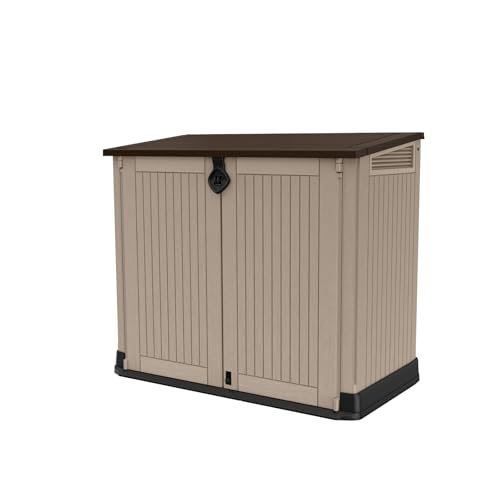
Keter Store-It-Out Midi Outdoor Resin Storage Shed, 30 Cu. Ft., Beige
Who it suits: Apartment households with a ground-floor patio, a deep balcony or a parking-space store corner, whose clutter is bulky — bins, a folded bike’s worth of gear, pet supplies, pool and garden overflow — and who want it behind doors, invisible.
The Midi is the largest object in this guide and the one that most changes how an apartment’s outdoor space feels, because it replaces the pile with a facade. Thirty cubic feet stands behind wide front doors, with a lift-up lid as a second way in — top access for dropping things in, front access for taking things out without excavating. Keter’s own listing leads with the two-32-gallon-trash-can test, which is the right mental image: if it swallows two wheelie bins’ worth of volume, it swallows the apartment overflow that actually exists — the balcony chairs in winter, the pet gear, the gardening bag, the sports equipment with no indoor home. Construction is polypropylene resin with steel reinforcement, weather-resistant and lockable, so the contents stay dry and the building’s rules about visible storage stay satisfied: from outside, it reads as a neat low cabinet, not as stored stuff. For ground-floor patios especially, that concealment is the difference between a terrace and a yard sale that never ends.
The apartment caveats are real and we will state them plainly. This is the pick most likely to collide with a lease or a balcony-depth problem: it needs genuine depth, it is the heaviest piece here to get up stairs, and on upper balconies you must think about concentrated weight in a way deck-box shoppers never do — thirty cubic feet of dense gear is a lot of kilograms on a slab designed for people and planters. Read your building’s rules, spread the load against the building wall rather than the railing edge, and when in doubt choose the bench boxes below. Its price position is the top of this guide’s small range — check the current price on Amazon — and even so it uses a modest slice of the $1,500 budget, which is the recurring story of apartment storage: the constraint was never money. Readers whose outdoor space is a true small patio rather than an apartment balcony will find the same concealment logic at patio scale in Best Outdoor Storage Box For Small Patios Under $1500.
- 30 cu. ft. behind front doors plus a lift-up lid — two ways in, zero excavation.
- Conceals up to two 32-gallon trash cans’ worth of bulky apartment overflow.
- Steel-reinforced resin, weather-resistant and lockable — a cabinet, not a pile.
Honest limitation: The deepest and heaviest pick here; upper-balcony weight and lease rules must be checked first, and shallow balconies should skip it entirely for the bench boxes.
Choose it if you have ground-floor or deep-balcony space and bulky clutter to make disappear. Skip it if your balcony is shallow or your building restricts storage furniture — the Marvel below solves the same problem at bench scale.
Keter Marvel 71 Gal Outdoor Storage Box, Brown
Who it suits: Balcony households whose storage must earn its footprint as seating — the box goes against the railing, stores the cushions, and seats two guests on top of them.
The Marvel is the apartment pick we would buy first with our own money, because it understands the balcony equation: every square foot must work twice. Seventy-one gallons is genuinely useful volume — the maker lists patio cushions, pool accessories and garden tools, and the interior dimensions (about 44.6 inches long inside) take folded cushions and long items that defeat smaller boxes. The exterior is about 45.9 inches wide, 17.4 deep and 22.2 high — and that depth, barely more than a chair’s, is the apartment-relevant number: it lines a railing without eating the walkway. The lid is a bench rated by the maker at 485 pounds of capacity, which in practice means two adults sit without a thought, and the wood-look resin texture keeps it reading as furniture from indoors. Assembly is tool-free and fast, the lid is lockable, and the whole thing is light enough to reposition when the balcony layout changes — which, in apartment life, it does every season.
Its position is the value end of this guide — check price on Amazon — and that is the point to absorb about apartment storage at a $1,500 budget: the best balcony box in this guide costs a small fraction of the allowance, and the correct use of the remaining budget is a second box for a second job (the City as a side table, below) plus the unglamorous accessories — a cover for winter, a padlock, cushion storage bags — not a more expensive single box. Shoppers comparing apartment tiers will find the same picks weighed at a stricter allowance in Best Outdoor Storage Box For Apartments Under $500, and the category’s furniture-first logic developed further in Best Deck Box For Apartments Under $1500. The Marvel’s honest weaknesses are few: brown is the finish, the bench is firm rather than plush, and 71 gallons will not take a deep-sofa cushion set — measure your cushions folded before you fall in love.
- 71 gallons in a slim 17.4 in. depth that lines a railing without blocking the walkway.
- Bench lid rated by the maker at 485 lb — real seating for two adults.
- Tool-free assembly, lockable lid, wood-look resin that reads as furniture.
Honest limitation: One finish, a firm seat, and an interior that wants cushions folded — deep-sofa sets should measure first or step up to a larger box in the house guides.
Choose it if your balcony needs storage and seating in the same square feet. Skip it if your clutter is bulky rather than soft — that is the Midi’s concealment game.
EAST OAK Outdoor Storage Box, 60 Gallon Deck Box, Grey
Who it suits: Renters who move — the box that assembles in minutes without tools, carries by its own handles, and will leave the balcony exactly as it found it when the lease ends.
Sixty gallons is the apartment sweet spot for a primary box: big enough for the cushion set of a two-seat balcony sofa plus the daily clutter, small enough to live against a wall without dominating it. EAST OAK’s version earns its place on logistics as much as capacity. The maker’s listing describes snap-together assembly in about fifteen minutes — panels that fit together by hand, no tools, no hardware bag, no leftover screws of mysterious purpose — and side handles that make the assembled box a two-hand carry rather than a drag. For renters, that combination is the whole product: it arrives through the elevator as flat panels, it assembles on the balcony in less time than a coffee, and on moving day it comes apart or carries out whole, which cannot be said of any shed or most furniture. The lid is lockable with a slide latch and a padlock hole, the resin is waterproof and fade-proof, and the flat top serves as extra seating or a side surface — the maker rates the seat generously, and in practice it takes a perched guest happily.
Positioned at the accessible end of the guide — check the current price on Amazon — the EAST OAK is the pick for the reader whose $1,500 budget is really a whole-home budget and whose balcony line item should be small, solved and forgotten. It is also the natural second box: behind the Midi it takes the soft goods, behind the Marvel it takes the tools and chemicals the bench should not. Householders reading this guide by mistake — it happens, the budgets match — should know this same brand’s 180-gallon box anchors our house system in Best Outdoor Storage Box Under $1500, where the snap-together philosophy scales up. Here at apartment scale, its limitations are the honest ones of its class: resin panels snap together rather than bolting, so it feels light rather than vault-like; the grey is the grey; and 60 gallons is a two-seat household’s box, not a family’s.
- 60 gallons — the two-seat balcony’s primary box, cushions plus daily clutter.
- Snap-together, tool-free assembly in minutes; side handles for the inevitable move.
- Lockable lid, waterproof and fade-proof resin, flat top that seats or serves.
Honest limitation: Snap-panel construction feels light rather than substantial, and capacity suits a couple’s balcony set, not a family’s full outdoor inventory.
Choose it if you rent, move, or simply refuse flat-pack drama. Skip it if you want the box to read as heavy furniture — the Marvel’s bench presence is stronger.
Keter Kentwood 50 Gal Outdoor Storage Box, Grey
Who it suits: The middle balcony — bigger than a Juliet, smaller than a terrace — that needs one box to hold the dining cushions and pool or beach gear, then sit on it.
The Kentwood is the Marvel’s slightly smaller, slightly sleeker sibling in spirit: 50 gallons of lockable, weather-resistant resin in a compact footprint the maker explicitly aims at balconies, porches and compact patios. The interior brief is the apartment greatest-hits list — patio dining cushions, pool accessories, beach towels, garden items — and the box doubles as extra seating, which on a balcony set for four is often the difference between hosting and apologizing. Assembly is the other headline: tool-free and, by the maker’s account, under ten minutes, which matters disproportionately in apartments where the tool kit is a single multipurpose screwdriver in a kitchen drawer. The wood-look texture keeps it in furniture territory visually, and the lock-ready lid covers the buildings whose rules require stored items to be secured rather than merely contained.
In this guide it is the hedge pick, and we mean that as praise: readers torn between the Marvel’s 71 gallons and the City’s 30 will find the Kentwood is the size that actually matches a four-chair dining set’s cushions, neither swallowing the balcony nor rationing the storage. Its price position is the value end of the guide — check price on Amazon — leaving the $1,500 budget’s bulk for the rest of the home, exactly as an apartment budget should behave. Where it cedes ground: the Marvel holds more and seats more formally; the EAST OAK assembles and moves more easily; and households whose balcony dining is six seats should stop rationing and buy the 71. Readers working through the apartment tiers systematically will find this box’s closest comparisons in Best Outdoor Storage Box For Apartments Under $700.
- 50 gallons sized to a four-chair dining set’s cushions, in a compact balcony footprint.
- Doubles as extra seating; lock-ready lid for buildings that require secured storage.
- Tool-free assembly in minutes — the kitchen-drawer tool kit is sufficient.
Honest limitation: It is the middle of everything — capacity, presence, price — and specialists beat it on each axis: bigger, prettier or cheaper picks all exist in this same guide.
Choose it if your balcony and your cushion set are both mid-size and you want one box, done. Skip it if you know your load is large (Marvel) or your space is tiny (City or Suncast, below).
Keter City 30 Gal Outdoor Storage Box and Patio Side Table, Grey
Who it suits: Small-balcony households who need a side table anyway — and would like the table to secretly hold the cushions, the pool gear and the balcony’s small clutter.
The City is the cleverest object in this guide, because it solves the balcony’s real equation — too many functions, too few square feet — by merging the two pieces every balcony needs. As a table it stands about 21.7 inches high with a top sized for drinks, a book and a plant; as a box it holds 30 gallons, which the maker pitches at cushions, garden tools, pool essentials and bird seed, and which in apartment reality means the throw pillows, the watering can, the balcony gardening kit and the string-light tangle. Exterior dimensions are about 22.75 inches long, 17.3 wide and 21.7 high — genuinely small, the footprint of the side table it replaces. Construction is weather-resistant resin with a wood-look texture, lockable, and assembly is the no-tools, minutes-long exercise this brand specializes in. On a balcony where a dedicated storage box would be a luxury the floor plan cannot afford, a table that stores is not a compromise; it is the only version of storage that fits at all.
Its price is the lowest in this guide — check the current price on Amazon — and at a $1,500 budget the rational move is often two of the system’s small pieces rather than one large one: the City beside the chairs, the Suncast seat in the corner, and the balcony is furnished and stored for a sliver of the allowance. The City’s limits are the honest arithmetic of 30 gallons: it will not take a sofa’s cushions, it will not take anything long, and as a table its top is resin — handsome, wipeable, and not to be confused with stone or teak. Buy it as what it is, the hardest-working side table in the category, and it will not disappoint. Buy it as your only storage for a large balcony set and it will — which is why this guide gives you five other picks.
- A real side table — about 21.7 in. high — hiding 30 gallons of lockable storage.
- Footprint of roughly 22.75 x 17.3 in.: the storage that fits when a box cannot.
- Weather-resistant, wood-look resin; assembles in minutes without tools.
Honest limitation: Thirty gallons is a table’s worth, not a sofa set’s; the resin top is practical rather than luxurious, and long items simply do not fit.
Choose it if your balcony needs a table and your storage needs are small and daily. Skip it if cushions are your main load — start at the Kentwood and work up.
Suncast 22 Gallon Small Deck Box with Seat, Java
Who it suits: The corner case, literally: tiny balconies, Juliet rails and covered porches where the only available space is one corner, and the storage need is a seat’s worth of small things kept dry.
Twenty-two gallons sounds like a rounding error in a $1,500 guide, and it is instead the most apartment-realistic pick here, because most balconies do not need a system — they need the watering can, the throws, the dog towels and the winter accessories out of the weather and off the floor. The Suncast’s interior, about 20.5 x 15.5 x 17 inches, is sized exactly for that stratum of life, and its reinforced lid holds up to 200 pounds by the maker’s rating, so the box is also the corner seat — for putting on shoes, for the morning coffee, for the guest when the chairs run out. The wicker-pattern Java finish is the warmest look in this guide and the one that blends with the rattan-and-teak furniture apartments actually have, where the greys can read cold. It is made in the USA, assembles by hand in minutes with no tools, and the maker’s listing notes its second life indoors — entryway, sunroom, shoes and seasonal items — which for renters means it survives the next move as furniture rather than as a balcony-specific problem.
At the value end of the guide — check price on Amazon — it is the pick that proves the thesis of this whole article: apartment storage is a fit problem, not a budget problem, and the $1,500 shopper’s skill is buying the right small things rather than one big one. Its limits are pure size: nothing long, nothing bulky, no cushion set beyond a pair of chair pads. Pair it with the City and a balcony is functionally complete; pair it with the Marvel and the balcony has seating for four and storage for everything soft. Either way, it earns its corner.
- 22 gallons in a footprint that fits the corner every balcony has.
- Reinforced seat lid rated by the maker at 200 lb — storage that sits.
- Wicker-pattern Java finish, made in the USA, hand assembly in minutes.
Honest limitation: Strictly small-load storage — no long items, no full cushion sets — and the seat suits one person at a time.
Choose it if your need is a corner’s worth of dry storage that doubles as a seat. Skip it if you have one box to buy and a sofa’s cushions to store — that is the Marvel.
Comparison Table
| Product | Type | Best use | Link |
|---|---|---|---|
| Keter Store-It-Out Midi | Horizontal store, 30 cu. ft., doors + lid | Concealing bulky overflow on deep balconies and patios | Check on Amazon |
| Keter Marvel 71 Gallon | Bench deck box, slim depth | Cushions stored, guests seated, railing-side | Check on Amazon |
| EAST OAK 60 Gallon | Snap-together deck box | The renter’s primary box — fast in, easy out | Check on Amazon |
| Keter Kentwood 50 Gallon | Compact deck box, seats | Mid-size balconies and four-chair cushion sets | Check on Amazon |
| Keter City 30 Gallon | Side-table deck box | Small daily storage disguised as furniture | Check on Amazon |
| Suncast 22 Gallon, Java | Corner seat box | Small things kept dry in the corner, plus a seat | Check on Amazon |
How to Choose: Balcony Rules, Weight and Access
Read the rules before the listings. Apartment storage lives under three layers of authority — the lease, the building’s house rules, and municipal fire and balcony codes — and the common restrictions are predictable: no structures, nothing anchored, nothing overhanging the railing, stored items concealed or in approved furniture, and on many balconies a weight limit that is really about concentrated loads. Every pick in this guide was chosen to survive those rules: freestanding, furniture-like, lockable, removable in minutes. If your building is stricter than average, the furniture-disguised picks — the City table, the Marvel bench, the Suncast seat — are the safest language to speak, because they are patio furniture first and storage second, which is exactly how the rules usually draw the line.
Measure three things, in inches, before ordering: the balcony’s depth from wall to railing (the box’s depth plus a walkway of at least a body’s width is the real budget), the door and elevator the flat-pack must travel (panel boxes travel anywhere; the Midi’s assembled bulk does not forgive a narrow stairwell), and your cushions folded, because cushion sets are the load most often misjudged — a deep-seat cushion folds to a slab that defeats a nominally large box whose interior is a few inches too short. Then think about weight distribution: on upper balconies, keep heavier boxes against the building wall, spread dense loads rather than stacking them in one corner, and treat a bin store full of soil, tools and liquids as the structural event it is.
Finally, plan the system, not the box. Apartment clutter comes in three kinds — soft (cushions, throws), daily (watering, pet, gardening smalls) and bulky (bins, seasonal, sports) — and the picks map onto them cleanly: a bench box for the soft, a table or seat box for the daily, the Midi for the bulky where rules and depth allow. Two small boxes in the right places beat one large box in the wrong one, every time, and at this budget you can afford the map rather than the compromise.
Common Mistakes Apartment Shoppers Make
The first is importing house logic: ordering the biggest box the budget allows and discovering that a balcony is not a small yard but a different country, with depth, rules and elevators. The second is measuring the balcony but not the journey — the stairwell turn, the elevator door, the apartment’s own hallway — which is how assembled storage ends up sold secondhand in the building’s lobby. The third is ignoring the view from inside: a balcony box is seen daily through the sliding door, and the industrial-looking bargain that seemed fine in the listing becomes the room’s least favorite object; furniture-finish resin exists precisely because of this.
Fourth, storing damp: resin boxes shed weather, they do not dry contents, and cushions put away wet in a sealed box will mildew in a warm month — dry first, and value the lockable-but-ventilated designs. Fifth, forgetting the move: every apartment purchase is a future moving problem, and the snap-together, carry-handled picks in this guide are chosen with the exit in mind. Sixth, spending the whole budget because it exists. The correct apartment system in this guide costs a fraction of $1,500; the rest of the money belongs to the rest of your home.
Final Recommendation
For most apartment households: the Marvel as the primary box, the City as the side table, and the balcony is solved — storage, seating and a table, in furniture finishes, for a small fraction of the budget. Add the Midi only if your space is a ground-floor patio or genuinely deep balcony and your clutter is bulky; add the Suncast seat if you have the corner and the small daily load. Renters who move often should build on the EAST OAK instead of the Marvel for its minutes-long assembly and carry-out ease. And keep the rest of the $1,500. The skill this tier rewards is not spending — it is fitting.
Living With the System: Seasons, Moves and Neighbors
A balcony system has a life beyond the day it is assembled, and apartment readers plan for three recurring events: the season change, the neighbor equation, and the move. The season change is when apartment storage earns its keep twice a year. In spring, the winter layer — throws, the heater’s box, the holiday balcony lights — goes into the bench box’s bottom, and the summer layer comes up. In autumn the rotation reverses, and the discipline that makes it pleasant is the one this guide has repeated: everything goes in dry, because a sealed resin box on a sunny balcony is a warm, still environment that preserves dry contents beautifully and punishes damp ones without appeal. A fitted cover over the primary box is worth its modest cost in buildings where the balcony is fully exposed, less for the box’s sake — the resin is weatherproof — than for the finish’s, since a covered bench greets spring looking like furniture instead of like equipment that wintered outside.
The neighbor equation is the one nobody mentions in house guides. A balcony box is visible to the units across the courtyard and audible to the unit below: a lid dropped at midnight lands in someone else’s bedroom. This is a practical argument for the furniture-finished, gently closing picks in this guide — wood-look resin reads as a bench from across the way, and a lockable lid kept closed keeps both the contents and the building’s opinion of your balcony where you want them. It is also an argument for keeping the balcony’s storage inside the railing line and below its sightline where your building asks it, which every pick here was chosen to do. Apartment storage that respects the building’s visual rules is storage that never becomes a lease conversation, and that is worth more than another ten gallons.
And then the move, which for renters is not a risk but a schedule. The system in this guide was chosen with the exit in mind: the EAST OAK and the Keter boxes disassemble or carry whole, the Suncast seat becomes entryway furniture in the next home, the City becomes a side table indoors without missing a beat. Only the Midi asks a question on moving day — it travels assembled or not at all in most stairwells — which is why we flag it for ground-floor and long-lease households. The deeper point is that apartment storage bought well is not a sunk cost per address; it is a kit that re-forms at every balcony you will ever rent, and a $1,500 budget spent on that kit — even the fraction of it this guide actually spends — is buying the kit’s quality, not a single balcony’s season.
What to Do With the Rest of the Budget
Because this guide has insisted that apartment storage should cost a fraction of $1,500, it owes you an account of the remainder — not as a shopping list, but as an order of priorities. First, finish the system properly: the padlocks every listing leaves out, a fitted cover for the primary box if your balcony is exposed, and cushion storage bags for the winter rotation, which keep the soft inventory dust-free inside the box and make the season change a ten-minute job. Second, fix the balcony the storage serves: a washable outdoor rug under the seating, shade for the hour the sun makes the balcony unusable, and light for the evening — the three purchases that convert a stored balcony into a used one. Third, and only then, consider upgrading the primary box within this guide’s picks — from the Kentwood to the Marvel, from one small piece to the two-piece system — if the first season shows the load genuinely exceeds the box. That sequence matters: accessories before ambience, ambience before capacity. Apartment households who follow it end with a balcony that works and a budget mostly intact, which is a better outcome than any single purchase this category sells.
A Note on Measuring Cushions, the Load That Lies
One measurement deserves its own warning because it defeats more apartment buyers than every other combined: the cushion set. Cushions are sold by the furniture’s dimensions and stored by their own, and the two numbers are related only loosely — a deep-seat cushion is a thick slab that folds reluctantly, stacks worse, and turns a nominally generous box into a lid that will not close by exactly the two inches that matter. Before ordering any box in this guide, fold your largest cushion the way it will actually be stored, measure the slab in three dimensions, and compare it against the interior dimensions in the maker’s listing — the Marvel’s interior, for example, is published at about 44.6 inches long, and that number, not the 71 gallons, decides whether your set fits. Do the same for the balcony’s longest resident, whether that is a folded lounger or a broom. Ten minutes with a tape measure is the entire difference between a system that closes and a return that has to ride the elevator twice.
FAQ
Can I put a small shed on an apartment balcony? Almost never. Sheds count as structures under most leases and building rules, they concentrate weight, and many balconies cannot take the footprint. The freestanding boxes and the low horizontal store in this guide are designed to stay on the right side of those rules — but read your own lease, because buildings differ and yours is the one that counts.
How much weight can a balcony box hold — and how much can the balcony? The boxes state their own seat and load ratings (the Marvel’s lid is maker-rated at 485 lb, the Suncast seat at 200 lb). The balcony’s limit is your building’s business: keep heavy storage against the building wall, spread dense loads, and ask the landlord before installing anything bin-store-sized on an upper floor.
What size box fits a typical balcony? Depth is the governing number. A box around 17–18 inches deep, like the Marvel, lines a railing and leaves a walkway on most balconies; side-table boxes around 22 inches long fit beside chairs; anything deeper needs a measured, deliberate decision. Measure your depth and subtract your walkway before you shop capacities.
Will a resin box keep cushions dry on an open balcony? It will shed rain and keep contents dry in normal weather, and every pick here is weather-resistant resin with a lockable lid. It will not dry cushions that go in damp, and wind-driven rain on an exposed high balcony is harsher than a patio’s — a fitted cover over the box is cheap insurance in exposed buildings.
Is it worth spending the full $1,500? For apartment storage alone, no — and this guide will not pretend otherwise. A complete, well-chosen balcony system costs a fraction of it. Spend what the system needs, add the accessories that finish it (padlock, cover, cushion bags), and let the rest of the budget serve rooms where $1,500 is a normal amount of money.
Which pick is easiest to move with when the lease ends? The EAST OAK 60 — snap-together panels, side handles, no tools either way. The Suncast 22 is the other easy traveler, small enough to become entryway furniture in the next home.


