Where to buy
Check the latest price, availability and delivery on Amazon. Orders are placed on Amazon. We may earn a commission from qualifying purchases.
- Best overall for small spaces: VASAGLE TV Stand for TVs up to 50 Inches, 43.3 Inch, Rustic Brown — Check on Amazon
- Walker Edison 2 Door Cabinet Corner TV Stand, 44 Inch, Driftwood — Check on Amazon
- Walker Edison Wren Classic 4 Cubby TV Stand, 58 Inch, Charcoal — Check on Amazon
- mopio Ensley 59 Inch Mid-Century Modern TV Stand, Walnut — Check on Amazon
- VASAGLE TV Stand with Power Outlets and LED Lights, 63 Inch, Rustic Brown and Ink Black — Check on Amazon
- Walker Edison 3-Drawer Mid-Century Modern TV Stand, 58 Inch, Caramel — Check on Amazon
Disclosure: As an Amazon Associate, dailyhomedecorating.com earns from qualifying purchases. Links to Amazon on this page are affiliate links; they cost you nothing extra. Listing details such as price and availability change often, so check the current Amazon listing before you buy.
The best media console for small spaces under $400 is the one that treats floor area as the scarcest material in the room. A small space — a den, a spare bedroom turned media room, a compact living room in a house, a snug primary bedroom — punishes furniture in a specific way: every inch of depth is an inch off a walkway, every inch of height crowds the sightline, and a console that merely fits is not enough if it stores nothing but the TV’s own entourage. This guide to the best media console for small spaces under $400 therefore ranks the tier by footprint discipline first: the smallest honest widths, including a 43-inch console and a corner cabinet that converts dead angle into the media wall; depths at the shallow end of the category; heights that stay below the room’s visual waterline; and storage that earns its area — cubbies, drawers and doors that hold the room’s overflow, not just its electronics. Every pick is a verified console from this tier, with dimensions and capacities taken from the maker’s own documentation.
Two ideas organise the list. The first is that in a small space, the console’s shape matters more than its size: a corner cabinet can be the largest piece in the room and still cost the least usable floor, while a long, low, shallow credenza can run 59 inches and leave the room feeling emptier than a chunky 48-inch box does. The second is that small-space storage must be honest — open cubbies you can see into, drawers that swallow clutter, doors that close — because in a small room there is no “away” for mess to go to; it is either inside the furniture or on display. For most small spaces we would start with the VASAGLE 43.3-inch stand, a compact console with a published 110-pound top capacity — check price on Amazon. Below: the quick picks, how we chose, detailed reviews organised by shape and footprint, a comparison table, a small-space measuring guide, the mistakes that shrink rooms, and the questions small-space shoppers ask. If your small space is specifically an apartment, the renter-focused ranking is Best Media Console For Small Apartments Under $400.
In this guide
Quick Picks
Short on time, or comparing several options at once? Each row below names a small-space situation and the console that suits it, with a link to the listing.
| Small-space situation | Pick | Why it stands out | Link |
|---|---|---|---|
| Best overall for small spaces | VASAGLE TV Stand for TVs up to 50 Inches, 43.3 Inch, Rustic Brown | The smallest footprint here, with a 110 lb top rating — check price on Amazon | Check on Amazon |
| Best for a corner | Walker Edison 2 Door Cabinet Corner TV Stand, 44 Inch, Driftwood | Turns dead corner angle into a doored media cabinet, TVs up to 48 inches | Check on Amazon |
| Best storage per footprint | Walker Edison Wren Classic 4 Cubby TV Stand, 58 Inch, Charcoal | Four cubbies and a 250 lb maximum load in a simple 58-inch frame | Check on Amazon |
| Best low and shallow | mopio Ensley 59 Inch Mid-Century Modern TV Stand, Walnut | 17 inches tall, 13.7 deep — length without bulk | Check on Amazon |
| Best slim with power | VASAGLE TV Stand with Power Outlets and LED Lights, 63 Inch | 13.8 inches deep with built-in outlets — no floor power strip | Check on Amazon |
| Best drawer storage | Walker Edison 3-Drawer Mid-Century Modern TV Stand, 58 Inch, Caramel | Three drawers absorb the room’s small clutter | Check on Amazon |
How These Picks Were Chosen
The first filter was the budget, applied the way a shopper experiences it: every console below is a real Amazon listing that lives in this tier — check the current price on Amazon before you order, because pricing moves with sales and finish choices. No pick here needs a discount to belong. Anything that was really a dresser, a floating wall shelf or a rolling cart was left out; everything here is a floor-standing console a TV can sit on, with storage below.
The second filter was the small-space brief, applied as geometry. We read maker listings and manuals and ranked by three measurements before any feature: depth, because in a small room depth is walkway; height, because a console above 24 inches starts spending the room’s air; and footprint honesty — the actual rectangle of floor the piece removes from the room, corners included. Only after the geometry did features count: storage that serves the whole room, capacities the maker publishes (the picks here state figures from 100 to 250 pounds), and cable behaviour, because in a small space you sit close enough to read the cable run like a book. Where sources for a model disagreed, the number was left out rather than flattered; where a maker publishes a figure, the review says whose figure it is.
A distinction worth stating, because shoppers conflate them: this guide is about small spaces in any home — dens, spare rooms, bedrooms, compact living rooms — not specifically rentals. The apartment guide in this batch weighs moving logistics and lease rules; this one weighs pure geometry and storage yield, and assumes the console can stay put, be anchored properly, and be chosen for the room’s long term. The overlap in picks is honest — good small furniture is good small furniture — but the ranking reasons differ, and the reviews below are written for the room, not the lease.
Best Media Console for Small Spaces Under $400: The 6 Picks
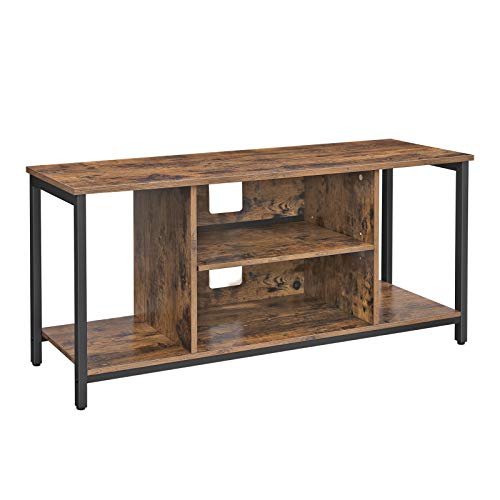
VASAGLE TV Stand for TVs up to 50 Inches, 43.3 Inch, Rustic Brown
Who it suits: The smallest media walls in this guide — dens, bedrooms and snug living rooms with a TV up to 50 inches and a wall segment in the mid-forties.
Start with the rectangle it removes from your room: 43.3 inches long by 15.7 deep — the smallest floor claim of any pick here — and then notice what the maker still managed to publish for it: a maximum static load of 110.2 pounds on the top and 33 pounds per shelf, from the model’s own instruction manual. That combination, tiny footprint with stated strength, is exactly the small-space brief. The design is an open industrial frame in rustic brown over steel, with shelving for a console, a streaming box and the room’s books, an adjustable shelf for gear heights, and adjustable feet that level it on the floors small older rooms specialise in. At 37.4 pounds it can be carried into the room by one person and nudged into its final position alone — a real virtue when the room is too small for two people and a cabinet to occupy it at once. The 19.7-inch height keeps a bedroom or den screen at a comfortable level without spending the wall. Check the current price on Amazon; it sits in the lower part of the tier.
The limits are written into the virtues. The 50-inch TV ceiling is absolute — a bigger set’s feet overhang a 43.3-inch top — so this is the console for the TV the room actually suits, and rooms are happier when the screen is sized to the seating distance anyway. Open shelves in a small space are read at close range: cables need a spine and ten minutes, and dust is a weekly sentence rather than a monthly one. And the industrial rustic finish is a style that suits dens and bedrooms better than formal rooms. As the default answer to “the wall is short,” it has no rival in this guide.
- 43.3 (L) x 15.7 (D) x 19.7 (H) inches — the smallest footprint here; TVs up to 50 inches.
- Maker-published capacities: 110.2 lb on top, 33 lb per shelf; adjustable shelf and leveling feet.
- Unit weight 37.4 lb — one-person placement in a room with no spare floor.
Honest limitation: A hard 50-inch TV ceiling, and open shelves that show cables and dust at close range.
Choose it if your wall segment is short and your TV is 50 inches or under. Skip it if the room’s TV is larger — the 58-inch picks below are its scale.
Walker Edison 2 Door Cabinet Corner TV Stand, 44 Inch, Driftwood
Who it suits: Small rooms whose geometry is the problem — the corner is free, the walls are spoken for, and the screen needs a home that costs no wall at all.
Every small room has a corner doing nothing, and this console is the argument for promoting it. Shaped to settle into the angle, it spans 44 inches across its front, runs 16 inches deep and 23 high, and closes two doors over its storage — the only compact pick here that hides everything it holds. It is rated for TVs up to 48 inches, the size that suits the diagonal viewing distances a corner layout creates, and the driftwood finish is pale enough to keep a small room’s corner from becoming a dark hole. The placement math is what sells it: the corner footprint was unusable floor, so the console’s effective cost to the room approaches zero, while the flat walls stay free for the seating, the desk or the shelves the room actually needs. At roughly 66 pounds it is a settled, furniture-weight piece once placed. Check the current price on Amazon.
The cautions are commitment and verification. A corner console only earns its keep in a corner, so confirm the layout before ordering: sightlines from every seat, glare across the diagonal, and an outlet within cable reach — corner setups strand more buyers on power than on any other detail. The shaped back also means the piece will not moonlight against a flat wall in a future room; it is a one-layout purchase, made with confidence or not at all. And the 48-inch ceiling asks the usual foot-span measurement. For the room whose corner is the answer, it is the cleverest spend in this guide.
- 44 (W) x 16 (D) x 23 (H) inches; corner-shaped cabinet for TVs up to 48 inches.
- Two doors close over all storage; pale Driftwood finish keeps the corner light.
- Converts unusable corner floor into the media wall at near-zero room cost.
Honest limitation: A one-layout purchase — it works in a corner or not at all — with a 48-inch TV ceiling.
Choose it if your room’s corner is free and its walls are not. Skip it if your layout may change — the straight consoles move with you.
Walker Edison Wren Classic 4 Cubby TV Stand, 58 Inch, Charcoal
Who it suits: Small rooms that need storage more than they need a TV stand — spare rooms and dens where the console must also be the room’s cupboard.
Judge the Wren by storage yield per inch of wall. Its frame — 58 long, 16 deep, 24 high — divides into four open cubbies, and open cubbies are the highest-yield storage a console offers: no door swing to clear in a tight room, no depth lost to cabinet framing, and a shape that takes bins, baskets, books and board games at full size. The maker rates its maximum load at 250 pounds, the strongest figure in this guide, so the cubbies can hold the heavy overflow — the vinyl collection, the reference books — that small rooms have nowhere else to put. The charcoal finish recedes, the 70-pound build assembles more simply than any door-fronted pick, and the open design ventilates whatever electronics share the space. In a small room that must store a life, not just a setup, this is the hardest-working rectangle here. Check the current price on Amazon; it is typically among the tier’s most accessible.
The trade is exposure. Open cubbies in a small room are storage you live inside of: their contents are the room’s decor whether you style them or not, so the Wren rewards bins and baskets and punishes piles. Cables and dust are equally visible at small-room distances — a cable spine and a duster are part of the purchase. And the model’s long production history means the current listing’s TV-size guidance is the one to follow, rather than older write-ups. For the small room whose problem is stuff, the Wren is the answer; for the room whose problem is tidiness theatre, the doored picks argue better.
- 58 (L) x 16 (D) x 24 (H) inches; maker-rated maximum load 250 lb; unit weight 70 lb.
- Four open cubbies — the highest storage yield per inch in this guide, with no door swing.
- Charcoal finish recedes; simplest assembly here; full ventilation for gear.
Honest limitation: Open storage is always on display — it rewards bins and punishes piles.
Choose it if your small room needs a cupboard that holds a TV. Skip it if you need anything hidden — take a doored pick.
mopio Ensley 59 Inch Mid-Century Modern TV Stand, Walnut
Who it suits: Small rooms with one long wall — the counterintuitive pick whose length is exactly why it works in a tight space.
The Ensley teaches the small-space lesson that bulk, not length, is the enemy. It runs 59 inches long, yet it stands only 17 inches high and 13.7 deep — the shallowest cabinet here — on tapered legs that keep the floor line visible from wall to wall. The effect in a small room is disproportionate: the wall gains a media console and loses almost nothing, because sightlines pass over the low top and light passes under the raised body. Behind the slatted sliding doors — which pass air and remote signals, so the front can stay shut — an adjustable shelf holds the gear; the maker states a 100-pound capacity with a reinforcement bar beneath, and the feet adjust for uneven floors. At 60 pounds it is movable by one determined person. In walnut it also gives a small room a designed centre rather than a storage apology. Check the current price on Amazon.
The limits are depth and top discipline. At 13.7 inches, receivers need not apply — this is a console for consoles, soundbars and streamers. The low top in a small room is prime real estate and will attract objects; the look survives only under an editing rule. And a 59-inch piece in a small room must be measured against the wall’s interruptions — door swings, radiators, the window’s edge — because a long console that collides with any of them is worse than a short one that fits cleanly. When the wall is long and the gear is slim, it is the most space-generous pick in the guide.
- 59 (W) x 13.7 (D) x 17 (H) inches — the shallowest, lowest profile here; TVs 55 to 65 inches; 100 lb capacity.
- Slatted sliding doors pass air and signals behind a closed, calm front.
- Raised on tapered legs, it keeps the floor line visible — small rooms read larger.
Honest limitation: No receivers at 13.7 inches deep, and the long body must clear every door swing and radiator on its wall.
Choose it if your small room has one long wall and slim gear. Skip it if your components are deep — the 3-Drawer below is built for them.
VASAGLE TV Stand with Power Outlets and LED Lights, 63 Inch, Rustic Brown and Ink Black
Who it suits: Small rooms where the floor must stay completely clear — long, slim and self-powered, it removes the power strip from the room’s scarcest surface.
In a small space, the floor is not a surface, it is a route — and the standard media-wall power strip squats right in the middle of it. This VASAGLE builds power into the console instead: three AC outlets and two USB-A ports, in a frame 63 inches long, just 13.8 deep and 20 high, rated for TVs up to 65 inches. The proportions are the small-space trick from the Ensley played differently: length along the wall in exchange for almost no depth into the room, with open shelves that keep components visible and ventilated, and built-in LED lighting that gives a small room an evening glow without a lamp’s footprint. At 48 pounds it is the lightest full-size pick here — easy to place precisely in a room where placement options are few. Check the current price on Amazon; it sits in the lower half of the tier.
The cautions are openness and power sense. Open shelves at small-room range show everything — components aligned, cables dressed along the frame, or the room looks stored rather than lived in. The built-in outlets are for electronics at sensible loads; anything that heats belongs on a wall socket. And the 13.8-inch depth repeats the receiver exclusion. For the small room whose devices outnumber its outlets, it solves the floor problem outright.
- 63 (L) x 13.8 (D) x 20 (H) inches; for TVs up to 65 inches; unit weight 48 lb.
- Built-in charging: 3 AC outlets and 2 USB-A ports — the power strip leaves the floor.
- Open, slim frame with LED lighting that replaces a lamp’s footprint at night.
Honest limitation: Open shelves demand styling at close range, and built-in power is for electronics, not heaters.
Choose it if your small room’s floor must stay clear and its devices are many. Skip it if you need closed storage — the corner cabinet closes.
Walker Edison 3-Drawer Mid-Century Modern TV Stand, 58 Inch, Caramel
Who it suits: Small multi-use rooms — the den that is also an office, the bedroom that is also a dressing room — where the console’s drawers can absorb the room’s small clutter.
Small rooms fail on small things: the chargers, remotes, notebooks, batteries and paperwork that have no drawer to go to and so colonise every surface, the console’s top first. The 3-Drawer console is the only pick here that answers with drawers — three of them, under a TV up to 65 inches, alongside two open shelves for the working gear. The cabinet measures 58 by 16 by 24 inches, so unlike the shallow picks it also takes the deep components, receivers included, that a den’s serious setup may run. The mid-century design — tapered legs, caramel finish — suits the light multi-use rooms small spaces tend to be, and at 64 pounds it is a manageable build. In a room doing two jobs, furniture that does two jobs is the whole strategy. Check the current price on Amazon.
The cautions are allocation and scale. Drawers consume the volume shelf-only designs give to components, so map the gear against the two open shelves before ordering; a receiver, two consoles and a disc library may exceed them. At 58 inches and full depth it is also a real footprint — the pick for a small room with a proper wall, not for the mid-forties wall segment the VASAGLE 43 serves. And drawers fill: the small-room discipline is a seasonal edit, or the console becomes the clutter it was bought to hide. For the multi-use small room, it is the most strategic pick in the guide.
- 58 (L) x 16 (D) x 24 (H) inches; for TVs up to 65 inches; unit weight 64 lb.
- Three drawers for the room’s small clutter plus two open shelves for gear.
- Full 16-inch depth — the small-space pick that still fits a receiver.
Honest limitation: Drawers trade against component volume, and the full-size footprint needs a proper wall.
Choose it if your small room does two jobs and needs the drawers. Skip it if your wall is short — the 43-inch VASAGLE is your scale.
Comparison Table
| Product | Size (L x D x H) | Max TV | Best small-space use | Link |
|---|---|---|---|---|
| VASAGLE TV Stand 43.3 Inch, Rustic Brown | 43.3 x 15.7 x 19.7 in | 50 inch | The smallest footprint, honestly rated | Check on Amazon |
| Walker Edison Corner TV Stand, Driftwood | 44 x 16 x 23 in | 48 inch | Doored storage at near-zero room cost | Check on Amazon |
| Walker Edison Wren 4 Cubby, Charcoal | 58 x 16 x 24 in | 60 inch | Maximum storage yield, 250 lb maximum load | Check on Amazon |
| mopio Ensley, Walnut | 59 x 13.7 x 17 in | 65 inch | Low and shallow — length without bulk | Check on Amazon |
| VASAGLE with Power Outlets and LED | 63 x 13.8 x 20 in | 65 inch | Slim and self-powered, floor stays clear | Check on Amazon |
| Walker Edison 3-Drawer Mid-Century, Caramel | 58 x 16 x 24 in | 65 inch | Drawers for a multi-use room’s clutter | Check on Amazon |
How to Choose a Media Console for a Small Space
- Budget the floor, not the wall. Write down the rectangle each candidate removes from the room — length times depth — and compare those numbers before any feature. In small spaces, that rectangle is the price; everything else is what you get for it.
- Spend depth last. Depths here run 13.7 to 16 inches. If your gear is slim, the shallow picks return real walkway. If you run a receiver, only the 16-inch cabinets qualify — measure the component, add an inch for cables, and let that decide.
- Keep the height under the sightline. Consoles of 17 to 24 inches keep a small room’s air free. Taller pieces belong in taller rooms; in a small space, height is the dimension that crowds.
- Interrogate the corner. If a corner is free and the sightlines work, a corner cabinet is the closest thing to free furniture a small room offers. Verify glare and outlet reach before committing.
- Demand storage yield. Cubbies, drawers or doors — the console must hold more than media. In a small room, furniture that stores one thing is a luxury the floor cannot afford.
- Read the maker’s capacity. The verified figures here run from 100 to 250 pounds. Small rooms stack life onto every surface; margin is what keeps that safe.
- Dress the cables like decor. At small-room distances the cable run is visible art, good or bad. Ports, spines and built-in power are design features here, not conveniences.
- Anchor the TV. Small rooms mean close traffic — chairs pulled out, bags swung, children and dogs at elbow range. An anti-tip strap to a wall stud is part of the installation, not an extra.
- Confirm the tier in the cart. Check the current price on Amazon for your finish, delivery included. If the total climbs out of the tier, the same geometry-first ranking a rung down is in Best Media Console For Small Spaces Under $300.
The Geometry of Small Rooms
Small rooms obey a few rules that this guide’s ranking simply follows. The first is that perceived size is governed by the floor line: furniture raised on legs, like the Ensley, lets the eye travel under and through, and the room reads larger than the same footprint on a plinth base. The second is that corners are negative space until furniture claims them — the corner cabinet’s whole case. The third is that vertical calm beats vertical storage in a small room: a low console under a screen leaves the wall’s upper half empty, and empty wall is what small rooms are shortest of, visually. The fourth is that every object at close range is decor, including the cables and the power strip, which is why the powered VASAGLE and a ten-minute cable routine appear in a furniture guide at all.
None of this requires a small budget to matter more than a large one — the same tier ranked for general rooms is in Best Media Console Under $400 — but small rooms punish the wrong choice faster, because there is no spare room for the mistake to be moved to. The companion purchase that most often completes a small media wall is vertical storage elsewhere: the shelves in Best Bookcase Under $400 take the books and boxes upward, leaving the console low, shallow and calm. And when the small space is a shared family room, the safety-and-doors ranking in Best Media Console For Families Under $400 is worth reading alongside this one before the final choice.
Bedrooms, Dens and Second Screens
Small spaces are often second-screen rooms, and the brief shifts subtly there. A bedroom console is watched from a pillow, which raises the ideal screen height — the 23- and 24-inch picks, the corner cabinet and the 3-Drawer, serve beds better than the 17-inch Ensley, however much the Ensley wins a living room. A den or gaming nook reverses the priority again: the console count rises, ventilation matters more than doors, and the Wren’s open cubbies or the powered VASAGLE’s outlets become the argument. A spare room that hosts guests twice a year and hobbies the rest of the time wants the console to disappear into storage duty — drawers and doors again. None of these rooms needs a different tier; they need the same six picks read through the room’s actual evenings. That is the honest way to use this guide: find your room in the reviews, not your neighbours’ room.
What to Pair With It — and What to Leave Out
A small media wall is a system, and the console is only its base. The pairings that earn their floor are few. A soundbar is the first: it replaces the speaker pair a small room cannot place, sits on or in every console here, and should be counted in the top’s load and the shelf’s depth from the start. A single tall, narrow bookcase is the second — it takes the storage pressure upward so the console can stay low, and one is enough; two flanking towers turn a small wall into a shrine and the room into its corridor. A low lamp at the room’s edge, rather than on the console, is the third: console tops in small rooms are too valuable and too visible to spend on lighting that works better elsewhere.
The leave-out list matters as much. Component stacks beyond two or three devices belong to bigger rooms; in a small space, a streaming box quietly replaces the disc player, the cable box and the media PC, and the console’s shelves breathe again. Decorative objects on the top compete with the screen at close range — one object is styling, three are a shelf sale. And a rug that runs under the console’s front legs is a small-room trap: it tilts the piece, complicates leveling, and gathers the cables you dressed so carefully. Keep the console on the hard floor, the top nearly bare, the storage vertical elsewhere, and the small room will read as designed rather than as storage with a TV in it — which is the entire ambition of this guide.
Setup in a Tight Room
Setup order matters when there is no spare floor to stage in. Assemble the console in its final position, panel by panel — carrying parts into a small room is easy, carrying a finished cabinet through it is not. Level before loading: adjustable feet appear on the compact picks precisely because small, older rooms have the least level floors. Fit the TV, then the anti-tip strap, then route the cables while the console is still a hand’s width from the wall and you can reach behind it; push it home last. Load heavy items low and central, leave a hand’s width of air around anything with a fan, and walk the room’s routes — door to sofa, sofa to kitchen — before declaring the job done. If a route clips the console’s corner, the console is in the wrong place or is the wrong console, and setup day is the cheap day to learn it.
Measuring a Small Space: The Rectangle Test
Small-space measuring is one test with four numbers. Write the room’s usable wall segments down first — not the room’s dimensions, but the actual runs of wall between doors, windows and radiators — because consoles live on segments, not on walls in the abstract. Against each candidate, compute the rectangle: length times depth, the floor it removes. Then the air: height against the room’s ceiling and the window sills, because a console that crosses a sill line crowds the room’s light. Then the TV’s feet against the top, and the deepest component against the depth, with the cable inch added. Four numbers, and the ranking in this guide usually falls out of them by itself: the smallest rectangle that holds your TV and your gear, at the lowest height that serves your seats, is the console your room is asking for. Tape it on the wall and the floor for an evening before ordering — in a small room, tape is the cheapest furniture you will ever buy, and the most honest.
Small Spaces That Are Not Rooms
Some small spaces are not rooms at all: the under-stair nook, the landing wide enough for a chair, the alcove a builder left without a purpose. These fragments follow the same geometry with one addition — they usually borrow their seating and light from the room they adjoin, so the console’s job is purely to hold a screen and its gear at the fragment’s scale. The 43-inch VASAGLE and the corner cabinet were practically designed for alcoves, and a screen of 43 to 50 inches at fragment distance is generous. The discipline is to resist upgrading the fragment into a room: no towers, no second seating, no storage beyond the console’s own. A nook that does one thing beautifully beats a nook pretending to be a den, and the console that respects the fragment’s scale is the one that will still look right when the rest of the house changes around it.
Common Buying Mistakes
- Comparing widths and ignoring depths. In a small room, two inches of depth is a walkway. The rectangle is the price — compute it.
- Forgetting the corner exists. Buyers measure the flat wall, buy the flat console, and leave the room’s only free volume unclaimed.
- Sizing the TV to the wall instead of the seats. A 50-inch screen at five feet is a cinema; a 65-inch at five feet is a headache with a stand under it.
- Choosing open storage, then storing openly. Cubbies in a small room are display. Bins or a doored pick — decide before the clutter does.
- Letting the power strip colonise the floor. In a small room the floor is a route. Built-in power or a mounted strip, planned from the start.
- Skipping the strap because the room is small and calm. Small rooms are high-traffic by definition — everything passes the TV at elbow range.
- Assembling in another room. A finished 58-inch cabinet does not negotiate a small doorway gracefully. Build in place.
- Buying tall for storage. Height crowds a small room faster than any other dimension; go wide, low or cornered first.
Final Recommendation
- Most small spaces: VASAGLE TV Stand for TVs up to 50 Inches, 43.3 Inch.
- A free corner: Walker Edison 2 Door Cabinet Corner TV Stand, 44 Inch.
- Storage above all: Walker Edison Wren Classic 4 Cubby TV Stand.
- One long wall, slim gear: mopio Ensley 59 Inch Mid-Century Modern TV Stand.
- Clear floor, many devices: VASAGLE TV Stand with Power Outlets and LED Lights.
- A multi-use room: Walker Edison 3-Drawer Mid-Century Modern TV Stand.
Our top two for small spaces are the 43.3-inch VASAGLE — the smallest honest footprint in the tier, with a maker-published capacity most bigger consoles never state — check price on Amazon — and the corner Walker Edison for any room whose corner is free, because furniture that costs no usable floor is the rarest bargain in a small home. The Wren wins the storage argument, the Ensley wins the airiness argument, and both are right in the rooms they describe. Compute the rectangle, interrogate the corner, keep the height down and the cables dressed, and the small room will feel like a choice rather than a constraint.
Frequently Asked Questions
What is the best console size for a small room?
The one whose floor rectangle the room can spare. For most small rooms that means 43 to 48 inches wide and no more than 16 deep, under a TV sized to the seating distance — the footprint the 43.3-inch VASAGLE and the corner cabinet serve. Long, low, shallow consoles are the exception: at 13.7 inches deep, a 59-inch credenza can cost a room less than a chunky 48-inch box.
Is a corner media console really space-efficient?
Yes — it is the only design that converts otherwise unusable floor into the media wall. The conditions are layout certainty: sightlines from the seats, glare across the diagonal, and an outlet within reach. Meet those, and a corner console is close to free furniture.
Open cubbies or doors in a small space?
Cubbies store more per inch and need no swing clearance, but everything in them is on display at close range. Doors hide the room’s overflow completely at the cost of some depth and ventilation. Small rooms with storage pressure lean cubbies-plus-bins; small rooms with tidiness pressure lean doors.
How shallow can a media console be?
As shallow as your deepest component allows. Slim setups — a console, a streamer, a soundbar — live happily at 13.7 to 13.8 inches, the depth of the Ensley and the powered VASAGLE. A full-size AV receiver needs the 16-inch cabinets. Measure the gear, add an inch for cables, and that number is your minimum.
Can a small room handle a 65-inch TV?
If the seating distance is roughly eight feet or more and the wall takes a 58- to 63-inch console without crowding the routes, yes — the low, shallow picks here exist for exactly that. Closer than that, a 50- to 55-inch set will look bigger, cost less wall, and leave the room in balance.
What else makes a small media wall work?
Vertical storage elsewhere, so the console can stay low and calm — a bookcase taking the overflow upward — plus disciplined cables and a top surface kept nearly bare. The console is half the system; the other half is everything you decided not to put on it.