Where to buy
Check the latest price, availability and delivery on Amazon. Orders are placed on Amazon. We may earn a commission from qualifying purchases.
- Best overall: BenQ e-Reading Floor Lamp, Matte Silver — Check on Amazon
- Philips Hue Signe Gradient Floor Lamp, Black — Check on Amazon
- Koncept Z-Bar Floor Lamp (Gen 3), Metallic Black — Check on Amazon
- Govee Tree Floor Lamp with 3 Rotatable Lights, Matter Compatible — Check on Amazon
See 2 more Amazon options
- Brightech Sky LED Torchiere Floor Lamp, Dimmable, Black — Check on Amazon
- SAFAVIEH Landen Leaf Floor Lamp, Antique Gold Finish, Fabric Shade — Check on Amazon
Read the full guide ↓
Disclosure: As an Amazon Associate, dailyhomedecorating.com earns from qualifying purchases. Links to Amazon on this page are affiliate links; they cost you nothing extra. Listing details such as price and availability change often, so check the current Amazon listing before you buy.
Shopping for the best floor lamp under $400 puts you in a strange and honestly quite pleasant position: you have more budget than this category knows what to do with. The mainstream floor lamp market on Amazon tops out well below this line — the best-selling pole lamps, torchieres and shaded lamps cluster far under it — so a $400 ceiling does not buy you a brighter version of a cheap lamp. It buys you entry into the small group of lamps that were designed rather than merely manufactured: a task lamp with a published color-rendering figure and an ambient sensor, a gradient light sculpture from a real lighting ecosystem, an articulated architect’s arm scaled up to floor height. This guide is about spending that headroom deliberately. Every pick below was chosen because the extra money buys something you can point at — measured light quality, a base that does not tip, an arm that stays where you aim it — and we will tell you plainly where the money stops buying anything at all.
Two honesty notes before the picks, because this tier needs them. First, brightness: almost every lumen figure in this category is a maker’s figure with no shared measurement standard behind it, and almost no floor lamp publishes a verified color rendering index (CRI). One pick below does publish a CRI — the BenQ, at Ra 95 by its maker’s specification — and that fact alone explains much of its ranking. For every other lamp we report the maker’s claims as claims, and we weight light direction and control (where the light goes, how finely you can dim it, whether you can change its color) at least as heavily as the number on the box. Second, the ceiling itself: in our research across this whole series, the most expensive floor lamp we could verify as genuinely orderable on Amazon sits just under this guide’s $400 line. Above it, the band is essentially empty until true designer territory far above. So this is not a guide to the bottom rung of the premium market. It is, effectively, a guide to the top of the orderable one.
Our headline recommendation is the BenQ e-Reading Floor Lamp, the only lamp here engineered around the quality of light on a page rather than the look of the lamp in a room. If your living room’s problem is atmosphere rather than reading, start with the Philips Hue Signe instead. Readers working with a smaller budget will find the same market mapped tier by tier in Best Floor Lamp Under $300, and anyone furnishing a bedroom rather than a living space should see Best Floor Lamp For Bedrooms Under $300, where the judging criteria shift toward warm light and quiet dimming. Below you will find the quick picks table, detailed notes on all six lamps, a comparison table, a buying checklist for this tier, an honest account of what $400 does and does not add, the mistakes buyers make with this much headroom, and answers to the questions this budget always raises.
In this guide
Quick Picks
Short on time, or comparing several options at once? Each row below names a buyer type and the lamp that suits it, with a link to the listing.
| Buyer type | Pick | Why it stands out | Link |
|---|---|---|---|
| Best overall | BenQ e-Reading Floor Lamp | Published Ra 95 CRI, ambient-sensing auto-dim and an oval pool of task light | Check on Amazon |
| Best smart / design | Philips Hue Signe Gradient Floor Lamp | A gradient light sculpture that washes the wall and joins the Hue ecosystem | Check on Amazon |
| Best articulated task lamp | Koncept Z-Bar Floor Lamp (Gen 3) | A counterbalanced architect’s arm at floor height, with a touch dimmer | Check on Amazon |
| Best for zoning a room | Govee Tree Floor Lamp, 3 Rotatable Lights | Three independently aimed heads light three zones from one outlet | Check on Amazon |
| Best uplight value | Brightech Sky LED Torchiere Floor Lamp | Ceiling-bounce ambient light with a felt-covered weighted base | Check on Amazon |
| Best traditional lamp | SAFAVIEH Landen Leaf Floor Lamp | A real fabric shade on a standard bulb socket — no app, no ecosystem | Check on Amazon |
How These Picks Were Chosen
The first filter was the budget, applied the way a buyer experiences it: every lamp below is a real Amazon listing whose recommended configuration sits at or under $400 in the United States. One pick — the Koncept Z-Bar — carries an explicit condition, because its generation has been discontinued and its live listing price could not be verified from a dated source during our research: it belongs in this guide on design merit, and the rule printed in its review is to buy it only if the live price you see is at or under the $400 line. We would rather print that condition than quietly drop one of the most interesting lamps in the category, or worse, invent a price for it. Where any listing’s price moves with deals and finishes, we say so and tell you to check the current price on Amazon before ordering.
The second filter was what the money buys. At the top of this market, a higher price should purchase at least one of four things: verified light quality (a published CRI, a wide and honest color-temperature range), mechanical quality (a counterbalanced arm, a base with real mass low down), control quality (smooth dimming, a sensor that manages brightness for you, a mature smart ecosystem), or material quality (metal and real shade fabric instead of printed plastic). Lamps that offered only a taller pole and a bigger claim were cut. We also favored lamps whose light source strategy is honest about the future: two of these six take a replaceable bulb or are built to a serviceable design, and where a lamp seals its LED inside forever, we say so in its review and weigh the maker’s warranty and track record instead.
We did not use these lamps ourselves. We read maker listings and specification pages, compared output claims, color ranges, base weight and dimensions, dimming methods and warranty terms, and treated every brightness number as a claim rather than a measurement — because in this category that is what it is. Where a maker’s own figures conflict between production runs, we note the conflict instead of picking the flattering number. Where a listing was vague about a dimension or a rating, we say so rather than guess. The result is a short list on purpose: six lamps that each win a different buyer’s argument, at a tier where padding the list with near-duplicates would be easy and dishonest.
The 6 Best Floor Lamps Under $400
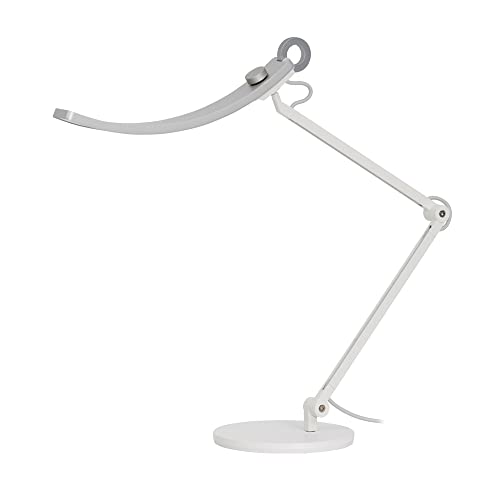
BenQ e-Reading Floor Lamp (AR15_D Floor), Matte Silver
Who it suits: Readers, crafters, musicians and anyone whose main chair is also their desk — buyers who want the light itself to be measurably good, and who will trade smart features and decorative presence for an oval of even, sensor-managed illumination.
The BenQ is the odd one out in this guide, and the ranking reflects it: this is a lighting instrument that happens to stand on the floor. Its wide, curved head throws an oval of light roughly 35 by 27 inches — a desk’s worth of even coverage from a lamp that never touches the desk — and an ambient sensor reads the room and auto-dims the lamp to suit, with distinct modes tuned for screens and for paper. BenQ specifies a color rendering index of Ra 95 for the series, the only verified CRI figure attached to any pick in this guide, and offers 13 color-temperature steps from 2700K warm to 5700K daylight across 23 brightness levels, so the light over a page can be matched to the hour and the task with unusual precision. The maker’s brightness claim is expressed in lux at the surface (at least 500 lux at the center of the pool) rather than the category’s usual unanchored lumens, which is itself a sign of a company measuring the thing buyers actually experience. One ordering caveat matters and we print it in bold spirit if not in bold type: this ASIN is the e-Reading listing family, so select the floor lamp configuration on the listing before checkout — the desk version shares the page. Check the current price on Amazon for that configuration; it sits at the upper end of this guide’s range, and it earns its place there.
The physical design backs the optics. The lamp stands about 55.5 inches tall and weighs about 10.4 kilograms, most of it in a heavy alloy base of aluminum, zinc alloy and engineering resin that simply does not tip in normal household contact — a meaningful fact in any home where a floor lamp shares floor space with feet, pets or a vacuum cleaner. There is no app, no account, no Wi-Fi and no remote: controls live on the lamp, and the sensor does the one automated job that actually matters for reading light. What you give up is everything decorative and everything connected. The BenQ looks like equipment, because it is; it produces white light only, in a pool aimed at a work surface, and it will not wash a wall with color for movie night or join a whole-home scene. Its light engine is integrated, so its lifespan is the driver’s lifespan, though BenQ is an established display company with a real support operation behind the product. Judged as a reading and task lamp, nothing else orderable under $400 is built to this standard; judged as living-room atmosphere, it is not really competing — and this guide ranks it first because most buyers at this tier are, whether they say so or not, buying one serious light for one serious chair.
- Published CRI of Ra 95 (maker specification) — the only verified color-rendering figure among these picks.
- Ambient-sensing auto-dim with screen and paper modes; 13 color temperatures from 2700K to 5700K, 23 brightness levels.
- About 10.4 kg with a heavy alloy base: the most tip-resistant lamp in this guide — check price on Amazon.
Honest limitation: The listing is a family page — you must select the floor configuration before checkout — and the lamp is a white-light task instrument only: no color, no smart ecosystem, no decorative glow, and an integrated light engine.
Choose it if your main chair is where you read, work or make things, and light quality is the purchase. Skip it if you want ambience, color or a lamp that decorates the room when it is off — the Signe below is that lamp.

Philips Hue Signe Gradient Floor Lamp, Black
Who it suits: Design-led buyers and Hue households — anyone whose floor lamp is primarily a piece of atmosphere: a vertical wash of blended color against the wall behind the sofa or the TV, in a home already lit by an ecosystem.
The Signe is the opposite philosophy to the BenQ, executed just as seriously. A slim aluminum pole, about 57.4 inches tall, hides its light source entirely and throws a seamless gradient of color upward along the wall behind it — multiple colors blending along a single fixture, so the wall becomes the lampshade. Signify rates the output at up to 2,550 lumens at 4000K and 1,800 lumens at 2700K; as always those are maker figures, but the honest translation is that this is genuinely bright for an indirect lamp, enough to carry a living room’s ambient layer on its own when bounced off a wall and ceiling. It speaks Bluetooth out of the box for app control in one room, and joins the full Hue ecosystem — scenes, routines, voice assistants, entertainment sync — when paired with a Hue Bridge. This guide links the black version; a white version exists under its own listing, and an oak finish sits at the very top of this guide’s budget by the maker’s pricing, so confirm the finish and check the current price on Amazon before ordering, because the finishes do not share one price.
The Signe’s case rests on integration and restraint. It occupies almost no visual space, its footprint hugs the wall, and in a Hue home it simply becomes part of the lighting you already control — the gradient scenes for film nights and the slow warm dim for evenings are things no bulb-based lamp in this guide can imitate. The limits are the ecosystem’s limits, stated plainly. Signify publishes no CRI for the Signe, so treat its white as pleasant rather than color-accurate — this is not the lamp to sew or sort photographs under. Full automation, out-of-home control and entertainment features require the Bridge, an additional purchase that this guide’s budget can absorb but which should be counted honestly. The light is indirect by design: it will make a room glow and it will not put a readable pool of light on a book in your lap. And the LED is integrated and sealed. Within those terms, it is the most beautiful light in this guide and the natural ceiling of what Amazon sells in this category — the lamp the rest of the market is priced beneath.
- Seamless multi-color gradient wash from a slim aluminum pole — the strongest design statement in this guide.
- Maker-rated up to 2,550 lumens at 4000K: real ambient brightness for an indirect lamp.
- Bluetooth out of the box, full Hue ecosystem with a Bridge — check price on Amazon, and confirm the finish.
Honest limitation: No published CRI, indirect light only (no task pool), the full feature set needs a Hue Bridge bought separately, and the LED is integrated and non-replaceable.
Choose it if atmosphere is the job and your home runs, or will run, on Hue. Skip it if you need reading light, verified color accuracy, or a lamp with zero ecosystem attached.

Koncept Z-Bar Floor Lamp (Gen 3), Metallic Black, Cool White
Who it suits: Buyers who think like architects — anyone who wants a reading and task light that can be positioned over a chair, a desk edge or a workbench with counterbalanced precision, and who values a lamp that is a piece of industrial design when it is off.
The Z-Bar takes the articulated desk lamp — the sprung, counterbalanced arm that has served drafting tables for a century — and scales it to floor height. The aluminum arm and head move through a wide arc and hold their position without knobs or locks, so the light comes to you: pulled low over a book, swung out over a keyboard, pushed up and away when the chair becomes a sofa corner. A touch dimmer on the head sets the level, and the LED bar spreads light along a line rather than a point, which suits pages, sheet music and work surfaces better than a single bulb’s cone. This listing is the Gen 3 in metallic black with the cool-white configuration (model AR5000-C-MBK-FLR); a warm-white silver variant exists under a different listing, so confirm the configuration on the live page. Now the condition this pick carries, printed as plainly as we can print it: the Gen 3 has been discontinued in favor of a newer generation that sells above this guide’s budget at design retailers, and during our research we could not verify a current Amazon price for this listing from a dated source. We therefore print no price at all — check the current price on Amazon, and treat this pick as belonging in this guide only if the live price is at or under $400.
Why include a discontinued lamp with a price condition in a best-of guide? Because nothing else orderable in this category does what it does. Every other pick here is fixed-geometry: the light goes where the lamp’s shape sends it, and you arrange the room around that fact. The Z-Bar inverts the relationship — the room stays as it is and the light rearranges itself — and for readers, musicians, model-makers and anyone whose chair is fixed by the room rather than chosen for the light, that inversion is worth real money. The honest costs follow from its status. A discontinued generation means stock is finite, warranty support runs through a design brand rather than a mass-market operation, and the integrated LED head is not a user-replaceable part. We verified no lumen figure for this model that we were willing to print, so none appears here; judge it by its geometry and its dimmer, not by a number. If the live listing has drifted above the line, the BenQ above gives you the better light in a fixed shape for similar money — the Z-Bar is the pick only when its price and its arm both fit.
- Counterbalanced articulated arm at floor height: the light positions itself over your chair, desk or bench.
- Aluminum construction and a touch dimmer — a design object from a specialist lighting brand.
- Check price on Amazon and buy only if the live price is at or under this guide’s $400 line.
Honest limitation: A discontinued generation with finite stock, an integrated LED head, no verified current price we could print, and no lumen figure we were willing to repeat.
Choose it if positional freedom is the thing your room demands and the live price respects the budget. Skip it if the listing sits above the line, or you want the security of a current-production lamp — take the BenQ.
Govee Tree Floor Lamp with 3 Rotatable Lights, Matter Compatible
Who it suits: Open-plan households and rearrangers — anyone whose one living space must be a lounge, a reading corner and a video-call backdrop at different hours, and who wants to re-aim the light instead of buying three lamps.
The Tree’s idea is zoning. Three heads on a single pole rotate independently — the arms sweep 350 degrees horizontally and tilt 90 degrees vertically — so one head can wash the wall behind the television, one can aim down at a reading chair and one can bounce off the ceiling for a general glow, all from a single outlet and roughly a square foot of floor. Govee rates the three heads at up to 1,500 lumens combined, about 500 per head; as with every figure in this guide that is a maker’s number with no shared standard behind it, and the honest reading is flexible ambient light rather than task power. Each head carries full RGB color plus white with Govee’s LuminBlend mixing, dozens of dynamic scenes and music sync, and the lamp speaks Matter, so it ties into Alexa, Google Home or SmartThings instead of living only inside its maker’s app. Check the current price on Amazon: it sits comfortably inside this guide’s budget, at a level that quietly demonstrates where this market’s real ceiling sits — the Tree is here not because it is expensive but because nothing at any price below the line zones a room the way it does.
At a $400 tier, the Tree’s competition is not other smart lamps; it is the argument that you should buy one serious lamp instead. The counter-argument is that zoning is a serious function. A fixed lamp lights the room you have; the Tree lights the three rooms your open-plan space pretends to be, and re-lights them every time the furniture moves. The costs are the smart-lamp costs, and at this budget they deserve weight. The LEDs are integrated and not replaceable, so the lamp’s life is its driver’s life. Its best features live in an app and on a 2.4GHz network, and Matter softens but does not erase that dependence. And 500 lumens per head means no single head serves as a strong reading light at distance — aimed close over a chair it works; expected to light a desk across the room, it will not. If your household’s pattern is one room doing many jobs, with the furniture rearranged seasonally, the Tree earns its place in a $400 guide on flexibility alone. Our Best Floor Lamp Under $700 guide covers the tier above, where zoning gives way to true designer pieces.
- Three independently rotating heads: wall wash, reading aim and ceiling bounce from one outlet and one footprint.
- Full color plus white with Matter support — the least app-locked smart ecosystem among the value picks.
- Sits well inside the budget — check price on Amazon — so the premium buys flexibility, not badge.
Honest limitation: Integrated, non-replaceable LEDs; features depend on an app and a 2.4GHz network; per-head output is ambient rather than task-grade.
Choose it if one open space does three jobs and the furniture moves. Skip it if you want one pool of excellent light in one place — that is the BenQ — or a lamp with no software in it at all.
Brightech Sky LED Torchiere Floor Lamp, Dimmable, Black
Who it suits: Anyone whose living room is simply too dark — north-facing rooms, basement spaces, homes with one weak ceiling fixture — who needs a floor lamp to do a ceiling light’s job, and who would rather spend a fraction of this budget brilliantly than all of it decoratively.
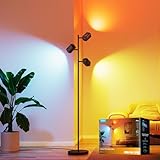
The Sky is the value anchor of this guide and, for sheer light-per-dollar, its most persuasive lamp. It aims its output straight up, bounces it off the ceiling and returns it as the even, shadow-soft ambient light a good ceiling fixture would have provided. A note on its output figure, because honesty about this model requires it: Brightech’s claimed lumens for the Sky have differed between production runs — figures around 2,190 lumens in the long-running specification and higher claims on newer listings — and since these are maker figures with no shared standard, we print the conservative reading and the conclusion independent roundups keep reaching, which is that in the real world this lamp lights a small-to-medium room on its own. The color is fixed at 3000K warm white, the head pivots to angle the wash, and a touch dimmer on the pole steps through three brightness levels with memory. This guide links the black finish; other finishes exist under their own listings, so confirm the finish and check the current price on Amazon — in every finish, it sits at the very bottom of this guide’s price range.
Two details lift the Sky above the budget torchieres it resembles. The first is its base: nearly all of the lamp’s weight sits in a felt-covered weighted base about 10 inches across — stable against bumps and vacuum strikes, and the felt slides on hardwood and laminate without scratching, which makes it as kind to floors as it is firm on them. The second is backing: Brightech offers a 3-year warranty with US-based support, a commitment most of this category never makes. The limits are real and should be weighed at any budget. The LED is integrated and rated by the maker at 20,000 hours, so when it or its driver eventually fails, the lamp is finished. The 3000K color never changes, the dimmer moves in three steps rather than a smooth sweep, and a tall person standing close can see up into the bowl and catch glare. None of that changes the arithmetic: if darkness is your problem, the Sky solves it for a small part of this budget and leaves the rest for the reading chair — which is why it, and not a pricier lamp, closes so many of our floor lamp guides. Readers cross-shopping the shaded alternative in this guide should also see how the same budget splits in Best Floor Lamp For Modern Homes Under $400, where the ranking is re-run for design-led rooms.
- Ceiling-bounce uplight that genuinely serves as a small-to-medium room’s main light.
- Felt-covered weighted base of about 10 inches: stable, and it will not scratch hard floors.
- Three-level touch dimmer with memory, a pivoting head and a 3-year warranty — check price on Amazon.
Honest limitation: Integrated, non-replaceable LED with a fixed 3000K color and a stepped (not smooth) dimmer; maker output claims vary by production run.
Choose it if darkness is the problem and you want it solved decisively at the bottom of the budget. Skip it if you want adjustable color temperature, color effects or a lamp that aims light down at a page.

SAFAVIEH Landen Leaf Floor Lamp, Antique Gold Finish
Who it suits: Traditionalists and the app-averse — buyers who want a lamp that looks like furniture, works with a wall switch, and can be serviced forever with a standard bulb, in a guide otherwise full of sealed electronics.
The Landen closes this guide as its conscience. A metal stem in an antique gold leaf finish — a finish, honestly noted, not solid brass — carries a fabric drum shade about 15 inches across at 63.5 inches tall, and inside sits the most future-proof technology in lighting: a standard E26 socket. The listing quotes 800 lumens, but with a socket lamp that figure describes the bulb SAFAVIEH pictures it with; fit your own bulb and you choose the brightness, the color temperature and the color rendering, forever, for the price of a bulb. Want high-CRI warmth over a reading chair? Fit the bulb that does it. Want voice control? Fit a smart bulb, and the smarts live in a replaceable part rather than in the lamp. This matters more at a $400 tier than anywhere: five of these six picks are sealed systems whose light engines will one day decide the lamp’s fate, and the Landen is the one that cannot be totaled by a dead driver. Its pricing also moves around more than most in this guide, so check the current price on Amazon before ordering and avoid buying at a spike — patience with this listing tends to be rewarded, and in every sighting from our research it sat far below this guide’s ceiling.
What does the traditional route give up? Dimming is whatever your bulb and setup provide — the lamp itself is a switch, not a dimmer, so plan on a dimmable bulb plus a plug-in dimmer or a smart bulb if you want levels. The fabric shade that makes its light so forgiving also caps its output: this is warm ambient light for a seating area, not a room-filling uplight, and a large living room asking it to be the only source will find evenings dim. A shade is also the most fragile part of any lamp in a move or a knock. Those are mild, manageable caveats, and they purchase something no other pick here offers: a lamp with no software, no sealed engine and no ecosystem, whose every wear part costs a bulb. In a $400 guide, the Landen’s argument is that the smartest spend is sometimes the lamp that will still be working, unchanged, in twenty years — and it is a genuinely strong argument. It is also the natural bridge to the tier below, where socket lamps dominate: Best Floor Lamp Under $150 is full of its relatives.
- Standard E26 socket: your choice of bulb, brightness, color temperature and CRI — replaceable forever.
- No app, no account, no network: it works identically in any room, in any home, indefinitely.
- Fabric drum shade gives the softest, most forgiving light in this guide — check price on Amazon, and buy on a dip.
Honest limitation: No built-in dimming — levels come from your bulb or a smart plug — and the fabric shade makes it ambient light, not a room-filler. Its price moves around, so timing matters.
Choose it if you want furniture-grade looks and a lamp that can never be bricked. Skip it if you want app scenes, color effects or serious uplight — the Signe and the Sky divide those jobs between them.

The Lamps Above This Line — and Why They Are Not Picks
Honesty about a $400 guide requires a short tour of what sits above it, because buyers with this budget always ask. The band immediately above the line is, on Amazon, essentially empty: in our research the most expensive floor lamp we could verify as genuinely orderable sat just under $400. Beyond that gap live the true design objects — Dyson’s Solarcycle Morph floor lamp, a light-tracking task sculpture priced far above this guide; the current-generation Koncept arms at design retailers; the Uttermost floor range — sold through design channels, showrooms and listings we could not verify to the standard this guide requires. They are named here, in prose, without purchase links, so you know the landscape: stretching past $400 on Amazon does not unlock a better class of lamp the way stretching from $100 to $200 does. It mostly unlocks the same lamps at worse prices, until the jump to genuine designer retail. If your budget is truly flexible and design is the priority, shop that retail deliberately rather than overpaying inside this category — and if it is not, spend at or below the line with confidence that you have seen the top of the orderable market.
Comparison Table
| Product | Type | Light source | Best use | Link |
|---|---|---|---|---|
| BenQ e-Reading Floor Lamp | Curved-head task lamp | Integrated LED, Ra 95 CRI, sensor auto-dim | Reading, desk work and crafts at one serious chair | Check on Amazon |
| Philips Hue Signe Gradient | Wall-wash design pole | Integrated LED, gradient color | Atmosphere and ecosystem lighting for living rooms | Check on Amazon |
| Koncept Z-Bar Floor Lamp (Gen 3) | Articulated arm lamp | Integrated LED bar, touch dimmer | Positionable light over chairs, desks and benches | Check on Amazon |
| Govee Tree Floor Lamp | Multi-head smart pole | Integrated LED, color + white | Zoning an open-plan room from one outlet | Check on Amazon |
| Brightech Sky LED Torchiere | Torchiere uplight | Integrated LED, fixed 3000K | Replacing a weak or missing ceiling light | Check on Amazon |
| SAFAVIEH Landen Leaf Floor Lamp | Traditional shaded lamp | Replaceable E26 bulb | Furniture looks with zero software, serviced by a bulb | Check on Amazon |
How to Choose the Best Floor Lamp Under $400
- Name the job before the lamp. This budget contains four different products wearing one name: a task instrument (BenQ), an atmosphere sculpture (Signe), a positionable arm (Z-Bar), and room-lighting infrastructure (Sky, Tree). Most disappointment at this tier comes from buying one to do another’s job — an indirect lamp asked to light a book, a task lamp asked to warm a party. Write down the chair, the surface and the hour the lamp serves, then shop.
- Demand a number you can check. At this tier you can finally buy verified light quality: a published CRI (the BenQ’s Ra 95), a stated color-temperature range, a lux figure at the surface. Where a maker publishes none of these — most of this guide — treat brightness claims as marketing and judge by geometry: light aimed at a ceiling fills a room, light through a shade fills a corner, light aimed at a page fills a book.
- Weigh the base, literally. Stability is the quiet luxury of this tier. The BenQ puts about 10.4 kg under its head; the Sky concentrates its weight in a felt-covered base that also protects floors. A tall lamp on a light, hollow base is a tier-below product wearing a tier-above price, and it is the first thing to check in person or in a listing’s specifications.
- Decide your relationship with sealed light engines. Five of these six lamps integrate their LEDs; when the driver dies, the lamp dies. Makers rate the engines for tens of thousands of hours and the better brands warranty them for years, but if your instinct is buy-it-for-decades, the socket lamp (Landen) or the established-brand instruments are the safer architecture — and a socket lets you fix color and brightness yourself, forever.
- Count the ecosystem honestly. A Hue lamp’s best features need a Bridge; a Matter lamp’s need a hub app and a stable network; a smart bulb in a dumb lamp needs nothing but the bulb. None of these is wrong, but the accessory and the account are part of the purchase. Buy the ecosystem you already live in, or the one you are genuinely willing to adopt.
- Check the configuration, not just the product. At this tier, listings are families: floor versus desk versions (BenQ), finishes at different prices (Signe, Sky), generations current and discontinued (Z-Bar). The single most common expensive mistake in this category is checking out with the wrong variant. Confirm the configuration, finish and generation on the live listing before you pay.
- Spend the headroom on the axis you lack. If your room is dark, the Sky plus change beats any single decorative lamp. If your chair is unusable after dark, the BenQ is the purchase. If the room is lit but lifeless, the Signe. The $400 is an allowance, not a target — three of these six picks sit far below it, and keeping the difference is a legitimate outcome of a good guide.
- Compare the ladder before you commit. The tier below overlaps this one heavily, because the orderable market’s ceiling is where it is. Best Floor Lamp Under $300 ranks nearly the same money without the two design instruments; if neither the BenQ nor the Signe is your lamp, that guide may serve you better for less.
What $400 Buys — and What It Doesn’t
Here is the tier’s honest shape. Four hundred dollars buys the top of the orderable floor lamp market: the only verified-CRI task lamp in the category, the flagship gradient lamp of the biggest smart-lighting ecosystem, and a discontinued architect’s arm that design retail has already replaced at a higher price. It buys bases with real mass, metal where plastic used to be, dimming that sweeps instead of steps, and sensors that manage light for you. Those are genuine goods, and for the buyer whose chair or whose wall is the point, they are worth the money exactly once.
What $400 does not buy deserves equal clarity. It does not buy designer objects — the true design names start above this tier and mostly live far above it, in channels this guide could not verify to its standard. It does not buy immunity from the category’s physics: five of these six light engines are sealed, indirect lamps still cannot light a page, and a fabric shade still caps output. And it does not buy a brighter room in any simple sense — the cheapest pick in this guide moves as much usable ambient light as the dearest. Spend the $400 on light quality, position, stability or atmosphere — the axes where this tier is genuinely better — and let the change stay in your pocket when your problem turns out to be plain darkness.
Common Buying Mistakes
- Assuming a higher price means a brighter lamp — at this tier, price buys light quality, control and design, not raw output.
- Checking out with the wrong variant: the desk version of a floor lamp’s listing family, the wrong finish, or a discontinued generation at a collector’s price.
- Buying an indirect lamp (Signe) as a reading light, or a task lamp (BenQ) as living-room atmosphere.
- Ranking lamps by printed lumen numbers, which are maker claims with no shared measurement standard behind them.
- Forgetting the Bridge: pricing a Hue lamp without the accessory its best features require.
- Ignoring the base — a tall, top-heavy lamp on a light base is a tip hazard no warranty fixes.
- Paying a spike price for a volatile listing instead of checking the current price on Amazon across a few days.
- Buying a sealed LED lamp for a decades-long horizon without weighing the one socket lamp that a bulb can service forever.
Final Recommendation
- Most buyers at this tier: BenQ e-Reading Floor Lamp — verified light quality and a sensor that manages it — check the current price on Amazon, and select the floor configuration.
- Atmosphere and design: Philips Hue Signe Gradient — the wall becomes the lamp; budget the Bridge if you want the full ecosystem.
- Positionable task light: Koncept Z-Bar — only while the live price respects the $400 line.
- Open-plan zoning: Govee Tree — three aimed heads from one outlet, well inside the budget.
- Plain darkness: Brightech Sky — solve it at the bottom of the budget and keep the change.
- No software, ever: SAFAVIEH Landen — a shade, a socket and a bulb you choose.
Our top two are the BenQ for anyone whose evenings happen in one chair — it is the only lamp here whose light is specified like a tool’s — and the Signe for everyone whose room is already lit but not yet alive. Between them they mark the two honest reasons to spend at this tier: the quality of light on a surface, and the quality of light on a room. Everything else in this guide is a variation on value, flexibility or permanence, and several of those variations cost a fraction of the budget. Measure your chair’s distance from the outlet, decide whether the lamp serves a page or a wall, check the current price on Amazon and confirm the configuration on the listing, and buy the lamp whose strength matches the lack you actually feel.
Frequently Asked Questions
Is a floor lamp under $400 really better than one under $200?
Better at specific things, not at everything. The extra money buys verified light quality (a published CRI and sensor-managed dimming on the BenQ), design and ecosystem integration (the Hue Signe), mechanical sophistication (the Z-Bar’s counterbalanced arm), and heavier, more stable construction. It does not buy a dramatically brighter room — the strongest ambient lamp in this guide is also one of its cheapest. If your need is light quality, position or atmosphere, the tier earns its price; if your need is simply more light, the tier below serves you for less.
Why is there so little choice between $300 and $400?
Because the mainstream market ends below it. The best-selling floor lamps on Amazon cluster under $200, a small group of serious instruments and design lamps occupies the stretch up to roughly this guide’s ceiling, and the next class up — designer retail — starts far above it. A $400 budget therefore buys from a short list almost by definition. That is also why this guide refuses to pad: six lamps that each win a different argument are worth more than twelve that split the same ones.
What does CRI mean, and should I pay for a high one?
CRI — color rendering index — measures how faithfully a light shows colors compared with a reference source, on a scale to 100. It matters when the surface under the lamp is color-critical or detail-critical: reading print for hours, sewing, painting, sorting, applying makeup. For ambient living-room light it matters far less, which is why most makers in this category never publish it. If your lamp serves a task chair, a published high CRI like the BenQ’s Ra 95 is one of the few specifications at this tier worth paying for; if it serves a sofa’s atmosphere, spend the money on control and design instead.
Should I worry that most of these lamps have sealed LEDs?
Weigh it, don’t fear it. Integrated LED engines are typically rated for tens of thousands of hours — years of evening use — and the stronger brands in this guide warranty their lamps accordingly. The real cost of a sealed design is that the lamp’s life is set at the factory and its color and output can never be upgraded. If you expect a lamp to serve for a decade or more, or you like choosing your own light, the socket-based Landen removes the question entirely; if you expect to redecorate within the engine’s rated life, the sealed designs’ advantages in shape and control are worth more than the theoretical risk.
Do I need a Hue Bridge for the Signe floor lamp?
Not for basic use: the Signe works over Bluetooth with the Hue app in the same room, so you can set colors, gradients and brightness out of the box. The Bridge unlocks the full system — control from anywhere, routines and automations, voice-assistant integration beyond the basics, and entertainment syncing. If the Signe is your only Hue product and it lives in one room, start without the Bridge; if you already run Hue, or plan to, the Bridge is what makes this lamp a system rather than a novelty, and this budget can absorb it.
How bright should a living-room floor lamp be?
Think in layers and direction rather than one number — which is just as well, because the numbers on listings are maker claims with no shared standard. A living room generally wants a base layer of ambient light (an uplight or a wall-wash lamp can carry a small-to-medium room alone), a task layer at the reading chair (a few hundred focused lumens close to the page), and accent light for mood. In this guide, the Sky and the Signe are ambient layers, the BenQ and the Z-Bar are task layers, the Tree splits itself across zones, and the Landen is a seating-area accent. Buy the layer your room lacks, then use dimming to land at the level your evenings actually want.


