Where to buy
Check the latest price, availability and delivery on Amazon. Orders are placed on Amazon. We may earn a commission from qualifying purchases.
- Best overall: SUNMORY 32W/3000LM Super Bright LED Torchiere Floor Lamp with Remote — Check on Amazon
- Brightech Sky LED Torchiere Floor Lamp, Black — Check on Amazon
- SUNMORY Arc Floor Lamp with 9W 3 Color Temperature Bulb — Check on Amazon
- LEPOWER Wood Tripod Floor Lamp — Check on Amazon
- Simple Designs LF1014-BLK Etagere Shelf Floor Lamp — Check on Amazon
See 1 more Amazon option
- Ambimall 60-Inch Floor Lamp with 9W Bulb — Check on Amazon
Read the full guide ↓
Disclosure: As an Amazon Associate, dailyhomedecorating.com earns from qualifying purchases. Links to Amazon on this page are affiliate links; they cost you nothing extra. Listing details such as price and availability change often, so check the current Amazon listing before you buy.
Finding the best floor lamp under $150 sounds simple until you stand in an actual living room and try to work out what the lamp has to do. It has to replace or supplement a ceiling light that is too harsh, too dim or missing entirely. It has to put reading light over one end of a sofa without blinding the person at the other end. It has to survive being bumped by a vacuum cleaner, moved for a party and reached around by someone holding a mug. And at this budget it has to do all of that without the wobble, the buzzing dimmer or the yellowing plastic shade that give cheap floor lamps their reputation. The good news is that $150 is a genuinely useful ceiling for this category. Below it sit some excellent LED torchieres with real output, a proper mid-century tripod in real wood, an arc that delivers light over a sofa from a base tucked out of the way, and a shelf lamp that earns its floor space twice. What you do not get at this level — and should not expect — is heirloom metalwork, silent museum-grade dimming or smart-home integration beyond what a smart plug can add. Judge these lamps on light, stability and controls, in that order, and the budget treats you well.
This guide compares six lamps that approach the job from different directions, because “floor lamp” covers at least four different tools. A torchiere bounces light off the ceiling and lights the whole room indirectly; it is the closest thing to a ceiling fixture you can plug into a wall. A shaded lamp throws light sideways and down, which is warmer and better for faces, corners and reading chairs. An arc lamp relocates the light source away from its base, which solves the classic problem of the only outlet being nowhere near the middle of the sofa. A shelf lamp trades some light quality for storage, which in the right room is the correct trade. Two of our six are torchieres, and they are not interchangeable: one is a high-output, fully adjustable modern lamp with a remote, the other is a simpler, fixed-warmth design from an established lighting brand with a long warranty. Choosing between them is mostly a question of whether you want control or simplicity, and the reviews below make that trade explicit rather than pretending one lamp wins everything.
Our short answer: for most living rooms, start with the SUNMORY 32W torchiere. It is the brightest lamp here by a wide margin, its color temperature adjusts from warm to daylight, it dims smoothly from the sofa with a remote, and its head rotates far enough to work as either an uplight or a directed light. If you prefer a lamp with no remote to lose and no settings to manage — one touch control, warm light, done — the Brightech Sky is the calmer buy and carries the strongest warranty support in this group. If your seating floats away from the walls, look at the SUNMORY arc. If style leads your decision, the LEPOWER tripod is the one guests will ask about. The Simple Designs shelf lamp and the compact Ambimall solve narrower problems — storage and small footprints respectively — and solve them honestly at the low end of this budget. Every pick below includes who it suits, what it does well, one honest limitation, and a clear choose-or-skip verdict, so you can match a lamp to your room instead of to a marketing photo.
In this guide
Quick Picks
In a hurry? This table matches each lamp to the job it handles best under $150.
| Buyer type | Pick | Why it stands out | Link |
|---|---|---|---|
| Best overall | SUNMORY 32W/3000LM Torchiere Floor Lamp with Remote | 3000 lumens, adjustable 3000K–6000K color, stepless dimming and a rotating head | Check on Amazon |
| Best for simple, warm light | Brightech Sky LED Torchiere Floor Lamp | Fixed warm 3000K light, 3-way touch dimmer with memory, weighted 10-inch base | Check on Amazon |
| Best over a sofa | SUNMORY Arc Floor Lamp with 9W Bulb | Curved arm puts light over seating while the base tucks behind or beside it | Check on Amazon |
| Best mid-century style | LEPOWER Wood Tripod Floor Lamp | Real rubber-wood tripod legs and a flaxen linen shade; takes your choice of E26 bulb | Check on Amazon |
| Best with storage | Simple Designs LF1014-BLK Etagere Shelf Floor Lamp | Three open shelves under a linen shade in one 62.5-inch frame | Check on Amazon |
| Best compact value | Ambimall 60-Inch Floor Lamp with 9W Bulb | Shorter 60-inch height, rotating shade and a 3-color-temperature bulb included | Check on Amazon |
How These Picks Were Chosen
We built this list from manufacturer specifications and retailer listings, and we checked every model number, dimension and light output figure against the maker’s own published data before including a lamp. That step matters more than it sounds: floor lamps are sold under shifting titles, the same model appears in several colors with different listing pages, and headline brightness numbers are frequently rounded up. Where a maker’s own page and a marketplace listing disagreed — it happens with wattage on integrated LED models — we used the manufacturer’s figure and noted the spec conservatively in the review. Every lamp here had to clear four bars. First, real-world output: a lamp sold as a room light needs enough lumens to change how the room feels, not just glow decoratively, so decorative-only novelty lamps were cut. Second, stability: a weighted or wide base appropriate to the lamp’s height, because a tall lamp that rocks on carpet is a lamp that eventually falls on carpet. Third, honest controls: dimming that actually dims, switches placed where a person sitting down can reach them, and no app requirement for basic operation. Fourth, a total cost that stays inside the under-$150 frame once you add anything the lamp needs to work — two picks below ship without a bulb, and we say so plainly rather than letting the headline price flatter them.
We also deliberately mixed lamp types instead of ranking six near-identical torchieres. A single “winner” format would be tidier and less useful, because the right lamp for a room with no ceiling fixture is the wrong lamp for a reading corner, and both are wrong for a renter who needs shelves more than lumens. If you are working through a tighter budget as well, our companion guide to Best Floor Lamp Under $100 covers the step-down options, and if your room is large or formal enough to justify spending more, Best Floor Lamp Under $300 is the next rung up. This guide stays at $150 and spends the whole budget on light quality, build and controls rather than on decorative finishes.
The 6 Best Floor Lamps Under $150
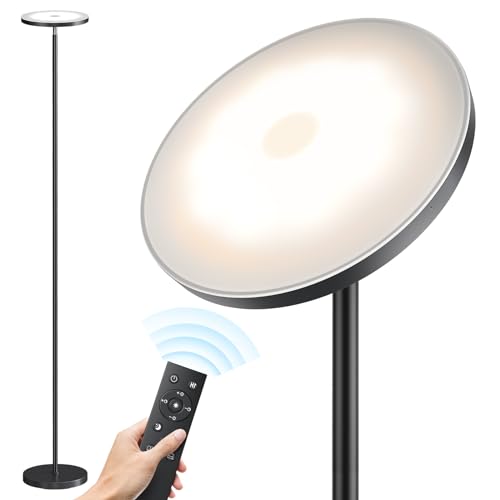
SUNMORY 32W/3000LM Super Bright LED Torchiere Floor Lamp with Remote
Who it suits: Anyone whose living room lacks a ceiling light, or whose ceiling light is a single harsh bulb in the center of the room. Also the best fit here for open-plan spaces where one lamp has to cover a seating area and a dining corner at different times of day.
The headline numbers are real and they matter: 32 watts of integrated LED producing up to 3000 lumens, on a 69-inch pole with a 9.8-inch base. Three thousand lumens is roughly double what most decorative floor lamps produce, and it is the difference between a lamp that assists your ceiling light and a lamp that replaces it. Because this is a torchiere, that output fires upward and bounces off the ceiling, so the room fills with indirect light that does not glare at a television screen or into the eyes of someone across the sofa. The head rotates 350 degrees horizontally and tilts 180 degrees longitudinally, which quietly changes what the lamp is: angled down and to the side, it stops being an uplight and becomes a large-area task light over a desk corner or reading chair. Few lamps at any price in this guide can do both jobs.
Control is the second strength. Brightness dims steplessly from 5 to 100 percent, and color temperature adjusts across 3000K to 6000K — warm and firelit at one end, neutral daylight at the other — from a remote that also stores preset modes for reading, working and low night light, with a memory function that returns the lamp to your last settings. There is a foot switch on the cord for the times the remote is across the room. In daily life, the combination means the lamp can be bright and cool while you clean or work, then warm and low for the evening, without anyone getting up. Assembly follows the usual pattern of screwing pole sections together and fitting the head and base, and the rated LED life is 30,000 hours, which at evening use is many years of service.
Pros: Highest output in this guide at 3000 lumens; genuinely useful color-temperature range; stepless dimming with remote, foot switch and memory; rotating, tilting head works as uplight or directed light; tall 69-inch height gets light above seated eye level.
Honest limitation: The integrated LED is not a replaceable bulb. When the light source eventually reaches the end of its life, the lamp is done — you are relying on that long rated lifespan and the maker’s warranty rather than on a two-minute bulb swap. The remote is also one more small object to keep track of, and the lamp’s brightness advantage is wasted in a small room with low, dark ceilings, where bounced light has little to bounce from.
Choose this if your room needs a ceiling-light replacement with real flexibility. Skip it if you want a shaded lamp’s warm sideways glow, or you strongly prefer a standard replaceable bulb. Check the current listing for colors and availability, and check price on Amazon before you buy.

Brightech Sky LED Torchiere Floor Lamp, Black
Who it suits: Buyers who want warm, bright, indirect light with the fewest possible decisions — and buyers who value buying from an established lighting company with a stated multi-year warranty over buying the most featured lamp on the page.
The Sky is the minimalist counter-argument to the SUNMORY above. It is a 63-inch torchiere with an integrated LED rated at 2190 lumens in a fixed warm 3000K. That is less output and no color adjustment, and for a large share of living rooms it is exactly enough: warm light, bounced off the ceiling, at a brightness that fills a typical room without strain. The control is a 3-way touch dimmer on the pole — tap through three brightness levels — with a memory function that restores your last level when you switch back on. There is no remote, no app, no pairing and nothing to configure. The head tilts, so you can angle the wash of light toward a seating area rather than straight up, which helps in rooms where the lamp must stand off to one side.
Build is where the Sky earns its place. The 10-inch base is weighted — the maker puts most of the lamp’s roughly 8.6 pounds low, where it belongs — and the slim metal pole has essentially no visual footprint, so the lamp disappears into a corner in a way shaded lamps do not. Brightech rates the integrated LED for 20,000 hours and backs the lamp with a 5-year limited warranty according to its own product page, the strongest stated coverage in this group. It also stays cool in use, a genuine practical point if the lamp stands where children or curtains pass close by. The black finish in this listing is one of several colors the model is made in; the lamp linked here is the black version.
Pros: Bright 2190-lumen warm uplight; dead-simple 3-way touch dimmer with memory; weighted 10-inch base and slim profile; established brand with a 5-year limited warranty; cool-running LED head.
Honest limitation: The color temperature is fixed at 3000K. If you want cooler daylight for a home-office corner, this lamp cannot give it to you, and three brightness steps are coarser than stepless dimming when you are trying to land on an exact evening level. As with the SUNMORY, the LED is integrated rather than a replaceable bulb.
Choose this if you want set-and-forget warm light from a company that will answer the phone. Skip it if you need adjustable color temperature, a remote, or light directed downward for reading. Check price on Amazon and confirm the finish on the listing, since this model is sold in several colors.

SUNMORY Arc Floor Lamp with 9W 3 Color Temperature Bulb
Who it suits: Anyone whose sofa sits away from the wall — or whose only free outlet does — and who wants light delivered over the seating instead of from behind it. Also a kind first lamp for a first apartment, because it solves the common “no ceiling fixture, switch controls an outlet” layout in one piece.
An arc lamp is a piece of spatial problem-solving. The base stands where there is room — behind the sofa, beside it, in a corner — and the curved metal arm carries the shade out over the seat, so the light lands where people actually sit and read. This SUNMORY uses a hanging, adjustable shade on that arm, so you can fine-tune the direction once the arc is in place. The included 9W LED bulb offers three color temperatures, letting you shift between warm evening light and a crisper tone for reading or crafts without changing bulbs. Output is modest next to the two torchieres above, and that is the correct expectation: this is a lamp for a seating zone, not a whole-room light source, and judged on that job it is well matched.
The practical virtues are placement and price of risk. The base is designed to tuck partly under many sofas, reclaiming floor space; the lamp asks for no drilling, no wiring and no landlord negotiation; and when you move, it breaks down and travels like any other piece of flat-pack furniture. In our earlier arc-specific testing notes for this model family, the recurring theme was that renters valued exactly this combination — overhead-style light with zero installation. If you are comparing arcs specifically rather than floor lamps generally, our dedicated guide to Best Arc Floor Lamp Under $100 goes deeper on reach, base size and ceiling clearance.
Pros: Delivers light over a sofa from an out-of-the-way base; adjustable hanging shade; included bulb with three color temperatures; no installation, renter-friendly, easy to move; replaceable standard bulb, unlike the integrated torchieres.
Honest limitation: An arc’s reach is fixed by its arm. Measure before you buy: if the base cannot get close enough to the sofa, the shade will hang short of the seat or crowd a walkway, and a tall arc under a low ceiling can feel looming in a small room. It will not light a whole room the way a torchiere does.
Choose this if your seating floats or your outlets are in the wrong places. Skip it if your sofa already sits against a wall with room for a straight lamp beside it — a simpler lamp will serve you better. Check price on Amazon before ordering.
LEPOWER Wood Tripod Floor Lamp
Who it suits: Style-led buyers furnishing a mid-century, Scandinavian or warm-minimal living room, and anyone who wants a lamp that takes a standard bulb they choose themselves — including a smart bulb.
Most floor lamps under $150 are metal poles with a shade or a dish on top. The LEPOWER is built differently: three legs of natural rubber wood splay from under a flaxen linen drum shade, in the tripod pattern that defined mid-century lighting. It stands about 61 inches tall with a footprint roughly 19 by 19 inches, and at a little over six pounds it is easy to place and reposition while you arrange a room. The linen shade diffuses light sideways and downward, which is the flattering direction for living rooms — faces, books and upholstery all look better under shaded light than under a bare uplight — and the wood warms up rooms that are otherwise all painted metal and fabric.
The lamp uses a standard E26 socket rated to 60 watts maximum, controlled by a foot switch on a generously long cord of about 10.6 feet, which makes outlet placement much less of a negotiation than with short-cord lamps. Two honest consequences follow from the socket design. First, no bulb is included: budget for one, ideally an LED in the 10–12W range the maker suggests, which also lets you pick your own color temperature. Second, dimming is whatever your bulb supports — pair it with a dimmable bulb and a compatible setup, or a smart bulb, and this simple lamp becomes the most flexible of the shaded picks here. The tripod stance is stable on hard floors; on deep carpet, take a moment to seat all three feet evenly.
Pros: Genuine wood tripod design that anchors a room’s style; standard E26 socket takes any bulb up to 60W, including smart bulbs; long cord and foot switch; soft, flattering shaded light; light enough to move easily.
Honest limitation: The bulb is not included, so the true cost is the lamp plus a bulb, and the wide tripod footprint — about 19 inches across — needs more clear floor than a pole lamp. It is a corner-and-beside-chair lamp, not a squeeze-behind-the-sofa lamp.
Choose this if the lamp will be seen and you want it to look like furniture. Skip it if floor space is tight or you want dimming and color control built in out of the box. Check price on Amazon, and remember to add a bulb to your order if you do not have a spare E26 LED at home.

Simple Designs LF1014-BLK Etagere Shelf Floor Lamp, Black
Who it suits: Anyone who needs the lamp’s patch of floor to do two jobs — light plus a home for books, a plant, remotes and the router-adjacent clutter that otherwise colonizes the sofa arm.
The LF1014 is an open etagere frame, 62.5 inches tall, with three shelves stacked beneath a white linen shade. It is less a lamp with a gimmick than a small bookcase with a lamp on top, and in rooms short on surfaces — studio apartments, dorm-style first homes, spare-room offices — that combination is legitimately useful. The shade sits at a height that works beside a sofa or bed, the shelves are sized for paperbacks, framed photos and small decor, and the black frame version linked here pairs with most furniture finishes. Because the light source is a standard medium-base (E26) socket under a fabric shade, the light itself is soft and local: this is ambient and reading light for one seating spot, not a room-filling fixture.
Set expectations correctly and this lamp satisfies. The frame is lightweight manufactured material rather than solid timber, the shelves are for display-weight objects rather than a full encyclopedia set, and — as with the LEPOWER — the bulb is not included, so add an LED bulb to the order. Assembly is a screw-together frame build, straightforward and tool-light. What you get for the low end of this budget is versatility that none of the brighter lamps above can offer: no torchiere will hold your book when you put it down.
Pros: Three usable shelves in the footprint of one lamp; soft shaded light at sofa height; standard E26 socket lets you choose bulb brightness and tone; sits at the low end of this budget; works beside a sofa, bed or desk.
Honest limitation: Light output depends entirely on the bulb you add, and even with a strong bulb a shaded shelf lamp cannot match a torchiere for whole-room light. The open shelves also show dust and clutter honestly — if the shelves will hold mess, the lamp will display it.
Choose this if storage is as scarce as light in your room. Skip it if your priority is maximum brightness or a minimalist look. Check price on Amazon and plan a bulb purchase alongside it.
Ambimall 60-Inch Floor Lamp with 9W Bulb
Who it suits: Buyers with lower ceilings, smaller rooms or a tighter corner of the budget — and anyone furnishing a bedroom, nursery corner or study nook where a full-height lamp would overwhelm the space.
At 60 inches, the Ambimall is the shortest lamp in this guide, and that is its point. Standard floor lamps run 63 to 72 inches; in a room with an eight-foot ceiling and low-slung furniture, the shorter pole keeps the shade at a natural height beside an armchair instead of towering over it. The included 9W LED bulb provides three color temperatures, and the shade rotates so you can aim the light toward a page or bounce it toward a wall. Everything needed is in the box — bulb included, simple assembly — which makes this the lowest-friction purchase on the list.
It is also the most modest lamp here in output and presence, and we would rather say that plainly than oversell it. One shaded 9W bulb lights a reading chair and softens a corner; it does not replace a ceiling fixture in a large living room, and the build is lightweight rather than hefty. Placed within its competence — a bedroom corner, a dorm, a small apartment’s reading spot — it does the job neatly for the smallest spend in this guide. Readers furnishing a whole small flat may also want to compare the apartment-focused picks in Best Floor Lamp For Small Apartments Under $150, where lamps are judged on footprint first.
Pros: Compact 60-inch height suits low ceilings and small rooms; bulb included with three color temperatures; rotating shade aims the light; simple, quick assembly; lowest spend in this guide.
Honest limitation: Modest output from a single 9W bulb — a zone light, not a room light — and a lightweight build that prefers a quiet corner over a high-traffic spot where it will be knocked regularly.
Choose this if you need a gentle, compact lamp for one seat or one corner. Skip it if you need to light a whole living room. Check price on Amazon before you buy.

Comparison Table
The table below puts the six lamps side by side on the specifications that decide how they behave in a room. Brightness figures are the makers’ rated lumens; for the two socket lamps, output depends on the bulb you fit, so we describe the socket instead of inventing a number.
| Pick | Type | Height | Light source | Controls | Link |
|---|---|---|---|---|---|
| SUNMORY 32W Torchiere | Torchiere uplight | 69 in | Integrated LED, 3000 lumens, 3000K–6000K | Remote + foot switch, stepless dimming, memory | Check on Amazon |
| Brightech Sky | Torchiere uplight | 63 in | Integrated LED, 2190 lumens, 3000K warm | 3-way touch dimmer on pole, memory | Check on Amazon |
| SUNMORY Arc | Arc with hanging shade | Arc format | 9W LED bulb included, 3 color temperatures | Standard switch; bulb-based control | Check on Amazon |
| LEPOWER Tripod | Tripod with linen shade | 61 in | E26 socket, max 60W, bulb not included | Foot switch on 10.6 ft cord | Check on Amazon |
| Simple Designs LF1014 | Etagere shelf lamp | 62.5 in | E26 socket, bulb not included, 3 shelves | Standard switch; bulb-based control | Check on Amazon |
| Ambimall 60-Inch | Shaded pole lamp | 60 in | 9W LED bulb included, 3 color temperatures | Rotating shade; standard switch | Check on Amazon |
How to Choose a Floor Lamp Under $150
Start with the job, not the lamp. Write down, in one sentence, what is wrong with your room’s light today. “The ceiling light is harsh and the corners are dark” points to a torchiere plus patience. “I can’t read comfortably on the sofa” points to an arc or a shaded lamp placed at the seat. “The room is fine but dead in the evening” points to a shaded lamp with warm light. Every disappointed floor-lamp purchase we have seen traces back to buying a lamp for a job it was not built to do — most often buying a pretty shaded lamp to fix a room with no ceiling light, then blaming the lamp for being dim. Shaded lamps are zone lights by design. If the room itself is dark, you need lumens aimed at the ceiling first.
Understand lumens before style. Lumens measure total light output. As a working rule, a living room feels adequately lit at roughly 1,500 to 3,000 lumens of combined ambient light depending on size, wall color and ceiling height — which is why the 3000-lumen SUNMORY torchiere can carry a room alone, the 2190-lumen Sky can carry a modest one, and a single shaded bulb, however lovely, is a supplement. Dark walls and ceilings absorb bounced light; a torchiere in a navy-painted room with a dark ceiling will underperform its numbers. If your ceilings are very high — ten feet or more — uplight also loses force on the way down, and a mix of uplight plus a shaded lamp at seating level usually beats either alone.
Decide how you feel about integrated LED. Two of our top picks have built-in LEDs that cannot be replaced. In exchange you get slim design, high output and long rated life — 20,000 to 30,000 hours is a decade of evenings. The socket lamps (LEPOWER, Simple Designs) and bulb-included lamps (SUNMORY arc, Ambimall) keep the older bargain: when the light dies or you want a different tone, you change a bulb. Neither answer is wrong; the mistake is not knowing which bargain you made until the first failure.
Check the base against your floor and your life. Weighted round bases of about ten inches suit pole lamps on hard floors and low carpet. Tripods spread wider and sit happily on hard floors but need their feet seated evenly on thick carpet. Arc bases are heavy by necessity and want to slide partly under furniture. If the lamp will stand in a walkway, beside a play space or anywhere a dog’s tail operates at pole height, weight and footprint stop being specifications and become the whole decision.
Match controls to the seat. A dimmer you must stand up to reach is a dimmer you will not use. Remotes and foot switches serve people already seated; pole touch controls serve people walking past. Think about who switches this lamp off last at night, from where, and buy accordingly. Finally, measure twice: lamp height against ceiling height and furniture height, shade or arc reach against the seat it must serve, and cord length against the distance to the outlet you actually have. Five minutes with a tape measure prevents the most common return in this category.
Placement, Room Size and Ceilings: Getting the Most From Your Lamp
Where a floor lamp stands matters almost as much as which one you buy, and it is the part of the purchase most people improvise. Start with the corners. A torchiere placed in a corner wastes some of its spread — two walls intercept light that would otherwise travel — but gains a clean, glare-free wash over the seating nearest it, which is often the trade a living room wants. The same lamp a foot or two out from the corner throws noticeably further into the room. If your torchiere has a tilting or rotating head, like both of the top picks here, use it: angling the head a few degrees toward the main seating area compensates for a lamp that cannot stand in the ideal spot, which in real homes is most lamps.
Room size sets honest expectations. In a small living room of around 120 square feet, the Brightech Sky’s output is genuinely sufficient as a main light, and the SUNMORY torchiere will spend most of its life dimmed. In a large or open-plan space of 300 square feet or more, even 3000 lumens is a foundation rather than a finish — plan the layout so a second source, even a modest shaded lamp at the far seating area, fills the gradient. Light falls off quickly with distance; a single lamp, however bright, leaves the far side of a big room in relative shadow, and the eye reads that contrast as gloom even when the measured light near the lamp is strong.
Ceilings deserve a sentence of their own because they decide whether uplight works at all. The ideal partner for a torchiere is a flat, white or near-white ceiling at eight to nine feet: close enough to return the light, pale enough to return most of it. Every step away from that ideal — cream paint, then beige, then wood tones, then dark colors, then height beyond ten feet — taxes the effect. None of this makes a torchiere a bad buy in a less-than-ideal room; it means you should size up in output, which at this budget means choosing the 3000-lumen pick, and keep a shaded lamp in the plan for seating-level light. Vaulted and beamed ceilings are the one case where we would steer a buyer away from uplight as the primary strategy altogether: the light goes up and largely stays there.
Finally, think in layers rather than in lamps. The rooms that feel best lit rarely rely on one source. Ambient light from a torchiere sets the base level; a shaded or arc lamp at the sofa provides the middle layer where people read and talk; and the lamps you already own — a table lamp, a lit shelf — add the accents. The under-$150 budget in this guide buys any one of those layers properly. If you are furnishing from darkness, buy the ambient layer first, live with it for a week, and let the room tell you where the second lamp needs to stand. That sequence, unglamorous as it is, produces better-lit rooms than buying two lamps at once on guesswork.
Common Buying Mistakes
Buying by wattage. Wattage measures power consumed, not light produced — and with LED the relationship has broken entirely. A 32W LED torchiere out-lights a 100W incandescent. Shop by lumens, and treat any listing that advertises wattage as brightness with suspicion.
Forgetting the bulb. Two lamps in this guide ship without one. The purchase is not finished — or fairly compared — until a suitable LED bulb is in the cart. The flip side is an opportunity: the bulb is where you choose brightness and color temperature on a socket lamp.
Ignoring color temperature. A fixed 3000K lamp in a north-facing room you use as a daytime office will feel sleepy; a 6000K daylight setting in an evening living room feels clinical. Either buy adjustable color, or be honest about when the room is used and buy the fixed tone that matches.
Placing a torchiere under a dark or very high ceiling. Uplight is a partnership with the ceiling. Dark paint, exposed dark beams or great height all tax it. In those rooms, shaded and arc lamps that deliver light directly earn their place.
Skipping the footprint check on tripods and arcs. A 19-inch tripod spread or an arc base that cannot tuck under the sofa will colonize exactly the floor you walk on. Measure the spot, not just the wall.
Expecting one lamp to do every job. Ambient, reading and accent light are three jobs. The lamps here that do two of them well are the bargains; a lamp claiming all three at this budget is usually mediocre at each.
Final Recommendation
For most readers, the answer is the SUNMORY 32W/3000LM Torchiere Floor Lamp: it is the only lamp here that can genuinely replace a ceiling light, it adjusts in brightness and color to follow the room from workday to evening, and its rotating head gives it a second career as a directed light. Buy it if your room is under-lit; it solves the actual problem. If your room is adequately lit and you simply want warm, simple, dependable uplight, the Brightech Sky is the calmer long-term purchase, and its warranty support is the best in this group. Choose the SUNMORY arc when your seating arrangement — not your brightness — is the problem, the LEPOWER when the lamp is also a piece of furniture, the Simple Designs when the floor space must store as well as shine, and the Ambimall when the room and the budget are both small. Any of the six is a defensible buy matched to the right room; the only wrong purchase is a lamp bought for a job it was never designed to do. When you are ready, Check on Amazon for the current listing details of our top pick.
Frequently Asked Questions
How many lumens does a living room floor lamp need?
It depends on whether the lamp works alone or with other light. As a sole ambient source for a typical living room, look for roughly 2,000 to 3,000 lumens of indirect light — the range our two torchieres cover. As a supplement beside a seat, 800 to 1,200 lumens of shaded light is comfortable for reading and conversation. Dark walls, dark ceilings and high ceilings all push the requirement upward.
Is a torchiere or a shaded floor lamp better?
They do different jobs. A torchiere lights the room by bouncing light off the ceiling — best for overall brightness without glare. A shaded lamp lights the area around itself — best for reading, faces and atmosphere. Many well-lit living rooms end up with one of each: a torchiere for the room, a shaded lamp for the chair.
What does “integrated LED” mean, and should I avoid it?
It means the light source is built into the lamp rather than being a screw-in bulb. You gain slim design and high efficiency; you lose the ability to replace just the light when it eventually fades. Rated lives of 20,000–30,000 hours mean “eventually” is many years of normal use away. Avoid it only if replaceability matters more to you than design and output — in which case choose a socket lamp and a good bulb.
Can a floor lamp under $150 replace a ceiling light?
A high-output torchiere can, in a room with a standard-height, light-colored ceiling. The 3000-lumen pick in this guide was chosen for exactly that job. In rooms with dark or very high ceilings, plan on a torchiere plus a second lamp at seating level rather than expecting any single lamp at this budget to do everything.
How tall should a floor lamp be?
For uplight torchieres, taller is generally better — 63 to 72 inches puts the light source high enough to spread across the ceiling. For shaded reading lamps, the bottom of the shade should sit near seated eye level, around 40 to 48 inches from the floor beside a typical sofa or chair, so the bulb is hidden from your eyes while the light reaches your book. The 60- to 63-inch lamps here suit average furniture; very low or very high seating deserves a second look at the numbers.
Are these lamps safe around children and pets?
Stability is the main question. Weighted bases and wide tripod stances resist casual bumps; tall, light lamps in walkways are the risk regardless of brand. LED light sources also run far cooler than halogen torchieres of the past, which removes the burn hazard that once made uplights a worry. Place any floor lamp out of main traffic paths, route cords where they cannot be tripped over or chewed, and the category is a safe one.


