Where to buy
Our picks for the best bookshelf for small spaces under $700 — check the latest price, availability and delivery on Amazon. Orders are placed on Amazon. We may earn a commission from qualifying purchases.
- Best overall for small spaces: Tribesigns 6-Tier Corner L-Shaped Bookshelf — Check on Amazon
- Nathan James Theo 6-Shelf Wall-Mount Bookcase — Check on Amazon
- Sauder Barrister Lane Cubby Bookcase — Check on Amazon
- Tribesigns 72-Inch Tall 6-Tier Library Bookcase — Check on Amazon
See 2 more Amazon options
- Bush Home Salinas 5 Shelf Bookcase — Check on Amazon
- Tribesigns 6-Tier Arched Bookshelf — Check on Amazon
Read the full guide ↓
Disclosure: As an Amazon Associate, dailyhomedecorating.com earns from qualifying purchases. Links to Amazon on this page are affiliate links; they cost you nothing extra. Listing details such as price and availability change often, so check the current Amazon listing before you buy.
The best bookshelf for small spaces under $700 is not the smallest bookshelf you can find — it is the one that extracts the most storage from the geometry your room is currently wasting. Small spaces are rarely short of volume; they are short of usable rectangles. The corner behind the door, the 30 inches between the window frame and the wall’s end, the low stretch under the eaves or beneath a sill, the vertical air above a desk: every small room hides several of these fragments, and the wrong bookshelf — a standard wide tower bought by habit — fits none of them. The right one is chosen by shape first: an L for the corner, a ladder for the narrow wall strip, a low wide case for the under-window run, a slim tower where a single vertical column is all the floor there is. Get the shape right and a small space can hold a surprising library; get it wrong and even a tiny bookcase becomes an obstacle you sidestep daily.
This guide therefore ranks the under-$700 field by geometry before anything else. Every pick sits inside the ceiling — check price on Amazon for the current figure — and each claims a different fragment: the corner, the narrow wall, the low run, the slim column, the alcove, the feature nook. We compared true footprints, per-shelf load ratings, depths against walking clearances, and how each case behaves in the tight traffic patterns of small rooms, where a bookshelf is brushed past a dozen times a day and must neither wobble nor snag. Homeowners in compact houses, apartment dwellers and anyone furnishing a small home office or reading nook will find their fragment below; readers whose small space is specifically a rental should also see Best Bookshelf For Small Apartments Under $700, where lease and moving questions get their own treatment.
Our short answer: the corner Tribesigns leads for small spaces because the corner is the most commonly wasted fragment and this is the only pick built exclusively for it — six tiers, anti-drop panels, zero usable wall consumed. The Theo follows for narrow walls, the Sauder for low runs, and the slim Tribesigns tower for the single-column library. The reviews below take each fragment in turn, with the measuring discipline small spaces demand: in a small room, an inch is not a rounding error, it is the difference between a shelf that fits and a shelf that fights the door.
In this guide
Quick Picks
In a hurry? Match your room’s wasted fragment to its bookshelf.
| Buyer type | Pick | Why it stands out | Link |
|---|---|---|---|
| Best overall for small spaces | Tribesigns 6-Tier Corner L-Shaped Bookshelf | Six tiers in the dead corner, anti-drop panels, no usable wall consumed | Check on Amazon |
| Best for narrow walls | Nathan James Theo 6-Shelf Bookcase | 30-inch wall-mounted ladder with 55 lb shelves — storage on a wall strip | Check on Amazon |
| Best for low runs and under windows | Sauder Barrister Lane Cubby Bookcase | 47.5-inch height fits under sills; ten cubbies organize a whole small room | Check on Amazon |
| Best slim library column | Tribesigns 72-Inch Tall 6-Tier Library Bookcase | Six closed-back tiers in a 35-inch width — a library in one column | Check on Amazon |
| Best for alcoves and mixed loads | Bush Home Salinas 5 Shelf Bookcase | 63-inch height and adjustable 50 lb shelves for awkward nooks | Check on Amazon |
| Best small-space statement | Tribesigns 6-Tier Arched Bookshelf | A 31.5-inch-wide arch gives a tiny room one designed moment | Check on Amazon |
How These Picks Were Chosen
Geometry filtered first, in the literal sense: we mapped the fragments small rooms actually offer — corners, sub-36-inch wall strips, under-window runs below 48 inches, single columns, alcoves — and required each pick to own one of them properly rather than merely being a shrunken version of a big-room case. Depth was rationed hard: every pick sits between 11.81 and 12.13 inches deep, because in a small room a 16-inch-deep case steals walking clearance and reads as a wardrobe, not a bookshelf.
We did not hands-on test these bookcases. We compared manufacturer specifications — dimensions, shelf counts, per-shelf load ratings, back construction, anchoring hardware — against small-space realities. Traffic tolerance mattered: cases in small rooms are brushed, bumped and leaned past constantly, so planted weight, wall-fixing or two-wall corner placement earned credit. Load honesty mattered: small-space shelves get loaded densely because there is nowhere else, so published per-shelf ratings were checked and display-grade ones labeled plainly. Visual weight mattered most of all after fit — open frames, low profiles and light finishes keep a small room’s air, and we scored accordingly.
Finally, each pick had to justify itself against the null option: in a small space, the alternative to a well-shaped bookshelf is not another bookshelf, it is no bookshelf — books in boxes, piles on the floor. A pick earned its place only if it converted genuinely wasted geometry into storage a household will actually use daily.
The 6 Best Bookshelves for Small Spaces Under $700
Tribesigns 6-Tier Corner L-Shaped Bookshelf
Who it suits: Any small room with a free corner — which is to say nearly every small room — and anyone whose straight walls are already fully committed.
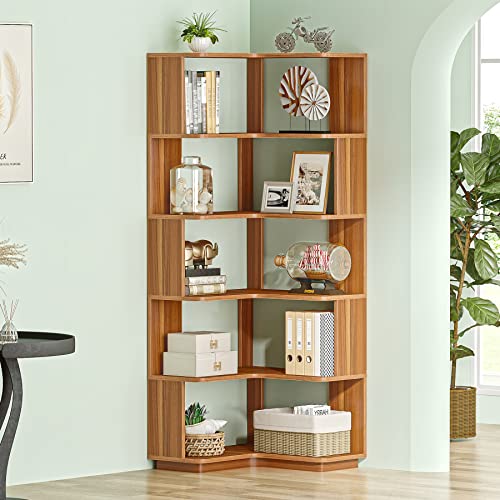
Start the small-space survey where the waste is: the corner. Two walls meet, furniture geometry fails, and the square footage sits idle behind a plant or a lamp. This Tribesigns was designed for exactly that failure point. Its L-shaped frame wraps the corner with six tiers at 64.9 inches tall, and because corner floor space was never going to hold a sofa, a desk or a door’s swing (measure the swing — see below), the storage it adds is effectively free: six tiers of books, baskets, plants and display pieces bought with geometry the room had already written off. In a small space, that is the highest-value transaction furniture can offer, and it is why this specialist leads a guide full of excellent generalists.
The details suit the role. Anti-drop panels keep books and objects from sliding off the open sides — essential in a corner that gets reached into at angles. The two-wall embrace makes the unit feel inherently settled, and anchoring (recommended as always) is quick and hidden. At 64.9 inches the case stays below the loom line, adding storage without the tower’s visual pressure, and the wood-grain finish warms the corner that small rooms often leave cold. Tier by tier, plan the loading by shape: long book rows on the straight runs of the L, and the deep corner point given to round, small or display items — a plant, a bowl, a stack of magazines — that forgive the awkward geometry.
Its limits are the honest taxes of the format: per-tier capacity is display-grade rather than heavy-library-grade, and the corner point wastes square-box space. The corner itself must also be genuinely free — door swings, baseboard heaters, vents and window frames disqualify more corners than optimism admits, so measure with the door open and the heater in mind. Where the corner passes inspection, this is the small-space pick that adds a bookcase while subtracting nothing, at a position well inside the budget — check price on Amazon. It also pairs beautifully with the wall-mounted Theo on the adjacent strip of wall, the two together shelving a whole small room from its leftovers.
- L-shaped six-tier design built solely for corners — storage from wasted geometry.
- Anti-drop panels; 64.9-inch height stays visually low-pressure.
- Two-wall placement feels settled; anchoring is quick and discreet.
Honest limitation: Display-grade capacity, and the deep corner point is awkward for square storage.
Choose it if your small room has a clear corner doing nothing. Skip it if the corner is interrupted by doors, vents or heaters.
Nathan James Theo 6-Shelf Wall-Mount Bookcase
Who it suits: Small rooms with one narrow wall strip — between a window and a corner, beside a door casing — and owners who can mount to the wall.
After the corner, the commonest small-space fragment is the narrow wall strip: 30-odd inches stranded between a window frame and a corner, too slim for standard furniture, too valuable to waste in a room short of everything. The Theo is dimensioned as if it were designed from a survey of those strips — because at 30 inches wide, wall-mounted, with six shelves, that is precisely its habitat. Mounting changes the small-space math fundamentally: the frame fixes to the wall’s structure, the floor beneath stays visually and literally clear for a basket, a pair of shoes or the vacuum’s path, and the shelves carry 55 pounds each — the joint-strongest rating in this guide — so the dense loading small spaces impose is fully within engineering.
The ladder profile is the other small-space virtue. Open sides and back let light and sightlines pass, so a tall unit does not wall off a small room the way a solid case can; the matte black frame and reclaimed-oak-finish laminate shelves read as a deliberate design rhythm on the wall. The modular design extends the logic: when a second strip frees up — or the household moves to a larger room — a second Theo lines up into a run, and the small-space solution becomes the big-room library without a single wasted purchase. Assembly is the gentlest here, quoted by the maker at roughly 40 minutes with a Phillips screwdriver, and anti-tip hardware is included even though a stud-mounted unit has answered the tipping question by design.
The conditions: you must be able to drill into studs or rated anchors, so this is an owner’s pick or a permissioned renter’s; the open back wants bookends; and fixed shelf spacing should be checked against your tallest books before ordering. For the small room with a narrow strip and a drill, nothing else under the ceiling converts so little wall into so much strong shelving — check price on Amazon for the finish options, including the brighter frame variant in the same line.
- 30-inch wall-mounted ladder — built for narrow wall strips.
- 55 lb per shelf across six shelves; floor beneath stays clear.
- Modular — a second unit turns strips into a library run.
Honest limitation: Requires stud mounting and drilling permission; open back needs bookends.
Choose it if your fragment is a narrow wall and you can mount. Skip it if you cannot drill or need a closed back.
Sauder Barrister Lane Cubby Bookcase
Who it suits: Small rooms whose only run is low — under a window, beneath a sloping ceiling, along the wall a sofa’s back defines — and households needing organization more than altitude.
Height is not the only direction small spaces hide. The low run — the wall beneath a window sill, the stretch under a stair slope or an eave, the long side of a room where a tall case would block the light — is a fragment standard towers cannot touch, and it is where the Barrister Lane lives. At 47.52 inches tall, 53.15 inches wide and 12.13 inches deep, it slides under sills and slopes that exclude every tower in this guide, and its ten cubbies (eight small, two large) convert that low run into the most organized storage per foot in the guide: books in three cubbies, baskets in two, games flat in a large one, a charging basket in another, display on the flat gallery top that runs the case’s whole length like a low shelf at exactly plant-and-photo height.
In a small room, that top surface is half the value. Small spaces starve for horizontal surfaces — the place to put a lamp, a drink, the book in progress — and the Sauder’s gallery top provides 53 inches of it at sofa-arm height, doubling as a console behind a floating sofa or a display ledge under the window. The low stance also keeps the room’s sightlines open, which in a small space is a form of square footage: you see over this case, so the room reads whole. Sauder’s label tags keep the cubby system honest, the Scribed Oak finish warms compact rooms, and the 5-year limited warranty backs the engineered wood. No mounting is required in a child-free home, making it the most placement-flexible pick here.
Its limits: fixed cubby openings reject the oversized, and as pure book storage it trails the towers — this is an organizer that holds books superbly rather than a maximum-capacity library. In a small space, that is usually the right trade, because small rooms fail from disorder sooner than from capacity. It sits comfortably inside the budget — check price on Amazon — and pairs with the corner unit to organize an entire small room from its two most wasted fragments. Households organizing a compact family room will find the same case argued from the family angle in Best Bookshelf For Families Under $700.
- 47.52-inch height fits under windows and slopes towers cannot use.
- Ten labeled cubbies plus a full-length gallery top surface.
- Low profile preserves sightlines — small rooms read larger.
Honest limitation: Fixed openings reject oversized items; book capacity trails tall towers.
Choose it if your fragment is a low run and your need is organization. Skip it if you need maximum book capacity from one piece.
Tribesigns 72-Inch Tall 6-Tier Library Bookcase
Who it suits: Small spaces with exactly one free column of wall and a collection too big for specialists — the slim tower as a complete library in a single footprint.
Sometimes the survey ends with a single column: one uninterrupted stretch of wall, roughly three feet wide, and a household library that will not shrink. The Tribesigns tower is that column’s complete answer — six tiers in a 35.43-inch width and an 11.81-inch depth, with a closed particleboard back that gives the case a finished, furniture-grade face. In a small room the closed back matters beyond looks: it means the case can stand at the end of a sofa run or beside a desk and present a clean surface to the room from its visible side, and it keeps books and small objects from migrating behind the shelves into the unreachable void that small rooms cannot afford to feed.
Density is its argument: no other freestanding pick here holds as many books per inch of width. The discipline it demands is loading — 22 pounds per shelf, 132 pounds total — so the small-space pattern applies with force: heaviest hardcovers and reference low, paperbacks and lighter rows above, display at the top. Anchoring is mandatory and simple with the included anti-tip hardware, and in a small room the case should be assembled in place, since a built 72-inch tower does not negotiate tight doorways gracefully; the box itself runs roughly 78 to 83 pounds, a two-person carry on stairs.
Its honest cost in a small space is visual: a solid tower is the most present object in this guide, and in a very small room it will be the wall. The white finish mitigates that — bright, reflective, quiet against light walls — and for the reader whose collection is the room’s purpose, presence is the point. For everyone else, the open and low picks above will feel lighter. Priced well inside the ceiling — check price on Amazon — it remains the capacity champion of small-space shelving.
- Six closed-back tiers in a 35.43″ x 11.81″ column — maximum density.
- Finished back suits end-of-sofa and beside-desk placement.
- Anti-tipping hardware included; white finish keeps it light visually.
Honest limitation: The most visually solid pick here; 22 lb per shelf requires low-heavy loading.
Choose it if one column must hold the whole library. Skip it if your small room needs visual lightness above capacity.
Bush Home Salinas 5 Shelf Bookcase
Who it suits: Awkward small spaces — alcoves, nooks, the wall beside a chimney breast — where a mid-height, adjustable case fits the irregularity better than any tower.
Small spaces are rarely tidy rectangles; they are alcoves beside fireplaces, nooks under stairs, the deep reveal beside a chimney breast. The Salinas fits that irregular world for two reasons. First, its 63-inch height — tall enough for five real shelves, short enough to slide into alcoves and under bulkheads that exclude 72-inch towers. Second, its adjustability: two fixed shelves for structure, three adjustable shelves rated at 50 pounds each, so the case composes itself around the awkward objects small homes accumulate — the tall vase that lives nowhere, the board-game stack, the printer and its paper. In a nook, a case that adapts is worth more than a case that merely fits.
Bush’s standards testing (ANSI/SOHO) and the unit’s 68-pound built weight give it a planted solidity that suits high-traffic small rooms, where furniture is brushed daily. The Cape Cod Gray farmhouse finish (other finishes exist in the line — check the current listing on Amazon) is forgiving of scuffs and reads warm in the low-light corners alcoves tend to be. At 32 inches wide and 12 inches deep it respects walking clearance, and anchoring a 63-inch case is a quick, discreet job.
Its limits in this lens: five shelves cap total capacity below the six-tier picks, and its traditional styling is a deliberate note in a modern small room. But for the irregular fragment — the alcove that has defeated every previous furniture attempt — the Salinas’s combination of mid height, real strength and movable shelves is the most adaptable tool in the guide, inside the budget with room to spare; check price on Amazon.
- 63-inch height fits alcoves and bulkheads towers cannot.
- Three adjustable shelves at 50 lb each adapt to awkward objects.
- ANSI/SOHO tested; 32″W x 12″D respects small-room clearances.
Honest limitation: Five shelves cap capacity; traditional styling is a visible choice.
Choose it if your fragment is an alcove or nook with mixed contents. Skip it if you need six tiers or a modern profile.
Tribesigns 6-Tier Arched Bookshelf
Who it suits: The design-led small space — a compact room that needs its one tall piece to be beautiful, because in a small room there is nowhere for an ugly object to hide.
Small rooms are unforgiving aesthetically: every object is in view, always, at close range. That is the arch’s small-space case. Its footprint is genuinely compact — 31.5 inches wide, 11.81 inches deep — but its 77.16-inch arched silhouette gives a tiny room the designed moment that makes the whole space read as intentional rather than improvised. Six open tiers hold a real, edited collection; the curve frames the top shelf as a display niche; and the black finish draws one confident vertical line in a room that probably has pale walls and low furniture. In a small living room it is the piece that answers the “where did you get that” question, while quietly storing the library.
Small-space discipline applies with emphasis. The arch is the tallest pick here, so anchoring with the included anti-tipping kit is mandatory — doubly so because small rooms put tall furniture in traffic’s way. Style it edited: small spaces cannot afford visual clutter, and the arch rewards the two-thirds rule more than any pick here, its tiers reading best with books grouped, objects few and large, and air left deliberately. Load display-honestly: heavy rows low, treasures in the curve.
Its compromises are real for this lens: display-grade load ratings, a top tier shaped for objects, and a silhouette that commits a small room’s whole mood — tape the outline and live with it before ordering, because a small room offers no corner to retreat a mistake into. For the compact home whose owner curates rather than accumulates, it is the most rewarding square footage in the guide, comfortably inside the ceiling — check price on Amazon. Those whose small space is a whole small home should also weigh the general field in Best Bookshelf Under $700 before deciding.
- 31.5-inch-wide arch — one designed moment in a compact footprint.
- Six open tiers suit an edited, curated collection.
- Anti-tipping kit included — mandatory at this height in traffic.
Honest limitation: Display-grade loads; the statement silhouette commits a small room’s mood.
Choose it if your small space is curated and design-led. Skip it if you accumulate more than you curate, or cannot anchor.
Comparison Table
| Product | Fragment it claims | Size (W x D x H) | Best use | Link |
|---|---|---|---|---|
| Tribesigns Corner L-Shaped | The corner | 64.9″ tall, L-shaped | Storage from wasted geometry | Check on Amazon |
| Nathan James Theo 6-Shelf | The narrow wall strip | 30″ wide, 6 shelves | Strong shelving, clear floor | Check on Amazon |
| Sauder Barrister Lane Cubby | The low run | 53.15″ x 12.13″ x 47.52″ | Under-window organization | Check on Amazon |
| Tribesigns 72-Inch 6-Tier Library | The single column | 35.43″ x 11.81″ x 72.04″ | Maximum books per inch | Check on Amazon |
| Bush Home Salinas 5 Shelf | The alcove or nook | 32″ x 12″ x 63″ | Mixed loads in irregular spaces | Check on Amazon |
| Tribesigns 6-Tier Arched | The feature nook | 31.5″ x 11.81″ x 77.16″ | A designed focal point | Check on Amazon |
How to Choose a Bookshelf for a Small Space
Survey before you shop. Walk the room and list its fragments honestly: the corner (measure it with doors open and heaters in mind), the narrow strips between frames and corners, the low runs under sills and slopes, the alcoves, the single column. Measure each fragment in inches — width, height to the first obstruction, depth to the walking line — and only then open a catalog. Small-space shelving bought by fragment almost never fails; bought by habit, it almost always does. The fragment also picks the format for you: corner to the L, strip to the ladder, low run to the cubby case, column to the tower, alcove to the adjustable mid-height, feature nook to the arch.
Then ration depth and respect traffic. Hold every candidate to roughly 12 inches deep — all six picks here comply — because depth is what small rooms feel. Check the walking line: a case that narrows a passage below comfortable passage will be bumped daily, so favor planted, anchored or wall-fixed options and keep shelf fronts flush. Load ratings deserve a harder look in small spaces, not a softer one: with nowhere else to put things, small-space shelves get loaded densely, so match your heaviest intended shelf to the published per-shelf figure.
Finally, think in combinations. The small-space win is often two fragments claimed at once — corner unit plus low cubby run, ladder on the strip plus the tower column — and the under-$700 ceiling, applied per piece, leaves room for exactly that pairing on most combinations here; check price on Amazon for the pair you are weighing. Two right-shaped shelves will out-store and out-calm one wrong-shaped tower every time. For the tighter end of the budget ladder, Best Bookshelf Under $400 applies the same fragment logic at a lower tier, and Best Bookcase Under $700 compares the same formats from a bookcase-first angle.
Measuring a Small Space So the First Order Fits
Use tape on the wall, not imagination. Mark the candidate’s width and height at the fragment, then check the three clearances small rooms hide: the door swing that crosses corners, the tilt-up diagonal a tall flat-pack needs to stand (assemble in place when in doubt), and the baseboard that pushes every case an inch off the wall it must anchor to. Photograph the taped outline and live with it a day; small rooms reveal their objections slowly — the drawer that must open, the vacuum’s turning circle, the chair that pulls out into the walking line.
Measure the contents too. Small-space shelves fail by centimeters: the storage box a half-inch too deep for a 12-inch shelf, the art book a half-inch too tall for a fixed opening. Take your three bulkiest items’ dimensions to the listing page of any fixed-format pick — cubbies especially — before ordering. Adjustable shelves forgive this homework; fixed formats demand it.
And measure the journey: the box’s package dimensions against your doorway, hallway turn and stairwell. In a small space, the room is rarely the tightest squeeze the furniture will face — the route to it is.
Loading Patterns That Make Small Shelves Work Harder
Small-space shelves fail by accumulation, not by catastrophe: one more book, one more basket, until every tier is packed and the room feels like a warehouse. The counter-discipline is a loading pattern decided in advance. Assign each tier a single category and a fill limit — books to two-thirds of the run, objects in odd-numbered groups, one tier kept deliberately light as the room’s visual rest. When a category outgrows its tier, the answer is rotation (a box of off-season books stored elsewhere) rather than compression, because a compressed shelf stops being used: nobody pulls a book that requires extracting three others, and unused storage in a small space is just decorated clutter.
Weight follows the same plan. The bottom tier takes the dense and the heavy — reference books, game stacks, the full baskets — which suits both the load ratings and the stability of every case here. Middle tiers take the daily rotation. Top tiers take the light, the tall and the seen: plants, display pieces, the books you want visible more than read. On the Salinas’s adjustable shelves, set the spacing to the pattern before loading, tallest opening at the bottom; on fixed formats, let the pattern choose which case you buy — cubbies for categories, open tiers for display rhythm, the tower for uniform book mass.
Beyond the Living Room: Small Spaces Elsewhere in the Home
The fragment logic of this guide travels. A small bedroom’s fragment is usually the wall beside the wardrobe — a narrow strip where the Theo’s 30-inch ladder holds the reading pile and frees the nightstand. A small home office’s fragment is the wall above and beside the desk, where vertical shelving keeps the work surface clear — the one surface a small office cannot surrender. A hallway wide enough to spare 12 inches gains a library run from the low Sauder, whose top becomes the landing strip for keys and mail that small homes otherwise scatter. Even a small bathroom with a dry corner can take the corner unit’s lower tiers for towels and baskets, provided the room’s humidity is vented — engineered wood and steam are acquaintances, not friends, so keep shelving out of the shower’s splash zone and prefer the bathroom’s driest wall.
The principle underneath every room is the same one this guide opened with: small spaces are not short of volume, they are short of usable rectangles, and each room hides its own fragments. Survey them room by room, claim them shape by shape, and the home that felt storage-starved turns out to have had the space all along — it was just shaped like corners, strips and low runs, waiting for furniture designed to fit them.
Common Buying Mistakes
Buying a standard tower for a fragment-shaped problem. A wide tower in a room whose free space is a corner and a low run fits neither. Survey fragments first, then buy the shapes that claim them.
Letting depth creep. A 15- or 16-inch-deep case in a small room eats the walking line and reads as a wardrobe. Hold the ~12-inch line every pick here observes.
Forgetting the door swing and the tilt-up. Corners crossed by door swings and towers that cannot stand up in the room are the two classic small-space returns. Measure both before ordering.
Overloading display-grade shelves because there is nowhere else. Small-space density is exactly why per-shelf ratings matter. Heavy rows belong on the 50-to-55-pound shelves of the Salinas and Theo.
Skipping the anchor in a high-traffic small room. Tight rooms mean constant passing contact. Anchor every tall case into a stud; the hardware is included with each tall pick here.
Filling every shelf completely. In a small room, a packed shelf is visual noise at close range. Edit the collection, style at two-thirds, and let the room breathe.
Pairing Bookshelves With the Rest of a Small Room
A bookshelf never stands alone in a small room; it stands in relation to the sofa’s arm, the desk’s edge and the door’s swing, and those relations decide whether the room feels composed or crowded. Keep one clear rule of proportion: the bookshelf’s height should relate to something — the window’s head, the door frame, the top of the wainscot — rather than stopping at an arbitrary altitude mid-wall. The low Sauder works because its top continues the line of a sofa back or a sill; the tower works because it commits to the ceiling’s neighborhood; mid-height cases that end at eye level with nothing above them are the ones that make small rooms feel unresolved, which is why the Salinas earns its place in alcoves, where the architecture itself supplies the frame its height answers to.
Leave the shelf breathing room on both sides where the fragment allows it — even six inches of wall between a case and a corner reads as intention, while a case jammed to the millimeter reads as storage overflow. And keep the floor in front of the shelves sacred: the 18 inches a person needs to stand, browse and pull a book is part of the bookshelf’s true footprint, and small rooms that lend that space to a coffee table’s corner or a storage ottoman end up with shelves nobody uses. A bookshelf that cannot be stood in front of is a bookcase-shaped cupboard, and its contents will migrate to the floor — the exact failure this guide exists to prevent.
Small Spaces Grow: Planning for the Next Shelf Before You Need It
Collections grow and small spaces do not, so the last small-space skill is planning the second shelf before the first one fills. The time to decide is at the first purchase: choose formats that have a known partner. The corner unit now implies the low cubby run later, on the wall the corner feeds into. The ladder now implies its twin later, bought in the same finish while the line is current. The tower now implies the corner satellite later, for the overflow and display the tower’s density cannot style. Householders who plan the pair at the start can also buy in the right order — the fragment in most pain first — and can watch for the second piece with patience rather than desperation.
And when both fragments are claimed and the collection still grows, the honest small-space answer is editing, not a third case: a library that fits its room, rotated and curated, serves a small home better than a larger library in storage boxes. The bookshelf’s job in a small space was never to hold everything. It is to hold the right things, beautifully reachable, in geometry the room was wasting — and by that measure, every pick in this guide succeeds.
Final Recommendation
For most small spaces, start with the corner: the Tribesigns L-shaped bookcase converts the room’s most wasted geometry into six tiers of storage while consuming no usable wall, well inside the under-$700 budget — check price on Amazon. Claim the narrow strip with the Theo, the low run with the Sauder, the single column with the Tribesigns tower, the alcove with the Salinas, and give the design-led small room its arch. Survey the fragments, hold the 12-inch depth line, anchor what is tall, and a small space will hold a library that feels chosen rather than crammed. For small spaces working to a tighter tier, see Best Bookshelf Under $300.
Frequently Asked Questions
What type of bookshelf is best for a small space?
The one shaped for your room’s wasted fragment: an L-shaped corner unit for corners, a wall-mounted ladder for narrow strips, a low cubby case for under-window runs, a slim tower for a single column. Shape-matching beats simply buying a smaller standard case.
How deep should a bookshelf be in a small room?
About 12 inches. Standard books need 11 to 12 inches, and every pick in this guide sits between 11.81 and 12.13 inches deep — enough for books without stealing walking clearance.
Can a small room hold a real book collection?
Yes, by going vertical and combining fragments: a six-tier slim tower holds several hundred volumes in about three feet of width, and pairing it with a corner unit covers most home libraries without touching the room’s main walls. Add the low cubby run under the window and the same small room holds a working library, a games store and a display gallery at once — each fragment doing the job its shape suits, none of them competing for the wall the sofa needed. That is the whole small-space method in one room: fragments first, furniture second, and a collection that finally fits the home it lives in.
Are corner bookshelves actually useful or a gimmick?
Useful, when they are built for books — the Tribesigns corner unit’s anti-drop panels and six real tiers make it a genuine bookcase. Plan square boxes elsewhere; the deep corner point suits round and display items. The test that separates the useful corner case from the gimmick is whether you would assign it real, daily categories — the current reading pile, the games in weekly rotation, the baskets that otherwise live on the floor. A corner unit that passes that test stops being a novelty within a month and becomes, quietly, the hardest-working geometry in the small room.
How do I stop a small room’s bookshelf looking cluttered?
Edit and style at roughly two-thirds fill, group books with breathing room, keep the heaviest and densest rows low, and choose closed or cubby formats if visual calm matters more than display. One more habit separates calm small-room shelves from chaotic ones: a single category per tier, visibly enforced. When games creep onto the book tier and baskets colonize the display tier, the eye reads disorder even at the same fill level. Restore the categories during a five-minute weekly reset and the small room keeps the composed feeling that made the shelf worth its footprint in the first place.
What is the smallest room that can still fit a full bookshelf?
Smaller than most people expect. A wall-mounted ladder needs only a 30-inch strip of wall and no floor at all; a corner unit needs the corner itself. Even a room that fits little more than a bed and a chair usually hides one of the fragments this guide surveys — a strip, a corner, a low run under the window. The question is rarely whether a small room can hold a bookshelf, but which shape its leftover geometry is waiting for.
Should a small-space bookshelf be anchored?
Yes — small rooms mean close, constant traffic, so tall cases should always be anchored into a stud with their included hardware. Wall-mounted designs like the Theo answer the question by fixing to the wall itself.