Where to buy
Check the latest price, availability and delivery on Amazon. Orders are placed on Amazon. We may earn a commission from qualifying purchases.
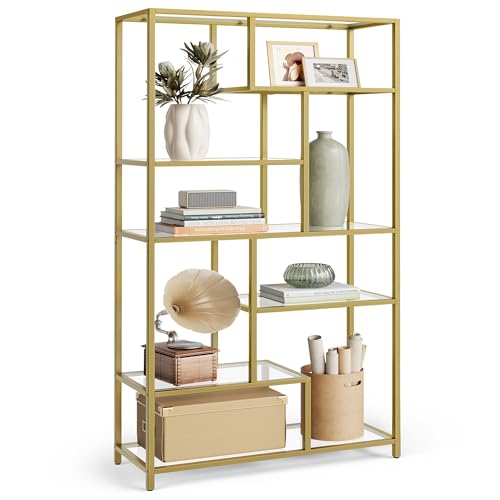
- Best overall for small spaces: VASAGLE 6-Tier Glass Bookshelf, Metallic Gold — Check on Amazon
- Prepac Nordik 6-Tier Corner Bookcase, Natural Oak — Check on Amazon
- International Concepts Shaker Bookcase, Solid Parawood — Check on Amazon
- Sauder Barrister Lane Bookcase, Scribed Oak — Check on Amazon
- Sauder Bookcase with Doors, Chalked Chestnut — Check on Amazon
See 1 more Amazon option
- Concepts In Wood Traditional Triple Wide Bookcase, Dry Oak — Check on Amazon
Read the full guide ↓
Disclosure: As an Amazon Associate, dailyhomedecorating.com earns from qualifying purchases. Links to Amazon on this page are affiliate links; they cost you nothing extra. Listing details such as price and availability change often, so check the current Amazon listing before you buy.
The best bookcase for small spaces under $1000 is not a shrunken version of a normal bookcase — it is a different kind of object, chosen by different rules. A small space, whether it is a narrow hallway, a box-room office, the wall beside a bed or the landing everyone squeezes past, punishes the usual buying logic twice: a case can fit the tape measure and still fail the room, by blocking its light, crowding its traffic, or looming at a scale the space cannot carry. So this guide judges its picks on the qualities small spaces actually reward: narrow and corner footprints, shallow-but-sufficient depth, low profiles where sightlines matter, materials that return light instead of eating it, and doors where a small room cannot afford to display its clutter. The budget matters here in a specific way — at this tier you can buy the engineered formats (corner towers, glass, cubbies, solid wood at low height) that genuinely solve small geometry, instead of the cheap slab tower that merely fits in it.
The six picks claim six different small-space situations. The VASAGLE glass tower leads for the classic problem — a tight room that needs six tiers without losing its light or its sense of size. The Prepac Nordik owns the corner, the most reliably wasted geometry in any home. The International Concepts Shaker is the low, solid-wood answer for under-window walls, alcoves and rooms with low ceilings. The Sauder Barrister Lane turns a long low wall — a hallway, the wall under a screen — into ten labeled cubbies with a display top. The doored Sauder is the small room’s calm machine: presentable shelves above, the entire mess behind doors below. And the Concepts In Wood triple wide appears as the deliberate exception, for the small-but-long room whose one end wall can take a full library while its floor stays clear — with the conditions stated honestly. If your small space is a whole small apartment, our Best Bookcase For Small Apartments Under $1000 guide covers the same problem at home scale, and the Best Bookcase For Small Spaces Under $700 guide runs the same logic at the tier below.
One principle organizes everything below: in a small space, you are not buying shelves, you are buying the room’s remaining light, air and floor — and the case is good exactly insofar as it stores without spending them. That is why glass outranks oak here, why corners outrank walls, and why a 48-inch case can beat a 72-inch one in a room where the tall case would be the only thing anyone notices. Read the placement section before choosing; in small spaces, where a case stands matters as much as which case it is, and the wrong wall has ruined more good purchases than any specification.
A final note on the budget, because spending toward four figures on a small-space case invites an obvious question. The answer is that small spaces are where format costs money: corner engineering, tempered glass, framed doors and solid timber are all more expensive than panels, and all of them pay their way precisely where space is scarce — in light returned, clutter hidden, dead geometry revived. A cheap tower fits a small space the way a cheap sofa fits it: technically, and at the room’s expense, every day.
In this guide
Quick Picks
| Pick | Bookcase | Best for | Size (W × D × H) | Amazon |
|---|---|---|---|---|
| Best overall for small spaces | VASAGLE 6-Tier Glass, Metallic Gold | Tight rooms that need light | 31.5 × 11.8 × 70.9 in | Check on Amazon |
| Best for corners | Prepac Nordik Corner, Natural Oak | Dead corner geometry | 23.3 × 23.3 × 71.5 in | Check on Amazon |
| Best low profile | International Concepts Shaker, Unfinished | Under windows, low ceilings | 48 in tall, Shaker profile | Check on Amazon |
| Best for hallways | Sauder Barrister Lane, Scribed Oak | Long low walls, cubbies | 53.2 × 12.1 × 47.5 in | Check on Amazon |
| Best for hiding clutter | Sauder Bookcase with Doors, Chalked Chestnut | Small rooms, visible mess | 35.3 × 13.2 × 69.8 in | Check on Amazon |
| Best end-wall library | Concepts In Wood Triple Wide, Dry Oak | Long narrow rooms | 72 × 10.6 × 72 in | Check on Amazon |
How These Picks Were Chosen
We filtered the under-$1000 field by small-space physics. First, footprint honesty: widths, depths and corner dimensions verified against manufacturer model numbers and retailer data — in a small space, an invented inch is a failed purchase. Second, depth in the useful band: roughly 11 to 13 inches, deep enough for real books and the small room’s storage bins, never the 15-plus inches that tax a tight floor. Third, light and sightline behavior: glass, low profiles and corner placement scored up; tall dark slabs scored down, whatever their shelf count. Fourth, clutter control — doors and cubbies — because a small room displays everything it owns unless furniture closes on it. Fifth, placement flexibility: every pick had to make sense in at least two different small-space situations (a hallway and a bedroom, a corner and a nook), because small-space furniture gets re-deployed as rooms change jobs.
Prices in this tier move with finishes and sales, so check price on Amazon rather than trusting any printed figure; the under-$1000 framing is the ceiling these picks were selected against. The general guide to the Best Bookcase Under $1000 covers the same budget without the small-space filter, for readers whose rooms impose fewer constraints.
What did not make the cut: two narrow towers whose 8-inch shelves stranded every hardcover we measured against them — narrow is not the same as small-space-appropriate — a revolving case whose footprint was small but whose swing radius was not, and several ladder shelves whose leaning geometry wastes the floor strip behind them while borrowing wall it cannot anchor to. Small spaces forgive none of those tricks. The six survivors store honestly in the geometry they claim.
The 6 Best Bookcases for Small Spaces Under $1000
VASAGLE 6-Tier Bookshelf, Tempered Glass, Metallic Gold (ULGT502A01)
Who it suits: Any small room that cannot afford to lose light or visual size — the box-room office, the compact bedroom, the living room corner that a solid tower would turn into a closet.
The VASAGLE is 31.5 inches wide, 11.8 inches deep and 70.9 inches tall, with six tempered glass shelves on a metallic gold frame — and in a small space, its transparency is a storage specification, not a style note. Light crosses it, sightlines cross it, and the wall behind it stays part of the room, so six tiers of storage cost the room almost none of its perceived size. Compare the solid equivalent: the same footprint in dark wood ends the room at the case’s face and shadows everything near it. The gold frame gives the transparency a warm structure, the glass wipes clean in seconds — a real consideration where every surface is within reach of daily life — and the open tiers take the mixed loads small rooms actually store: books in stacks, a plant, the beautiful objects that make a small room feel chosen rather than cramped.
Pros:
- Six tiers that cost the room almost no light or visual size
- Modest 31.5-inch width fits tight walls
- Glass wipes clean instantly; no dusting texture
- Gold frame warms compact palettes
Honest limitation: Glass takes display loads, not a dense hardcover wall — if your small space must hold a working library’s full weight, the doored Sauder below is the honest pick. Fingerprints need a weekly wipe, and like every tall case it must be anchored.
Choose it if light and air are your small space’s scarcest resources. Skip it if your storage is heavy and book-dense.
Living with it: Keep it edited — in a small room, a glass case filled to bursting reads as clutter at eye level, while the same case at two-thirds capacity reads as design. Put the plant where the window light reaches through the shelves; the layered shadows are the prettiest accident in small-space decorating, and this case produces them daily for free.
Prepac Nordik 6-Tier Corner Bookcase, Natural Oak (SBR-2210-1)
Who it suits: The universal small-space situation: no wall free, one corner idle. Bedrooms, offices, living rooms and landings all have this corner; the Nordik is how it starts earning.
At 23.25 inches along each wall and 71.5 inches tall, the Nordik converts the corner into six tiers of storage with legs designed to sit flush into it — no dust gap, no awkward float. Corner capacity is the purest found space in a home: the footprint’s alternative use was nothing, so the cost-benefit math beats every wall case before finishes are even discussed. The natural oak laminate and mid-century lines keep the tower looking intentional rather than improvised, and the height stack suits small-space logic perfectly — daily items at hand height, the archive rising above, a plant crowning it into the room’s light. Because it touches two walls, anchoring is easy and doubly secure, which matters for a 71-inch tower in a tight room where it will be brushed past daily.
Pros:
- Six tiers on a footprint with no competing use
- Flush-fit corner design — no wasted gap
- Full 71.5-inch vertical in a 23-inch corner
- Two-wall anchoring is simple and solid
Honest limitation: Corner shelves are compact — wide bins and oversized items do not fit, and the stated per-shelf weight limit is modest. Books, media and objects are its load; heavy storage belongs elsewhere.
Choose it if a corner is what you have. Skip it if your items run wide — the Barrister Lane’s cubbies will fit them.
Living with it: Corners darken first, so load the top tiers bright and keep a lamp or plant nearby; in a small bedroom the Nordik plus an angled chair makes a reading nook out of square footage that was previously just where the room ended. It is the rare storage purchase visitors compliment, because it looks like the room was designed around it.
International Concepts Shaker Bookcase, Solid Parawood, Unfinished
Who it suits: Small spaces where height is the constraint — under-window walls, alcoves, attic rooms with sloped ceilings, and any tight spot where a tall case would crowd the ceiling or the eye.
The Shaker stands 48 inches tall in solid parawood, in the clean Shaker profile, sold unfinished. In small spaces the low case has three compounding virtues. It fits the geometry other cases cannot: below sills, beneath slopes, along the wall a doorway chops into short runs. It preserves the room’s sightlines completely — nothing crosses the eye’s horizontal, so the space reads its full size. And solid wood at low height is the most forgiving purchase in this guide: it can be painted to the wall color so storage all but disappears, dented and repaired, moved and repainted as the small room changes jobs from nursery to office to guest room. The unfinished surface is the enabler — your exact color, in a durable finish you choose, on timber that will outlast the room’s next three purposes.
Pros:
- 48-inch profile fits under windows and sloped ceilings
- Solid parawood — repairable, repaintable, movable
- Paint it wall-color and storage visually disappears
- No anchoring dilemma; low tip profile
Honest limitation: It arrives unfinished — budget the painting weekend. Low means fewer shelves: this is the curated case for a small room’s working collection, not a full library’s home.
Choose it if your constraint is height or your room changes jobs often. Skip it if you need tall capacity — the Nordik uses the vertical you are sparing.
Living with it: The top surface at 48 inches becomes part of the room’s furniture plane — a lamp, a plant, the landing strip for keys in a hallway installation — which means the case earns as a console while it stores as a bookcase. Small spaces love furniture with two jobs, and few pieces do both as gracefully as a low solid-wood case.
Sauder Barrister Lane Bookcase, Scribed Oak (414724)
Who it suits: Small spaces with a long low wall and many categories to store — hallways, the wall beneath a mounted screen, the landing that collects everything the household has no place for.
The Barrister Lane runs 53.15 inches wide, 12.13 inches deep and 47.52 inches tall, divided into ten cubbyholes with ID label tags under a gallery-edged top. Hallways and landings are the purest small spaces — pure traffic, no furniture tradition — and a low cubby wall is the format that civilizes them: shoes and bags in labeled cubbies by the door, books and games along the living-room wall, the top working as the console surface every entry needs. The depth stays at a traffic-safe 12 inches, the height never crowds a ceiling or a sightline, and the scribed oak finish warms the transitional spaces that wood tones flatter most. In a small living room, the same case under the screen becomes the media wall that makes the room feel furnished rather than equipped.
Pros:
- Ten labeled cubbies tame hallway and entry chaos
- Low profile keeps tight rooms and passages open
- Gallery top doubles as a console surface
- Traffic-safe 12-inch depth
Honest limitation: Fixed cubbies exclude tall volumes and oversized pieces, and the 53-inch width needs a genuinely long low wall — measure the run, radiators and door swings included, before ordering.
Choose it if your small space is a passage or a long low wall. Skip it if your space is a corner or a nook — the Nordik and the Shaker own those.
Living with it: The labels are the system: in a hallway case, every cubby with a name stays a cubby with a purpose, and the daily reset takes two minutes. Keep one cubby empty as the household’s inbox — small spaces stay sane when incoming things have exactly one legal place to land.
Sauder Bookcase with Doors, Chalked Chestnut (426310)
Who it suits: Small rooms that must look calm — the compact living room, the small home office, the bedroom where work equipment sleeps — and anyone whose clutter is visual before it is physical.
At 35.28 inches wide, 13.23 inches deep and 69.76 inches tall, this Sauder pairs three adjustable open shelves with a cabinet behind framed doors. In a small room, doors are not a style feature; they are the difference between a space that reads as a room and one that reads as storage. The small room cannot banish its infrastructure to another room — the router, the printer paper, the games, the chargers live here — so the case that closes on them is performing the room’s most important service. The 13.2-inch depth, the deepest here, is sized for the bins and boxes small-space storage actually uses, and the Chalked Chestnut face keeps the tall case composed rather than looming. Load the open shelves with the room’s presentable third and let the doors handle the rest.
Pros:
- Doors make a small room read as a room, not storage
- Deep 13.2-inch shelves fit bins and equipment
- Compact 35-inch width for a full-height case
- Adjustable shelves for the display third
Honest limitation: A tall solid case spends visual weight — in the smallest, darkest rooms the glass VASAGLE is the kinder tower. It must be anchored, and its assembly is a two-person job at its weight.
Choose it if visible clutter is your small space’s core problem. Skip it if the room is tiny and dim — glass or a low case will treat it better.
Living with it: Enforce the one rule that makes it work: if it has a cable, a blinking light or a paper stack, it lives behind the doors. Small rooms reset visually in the seconds those doors take to close, and the habit — everything infrastructural behind them, everything displayed deliberate — is worth more than any single specification in this guide.
Concepts In Wood Traditional Triple Wide Bookcase, Dry Oak (MI7272-CCC)
Who it suits: The long, narrow room — the railroad living room, the galley office, the small space whose one end wall is free while every side wall is spoken for — where a single full library wall clears the rest of the room entirely.
Seventy-two inches wide and tall, 10.63 inches deep, fifteen shelves in three bays of genuine wood veneer with solid molding. The small-space logic is consolidation, and it is real: a narrow room with storage smeared along both long walls feels like a corridor with obstacles, while the same room with everything committed to one end wall walks clear and lives wide. The shallow-for-its-size depth helps — 10.63 inches hugs the end wall without projecting into the room’s working length — and the three bays let a small room’s several lives (books, work, display) share one footprint instead of colonizing three. The conditions are stated without apology: the end wall must truly measure six feet, the delivery route must pass a very large case, and anchoring is mandatory. Where those hold, no other pick transforms a narrow room as completely.
Pros:
- Consolidates a whole room’s storage onto one end wall
- Shallow 10.6-inch depth for its capacity
- Fifteen shelves in three organized bays
- Clear long walls make a narrow room live wide
Honest limitation: It is the biggest commitment in this guide — heavy, immovable once loaded, and wrong for any space whose end wall is under six feet or whose route cannot pass it. Measure twice; this case forgives nothing.
Choose it if your small space is long and its end wall is free. Skip it if the room is small in every dimension — the Nordik and VASAGLE will serve it better.
Living with it: Defend the emptiness the wall creates. The moment boxes and side tables creep back along the long walls, the bargain is spent; kept clear, the room gains the one thing small spaces are shortest on — an unobstructed path and an unobstructed view, end to end, with the library glowing at the far end like a destination.
Placement Rules for Small Spaces
Where a case stands decides whether a small space works, and four rules cover most rooms. Keep the window wall low. Tall cases belong on walls perpendicular to the window, where they do not tax the light; under the window itself, only low cases (the Shaker, the Barrister Lane) may apply. Respect the traffic line. In hallways and landings, depth is a safety spec: 12 inches or so preserves the passage, and nothing with doors should swing into the walking path unconsidered. Give the corner its tower. Corners are the only footprint with no rival claimant; a corner left empty in a small home is storage declined. Anchor tall cases where they stand, not where you wish they stood — studs are where they are, and a case’s final position should be chosen with the stud finder in hand, because a strap into drywall alone is a decoration, not an anchor.
Finally, judge the placement at the room’s worst hour — evening, lamps on, the day’s objects out. Small spaces are honest at that hour: the right case disappears into usefulness, and the wrong one is the only thing in the room you can see. Live with the taped footprint through one such evening before the box arrives, and you will place the case once, correctly.
Comparison Table
| Bookcase | Small-space situation | Light effect | Standout trait | Amazon |
|---|---|---|---|---|
| VASAGLE 6-Tier Glass | Tight room, any wall | Transmits light | Six tiers, room keeps size | Check on Amazon |
| Prepac Nordik Corner | Dead corner | Neutral | Found-space storage | Check on Amazon |
| International Concepts Shaker | Under window, low ceiling | Preserves sightlines | Solid wood, paintable | Check on Amazon |
| Sauder Barrister Lane | Hallway, long low wall | Low, open | 10 cubbies + console top | Check on Amazon |
| Sauder with Doors | Small room, visible clutter | Solid, composed | Doors hide infrastructure | Check on Amazon |
| Concepts In Wood Triple Wide | Long narrow room, end wall | Warm, architectural | Consolidated library wall | Check on Amazon |
How to Choose the Best Bookcase for a Small Space
Diagnose the space before the storage. Is your constraint light, floor, height, traffic or visual clutter? Each constraint has a pick in this guide built for it — glass for light, corners for floor, low cases for height and sightlines, shallow depth for traffic, doors for clutter. A case bought against the wrong diagnosis fits and still fails.
Measure the space’s real dimensions. Footprint from the baseboard face, height at the ceiling’s lowest point on the tilt-up path, depth against your largest regular object — and the delivery route measured like a second room. In small spaces the tolerances are the purchase; the tape measure is the whole game.
Prefer two-job furniture. A low case whose top works as a console, a cubby wall that organizes an entry, a corner tower that finishes a room’s composition — small spaces repay furniture that earns twice. Single-purpose storage is a luxury of large floor plans.
Decide the anchor honestly. Tall cases need a stud strap. If the wall or the lease says no, buy the low formats and spend the height budget elsewhere; an unanchored tower in a tight room, brushed past daily, is the worst object in this entire category.
Leave the space its air. Whatever you buy, load it to two-thirds and style the rest. A small room’s luxury is not capacity but calm, and the case that preserves calm while storing the essentials is the one that was actually best for the space.
Small Spaces by Room: Hallway, Bedroom, Office, Landing
The hallway is a traffic machine that happens to have walls. Its case must be shallow (the Barrister Lane’s 12 inches is the ceiling, not the target), low enough to keep the passage feeling open, and useful at entry speed: cubbies and a console top, because hallway storage is used in motion, coat on, keys in hand. Nothing with swinging doors should open into the walking line unconsidered, and nothing tall belongs where a carried laundry basket turns. The small bedroom inverts the priorities: the case is seen from the bed, at rest, for years — so composure and quiet finishes matter more than capacity, glass and low wood beat busy cubbies, and the top shelf’s contents are the room’s last picture every night. Load it like a bedside composition, not a warehouse.
The box-room office is where small-space cases go to be judged as equipment: shelf spacing for binders and reference, depth for a printer’s paper tray, doors for the cable-and-paper sprawl that makes a small office feel chaotic at exactly desk distance. The doored Sauder was practically specified by this room. The landing and the nook — the top of the stairs, the space under a slope, the alcove nobody furnishes — reward the opportunists: the corner tower where two walls meet, the low Shaker under the slope, each converting a space with no furniture tradition into the home’s most satisfying storage, precisely because everything there is found capacity.
Depth, Spacing and the Small-Space Numbers That Matter
Three numbers decide a small-space case, and none of them is the shelf count. Depth first: below 10 inches, hardcovers and binders overhang; 11 to 12 inches is the small-space sweet spot, storing real books while returning floor; 13 inches is justified only when bins and equipment demand it, and only on a wall that is not a traffic line. Shelf spacing second: fixed gaps around 11 to 13 inches strand tall books and waste short ones, so in a small space — where every wasted inch is a larger fraction of the whole — adjustable shelving earns a premium it does not earn in big rooms. Height-to-ceiling ratio third: a case that stops a clear foot or more below the ceiling looks placed; one that stops a few inches short looks like an error, and in a small room errors are at eye level forever. Measure all three against your space and your tallest, deepest, most-used objects, and the case that survives the numbers will survive the room.
Common Buying Mistakes
Buying the tallest case the ceiling allows. Height is not free in a small room — it spends light, sightlines and calm. Buy the height the storage needs, not the height the wall permits.
Judging by footprint alone. A narrow case with 8-inch shelves fits the floor and fails the books. Depth and shelf spacing are small-space specs too; check them against your largest regular items.
Putting a dark tower in the room’s only light path. The shadow is permanent and the shelves are not worth it. Glass, corners and low profiles exist precisely for this room.
Skipping the route measurement. Small spaces often come with small doors, tight landings and narrow stairs. The case that fits the room but not the route is a return, and returns in this size class are nobody’s idea of fun.
Filling every shelf completely. In a small room, a packed case reads as a wall of stuff at conversational distance. Air on the shelves is what separates a furnished small space from a stored one.
Final Recommendation
For most small spaces, buy the VASAGLE 6-Tier Glass Bookshelf: six real tiers that cost the room almost nothing in light or size — the rarest bargain in small-space furniture. If your space’s free geometry is a corner, the Prepac Nordik converts it into a tower of found storage. The Shaker owns the low walls, the Barrister Lane civilizes hallways and long walls, the doored Sauder restores calm to cluttered small rooms, and the triple wide — end wall permitting — consolidates a narrow room’s whole storage life onto one honest wall. Diagnose your constraint, measure like it matters, anchor what is tall — and the small space stops being the problem the furniture has to apologize for.
Renters, Short Stays and Small Spaces
Small spaces are disproportionately rented spaces, and renting adds two constraints this guide has threaded through its picks: the anchor question and the exit question. On anchoring, the honest hierarchy is this — a strap into a stud with two small holes to patch at move-out is accepted by most landlords and is always the right answer for a tall case; where that is genuinely impossible, the low formats in this guide (the 47.5-inch Barrister Lane, the 48-inch Shaker) are the engineered alternative, not a compromise, because their geometry carries the lowest tip risk in the category. What is never the answer is a tall case left freestanding on the theory that it feels stable; tight rooms involve more incidental contact, not less.
On exit: a small-space case should be bought with its second home already imagined. Corner and low formats re-deploy into nearly any next floor plan; glass works in halls and bedrooms as readily as living rooms; solid wood survives the van, the stairs and the repaint. The case that only fits this one nook, in this one finish, is a future listing and a future loss. Renters who internalize that rule end up, after three moves, owning a small set of adaptable, good furniture — which is exactly the fleet a small-space life rewards — instead of a trail of space-specific purchases abandoned at each address. Buy the adaptable case once, at this tier, and let the addresses change around it.
Care in Close Quarters
Small-space furniture lives within arm’s reach of everything — cooking, shoes, pets, weather at the door — so it accumulates wear faster than the same case in a large room, and care is correspondingly simpler and more frequent. Glass wants its weekly microfiber minute. Laminate and chalked finishes want a damp cloth and felt pads under the objects that live on them, because in a tight room objects are set down harder and slid more. Solid wood wants its spills wiped the day they happen and rewards the habit by being the only surface here that can be made new again with sandpaper and an hour. Five minutes a month, matched to the material, is the whole program — and in a small space you will see the difference daily, because there is nowhere in the room from which the case is not visible.
When a Small Space Grows: Scaling Without Starting Over
Small spaces change — a child arrives, a job goes remote, a partner moves in — and the case bought well at this tier adapts instead of expiring. The mechanisms are boring and decisive: adjustable shelves re-gap for the new category of things; a format with a second room in it (the corner tower that moves from living room to bedroom, the low case that becomes an entry console) survives the rearrangement that kills single-purpose furniture; a finish that can be repainted lets the case follow the room’s new job in an afternoon. When the space genuinely outgrows the case, the honest scaling move is a matched second act — the same format’s sibling on the opposite wall, the second low case beside the first — rather than a wholesale replacement, because small rooms punish visual variety: two of a kind read as architecture, two different cases read as accumulation.
And when the household eventually leaves the small space behind, these are the cases that go with it. Every pick in this guide was chosen partly for that portability of purpose — the glass tower that becomes a dining-room display, the solid-wood low case that becomes a hallway console, the cubby wall that becomes craft storage in a bigger home’s spare room. A small space is a chapter, not a life sentence, and furniture bought at this level should be written for the whole book.
Frequently Asked Questions
What type of bookcase is best for a small space?
The type that matches the constraint: glass towers where light is scarce, corner cases where only a corner is free, low wide cases under windows and along hallways, and doored cases where clutter must disappear. This guide’s six picks map onto those situations; a generic tall slab tower is the one format that serves none of them well.
How deep should a bookcase be in a small room or hallway?
For books, 10 to 12 inches is the working band. Hallways and traffic paths should stay near 12 inches so the passage stays comfortable; if the case must hold bins or equipment, 13 inches — the doored Sauder’s depth — is worth it on a non-traffic wall. Deeper than that rarely earns its floor in a small space.
Can a tall bookcase work in a small room?
Yes, if it respects the light — glass, a corner placement, or a wall perpendicular to the window — and if it is anchored. Tall is a problem when it is also dark, deep and placed in the light’s path; a tall case that avoids those three errors stores a great deal while costing the room very little.
Is a corner bookcase really better than a regular one for small spaces?
When the corner is the free geometry, yes — its footprint had no competing use, so its capacity is effectively free. Its shelves are smaller and its loads lighter than a wall case’s, so it suits books and objects rather than bins; matched to the right load, it is the best storage bargain in a small home.
How do I stop a small room from looking cluttered with a bookcase?
Load to two-thirds, group objects with air between them, keep the palette of visible spines and bins limited, and give the room’s infrastructure a door to live behind. Clutter in a small room is mostly unassigned objects; a case with cubbies, labels or doors assigns them, and the room calms down.
Should a small-space bookcase match the wall color?
It is one of the strongest tricks available: a low case painted to the wall — easiest with the unfinished solid-wood Shaker — reads as architecture and nearly disappears, while glass achieves the same disappearance by transparency. Contrast is for rooms with size to spare; in a small space, disappearance is usually the better design.
Are two smaller bookcases ever better than one in a small space?
When the space offers two different kinds of free geometry — a corner and a low wall, for instance — a matched pair of formats can out-store and out-style one case forced into a single spot. Keep the pair in the same finish family so the room reads them as one system; two unrelated cases in two styles is how small rooms start to feel like storage units with furniture in them.
What can I put in the space under the stairs or a sloped ceiling?
Low cases are built for it: a 48-inch solid-wood case like the Shaker fits beneath most slopes with room to spare, and its top follows the ceiling line as a display ledge. Measure the height at the case’s back edge, not the front — slopes are deceptive — and leave a hand’s width for reaching the top shelf comfortably.
How many books fit in a small-space bookcase?
Estimate in linear feet rather than shelf counts: a 24-to-32-inch-wide case with five or six tiers typically holds somewhere in the range of 120 to 220 standard books once sensible gaps and a few objects are included. Measure your current collection spine-to-spine and compare it with the total shelf width of the case you are considering — that arithmetic never lies, even in a small room.
Related guides: small apartments — Best Bookcase For Small Apartments Under $1000; all-round picks at this tier — Best Bookcase Under $1000; small-space family rooms — Best Bookcase For Families Under $1000; modern small spaces — Best Bookcase For Modern Homes Under $1000; smaller small-space budget — Best Bookcase For Small Spaces Under $300.


