Where to buy
Check the latest price, availability and delivery on Amazon. Orders are placed on Amazon. We may earn a commission from qualifying purchases.
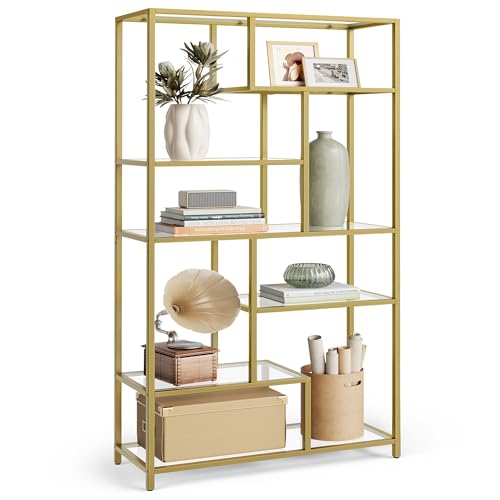
- Best overall for modern homes: VASAGLE 6-Tier Glass Bookshelf, Metallic Gold — Check on Amazon
- Prepac Nordik 6-Tier Corner Bookcase, Natural Oak — Check on Amazon
- Sauder Barrister Lane Bookcase, Scribed Oak — Check on Amazon
- Sauder Bookcase with Doors, Chalked Chestnut — Check on Amazon
- International Concepts Shaker Bookcase, Solid Parawood — Check on Amazon
See 1 more Amazon option
- Concepts In Wood Traditional Triple Wide Bookcase, Dry Oak — Check on Amazon
Read the full guide ↓
Disclosure: As an Amazon Associate, dailyhomedecorating.com earns from qualifying purchases. Links to Amazon on this page are affiliate links; they cost you nothing extra. Listing details such as price and availability change often, so check the current Amazon listing before you buy.
The best bookcase for modern homes under $1000 has a harder job than storage. A modern room is a composition — clean lines, controlled color, light doing half the decorating — and a bookcase is the largest single object most living rooms contain. The wrong one does not just store books badly; it breaks the room. The right one does something no other furniture can: it gives a modern interior its vertical rhythm, a place where books, objects and negative space are arranged like the room itself was arranged. That is why this guide judges its picks as design objects first and storage second — while insisting they still pass the storage tests: real depth, honest construction, shelf spacing that fits actual books, and formats that survive a decade of redecorating rather than one season of it.
The six picks map onto the six design languages modern homes actually speak. The VASAGLE glass case leads for light, glam-modern rooms: tempered glass on a metallic gold frame that displays without darkening. The Prepac Nordik is the mid-century answer, a tall corner case in natural oak with tapered-leg lines. The Sauder Barrister Lane brings the modern-farmhouse dialect — a wide, low wall of cubbies in scribed oak under a gallery top. The doored Sauder in Chalked Chestnut is the transitional piece, hiding the room’s infrastructure behind framed doors. The International Concepts Shaker is the minimalist’s solid-wood case, sold unfinished so its color is exactly yours. And the Concepts In Wood triple wide is the statement library wall for modern rooms with traditional bones. If your room leans smaller or your budget does, our guides to the Best Bookcase For Modern Homes Under $700 and the Best Bookcase Under $1000 cover the adjacent ground.
One design principle runs through every review below: modern rooms are ruined by visual weight in the wrong place. Tall, dark, solid cases eat light and shrink rooms; glass, open frames, low profiles and pale finishes return light and keep sightlines long. That is why this guide’s order is not the general guide’s order — the picks are ranked by what they do to a modern room’s light and line, with capacity as the supporting argument. Read the styling section even if you already know your pick: at this level, how a case is loaded matters as much to the result as which case you buy, and the difference between a modern room and a storage room is mostly arrangement.
A final honesty note: “modern” at this price does not mean designer furniture, and nothing here pretends to be a gallery piece with a four-figure-per-shelf pedigree. What the budget buys is the best of the well-made mainstream — real glass, real veneer, solid wood in a paintable form, and finishes that hold up in photographs and in person. Judged as design value per dollar, this is a genuinely strong tier, and several of these cases anchor rooms that look far more expensive than they were.
In this guide
Quick Picks
| Pick | Bookcase | Best for | Size (W × D × H) | Amazon |
|---|---|---|---|---|
| Best overall for modern homes | VASAGLE 6-Tier Glass, Metallic Gold | Light, display, glam-modern rooms | 31.5 × 11.8 × 70.9 in | Check on Amazon |
| Best mid-century | Prepac Nordik Corner, Natural Oak | Corner storage, retro lines | 23.3 × 23.3 × 71.5 in | Check on Amazon |
| Best modern farmhouse | Sauder Barrister Lane, Scribed Oak | Wide low cubbies, styled top | 53.2 × 12.1 × 47.5 in | Check on Amazon |
| Best transitional | Sauder Bookcase with Doors, Chalked Chestnut | Hidden storage, framed doors | 35.3 × 13.2 × 69.8 in | Check on Amazon |
| Best minimalist solid wood | International Concepts Shaker, Unfinished | Paint it any color, clean lines | 48 in tall, Shaker profile | Check on Amazon |
| Best statement wall | Concepts In Wood Triple Wide, Dry Oak | Six-foot library composition | 72 × 10.6 × 72 in | Check on Amazon |
How These Picks Were Chosen
We filtered the under-$1000 field through a modern room’s requirements. First, line: every pick had to have a deliberate silhouette — glass and metal, mid-century taper, Shaker restraint, framed doors — rather than the generic slab-sided box that reads as office furniture. Second, light behavior: we favored cases that transmit, reflect or at least do not devour light, and we say plainly where a pick is a deliberate exception for rooms that can carry weight. Third, finish honesty at viewing distance: modern rooms expose furniture to scrutiny, so veneers had to be genuine, glass genuinely tempered, and the one unfinished pick had to be solid wood worth finishing. Fourth, storage competence — depth near or above 11 inches on the main shelves, adjustable shelving where the format allows, and dimensions verified against manufacturer model numbers, because a beautiful case that strands your books is sculpture, not furniture. Fifth, versatility across modern sub-styles, from Scandinavian pale to warm transitional, because modern homes redecorate around their large pieces.
Prices in this tier move with finish options and sales, so check price on Amazon rather than relying on any printed figure; the under-$1000 framing is the ceiling these picks were selected against. Readers furnishing compact modern rooms should pair this guide with our Best Bookcase For Small Spaces Under $1000 roundup, where several of these same formats are judged purely on footprint.
What did not make the cut: two chrome-and-smoked-glass cases whose finishes dated on sight — the fastest-aging combination in the category — a run of “modern” slab cases in grey-wash laminate that read as rental-office furniture in person, and one sculptural asymmetric case whose shelves fit almost no real books. Modern design that fails storage is a photograph, not a purchase. The six survivors are cases a designer would specify and a reader can actually live with.
The 6 Best Bookcases for Modern Homes Under $1000
VASAGLE 6-Tier Bookshelf, Tempered Glass, Metallic Gold (ULGT502A01)
Who it suits: Modern rooms that run on light — bright, open-plan, glam-leaning or Scandinavian spaces where a solid case would land like a wardrobe in the middle of the composition.
The VASAGLE is 31.5 inches wide, 11.8 inches deep and 70.9 inches tall: six tempered glass shelves carried on a metallic gold frame. The design effect is the point — objects on glass appear to float, light passes through the case instead of dying against it, and the room’s sightlines survive a six-tier tower that in wood would dominate everything. Gold is the warm metal of current modern interiors, and here it is used structurally rather than as trim, so the case reads as one confident gesture. It is a display instrument first: ceramics, sculpture, plants, art books laid flat, the collection as composition. In a modern room, that is not a lesser function than storage — it is the function the room was asking for.
Pros:
- Tempered glass keeps light and sightlines moving through the room
- Metallic gold frame is a deliberate, current design statement
- Six tiers at nearly 71 inches — display capacity with visual lightness
- Glass wipes clean instantly and never fades or peels
Honest limitation: Glass is for display loads, not book walls — six tiers of hardcovers would overload both the shelves’ character and the design. Fingerprints are a standing weekly wipe, and the gold finish is a commitment: it anchors a palette rather than disappearing into one.
Choose it if your room’s problem is darkness or visual weight. Skip it if you need dense book storage — the Concepts In Wood or the doored Sauder will hold your library while this one holds the room.
Living with it: Style it with restraint: groups of three, one trailing plant, a horizontal stack where a vertical row would crowd, and one shelf left close to empty. Negative space is the luxury material in glass shelving, and the owners who love these cases are the ones who edit rather than fill. A microfiber cloth lives in the nearest drawer; thirty seconds a week keeps the whole case invisible except for what it displays.
Prepac Nordik 6-Tier Corner Bookcase, Natural Oak (SBR-2210-1)
Who it suits: Mid-century modern rooms, and any modern room whose only free geometry is a corner — which describes most apartments and many houses.
The Nordik is a corner case with genuine period fluency: 23.25 inches on each wall side, 71.5 inches tall, six tiers, natural oak finish, and a leg structure that lets it sit flush into the corner while keeping the tapered, lifted stance mid-century design is built on. Corners are where modern rooms go unfinished — the eye slides off them — and a tall corner case completes the room’s vertical circuit while adding a full tower of storage on floor space that was earning nothing. The oak tone is the warm neutral that current modern interiors use to keep minimalism from going cold, and it pairs with the era’s palette — walnut, brass, black, white — without fighting any of it.
Pros:
- Authentic mid-century lines: natural oak, tapered stance, clean planes
- Converts a dead corner into six tiers of storage
- Extra-tall format completes a room’s vertical composition
- Warm oak neutral works across modern palettes
Honest limitation: Corner geometry limits shelf width — this is a books-and-objects tower, not a bin store, and the stated per-shelf weight limit is modest. It also only earns its keep in a corner; on a flat wall it is the wrong shape.
Choose it if your room speaks mid-century or your corner is empty. Skip it if you need wide shelving — that is the Barrister Lane’s geometry.
Living with it: Corners starve for light, so load the Nordik bright-first: pale ceramics and the lightest book spines up top, a small plant where it catches the room’s light, and the visual weight low. Beside an angled reading chair it creates the nook that modern open plans often lack — a deliberate small destination inside a large calm room.
Sauder Barrister Lane Bookcase, Scribed Oak (414724)
Who it suits: Modern farmhouse and warm-minimal rooms — the large current family of modern interiors that wants clean organization with wood character rather than gloss.
At 53.15 inches wide, 12.13 inches deep and 47.52 inches tall, the Barrister Lane is a low wall of ten cubbyholes in a scribed oak finish, each cubby fitted for an ID label tag, topped by a gallery surface with a raised edge. The modern-farmhouse trick it performs is order with texture: the cubby grid is pure modern geometry — a rhythm of identical squares — while the weathered oak keeps it human. The gallery top is the styling surface modern rooms need and rarely get: a long, low ledge at exactly display height for a lamp, a leaning frame, a plant, a stack of art books. Under a wall-mounted screen or a long window, it reads as a built-in — the highest compliment flat-pack furniture can earn.
Pros:
- Cubby grid gives modern order with warm oak texture
- Gallery top is a genuine long display ledge
- Low profile keeps sightlines and light uninterrupted
- Labels let the organization look intentional, not improvised
Honest limitation: Cubbies fix your storage geometry — tall volumes and oversized pieces have no home here, and per-cubby loads stay moderate. The scribed oak is a specific warm-rustic note; in a cool grey-and-chrome room it will sound off-key.
Choose it if your modern leans warm and your wall is long and low. Skip it if your palette is cool minimalism — the VASAGLE or a painted Shaker will sit better.
Living with it: The styling rule for a cubby wall is rhythm with relief: most cubbies filled with books or baskets in a limited palette, two or three holding a single object, one left empty. The top wants three groupings, not a crowd — lamp, plant, art — with air between them. Get those two decisions right and the case photographs like a magazine’s idea of your room, every day, with no further effort.
Sauder Bookcase with Doors, Chalked Chestnut (426310)
Who it suits: Transitional modern homes — rooms that want clean lines but refuse to give up warmth, and households whose modern look keeps being ambushed by their own equipment.
This Sauder stands 35.28 inches wide, 13.23 inches deep and 69.76 inches tall, with three adjustable open shelves above and a storage cabinet behind framed doors below, in a Chalked Chestnut finish with decorative metal hardware. Its modern credential is discipline: the framed doors give the tall case a composed, architectural face, and they hide the router, the consoles, the board games and the paper — the entire un-photogenic infrastructure of a real household — behind it. The chalked finish is the warm matte neutral that transitional interiors are built on, pairing with both the black-and-white modern palette and the wood-and-linen one. Depth is the functional luxury: 13.2-inch shelves take the big art books and media boxes that shallower designer cases reject.
Pros:
- Framed doors keep a modern room visually silent
- Deep 13.2-inch shelves fit art books, media and bins
- Chalked matte finish bridges modern and traditional palettes
- Three adjustable shelves for a styled, changing display
Honest limitation: It is the most visually solid pick here — in a small or dark room it will read as weight, where the VASAGLE would read as light. It is engineered wood, and a two-person assembly at its size and weight.
Choose it if your modern room needs its clutter to vanish. Skip it if the room is small and north-facing — choose glass or the low Barrister Lane instead.
Living with it: Treat the open shelves as a three-panel composition — books, object, air — and let the doors absorb everything that breaks the spell. The case rewards a strict rule: if it has a cable, a controller or a blinking light, it lives behind the doors. Followed for a month, that rule alone makes a living room feel designed rather than accumulated.
International Concepts Shaker Bookcase, Solid Parawood, Unfinished
Who it suits: Minimalists and color-led decorators — anyone whose modern room has an exact palette that no factory finish has ever matched.
The Shaker case is solid parawood in a clean, rail-and-stile profile, 48 inches tall, sold unfinished by International Concepts. For a modern home, unfinished is the ultimate specification: the case becomes precisely your color — the same white as your walls so it disappears into architecture, a saturated accent that exists nowhere in any catalog, or a clear oil finish that lets the timber’s own pale grain do the work. Shaker design is the quiet ancestor of modern minimalism, all proportion and no ornament, so the silhouette will not date when the color does — and when the color dates, you repaint it, because solid wood allows a second and third life that laminate never does. The low profile suits modern rooms’ preference for long horizontal lines and unbroken sightlines.
Pros:
- Solid parawood in an exact color you choose
- Shaker restraint is permanently modern
- Repaintable and repairable for decades of redecorating
- Low profile preserves sightlines and light
Honest limitation: You supply the finish — a weekend of painting or staining stands between delivery and use. At 48 inches it is a low case with fewer shelves than the towers here, and solid wood asks for basic care against standing water.
Choose it if your palette is precise or your style is minimal. Skip it if you want a finished case on day one in a tall format.
Living with it: Painted wall-color, it becomes the modern room’s favorite trick — storage that reads as architecture. Painted in an accent, it is the room’s one deliberate color event, with books as the texture inside it. Keep the leftover paint labeled; the case will look freshly installed for as long as you can touch up a scuff in thirty seconds, which is to say, indefinitely.
Concepts In Wood Traditional Triple Wide Bookcase, Dry Oak (MI7272-CCC)
Who it suits: Modern rooms with traditional bones — high ceilings, real moldings, a fireplace wall — and collectors who want the library wall as the room’s defining architectural gesture.
Seventy-two inches wide and 72 tall, fifteen shelves across three bays, in genuine wood veneer with solid wood molding and a ten-step polyurethane finish in Dry Oak. In the right modern room — the kind with volume, light and one long wall — a full library wall is not a traditional intrusion but the strongest modern move available: a single, floor-committed plane of rhythm and texture that turns books into the room’s wallpaper. The three-bay structure keeps the composition architectural rather than monotonous, and the veneer’s real grain rewards the close viewing that modern rooms, with their limited object counts, give everything in them.
Pros:
- A six-foot library wall is a complete design statement
- Genuine veneer and solid molding reward close viewing
- Fifteen shelves compose in three architectural bays
- Warm Dry Oak grounds bright modern palettes
Honest limitation: It needs the room for it: volume, light and a six-foot wall. In a small or dim modern space it will overwhelm, and it is the heaviest, least movable purchase in this guide once placed and loaded.
Choose it if your room has the scale and your collection deserves a wall. Skip it if the room is compact — the modern small-space answer is glass, corners and low profiles.
Living with it: Compose it like a facade: symmetry across bays at the large scale, variety within them, horizontal stacks to rest the eye, and one object per bay that earns its place. A library wall styled with discipline makes the whole room feel curated; the same wall stuffed edge-to-edge makes it feel like storage with good joinery. The difference is editing, and it costs nothing.
Styling a Bookcase in a Modern Room
The case is half the result; the arrangement is the other half, and modern rooms are unforgiving of careless shelves because there is nowhere for clutter to hide. Four rules carry most of the effect. Leave air. A modern shelf is composed, not filled — roughly a third of your shelf length should be space, stack or single object rather than upright books. Work in odd numbers and varied heights: groups of three, a tall vase against a low stack, books horizontal where the eye needs rest. Limit the palette: book spines are color whether you planned it or not; either embrace a deliberate spectrum or quiet it with a few covered or reversed sections — but choose, because accidental rainbow is the fastest way to make a good case look cheap. Repeat one material: echo the case’s own note — brass, oak, glass, matte black — in one or two objects across the room, and the case stops being furniture and becomes part of the architecture.
Lighting finishes the job. A case placed where daylight rakes across it gains texture for free; a small picture light or a nearby lamp turns the evening version into the room’s warmest surface. Glass shelves want light most of all — lit, they glow; unlit in a dark corner, they merely disappear. Before you judge any new case, live with it through one full day of light; modern furniture is designed in four dimensions, and the fourth is time.
Styling also has a maintenance rhythm, and it is lighter than people fear. A modern case asks for a monthly five-minute edit rather than a yearly overhaul: remove one thing that has drifted in without earning its place, straighten the stacks, return the borrowed books, wipe the surfaces the eye actually reaches. Rooms stay modern by subtraction, and the bookcase — as the room’s largest display — is where subtraction pays the highest interest. Owners who build that small habit find the case looks installed-by-a-designer indefinitely; owners who do not will eventually own a storage unit in a modern frame, which is a sadder and entirely avoidable object.
Comparison Table
| Bookcase | Design language | Light behavior | Standout trait | Amazon |
|---|---|---|---|---|
| VASAGLE 6-Tier Glass | Glam modern | Transmits light | Floating display, gold frame | Check on Amazon |
| Prepac Nordik Corner | Mid-century | Warm oak, low glare | Corner tower, tapered stance | Check on Amazon |
| Sauder Barrister Lane | Modern farmhouse | Low, keeps sightlines | Cubby grid, gallery top | Check on Amazon |
| Sauder with Doors | Transitional | Solid, composed face | Doors hide infrastructure | Check on Amazon |
| International Concepts Shaker | Minimalist | Your color, your call | Solid wood, paintable | Check on Amazon |
| Concepts In Wood Triple Wide | Modern traditional | Warm, architectural | Six-foot library wall | Check on Amazon |
How to Choose the Best Bookcase for a Modern Home
Name your modern first. Glam, mid-century, Scandinavian, farmhouse-modern, transitional and minimal rooms are all “modern” and all want different cases. The reviews above are organized by dialect on purpose: match the case’s language to the room’s, and half the decision is made.
Judge the light before the storage. Stand where the case will stand at the room’s darkest hour. If the corner is already dim, glass or a low profile is the honest choice; a tall solid case will tax the room every day. If the wall is bright and long, you have the budget of light that a library wall spends.
Check the storage specs like a skeptic. Modern cases sometimes sacrifice depth and spacing to silhouette. Confirm shelf depth against your largest books (11 inches or more for art books and media), and prefer adjustable shelves when your collection mixes formats. Every pick here passed that check; anything you consider elsewhere should too.
Decide what disappears. Modern rooms are defined by what is not visible. If your household generates visible infrastructure — cables, consoles, games, paper — doors are a design feature, not a compromise. Budget the doored Sauder’s discipline into rooms that need calm.
Buy the ten-year silhouette. Finishes trend; proportions endure. Clean lines, honest materials and a format that works in more than one room will survive your next two redecorations. The Shaker can be repainted, the glass never dates, the oak tones are permanent neutrals — that is what longevity looks like in this tier.
Prototype the arrangement before you commit. Modern rooms forgive a case’s dimensions more easily than its composition. Before ordering, tape the footprint on the floor and the height on the wall, then stand across the room and judge the rectangle you have drawn: does the wall want a tall narrow event, a low long one, or a full plane of shelving? That five-minute exercise, honestly done, prevents the most expensive mistake in this guide — the right case in the wrong proportion — and it costs nothing but painter’s tape.
Consider the second room. Modern homes rearrange. A case that works in the living room today and the study, bedroom or entry in three years is worth more than a marginally prettier case that only fits one wall in one configuration. Corner and low formats travel between rooms most easily; the six-foot library wall is the deliberate exception — buy it for the room it will define, and let it define that room for good.
Color, Finish and Pairing: Making the Case Belong
Modern rooms are palette systems, and a bookcase — the largest object in most of them — either plugs into the system or fights it. Start from the room’s existing anchors. In a white-and-oak Scandinavian scheme, the Nordik’s natural oak continues the wood note while the VASAGLE’s glass adds the sparkle the palette sometimes lacks; a dark case would be the only heavy object in the room and would look like a guest who dressed wrong. In a warm transitional scheme of linen, leather and aged brass, the Chalked Chestnut Sauder and the Barrister Lane’s scribed oak speak the room’s language natively, and the gold frame of the VASAGLE rhymes with the brass. In a high-contrast black-and-white scheme, the strongest moves are the extremes: glass-and-gold as the single warm event, or the Shaker painted to the wall’s exact white so storage disappears into architecture and the books become the only color in the composition — a look designers return to because it never dates.
Two pairing rules prevent most mistakes. First, repeat the case’s material once, small, elsewhere — a brass lamp echoing the gold frame, an oak tray echoing the Nordik — because a material that appears twice looks chosen and once looks accidental. Second, let the books be a color decision. A wall of multicolored spines is a vibrant, maximalist statement; the same collection with its loudest spines turned or grouped reads calm. Neither is wrong, but in a modern room the choice should be made on purpose, ideally before the case arrives, because it changes which finish flatters the collection — busy spines calm down behind glass and inside cubbies, while quiet spines can carry a bold frame.
Finally, consider the room’s second life. Modern homes redecorate by changing textiles and art, not furniture, so the case should be the constant the changes play against. That is the deep argument for this guide’s palette: oak, chalk, glass, gold and paintable wood are all finishes that survive the room’s next three color schemes. A case bought in this season’s fashionable tint, by contrast, becomes the room’s problem in two years — large, expensive, and wrong. Buy the constant; redecorate the cheap layers.
The Bookcase in Open-Plan Living
Open-plan rooms give a bookcase a second job: it is seen from everywhere, often from behind, and it helps divide a large space into places. That changes the selection math. Finished presence matters — open frames (the VASAGLE, the Nordik’s corner form) and fully finished cases behave from every angle, while a case with a raw back panel should stay against a wall. Height becomes zoning: a low case like the Barrister Lane or the Shaker can edge a reading zone without blocking light or conversation across it, while a tall case against the perimeter wall anchors a zone from outside. Display becomes double-sided thinking: in open plan, the top of a low case is a surface seen from standing height all day, so its styling — three groupings, nothing dusty, nothing precarious — is as visible as any shelf.
Open plan also punishes visual noise at scale, because there is no door to close on it. This is where the doored Sauder quietly wins apartments it was never photographed in: the room’s entire media and paper infrastructure vanishes behind two framed doors, and the open plan stays the calm, continuous space it was designed to be. And it is where the library wall makes its boldest claim — a six-foot composition of books can be the single textured wall an open plan needs, the warm counterweight to kitchen gloss and screen glass. Choose the case for the whole space it will be seen in, not the three feet of wall it stands on, and open-plan rooms stop fighting their furniture.
Common Buying Mistakes
Filling a modern case completely. A packed shelf is storage; a composed shelf is design. The same books in the same case read completely differently with a third of the length given to air and objects.
Choosing the darkest, tallest case for a small bright room. It will eat the light the room was loved for. Visual weight is a budget — spend it where the room can afford it.
Matching wood tones exactly across brands. It almost never works, in photographs or in person. Contrast cleanly — glass against wood, painted against oak — and the room looks deliberate instead of nearly-matched.
Ignoring the back view in open-plan rooms. Modern homes show furniture from every side. Open frames and finished cases behave from behind; a raw-backed slab case in the middle of an open plan will bother you daily.
Skipping the anchor for the look of it. A strap is invisible from the front and takes minutes. Tall modern cases are still tall cases; anchor them and let the design, not the worry, be what you notice.
Final Recommendation
For most modern homes, buy the VASAGLE 6-Tier Glass Bookshelf: it is the pick that improves the room itself — light, line and display — while holding a genuine six tiers of your life, and it will still look current after several redecorations. If your modern is mid-century or your only space is a corner, the Prepac Nordik is the fluent answer. The Barrister Lane warms a farmhouse-modern room, the doored Sauder keeps a transitional room silent, the Shaker gives minimalists solid wood in their exact color, and the Concepts In Wood builds the library wall for rooms with the scale to deserve it. Name your dialect, judge your light, anchor the result — and the case will look like it was always part of the architecture.
Assembly and Care: Keeping a Design-Led Case Looking Designed
Design-led furniture shows its assembly quality, because clean lines have nowhere to hide a racked frame or a misaligned door. Build on a soft surface to protect finishes, tighten hardware progressively in a cross pattern so panels pull square, and level the case in its final position before loading it — a glass tower or a framed-door case that stands a quarter-inch out of level will announce it in every reflection and door gap. Doors are adjusted last, loaded and leveled, using their hinge screws in small turns; most “defective door” complaints in this tier are adjustment, not defects. Keep the model number and instructions: every maker in this guide supports its models with parts, and at this price that support is part of the purchase.
Care is material-specific and light. Glass wants a microfiber cloth and nothing abrasive — thirty seconds returns it to invisibility. Veneer and chalked laminate finishes want dusting and coasters rather than silicone polishes, which cloud matte surfaces and complicate any future touch-up. Painted solid wood is the forgiving one: keep the labeled leftover paint, and scuffs become thirty-second repairs instead of permanent history. Metal frames wipe clean and ask only that felt pads sit under anything rough that lives on the shelves. Do these small things and a design-led case keeps the quality that made the room — which, in a modern home, is the entire point of buying at this level.
Frequently Asked Questions
What bookcase style suits a modern living room best?
The one that matches your room’s dialect: glass and metal for glam and Scandinavian spaces, oak and tapered lines for mid-century, cubbies and weathered wood for modern farmhouse, framed doors for transitional rooms, and clean Shaker restraint for minimalism. This guide’s six picks map one-to-one onto those languages.
Will a glass bookcase hold real books?
Yes, in display quantities — mixed rows, horizontal stacks and art books are exactly its load. What tempered glass should not be asked to do is a dense, six-tier hardcover wall; that is the job of the panel and veneer cases in this guide. Match the material to the load and glass is a durable, long-lived choice.
How do I keep a modern bookcase from looking cluttered?
Compose rather than fill: leave about a third of each shelf to air, stacks or single objects, group in odd numbers, and limit the visible palette. If the clutter is equipment rather than books, the honest fix is doors — no styling technique hides a router as well as a door does.
Should a bookcase match the wall color or contrast with it?
Both work, deliberately. Matched — the painted Shaker in your wall color — makes storage read as architecture and suits minimal rooms. Contrasted — glass and gold, oak against white — makes the case a designed event. The failure mode is the near-match: close-but-not-equal tones look like a mistake.
Is a corner bookcase a good idea in a modern room?
Often the best one. Modern rooms prize completed compositions, and an empty corner is an unfinished sentence. A tall corner case like the Nordik finishes the room’s vertical rhythm while adding storage on otherwise dead floor space — provided its style speaks the room’s language.
How long will these finishes stay in style?
Proportions outlast finishes, and the safest finishes here are the permanent neutrals: oak tones, chalked matte neutrals, glass, and any color you paint yourself and can repaint. Trend-led finishes are the ones to buy only if you love them enough to keep them after the trend — the gold frame earns that loyalty in the right room.
What is the most timeless bookcase finish for a modern home?
Natural oak tones, matte chalked neutrals, clear glass and any color painted onto solid wood — because it can be repainted — have all outlived several trend cycles. The finishes that date fastest are the ones invented for a single season: grey-washed woods, smoked glass, and novelty colors in materials that cannot be refinished. Buy proportion first and a permanent finish second, and the case will not need replacing when the room’s accent color changes.
Can a bookcase work as a room divider in a modern open-plan space?
Yes, if it is finished and stable from every angle. Open-frame and glass cases divide space without blocking light, which is why they suit open plan best; low cases edge a zone while keeping sightlines across it. Any freestanding case used as a divider must be anchored or weighted according to its maker’s guidance — a divider is touched from both sides and must be planned accordingly.
How many books should a modern bookcase actually hold?
Fewer than it can. Modern styling treats books as one material among several — figure on filling half to two-thirds of the shelf length with books and giving the rest to objects, stacks and air. If your collection genuinely exceeds that, the honest modern answer is the library wall: commit one full wall to books as a deliberate composition rather than overfilling a display case.
Related guides: all-round picks at this tier — Best Bookcase Under $1000; family modern rooms — Best Bookcase For Families Under $1000; smaller modern budget — Best Bookcase For Modern Homes Under $400; compact modern rooms — Best Bookcase For Small Apartments Under $1000; tight spaces — Best Bookcase For Small Spaces Under $1000.


