Where to buy
Check the latest price, availability and delivery on Amazon. Orders are placed on Amazon. We may earn a commission from qualifying purchases.
- Best overall: Furinno LUDER Book Shelf, 5-Cube Bookshelf, Bookcase with Open Shelf, White — Check on Amazon
- Furinno PASIR Book Shelf, 3-Tier Bookshelf, Storage Shelves Bookcase, Plain White — Check on Amazon
- Furinno Turn-N-Tube 5-Tier Multipurpose Shelf / Display Rack / Bookshelf, Square Tubes, French Oak Grey/Black — Check on Amazon
- Furinno TURN-N-TUBE Corner Shelf, 5-Tier Corner Bookshelf, Beech — Check on Amazon
See 2 more Amazon options
- Yoobure Tree Bookshelf, 6 Shelf Retro Floor Standing Bookcase, Rustic Brown — Check on Amazon
- Furinno LUDER Book Shelf, 5-Cube Bookshelf, Reversible Bookcase, Amber Pine — Check on Amazon
Read the full guide ↓
Disclosure: As an Amazon Associate, dailyhomedecorating.com earns from qualifying purchases. Links to Amazon on this page are affiliate links; they cost you nothing extra. Listing details such as price and availability change often, so check the current Amazon listing before you buy.
Finding the best bookcase under $50 means accepting one hard truth first: at this budget you are not buying furniture that will be handed down, you are buying organized vertical space at the lowest honest cost per shelf. The good news is that this tier is more capable than its reputation. The best bookcase under $50 today is a real, dimensioned, load-rated piece of storage that can hold a working library, tame a hallway or give a rental living room a finished wall — as long as you choose the shape that matches your load, your floor plan and your patience for assembly.
This is the general guide for the whole under-$50 bookcase tier, with no special household assumed. Every pick below is a real, currently listed Amazon model chosen to sit inside this budget tier — check price on Amazon before you buy, because budget listings move — and each was judged on the same plain questions. How much can each shelf actually hold, in the maker’s own stated numbers? How much floor does the unit take to earn that storage? Is the back open or closed, are the shelves fixed or flexible, and how honestly does the maker describe the materials? A bookcase that answers those questions plainly beats a prettier listing that hides them.
Our short answer is this. Start with the Furinno LUDER 5-Cube in white, our best overall pick, and work down the list by the job you need done: the six bookcases below each win a different argument — strength, width, tool-free assembly, corners, narrow walls and low profiles — and the reviews explain, honestly, including the limitations, which argument should win in your home. Readers whose collections have already outgrown this tier will also want Best Bookcase Under $100, where the extra headroom buys thicker panels and adjustable shelves.
In this guide
Quick Picks
In a hurry? This table matches each bookcase to the situation it handles best.
| Buyer type | Pick | Why it stands out | Link |
|---|---|---|---|
| Best overall | Furinno LUDER Book Shelf, 5-Cube Bookshelf, Bookcase with Open Shelf, White | Five cubes in a slim 15.8-inch-wide tower, closed back, 30 lb stated per cube | Check on Amazon |
| Best for heavy books | Furinno PASIR Book Shelf, 3-Tier Bookshelf, Storage Shelves Bookcase, Plain White | 40 lb stated per shelf — the strongest shelves in this guide — in a low, wide frame | Check on Amazon |
| Best tool-free assembly | Furinno Turn-N-Tube 5-Tier Multipurpose Shelf, Square Tubes, French Oak Grey/Black | Twist-together tubes, no tools, five tiers at 57.4 inches tall | Check on Amazon |
| Best for corners | Furinno TURN-N-TUBE Corner Shelf, 5-Tier Corner Bookshelf, Beech | Quarter-round shelves that turn a dead corner into five display levels | Check on Amazon |
| Best narrow statement piece | Yoobure Tree Bookshelf, 6 Shelf Retro Floor Standing Bookcase, Rustic Brown | Tree silhouette only 15 inches wide, six short shelves for paperbacks and decor | Check on Amazon |
| Best low profile | Furinno LUDER Book Shelf, 5-Cube Bookshelf, Reversible Bookcase, Amber Pine | 31.5 inches tall, works under windows and can be laid horizontally | Check on Amazon |
How These Picks Were Chosen
We began with budget discipline. Every bookcase below is a genuine Amazon listing selected to belong in this guide’s under-$50 tier — check price on Amazon before you buy, because budget listings change often and small furniture drifts in and out of the tier with promotions. Models whose listings hid their dimensions, materials or weight limits behind adjectives were excluded, as were handsome solid-wood and metal-frame bookcases positioned far above this tier, however good they might be in a larger budget.
We did not hands-on test these bookcases. Instead we compared what decides whether a budget bookcase succeeds: the maker’s stated dimensions against the wall it must fit, the stated per-shelf and total weight capacity, the panel material and thickness story, the back construction — a closed back panel adds rigidity and stops books sliding through, an open back saves weight and cost — and the assembly method, since a bookcase you cannot face building is storage you do not own. Listings that stated their facts plainly ranked above listings that merely promised sturdiness loudly.
Because this is the base guide, the filter was breadth: the six survivors had to cover six genuinely different shapes of the same job. There is a tall cube tower, a low wide three-tier, a tool-free tube frame, a corner unit, a narrow tree design and a low reversible cube case. If two candidates did the same job the same way, we kept the one with the clearer stated limits. You will notice one maker appears several times; that is the honest shape of this tier, where a handful of high-volume composite-wood specialists dominate, and pretending otherwise would mean recommending worse-verified products for the sake of a varied logo list.
A word on materials, because every pick here uses them: composite wood — particleboard or MDF with a laminated finish — is what makes a sub-$50 bookcase possible. It is consistent, light and cheap to ship flat. Its weaknesses are equally consistent: it dislikes water, its screw holes do not forgive repeated re-assembly, and a long shelf loaded past its rating will sag over time. None of that disqualifies it for books, baskets and decor kept within the stated limits. It does mean the stated limits are the product, in a sense — respect them and these units serve for years; ignore them and no bookcase at this price would have saved you.
Finally, safety shaped the shortlist. Tall, narrow furniture can tip, and bookcases invite climbing toddlers and top-heavy loading. We favored designs with closed backs, low centers of gravity or included anti-tip hardware, and throughout the reviews we flag where a wall anchor is essential rather than optional. Whatever you buy from this list, anchor a tall unit to the wall if anyone small lives with you — the strap costs minutes and the risk it removes is not theoretical.
The 6 Best Bookcase Under $50 Options — Reviewed
Furinno LUDER Book Shelf, 5-Cube Bookshelf, Bookcase with Open Shelf, White
Best for: most buyers — a first bookcase that has to hold a mixed library in a slim footprint and look finished doing it. Check on Amazon
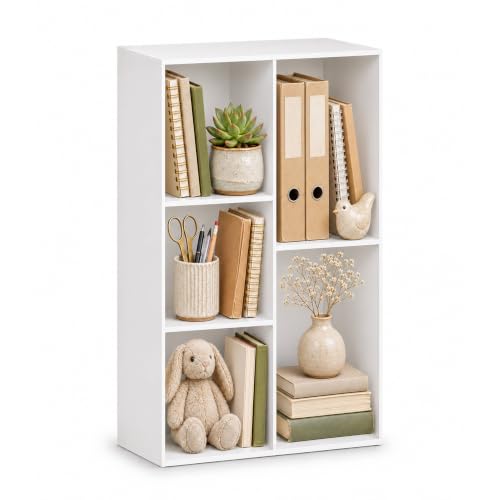
The LUDER 5-Cube is the shape this tier does best: a vertical tower of five open cubes, 9.4 inches deep, 15.8 inches wide and 52 inches tall, built from composite wood with a closed back panel. That footprint is the headline. Fifteen and a bit inches of width is less than a floor tile and a half, so the LUDER slides into the gaps other furniture leaves — beside a sofa, at the end of a hallway, between a desk and a wall — while still offering five separate compartments for books, baskets, framed photos and the small clutter that otherwise colonizes flat surfaces.
The stated capacity is what lifts it to best overall. Furinno rates each cube at up to 30 pounds, 150 pounds total when evenly distributed — numbers you should treat as a ceiling, not a target, but which compare well with everything else here. In practice that means a cube of paperbacks, a cube of hardcovers laid flat, a cube with a fabric bin of chargers and games, and two cubes for display, all without asking any single shelf to do something heroic. The closed back matters more than it looks: it keeps books from being pushed through the unit, adds real rigidity to a tall narrow frame, and gives the white finish a clean, shadow-free backdrop that photographs — and lives — tidier than open-back rivals.
Assembly is conventional flat-pack: panels, dowels and screws, a screwdriver job rather than a tool-free one, and worth doing on a soft floor with the back panel attached square, because the back is doing structural work. Once built, the unit is light enough to reposition empty and steady enough, when loaded low and anchored, to forget about.
Pros:
- Slim 15.8-inch width fits gaps no standard bookcase can use
- Strongest stated total capacity in this guide at 150 lb evenly distributed
- Closed back panel adds rigidity and keeps books from sliding through
- Five separate cubes organize mixed storage better than open shelves
Honest limitation: the cubes are fixed and modestly sized — oversized art books, tall binders and vinyl records will not fit every compartment, and the 9.4-inch depth is shallower than a standard bookcase, so measure your tallest books before ordering. Composite wood also means this is a keep-it-dry, assemble-it-once piece.
Choose it if you want one bookcase that does a bit of everything in very little width. Skip it if your collection is mostly oversized volumes or you need adjustable shelves. Check on Amazon
Furinno PASIR Book Shelf, 3-Tier Bookshelf, Storage Shelves Bookcase, Plain White
Best for: heavy books — textbooks, cookbooks, reference rows — and anyone who prefers low and wide over tall and narrow. Check on Amazon
The PASIR takes the opposite approach to the LUDER: instead of climbing, it spreads. At 9.7 inches deep, 23.7 inches wide and just 31.5 inches tall, its three wide shelves sit at console height — low enough to double as a display surface on top, stable by geometry rather than by anchoring, and easy for every member of a household to reach. If the LUDER is a tower, the PASIR is a bench for books.
Its party trick is strength. Furinno rates each PASIR shelf at up to 40 pounds, 120 pounds across the unit — the highest per-shelf figure in this guide, and the one that matters for real book weight. A two-foot row of hardcovers is heavier than most people guess, and shelves rated at 10 or 15 pounds quietly bow under it over a year. The PASIR’s rating, its short spans and its enclosed back panel — reinforced, the maker notes, to keep the frame aligned and reduce twisting — make it the pick we would load with the dense stuff: the textbook shelf, the cookbook shelf, the reference shelf. The laminated finish is described as scratch-resistant, which suits a unit that will live at hand height and take daily contact.
The trade is height and count: three shelves is three shelves. This is not the case for a thousand-paperback collection; it is the case for the books you actually open, plus a plant and a lamp on top. Assembly is simple flat-pack work, and the wide, low result is the least tippy thing in this guide even before anchoring.
Pros:
- 40 lb stated per shelf — the strongest shelves here, right for textbooks and cookbooks
- Low, wide stance is inherently stable and doubles as a display top
- Enclosed back panel adds rigidity and a finished look from every angle
- Scratch-resistant laminate suits busy, high-contact spots
Honest limitation: only three shelves and a 31.5-inch height cap your total storage; a serious library outgrows it quickly, and the fixed shelf spacing may not suit very tall volumes on every tier.
Choose it if your priority is loading real book weight without sag, or you want storage under a window line. Skip it if you need maximum shelf count per dollar. Check on Amazon
Furinno Turn-N-Tube 5-Tier Multipurpose Shelf / Display Rack / Bookshelf, Square Tubes, French Oak Grey/Black
Best for: renters, dorm rooms and anyone who wants five shelves standing today, with zero tools and zero leftover screws. Check on Amazon
The Turn-N-Tube idea is disarmingly simple: composite-wood shelves threaded together by square plastic tubes that twist on by hand. No Allen key, no cam locks, no mysteriously spare dowel. The 5-tier version stands 57.4 inches tall on an 11.6 by 23.6 inch footprint, weighs about 19 pounds, and can be assembled — and, just as importantly, disassembled for a move — in minutes. For students, first apartments and anyone furnishing a room this weekend, that convenience is a genuine feature, not a gimmick.
The French Oak Grey shelves with black tubes also give it the most contemporary look of the tube family: a two-tone, slightly industrial profile that reads as intentional decor rather than budget compromise. Five open tiers at roughly book height suit a mixed load of paperbacks, baskets, plants and display pieces, and the open back keeps the unit light and easy to place against any wall.
Now the honesty. The listing rates the unit at 75 pounds total, and the tube design’s per-shelf practical limit is modest — this is a display-and-paperback shelf, not a textbook shelf. Load each tier with a sensible mix, keep the heaviest items low, and it is perfectly serviceable; fill every tier with hardcovers and you are asking plastic joinery to do a steel frame’s job. It also has no back panel, so books need bookends or baskets to stay disciplined.
Pros:
- Genuinely tool-free assembly and disassembly — ideal for movers and renters
- Tallest unit in this guide at 57.4 inches, five full tiers
- Two-tone French Oak Grey and black finish looks modern, not makeshift
- Light 19 lb build is easy to carry and reposition
Honest limitation: the 75 lb total rating is the lowest ceiling here alongside the corner unit, and open backs plus tube joinery mean it flexes more than panel-built cases under heavy or uneven loads.
Choose it if convenience and looks outrank load, or your living situation is temporary. Skip it if your shelves will carry dense hardcover rows. Check on Amazon
Furinno TURN-N-TUBE Corner Shelf, 5-Tier Corner Bookshelf, Beech
Best for: the corner. Every room has one doing nothing; this turns it into five levels of display and light storage. Check on Amazon
The corner variant of the Turn-N-Tube family uses quarter-round shelves on the same twist-together tube system, sized 11.6 by 11.6 inches and 57.7 inches tall. It occupies the wedge of floor where two walls meet — space that is functionally free in most rooms — and returns five display surfaces for plants, photos, a speaker, a basket of remotes and a short stack of books at reading-chair height.
Judged as a bookcase it is a specialist, and we will be plain about the numbers: the maker rates it at 10 pounds per shelf, 50 pounds total. That is display weight, not library weight. A shelf of paperbacks laid flat, yes; a shelf of standing hardcovers, no. Within that honest envelope it is a cheerful, useful thing — the beech finish is warm and neutral, assembly is the same tool-free twist, and the tall, narrow silhouette draws the eye up and makes a small room feel deliberately arranged rather than merely filled.
It is also the pick most likely to be bought as a pair: two corners flanking a sofa or a media console give a room symmetry that a single wide bookcase cannot. If your real need is book bulk, look at the LUDER or PASIR instead and let this one do the job it is shaped for.
Pros:
- Uses genuinely dead corner space — near-zero opportunity cost of floor
- Five display levels at full 57.7-inch height
- Tool-free assembly, featherweight to move
- Warm beech finish pairs easily with light and mid-tone rooms
Honest limitation: 10 lb per shelf is the lightest rating in this guide; it is a display stand that holds some books, not a bookcase that displays some objects, and quarter-round shelves waste space for rectangular storage boxes.
Choose it if your corner is empty and your load is light. Skip it if you need to store a real collection — it will not pretend otherwise. Check on Amazon
Yoobure Tree Bookshelf, 6 Shelf Retro Floor Standing Bookcase, Rustic Brown
Best for: narrow walls, bedside and hallway spots, and anyone who wants their storage to double as the room’s one interesting object. Check on Amazon
The Yoobure abandons the rectangle entirely. Its six short shelves branch off a central spine like a stylized tree, in a footprint just 15 inches wide and 7.8 inches deep, standing about 45 inches tall. Each branch shelf holds a short run of books — the maker suggests five to ten per shelf — kept upright by the shelf’s own raised edges, so the unit works without bookends and reads from across the room as sculpture first, storage second.
That format has real functional logic for the right collection. Paperbacks, manga, CDs, small-format art books and a rotating cast of current reads suit short shelves perfectly, and the divided layout forces a pleasant discipline: six small curated groups instead of one sagging row. The rustic brown finish and retro silhouette warm up modern rooms, and the maker includes anti-tip straps — a thoughtful inclusion on a tall, narrow, top-branchy design, and one you should actually use. At about 15 pounds, it is also the easiest pick here to carry from room to room as your reading chair migrates.
The limitations are built into the charm. Seven-point-eight inches of depth excludes most hardcovers and all big-format books; total capacity is a few dozen small books, not a library; and the branch shelves cannot take baskets, boxes or binders. Buy it as a paperback tree and bedside display, and it delights. Buy it as your only bookcase, and it will run out of branches by the second bookshelf-worth of books.
Pros:
- Narrowest, shallowest footprint here — fits walls nothing else can use
- Six divided shelves keep small books upright without bookends
- Anti-tip straps included, and a backboard-reinforced spine
- Genuine decorative presence in rustic brown
Honest limitation: shallow 7.8-inch shelves rule out most hardcovers and large formats, and total storage is modest — this is a curated-reads shelf, not bulk storage.
Choose it if your books are small-format and your wall space is smaller. Skip it if you need depth, bulk or box storage. Check on Amazon
Furinno LUDER Book Shelf, 5-Cube Bookshelf, Reversible Bookcase, Amber Pine
Best for: under-window walls, TV-adjacent low storage, kids’ reach, and rooms where a tall case would crowd the sightlines. Check on Amazon
The second LUDER in this guide is a different animal from the first: same cube idea, opposite posture. This reversible 5-cube case is 9.4 inches deep, 19.5 inches wide and only 31.5 inches tall, with five cubes in two sizes and a closed back. Stood as designed it is a low bookcase that slides under most window sills and beside most sofas; laid horizontally — the reversible part — it becomes a long, low bench of storage that can sit under a wall-mounted TV or at the foot of a bed.
Low furniture earns its keep in specific rooms. In a child’s room it keeps books at child height with no climbing incentive and no tip drama. In a living room it stores without looming. In a rental it adds storage that never fights the architecture. The amber pine finish is the warmest tone in the Furinno picks here, and the two cube sizes divide naturally into books below, baskets and display above.
Capacity expectations should stay modest: this compact case is built for everyday paperback-and-basket loads rather than the tall LUDER’s heavier rating, and its shallow 9.4-inch depth shares the family trait of suiting standard books rather than oversized volumes. Assembly is simple panel work, and at this size it is a one-person, one-coffee job.
Pros:
- 31.5-inch height fits under windows and keeps rooms feeling open
- Reversible design works vertically or laid horizontally
- Closed back and two cube sizes organize mixed storage neatly
- Low stance is inherently stable — a natural fit for kids’ rooms
Honest limitation: total storage is the smallest of the panel-built picks, and the shallow depth and fixed cubes will not take oversized books or tall binders.
Choose it if your wall is short, your ceiling is low or your readers are small. Skip it if you need height and volume. Check on Amazon
Comparison Table
Every figure below is the maker’s own stated specification from the listing — dimensions in inches (D x W x H) and stated weight capacity. Where a listing gives a total only, we say so rather than inventing a per-shelf number.
| Bookcase | Size (D x W x H) | Shelves | Stated capacity | Back | Assembly |
|---|---|---|---|---|---|
| Furinno LUDER 5-Cube, White | 9.4 x 15.8 x 52 | 5 cubes | 30 lb per cube, 150 lb total | Closed | Flat-pack, screwdriver |
| Furinno PASIR 3-Tier, Plain White | 9.7 x 23.7 x 31.5 | 3 | 40 lb per shelf, 120 lb total | Closed | Flat-pack, screwdriver |
| Furinno Turn-N-Tube 5-Tier, Square Tubes | 11.6 x 23.6 x 57.4 | 5 | 75 lb total | Open | Tool-free twist |
| Furinno Turn-N-Tube 5-Tier Corner, Beech | 11.6 x 11.6 x 57.7 | 5 corner | 10 lb per shelf, 50 lb total | Open | Tool-free twist |
| Yoobure Tree Bookshelf, Rustic Brown | 7.8 x 15 x 45 | 6 branch | 5–10 books per shelf (maker) | Backboard spine | Screw assembly, straps included |
| Furinno LUDER 5-Cube Reversible, Amber Pine | 9.4 x 19.5 x 31.5 | 5 cubes | Everyday loads — see listing | Closed | Flat-pack, screwdriver |
How to Choose the Best Bookcase Under $50
Start with the load, not the look. Weigh your heaviest intended shelf, honestly. A two-foot row of hardcover novels can outweigh a small child; a shelf of paperbacks is a fraction of that. Match the row to a stated per-shelf rating with room to spare: the PASIR’s 40-pound shelves exist for dense rows, the corner unit’s 10-pound shelves exist for objects. If a listing will not state a number, treat that silence as your answer.
Measure the wall, then the books. Width and height decide where the case can live; depth decides what it can hold. Standard novels sit happily in 9 to 10 inches of depth; oversized art books, binders and vinyl want 12 inches or more — deeper than anything in this tier, which is a legitimate reason to step up a tier rather than force a fit. Measure your three tallest books and compare them with shelf spacing and cube openings, not just overall height.
Closed back versus open back is a real fork. A closed back panel adds rigidity, stops books sliding through, and looks finished from the side and front. An open back is lighter, cheaper, easier to move and fine against a wall for display loads. Neither is a defect; buying the wrong one for your load is.
Fixed versus flexible layouts. Cube cases organize mixed storage beautifully and forgive untidiness — a basket hides a multitude of chargers. Open shelves take long rows and tall items but expose everything. Tree shelves curate small collections. Pick the layout that matches what you own today, not the library you daydream about.
Plan the anchoring before the unboxing. Anything tall and narrow — the tube tower, the corner unit, the tree — should be strapped to a wall in a home with children or pets, and heavy loading always goes on the lowest shelves regardless. If your walls are rental-sensitive, favor the low, wide picks, whose stability comes from geometry.
Count total cost honestly. At this tier the bookcase is cheap; bookends, baskets and an anti-tip strap may not be included. Budget for the two or three accessories your chosen design needs and the comparison against the next tier up becomes fair.
Will It Fit? A Five-Minute Check Before You Order
Tape the footprint on the floor with painter’s tape — width and depth from the table above — and live with it for an hour. Walk past it, open the nearest door fully, and check the vacuum can still get through. Then measure your tallest and deepest books and hold them against the shelf spacing in the listing’s dimension diagram. Check the wall behind for outlets you still need, baseboard heaters the case would crowd, and the swing of any nearby door. Finally, if the unit is tall, find the stud or plan the anchor point now, not with the bookcase already loaded. Five minutes of tape prevents the single most common budget-furniture disappointment: a perfectly good bookcase in a space it never fit.
Common Buying Mistakes
Buying by shelf count alone. Six tiny shelves can hold less than three wide ones. Compare stated capacity and usable dimensions, not tier counts.
Loading to the marketing photo. Listing photos show shelves groaning with hardcovers that the stated rating would not support. The rating is the truth; the photo is theatre.
Ignoring depth. A 7.8-inch-deep tree shelf and a 12-inch-deep art book are strangers. Depth mismatches are the top reason budget bookcases get returned or resented.
Skipping the wall anchor. Tall, narrow, top-loaded furniture tips. The strap takes minutes. Use it.
Assembling on carpet and over-tightening. Composite panels built on soft flooring go together out of square, and over-torqued screws crack the very holes that hold the unit rigid. Build on a hard, flat surface; snug is tight enough.
Putting the heaviest row on top. Weight goes low, always — for stability, for sag, and for the day something gets pulled off a shelf.
Materials in This Guide, Explained Honestly
Every pick here is built from composite wood — particleboard or MDF — with a laminated or printed finish, and the two tube models add PVC posts. That is not a euphemism to be embarrassed by; it is the engineering that makes a bookcase at this price possible at all. Composite panels are dimensionally consistent, light to ship, and strong enough in compression for the stated ratings. Their enemies are water soaking into an edge, screws being driven in and out repeatedly, and long shelves loaded past rating until they creep into a permanent bow. Keep the unit dry, assemble it once and well, respect the numbers, and the material will not be the reason the bookcase fails. The Yoobure’s engineered-wood branches and backboard spine follow the same rules. Nothing in this tier is solid timber, and any listing at this price implying otherwise is telling you something about its honesty rather than its lumber.
Assembly, Care and the First Month
Panel cases (both LUDERs and the PASIR) go together with dowels, screws and a back panel; build them on a hard floor, leave the back-panel fasteners slightly loose until the frame is square, then tighten in a cross pattern. Tube cases twist together by hand — resist the urge to force a tube that is not aligned; back it off a quarter turn and reseat it. The Yoobure’s branches screw to the spine; fit the anti-tip straps before loading a single book.
In the first month, do three things. After a week, re-check fasteners — composite panels settle and a quarter-turn now prevents a wobble later. Load progressively: heaviest shelf first, at the bottom, and watch each shelf for a day before filling the next. And keep a dry cloth routine: dust weekly, wipe spills immediately, never let a wet mug ring sit on laminate. These small habits are the entire difference between a budget bookcase that lasts two years and one that lasts seven.
What Under $50 Really Buys — and What It Does Not
It helps to walk into this tier with calibrated expectations, because almost every disappointed budget-bookcase owner bought a fantasy instead of a specification. Under $50 buys you flat-packed composite panels, a laminated finish that wipes clean and shrugs off dust, fixed shelf positions in most designs, and per-shelf load ratings in the 10-to-40-pound range. It buys genuine usefulness: a few hundred paperbacks’ worth of organized storage, a finished-looking wall, a corner redeemed. For a first apartment, a child’s room, a hallway or a home office that needs order this month rather than someday, that is a completely respectable purchase.
It does not buy adjustability as a rule — if your collection mixes tall binders with short novels, fixed cubes will waste some vertical inches, and you will solve it with horizontal stacks and baskets rather than shelf pins. It does not buy deep shelves: at 9 to 12 inches, this tier suits standard books and media, not oversized atlases or record sleeves standing proud. It does not buy forgiving materials — a composite panel remembers every flooded plant pot and every screw that was removed and driven back twice. And it does not buy mass: these are light units, which is why anchoring and low loading matter more here than they do for a heavy timber case.
None of that makes the tier a compromise to apologize for; it makes it a tool with a defined envelope. The buyers who love their under-$50 bookcases are the ones who measured, matched the rating to the load, and let the case do the job it was shaped for. The buyers who hate them asked a 10-pound corner shelf to be a library. This guide exists so you end up in the first group: every review above names the envelope as plainly as the virtue, and the comparison table puts the makers’ own numbers side by side so the matching takes minutes, not guesswork.
One more calibration: expect to replace or retire a heavily used budget bookcase on a shorter horizon than a mid-range one, particularly if it moves house often — flat-pack joinery tolerates one careful move, resents three. Bought for a defined chapter of life — the dorm years, the first rental, the growing child’s current reading stage — that horizon is not a flaw at all. It is the entire economic logic of the tier.
Organizing the Shelves Once It Stands
A budget bookcase looks its best — and works its hardest — when the loading follows a few quiet rules. Put the heaviest shelf at the bottom: the textbook row, the full baskets, the bound sets. This is stability and sag prevention at once, and it visually grounds the unit. Work upward in descending weight and ascending decoration: working books in the middle, where hands actually reach; light paperbacks, framed photos and plants toward the top, where the eye wants air.
Mix orientations. A run of vertical books beside a short horizontal stack reads as arranged rather than stored, and the horizontal stack doubles as a bookend for its neighbors — useful on the open-backed tube models, essential on the corner unit where nothing else will hold a row upright. Leave one shelf or cube deliberately part-empty. Negative space is what separates a styled bookcase from a storage problem, and on the cube cases a single fabric bin per unit hides the chargers, remotes and game cases that make open storage look chaotic.
Group by use, not by size: the current-reads shelf near the chair, reference near the desk, children’s books at child height on the low picks. And revisit the arrangement after a month — the shelf you actually empty and refill is your real library; the rest is display, and it is allowed to be. A bookcase organized around real habits stays tidy with almost no effort, which is the entire point of buying one.
Final Recommendation
For most people, the answer is the Furinno LUDER 5-Cube in White: the strongest stated total capacity in this tier, a closed back, five organizing cubes and a footprint slim enough for the walls other bookcases cannot use. If your shelves will carry genuinely heavy rows — textbooks, cookbooks, reference sets — the Furinno PASIR 3-Tier and its 40-pound shelves are the honest specialist, and its low stance needs no apology in any room. Choose the tube tower for tool-free convenience, the corner unit for dead space, the Yoobure for narrow-wall charm, and the low LUDER for under-window calm. Every one of them, respected within its stated limits, is a better buy than a costlier bookcase chosen by photograph alone. Readers furnishing a whole wall may also like Best Media Console Under $50 for the TV side of the room and Best Storage Ottoman Under $50 for the clutter that never quite fits a shelf.
Frequently Asked Questions
Can you really buy a good bookcase for under $50?
Yes — with the right definition of good. Under $50 buys composite-wood construction, fixed shelves and modest per-shelf ratings, but the picks above state real dimensions and real load limits and will hold books, baskets and decor for years if you respect those limits and keep the unit dry and anchored. What it will not buy is solid wood, adjustable shelving throughout, or heirloom joinery.
How many books fit on a budget bookcase?
It depends on format and rating more than shelf count. A 24-inch shelf of paperbacks might hold 25 to 30 books; the same shelf of hardcovers fewer, and much heavier. Work from the stated per-shelf weight limit: fill a shelf, and if the load is mostly hardcovers, stay visibly under the rating rather than at it.
Do I really need to anchor a bookcase to the wall?
For tall, narrow units, yes — especially with children or pets in the home, and always when the top shelves carry weight. Low, wide units like the PASIR and the low LUDER are far more stable by design, but anchoring costs minutes and removes a real risk, so we recommend it for anything over about 30 inches tall.
What is the difference between a bookcase and a bookshelf?
In practice, very little in modern listings: sellers use the words interchangeably. Traditionally a bookcase is a framed case with sides and a back, while a bookshelf can be a single shelf or an open rack. In this guide the closed-back cube cases are the most bookcase-like, and the open tube racks the most shelf-like — choose by construction, not by the word in the title.
Will composite wood shelves sag?
Loaded within their stated rating, on the spans these units use, sag should be minimal for years. Loaded past the rating — particularly with a heavy row concentrated mid-span — composite shelves creep and bow permanently. The defense is simple: respect the per-shelf number, spread heavy rows, and put the densest books on the shortest or lowest shelves.
Can two budget bookcases work as one wall of storage?
Yes, and it is one of the smartest ways to furnish with this tier. Two identical low or cube units side by side read as a single built-in, cost less than most single wide bookcases, and can be split up later when you move or rearrange. Buy both at the same time so the finish matches exactly, anchor each one independently, and keep the join between them free of load so neither frame racks against the other.
How long does assembly take?
The tube models genuinely take minutes and no tools. The panel cases are a relaxed one-person job with a screwdriver — allow a comfortable session rather than a rushed one, build on a hard floor, and keep the back panel square as you fasten it, because the back is part of the structure.
Still deciding on the room as a whole? These guides cover the neighboring jobs: Best Bookcase For Small Spaces Under $50 for the tightest floor plans, Best Bookcase For Families Under $50 if children change the safety math, Best Bookcase For Modern Homes Under $50 for a more styled shortlist.