Disclosure: As an Amazon Associate, dailyhomedecorating.com earns from qualifying purchases. Links on this page are affiliate links; they cost you nothing extra. Prices and availability change often, so check the current Amazon listing before you buy.
This guide is a complete wheelbarrow review resource for home gardeners, allotment keepers and anyone facing a season of hauling. In this review we put the modern wheelbarrow — in its single-wheel, dual-wheel and cart forms — under the kind of loads a real garden produces, and judge it the way an owner would after a full season. A wheelbarrow looks like the simplest tool in the shed, yet the difference between a good one and a frustrating one shows up on every trip: in how the load balances, how the wheel rolls over your ground, how the handles feel in your hands and how cleanly the tray empties when you arrive. Across the sections that follow you will find an honest look at the main designs on the market, the trade-offs that actually matter, worked examples for common jobs, and the care habits that keep a barrow rolling for years. Product picks in this wave are presented in prose while verification is pending, with qualitative tiers instead of prices, so you can shortlist by fit and then check the current listing for the model that matches your ground and your jobs.
Key Takeaways: Match the barrow to your most common load and your tightest corner, not to your biggest imaginable job. A single wheel is nimble but asks your arms to balance; two or four wheels are steadier but need more room. Steel trays take punishment, poly trays resist rust and weigh less. Keep loads low, centred and within the maker’s rating, lift with your legs, keep pneumatic tyres at sidewall pressure, and store the barrow tipped, hung or covered so it never pools water.
Wheelbarrow Review: The Short Verdict
The modern wheelbarrow earns its place in almost every garden, and this wheelbarrow review reaches a clear verdict: for general soil, compost and waste work on ordinary ground, a well-made traditional barrow remains the most versatile single purchase, while dual-wheel and cart designs are the better answer for heavier-feeling loads, newer users and flatter, more open plots. It suits anyone who moves material further than a few steps, works beds and borders regularly, or faces seasonal jobs like mulching, leaf clearing and log moving. It does not suit someone whose entire outdoor space is a small paved patio where a trug and a hand truck cover everything, or a user who needs powered help for very long distances. The sections below explain how that verdict breaks down by design, by job and by user.
In this guide
What a Wheelbarrow Is and Where It Fits
A wheelbarrow is a lever and a wheel working together: the wheel carries most of the weight, the handles give you leverage and steering, and the tray holds material in a shape that tips out cleanly. Around that simple idea the market has built several families. The traditional single-wheel barrow is the all-rounder, happiest threading between beds. The dual-wheel barrow adds a second wheel for stability. The four-wheeled garden cart gives up tipping agility for a level bed that pulls or pushes like a wagon. Convertible designs try to be several tools at once. Understanding which family your jobs belong to matters more than any single product name, and it is the foundation of any honest review.
When you Treat the wheel as the engine of the thing, since every push you make travels through it, the details come into focus quickly: a barrow that converts into a dolly or cart earns its shed space twice, but every conversion adds joints, latches and compromises that a single-purpose tool simply does not carry. At the same time, a single wheel tracks neatly between beds and through gates, but it asks your arms to do the balancing, while two wheels or four wheels share that balancing work and ask more room when you turn. Shoppers who match the tool to their most common load almost always end up happier than shoppers who match it to their biggest imaginable load. In practice that means walking your route once with fresh eyes, noting gates, steps, slopes and soft patches, and then reading every product description against that route rather than against an ideal garden that nobody actually owns.
When you Consider how the tray behaves when it is only half full, which is how most loads actually travel, the details come into focus quickly: a steel tray shrugs off rubble, broken concrete and sharp-edged stone, while a poly tray is lighter to lift, quieter in use and immune to rust, though it can flex under a pointed load. At the same time, grip shape and handle spacing decide whether the tool feels natural with gloves on in winter and with bare hands in summer, and small differences here are felt on every trip. The honest test is a loaded run over your own ground, and any design that fights you on that run will fight you for years. In practice that means walking your route once with fresh eyes, noting gates, steps, slopes and soft patches, and then reading every product description against that route rather than against an ideal garden that nobody actually owns.
When you Start with the ground the barrow has to cross, because ground decides more than brand does, the details come into focus quickly: a deep tray suits bulky, light material such as leaves, clippings and mulch, while a shallower tray keeps dense material like wet soil and gravel lower and easier to control. At the same time, the legs matter more than they look, because a barrow spends much of its life parked mid-load, and a stance that rocks or sinks into soft ground makes loading awkward and occasionally messy. When two designs look equal on paper, choose the one whose wheel, handles and storage fit your daily routine more closely. In practice that means walking your route once with fresh eyes, noting gates, steps, slopes and soft patches, and then reading every product description against that route rather than against an ideal garden that nobody actually owns.
When you Think about the work in terms of trips saved rather than loads carried, the details come into focus quickly: pneumatic tyres roll kindly over roots, gravel and uneven lawns, while flat-free tyres remove punctures and pressure checks from your life at the cost of a firmer, less forgiving ride. At the same time, a barrow that converts into a dolly or cart earns its shed space twice, but every conversion adds joints, latches and compromises that a single-purpose tool simply does not carry. Long after the purchase is forgotten, the trips remain, so it pays to choose for the trips. In practice that means walking your route once with fresh eyes, noting gates, steps, slopes and soft patches, and then reading every product description against that route rather than against an ideal garden that nobody actually owns.
When you Notice how a design behaves at walking pace over grass, which is slower and rougher than a showroom floor, the details come into focus quickly: the legs matter more than they look, because a barrow spends much of its life parked mid-load, and a stance that rocks or sinks into soft ground makes loading awkward and occasionally messy. At the same time, a steel tray shrugs off rubble, broken concrete and sharp-edged stone, while a poly tray is lighter to lift, quieter in use and immune to rust, though it can flex under a pointed load. A barrow is a simple tool, which is exactly why the small details decide whether it feels like help or like hard work. In practice that means walking your route once with fresh eyes, noting gates, steps, slopes and soft patches, and then reading every product description against that route rather than against an ideal garden that nobody actually owns.
Design, Build and Setup
Build quality in this category is visible. Look at how the tray is supported, whether the undercarriage braces the load or merely touches it, how the wheel axle is mounted, and whether the handles are shaped for a gloved hand. Assembly on most home models is a short job with basic tools: attach the wheel and legs, fit the handles, and check every fastener again after the first few loaded trips, because new assemblies settle. There is no substitute for a slow first inspection — spin the wheel, check for play in the axle, and confirm the tray sits level before the first load goes in.

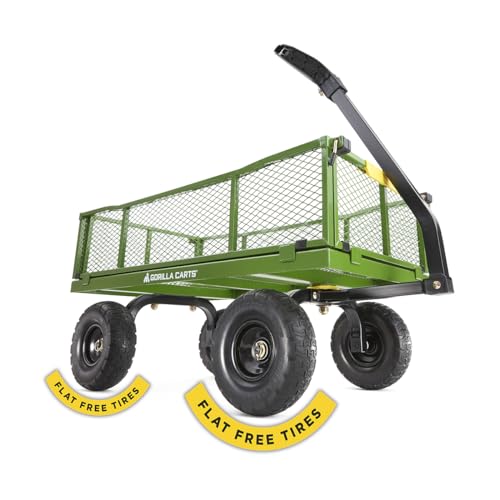
Gorilla Carts Steel Utility Cart — Best Four-Wheel Alternative
In prose terms, this pick is a four-wheeled steel utility cart take on the classic barrow, built around a steel bed, a pull handle that keeps the load level, and a dump-style release on many versions that lets you tip material out instead of shovelling it. It is presented here without a purchase link while verification is pending, so judge it on the fit described rather than on any headline claim. Best for: readers whose jobs match the strengths just described. Not suited for: readers whose ground, storage or typical load point the other way, and who would be better served by a different shape of tool from the same shortlist. Check the current listing carefully before you buy, compare the tray material, wheel type and handle design against your route, and treat any optional extras as exactly that — optional.

WORX Aerocart — Best Convertible
In prose terms, this pick is a convertible yard tool that shifts between wheelbarrow, dolly and cart duties, aimed at households that want one piece of kit to cover several lighter jobs rather than a single-purpose barrow. It is presented here without a purchase link while verification is pending, so judge it on the fit described rather than on any headline claim. Best for: readers whose jobs match the strengths just described. Not suited for: readers whose ground, storage or typical load point the other way, and who would be better served by a different shape of tool from the same shortlist. Check the current listing carefully before you buy, compare the tray material, wheel type and handle design against your route, and treat any optional extras as exactly that — optional.

Jackson Professional Wheelbarrow — Best Traditional Pick
In prose terms, this pick is a contractor-leaning single-wheel barrow in the traditional mould, with a steel tray, hardwood-style handles and a stance made for daily site and garden work. It is presented here without a purchase link while verification is pending, so judge it on the fit described rather than on any headline claim. Best for: readers whose jobs match the strengths just described. Not suited for: readers whose ground, storage or typical load point the other way, and who would be better served by a different shape of tool from the same shortlist. Check the current listing carefully before you buy, compare the tray material, wheel type and handle design against your route, and treat any optional extras as exactly that — optional.

True Temper Wheelbarrow — Best Everyday Household Pick
In prose terms, this pick is a long-running household name in this category, offering straightforward steel and poly tray barrows aimed at ordinary garden, landscaping and home-improvement hauling. It is presented here without a purchase link while verification is pending, so judge it on the fit described rather than on any headline claim. Best for: readers whose jobs match the strengths just described. Not suited for: readers whose ground, storage or typical load point the other way, and who would be better served by a different shape of tool from the same shortlist. Check the current listing carefully before you buy, compare the tray material, wheel type and handle design against your route, and treat any optional extras as exactly that — optional.
Performance in Real Use
Performance is where brochures end and ownership begins. A barrow that feels fine empty can feel entirely different with a wet load of soil on a soft lawn, and the honest differences between designs show up in four recurring situations: the lift, the roll, the turn and the dump. The lift rewards leverage and handle height. The roll rewards the right tyre for your surface. The turn rewards a wheel count that matches your space. The dump rewards a tray shape that empties without you climbing in with a spade to finish the job.
When you Consider how the tray behaves when it is only half full, which is how most loads actually travel, the details come into focus quickly: a single wheel tracks neatly between beds and through gates, but it asks your arms to do the balancing, while two wheels or four wheels share that balancing work and ask more room when you turn. At the same time, a deep tray suits bulky, light material such as leaves, clippings and mulch, while a shallower tray keeps dense material like wet soil and gravel lower and easier to control. When two designs look equal on paper, choose the one whose wheel, handles and storage fit your daily routine more closely. In practice that means walking your route once with fresh eyes, noting gates, steps, slopes and soft patches, and then reading every product description against that route rather than against an ideal garden that nobody actually owns.
When you Ask where the load sits in relation to the wheel, because that relationship is the whole physics of the tool, the details come into focus quickly: long handles give leverage that makes a heavy tray feel lighter at the lift, yet they also lengthen the whole tool, which matters in a small shed and on a narrow path. At the same time, a steel tray shrugs off rubble, broken concrete and sharp-edged stone, while a poly tray is lighter to lift, quieter in use and immune to rust, though it can flex under a pointed load. None of these choices is right in the abstract; each is right for a particular garden, a particular route and a particular pair of hands. In practice that means walking your route once with fresh eyes, noting gates, steps, slopes and soft patches, and then reading every product description against that route rather than against an ideal garden that nobody actually owns.
When you Look at the handles first, since your hands are the part of you that meets the tool every single trip, the details come into focus quickly: grip shape and handle spacing decide whether the tool feels natural with gloves on in winter and with bare hands in summer, and small differences here are felt on every trip. At the same time, a single wheel tracks neatly between beds and through gates, but it asks your arms to do the balancing, while two wheels or four wheels share that balancing work and ask more room when you turn. The honest test is a loaded run over your own ground, and any design that fights you on that run will fight you for years. In practice that means walking your route once with fresh eyes, noting gates, steps, slopes and soft patches, and then reading every product description against that route rather than against an ideal garden that nobody actually owns.
When you Look at the handles first, since your hands are the part of you that meets the tool every single trip, the details come into focus quickly: pneumatic tyres roll kindly over roots, gravel and uneven lawns, while flat-free tyres remove punctures and pressure checks from your life at the cost of a firmer, less forgiving ride. At the same time, the legs matter more than they look, because a barrow spends much of its life parked mid-load, and a stance that rocks or sinks into soft ground makes loading awkward and occasionally messy. Long after the purchase is forgotten, the trips remain, so it pays to choose for the trips. In practice that means walking your route once with fresh eyes, noting gates, steps, slopes and soft patches, and then reading every product description against that route rather than against an ideal garden that nobody actually owns.
When you Judge a barrow on the day the job goes wrong, not on the day everything is dry and level, the details come into focus quickly: long handles give leverage that makes a heavy tray feel lighter at the lift, yet they also lengthen the whole tool, which matters in a small shed and on a narrow path. At the same time, a single wheel tracks neatly between beds and through gates, but it asks your arms to do the balancing, while two wheels or four wheels share that balancing work and ask more room when you turn. When two designs look equal on paper, choose the one whose wheel, handles and storage fit your daily routine more closely. In practice that means walking your route once with fresh eyes, noting gates, steps, slopes and soft patches, and then reading every product description against that route rather than against an ideal garden that nobody actually owns.
In Use: Moving compost and soil to raised beds
Compost and soil are the classic barrow loads: dense, forgiving to pile, and needed in exactly the places a vehicle cannot reach. Work in sensible part-loads on soft ground, keep the heap centred over the wheel, and tip close to the bed so you are spreading rather than carrying the last stretch by hand.
In Use: Hauling mulch, bark and leaves
Mulch and leaves are bulky rather than heavy, so tray volume and a high, stable pile matter more than raw strength. A deeper tray and a calm, unhurried pace keep light material from bouncing out over bumps, and a tarp laid in the tray makes the final scraps easy to gather.
In Use: Shifting gravel, sand and stone
Gravel and stone punish trays and tyres alike. Load less than instinct suggests, because dense material concentrates weight and a pointed stone can dent steel or stress poly. Roll slowly, avoid sudden turns, and lower the tray gently at the dump rather than letting it crash down.
In Use: Clearing garden waste and prunings
Prunings are awkward, springy and determined to fall off. Lay long pieces lengthways, weigh them down with heavier material in the middle, and accept an extra trip rather than building a tall, unstable tower that sheds branches along the path.
Strengths and Trade-Offs
Strengths
- One tool covers soil, compost, waste, logs and supplies, replacing countless bucket trips.
- The wheel carries the weight, so your back and arms do far less than with any carried container.
- Simple construction means simple care: a rinse, a dry, an occasional tyre check and fastener check.
Trade-offs
- A single-wheel design demands balance from the user and can tip if loaded high or off-centre.
- Barrows are bulky to store, and a carelessly stored one collects water and rusts.
- No barrow is good at stairs, very soft mud or very long distances; those jobs want a different tool.
How It Compares
Set against its rivals, the traditional barrow wins on agility and simplicity, the dual-wheel design wins on steadiness for newer users, and the four-wheeled cart wins on level, bulky loads over flat ground. A hand truck beats all of them on paved surfaces with boxed or bagged goods, and a powered carrier beats all of them on distance, at far greater cost and complexity. For the ordinary garden, the comparison usually ends where it began: the barrow family covers the widest range of real jobs for the least fuss.
When you Weigh up storage before you weigh up capacity, because a barrow you cannot store well will not last well, the details come into focus quickly: a deep tray suits bulky, light material such as leaves, clippings and mulch, while a shallower tray keeps dense material like wet soil and gravel lower and easier to control. At the same time, long handles give leverage that makes a heavy tray feel lighter at the lift, yet they also lengthen the whole tool, which matters in a small shed and on a narrow path. A barrow is a simple tool, which is exactly why the small details decide whether it feels like help or like hard work. In practice that means walking your route once with fresh eyes, noting gates, steps, slopes and soft patches, and then reading every product description against that route rather than against an ideal garden that nobody actually owns.
When you Remember that dumping is half the job, and a tray that empties cleanly saves real effort at the end of each run, the details come into focus quickly: grip shape and handle spacing decide whether the tool feels natural with gloves on in winter and with bare hands in summer, and small differences here are felt on every trip. At the same time, long handles give leverage that makes a heavy tray feel lighter at the lift, yet they also lengthen the whole tool, which matters in a small shed and on a narrow path. Long after the purchase is forgotten, the trips remain, so it pays to choose for the trips. In practice that means walking your route once with fresh eyes, noting gates, steps, slopes and soft patches, and then reading every product description against that route rather than against an ideal garden that nobody actually owns.
When you Look at the handles first, since your hands are the part of you that meets the tool every single trip, the details come into focus quickly: a barrow that converts into a dolly or cart earns its shed space twice, but every conversion adds joints, latches and compromises that a single-purpose tool simply does not carry. At the same time, a steel tray shrugs off rubble, broken concrete and sharp-edged stone, while a poly tray is lighter to lift, quieter in use and immune to rust, though it can flex under a pointed load. A barrow is a simple tool, which is exactly why the small details decide whether it feels like help or like hard work. In practice that means walking your route once with fresh eyes, noting gates, steps, slopes and soft patches, and then reading every product description against that route rather than against an ideal garden that nobody actually owns.
When you Notice how a design behaves at walking pace over grass, which is slower and rougher than a showroom floor, the details come into focus quickly: pneumatic tyres roll kindly over roots, gravel and uneven lawns, while flat-free tyres remove punctures and pressure checks from your life at the cost of a firmer, less forgiving ride. At the same time, long handles give leverage that makes a heavy tray feel lighter at the lift, yet they also lengthen the whole tool, which matters in a small shed and on a narrow path. A barrow is a simple tool, which is exactly why the small details decide whether it feels like help or like hard work. In practice that means walking your route once with fresh eyes, noting gates, steps, slopes and soft patches, and then reading every product description against that route rather than against an ideal garden that nobody actually owns.
Who Should Buy It and Who Should Skip It
Buy a wheelbarrow if you garden beyond a few pots, maintain beds or a lawn, keep a compost system, burn wood, or face even one big seasonal job a year such as mulching or a patio project. Before you buy, walk your route, measure your narrowest gate, decide where the barrow will live, and be honest about the heaviest load you move often. Skip it, for now, if your space is tiny and paved, if a shared tool is genuinely available whenever you need it, or if your real problem is distance rather than weight, in which case a cart or powered help deserves the budget instead.
When you Picture the tightest corner on your usual route and judge every design against that corner, the details come into focus quickly: a steel tray shrugs off rubble, broken concrete and sharp-edged stone, while a poly tray is lighter to lift, quieter in use and immune to rust, though it can flex under a pointed load. At the same time, long handles give leverage that makes a heavy tray feel lighter at the lift, yet they also lengthen the whole tool, which matters in a small shed and on a narrow path. A barrow is a simple tool, which is exactly why the small details decide whether it feels like help or like hard work. In practice that means walking your route once with fresh eyes, noting gates, steps, slopes and soft patches, and then reading every product description against that route rather than against an ideal garden that nobody actually owns.
When you Ask where the load sits in relation to the wheel, because that relationship is the whole physics of the tool, the details come into focus quickly: a deep tray suits bulky, light material such as leaves, clippings and mulch, while a shallower tray keeps dense material like wet soil and gravel lower and easier to control. At the same time, a steel tray shrugs off rubble, broken concrete and sharp-edged stone, while a poly tray is lighter to lift, quieter in use and immune to rust, though it can flex under a pointed load. The honest test is a loaded run over your own ground, and any design that fights you on that run will fight you for years. In practice that means walking your route once with fresh eyes, noting gates, steps, slopes and soft patches, and then reading every product description against that route rather than against an ideal garden that nobody actually owns.
When you Picture the tightest corner on your usual route and judge every design against that corner, the details come into focus quickly: the legs matter more than they look, because a barrow spends much of its life parked mid-load, and a stance that rocks or sinks into soft ground makes loading awkward and occasionally messy. At the same time, grip shape and handle spacing decide whether the tool feels natural with gloves on in winter and with bare hands in summer, and small differences here are felt on every trip. That is why experienced gardeners talk about wheels, handles and balance far more than they talk about tray colour or badges. In practice that means walking your route once with fresh eyes, noting gates, steps, slopes and soft patches, and then reading every product description against that route rather than against an ideal garden that nobody actually owns.
When you Separate the jobs you do weekly from the jobs you do once a year, and buy for the weekly ones, the details come into focus quickly: the legs matter more than they look, because a barrow spends much of its life parked mid-load, and a stance that rocks or sinks into soft ground makes loading awkward and occasionally messy. At the same time, long handles give leverage that makes a heavy tray feel lighter at the lift, yet they also lengthen the whole tool, which matters in a small shed and on a narrow path. A barrow is a simple tool, which is exactly why the small details decide whether it feels like help or like hard work. In practice that means walking your route once with fresh eyes, noting gates, steps, slopes and soft patches, and then reading every product description against that route rather than against an ideal garden that nobody actually owns.
Setup, Care and Maintenance Essentials
Care is unglamorous and decisive. Rinse soil and compost out after use, because both hold moisture against the tray. Dry the barrow before storing it. Check pneumatic tyre pressure against the sidewall figure, oil the axle occasionally, tighten fasteners seasonally, and touch up chipped paint on steel before rust gets a foothold. Store it tipped, hung or upside down under cover. A barrow treated this way is a decade-long tool; a barrow left full of rainwater in a corner is a two-season disappointment.
When you Weigh up storage before you weigh up capacity, because a barrow you cannot store well will not last well, the details come into focus quickly: long handles give leverage that makes a heavy tray feel lighter at the lift, yet they also lengthen the whole tool, which matters in a small shed and on a narrow path. At the same time, a steel tray shrugs off rubble, broken concrete and sharp-edged stone, while a poly tray is lighter to lift, quieter in use and immune to rust, though it can flex under a pointed load. None of these choices is right in the abstract; each is right for a particular garden, a particular route and a particular pair of hands. In practice that means walking your route once with fresh eyes, noting gates, steps, slopes and soft patches, and then reading every product description against that route rather than against an ideal garden that nobody actually owns.
When you Treat the wheel as the engine of the thing, since every push you make travels through it, the details come into focus quickly: a single wheel tracks neatly between beds and through gates, but it asks your arms to do the balancing, while two wheels or four wheels share that balancing work and ask more room when you turn. At the same time, pneumatic tyres roll kindly over roots, gravel and uneven lawns, while flat-free tyres remove punctures and pressure checks from your life at the cost of a firmer, less forgiving ride. None of these choices is right in the abstract; each is right for a particular garden, a particular route and a particular pair of hands. In practice that means walking your route once with fresh eyes, noting gates, steps, slopes and soft patches, and then reading every product description against that route rather than against an ideal garden that nobody actually owns.
When you Remember that dumping is half the job, and a tray that empties cleanly saves real effort at the end of each run, the details come into focus quickly: grip shape and handle spacing decide whether the tool feels natural with gloves on in winter and with bare hands in summer, and small differences here are felt on every trip. At the same time, a steel tray shrugs off rubble, broken concrete and sharp-edged stone, while a poly tray is lighter to lift, quieter in use and immune to rust, though it can flex under a pointed load. That is why experienced gardeners talk about wheels, handles and balance far more than they talk about tray colour or badges. In practice that means walking your route once with fresh eyes, noting gates, steps, slopes and soft patches, and then reading every product description against that route rather than against an ideal garden that nobody actually owns.
When you Look at the handles first, since your hands are the part of you that meets the tool every single trip, the details come into focus quickly: grip shape and handle spacing decide whether the tool feels natural with gloves on in winter and with bare hands in summer, and small differences here are felt on every trip. At the same time, long handles give leverage that makes a heavy tray feel lighter at the lift, yet they also lengthen the whole tool, which matters in a small shed and on a narrow path. When two designs look equal on paper, choose the one whose wheel, handles and storage fit your daily routine more closely. In practice that means walking your route once with fresh eyes, noting gates, steps, slopes and soft patches, and then reading every product description against that route rather than against an ideal garden that nobody actually owns.
Final Verdict
Our wheelbarrow review verdict is straightforward: a wheelbarrow is one of the highest-value tools a garden household can own, and the right one is the one matched to your ground, your route and your most common load. Choose the traditional design for agility, the dual-wheel for steadiness, or a cart for level bulk over flat ground, keep it maintained and stored dry, and it will quietly save you thousands of steps and hundreds of lifted buckets over its life.
Going Deeper: Wheelbarrow Review in Everyday Practice
Beyond the headline questions sit the everyday details that decide whether a barrow becomes a favourite tool or a shed ornament, and they deserve a closer look before any decision is finalised.
When you Remember that dumping is half the job, and a tray that empties cleanly saves real effort at the end of each run, the details come into focus quickly: the legs matter more than they look, because a barrow spends much of its life parked mid-load, and a stance that rocks or sinks into soft ground makes loading awkward and occasionally messy. At the same time, a steel tray shrugs off rubble, broken concrete and sharp-edged stone, while a poly tray is lighter to lift, quieter in use and immune to rust, though it can flex under a pointed load. Write your own short list of non-negotiables before you shop, and let that list, not a headline, make the decision. In practice that means walking your route once with fresh eyes, noting gates, steps, slopes and soft patches, and then reading every product description against that route rather than against an ideal garden that nobody actually owns.
When you Judge a barrow on the day the job goes wrong, not on the day everything is dry and level, the details come into focus quickly: the legs matter more than they look, because a barrow spends much of its life parked mid-load, and a stance that rocks or sinks into soft ground makes loading awkward and occasionally messy. At the same time, long handles give leverage that makes a heavy tray feel lighter at the lift, yet they also lengthen the whole tool, which matters in a small shed and on a narrow path. Shoppers who match the tool to their most common load almost always end up happier than shoppers who match it to their biggest imaginable load. In practice that means walking your route once with fresh eyes, noting gates, steps, slopes and soft patches, and then reading every product description against that route rather than against an ideal garden that nobody actually owns.
When you Notice how a design behaves at walking pace over grass, which is slower and rougher than a showroom floor, the details come into focus quickly: grip shape and handle spacing decide whether the tool feels natural with gloves on in winter and with bare hands in summer, and small differences here are felt on every trip. At the same time, a single wheel tracks neatly between beds and through gates, but it asks your arms to do the balancing, while two wheels or four wheels share that balancing work and ask more room when you turn. The honest test is a loaded run over your own ground, and any design that fights you on that run will fight you for years. In practice that means walking your route once with fresh eyes, noting gates, steps, slopes and soft patches, and then reading every product description against that route rather than against an ideal garden that nobody actually owns.
Using and Storing a Wheelbarrow Safely
A few safety habits run through everything in this article, and they are worth stating plainly. Never load a barrow beyond the maker’s stated rating for that model; the rating exists because trays bend, axles flex and tyres fail when they are pushed past it, and a load that feels manageable standing still feels very different once it is moving. When you lift loaded handles, bend your knees and lift with your legs, not your back, keeping the handles close and rising in one smooth motion rather than jerking the load up. Keep every load balanced from side to side and settled low in the tray, with the heaviest material over the wheel rather than piled high at the front or back. If your barrow runs a pneumatic tyre, keep its pressure at the figure printed on the tyre sidewall; a soft tyre makes steering vague and a badly overfilled one rides harshly and wears unevenly. For storage, stand the barrow tipped and stable, or hang it securely, so that it cannot topple onto a child, and never leave it sitting upright outdoors collecting standing water, because pooled water breeds mosquitoes and quietly rusts a steel tray from the inside out.
Frequently Asked Questions
Is one wheel or two wheels better for a beginner?
Two wheels are usually kinder for a beginner, because the barrow helps with side-to-side balance and your arms can concentrate on pushing and steering. A single wheel is more manoeuvrable in tight beds and on narrow paths, and experienced users love that agility, but it does ask more of your wrists and forearms while you learn. If your ground is open and your loads are modest, either works; if your loads feel heavy, start with the steadier option.
How do I stop a wheelbarrow tipping over sideways?
Most sideways tips come from a load that is high, off-centre or both. Keep heavy material low and centred over the wheel, slow down for turns, and avoid crossing a slope at an angle with a full tray. On a single-wheel barrow, keep a firm two-handed grip and let the barrow slow rather than wrestling it back upright; setting it down and reloading beats a spilled load and a strained wrist every time.
What is the difference between a steel and a poly tray?
A steel tray is the tougher choice for rubble, stone and sharp-edged material, and it can be hammered back into shape after a dent, but it is heavier and will rust if the coating is chipped and ignored. A poly tray is lighter, quieter and cannot rust, which suits soil, compost and garden waste, though it can flex under pointed loads and may crack if abused in hard frost. Match the tray to the roughest load you move regularly.
Are pneumatic or flat-free tyres better?
A pneumatic tyre gives the softest, most forgiving ride over roots, gravel and uneven lawns, and it is easier on your arms over a long session. The trade-off is upkeep: it needs its pressure kept at the figure on the sidewall and it can puncture. A flat-free tyre removes both worries and is a fine choice for thorny ground or a barrow that sits unused for weeks, but it rides firmer and can feel harsher on hard surfaces.
How should I store a wheelbarrow?
Store it tipped up and stable against a wall, hung securely on strong hooks, or upside down, so it cannot fall on a child and cannot collect rain. Never leave it sitting upright outdoors where standing water pools in the tray, because that water breeds mosquitoes and rusts steel from the inside. A quick rinse, a dry-off and a sheltered spot will add years to any barrow, whatever it is made of.
How much should I load at a time?
Load to a level you can lift smoothly with your legs, steer confidently and set down under control, and never beyond the maker’s stated rating for your model. Dense materials such as wet soil, sand and gravel reach a sensible limit far sooner than bulky materials such as leaves or mulch. Two comfortable trips are faster, safer and less tiring than one overloaded trip that ends in a spill or a strain.


