Disclosure: As an Amazon Associate, dailyhomedecorating.com earns from qualifying purchases. Links on this page are affiliate links; they cost you nothing extra. Prices and availability change often, so check the current Amazon listing before you buy.
Welcome to a shoe cabinet buying guide that starts where most buying goes wrong: not with products, but with your hallway, your shoes and your household’s habits. A shoe cabinet is one of the few furniture purchases where the wrong choice fails completely — a cabinet that rejects your daily trainers stores nothing that matters — while the right choice disappears into daily life so completely you forget it was ever a decision. This guide walks the whole purchase in order: what a shoe cabinet does and the main types, the picks worth considering at a glance, the criteria that actually decide satisfaction phrased as the questions you should ask, how to prioritise by household, mini-reviews of the leading designs, and the setup and care essentials that keep a good purchase good.
Key Takeaways
Key takeaways: measure your hallway and your bulkiest everyday shoes before looking at a single product. Choose the format — flip drawer, shelf cabinet, cubby, open rack or bench — before choosing the model, because format decides what can ever fit. Treat listed capacity as optimistic and buy headroom. Anchor any tall cabinet to the wall; that is a safety requirement, especially with children. Closed cabinets need dry shoes and occasional airing to stay fresh. Tier, not price, is the honest comparison: entry cabinets solve narrow halls, mid-tier shelf cabinets solve mixed collections, and no tier solves boots unless a tall bay is designed in.
In this guide
What a Shoe Cabinet Does and the Main Types
A shoe cabinet’s job is to intercept shoes at the door — to give every pair a home within a step of where it comes off, behind a front that keeps the entryway looking like a room rather than a storage accident. Everything else is variation. The variations matter because each type trades the same currencies differently: floor depth, capacity, airflow, access speed and flexibility.
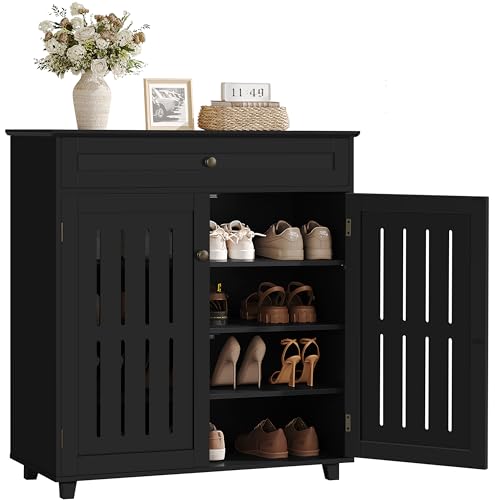
Shoe cabinets divide into a few honest families, and naming them clarifies every later decision. The flip-drawer or tipping-drawer cabinet is the slim specialist: shallow, tall, closed, brilliant for low shoes in narrow halls, useless for boots. The shelf cabinet with hinged doors is the generalist — adjustable shelves swallow trainers, heels and some boots, at the cost of more depth. The cubby cabinet divides space into fixed cells, which suits households that like assigned places and children who need simple systems, though fixed cells waste space on odd-shaped footwear. Open rack cabinets trade dust protection and looks for airflow and instant access, and remain the right answer for damp-heavy households. Bench cabinets add a seat — genuinely useful where people sit to lace boots — but seating height limits storage height. Most real products blend these families: a cabinet may pair flip drawers above with a shelf bay below, or doors over cubbies. Shop the blend that matches your shoe mix rather than the label, and check each compartment type against the shoes you actually own before falling for a handsome front.
Flip-drawer cabinets: the slim specialists
Choose this type when depth is your binding constraint and your daily shoes are low. The tipping tray stores shoes in a fraction of a shelf’s depth, the closed front calms a narrow hall, and access is quick. Accept the exclusions as permanent: boots, high-tops and the chunkiest trainers live elsewhere, and capacity for large sizes runs below the headline count.
Shelf cabinets: the generalists
Choose this type when your collection is mixed and your room can spare depth and door swing. Shelves accept almost anything low or mid-height, adjustable spacing creates a boot bay where designs allow, and the cabinet doubles as real furniture with a usable top. Accept the managed compromises: shoes go in dry, the interior gets aired, and the footprint is a commitment.
Cubby, open and bench designs: the specialists
Cubbies suit households that run on assigned places — families above all. Open racks suit damp-heavy, access-first storage in closets, garages and utility spaces. Bench cabinets suit homes where sitting to lace boots is a daily ritual and storage height can be traded for a seat. Many households honestly need a hybrid: a closed cabinet for the hall plus a tray or rack where the wet and tall footwear lives.
Top Picks at a Glance
The table below positions the guide’s six representative cabinets by role and qualitative tier — Best Overall, Best for Small Spaces and so on — because roles outlast prices. Each pick is treated in prose only in this guide, with a pick slot marking where its full listing link belongs at publication.
| Pick | Badge | Format | Tier in words |
|---|---|---|---|
| VASAGLE Shoe Cabinet | Best Overall | Shelf cabinet with doors | Mid tier |
| HOMIDEC Shoe Cabinet | Best for Small Spaces | Slim tipping drawers | Entry tier |
| TRIBESIGNS Shoe Cabinet | Best for Families | Doors plus drawer storage | Mid tier |
| SeeSpring Shoe Cabinet | Best Slim Alternative | Flip drawers | Entry tier |
| Prepac Shoe Storage Cabinet | Best for Assigned Order | Cubby cabinet | Practical tier |
| Yaheetech Shoe Rack Cabinet | Best for Airflow | Open tiered rack | Entry tier |
How Much Capacity Do You Really Need?
Treat every capacity claim on a shoe cabinet listing as optimistic. Makers count pairs using slim shoes in small sizes, perfectly nested, in every compartment including the ones real households reserve for boots or cleaning supplies. A cabinet advertised with a generous pair count may hold noticeably fewer once your household’s actual mix goes in: men’s sizes take more room than women’s flats, trainers are bulkier than sandals, and one pair of winter boots can consume a compartment a listing counted for several pairs. Flip drawers shrink usable capacity further because their tilted trays reject tall footwear entirely. The honest way to shop is to count your own shoes first — the pairs that genuinely need to live by the door, not the whole collection — and then assume any cabinet delivers somewhat less than its headline number for your mix. Leave headroom, too: a cabinet filled to one hundred percent is a cabinet nobody wants to open, and the overflow pair on the floor beside it is how entryway clutter restarts. Buying slightly more cabinet than your current count, in a format your bulkiest everyday shoes actually fit, beats buying the biggest number on the page.
How Deep Can Your Hallway Honestly Go?
Measuring for a shoe cabinet is a five-minute job that prevents the most common return in this category: the cabinet that fits the wall but fights the room. Start with the obvious — width along the wall, height under any rail or shelf, and depth from skirting board to the furthest point the cabinet can occupy without crowding the walkway. Then measure the things people forget. A flip drawer needs clear floor in front of it to tilt open; a hinged door needs swing room that does not clip the front door’s own arc. Check that the open front door, coat hooks above, and any radiator or light switch still work with the cabinet in place. Note floor level, too: hallways in older homes slope, and a tall cabinet on an uneven floor rocks until it is levelled and anchored. Finally, measure your bulkiest everyday shoes, not your neatest pair — the cabinet must swallow the trainers and boots you wear weekly, or it will store the shoes you rarely use while the daily pairs pile up beside it. Write the numbers down and shop against them; a cabinet chosen against real measurements feels custom, and one chosen by eye rarely does.
Small entryways are where shoe cabinets earn their keep, and also where the wrong one hurts most. The slim flip-drawer format exists precisely for narrow halls: it stores shoes in a shallow footprint that a shelf rack cannot match, and its closed front reads as a console rather than storage, which calms a small space visually. The discipline is depth honesty — measure the walkway with the drawer tilted open, not just closed, and leave comfortable passing room, because a cabinet you sidle past daily will annoy you daily. Vertical space is your ally: a taller anchored cabinet on a small footprint usually beats a wide low one in a tight hall, provided the wall fixing is done properly. Mirror-front and light-finish designs reflect what light a hallway has and feel smaller than they are. If even a slim cabinet overwhelms the space, be honest about the alternatives — an over-the-door organiser inside a closet, or a low rack under a bench — rather than forcing furniture into a room that rejects it. The goal is a hallway that works at eight in the morning with bags, coats and children in it, not one that photographs well empty.
Will It Hold Your Tallest, Bulkiest Shoes?
Boots are the footwear that breaks shoe cabinet plans. Flip drawers reject them outright — the tilted tray is built for low shoes — and even shelf cabinets often space their shelves for trainers, leaving tall boots to slouch, fold, or live elsewhere. Plan boot storage explicitly rather than discovering the problem in November. Some cabinets include one taller compartment or a removable shelf that creates a boot bay; that single flexible space is worth more than several extra slim compartments. If no cabinet in your depth budget offers a boot bay, pair the cabinet with a simple boot tray beside it for the wet season, and accept the hybrid openly instead of crushing boot shafts into spaces that damage them. Storing boots folded or crushed ruins their shape over a season, so the honest solution is always a space that lets them stand. Work boots and wellies bring mud as well as height: a washable tray under them, inside or beside the cabinet, keeps grit and meltwater off the cabinet floor and your hallway boards. Households in wet climates should weight this section heavily — the cabinet that handles your boots handles your hardest storage problem, and everything else is easy by comparison.
How Will You Keep a Closed Cabinet Fresh?
Ventilation is the honest trade-off at the heart of every closed shoe cabinet. Doors hide the mess and keep dust off, but a sealed box also traps whatever your shoes bring home: warmth, residual sweat, damp from a rainy commute, and the odour that follows. Leather and fabric uppers need to dry between wears, and a cabinet that never breathes can keep shoes faintly musty and, in humid homes, invite mildew on linings and glues. The practical habits are simple. Never store wet or just-worn shoes straight into a closed cabinet — let them air in the open for a few hours first, ideally overnight after a wet day. Leave doors ajar occasionally on a dry day, choose designs with slatted, louvred or vented backs where you can, and drop a simple moisture absorber or odour sachet in the bottom compartment if your hallway runs humid. Rotate pairs so the same shoes are not sealed away day after day. None of this makes a closed cabinet a bad choice — it makes it a managed one. If your household generates a lot of damp trainers and work boots, an open rack may honestly serve you better, and this guide says so where it applies rather than pretending doors suit everyone.
How Solid Is the Build, and What Moves?
Most shoe cabinets in this class are built from engineered wood — particleboard or medium-density fibreboard with a foil, melamine or painted finish — with solid wood and metal-frame designs appearing as you move up in tier. Engineered panels keep a large cabinet affordable and light enough to move, and modern finishes shrug off the scuffs of hallway life well. Their weakness is moisture and edge damage: a chipped corner drinks damp from wet shoes, swells, and never quite recovers, which is why wiping spills and storing only dry shoes matters more with this construction than the brochures admit. Check how panels join — cam locks and dowels are standard, and a cabinet assembled carefully, with glue in the dowels and every fastener snug, feels dramatically more solid than the same design rushed together. Backs are often thin hardboard; a flimsy back is not a deal-breaker once the cabinet is anchored, but it is another reason not to skip the wall fixing. Handles, hinges and flip-drawer pivots are where daily quality lives: metal hardware outlasts plastic, and a drawer front that aligns evenly on day one is the best predictor of one that still aligns in year three.
Most slim shoe cabinets use tipping drawers, also called flip drawers: the front panel and a shallow tray tilt forward together, and shoes sit heel-down in the tilted compartment. The design is clever space engineering — it stores shoes in a fraction of the depth a shelf needs — but it behaves differently from a normal drawer and deserves honest description. The compartment is shallow, so chunky trainers, high-tops and most boots simply do not fit, whatever the listing photograph suggests. Shoes rest at an angle, which suits flat and low-heeled styles best. The pivot mechanism is the moving part that wears: treat it gently, do not force an overfilled drawer shut, and expect a budget hinge to feel looser after a year of daily family use than it did on day one. Mind pinch points, too — the tilting front can nip fingers, and small children find the motion irresistible, which is one more reason the cabinet behind the drawer must be anchored to the wall. Used within its limits, a flip drawer is fast, tidy and satisfying. Loaded with the wrong shoes, it becomes the drawer that never quite closes, and the shoes migrate back to the floor in front of it.
How to Prioritise by Use Case
The narrow-hall apartment: depth first, everything else second. A slim flip-drawer cabinet, anchored, storing the low daily rotation, with seasonal and tall footwear in a closet. Judge success by whether the walkway still breathes with the drawers open.
The family house: compartments and robustness first. A larger shelf or cubby cabinet near the door, a low compartment per child, heavy shoes low, and the wall anchor treated as part of assembly. Judge success by whether the hallway resets itself each evening without negotiation.
The mixed-collection home: flexibility first. A shelf cabinet with spacing you can adjust, one taller bay if boots matter, and an honest overflow plan — a rack in the closet beats a cabinet stuffed past closing.
The wet-climate household: airflow first. An open rack where the daily wet rotation dries, possibly paired with a smaller closed cabinet for the tidy pairs. Judge success in winter, not in the showroom season.
best shoe cabinet options for small spaces
best shoe cabinet picks for families
The Picks in Detail
Each mini-review below carries the same verdict structure — best for, not suited for, strengths and trade-offs — so the six can be compared honestly at a glance. All are presented in prose; check the current listing for the model that matches your measurements and shoe mix.
VASAGLE Shoe Cabinet — shelf cabinet with doors
The VASAGLE Shoe Cabinet takes the shelf-cabinet route: hinged doors over interior shelves, in the warm, furniture-first styling the brand is known for. Shelves change the storage conversation — instead of tilted trays dictating what fits, you get level space that accepts trainers, heels, ankle boots and the odd shoebox, and adjustable or removable shelving on designs of this type lets one bay grow taller for boots. It asks for more depth than a flip-drawer unit and room for its doors to swing, so it suits a proper entryway, bedroom wall or closet rather than the slimmest corridor. The closed doors keep dust off and visual noise down, with the familiar ventilation caveat: store shoes dry and air the interior occasionally. Hardware and finish sit in the solid mid tier — the kind of cabinet that feels like furniture because it is built and finished like furniture. For households whose shoe mix defeated a flip drawer, this is the natural next step.
Best for: mixed shoe collections including ankle boots, and rooms with depth to spare. Not suited for: the narrowest hallways or anyone who cannot give doors swing room. Strengths: flexible shelf space; furniture styling; fits taller styles than flip drawers. Trade-offs: deeper footprint; door swing needs clearance; interior needs the usual airing habit.
HOMIDEC Shoe Cabinet — slim tipping-drawer cabinet
The HOMIDEC Shoe Cabinet represents the slim tipping-drawer school at its most straightforward: a tall, shallow, closed cabinet whose flip compartments swallow everyday low shoes while asking very little floor space in return. In prose terms it sits in the entry tier of this category — the kind of cabinet bought to solve a narrow hallway this weekend rather than to furnish a home for a decade — and judged on those terms it makes its case well. The closed front keeps a chaotic shoe collection visually silent, the tilted trays are quick to load one-handed while holding a bag, and the format suits flats, loafers, trainers and school shoes in the sizes most households wear daily. Its limits are the format’s limits, stated plainly: boots and high-tops do not fit the trays, capacity for bulky men’s trainers runs below the optimistic listing count, and the pivot hardware rewards gentle use. Anchored to the wall as every tall slim cabinet must be, it is a tidy, honest answer to a small entryway.
Best for: narrow hallways and small apartments storing mostly low everyday shoes. Not suited for: boot-heavy households or anyone wanting open airflow. Strengths: shallow footprint; closed, calm front; quick one-handed loading. Trade-offs: flip trays reject tall footwear; engineered panels dislike standing damp; hardware is entry-tier and prefers a gentle hand.

TRIBESIGNS Shoe Cabinet — larger cabinet with doors and drawer storage
The TRIBESIGNS Shoe Cabinet plays a different game from the slim flip-drawer pair above: it is a fuller piece of entryway furniture, combining closed shelving behind doors with drawer storage for the gloves, keys and clutter that share a hallway with shoes. That breadth makes it the family option in this line-up — more compartments, more varied spaces, and room for the shoe mix a household actually owns rather than only its flattest members. The cost is footprint: it needs a wall and floor area the slim cabinets do not, and in a narrow hall it would crowd the walkway it is meant to civilise. Assembly is a bigger job, too, simply because there is more cabinet. In return you get the generalist virtues — shelves that accept trainers and heels, closed storage that hides everything, and a top surface that works as a proper console. Anchor it, load heavy pairs low, and it anchors the entryway routine of a busy home.
Best for: families and larger entryways wanting one cabinet to hold shoes plus hallway clutter. Not suited for: narrow halls where depth is the binding constraint. Strengths: varied storage in one unit; furniture presence; shelves suit mixed footwear. Trade-offs: larger footprint; longer assembly; closed shelves still need dry-shoe discipline.
SeeSpring Shoe Cabinet — slim flip-drawer cabinet
The SeeSpring Shoe Cabinet is another committed flip-drawer design, aimed at the same narrow-hall problem and solving it the same way: stacked tipping compartments behind a flat, furniture-like front. Its appeal is how completely it disappears — closed, it reads as a slim console; open, each drawer presents its pairs at an angle that makes choosing shoes quick. As with every cabinet of this type, the experience depends on matching it to the right footwear: low and mid-height everyday shoes load and retrieve beautifully, while chunky trainers crowd the trays and tall styles are excluded entirely. Ventilation is the other managed compromise — shoes should go in dry, and the cabinet benefits from doors left open on a dry day now and then. Build and hardware are squarely in the practical tier, which is fair for its role. Treat the pivots kindly, anchor the unit to the wall before first use, and it delivers the calm hallway it promises.
Best for: slim entryways, renters who can anchor, and households of low-shoe wearers. Not suited for: families storing many bulky trainers or any boots. Strengths: very shallow depth; tidy closed look; compartments keep pairs separated. Trade-offs: no tall-footwear storage; sealed interior needs airing habits; tray capacity runs below headline claims for larger sizes.
Prepac Shoe Storage Cabinet — cubby-style storage cabinet
The Prepac Shoe Storage Cabinet represents the cubby approach: a bank of individual cells, each sized for a pair, behind a clean flat front. Cubbies impose order by architecture — every pair has an address, children can learn the system in a day, and the morning search shrinks because there is nowhere for a shoe to hide except its own cell. The rigidity cuts both ways: cells sized for average shoes waste space on sandals and refuse oversized trainers or boots, so this format rewards households whose collection is uniform and punishes collectors of the bulky and tall. Prepac’s flat-pack furniture background shows in a design meant to assemble predictably and sit flat against a wall — where, like every tall storage unit, it must be anchored before use. For a family that wants assigned places and a hallway that resets itself each evening, the cubby cabinet is less a compromise than a system.
Best for: families wanting assigned compartments and a self-organising hallway. Not suited for: collections heavy in boots, high-tops or oversized trainers. Strengths: every pair has a fixed place; child-friendly system; tidy flat front. Trade-offs: fixed cells waste space on small shoes; tall footwear excluded; sealed cells need dry shoes and occasional airing.

Yaheetech Shoe Rack Cabinet — tiered rack-style cabinet
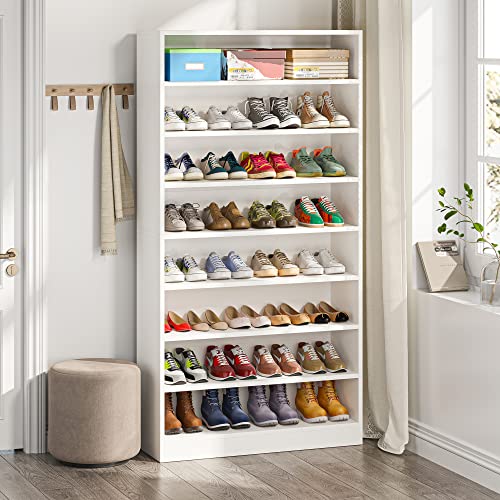
The Yaheetech Shoe Rack Cabinet leans toward the open, tiered end of the family — rack-style storage that prioritises airflow and instant access over a sealed, furniture-front look. That openness is a genuine feature for the right household: wet-weather trainers and work shoes dry instead of stewing, every pair is visible at a glance, and there are no mechanisms, pivots or doors between you and your shoes at seven in the morning. The trade-offs are equally genuine — dust settles, the look is utilitarian rather than calm, and a rack does nothing to hide a sprawling collection. Capacity in this format tends to be honest, because open tiers do not hide the space each pair takes, though tall boots still need a tier with real height. As a garage, utility or closet solution, or for a damp-climate hallway where drying matters more than appearances, this style earns its place in the line-up precisely by refusing to be a closed cabinet.
Best for: damp-heavy households, garages, closets, and anyone who values drying and access over looks. Not suited for: formal entryways where a hidden, furniture finish is the point. Strengths: best airflow of the group; no moving parts to wear; quick access. Trade-offs: dust settles on stored shoes; visual clutter stays visible; tall boots need a tall tier.
First Setup and Care Essentials
Assembly is the hidden cost of every flat-pack shoe cabinet, and planning for it honestly saves tempers. Expect a build measured in a relaxed hour or two rather than minutes, with the usual flat-pack choreography: many similar panels, bags of near-identical screws, and instructions that reward patience over speed. Lay every part out first, confirm the hardware count before you begin, and build on a rug or blanket so finished faces are not scratched by the floor they will stand on. Two people make the tall-cabinet stages far easier — one holds panels square while the other drives fasteners — and the final stage is non-negotiable: level the cabinet, then anchor it to the wall before a single shoe goes in. Keep the Allen key; flip-drawer pivots and door hinges benefit from a snug-up after the first month, once the cabinet has settled under load. If a panel arrives damaged, photograph it before assembly rather than after — replacement parts are far easier to arrange with evidence that the damage predates your screwdriver. None of this is difficult, but a cabinet thrown together in a hurry wobbles, and a wobbling tall cabinet is precisely the one that needed the most care.
Before anything else, the safety rule that shapes every tall shoe cabinet decision: a tall, narrow cabinet must be anchored to the wall. This is not optional fine print. A slim cabinet is deepest at its base only in the loosest sense — load the top shelves with heavy boots, let a child pull on an open flip drawer or climb a shelf to reach a hat, and the centre of gravity walks forward until the whole unit tips. Tip-over accidents with lightweight bedroom and hallway furniture are a well-documented household hazard, and entryway cabinets are exactly the tall, shallow, top-loaded shape that tips most easily. Every cabinet discussed in this guide should be fixed to a stud or a proper wall anchor with the anti-tip strap or bracket the maker supplies, or with a furniture strap you add yourself. If you rent and cannot drill, choose a low, wide cabinet instead of a tall slim one, load the heaviest shoes at the bottom, and never let children treat drawers as steps. Anchoring takes minutes, costs almost nothing, and turns a wobble-prone tower into a piece of furniture you can load without thinking about it. Do it on assembly day, not after the first scare, and re-check the strap whenever you move the cabinet for cleaning or redecorating.
A shoe cabinet asks for little care, but the little it asks for matters. Wipe the interior shelves or trays monthly — grit carried in on soles is abrasive, and a gritty tray grinds finish off both the cabinet and your shoe heels. Vacuum the bottom compartment where dirt collects, and check the floor beneath during the same pass; damp trapped under a cabinet is invisible until it marks flooring. Keep the moisture rules from the ventilation discussion: dry shoes before storing, air the cabinet on a dry day now and then, and refresh any odour absorber before it saturates. Tighten hinges, handles and flip-drawer pivots a couple of times a year, and confirm the wall anchor is still taut — straps can slacken when a cabinet is nudged by vacuuming or enthusiastic children. Wipe exterior scuffs promptly; on foil and melamine finishes a scuff cleaned early is invisible, while one left to collect grime becomes permanent. Finally, resist the slow creep of using the top as a dumping shelf for post, keys and parcels: a clear top keeps the cabinet looking like furniture, and keeps weight off the part of the unit furthest from its base.
Mistakes to Avoid
The classic mistakes repeat across this category. Buying by headline capacity instead of your own pair count. Choosing flip drawers for a boot household. Measuring the wall but not the walkway with drawers open. Skipping the wall anchor on a tall unit — the single most consequential shortcut in this guide. Storing wet shoes in a sealed cabinet and blaming the cabinet for the smell. Filling every compartment on day one so the system has no slack and the overflow restarts the floor pile. And buying a second cabinet before decluttering the collection the first one was meant to hold — a clear-out is the cheapest capacity upgrade in this entire category.
entryway benches for small spaces
Shoe Cabinet Buying Guide: Final Word
A good shoe cabinet purchase is boring in the best way: measured, matched, anchored, and then forgotten while the hallway quietly works. Use this guide’s order of operations — space, shoes, format, model — and the cabinet you choose will still be earning its floor space years from now.
What About Style, Finish and the View From the Door?
A buying guide that ignored looks would be lying about how hallways work: the shoe cabinet is often the largest object in the first room a guest sees, and its front is effectively a wall of your home’s first impression. The practical guidance is simpler than the styling industry suggests. Choose a finish that can be wiped without ceremony, because hallway furniture meets grit and damp hems weekly. In a small or dark hall, a finish close to the wall colour makes the cabinet recede and the room breathe; in a larger entryway, a deliberate contrast turns the cabinet into the room’s anchor piece, which suits households that want the entryway to feel furnished rather than fitted. Flat fronts are the easiest to clean and the calmest visually; slatted and louvred fronts buy airflow at the price of dusting patience — in a humid home that trade can be worth it, and this guide flags it as a freshness decision wearing a style costume. Handles are the jewellery: choose metal, choose a shape small hands and bag straps will not snag, and know that swapping handles later is the cheapest restyle this furniture allows.
Delivery, Assembly Day and the First Week
Buying well includes planning the arrival. Flat-pack cabinets arrive heavy and in panels; clear the hallway before delivery day rather than building the cabinet in the chaos it was bought to cure. Inspect panels before assembly and photograph any damage immediately — replacement parts are straightforward to arrange with evidence and awkward without it. Build where the cabinet will stand if space allows, because a tall assembled unit is an awkward thing to carry through doorways. Anchor before loading, without exception, and then run the first week deliberately: assign places, relocate the shoes that do not fit on day one rather than letting them lean, and set the dry-shoe habit while the household’s attention is on the new system. Cabinets are made or lost in that first week; the guide’s last buying advice is to spend it well.
Keep the paperwork and the spare hardware. Flat-pack furniture sheds the occasional screw over the years, finishes occasionally need a touch-up, and a cabinet whose maker still supplies parts is a cabinet with a longer life. None of this is glamorous, and all of it is the difference between a purchase and an investment in how your home runs.
A Word on Buying for a Household, Not a Person
Most shoe cabinets are bought by one person and used by several, and the buying mistakes multiply when the buyer shops only their own shoes. The household’s largest shoe size, not the buyer’s, decides whether trays and shelves fit. The household’s least tidy member, not its most organised, decides whether the system survives — choose compartments simple enough for the person least likely to use them carefully, because a system that depends on everyone’s best behaviour has no margin on a bad morning. Children’s growth belongs in the calculation too: a cabinet sized exactly for today’s small shoes is undersized within a few school years, which is one more argument for the headroom this guide keeps recommending. Finally, involve the household in the format decision at the level of a hallway conversation — people defend systems they helped choose and route around systems imposed on them. The best buying decision in this category is technically sound and socially adopted, and the second quality is purchased with five minutes of consultation rather than money.
The Buying Guide in One Passage
If this guide were reduced to the paragraph a friend would give you in the hallway itself, it would run like this. Measure the walkway with drawers imagined open, then count and sort your actual shoes, bulkiest first. Let the bulkiest daily pair choose the format — flip drawers for low shoes in narrow halls, shelves for mixed collections, cubbies for families who run on assigned places, open storage for the wet rotation. Discount the capacity on the box and buy headroom. Choose metal where it moves, plan the wall anchor before the delivery, and decide where the boots and the guests’ shoes will go. Then, and only then, compare models — by tier, by finish your hallway can live with, and by the verdict structure in this guide. A purchase made in that order is almost never returned, almost never reviewed with regret, and almost never thought about again, which is the whole point of buying entryway furniture well.
And one last check belongs at the very end of the buying process, after the model is chosen and before the order is placed: read the chosen cabinet’s details once more against your audit sheet, line by line — compartment type against bulkiest pair, claimed capacity against your discounted figure, depth against your taped walkway, anchoring kit against your wall. Five minutes of this unglamorous cross-checking catches the last class of buying error, the one where the right cabinet in the wrong variant, size or configuration is ordered by a tired click. The guide has asked a lot of questions; this final one is simply whether the answers survived the journey to the checkout.
Before You Order: A Practical Fit and Listing Check for the Shoe Cabinet
Most of the groundwork for choosing a shoe cabinet is covered above, so this section turns to the stage where orders are actually placed: verifying fit, reading listings critically and checking the practical details that photographs tend to hide. Work through it with your measurements and your shortlist in front of you.
Start With Your Space and Your Routine
A good test is the two-week question: imagine the shoe cabinet after a fortnight of ordinary use, with no special effort from you, and ask whether you would still choose it. Think about the end of the shoe cabinet’s life with you as well, including whether it could move to another room, be passed on, or be stored without damage when your needs change. Finally, judge the shoe cabinet against the life you actually lead this year, not the tidier or more ambitious life in the listing photographs, and the choice will usually make itself. Keep the care routine simple enough to repeat: a shoe cabinet that needs ten minutes of attention weekly will usually get it, while one that needs an hour monthly often gets none.
Build your shortlist in two passes: first remove every shoe cabinet that fails a hard requirement such as size, capacity or placement, then compare what remains on quality and feel rather than on features alone. Consider the busiest version of the day, not the calmest one, and ask whether the shoe cabinet still works when people are hurrying, carrying things or sharing the same space. Apply the same checks to each shortlisted example, whether that is the HOMIDEC Shoe Cabinet; the VASAGLE Shoe Cabinet; the TRIBESIGNS Shoe Cabinet, because consistent testing is what makes the differences between models visible. Dust, moisture, sunlight and heat each age Living Room Furniture items in different ways, so match the finish and material of the shoe cabinet to the conditions of the room or outdoor spot it will occupy.
When Small Problems Appear
Write down the three tasks you will do most often with the shoe cabinet and score each shortlisted option against those tasks alone, ignoring features you are unlikely to touch. If the shoe cabinet needs assembly, read the instruction preview if one is offered, count the steps honestly against the time you have, and check whether a second pair of hands is recommended. Keep the fittings, spare parts and instructions that come with the shoe cabinet together in one labelled place, because the part you need in a year is always the one that was put somewhere safe. If you are replacing an older shoe cabinet, list what failed or frustrated you about it, and check each item on that list against the new listing before you order its successor.
Take a break between shortlisting and ordering if you can, and return to the listings with fresh eyes, because fatigue makes almost any shoe cabinet look acceptable late in a long search. If a shoe cabinet comes in several sizes or configurations, choose by the measured demands of your space and household rather than by the middle option, which is a common default that suits nobody in particular. A slight wobble, a stiff action or a small misalignment on day one rarely improves on its own, so address it during setup while adjustments are still easy to make. If you shop with someone else, agree the must-haves together before looking, so that the shoe cabinet you choose is a shared decision rather than one person’s compromise discovered later.
The best shoe cabinet for a rented home may differ from the best for an owned one, because fixings, marks and alterations carry different consequences in each case. Where the shoe cabinet has a surface you will set things on, lean on, or load, consider the heaviest realistic load in your household rather than the lightest display load in the photos.
A Short Decision Checklist
- Who will use the shoe cabinet most, and any limits they have
- The one feature you will not compromise on
- Where the shoe cabinet and its accessories will be stored when not in use
- The material and finish, matched to light, moisture and wear in its spot
- The main job the shoe cabinet must do, written in one sentence
- Assembly needs, tools required and whether help is needed
- What your current arrangement does well that the shoe cabinet must not lose
- Packaging kept until the shoe cabinet has passed its first trial in place
Taken together, these checks take only a little time, yet they answer the questions that decide whether the shoe cabinet suits your home, your household and your routine, and they do so before money changes hands rather than after.
Frequently Asked Questions
What type of shoe cabinet is best for a small entryway?
A slim flip-drawer cabinet is usually the best fit, because its tipping trays store low shoes in far less depth than shelves need, and its closed front reads as a console. Measure the walkway with a drawer tilted open before committing, and anchor the tall unit to the wall. If your daily shoes include boots or chunky trainers that flip trays reject, a low shelf cabinet or a closet solution may honestly serve a small space better.
How many pairs should my shoe cabinet hold?
Count the pairs that genuinely need to live by the door — daily shoes for each household member, plus regular weekly pairs — then buy headroom above that number. Ignore headline listing counts, which assume slim small shoes perfectly nested; real collections hold fewer, especially in larger sizes. A cabinet running at comfortable capacity stays tidy, while one at maximum capacity gets bypassed and the floor pile restarts beside it.
Are shoe cabinets with doors better than open racks?
Neither is universally better. Doors win on looks, dust protection and order, and suit entryways where appearance matters. Open racks win on airflow and drying, and suit damp climates, work shoes and garages. Many households do best with both: a closed cabinet in the hall for the tidy rotation and an open rack or tray where wet and tall footwear dries. Choose by your shoes and climate, not by category loyalty.
Do I really need to anchor a shoe cabinet to the wall?
Yes, if it is tall or narrow — and most shoe cabinets are both. A loaded top shelf and an opened drawer shift weight forward, and children pulling or climbing raise the risk sharply. Anchoring with the supplied strap or bracket into a stud or proper wall anchor takes minutes and is the difference between a stable unit and a tip-over hazard. If you cannot anchor at all, choose a low, wide design instead and load it heaviest at the bottom.
Can a shoe cabinet store boots and high-tops?
Shelf cabinets can, where shelf spacing or a removable shelf creates a tall bay; ankle boots fit most shelf designs, and tall boots need deliberate height. Flip-drawer cabinets cannot — the tilted trays are built for low shoes, and no adjustment changes that. Cubbies depend on cell size. If boots are central to your household, shop for the tall bay explicitly, or pair the cabinet with a boot tray for the wet season.
What should I check before a shoe cabinet is delivered?
Confirm your hallway measurements against the cabinet’s depth plus drawer or door clearance, and your bulkiest shoes against its compartment type. Plan the assembly space, a second pair of hands for tall panels, and the wall you will anchor into — find the stud or buy proper anchors in advance. Finally, decide where overflow and boots will live if the cabinet cannot hold them, so delivery day completes a system instead of starting an argument with your hallway.
Related Guides
best shoe racks for open storage