Disclosure: As an Amazon Associate, dailyhomedecorating.com earns from qualifying purchases. Links on this page are affiliate links; they cost you nothing extra. Prices and availability change often, so check the current Amazon listing before you buy.
Learning how to choose solar garden lights well means reversing the usual shopping order. Instead of starting with styles and ending with your garden, you start with your garden — its sun, its shade, its routes and its surfaces — and let those facts narrow the styles until the choice is almost made for you. This guide walks through that process step by step, with worked examples for common households and a short prose-only shortlist of styles to consider once your criteria are clear, to be rechecked against current listings at publication.
Key Takeaways
- Map your sun and shade before looking at a single product.
- Name the job first: route, border, feature or atmosphere.
- Panel, battery access and seals matter more than brightness claims.
- Prove a small layout in your own weather before extending it.
In this guide
How To Choose Solar Garden Lights: The Method in Brief
The method in brief is to let the garden choose first and the catalogue second. Map the sun, name the jobs, match formats to surfaces, hold colour and height consistent by zone, inspect panels, batteries and seals, and prove a small layout before extending it. The steps that follow simply slow that sentence down into a process any household can follow in one weekend.
What You Need to Know Before Comparing
Beds that look open in spring can become shaded tunnels by July, when shrubs leaf out and perennials reach full height. A light that charged happily in April may struggle by midsummer simply because the garden grew around it, and the fix is rarely a new light — it is a small move sideways into a gap, or a light trim of the planting that leans over the panel. Gardeners who build a quick seasonal check into their routine, glancing at panels when they deadhead or weed, keep a layout performing instead of wondering why it faded.
Panel orientation sounds technical but is mostly common sense. A small panel tilted toward the open sky collects more than one lying flat under a overhanging leaf, and a panel that faces the brightest part of your sky will outperform one turned toward a wall. Many stake lights fix the panel angle for you, which is fine in open ground and limiting under trees. Where a design allows a separate or adjustable panel, a few minutes spent aiming it at unobstructed sky pays back every single evening. Treat placement as part of the product, because with solar lighting it genuinely is.
Everything a solar garden light does begins with the sun it actually receives, not the sun your garden gets in general. A panel shaded by a fence panel, an evergreen shrub or the eaves of the house may spend the whole day in soft shadow while a bed two steps away bakes in full light, and the two lights will behave like different products by evening. Before you judge any model, walk the garden at a few times of day and watch where the shadows fall, because that map, more than any brand name, decides which lights glow until late and which fade early. Honest expectations start there: solar lighting rewards sunny placement generously and punishes hopeful placement in deep shade without exception.
Longevity varies more than first impressions suggest. A cheap stake light in a sunny, sheltered garden can serve cheerfully for seasons, while a better light in a shaded, exposed corner dies early through no design fault. That is why sweeping verdicts about the whole category — wonderful or rubbish — are usually reports about one garden’s sun wearing a product’s name. Judge a model in conditions like yours, weight placement and care as heavily as brand, and treat any single dramatic success or failure story, including the ones in this guide’s category, as one data point rather than a law.
Brightness claims in this category should be read with generous scepticism. Without a wired supply, output is bounded by what a small panel gathered that day, so the same light is genuinely brighter after a clear June day than after a murky November one. Comparing models by their best-case claims therefore misleads; compare them by construction, battery access, panel size and position, and by how gracefully they fade. A light that dims gently late in the evening is behaving normally, not failing, and planning layouts that look good at moderate brightness is the real skill in solar lighting.
How to Choose Solar Garden Lights in Seven Steps
Step One: Walk the Garden at Night
Decide what actually needs light by walking your routes after dark with fresh eyes. Note where you hesitate — a step, a gate latch, a turn, a low edge — because those hesitation points are your true lighting brief, and they are rarely where a catalogue would put the lights. Also note where darkness is pleasant, around seating and under trees, so the plan protects atmosphere instead of flooding it away.
Colour of light changes a garden more than brightness does. A warm glow flatters brick, timber, skin and most planting, and it is what most households picture when they imagine a garden in the evening. A cooler, whiter light can look crisp against stone and modern paving but can also feel stark among leaves. Mixed sets bought at different times often clash quietly, so if a unified look matters, buy the run of a path from one family of lights in one go, and add decorative pieces deliberately rather than accidentally accumulating five slightly different whites along the same route.
Step Two: Map Sun and Shade Honestly
Across one ordinary day, check candidate positions in the morning, at midday and in the late afternoon, and mark each as sunny, mixed or shaded. Repeat the exercise mentally for winter, when the sun sits lower and fences and houses throw longer shadows. This map is the single most valuable document in the whole purchase, because it tells you where solar will thrive, where it will merely cope, and where a different kind of light is the honest answer.
The most common placement mistake is also the most understandable: putting the light where the effect is wanted instead of where the panel can work. A stake tucked deep inside a border glows beautifully in a catalogue photograph and starves in a real garden, because the planting that frames it also shades it. The working compromise is the front edge of the bed, the sunny side of a shrub, or a small clearing among low planting — positions where the panel sees open sky while the glow still washes across leaves and paths. When in doubt, favour the panel; a well-charged light in a slightly plainer spot beats a starved light in the perfect one.
Step Three: Match the Format to the Surface
Soil and lawn edges take stakes; paving, decking and walls need surface, deck or wall formats; pots can host small stakes or decorative pieces. Forcing a stake into gravel or leaving it wobbling in a crack guarantees a short, annoying life. Walk each position with its surface in mind and let the ground itself veto formats, because a secure, upright light always looks and performs better than a clever one installed badly.
Spacing shapes whether a path feels guided or merely dotted. Lights placed too far apart leave pools of darkness that make a route feel broken, while lights crowded together waste money and flatten the effect into a runway. A staggered rhythm along a path — alternating sides, tightening near steps and gates, relaxing along straight stretches — usually looks more natural than rigid pairs. Live with a layout for a few evenings before you finalise it, moving stakes is free, and the garden at night always reveals spacing problems that daylight hides completely.
Step Four: Choose the Light Colour and Mood
Decide the feeling before the fixtures. Warm light for planting, timber, brick and places people sit; crisper light only where stone and modern lines ask for it. Then hold the whole route to that one decision, buying matched pieces for a run rather than accumulating near-misses. Mood is not a soft extra in garden lighting — at night, mood is most of what the lights are for.
Everything a solar garden light does begins with the sun it actually receives, not the sun your garden gets in general. A panel shaded by a fence panel, an evergreen shrub or the eaves of the house may spend the whole day in soft shadow while a bed two steps away bakes in full light, and the two lights will behave like different products by evening. Before you judge any model, walk the garden at a few times of day and watch where the shadows fall, because that map, more than any brand name, decides which lights glow until late and which fade early. Honest expectations start there: solar lighting rewards sunny placement generously and punishes hopeful placement in deep shade without exception.
Step Five: Inspect Panel, Battery and Seals
For each candidate, ask three plain questions. Is the panel reasonably placed and sized for the light’s ambition? Can the battery be replaced when it tires, or is the light sealed and disposable? Do caps, lenses and compartments look sealed against the rain your garden actually gets? A design that answers these well will outserve a brighter claim with poor answers, especially by its second season.
Spacing shapes whether a path feels guided or merely dotted. Lights placed too far apart leave pools of darkness that make a route feel broken, while lights crowded together waste money and flatten the effect into a runway. A staggered rhythm along a path — alternating sides, tightening near steps and gates, relaxing along straight stretches — usually looks more natural than rigid pairs. Live with a layout for a few evenings before you finalise it, moving stakes is free, and the garden at night always reveals spacing problems that daylight hides completely.
Step Six: Plan Spacing and Numbers Conservatively
Lay out fewer lights than your first instinct suggests, staggered along routes and tightened only at steps and gates. You can always add; you cannot easily make a crowded runway look calm again. Count positions from your night walk, not from the length of the path alone, and leave budget in reserve for the one or two accent pieces — a flame light, an uplight — that give a finished layout its character.
Winter storage is a genuine choice rather than a rule. Hardy pathway lights often stay out all year and cope, but decorative and flame-effect styles last longer when the worst frosts are spent in a shed, cleaned, switched off and stored dry. If you leave lights out, expect shorter winter run times and check that meltwater is not sitting in the head. Either way, a light brought in or checked over in autumn should have its panel wiped and its battery state considered before spring, so the first long evenings of the new season start with a full, healthy charge.
Step Seven: Prove It Small, Then Extend
Buy a small number first and live with them through bright days and dull ones. Clean a panel, move a stake, watch the winter fade if the season allows, and learn what your garden does to this technology. Then extend the proven choice along the route with confidence. This patience is the difference between a layout that grows better each season and a drawer of abandoned lights.
Cleaning the panel is the highest-value maintenance a solar light ever asks for, and it takes seconds. Dust, pollen, dried rain spots and bird lime all film the surface and quietly tax the charge the battery receives, so a light that seems to be dying is often simply a light that cannot see the sun properly. Wipe the panel with a soft, damp cloth whenever you notice the film building, and check again after nearby building work, bonfires or a storm that throws grit around the garden. No solvents, no scouring pads and no pressure washer — the panel surface scratches easily, and a scratched panel clouds permanently.
Gear for This Guide
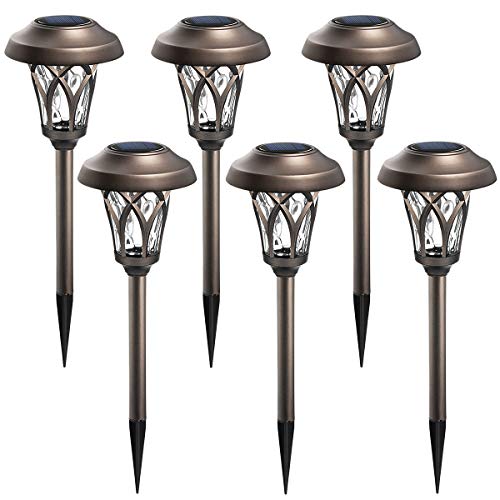
BEAU JARDIN Solar Garden Lights
Position in this guide: a classic pathway style with a decorative patterned glow, best suited to front walks and borders where a warm, traditional look matters more than raw brightness. Treat this as a prose-only shortlist entry until its listing is rechecked at publication, and compare its current listing details before you buy, because pack contents and finishes in this category change without much notice.
The traditional starting point for a front path, and the style used in most of the worked examples below.
Best for: households whose garden matches the role described above. Not suited for: deep shade, or anyone expecting wired-light brightness from a solar panel.

GIGALUMI Solar Pathway Lights
Position in this guide: a widely chosen pathway option in a simple stake format, suited to lining both sides of a path in matching sets and to renters who want light without any wiring. Treat this as a prose-only shortlist entry until its listing is rechecked at publication, and compare its current listing details before you buy, because pack contents and finishes in this category change without much notice.
The consistency pick for a longer route bought as one matched family.
Best for: households whose garden matches the role described above. Not suited for: deep shade, or anyone expecting wired-light brightness from a solar panel.

TomCare Solar Lights
Position in this guide: a flickering flame-effect style that trades a steady beam for movement and atmosphere, making it a patio and seating-area choice rather than a pure wayfinding light. Treat this as a prose-only shortlist entry until its listing is rechecked at publication, and compare its current listing details before you buy, because pack contents and finishes in this category change without much notice.
The atmosphere accent to add once the route itself is solved.
Best for: households whose garden matches the role described above. Not suited for: deep shade, or anyone expecting wired-light brightness from a solar panel.
Maggift Solar Garden Lights
Position in this guide: a straightforward stake light approach suited to smaller gardens, pots and starter layouts where simplicity and easy repositioning matter most. Treat this as a prose-only shortlist entry until its listing is rechecked at publication, and compare its current listing details before you buy, because pack contents and finishes in this category change without much notice.
The small-garden and pots option for a first, low-commitment layout.
Best for: households whose garden matches the role described above. Not suited for: deep shade, or anyone expecting wired-light brightness from a solar panel.
Common Mistakes
Steps, gates and level changes deserve light before purely decorative spots do, because that is where a stumble actually happens. A modest glow at the top and bottom of garden steps, beside a latch, or where a path meets a patio edge does more practical work than a dozen lights scattered through flower beds. Solar lights will not turn a dark staircase into a lit hallway, and they should never be your only answer where a fall would be serious, but as gentle markers of edges and changes they are genuinely useful, and they ask for no wiring in exactly the awkward places wiring is hardest to run.
Longevity varies more than first impressions suggest. A cheap stake light in a sunny, sheltered garden can serve cheerfully for seasons, while a better light in a shaded, exposed corner dies early through no design fault. That is why sweeping verdicts about the whole category — wonderful or rubbish — are usually reports about one garden’s sun wearing a product’s name. Judge a model in conditions like yours, weight placement and care as heavily as brand, and treat any single dramatic success or failure story, including the ones in this guide’s category, as one data point rather than a law.
Honesty about limits is what separates a useful guide from a sales pitch, so here it is plainly: solar garden lights are accent and wayfinding lights. They mark edges, soften darkness, guide feet and flatter planting, but they do not replace a wired light over a work area, a security light by a door, or a lamp you read by. Households who buy them for the jobs they are good at tend to love them; households who secretly wanted floodlights tend to call them useless within a week. Neither reaction is about the product — both are about the match between expectation and physics.
Pro Tips
- Photograph your garden’s shadows at midday in summer and winter; the pair of pictures is your permanent buying guide.
- Keep one spare light from a matched set so a single failure never breaks the rhythm of a route.
- Wipe panels when you deadhead — pairing the tiny job with an existing habit means it actually happens.
- Mark your sunniest winter positions and move key path lights there for the dark months.
Winter storage is a genuine choice rather than a rule. Hardy pathway lights often stay out all year and cope, but decorative and flame-effect styles last longer when the worst frosts are spent in a shed, cleaned, switched off and stored dry. If you leave lights out, expect shorter winter run times and check that meltwater is not sitting in the head. Either way, a light brought in or checked over in autumn should have its panel wiped and its battery state considered before spring, so the first long evenings of the new season start with a full, healthy charge.
Cleaning the panel is the highest-value maintenance a solar light ever asks for, and it takes seconds. Dust, pollen, dried rain spots and bird lime all film the surface and quietly tax the charge the battery receives, so a light that seems to be dying is often simply a light that cannot see the sun properly. Wipe the panel with a soft, damp cloth whenever you notice the film building, and check again after nearby building work, bonfires or a storm that throws grit around the garden. No solvents, no scouring pads and no pressure washer — the panel surface scratches easily, and a scratched panel clouds permanently.
Worked Examples
A Shady Cottage Garden
Everything a solar garden light does begins with the sun it actually receives, not the sun your garden gets in general. A panel shaded by a fence panel, an evergreen shrub or the eaves of the house may spend the whole day in soft shadow while a bed two steps away bakes in full light, and the two lights will behave like different products by evening. Before you judge any model, walk the garden at a few times of day and watch where the shadows fall, because that map, more than any brand name, decides which lights glow until late and which fade early. Honest expectations start there: solar lighting rewards sunny placement generously and punishes hopeful placement in deep shade without exception.
Beds that look open in spring can become shaded tunnels by July, when shrubs leaf out and perennials reach full height. A light that charged happily in April may struggle by midsummer simply because the garden grew around it, and the fix is rarely a new light — it is a small move sideways into a gap, or a light trim of the planting that leans over the panel. Gardeners who build a quick seasonal check into their routine, glancing at panels when they deadhead or weed, keep a layout performing instead of wondering why it faded.
A Sunny, Paved Modern Garden
Steps, gates and level changes deserve light before purely decorative spots do, because that is where a stumble actually happens. A modest glow at the top and bottom of garden steps, beside a latch, or where a path meets a patio edge does more practical work than a dozen lights scattered through flower beds. Solar lights will not turn a dark staircase into a lit hallway, and they should never be your only answer where a fall would be serious, but as gentle markers of edges and changes they are genuinely useful, and they ask for no wiring in exactly the awkward places wiring is hardest to run.
Spacing shapes whether a path feels guided or merely dotted. Lights placed too far apart leave pools of darkness that make a route feel broken, while lights crowded together waste money and flatten the effect into a runway. A staggered rhythm along a path — alternating sides, tightening near steps and gates, relaxing along straight stretches — usually looks more natural than rigid pairs. Live with a layout for a few evenings before you finalise it, moving stakes is free, and the garden at night always reveals spacing problems that daylight hides completely.
A Family Garden With a Long Front Path
Spacing shapes whether a path feels guided or merely dotted. Lights placed too far apart leave pools of darkness that make a route feel broken, while lights crowded together waste money and flatten the effect into a runway. A staggered rhythm along a path — alternating sides, tightening near steps and gates, relaxing along straight stretches — usually looks more natural than rigid pairs. Live with a layout for a few evenings before you finalise it, moving stakes is free, and the garden at night always reveals spacing problems that daylight hides completely.
The most common placement mistake is also the most understandable: putting the light where the effect is wanted instead of where the panel can work. A stake tucked deep inside a border glows beautifully in a catalogue photograph and starves in a real garden, because the planting that frames it also shades it. The working compromise is the front edge of the bed, the sunny side of a shrub, or a small clearing among low planting — positions where the panel sees open sky while the glow still washes across leaves and paths. When in doubt, favour the panel; a well-charged light in a slightly plainer spot beats a starved light in the perfect one.
Choosing Well: Field Notes From Real Gardens
Finally, keep the purpose of the whole exercise in view on the evenings when you assess a layout. The goal was never a bright garden; it was a garden you can move through calmly, sit in comfortably and enjoy looking at after dark, with planting suggested rather than exposed and routes implied rather than announced. Solar garden lights serve that goal precisely because they are gentle, and every judgement in this guide — about placement, panels, batteries and seasons — is really a judgement about protecting that gentleness from the two things that spoil it: starved charging and inflated expectation.
A word about gifts and inherited sets, because many gardens acquire solar lights that way. A gifted set deserves the same fair trial as a bought one: clean panels, sunny positions, one adjustment round, and judgement after a bright day rather than a dull one. Pieces that still do not suit the routes often find a second life as accents in pots on a sunny step, where expectations are lower and charm matters more. Very few solar lights are truly useless; most are simply standing in the wrong job, and reassigning them costs nothing but a minute’s thought.
Colour consistency deserves a second mention because it is the detail visitors notice without naming. A path lit in one warm tone feels calm and intentional, while a path that drifts between warm and cool from light to light feels accidental, even when every individual light is performing perfectly. The cause is usually piecemeal buying across months or brands. If you inherit a mixed set, group the similar tones together by zone rather than alternating them, and let any future purchases pull one zone at a time toward a single family, so the garden improves with every addition instead of merely growing.
Children, dogs and visiting feet are part of the real specification of a garden light. A stake placed exactly on the line a football takes, or where a dog rounds a corner at speed, will be knocked, and the question is whether it survives the knock gracefully — bending back, reseating, carrying on — or cracks at the stem. In family gardens it is worth favouring sturdier, simpler constructions along play routes and saving delicate decorative pieces for beds and pots where traffic never goes. Matching the toughness of the light to the life of that corner is a buying skill no listing can teach.
There is a quiet environmental argument for choosing serviceable designs that goes beyond one garden’s satisfaction. A light whose battery can be replaced stays in the ground for years, while a sealed light becomes waste the day its cell tires, however sound its housing remains. Multiplied across a whole path of matching lights, that difference is the difference between a small bag of spent batteries over a decade and a whole set of discarded lights. Buyers cannot fix the category’s design habits alone, but favouring replaceable batteries rewards the makers who build for repair, and it saves the buyer money at the same time.
The first week with a new set teaches more than a month of reading, if you pay attention deliberately. Note which lights are still glowing when you go to bed and which have faded, then walk the positions the next day and ask why: a shadow you had not noticed, a panel filmed with pollen, a shrub that leans further than you thought. Most layouts need exactly one round of this honest adjustment — a move here, a trim there, a swap between a strong and a weak position — and after that round the garden and the lights settle into a working understanding that lasts for seasons.
Ground conditions matter more than most buyers expect. Soft loam takes a stake cleanly and holds it upright, while stony ground bends spikes, clay bakes hard in a dry summer, and loose gravel lets a light lean a little further every week until the row looks drunk. The practical answers are unglamorous: make a pilot hole with a hand tool in hard ground, firm soil around each stake rather than merely pushing it in, and check uprights after heavy rain when the ground softens. A layout that stands straight reads as quality all by itself, whatever the lights cost, and a leaning layout undermines even genuinely good products.
When a whole set ages together, replacement strategy matters. Replacing one failed light in an old matched run with a new piece often stands out, because the newcomer is brighter and its colour slightly different from its weathered neighbours. Gardeners who keep one spare from the original purchase avoid that patchwork, and those who did not can replace in a small group at a natural break — from a gate, say, or around a corner — so the change reads as a new zone rather than a repair. Thinking in zones, as with colour, height and style, turns maintenance into quiet design.
Reflections and surfaces play a part that daylight shopping never reveals. Pale paving bounces a modest glow surprisingly far, making a small light feel generous, while dark soil and dense planting absorb the same output and ask for lights placed a little closer together. Water — a pond edge, a bird bath, even a wet path after rain — doubles a light’s presence with a reflection that costs nothing. Gardeners who notice these surfaces can achieve with placement what others chase with brighter products, and the effect always looks more natural because it belongs to the garden rather than to the fixture.
Height changes the character of a solar light more than its appearance in a photograph suggests. A low light hugs the ground, marking edges and throwing its pool exactly where feet fall, while a taller light lifts the glow into planting and onto faces, becoming part of the scene rather than a guide beneath it. Routes generally want the lower, ground-hugging behaviour, and borders and seating corners can enjoy the taller presence. Mixing heights along one route usually looks restless, so choose a height per zone and hold it, the same discipline that applies to colour and style throughout a considered layout.
A detail that rarely appears in listings is how a light behaves at the end of an ordinary evening rather than at its start. Every solar light is at its best just after dusk, when the battery is fullest, and the differences between designs show themselves later, in how gracefully the glow softens as the charge is spent. A well-matched light fades like a candle burning down, still present, still useful as a marker, simply quieter. A poorly matched one falls off a cliff. When you assess any set, resist judging it in the first hour and take your real reading later in the evening, because that later character is the one you will actually live with for most of the night.
Seasonal rituals keep a layout performing without ever becoming a chore. In spring, wipe panels, reseat stakes loosened by frost and move lights that new growth will shade. In summer, glance at panels when you water pots, and enjoy the longest, brightest evenings of the year. In autumn, clear fallen leaves off panels promptly, because a single leaf can shade a small panel almost completely. In winter, decide which lights earn storage and which stay as markers, and lower your expectations kindly. Four light touches a year is the entire maintenance contract, and it is a fair price for what the lights return.
More Practical Notes Before You Decide
Think about the view from inside the house as well as the view within the garden. A layout that looks balanced from the patio may present a stray, glaring point from an upstairs window, or leave the one route used every night — from door to gate, or door to bins — oddly unmarked while a decorative corner glows. Walk the plan from both directions and check it from the windows you actually look out of after dark. Garden lighting is scenery and signage at once, and the households who check both roles are the ones who stop adjusting their layouts.
Mulch, gravel and lawn each treat a stake differently across a season. Bark mulch swallows low lights as it is topped up, gravel migrates and loosens stems, and lawn edges meet the strimmer with predictable results. A small, deliberate clearing around each stake — a hand’s width of bare ground or a flat stone beneath the light — keeps the base visible, the stem safer and the panel above the splash zone where mud would otherwise film it after every rain. These tiny courtesies to the hardware are invisible in photographs and decisive in service life.
Consider, too, what the lights ask of the garden’s other inhabitants. Ground-nesting insects, hedgehogs on their rounds and birds settling at dusk all use the dark, and a garden lit edge to edge offers them less of it. Keeping one corner deliberately unlit — a wildlife patch, a compost corner, the far end beyond the last bed — costs the layout nothing and gives the night back to the creatures who owned it first. Many gardeners find the contrast improves the lit areas too, because light reads as light only where darkness survives beside it.
Documentation sounds excessive for garden lights until the second season, when you cannot remember which family the far path uses or when its batteries were last renewed. A single note — on a phone, in a gardening diary — recording the family name, where each run lives and any battery changes turns future buying from guesswork into a lookup. It also settles arguments with yourself about whether a light has truly faded or was always the dim one at the shady end, because the note remembers what memory politely revises.
It is worth understanding what dusk sensors do and do not do. The light switches itself on when the panel stops seeing daylight, which is elegant until a light is placed where a porch lamp, a street light or a neighbour’s security light shines on the panel all night — then the solar light may decide it is never night at all and stay off. If a light refuses to wake while its neighbours glow, check for artificial light falling on its panel before assuming a fault, and move it a short distance into genuine darkness, where its own simple logic works exactly as intended.
One practical test tells you more about a position than any amount of daytime guessing: stand the light there for two full days before judging it, because a single bright afternoon can flatter a spot that spends the rest of the week in a fence’s shadow. Two days smooths out the luck of the weather and shows the position’s true character, including the dull morning that reveals whether the panel ever really sees the sky. Gardeners who give positions this short probation period make far fewer disappointing permanent choices, and the lights they keep are the ones whose performance they actually understand.
When you extend a proven set, buy the extension in one go from the same family rather than dribbling pieces in across a season. Makers quietly revise finishes, colour temperatures and even heights between production runs, and pieces bought months apart can differ just enough to break a route’s rhythm. A single extension purchase keeps the new zone internally consistent, and if the family has changed slightly, the difference sits at a natural break between zones instead of alternating along a path where the eye compares every light with its neighbour.
There is a simple hierarchy for troubleshooting that saves money in this category. Position first, because shade explains most failures. Panel cleanliness second, because film is invisible until you wipe it and see the cloth. Battery third, because a tired cell mimics every other fault. Only after those three should a light itself be suspected, and by then most lights have already recovered. Owners who follow that order replace very few lights; owners who start by replacing lights often discover the new one behaving exactly like the old one, in the same shaded, dirty position.
Think about the view from inside the house as well as the view within the garden. A layout that looks balanced from the patio may present a stray, glaring point from an upstairs window, or leave the one route used every night — from door to gate, or door to bins — oddly unmarked while a decorative corner glows. Walk the plan from both directions and check it from the windows you actually look out of after dark. Garden lighting is scenery and signage at once, and the households who check both roles are the ones who stop adjusting their layouts.
Mulch, gravel and lawn each treat a stake differently across a season. Bark mulch swallows low lights as it is topped up, gravel migrates and loosens stems, and lawn edges meet the strimmer with predictable results. A small, deliberate clearing around each stake — a hand’s width of bare ground or a flat stone beneath the light — keeps the base visible, the stem safer and the panel above the splash zone where mud would otherwise film it after every rain. These tiny courtesies to the hardware are invisible in photographs and decisive in service life.
Consider, too, what the lights ask of the garden’s other inhabitants. Ground-nesting insects, hedgehogs on their rounds and birds settling at dusk all use the dark, and a garden lit edge to edge offers them less of it. Keeping one corner deliberately unlit — a wildlife patch, a compost corner, the far end beyond the last bed — costs the layout nothing and gives the night back to the creatures who owned it first. Many gardeners find the contrast improves the lit areas too, because light reads as light only where darkness survives beside it.
Measure Twice, Order Once: A Hands-On Fit Check Before You Choose a Solar garden lights
Choosing a solar garden lights goes wrong far more often at the measuring stage than at the comparing stage. Listings are easy to browse; rooms are unforgiving. This section turns the advice elsewhere in the guide into a single hands-on session with a tape measure, a phone camera and twenty unhurried minutes. Work through it before you order, and you will eliminate the most common causes of returns in the home decor & lighting category: the near-fit, the blocked door, the cable that does not reach, and the delivery that cannot get through the hallway.
Step One: Measure the Space, Then Measure the Journey
Measure the destination first — width, depth and height, at floor level and again higher up, because walls lean and skirting steals more room than people expect. Note sockets, vents, radiators, window swings and door arcs on the same sketch. Then measure the journey: every doorway, turn and stair the solar garden lights must pass through, boxed, on delivery day. A model that fits the room but not the route is a return waiting to happen. Photograph each measurement with the tape in frame; when you compare listings later, the photos end arguments that memory would lose.
Step Two: Mock It Up Before You Commit
Mark the footprint on the floor with painter’s tape, or build the volume from cardboard boxes, and live around the mock-up for a day. Open nearby doors and drawers against it, walk past it carrying something bulky, and sit or stand in your usual spot to check sightlines. For anything with a screen, flame, light or lid, check the viewing or working angle from where you will actually be, not from where the photograph was taken. This crude rehearsal catches proportion mistakes that no dimension table can, and it costs nothing but an evening.
A tape measure, a spirit level and ten patient minutes prevent more solar garden lights regrets than any amount of comparison shopping after the fact. When a listing is vague about a dimension, material or included part that matters to you, treat the vagueness itself as information and look for a clearer seller. Photograph your room at the time of day you will use the solar garden lights most, and compare candidates against that light rather than against bright midday photographs.
A solar garden lights chosen this way rarely surprises its owner, and that is the real goal: not the thrill of a bargain, but the quiet absence of regret. Keep the sketch and photographs with the receipt. If you ever add a matching piece, extend the setup, or move home, those twenty minutes of measurements become the most useful document you own for this category.
Frequently Asked Questions
What is the most important factor when choosing solar garden lights?
The sunlight at the exact position where each light will stand. A modest light in full sun will outperform a premium light in shade every time, so map your sun first and let that map lead every later decision about style, spacing and how many lights a route genuinely needs.
How many solar lights do I need for a path?
Fewer than marketing suggests. Start with staggered lights at natural hesitation points — steps, gates, turns and edges — and live with the layout before adding more. A calm route with clear markers looks better and works better than a crowded runway of light.
Should beginners choose stake lights or string lights?
Stake lights first, because they teach you your garden’s sun quickly, move in seconds and mark routes usefully from the first evening. String lights are a lovely second layer for fences and seating once you know where a separate panel can sit in reliable sun.
Does panel size matter when choosing?
In principle yes: a panel that can gather more daylight gives the battery a better chance, especially in mixed light and in winter. It is not the only factor — battery quality and honest placement matter just as much — but an unusually small panel on an ambitious light is a fair reason to be sceptical.
Can I mix brands along one path?
You can, but the route will usually look and fade unevenly because colour, height and brightness differ subtly between families. Mixing works best by zone — one family for the path, another style for accents — rather than alternating pieces along a single run.
What if I choose wrong?
Solar lighting is unusually forgiving of mistakes because nothing is wired in. Move the light, clean the panel, try a sunnier position, or reassign it to an accent role in a pot. A genuinely wrong purchase for a shaded route can still be a right purchase for a sunny corner.
Related Guides
Keep exploring with these companion guides: are solar garden lights worth it, solar garden lights buying guide, solar garden lights pros and cons, solar garden lights review, solar garden lights reviews, solar pathway lights for a clearer route, outdoor string lights for seating areas, outdoor lights for planters, raised garden beds to light around.