Disclosure: As an Amazon Associate, dailyhomedecorating.com earns from qualifying purchases. Links on this page are affiliate links; they cost you nothing extra. Prices and availability change often, so check the current Amazon listing before you buy.
A hose reel buying guide exists because the wrong reel is a daily annoyance and the right one is invisible, and the difference between them is decided by a handful of questions most shoppers never ask. This hose reel buying guide walks through those questions in the order they actually matter: the type of reel that fits your garden, the capacity your hose truly needs, the mount or stance that will carry it, and the materials and mechanisms that decide how it ages. By the end you will know which design to buy, which to skip, and why.
The products named in this guide, from the Giraffe Tools Retractable Hose Reel to the Eley Wall Mount Hose Reel, are discussed in prose only, with markers where verified links will be added at publishing. That is deliberate. A buying guide’s job is to get your decision right; the exact listing you buy from matters less than buying the design your garden, hose and habits actually call for. Read the types first, measure honestly, and let the picks at the end confirm a decision you have already mostly made.
Key Takeaways
- Start with the reel type: retractable, wall-mounted manual, cart, or enclosed cabinet; the type decides everything downstream.
- Size the reel to your hose’s real bulk and weight, with capacity to spare, never to the exact limit.
- A mounted reel is only as good as its wall: load-bearing surfaces only, tested under a full, wet hose.
- Wind evenly, guide a retractable return by hand, drain before frost, and any sound reel will serve for years.
What a Hose Reel Does and the Main Types
A wall-mounted manual reel is the oldest organised answer to hose storage: a frame bolted beside the outdoor tap, a crank handle, and a drum around which you wind the hose by hand. There is almost nothing in it to fail. The crank gives you complete control over how the hose layers onto the drum, the frame holds the hose off the ground and out of the weather’s worst, and the whole arrangement keeps the tap area looking deliberate rather than improvised. Gardeners who like simple tools they can understand at a glance tend to stay loyal to this design for decades.
Wall mounting does commit you to one watering base. The hose lives where the reel is, so the far corners of the garden must be reachable from that single point, and the wall itself becomes part of the tool: it must be a load-bearing surface in sound condition, because a reel carrying a long, water-filled hose is heavier than it looks on the day you hang it. In return you get the tidiest possible footprint. Nothing sits on the lawn, nothing needs wheeling out, and the hose is always exactly where you left it, coiled, drained of kinks, and ready.
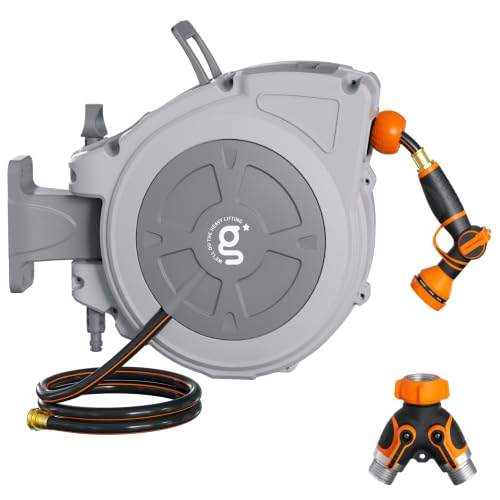
A retractable hose reel hides its hose inside a housing and winds it back with a spring mechanism when you give the hose a short tug. You pull out only the length you need, the reel locks at that length, and when the job is done the spring does the coiling for you in a slow, guided return. For gardeners who water most days, that small daily convenience is the entire argument: no armfuls of loops, no wrestling a stiff hose into a coil on wet grass, and no hose left lying across the lawn between sessions.
The retractable design asks something in return for that convenience. The spring mechanism is a moving part with a working life, the housing needs a solid mount because the whole unit carries the weight of a full hose, and the hose inside is part of the system rather than something you chose separately. Treat a retractable reel as an appliance rather than a hook on the wall. Bought with that expectation, and mounted properly on a surface that can carry it, it is the design that most reliably turns watering from a chore with setup and teardown into a walk out, a pull, and a walk back.
Portable Carts and Enclosed Cabinets
A hose reel cart puts the drum on wheels with a handle, turning hose storage into something that travels. You wheel the cart to the work, unwind what you need, and wheel it back to the shed or garage afterwards. For large gardens, allotments, and homes where the tap sits far from the beds, that mobility solves a real problem: the hose base comes to the watering instead of the watering dragging one long hose behind it. Carts also suit renters and anyone unwilling to drill into a wall, because the whole system is freestanding and leaves with you.
The cart’s trade-offs are the mirror of its freedom. It takes floor space in storage, it can tip on rough ground if pulled carelessly by the hose, and winding while the cart shifts under your feet takes a little practice. Wheels that roll well on paving may struggle on soft lawns, and a cart left outdoors all season weathers like anything else left outdoors. None of this disqualifies the design. It simply means the cart rewards gardeners who genuinely move around a plot, and mildly inconveniences those who water one small area and would be better served by a fixed reel.
Enclosed reels, cabinets and hose pots solve the problem aesthetically first and mechanically second. The hose coils inside a box, cabinet or decorative pot, hidden from view, protected from sun, and kept off the ground, while a guide hole or lid lets you pull hose out as needed. On a patio or front garden where a bright hose on a frame would dominate the view, the enclosed design is often the only one the household agrees on. The best of them wind smoothly and drain well; the category exists because looks are a legitimate function in a garden people live in.
Enclosure brings its own disciplines. A box that traps moisture around a wet hose invites mildew and shortens hose life, so drainage and the habit of putting the hose away as dry as conditions allow matter more here than with open designs. Capacity is finite and not always generous, and a hose that barely fits will fight you every single session. Measure your hose’s real coiled bulk honestly before choosing an enclosed reel, and remember that the prettiest storage in the world is a failure if winding the hose back into it is the worst part of watering.
In this guide
Top Picks at a Glance
The six picks below span the four types and the qualitative tiers between them, from accessible to premium. Treat the badges as summaries of the fuller mini-reviews later in this guide, and treat every pick as prose-only in this draft: no links are added until each product is verified, which protects you from ever following a recommendation we have not checked.
- Best Overall: Giraffe Tools Retractable Hose Reel — the routine-simplifying retractable for daily watering.
- Best Premium: Eley Wall Mount Hose Reel — buy-it-once metal wall mounting.
- Best Classic: Liberty Garden Wall Mounted Hose Reel — steel, crank, and almost nothing to fail.
- Best Portable: Suncast Hose Reel Cart — storage that travels to the work.
- Best Enclosed: Ames NeverLeak Hose Reel Cabinet — the hose hidden, the patio tidy.
- Best Retractable Alternative: Gorilla Grip Retractable Hose Reel — a second route into spring-guided winding.
How Much Capacity Do You Need?
Capacity is the specification that decides whether a reel works in your garden or merely fits on your wall. A reel must hold your whole hose with room to spare, because a drum filled to its absolute limit winds badly, layers unevenly, and strains the frame every time. Gardeners regularly underestimate the bulk of their own hose: a long hose, a thick hose, or a stiff hose in cold weather all coil larger than the same hose imagined in the abstract. When a reel’s stated capacity and your hose sit anywhere near each other, choose the larger reel. Spare capacity is not waste; it is what easy winding feels like.
There is a second, quieter side to capacity: weight. A long hose full of water is heavy, and that weight hangs on the mount, pulls on the cart, and resists the spring in a retractable housing. This is why honest capacity thinking starts with how much hose you actually use, not how much you own. Many gardens are watered with the first portion of the hose ninety days in a hundred, while the rest exists for one far corner. A reel sized for your real routine, with a plan for the exceptional day, usually serves better than the biggest drum you can hang.
Not every hose and reel pairing works, and the mismatch causes more returns than any defect. A reel’s drum needs a hose whose length and stiffness it can genuinely coil: very stiff hoses fight small drums, soft expandable hoses behave differently again and are not made to live wound under tension on every reel, and heavy contractor-style hoses overwhelm light frames. If you already own a hose you love, the reel must fit the hose, not the other way round. If you are buying both, buying them as a considered pair saves the whole problem from arising.
Retractable reels settle the pairing question by arriving with their hose already inside, which is a genuine part of their appeal: the maker has matched hose, drum and spring, and your job is only to mount the unit where that hose length serves your garden. The corresponding limit is that you cannot easily swap in a different hose later. Manual reels and carts ask more of you at purchase and repay it with flexibility for the rest of their lives. Neither philosophy is wrong. Knowing which one you are buying, and why, is most of what hose reel satisfaction is made of.
Where Will It Live, and What Will Carry It?
Where a reel lives decides how much of your garden it can serve and how much you will enjoy using it. The classic position is beside the outdoor tap, on the wall or ground nearest the areas you water most, with a clear swing for the crank and a straight run for the hose leaving the drum. Before fixing anything, walk your watering route with the hose you own: note where it snags, which corners it must turn, and where you always wish you had more length. That five-minute rehearsal, done before a single hole is drilled, prevents the classic error of a beautifully mounted reel in the wrong place.
Sun and shelter shape a reel’s lifespan from its position too. A reel in full afternoon sun bakes its hose daily, and ultraviolet light is the slow enemy of every hose material; a reel under an eave or in light shade ages noticeably more slowly. Drainage matters at ground level: a cart or cabinet sitting in a puddle line will rust, swell or grow mildew depending on its material. None of these considerations requires equipment. They require standing in the garden for a moment, looking at where water, sun and feet actually go, and placing the reel with that reality rather than with the catalogue photograph.
A wall-mounted reel is only as trustworthy as its mounting, and mounting deserves more respect than it usually gets. The reel, its drum, and a long hose heavy with water together load the fixings every time you pull hose out at an angle, which is most of the time. Fixings must bite into a load-bearing surface: solid masonry, sound timber, or studs, never into render, cladding, or a fence panel that flexes. If the wall beside your tap cannot carry the load, the honest answers are a post set in the ground for the purpose, or a different reel design altogether.
Test the mount before you trust it with a season. Hang the reel, coil the hose, fill it, and pull from the angles your watering actually uses, watching for any movement at the fixings. A mount that shifts on day one will not improve with age; it will work its fixings loose a fraction at a time until the reel comes away from the wall under load, usually mid-session and always at the worst moment. Checking takes five minutes. Re-drilling a damaged wall and replacing a fallen reel takes a weekend, which is why experienced gardeners treat the mounting step as the installation, and everything after it as decoration.
How Does It Rewind, and What Is It Made Of?
How a reel rewinds shapes every session you will ever have with it. A hand crank gives total control: you guide the hose with one hand, layer it evenly, and feel immediately when something snags. A spring retractor removes the effort and adds a mechanism, trading your labour for its moving parts. A simple frame or pot asks you to coil by hand entirely, which is slow, honest work that some gardeners genuinely enjoy at the end of a session. None of these is best in the abstract. The right answer is the one matched to how often you water and how much you mind the winding.
Uneven winding is the small fault that grows. A hose layered carelessly piles up on one side of the drum, then binds, kinks, or spills off the edge mid-rewind, and each bad layer makes the next one worse. The fix costs seconds: wind slowly, guide the hose across the drum in even layers, and never let a retractable spring slam the hose home unguided. Keep one hand lightly on the hose as it returns, walking with it rather than letting it whip. That single habit protects the hose, the mechanism, and your fingers all at once, and it is the difference between a reel that ages gracefully and one that fights you by midsummer.
Reel materials decide how a unit ages outdoors, and the honest differences are simple. Steel frames and drums shrug off knocks, carry heavy hoses without flexing, and tolerate years of sun and frost, at the cost of weight and the possibility of rust where coatings chip. Aluminium and quality resins resist corrosion and stay light enough to move easily, while very light plastic reels flex under a full hose, fade in sun, and grow brittle across a few winters. The material question is really a climate and commitment question: the harsher your weather and the longer you expect to keep the reel, the more frame substance matters.
Look past the headline material to the small parts, because that is where reels actually fail. Axles, crank handles, swivel fittings and guide rollers live harder lives than the drum does. A solid frame with a flimsy crank is a flimsy reel wearing a good coat. When you handle a reel before buying, work the crank, wobble the drum, and check how the hose connection is made. Smooth, play-free movement in the shop predicts years of the same in the garden; looseness on day one only ever grows. Gardeners who buy on frame material alone sometimes miss this, and gardeners who check the moving parts rarely regret a purchase.
Hose Reel Buying Guide: How to Prioritise by Use Case
For the daily flower-and-vegetable waterer, convenience is the priority and a retractable earns its place: the hose is out and away in moments, which is exactly what a twice-a-day routine needs. Pair it with the best drip irrigation system for raised beds for the beds themselves and the reel becomes the supply line for a calmer system. For the big-lawn household, capacity and honest coverage dominate: a sturdy wall reel or a cart that can follow the work, informed by the best oscillating sprinklers for the watering pattern at the hose’s end. For the patio household, appearance and footprint lead, and the enclosed cabinet wins. For the renter, the cart wins by default, since it asks for no holes and leaves when you do.
Daily life is the test every reel quietly passes or fails. A system that takes ten minutes of fiddling each session will be used less and less as summer wears on, whatever its build quality; a system that is ready in seconds, winds without a fight, and stores the hose completely becomes part of the household’s rhythm. Weight cuts both ways: too light and a cart dances under winding tension, too heavy and nobody volunteers to move it. Handles, crank height and the direction a hose leaves the drum all sound trivial in a shop and all become the experience of ownership by the second week.
Households edit watering plans in ways no specification predicts. Dogs investigate reels, children discover that a retractable hose is a fascinating machine, bicycles lean where bicycles should not, and delivery drivers take the shortest line across any garden. Place and choose with the real household in mind: a reel tucked sensibly out of the main traffic line survives its environment, and a retractable unit mounted where small hands cannot experiment with the rewind will have a longer, calmer life. Tools that fit the household get used for years; tools that fight it migrate to the back of the shed and stay there.
The honest way to judge a hose reel’s value is to count what it replaces. It replaces the minutes spent coiling and uncoiling by hand at every session, multiplied by every session in a season. It replaces the hoses you would otherwise replace early, because a hose stored coiled, shaded and unkinked outlives a hose stored in a heap. And it replaces a certain amount of low-grade garden irritation that is hard to price and easy to feel. For a gardener who waters weekly or more, those replacements add up to a tool that pays its way; for a gardener who waters twice a summer, they add up to very little.
Value also depends on buying the reel once. The cheapest reels are frequently bought twice: once in hope, and once again in a sturdier form after the first flexes, cracks or tangles its way out of favour. A mid-tier reel matched honestly to your hose and garden usually costs less across five years than two bargain reels and the frustration between them. That is not an argument for the most expensive reel in the shop. It is an argument for matching the purchase to the workload, because a reel’s workload is utterly predictable: your hose, your garden, your watering rhythm, none of which change when a reel is on sale.
The Picks in Detail
Giraffe Tools Retractable Hose Reel
Best for: retractable convenience. Not suited for: gardeners whose hose, wall or routine fights this design’s basic way of working.
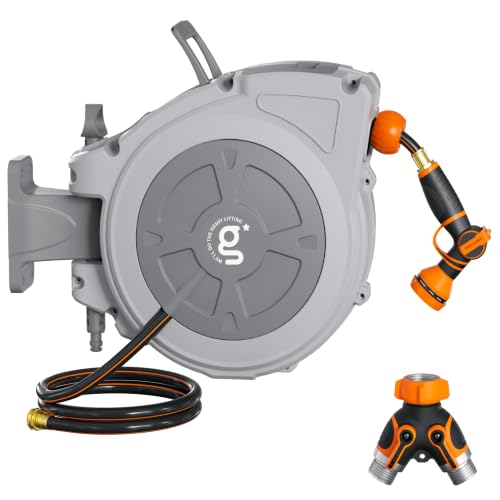
The Giraffe Tools Retractable Hose Reel is the name most gardeners meet first in the retractable category: a wall-mounted housing with the hose already inside, a spring rewind that draws the hose back in a guided return, and a mounting bracket that lets the unit swing to follow the direction of pull. It sits in the mid tier of the category in qualitative terms, and its appeal is pure routine: pull, water, tug, walk away. It is prose-only in this draft, so confirm the current listing and the exact variant before buying, and remember the standing rule for this design: guide the hose home with a hand rather than letting it fly.
Eley Wall Mount Hose Reel
Best for: premium wall-mounted build. Not suited for: gardeners whose hose, wall or routine fights this design’s basic way of working.
The Eley Wall Mount Hose Reel represents the premium, buy-it-once end of wall mounting: a metal reel built around smooth winding, durable fittings and the kind of fit and finish that gardeners describe with the word solid. Eley’s reputation rests on hose equipment engineered to be serviced and kept rather than replaced, and this reel is the storage half of that philosophy. It is a premium-tier product in qualitative terms, listed here prose-only with no verified link in this draft. It suits gardeners who have already replaced one flimsy reel and have no intention of replacing another.

Liberty Garden Wall Mounted Hose Reel
Best for: steel manual classic. Not suited for: gardeners whose hose, wall or routine fights this design’s basic way of working.
The Liberty Garden Wall Mounted Hose Reel is the classic steel answer: a sturdy wall frame, a hand crank, and a drum that asks nothing of the world except a load-bearing wall and a gardener willing to wind. Liberty Garden’s wall reels are long-standing fixtures of the category, valued because there is so little in them to go wrong and because steel tolerates the knocks of a working garden. This is a mid-tier, prose-only pick in this draft. For a fixed watering base beside the tap, it is the design against which the fancier options must justify themselves.
Suncast Hose Reel Cart
Best for: portable wheeled storage. Not suited for: gardeners whose hose, wall or routine fights this design’s basic way of working.
The Suncast Hose Reel Cart is the mobility pick: a wheeled resin cart with a handle, a leader hose to reach the tap, and a drum you wind while the cart stands where the work is. Suncast’s resin construction shrugs off rust and keeps the weight manageable, which matters in a product whose whole purpose is being moved. It occupies the entry-to-mid tier in qualitative terms and appears prose-only in this draft. It suits larger plots, shared gardens, and anyone whose tap and beds refuse to be near each other, provided the ground it must cross is reasonably kind to wheels.

Ames NeverLeak Hose Reel Cabinet
Best for: enclosed cabinet style. Not suited for: gardeners whose hose, wall or routine fights this design’s basic way of working.
The Ames NeverLeak Hose Reel Cabinet hides the hose inside a cabinet-style box, keeping a patio or front garden visually clean while the hose stays coiled, shaded and off the ground. The NeverLeak name refers to its internal water system design, built to resist the connection leaks that plague reels at the drum. It sits in the mid tier in qualitative terms and is prose-only in this draft, so check the current listing for the exact model. Choose it when appearance and enclosure genuinely matter, and be honest about your hose’s bulk, because enclosed capacity is the least forgiving kind.

Gorilla Grip Retractable Hose Reel
Best for: retractable value angle. Not suited for: gardeners whose hose, wall or routine fights this design’s basic way of working.
The Gorilla Grip Retractable Hose Reel is a second route into the retractable life, from a brand most households know for practical home goods rather than specialist garden engineering. Its proposition is the same spring-guided convenience: hose out to the length the job needs, a lock at that length, and a managed return instead of a wrestling match. It sits toward the accessible end of the retractable tier in qualitative terms and is prose-only in this draft. As with every retractable, its happiness depends on a truly solid mount and a household willing to guide the return rather than letting the spring slam the hose home.
First Setup and Care Essentials
A hose reel asks for very little maintenance, and repays all of it. Rinse grit from the drum and guides when it accumulates, because grit wound into a coil grinds at the hose cover with every layer. Check washers at the start of the season and replace any that have gone hard. Work the crank or test the retraction a few times before the first real watering, and oil or grease the moving points only if the maker provides for it. Ten minutes in spring is the entire annual budget for most reels, and it is the difference between equipment that starts the season ready and equipment that starts it as a repair project.
Hose care and reel care are the same habit seen from two sides. A hose put away clean, drained and evenly coiled lasts longer and winds better next time; a hose abandoned in a pressurised heap on hot paving ages in weeks. Avoid leaving any reel system charged with water pressure between sessions: close the tap, release the pressure through the nozzle, then wind away. That small sequence protects washers, seals and hose walls from living their whole lives under strain, and it makes the next session start with a reel that behaves. Long equipment life is rarely about buying the most expensive version; it is about these unremarkable routines.
The humblest safety topic in this whole subject may be the most important: a hose across a walkway is a trip line. It sits at ankle height, it is exactly the colour of the ground in poor light, and it catches the feet of people carrying shopping, chasing children, or simply walking a familiar path without looking down. A reel earns part of its keep precisely here, because a hose that is wound away after use cannot trip anyone. The discipline is to finish the job: water, rewind, and leave paths as clear as you found them, every time, not just when guests are expected.
During watering itself, route the hose along edges rather than across traffic, and be especially careful where a hose crosses a path to reach a bed beyond it. A charged hose under pressure is rounder, harder and more determined to trip someone than a slack one. If a crossing is unavoidable, make it visible and brief, and warn the household. Garden hoses also make wet paving slippery where they leak or drip at connections, which is one more reason to fix weeping washers promptly. None of this is dramatic, and that is the point: reel safety is mostly the accumulation of small, unglamorous habits.
Safety Worth Building Into the Routine
Safety with a hose reel begins at the rewind. A spring-loaded retractable reel stores real energy, and the pinch point where hose meets housing will catch a careless finger, a child’s exploring hand, or a glove cuff with no malice and no warning. Keep hands clear of the intake as the hose returns, guide it from a distance with a light grip on the hose itself rather than at the guide opening, and never let the hose retract freely at full speed. Teach everyone in the household the same rule, because the person who gets pinched is usually the person nobody warned.
Manual reels have their own modest hazards, and honesty about them prevents silly injuries. A crank handle spinning under a slipping hose load can rap knuckles, a cart can roll onto a foot on a slope, and a wall reel mounted at head height in a narrow passage will eventually meet a head. None of these risks is a reason to avoid owning a reel; all of them are reasons to mount, place and use it with the same ordinary attention you give a ladder or a mower. Tools that live outdoors and involve water, weight and moving parts reward households that treat them as tools rather than furniture.
Winter is the season that quietly destroys hose equipment, and the reel is where the damage concentrates. Water left inside a hose expands as it freezes, and that expansion splits hose walls, cracks reel housings, and bursts the seals where hose meets fitting. The autumn routine that prevents all of it takes minutes: run the water out, disconnect the hose from the tap, drain it fully by pulling it through the reel or walking its length, and store the reel and hose under cover where standing water cannot collect inside them. A reel put away dry in autumn simply works in spring.
Freezing climates add one more step that gardeners in mild regions skip: remove the hose from an outdoor reel entirely, or bring a retractable unit’s housing in if its maker advises it, because a spring mechanism and a housing full of ice are poor companions. Check the outdoor tap is shut off from inside where your plumbing allows it, and leave the outside tap open so any remaining water has somewhere to expand. Come spring, reconnect slowly, open the tap gently, and walk the system once looking for the splits and drips that announce winter damage before they become fountains.
Mistakes to Avoid
The most common hose reel mistake is buying for the garden you wish you had. A compact reel bought for a large plot will be cursed at every session; an oversized industrial drum bought for a courtyard will dominate it forever. The second mistake is its cousin: sizing the reel to the hose’s stated length without thinking about the hose’s bulk, stiffness, or the weight of it full of water. The third is mounting in haste, fixing a wall reel wherever the drill was handy rather than where the watering actually happens. Every one of these errors is made before the first watering, and every one is avoidable with a tape measure and ten honest minutes.
Usage mistakes matter almost as much. Overfilling a drum so the last layers spill, letting a retractable hose snap home unguided, leaving the system pressurised between sessions, and abandoning the whole kit full of water at the first frost will shorten any reel’s life, including an excellent one. The encouraging truth is that hose reels are forgiving equipment once the basics are right. They ask for a suitable size, a sound mount or stable stance, an even wind, and a dry winter. Gardeners who give them those four things routinely report the least glamorous and most valuable verdict in all of gardening equipment: it just works, season after season.
Leaks in a hose reel system almost always live at the connections, and they are almost always cheap to fix. The short leader hose between tap and reel, the swivel fitting where the hose meets the drum, and the washers inside each connector take the twisting and pressure cycling of every session. A spray or drip at any of these points is a washer that has flattened, hardened or gone missing, or a fitting that needs reseating, long before it is a failed reel. Keep spare washers wherever the reel lives, replace them at the first sign of spray, and resist overtightening, which crushes washers and strains threads.
A swivel that leaks only while the drum turns is telling you something specific: its internal seal is wearing, and it will get worse rather than better. Some reels allow that seal to be replaced; on others the swivel is part of the unit and its failure marks the reel’s real end of life. Either way, diagnosing honestly saves money. Gardeners replace whole reels for faults that live in a washer, and replace washers for months on reels whose swivel has genuinely gone. Learn which fault you have before spending anything, and the reel you own will usually turn out to be more repairable than you feared.
Round out the picture with hose reel pros and cons in full, then check how to choose a hose reel step by step before you order. If the hose itself needs replacing too, start from the best garden hoses so the pairing is right from the beginning, and see the best garden hose reels for the wider storage landscape.
Going Deeper: Living With Your Hose Reel
Depth in this subject comes from noticing how the small decisions compound. The reel you choose decides where the hose lives; where the hose lives decides how the watering starts; how the watering starts decides whether it happens on the tired evenings as reliably as on the keen spring ones. Gardeners who think of the reel as the first step of every watering session, rather than as a storage accessory bought afterwards, consistently end up with systems they like. It is the same logic that puts the tap, the reel and the beds in one mental picture instead of three separate purchases made in three separate months.
Going Deeper: Living With Your Hose Reel
There is also a quiet aesthetic dividend that practical gardeners underrate until they feel it. A garden with its hose wound away looks finished in a way that the same garden with a hose sprawled across the lawn never does, and that finished feeling changes how the space gets used: people sit out more, children play across the grass without negotiation, and the gardener’s own eye rests instead of snagging on the one untidy thing. Tidiness is not vanity here. It is the visible sign that the watering system has an end as well as a beginning, and that the garden returns to being a garden when the work is done.
Going Deeper: Living With Your Hose Reel
Experience teaches a related lesson about seasons. In spring, every reel feels adequate, because watering is light and enthusiasm is high. The reel is truly chosen in the eighth week of summer, when the garden is thirsty daily, the hose is stiff with sun, and the gardener is tired. Equipment that still winds sweetly then, that has not developed a wobble, a leak or a grudge, is the equipment that was bought well. When you read any advice on this subject, including this page, translate it into that eighth week. The purchase that survives August in your imagination is usually the right one in the shop.
Before You Commit: A Hands-On Fit and Compatibility Check for Hose Reel
This section exists to treat this as the final check before money changes hands, the point where a shortlist stops being a list of features and becomes a decision about one specific home. It adds a layer that a feature list cannot give you, grounded in the garden & lawn context this hose reel will actually live in. Where this guide names examples such as Giraffe Tools Retractable Hose Reel, Eley Wall Mount Hose Reel, Liberty Garden Wall Mounted Hose Reel, use them as test cases for the checks below rather than as shortcuts past them.
Consider the edge cases that sit just outside normal use, because a hose reel will meet all of them eventually. The unusually large load, the unusually small task, the day you are in a hurry, the day something else in the room is broken and this has to cover for it. Versatility is not about a long feature list; it is about behaving predictably when conditions are imperfect. Where a design offers settings, modes, attachments or configurations, ask what each one is actually for in your home, and be suspicious of flexibility you cannot attach to a real occasion. One well-judged configuration used weekly beats five clever ones used once, and the honest hose reel for your home is the one whose strengths line up with your most frequent edge case, not your rarest.
Build a simple decision checklist and score it in writing. Five lines are enough: fit in the space, fit with the routine, ease of cleaning or upkeep, quality of the parts that move or wear, and how the hose reel will be stored or will look when it is not the centre of attention. Score each contender quickly, then look only at the lowest scores, because purchases are usually ruined by their weakest point rather than saved by their strongest. If two options tie, choose the one whose weakness is cheapest or easiest to live with. This sounds mechanical, and it is meant to: a written checklist is the best defence against the very human habit of falling for the last photograph you looked at.
Finally, plan the first fortnight. Decide where the hose reel will live from day one, what it replaces, what accessory or companion it needs straight away and what small job you will use to learn its habits while returning it is still simple. Keep the packaging until that learning period is over, note anything that surprises you, and deal with a mismatch early rather than adapting yourself around a poor fit for years. The households that end up happiest with a hose reel are rarely the ones that researched longest; they are the ones that checked fit honestly, bought for the ordinary week, and paid attention during the first days instead of assuming the decision ended at checkout.
One more angle is worth your time: the second-order costs. A hose reel changes what happens around it. It can demand a different cleaning product, a new storage habit, a moved piece of furniture, a rearranged cupboard or a standing arrangement with the people you live with. List those knock-on effects before you buy and decide whether you accept them as part of the deal. Sometimes the answer is an easy yes, and the hose reel earns its place by improving the whole routine around it. Sometimes the honest answer is that the supporting changes are the real project, and the purchase should wait until you are ready for them. Either answer is useful; the only bad outcome is discovering the knock-on effects by accident, one irritation at a time, after the decision can no longer be revisited.
It also helps to separate the problems a hose reel can solve from the problems it merely moves. If the underlying difficulty is space, the answer may be a smaller format or a different location rather than a more elaborate model. If the difficulty is time, look for the option that removes steps rather than the one that performs each step slightly better. If the difficulty is that several people want different things, a compromise design that everyone rates as good enough will usually outlast a specialist design that one person loves and everyone else avoids. Naming the real problem in one sentence, out loud, before you order, is a surprisingly powerful filter, and many shoppers find that the sentence itself points at a different hose reel than the one they started out researching.
Frequently Asked Questions
How long does a hose reel usually last?
A hose reel’s life is decided less by its purchase tier than by its winters and its winding. A soundly made reel that is drained before frost, wound evenly, and kept out of the worst sun serves for many seasons; the same reel abandoned full of water in a freezing garden can be ruined in one. Moving parts set the ceiling: a simple crank frame has almost nothing to wear out, while a retractable spring is a mechanism with a working life. Judge lifespan claims accordingly, and weight your own storage habits honestly in the estimate.
Can I leave my hose on the reel all winter?
Only if it is fully drained and your winters are mild. The safe universal routine is to disconnect the hose from the tap, drain every drop you can by pulling it through the reel or walking its length, and store the reel under cover. Water trapped in a hose or housing expands as it freezes and splits whatever contains it, and the damage usually announces itself at the first spring watering rather than at the moment it happens. Gardeners in hard-freeze climates should bring the hose, and ideally a retractable unit, indoors for the season.
Why does my hose kink when I wind it onto the reel?
Kinks during winding usually come from twisting rather than from the reel itself. A hose develops a natural coil direction, and winding against it, or winding while the hose still holds twists from use, stores those twists as kinks on the drum. Wind slowly, guide the hose in even layers across the drum, and let it rotate freely as it comes in so twists can walk out at the free end. A hose that has lived in a tangled heap may need one patient session of laying it out straight in the sun before it will ever wind sweetly again.
Is a retractable hose reel safe around children?
It can be, with one rule taught early and enforced kindly: hands stay clear of the housing opening while the hose is moving. The spring return is the pinch risk, and a hose allowed to retract freely can travel fast enough to sting. Show children how the return is guided with a hand on the hose away from the intake, never let them play at letting go of a fully extended hose, and mount the unit where experimentation is not invited. With those habits, a retractable reel is ordinary garden equipment; without them, it is the one reel type that demands supervision.
What wall can carry a mounted hose reel?
A load-bearing wall in sound condition: solid masonry, sound brick, concrete, or timber fixed into studs. The reel’s weight is not just its own; a long hose full of water hangs on the mount, and every pull at an angle levers against the fixings. Render, cladding, thin fencing and deteriorated mortar are not mounting surfaces, however convenient their position. If the wall beside your tap cannot carry the load, set a sturdy post in the ground for the reel or choose a cart or cabinet design instead of asking a weak wall to do a strong wall’s job.
Why is my reel leaking at the centre fitting?
The centre or swivel fitting is where a reel’s water path turns with the drum, and its seal lives the hardest life in the system. A leak there that worsens as the drum turns points to a wearing swivel seal; a leak at the tap end or the leader hose is usually a washer. Start with the cheap diagnosis: shut off the water, release the pressure, and inspect and replace the washers first. If the swivel itself is the source and your reel’s design allows seal replacement, that repair restores it; if not, the leak is the reel honestly announcing its age.
Related Guides and Next Steps
Keep exploring with these guides from the same garden watering series:


