Disclosure: As an Amazon Associate, dailyhomedecorating.com earns from qualifying purchases. Links on this page are affiliate links; they cost you nothing extra. Prices and availability change often, so check the current Amazon listing before you buy.
Glass meal prep containers vs meal prep containers is a slightly crooked title until you translate it: on one side, the divided glass fleets built for portioned weekly lunches; on the other, the standard plastic meal prep containers that most people start with — light, cheap in tier, stacked in every supermarket. The quick verdict is two sentences. Choose glass if your lunches are reheated, your commute is civilised and you intend to keep the routine for years. Choose standard plastic if your containers get dropped, cycled, lost and launched, and you would rather replace cheaply than handle carefully. Everything below argues those sentences criterion by criterion, with a verdict at the end of each, because the honest answer changes depending on which part of your week you ask about.
Key Takeaways
- Glass wins: reheating quality, flavour neutrality, visibility, lifespan, table service.
- Plastic wins: weight, drop survival, entry tier, freezer-and-forget flexibility.
- Lids decide leaks on both sides — gasketed locking lids travel; simple lids stay home.
- Glass demands gradual temperature changes and chip checks; plastic demands periodic replacement.
- Most long-term preppers end up hybrid: glass for the planned week, plastic for the rough journeys.
Side-by-Side at a Glance
| Criteria | What it means | Why preppers care |
|---|---|---|
| Reheating | Glass: oven or microwave, lid off, even heat | Plastic: microwave only, warps over time | Glass, clearly |
| Flavour and stains | Glass: no stain, no odour memory | Plastic: stains and holds smells | Glass |
| Weight | Glass: a real daily load | Plastic: featherweight | Plastic |
| Drop survival | Glass: a hard-floor drop can be terminal | Plastic: bounces | Plastic |
| Lifespan | Glass: years per base, lids replaced | Plastic: replaced in rotation | Glass |
| Freezer behaviour | Glass: short spells, thaw-first rules | Plastic: flexible and forgiving | Plastic |
| Table service | Glass: serves as a dish | Plastic: decant first | Glass |
| Entry tier | Glass: mid to premium for good systems | Plastic: entry | Plastic |
In this guide
Reheating and Eating Quality: Glass Meal Prep Containers vs Meal Prep Containers
Reheating well is a small technique. Off comes the lid — fully off, unless your set’s maker explicitly designs it to vent in place. A sprinkle of water over grains revives them, a stir halfway through the microwave evens the hot spots, and a short standing rest after heating lets the temperature settle through a dense portion so the first bite and the last bite match. Glass helps here more than plastic ever did: it heats evenly, holds warmth at the desk while you finish a task, and then serves as the plate, which means one vessel from fridge to mouth and one vessel to wash. Just remember the base is now a hot dish. Oven gloves or a cloth, every time, because glass that looks cool can be anything but.
Plastic’s reheating story is shorter and sadder: microwave only, a lid that may or may not be invited, gradual warping across months of heat cycles, and a faint background flavour that accumulates in the walls until a strongly spiced week lives in the box permanently. None of that makes plastic unusable — it makes plastic a container you reheat in, while glass is a dish you eat from. Over hundreds of lunches, that difference is the one preppers cite when they explain why they switched and never switched back.
Criterion verdict: glass, decisively, for anyone who reheats most lunches.
Portioning, Visibility and the Fridge
The fridge is where a glass prep system quietly pays rent. Clear bases turn a shelf into an inventory: five lunches, two breakfasts, one soup, all visible without opening a single lid, all visibly ageing at the same honest rate so the oldest gets eaten first instead of discovered in a state of science. Stacking is the second dividend — rigid glass bases stack true, lids stay seated, and a uniform footprint turns one shelf into a grid instead of a landslide. This is also where glass parts company with general glass food storage containers: those are sized for ingredients and leftovers of random shape, while a meal prep fleet is deliberately uniform, portion-sized and repeatable, because its job is not to store food in general but to hold a week of decisions already made.
Think of a divided base as three small promises kept separately. The protein stays in its juices instead of leaking them into the rice. The grain stays fluffy instead of steaming itself soft against hot vegetables. The fresh element — slaw, salad, pickles — stays fresh because it never shared a sealed, warm space with cooked food. None of this requires culinary talent; it requires geometry. The limits deserve honesty too: dividers are fixed, so a meal that wants a different ratio has to negotiate with the moulding, and very saucy dishes will migrate over a divider on a bumpy journey whatever you do. Choose divided bases for structured plates, and keep plain bases for everything that pours.
Plastic counters with opacity as a feature: a frosted box hides a messy lunch from a shared office fridge’s public gaze, and nobody can audit your portions through the wall. Some households genuinely prefer that. But for the prepper’s own management — eat oldest first, spot the gap day, notice the portion that needs rescuing tonight — visibility is a working tool, and only glass offers it without opening every lid.
Criterion verdict: glass for self-management; a draw on privacy.
Transport, Leaks and the Daily Journey
Transport is where meal prep containers earn or lose their reputation, and glass asks for a slightly more adult commute. Carried flat, upright, in a bag that is not being swung around a bicycle courier’s back, a gasketed glass box is a model citizen — no leaks, no smells escaping, no sauce tattoo on the work shirt. It is also heavier than plastic and honest about it, and it will not survive the drop onto platform concrete that a plastic box shrugs off. The match to make is between container and journey: train, car and desk-to-desk office moves suit glass beautifully, while cycling in traffic, hiking and small children with throwing arms remain plastic’s home turf. Most converts keep both and stop seeing that as a compromise at all.
Leak discipline is mostly rim discipline. A gasket seals against the rim of the base, so a rim carrying a smear of sauce, a grain of rice or a film of oil is a leak waiting for a bump. Wipe the rim, close the lid on a cool or vented box rather than a steaming one, press or clip in the maker’s sequence, and carry the box flat with the lid up. Do that and even dressed, saucy preps travel quietly. Skip it and the finest locking lid in the world will weep into your bag and take the blame for a process failure. New sets deserve a sink test with water before their first curry — two minutes that tell you exactly how much trust your particular lids have earned.
Plastic’s transport case rests on survival rather than sealing: a plastic box in a dropped bag is a box that lands, while the same journey can end a glass base. Cyclists, couriers-by-bicycle, school bags and festival weekends belong to plastic, and no lid technology changes that physics. The mature position, reached by most households after a season, is that transport is not one criterion but two — sealing, which glass with gaskets wins, and survivability, which plastic wins outright.
Criterion verdict: glass for sealed, civilised journeys; plastic for rough ones.
Durability, Lifespan and Long-Term Cost in Tier Terms
The value case for glass meal prep is built from repetition. A plastic fleet is cheap to buy and quietly expensive to own: stained, warped and smell-haunted boxes get replaced in rotation, forever. A glass fleet costs more in tier at the start and then mostly stops costing — bases serve for years, and the ongoing spend shrinks to an occasional replacement lid. Against that, count what the system replaces outside the kitchen cupboard: the weekday lunches not bought at a counter, the leftovers actually eaten because they were visible, the takeaway not ordered because Thursday’s lunch was already made and looked good. Meal prep economics were always mostly about the food, and glass is the container material that makes the food habit stick.
Where the value leaks away is breakage and mismatch. A fleet bought in the wrong footprint, fought by the fridge and the bag, gets abandoned in a cupboard, and an abandoned system has the worst economics of all. Glass also asks for a steadier hand: households with toddlers launching tableware, or a commute involving a bicycle and potholes, will pay the breakage tax often enough to change the maths. Honest self-knowledge is the whole calculation. For a settled kitchen, a predictable commute and a real weekly routine, glass pays its premium back in longevity and in lunches eaten. For chaos, it does not, and plastic’s cheerful disposability is the rational buy.
Criterion verdict: glass on lifespan in careful kitchens; plastic wherever breakage is a weekly event.
Safety Habits Each Side Demands
The science is simple enough to respect. Glass is strong under even pressure and vulnerable to sudden, uneven temperature change, because the hot side of a wall expands while the cold side does not, and the stress concentrates exactly where a chip or a moulding line gives it a start. That is why the inspection habit and the thermal habit belong together: a sound base, warmed and cooled gradually, is a robust kitchen tool, while a chipped base shocked with heat is an accident with a date on it. None of this should scare anyone away from glass. It should produce the two or three small pauses — thaw first, rest on wood, cool before washing — that make the material’s long, stain-free service possible.
One rule outranks every other in this category: the lid is a fridge and transport device, never a cooking part. Plastic and silicone lids stay off in the oven without exception, and in the microwave they come off or vent only in the exact way the maker directs — some designs are made to loosen and shield, others must be removed outright, and guessing wrong warps lids and pressurises boxes. Build the habit at the prep session itself: lids live in one drawer, bases do the cooking and reheating, and the two meet only when food is cool and travelling or storing. Households that internalise that single separation get years from both halves of the system; households that bake a lid once usually understand immediately why the rule exists.
Plastic’s safety list is different rather than shorter: never reheat beyond the maker’s directions, retire warped or heavily stained boxes, and accept that lids and bases age together. Neither material is maintenance-free; they simply bill you in different currencies — glass in attention, plastic in replacements.
Criterion verdict: a draw, paid in different currencies.
Strengths and Trade-Offs of Each Side
- Glass — strengths: reheats and serves like a dish; never stains or holds odours; lasts for years.
- Glass — trade-offs: heavy; breakable; demands thaw-first, cool-first thermal manners.
- Plastic — strengths: light; drop-tolerant; entry tier; freezer-forgiving.
- Plastic — trade-offs: stains and smells accumulate; warps with reheating; replaced in endless rotation.
Who Each Option Suits and Who Should Skip Each
The office prepper is the natural glass citizen: a Sunday session, five clear boxes in the fridge, one travelling flat each morning to a desk, a microwave and a proper lunch hour. For this profile the divided base and the gasketed lid were basically invented, and the fleet can be small, uniform and excellent. The home worker is the second natural fit, with an even easier life — no commute to survive, reheating in the same base at a real table, and simple snap lids suddenly entirely sufficient. For both profiles, glass turns lunch from a daily negotiation into a decision made once, on Sunday, in bulk.
The batch-cooking parent runs the largest fleet and gets the largest return: family-sized cooking portioned into individual glass bases means teenagers reheat their own dinners, partners working late find a labelled-by-visibility plate waiting, and the fridge stops containing anonymous foil parcels. Weight and breakage risks rise with young children, so many families run glass for the adults and the fridge shelf, plastic for the school bags — a split that is not inconsistency but good engineering. The student or first-job prepper is the fourth profile: budget tight, routine new, and a value-tier divided set that turns cheap batch cooking into a week of lunches is one of the highest-return purchases in a first kitchen.
How to Decide
Ask four questions in order. First, the journey: if containers in your life get dropped, cycled or thrown, stop here and buy plastic — the debate is over. Second, the reheat: if most lunches are reheated and eaten at a desk or table, glass’s core advantage applies to you daily. Third, the horizon: a routine measured in years amortises glass; a six-week experiment does not. Fourth, the temperament: if thaw-first and chip-check sound like tyranny, believe yourself, and buy the material that forgives your actual habits rather than the habits you plan to acquire. The households that flourish with glass are not more virtuous. They are better matched.
Where to Buy: Representative Glass Options
PrepNaturals Glass Meal Prep Containers
PrepNaturals built its name squarely on this job: divided glass bases made for portioned weekly prep rather than general storage. The appeal is the layout. Divided bases keep a protein, a grain and a vegetable in their own zones through the fridge and the reheat, so a sauce stays beside the rice instead of soaking into it, and textures arrive at lunch closer to how they left the pan. The lids follow the locking, gasket-sealed pattern this end of the market expects, which suits a container that travels flat in a work bag. Treat it as the keen prepper’s format: excellent when your week genuinely runs on planned portions, more container than a casual leftovers household needs, and happiest in a kitchen where the same sizes repeat in tidy stacks.

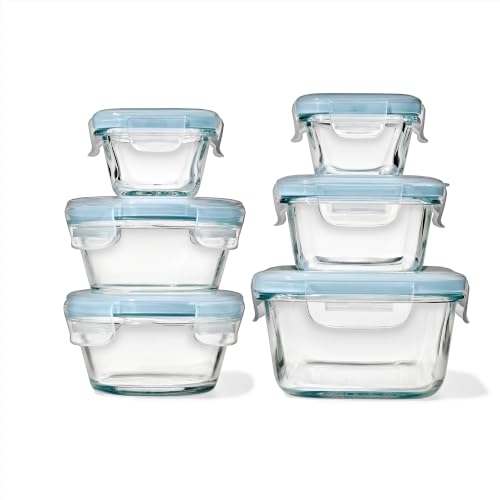
OXO Good Grips Smart Seal Glass Containers
OXO’s Smart Seal glass line brings the brand’s grip-and-seal discipline to meal prep: locking lids with a proper gasket, bases shaped for neat stacking, and a general feeling that every edge was considered twice. For portioned lunches the appeal is confidence — a sealed box of dressed grains or a saucy stew rides to work without perfuming the bag — and the glass reheats and serves as well as anything in this guide. The set leans premium in tier and the lids are a little more deliberate to close, which some households love and others find fussy at the end of a long prep session. If your prep is generous, saucy and mobile, Smart Seal is the polished end of the category and behaves like it.
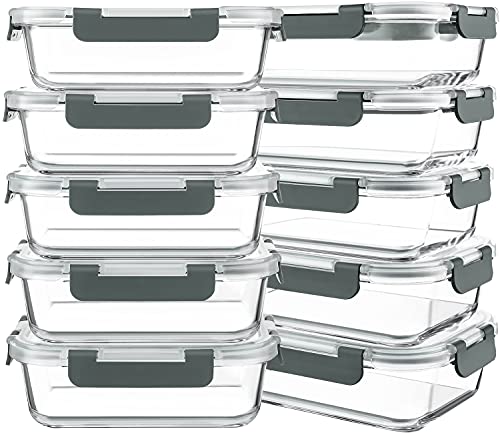
KOMUEE Glass Meal Prep Containers
KOMUEE’s pitch is coverage: enough divided glass boxes, in sensible portion sizes, to get a solo prepper from Sunday cooking to Friday lunch without a midweek wash-up emergency. The locking lids and gaskets suit a bag carried upright on a bus or train, the bases reheat in oven or microwave once the lids are off or vented as directed, and the clear walls keep the week’s plan visible. Refinement is where the tier shows — plastics on the lids feel utilitarian, and the set rewards owners who dry gaskets properly instead of sealing them away damp. None of that undermines the core value: a complete, honest glass prep system at an entry-to-mid tier.
On the plastic side, buy by the same lid logic — locking, gasketed designs for commuting, simple boxes for home — and treat the fleet as a renewable resource rather than an heirloom. Deeper glass verdicts live in our glass meal prep containers review and the reviews roundup, and the sizing method is in how to choose glass meal prep containers.
Final Recommendation by Use Case
Office and home preppers with civilised commutes: glass, and do not look back. Cyclists, school runs, chaotic bags and first experiments: plastic, without a shred of shame. Batch-cooking families: glass for the fridge and the adults, plastic for the school bags, freezer containers for the surplus — the three-material kitchen is not indecision, it is the correct engineering answer to three different jobs. Whichever side you land on, standardise the footprint, respect the lids, and let the routine, not the material debate, run your lunches.
More Practical Notes on Living With Glass Meal Prep Containers
The workflow difference glass makes is easiest to feel at the end of a prep session, when tired cooks do sloppy work. Portioning into clear bases, you see the week equalise in real time — this box short on vegetables, that one heavy on rice — and you fix it in seconds. Plastic hides those mistakes until Wednesday. Glass also imposes one useful discipline: because you should let food cool before sealing and refrigerating, the boxes sit in a cooling row first, which is exactly when you notice the portion that needs eating tonight instead. Meal prep fails through waste and boredom far more often than through cooking, and a transparent, orderly system quietly defends against both failure modes at once.
It is worth drawing the line between meal prep glass and freezer storage containers clearly, because using each for the other’s job breeds disappointment. Freezer containers are built for the long, cold archive: flexible walls that tolerate expansion, seals designed for months, shapes that stack in a chest freezer. Meal prep glass is built for the weekly cycle — portion, refrigerate, transport, reheat, wash, repeat — and its talents are clarity, reheating and table service. It can freeze a portion happily for a short spell, cooled first, with headroom left for expansion and a fridge thaw before reheating. Ask it to be a three-month freezer archive and you are using a bicycle as a lorry: possible, briefly, and not what it was designed for.
The hygiene argument for glass is not marketing; it is surface physics you can feel with a fingertip. A smooth glass wall gives oils and pigments almost nothing to grip, so the turmeric test that permanently tattoos plastic simply rinses away, and the garlic test that haunts plastic lids never reaches the base at all. For meal prep this matters beyond aesthetics: a prepper cycles the same boxes through strongly flavoured food weekly, and a container that carries no memory of last week’s curry makes this week’s salad taste like salad. Keep the gaskets honest with real drying and the whole system stays flavour-neutral, which is a phrase no one has ever truthfully applied to an old plastic box.
Transport is where meal prep containers earn or lose their reputation, and glass asks for a slightly more adult commute. Carried flat, upright, in a bag that is not being swung around a bicycle courier’s back, a gasketed glass box is a model citizen — no leaks, no smells escaping, no sauce tattoo on the work shirt. It is also heavier than plastic and honest about it, and it will not survive the drop onto platform concrete that a plastic box shrugs off. The match to make is between container and journey: train, car and desk-to-desk office moves suit glass beautifully, while cycling in traffic, hiking and small children with throwing arms remain plastic’s home turf. Most converts keep both and stop seeing that as a compromise at all.
Think of a divided base as three small promises kept separately. The protein stays in its juices instead of leaking them into the rice. The grain stays fluffy instead of steaming itself soft against hot vegetables. The fresh element — slaw, salad, pickles — stays fresh because it never shared a sealed, warm space with cooked food. None of this requires culinary talent; it requires geometry. The limits deserve honesty too: dividers are fixed, so a meal that wants a different ratio has to negotiate with the moulding, and very saucy dishes will migrate over a divider on a bumpy journey whatever you do. Choose divided bases for structured plates, and keep plain bases for everything that pours.
Visibility sounds like a small virtue until you count what it prevents. Food waste in most kitchens is not spoilage by surprise; it is forgetting — the container pushed to the back, the leftovers nobody could identify without opening. Glass ends the identification problem completely. A prepper can stand at the open fridge and plan the day by looking, assign the chicken to today and the lentils to tomorrow, and spot the empty slot that means Thursday needs a plan B. Households that track such things consistently find the clear fleet pays for itself in uneaten-then-binned food alone, long before anyone discusses the pleasures of reheating in glass.
The value case for glass meal prep is built from repetition. A plastic fleet is cheap to buy and quietly expensive to own: stained, warped and smell-haunted boxes get replaced in rotation, forever. A glass fleet costs more in tier at the start and then mostly stops costing — bases serve for years, and the ongoing spend shrinks to an occasional replacement lid. Against that, count what the system replaces outside the kitchen cupboard: the weekday lunches not bought at a counter, the leftovers actually eaten because they were visible, the takeaway not ordered because Thursday’s lunch was already made and looked good. Meal prep economics were always mostly about the food, and glass is the container material that makes the food habit stick.
Another common failure is buying variety instead of a system: three brands, four footprints, lids that fit nothing else, a cupboard that becomes a matching puzzle with missing pieces. Meal prep rewards boring uniformity almost embarrassingly well. A subtler mistake is portioning by optimism — boxes filled for the appetite you wish you had at lunch, food returning home uneaten until the routine is abandoned as not for me. Portion for the real eater, add a snack box if afternoons run long, and let the system fit the life rather than the aspiration. Finally, do not skip the ten-second chip check before reheating. It is the cheapest safety habit in the kitchen and the one most often skipped precisely because it is cheap.
Sauces and dressings deserve their own strategy, because they are where good meal prep goes soggy. The rule is separation until service: dressings travel in their own small sealed pots, sauces sit in the divided zone designed for them, and anything meant to be poured hot gets reheated in its own base and added at the desk. Glass helps twice here — small glass pots do not hold the flavour of last week’s vinaigrette, and a sauce reheated in glass tastes like sauce rather than like warm plastic. Preppers who master the sauce separation habit report the single biggest jump in how fresh a five-day-old lunch can taste, and it costs nothing but one extra small pot per box.
Rotation is the invisible system inside the visible one. Portions should be eaten in the order they were cooked, which sounds obvious and is constantly defeated by the favourite meal being pulled forward and the lentil soup ageing nobly at the back. Clear glass makes rotation a visual habit instead of a memory test: arrange the shelf oldest at the front, newest at the back, and take from the front like a shopkeeper stocking shelves. Households that run this one discipline waste almost nothing, because no portion ever becomes a mystery or a science project. It is the least glamorous paragraph in this entire guide and, week after week, possibly the most valuable.
Labelling divides households, and glass makes either camp workable. Minimalists rely on the clear walls — the food is its own label — and add nothing but the shelf-order discipline described above. Planners add a strip of masking tape and a date, which pays off the moment two similar-looking stews from different Sundays share a shelf, or a partner needs to know which box is theirs without opening three lids. What does not work is the middle path of intending to remember. Nobody remembers. Either trust the visibility system completely, with strict front-to-back eating, or tape and date everything. Both are respectable. Guessing is not a system.
The office fridge is a shared ecosystem with its own etiquette, and glass earns goodwill there. A sealed, clear, name-labelled box reads as organised and inoffensive; it does not leak onto a colleague’s lunch, perfume the shelf, or get mistaken for abandoned property during the Friday clear-out — especially if it is visibly claimed and visibly fresh. Take the day’s box home the same evening rather than letting empties accumulate, because a prepper’s reputation in a shared kitchen is built on the empties, not the lunches. Glass also helps the microwave queue: a base that reheats evenly and quickly is a small courtesy to everyone waiting behind you with a soup of their own.
Seasonality changes what a prep fleet carries, and the wise prepper lets it. Summer weeks lean on divided bases — grain salads, grilled proteins, raw vegetables, cold noodles — where compartment separation does its finest work and reheating barely features. Winter weeks swing to deep single bases: soups, stews, braises and bakes that reheat as one dish and eat like comfort. A fleet bought with both seasons in mind — divided and single in honest proportion — never feels wrong for the month, while a fleet bought in January alone can feel absurd by July. If you are choosing in one season, buy for the other one too, on paper at least.
Marinating is a side talent of glass bases that preppers underuse. A portion of chicken or tofu can sit in its marinade inside the very base it will later be cooked and stored in, because glass neither absorbs the marinade’s flavours nor surrenders any of its own, and the clear wall shows the coverage honestly. The same neutrality makes glass the right home for pickling quick vegetables, storing cut citrus, or holding a strongly spiced curry overnight without the container joining the recipe. Plastic absorbs; glass abstains. Across a year of strongly flavoured batch cooking, that abstinence is a large part of why glass fleets still look and smell new while plastic collections quietly retire themselves piece by piece.
Grip and lids matter more than brochures admit, especially for households cooking for older relatives or anyone whose hands are not at full strength. Locking clips vary widely in the force they demand, and a lid that a strong prepper finds reassuringly firm can be a daily frustration for arthritic fingers. The honest advice is tactile: where possible, handle the lid style before committing a fleet to it, favour wide tabs and simple snap designs for the boxes destined for weaker hands, and reserve the firmest gaskets for the commuter boxes those same hands will never open. A container that cannot be opened is a container that will not be used, whatever its seal can do.
Dishwasher strategy sounds trivial until a fleet is large. Bases stack into racks happily and emerge spotless, but lids and gaskets reward a top-rack, uncrowded wash and a complete air-dry before storage — heat and compression are their enemies, and a gasket dried bent will seal bent. Many households hand-wash lids while the bases ride the machine, a thirty-second compromise that noticeably extends lid life. Whichever rhythm you choose, the rule that outranks the rest is dryness before sealing: a fleet put away fully dry stays fresh-smelling indefinitely, while a fleet sealed damp once can carry the memory for weeks, in the gaskets, where smells always live.
Cupboard storage for the empty fleet deserves one deliberate decision. Nesting bases inside each other saves space but risks rim chips if glass knocks glass carelessly, so nest with a cloth or paper layer between bases, or stack flat with lids filed separately in a drawer or a vertical rack. Lids stored clicked onto bases keep gaskets compressed and age them early; lids stored loose stay springy and ready. The fleet that is pleasant to put away is the fleet that stays in service, because meal prep already asks enough of a Sunday afternoon without adding a cupboard avalanche to the bargain. Small storage kindnesses compound exactly like small annoyances do.
A second-hand glass fleet is tempting and mostly safe, with two inspections. Glass bases age gracefully and a used base with a perfect rim is a bargain; run the fingertip test around every edge and reject any base with a chip, however small, because its history of drops is unknown. Lids are the opposite bargain: used gaskets carry unknown smells, warps and fatigue, so price any second-hand set as bases only and expect to buy fresh lids. Makers who sell spare lids make second-hand fleets genuinely viable; makers who do not turn a cheap set into a disposable one. The rule generalises: in glass meal prep, always ask what the lids will cost you, in money or in trouble, before celebrating what the bases saved.
When a glass base does break, the ending should be as deliberate as the ownership was. Wrap fragments carefully, keep them out of the sink and the food waste, and check the maker’s guidance on whether the glass belongs in household recycling in your area, since heat-resistant glass often cannot join bottle glass in the same stream. Then do the useful thing: note what killed it. A drop argues for a storage change, a thermal crack argues for a habit change, and a chip argues for more honest inspections. Fleets managed this way shrink their losses year by year, because every breakage is converted into information instead of repeated as tuition.
Travel and holidays test a prep system differently. A glass fleet is home infrastructure, not luggage: for a self-catering week away, two or three bases in a padded box serve brilliantly for market salads, leftovers and beach picnics, while the full fleet stays home. At home, the holiday pattern reverses — the fleet earns its keep before departure, portioning the perishables that must be eaten first, and after return, taming the first shop back into routine. Preppers who travel often sometimes keep a small satellite set for the purpose. The mistake is only ever the same one: asking one fleet, unmodified, to be both a daily system and a suitcase, and being annoyed at glass for the laws of physics.
Gym and evening-activity lunches are the border country of this category. A glass box carried in a car to a desk after training is fine; the same box in a kit bag thrown into a boot, a locker and a bus floor is living dangerously. The mature solution is assignment rather than abstinence: the day’s most robust journey gets the plastic box, the desk days get glass, and nobody’s principles are troubled. Preppers who insist on one material for every journey tend to convert after the first breakage or the first stained, warped plastic box, depending on direction. Assignment by journey is not a compromise of the glass idea. It is the glass idea, applied with a map.
Reheating mixed portions well is a small craft worth learning once. Dense items — a thick stew, a packed grain — want a stir halfway and a standing rest; delicate items — greens, a soft egg, anything crisp — want to sit out the microwave entirely and join the plate after. Divided bases make this choreography easy because components can be lifted apart, and glass’s even heating shortens the whole process compared with plastic. A splash of water over grains, a loose cover against splatter where the maker allows, and a cloth for the hot base: four habits, learned in a week, that raise every reheated lunch a full grade for the rest of the fleet’s life.
Finally, there is the matter of enough. Container collections grow by optimism — a new size for a hypothetical meal, a second brand for a hypothetical routine — until the cupboard holds a museum and the prepper uses the same four boxes. The discipline that keeps a fleet honest is the one-in-one-out review each season: which bases actually worked, which lids are limping, which size has not left the shelf since spring. Retire, replace lids, resist novelty. A glass meal prep system is at its best when it is small, uniform and used to exhaustion, because the value was never in the glass. It was in the weeks the glass made predictable.
Breakfast is the meal prep beginners forget, and glass handles it with particular grace. Overnight oats portioned into small single bases, egg bakes cut and boxed for the week, yoghurt and fruit kept in separate small pots until the morning — all of it reads clearly through glass at the half-awake hour when decisions are worst. The divided principle applies here too: anything crisp, like granola, lives apart from anything wet until the moment of eating. A prepper who boxes breakfasts as faithfully as lunches removes two daily food decisions instead of one, and the small bases that sets include as filler pieces suddenly become the hardest-working members of the fleet.
A closing observation from households that have run both materials for years: the argument is rarely settled by a dramatic event. Nobody’s plastic box explodes and nobody’s glass base performs a miracle. The verdict accumulates in small change — the plastic box retired because it smelled of curry forever, the glass base still in service at its fiftieth reheat, the one breakage on the platform that briefly reversed the whole household’s opinion. Which is to say, the comparison above gives you the criteria, but your own first season with either material will supply the conviction. Choose the side whose small change you would rather accumulate, and commit for long enough to actually accumulate it.
Deciding at the Margin: Glass Meal Prep Containers When Meal Prep Containers Almost Wins
This section exists to focus on the marginal cases, the households that could happily live with either option, because that is where a comparison earns its keep. It adds a layer that a feature list cannot give you, grounded in the food storage & organization context this glass meal prep containers will actually live in. Where this guide names examples such as PrepNaturals Glass Meal Prep Containers, OXO Good Grips Smart Seal Glass Containers, KOMUEE Glass Meal Prep Containers, use them as test cases for the checks below rather than as shortcuts past them.
It also helps to separate the problems a glass meal prep containers can solve from the problems it merely moves. If the underlying difficulty is space, the answer may be a smaller format or a different location rather than a more elaborate model. If the difficulty is time, look for the option that removes steps rather than the one that performs each step slightly better. If the difficulty is that several people want different things, a compromise design that everyone rates as good enough will usually outlast a specialist design that one person loves and everyone else avoids. Naming the real problem in one sentence, out loud, before you order, is a surprisingly powerful filter, and many shoppers find that the sentence itself points at a different glass meal prep containers than the one they started out researching.
Start with the unglamorous measurements. For a glass meal prep containers, the numbers that decide satisfaction are rarely the headline ones in a listing; they are shelf depth, door swing, stack height and the reach to the back row. Write the real dimensions of your space down, including the awkward constraints you normally work around without thinking, and hold every contender up against that sheet rather than against a showroom photograph. Then walk the route the glass meal prep containers will take on delivery day and during normal use. A choice that fits on paper but fights you every time it is moved, opened, cleaned or stored will lose its shine quickly, however strong its other qualities look in a comparison table.
Next, rehearse the week, not the ideal day. Picture the glass meal prep containers inside a full weekly shop, leftovers from two dinners, and the odd bulky item that never quite fits the neat plan. Most disappointment comes from buying for the best-case scenario: the tidy version of the household, the motivated version of yourself, the weather or the guest list you hope for rather than the one you usually get. If the glass meal prep containers only makes sense when everything goes to plan, it is the wrong size, the wrong format or the wrong purchase for now. If it still looks useful on the tired, rushed, slightly chaotic version of the day, it has passed the most honest test there is, and the remaining questions are about detail rather than direction.
Pay close attention to the recurring friction points, because they compound. With a glass meal prep containers, owners tend to run into lids, seals and containers drifting apart in a drawer until nothing matches anything else. None of these is dramatic on its own, and that is exactly why they get underestimated at buying time. Ask how the design you are considering handles each one: can the wearing part be replaced, can the awkward part be reached without tools, does the job take two minutes or twenty. A glass meal prep containers that makes its own upkeep easy gets maintained; one that makes upkeep a project gets neglected, and neglected products perform badly in ways that then get blamed on the original purchase.
Frequently Asked Questions
Is glass better than plastic for meal prep?
For reheating, flavour and longevity, glass has the stronger case: it does not stain or hold odours, it reheats in oven or microwave, it serves at the table, and a base can serve for years. Plastic counters with lightness, low cost and indifference to being dropped, which matters for cycling commutes, children and chaotic bags. Many households run both — glass for the planned weekly lunches, a few plastic boxes for the rough journeys. The honest answer is that your commute, not the material debate, should make this decision.
Can I microwave food in a glass meal prep container?
Yes, with the lid off or vented exactly as the maker directs — a sealed box in a microwave builds steam pressure, and plastic lids warp and age fast under direct heat. Stir or rotate the food partway through so it reheats evenly, let it stand briefly before eating because glass holds heat and hot spots linger, and use oven gloves: a reheated glass base is a hot dish, not a cool lunchbox. If a lid is not marked microwave-safe, take it off entirely rather than resting it loosely on top.
Can I freeze meals in glass meal prep containers?
Yes for short, planned freezing, with respect for the rules: cool the food first, leave headroom because liquids expand, seal once cold, and thaw in the fridge before reheating rather than shocking the glass. For deep, months-long freezer banking, dedicated freezer storage containers are the better tool — they are shaped and sealed for that job. Meal prep glass earns its keep on the weekly cycle of fridge, bag and reheat; treat freezing as an occasional extra, inspect the base before and after, and retire anything that comes out chipped.
Do glass meal prep containers leak in a work bag?
The glass never leaks; the lid decides everything. Locking lids with a silicone gasket, closed on a clean dry rim, travel very well, especially carried flat and upright. Simple snap lids are fridge seals, not commute seals, and soups will eventually prove it. Wipe the rim before closing, do not overfill, let hot food cool and vent before sealing for transport, and give any new set a water test over the sink before its first real journey. A separate small bottle still beats any container for thin dressings and broths.
How do I check a glass container for damage?
Before reheating or packing, run a slow fingertip around the rim and corners and look at the edges against the light. Chips feel sharp or catchy, cracks show as fine bright lines, and either one means the base is retired from heat and travel — damaged glass can fail suddenly under temperature change or a knock. Check after any drop onto a hard floor, even if the container survived the fall itself. It takes ten seconds, and it is the habit that separates long, safe service from a mess in the oven.
What size glass meal prep container is right for lunch?
Let the meal decide rather than a chart. A composed plate of protein, grain and vegetables wants a divided base that holds a satisfying portion without cramming, because crushed food reheats unevenly and eats sadly. Soups and stews want a deeper single compartment with headroom for stirring. If you consistently scrape the base clean and stay hungry, size up; if food regularly comes home uneaten, size down and add a small snack box instead. Buying one or two test sizes before committing to a full fleet is the cheapest research in this whole category.
Related Reading
Keep exploring the system around the containers: the buying guide for the glass side; whether glass is worth it; vacuum storage bags for surplus batch cooking; storage baskets; under-bed storage for spare fleets.


