Disclosure: As an Amazon Associate, dailyhomedecorating.com earns from qualifying purchases. Links on this page are affiliate links; they cost you nothing extra. Prices and availability change often, so check the current Amazon listing before you buy.
These garden cart reviews take a different approach from a single-product test: five representative designs, one from each branch of the category, assessed side by side on design, build, real-use performance and honest limitations. A dump cart, a steel utility wagon, a compact utility cart, a convertible and a folding wagon each get a full prose review below, because the most useful question in this category is rarely which cart is best in the abstract — it is which kind of cart is best for your ground, your loads and your storage. A summary verdict opens each profile, strengths and trade-offs are stated plainly, and the closing sections cover the shared buying criteria, safety habits and care routine that apply whichever design you choose. For the single-design deep dive, see our garden cart pros and cons; for the full decision framework, our garden cart buying guide.
Key Takeaways
- Best all-round hauler: the dump cart design, for soil-driven gardens with room to work.
- Best flat-load versatility: the steel utility wagon with removable sides.
- Best for small properties: the compact utility cart and the convertible, for opposite reasons.
- Best for storage and events: the folding fabric wagon — within light-load limits only.
- Every design shares the same safety rules: load low and centred, respect slopes and latches, keep children off.
- Judge reviews by second-year ownership reports; carts reveal themselves over seasons, not unboxings.
In this guide
How These Garden Cart Reviews Were Judged
Long-lived carts share visible traits you can check without tools. Coatings are complete, including inside joints and under the bed, where rust actually starts. Fasteners are proper bolts with lock nuts rather than screws into thin material. The dump pivot is a real hinge with a sleeve or bearing surface, not a bolt through two holes that will oval out in a season. Wheel hubs carry bearings, or at minimum replaceable bushings, and the tyres are a standard size you could replace at any hardware store. The steering linkage has adjustment or at least tight, greased joints. None of these traits photograph well, which is why they are underweighted in online shopping and why reading owner reports from the second and third year of ownership tells you more than launch reviews. A cart is one of the few products where the boring details are the product; the bed is just the part you can see.
Capacity figures in this category deserve respectful scepticism. A headline load rating describes what a cart can carry under favourable conditions — evenly distributed, on firm level ground, at walking pace — not what it should carry down a wet slope or across a ploughed bed. Volume figures flatter in the other direction: a deep bed heaped with soil weighs far more than the same bed heaped with leaves, so volume alone tells you little until you pair it with the density of what you actually move. The honest way to shop is to start from your heaviest regular load, honestly estimated, and choose a cart whose rating clears it with room to spare. Working routinely at the very top of a cart’s rating shortens the life of tyres, bearings, pivots and frames, and it makes every slope and soft patch a negotiation. Headroom is not wasted money; it is the margin that keeps a tool easy and safe on its worst day, not just its best.
Four buyer profiles cover most of this category. The raised-bed builder needs dump action, a bed that fits between beds, and capacity for dense soil loads in repeated trips. The large-plot gardener needs distance gear: big pneumatic wheels, light handle weight, tractor-tow options, and a bed sized for green waste volume. The wood-heating household needs frame strength, point-load tolerance and all-surface wheels for the woodpile run in all weathers. The small-garden generalist needs compact dimensions, easy storage and versatility across light mixed loads more than any headline capacity. Every cart on the market serves one of these profiles better than the others, and most disappointed owners bought a cart tuned for a neighbour profile — the small gardener with a barge-sized dump cart that fits no path, the wood burner with a fabric wagon. Name your profile before you name a brand, and the shortlist largely writes itself.
The Reviews
Gorilla Carts GOR4-PS Poly Garden Dump Cart
The Gorilla Carts GOR4-PS is the reference design for the modern poly dump cart: a moulded poly bed on a steel frame, four pneumatic wheels, front-axle steering and a quick-release dump latch that lets the bed tip and empty where you point it. In our judgement it suits the raised-bed builder and the general large-garden owner best, because the poly bed shrugs off compost, wet soil and fertiliser without any rust anxiety, and the dump action removes the shovelling that makes soil work miserable. Treat it as a premium-tier, buy-once proposition in this category.
Its honest limitations follow from the design. The poly bed that laughs at compost is less indifferent to sharp rubble and dropped stone than a steel bed, the pneumatic tyres need occasional air and can puncture on thorn-heavy ground, and the dump latch — like every dump latch — demands the pinch-point respect described in our safety sections. None of these are surprises, and all are manageable with the rinse, pressure-check and latch-check habits this article recommends. Best for: soil, compost and mulch work on medium and large gardens. Not suited for: rubble-heavy hardscape work or owners who will never check a tyre.
Vivosun Heavy Duty Garden Cart
The Vivosun heavy duty garden cart represents the steel utility wagon side of the category: a steel bed and frame, mesh or solid side panels depending on configuration, and a straightforward fixed-bed design aimed at buyers who want carrying strength and versatility without paying for a dump mechanism. Removable sides on this style of wagon let it convert to a flat carrier for bagged goods, potted plants and awkward loads, which makes it a genuine household tool rather than a single-purpose garden one. Position it as a mid-tier value proposition: strong where it counts, simpler where simplicity saves money.
The trade-offs are the wagon’s usual ones. Everything loaded by hand is unloaded by hand, so loose soil and compost work is slower than with a dump cart. Steel asks for the rinse-and-dry routine to keep rust away from scratches and welds, and side panels add rattles if their fasteners are allowed to loosen. Against that, there is very little to go wrong: no latch to foul, no pivot to wear, and a bed that tolerates point loads from logs and bagged stone calmly. Best for: mixed household hauling and bagged or bulky loads. Not suited for: gardeners whose main work is moving loose soil in quantity.

SuperHandy Utility Service Garden Cart
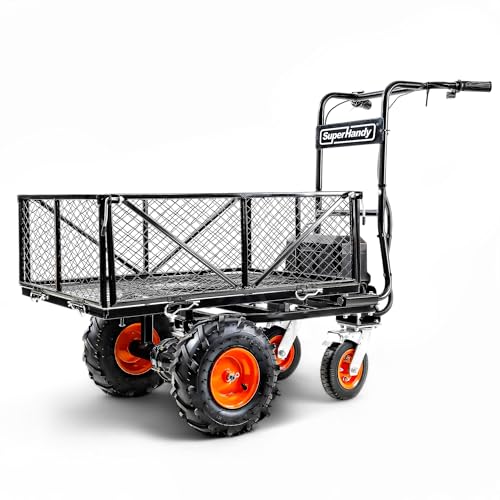
SuperHandy builds its reputation on compact utility equipment, and its utility service cart approach suits the smaller property: a manageable bed, a frame designed for mixed household and garden duty, and an emphasis on manoeuvrability over maximum volume. For the small-garden generalist — the profile with a side gate, a paved path and a shed that is already full — a cart in this class often fits daily life better than a full-size dump cart, because it turns where the big carts cannot and parks where they will not. Treat it as a mid-tier, space-conscious choice.
Be honest about the ceiling, though. A compact cart asked to move a whole raised-bed build of soil will do it in many small trips, and owners who regularly face dense, heavy loads will feel the frame and wheel size working near their limits. It is also, like every smaller cart, less forgiving of high, badly centred loads on slopes, simply because its wheelbase is shorter. Within its intended envelope — tools, green waste, bagged goods, modest soil work — it is a willing daily tool. Best for: small and medium gardens, tight paths, mixed light duty. Not suited for: bulk soil, stone or firewood as a weekly routine.

WORX Aerocart
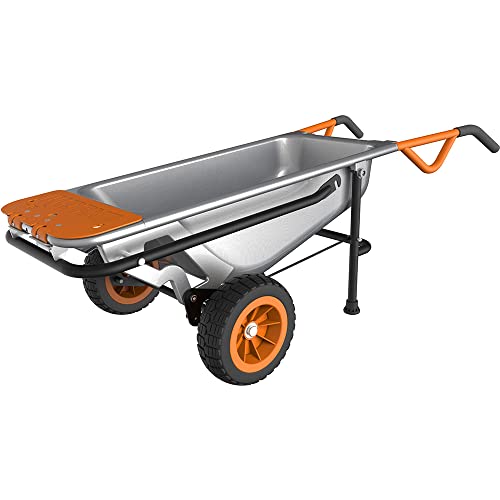
The WORX Aerocart is the category’s best-known convertible: a design that works as a two-wheel wheelbarrow for narrow paths and soft ground, then converts to a four-wheel cart stance for stable carrying, with additional working positions that makers of this style offer for jobs such as holding a refuse bag open or moving a heavy pot on a dolly plate. For a household with one storage corner and both kinds of work, that versatility is the entire argument, and it is a strong one. Position it as a premium-tier versatility play rather than a capacity play.
The compromises are structural. The bed is smaller than a dedicated dump cart’s, the conversion hardware adds joints that must be kept clean and checked for play, and in no single mode does it quite match the dedicated tool — the barrow mode is good rather than great, the cart mode stable rather than capacious. Owners who convert daily love it; owners who convert twice a year may be carrying complexity they do not use. Best for: small properties, mixed barrow-and-cart work, storage-poor households. Not suited for: bulk soil moving or buyers who want the fewest possible moving parts.
Mac Sports Collapsible Utility Wagon
The Mac Sports collapsible wagon represents the folding fabric end of the category, and it represents it well: a scissoring frame, a fabric bed, compact wheels, and a fold that takes it from working wagon to a flat package that hangs in a garage or rides in a car boot. For event duty, sports days, camping support and light garden errands — tools, produce, bagged potting mix on firm ground — it is arguably the most convenient hauler in this entire article, and it stores in spaces no steel cart could occupy.
Its limits are equally clear, and they are limits of physics rather than quality. Fabric beds and light frames are not built for dense soil, stone or firewood loads, and small wheels protest on rough, soft or muddy ground. Used inside its envelope it lasts well; used as a cheap substitute for a steel dump cart it will fail early and unfairly damage its own reputation. Best for: light loads, firm surfaces, minimal storage, multi-purpose household use. Not suited for: soil, rubble, slopes or any load you would describe as heavy rather than bulky.
Design and Build Themes Across the Range
The frame is the cart’s skeleton, and it deserves a harder look than the bed usually gets. Tubular steel frames are light for their strength and resist twisting well; look for clean welds, a coating that covers joints and ends, and cross-bracing under the bed rather than a bed simply resting on two rails. Check how the steering linkage and the dump pivot attach, because those junctions concentrate stress every single trip. A frame that flexes noticeably under a moderate load in the showroom will flex more, and creak more, after a season of soil and stone. Paint and powder-coat are not cosmetics here — they are the corrosion defence for a tool that lives among water, soil and fertiliser. Finally, consider the handle: a padded grip, a comfortable height for the person who will pull it most, and on many carts a tow hitch point so the cart can be pulled by a lawn tractor for genuinely long hauls across a big property.
Bed material shapes both durability and daily feel. Moulded poly beds shrug off water, compost acids, fertiliser and wet soil without rusting, they are quiet to load, and a dent that would crease steel usually flexes and recovers. Their limit is impact and ultraviolet exposure over many years stored outdoors. Steel beds carry dense, sharp loads — stone, rubble, scrap — with more indifference to abuse, and a scratched steel bed can be touched up, but rust is the standing enemy: once the coating is breached at a scratch or a weld, corrosion works quietly under the paint, especially in a bed that routinely holds wet material. Whichever material you choose, the maintenance rule is the same and takes thirty seconds: empty the bed after wet loads, hose out soil and compost residue, and store the cart dry and under cover when you can. Beds rarely fail from the loads they carry; they fail from what owners leave sitting in them.
Four wheels bring stability, and they bring a steering problem that two wheels never have. Most garden carts solve it with a front-axle steering linkage: the handle connects to the front axle, and pulling the handle to one side turns both front wheels together. Done well, this makes a loaded cart track through gates and around beds with surprising grace. Done cheaply, the linkage develops play, the wheels wander, and the cart develops a mind of its own on slopes. When you evaluate a cart, turn the handle slowly and watch for looseness, and imagine the same motion with a heavy load pushing from behind on a descent — that is the moment steering quality stops being a convenience and becomes a safety feature. Some designs add a handle that converts between hand-pulling and tractor towing; check that the conversion is positive and locked, not a pin that can walk out on rough ground.
Assembly is the first test a garden cart sets you, and it is worth doing slowly. Most steel carts arrive as a bed, a frame, four wheels, a handle and a bag of fasteners, and the job takes one person with basic hand tools somewhere under an hour if the instructions are followed in order. The two classic mistakes are tightening every bolt fully as you go — leave hardware finger-tight until the frame is complete and square, then tighten in sequence — and fitting a wheel or the steering linkage backwards, which the cart will punish with strange tracking until you correct it. Lay the parts out, check them against the parts list before you begin, and keep the fasteners in a tray rather than on the lawn. When assembly is done, load the cart lightly and pull it around the garden once, listening for rattles and watching how it tracks, before its first heavy load. That shakedown lap is when loose hardware announces itself cheaply.
Performance in Real Use
Soil and Compost Work
Moving soil is the garden cart’s defining job, and the one that separates real carts from light wagons. A load of topsoil or compost is dense, shifting and heavy beyond what its volume suggests, and it tests the bed, the frame, the tyres and your loading habits all at once. The dump bed earns its keep here: position the cart, release the latch, and the load lands where the bed points instead of where your shovel tires. For raised-bed filling — the signature project of the modern home garden — a cart that can travel the paths between beds and dump directly into the frame transforms a weekend of barrow work into an afternoon. Work in partial loads on soft or sloped ground, keep the soil spread flat rather than heaped, and rinse the bed the same day; damp compost left in a steel bed over a wet week is the fastest route to corrosion the category knows.
Green Waste and Leaf Season
Green waste — prunings, hedge clippings, spent plants, the armfuls of biomass a healthy garden produces weekly — is the load that justifies a cart to gardeners who rarely move soil. It is light but endless, awkward rather than heavy, and it multiplies trips like nothing else. A deep-bed cart parked at the hedge or the border swallows the clippings as you cut, then hauls the whole session’s work to the compost heap or the gate in one journey. Lay long prunings along the bed, alternating butt ends to keep the bundle level, and press each layer down before adding the next; an unpressed load of clippings is mostly air and will need twice the trips. In autumn this same duty peaks: perennial cut-downs, leaf fall and the final clearances fill the cart daily. Owners consistently report that green waste, not soil, is what their cart does most — plan bed size and your working routine around that reality and the cart becomes the garden’s circulatory system.
Firewood and Heavy Hauls
Firewood is the load that exposes weak frames and small wheels. Logs are dense, irregular and point-loaded: they rest on a few contact patches rather than spreading their weight, and they shift with a clunk at every bump. A steel or stout poly bed shrugs this off; a fabric wagon bed sags and chafes. Load logs along the bed’s length, largest at the bottom, and resist filling above the bed sides — a log that rolls off a moving cart aims for ankles with uncanny accuracy. The cart’s real firewood virtue is distance: the run from woodpile to porch or stove-side store is usually the longest repeated carry in a rural household, often over grass, gravel or snow-dusted paths where pneumatic tyres earn their keep. Households that heat partly with wood often find the cart pays for itself in this single duty before it ever touches the garden, which is worth remembering when the purchase feels like a garden luxury in spring.
Daily Organisation and Harvest
Not every garden cart load is heavy, and the category’s quieter virtue is organisation. A cart loaded with the day’s tools — spade, fork, rake laid along the bed, a trug of twine and labels, gloves, a kneeler — turns the garden’s geography from a series of trips back to the shed into one mobile workstation. Gardeners on larger plots lose surprising time to forgotten-tool walks; the cart abolishes them. At harvest, the same bed carries produce gently and in quantity: courgettes, apples, pumpkins and cut flowers travel in one shaded, ventilated load rather than in armfuls, and they arrive unbruised because they rode flat instead of being stacked in a bucket. This is also where a wagon’s removable sides or a convertible’s bag holder earn their place. Judge a cart partly as furniture for your workflow, not only as a vehicle for soil — the tool you reach for daily justifies itself differently from the tool you strain against monthly.
Surfaces, Slopes and Seasons
Your paths are a specification sheet you have already written. Paving and concrete forgive any wheel; gravel prefers wider tyres that roll over rather than plough through; lawns in winter want pneumatic tyres and restraint, because a loaded cart on saturated grass cuts ruts that outlast the season. Narrow gravel paths between raised beds set a maximum cart width more honestly than any gate. Steps and steep ramps are the cart’s natural enemies — a loaded cart cannot be bumped up steps the way a barrow sometimes can, so properties with terraced levels need a route plan: ramps, a longer gentle path, or staging loads at each level. Before buying, walk the full circuit from delivery point to furthest bed with your eyes on the ground rather than the catalogue. The cart that fits your surfaces will feel effortless; the cart that fights them will be left in the shed, which is the most expensive outcome of all.
A garden cart’s year has seasons, and each tests something different. Spring is volume: compost, soil and mulch moving constantly, beds being built, the dump latch working daily. Summer is distance and organisation — tools, harvest, watering support — with the cart as mobile workstation. Autumn is green waste and firewood, heavy mixed work in worsening ground conditions, when tyre grip and your slope discipline matter most. Winter is storage and the occasional wood run, and it is when last spring’s neglected maintenance announces itself as rust, seized pivots and perished tyres. None of this argues for a seasonal cart; it argues for buying one cart honest enough for spring’s weight and autumn’s ground, then keeping it through winter properly. It also suggests a buying calendar: purchasing in late winter, before the spring rush, gives you assembly and shakedown time before the cart’s hardest weeks arrive.
Strengths and Trade-Offs of the Category
Strengths
- Four wheels carry the load; the owner guides rather than lifts and balances.
- Designs exist for every property size, from folding wagons to tractor-towed steel carts.
- Simple machines with near-zero running costs and decade-scale service lives when kept dry.
Trade-offs
- Size and storage footprint grow with capability; the strongest carts are the bulkiest.
- Slope and loading discipline are learned skills the category quietly requires.
- Specialists beat generalists: no single design wins at soil, storage and narrow paths simultaneously.
Tipping is the garden cart’s characteristic accident, and it is almost always a load problem before it is a cart problem. A cart tips when its centre of gravity travels outside the rectangle described by its four wheels, and three habits push it there: stacking loads high, placing heavy items off-centre, and turning sharply on a side slope. Narrow carts with tall beds are inherently less forgiving than wide, low ones, which is worth weighing if your ground is uneven. The defences are habits, not hardware: keep heavy material low and centred, slow down before turns rather than during them, and never yank a stuck cart sideways by the handle — unload a shovelful or two, reposition, and pull straight. Teach anyone else who uses the cart the same habits, especially the rule that a cart that starts to go over gets released, not caught. Metal and soil can be picked up again; wrists and backs heal slowly.
Slopes are where garden carts demand respect, and the rules are simple enough to memorise. Never take a loaded cart straight down a slope steeper than you would comfortably walk backwards; traverse in gentle switchbacks if the ground allows, and keep the cart below you, never above you, so a runaway load moves away from your legs rather than into them. On a side slope, keep the load low and walk on the uphill side, ready to let go rather than be dragged if the cart goes over — a tipped cart is an inconvenience, a person pulled under one is an injury. Wet grass halves your footing and the wheels’ grip at the same time, so the slope that was fine in July can be a bad idea on a dewy October morning. When a load and a slope combine beyond your comfort, split the load. Two light trips have never injured anyone; one heroic trip is how most garden accidents begin.
How the Designs Compare With Each Other
The dump cart is the workhorse form of the garden cart, and the one most buyers picture first. A deep bed sits on a steel frame with four wheels, and the bed itself pivots: release a latch at the front, lift, and the load slides out where you want it instead of being shovelled or tipped out by hand. That single mechanism changes the economics of heavy garden work, because unloading is where a wheelbarrow taxes your back and where a simple trailer forces you to lift everything twice. Dump carts suit soil, compost, gravel, mulch and firewood — dense, loose loads that are miserable to unload any other way. The trade-off is mechanical: a pivot, a latch and a handle linkage are parts that can wear, loosen or bend if they are abused, so the dump mechanism rewards owners who keep it clean and resist the temptation to overload the bed beyond what the frame was built to carry.
The utility wagon form trades the dump pivot for simplicity and versatility. The bed is fixed, usually shallower than a dump cart bed, and the sides on many models fold down or come off entirely, turning the wagon into a flat carrier for long or awkward loads — bagged goods, potted trees, folded chairs, a cooler and everything else a household moves around a property. Wagons are often the better choice when the loads are boxed, bagged or bulky rather than loose, and when the same cart will serve the garden in spring, the sports field in summer and the firewood pile in autumn. What you give up is the effortless unload: everything that goes in by hand comes out by hand. For many households that is a fair trade, because the wagon’s flat, open bed swallows shapes a deep dump bed cannot, and fewer moving parts means fewer things to maintain over a long service life.
Folding fabric wagons occupy the light end of the category. A fabric sling hangs inside a scissoring steel frame, the whole thing collapses flat for storage or transport, and the wheels are smaller and lighter than those on a steel cart. These wagons shine for errands, events, beach and park trips, and light garden duty such as carrying hand tools, harvested produce and bagged potting mix across a lawn. They are not built for dense loads: a bed full of wet soil or stone asks more of fabric seams and light frames than they can honestly give, and small wheels struggle on rough, soft or muddy ground. Judged on their own terms — portability, storage footprint and convenience for light loads — they are excellent. Judged as substitutes for a steel dump cart on a working property, they disappoint, and the disappointment is predictable from the design rather than a flaw in any particular model.
Convertible designs try to erase the line between wheelbarrow and cart. The best-known approach gives you a two-wheel wheelbarrow configuration for narrow paths and soft ground, then converts to a four-wheel cart stance for stable, heavy carrying, sometimes with add-on modes such as a dolly position or a bag holder for leaves and clippings. The appeal is real: one tool in the shed instead of two, and a configuration for almost every surface a home garden presents. The honest cost is compromise and complexity. Conversion hardware adds joints and locking points that must be kept clean and checked, the bed is usually smaller than a dedicated dump cart’s, and no convertible matches a purpose-built tool at the extreme of its specialty. For smaller properties where storage space is the binding constraint, that compromise is often the smartest money in the category.
The wheelbarrow remains the garden cart’s oldest rival, and it keeps real advantages: it threads narrow paths and planks, it turns in its own length, it tips its load precisely into a trench or a bed corner, and on soft ground a single wheel can find a line that four wheels cannot. Its costs are borne by the user — a laden barrow asks your arms and back to carry a share of every load and to balance all of it, and that share grows crueller with distance, slope and age. The honest summary is that the barrow wins on agility and the cart wins on effort, stability and volume. Many serious gardeners own both and reach for each instinctively: barrow for the tight, precise job inside the beds, cart for the long haul from gate, pile and shed. If you can own only one, let your paths decide — wide and long argues cart, narrow and intricate argues barrow.
Household wagons and tow-behind lawn tractor trailers flank the garden cart on either side. The light household wagon — the kind sold for festivals and sports days — overlaps the cart’s light duties and stores smaller, but its bed, wheels and frame are built for picnics rather than soil, and using it as a soil cart shortens its life quickly. At the other extreme, a tractor-towed trailer out-carries any hand cart and asks nothing of your legs, but it needs the tractor, the storage, and turning room, and it cannot follow you into the beds. The hand-pulled garden cart occupies the deliberate middle: human-scale, always ready without fuel or hitching, stable on four wheels, and strong enough for the dense loads that define garden work. Most buyers who consider the extremes are really describing two different jobs; naming which job is yours — event wagon, tractor trailer, or daily garden hauler — usually settles the shortlist before brands enter the conversation.
Safety Notes That Apply to Every Model Reviewed
The dump mechanism that makes these carts so useful introduces the category’s sharpest pinch hazard. The bed pivots on a hinge at the rear and locks with a latch at the front, and both points can trap fingers — yours while releasing a loaded latch, and a helper’s while steadying the bed. Keep hands clear of the hinge line and the latch as the bed tips, because a loaded bed moves faster than you expect once its balance point passes, and it comes down with the full weight of its load behind it. Never reach under a raised bed to pull material clear; use a rake or shovel from the side. Before each use, work the latch once while the cart is empty to confirm it engages positively — a latch worn or fouled with soil can release under load at the worst moment, mid-slope or mid-turn. These are five-second habits that stand between a clever mechanism and an avoidable injury.
A garden cart looks like a toy to a child, and it must never be treated as one. Children should never ride in the bed, be pulled as passengers, or play on or under the cart: the bed has no restraint, the dump latch can release, the steering can jack-knife, and a cart that is stable under a centred load of soil is not stable under a moving, leaning passenger. The same rule applies to the parked cart — a raised dump bed propped or latched for cleaning is a heavy object at exactly a child’s head height, and an empty cart left on a slope can roll. Store the cart on level ground, bed down and latched, out of the routes children play along. If children garden alongside you, give them their own sized tools and their own loads to carry in a bucket. Participation is wonderful; the cart itself is adult equipment, and treating it that way consistently is what keeps it that way.
How you load a cart matters as much as how much you load. Weight centred low and slightly forward of the rear axle keeps the cart planted and the steering honest; weight stacked high or hung toward the back makes the whole rig top-heavy and eager to tip on a side slope or a sudden turn. Dense material goes in first and flat — soil and stone spread across the bed floor — with lighter, bulkier material on top. Long items should lie along the bed’s length, not across it, where they catch on gates and shift the balance sideways. Take ten seconds before you move to look at the load the way you would look at a loaded shelf: is anything perched, leaning or ready to slide? Loads shift most in the first few metres, usually at the first bump or turn, and a load that shifts at speed on a slope is how carts tip and how ankles get hurt. The ten-second check is the cheapest safety device in gardening.
Care and Maintenance Essentials
A garden cart asks for little maintenance, but it asks consistently. After wet or dirty work, hose soil and compost out of the bed, the pivot and the steering linkage, because packed soil holds moisture against steel and grit works into every moving joint. A few times a season, check tyre pressures on pneumatic wheels, spin each wheel to feel for rough bearings, and work the dump latch and pivot, adding a drop of oil where metal meets metal. Inspect the bed floor and frame rails for coating damage and touch up bare steel before rust establishes. Tighten the fasteners you can reach — carts vibrate over rough ground, and nuts loosen gradually rather than all at once. None of this takes more than fifteen minutes, and most of it can happen while the kettle boils after a garden session. The carts that die young almost never die from work; they die from being put away wet, loaded and ignored until spring.
Cleaning deserves its own paragraph because it is where ownership succeeds quietly. Soil and compost are mildly corrosive, hold moisture, and work grit into pivots, so the routine is: tip the bed, brush or hose out residue the same day, pay attention to the hinge line and latch, and let the cart dry before it goes under cover. A monthly once-over in the working season — tyre pressures, wheel spin, latch action, a fingertip check of accessible fasteners — catches the small looseness that becomes next year’s failure. Once a year, ideally at winter storage, wash the cart properly, touch up coating chips, oil the pivot and latch, and store it empty with the bed latched. Owners who do this describe carts lasting decades; owners who skip it describe carts lasting until the third winter. The difference is roughly one hour per year, which makes cart maintenance the best-value hour in the entire garden calendar.
Storage decides a cart’s lifespan as surely as its build quality. The ideal is boring: indoors or under a roof, empty, clean, bed latched, on level ground. Outdoor storage under a breathable cover is an acceptable second, provided the cart sits on paving, gravel or decking rather than soil, which wicks moisture into tyres and frames all winter. Storing a cart standing on its end saves space in a small shed, and many beds are shaped to allow it, but confirm the latch holds the bed closed in that position before you lean it anywhere a child or pet could brush past. Folding wagons win this category outright — a collapsed wagon hangs on a wall hook — and if your storage is a narrow garage bay rather than a barn, that advantage deserves real weight in your decision. Whatever you buy, measure its parked footprint before it arrives; the best cart in the world becomes a daily annoyance if it lives permanently in the doorway.
Wheel choice decides more of a garden cart’s real-world behaviour than almost any other specification. Pneumatic tyres — air-filled, like a bicycle’s — roll softly over roots, stones, lawn edges and uneven soil, cushioning the load and the person pulling it. They are the right choice for rough, natural ground. Their weakness is air itself: a slow puncture from a thorn or a sharp stone leaves you with a flat at the far end of the garden, and tyres left under-inflated wear quickly and roll heavily. Solid and flat-free tyres remove the puncture problem entirely and ask nothing of you between seasons, but they transmit every bump to the load and to your arms, and on soft ground a hard, narrow wheel can dig in where a pneumatic tyre would float. Neither is better in the abstract; the ground you cross most often should make this decision for you.
Wheel diameter matters as much as tyre type. Larger wheels roll over obstacles — hose lines, edging, roots, the lip of a shed ramp — with far less effort than small ones, and they keep the bed steadier on slopes because the axle sits higher and the cart tracks rather than trips. Small wheels, common on folding wagons, are fine on pavement and short grass and miserable almost everywhere else. Also look at how the wheels are carried: bearings or simple bushings, and whether the wheel can be removed for cleaning or replacement. A cart is a long-lived tool, and the wheels are its highest-wear component. A model whose wheels are standard, removable and replaceable will still be serving you in a decade; a model with proprietary wheels moulded into the frame becomes disposable the day one of them fails, whatever the bed and frame might otherwise have lasted.
Final Verdict
Across these garden cart reviews one pattern repeats: owners love the cart that matches their property and resent the cart that fights it, whatever the brand. Buy the dump cart for soil work, the wagon for mixed hauling, the compact or convertible for tight ground, and the folding wagon for light duty and small storage — then keep the shared habits of careful loading, slope respect and same-day rinsing, and any of these designs will serve for years. The scoring of the category itself is in our garden cart review, the value case in our is a garden cart worth it, and the selection method in our how to choose a garden cart.
Before you commit to any cart, run the physical checklist. Measure your narrowest gate and path and compare them with the cart’s overall width, not its bed width. Confirm the wheel type suits your dominant surface, and that wheels are removable and replaceable. Work the dump latch or folding mechanism yourself if you possibly can; feel for play, grit and positive engagement. Check the handle at your own height, loaded if the store allows even a modest test load. Read the warranty for what it excludes — commercial use, outdoor storage, overload — because exclusions describe the maker’s own doubts. Confirm spare tyres and tubes exist for the wheel size fitted. Finally, picture the cart parked in your actual storage space in February, wet and dirty, and confirm you still like it. A cart is bought in a moment and lived with for years; the checklist is how the years get a vote.
Frequently Asked Questions
Which garden cart is best for most people?
For most working gardens, a mid-size steel-framed dump cart with pneumatic wheels is the safest single recommendation: it handles soil, compost, mulch, green waste and firewood, unloads without shovelling, and stays stable under load. It is only the wrong answer when your property is very small, very steep or stepped — in which case a compact cart, a convertible or a wheelbarrow serves you better.
Are expensive garden carts worth it over budget ones?
Up to a point, yes, because the money buys the parts that decide lifespan: frame coating, real hinges, bearings, replaceable wheels and a latch that still engages in year three. Beyond that honest middle, extra money buys capacity or convertible features you may never use. The category punishes the cheapest tier hardest, because carts are long-lived tools and a cheap one tends to be bought twice.
How reliable are dump latches over time?
A well-made latch, kept clean and given an occasional drop of oil, works for years; a fouled or worn one is the category’s most common mechanical complaint. Test it empty before each use, keep soil out of the mechanism, and never force it under load. If a latch develops play or partial engagement, treat it as a safety item to repair rather than an annoyance to tolerate, because it holds a loaded, pivoting bed.
Can one cart really handle soil, wood and leaves?
Yes, with the right expectations. Soil wants dump action and load discipline, firewood wants a tough bed and low, lengthwise loading, and leaves want volume and a tarp to stop shedding. A deep-bed dump cart does all three well. What no single cart does equally well is combine those duties with tiny storage or very narrow paths — that combination is what compact and convertible designs exist for.
What do long-term owners complain about most?
Not the beds or frames, usually — the running gear. Flat pneumatic tyres, worn latch mechanisms, loose fasteners and rust that started at an ignored scratch account for most complaints, and all four are maintenance items rather than design failures. Owners who rinse, check and store dry overwhelmingly report carts that simply keep working, which is why these reviews weight care habits as heavily as specifications.
Should I buy a cart or a wheelbarrow first?
Buy for your dominant job. Long hauls of soil, waste or wood across a property argue for the cart first; intricate work inside narrow beds argues for the barrow first. If the budget eventually allows both, they complement rather than duplicate each other, and a convertible design can bridge the gap in a small property where only one tool fits.
Related Guides
Keep exploring with these guides from our garden and outdoor library: garden cart buying guide; garden cart pros and cons; garden cart review; best gardening tool sets; best garden sprayers.