Disclosure: As an Amazon Associate, dailyhomedecorating.com earns from qualifying purchases. Links to Amazon on this page are affiliate links; they cost you nothing extra. Prices and availability change often, so check the current Amazon listing before you buy.
Choosing the best weight for weighted blankets is the single decision that determines whether a weighted blanket feels like a calming hug or a workout. The standard starting point — shared by the makers in our verified pool — is roughly ten percent of your body weight, with small adjustments for personal preference, blanket size, and season. This guide turns that rule of thumb into a complete sizing method: how to calculate your starting weight, when to round up or down, how sharing changes the math, why hot sleepers should treat the number as a range, and how the three verified 15-pound blankets in our pool suit the broad middle of adult body weights. Three prose-only weight-class entries complete the six-pick structure for lighter and heavier sleepers, described without invented listings. For construction choices after you know your weight, see Best Weighted Blankets For Hot Sleepers if you run warm and Best Weighted Blankets For Anxiety for comfort-routine framing — comfort only, never medical claims.
Weight mistakes are expensive because they are not returnable feelings: too light and the blanket feels like an ordinary heavy quilt that cost weighted money; too heavy and you wake with tired legs, trapped heat, and a blanket migrating to the floor by choice — yours, at 2 a.m. The good news is that the math is simple and the adjustments are predictable. Work through this guide with your actual body weight and your actual bedroom temperature, and you will land within a pound or two of your ideal on the first purchase.
Where to Buy
The three linked picks are sold on Amazon in 15-pound versions; check each listing for the full range of weights and sizes currently offered before you buy. Our reference pick is the YnM Weighted Blanket — Check on Amazon. The other linked picks are the Gravity Weighted Blanket — Check on Amazon; and the Bearaby Cotton Hand-Knit Weighted Blanket — Check on Amazon. Three prose-only weight classes are explained below without links. Bedroom basics to complete a sleep setup are in Best Throw Pillows Under $100.
In this guide
Quick Picks
| Pick | Badge | Why it earns its place |
|---|---|---|
| YnM Weighted Blanket | Best Overall | Clear maker sizing guidance and a 15 lb personal size for the middle of the adult range. |
| Gravity Weighted Blankets for Adults | Best Premium | Maker offers 15, 20, and 35 lb options in the line — verify your weight on the listing. |
| Bearaby Cotton Hand-Knit Weighted Blankets for Adults – Chunky Knit Blanket – Sustainable | Best for Hot Sleepers | Breathable 15 lb knit with explicit round-up guidance from the maker. |
| Light Class: Around 10-12 lb Personal Blankets (prose-only) | Best for Smaller Adults | The correct starting class for lighter bodies and summer use. |
| Heavy Class: Around 20 lb Personal Blankets (prose-only) | Best for Larger Adults | The correct starting class when ten percent lands near twenty. |
| Sharing Class: Large Two-Person Blankets (prose-only) | Best for Couples | How sharing sizes and combined logic differ from personal math. |
Key Takeaways
- Start at about ten percent of your body weight; the YnM maker adds a pound for a single adult, Bearaby advises rounding up when between options — preference arbitrates the difference.
- Buy weight for the body, size for the bed: a personal blanket should drape your body, not hang off the mattress where weight wastes into the overhang.
- Between weights? Hot sleepers and first-timers should usually take the lighter option; cold sleepers who love pressure may take the heavier.
- Children need maker-specific age and weight guidance and must be able to remove the blanket independently; infants and toddlers must never use weighted blankets.
- Weight you kick off is weight you do not own — seasonal adjustment is normal and smart.
How These Picks Were Chosen
The linked picks are the pool’s three weighted blankets, all in verified 15-pound versions, chosen because their makers publish the clearest sizing guidance: YnM’s ten-percent-plus-a-pound rule for one adult, Gravity’s multi-weight line, and Bearaby’s ten-percent with round-up advice. Prose-only classes cover the weight ranges the pool’s 15-pound listings do not, without inventing ASINs or specifications. All guidance here is comfort sizing from maker instructions and general category practice — not medical advice. Anyone choosing a weighted blanket for a child, or for a person with health conditions, should follow the specific maker’s guidance and consult appropriate professionals. Unweighted sleep foundations are covered in Best Blankets For Sleeping.
The 6 Best Best Weight for Weighted Blankets — Reviewed
YnM Weighted Blanket
Our badge: Best Overall
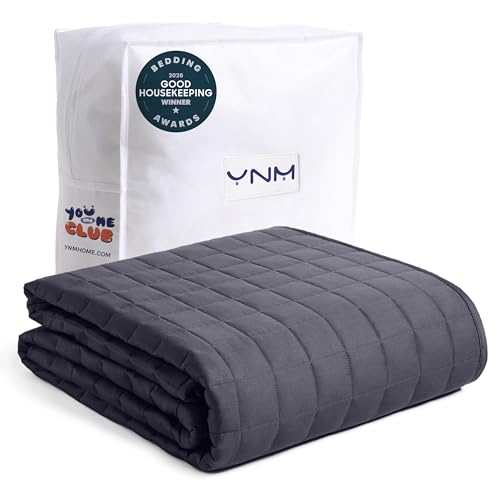
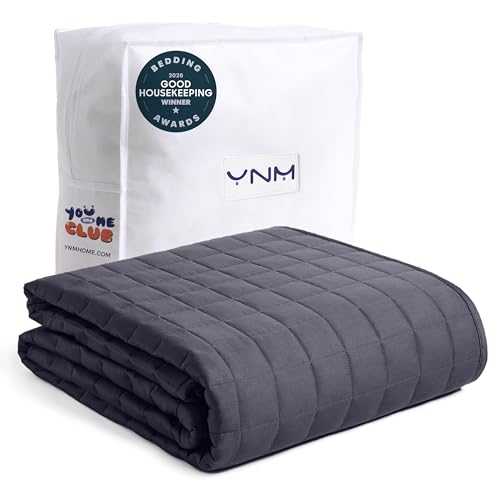
The YnM Weighted Blanket anchors this guide because its maker states the sizing rule most plainly: for one adult, take ten percent of your body weight and add one pound, and choose the large sharing sizes (the maker names 80-by-87 and 88-by-104 inches) when two people will share. This verified listing is the 15-pound, 60-by-80-inch personal size in dark grey — the right starting point for adults whose ten-percent math lands in the mid-teens.
Strengths
- Clearest published sizing rule in the pool, including explicit sharing guidance.
- Small two-inch compartments distribute whatever weight you choose evenly.
- Reduced fiberfill keeps a correctly weighted blanket from also being an overheated one.
Trade-offs
- This listing is one weight; lighter or heavier sleepers must select the matching listing variant carefully.
- Personal size wastes weight if draped over mattress edges — position it on the body, not the bed.
- Bead construction still sleeps warmer than open-knit cotton at equal weight.
| Color | Exclusive Microfiber Dark Grey |
| Size | 60 in x 80 in 15 lb |
| Weight | 15 pounds |
Worked example, using the maker’s rule as general guidance: a 140-pound adult calculates ten percent (14) plus one — 15 pounds, exactly this listing, which the maker also describes as ideal for a person of about 140 pounds. A 120-pound adult lands near 13 and should look for the line’s lighter variant; a 180-pound adult lands near 19 and should look heavier. The rule’s virtue is not false precision but a defensible starting point you then adjust by feel over two weeks. Choose YnM if your math lands mid-teens and you want classic bead distribution. Skip to the prose classes below if your math lands far from fifteen.
A distribution nuance belongs in any weight discussion, and the YnM illustrates it well: felt weight depends on how the pounds are spread. Fifteen pounds in small two-inch compartments lies evenly across the body’s curves, so no single area carries a concentrated load; the same fifteen pounds in large, loose compartments pools at the lowest point and feels heavier on the stomach or feet while feeling absent at the shoulders. When comparing two blankets of identical stated weight, the one with finer compartmentalization will almost always feel like the more accurate weight. This is also why a well-distributed blanket can feel surprisingly light on first touch — evenness removes the pressure peaks people mistake for adequate weight. Judge distribution in the first three nights, before judging poundage at all.
Best for: adults whose ten-percent calculation lands near 15 lb / Not suited for: much lighter or heavier sleepers using this exact listing
Choose YnM when the math points to fifteen. Check on Amazon

Gravity Weighted Blankets for Adults
Our badge: Best Premium
The Gravity Weighted Blankets for Adults contributes the line logic to this guide: the maker offers the blanket in 15, 20, and 35-pound options, which maps neatly onto light-middle, heavier personal, and sharing or high-preference territory — always verify which weight and size a given listing represents before ordering, since the verified listing here is the 15-pound twin/single (48 by 72 inches) in grey with a micro-plush duvet cover.
Strengths
- A stepped weight line makes body-weight matching straightforward within one product family.
- Gridded stitching keeps each weight class evenly distributed.
- Premium cover makes heavier classes feel like bedding rather than equipment.
Trade-offs
- Plush cover adds warmth at every weight; hot sleepers should size and ventilate carefully.
- The 35-pound class is serious weight — appropriate only where guidance and preference truly point there, and never for children.
- Twin/single footprint limits the 15-pound listing to personal use.
| Color | Grey |
| Size | 15 lbs 48″x72″ Twin/Throw |
| Weight | 15 pounds |
Use Gravity’s steps as a sanity check on your calculation: if ten percent of your body weight falls between steps, your temperature and pressure preference decide. Cool sleepers who love being tucked in take the upper step; warm sleepers and beginners take the lower. Households buying for two different bodies should buy two personal blankets at two correct weights rather than one shared compromise — the line structure makes that easy to execute. Choose Gravity for premium feel with clear weight steps. Skip it if breathability outranks plushness.
Gravity’s top step deserves a direct word, because headline weights mislead casual shoppers. A 35-pound blanket is not a personal blanket scaled up for luxury; it belongs to sharing territory and to a small number of large adults whose guidance math genuinely reaches it — and even they should arrive there through testing, not arithmetic alone. For everyone else, treat the existence of the heavy step as a warning against the “more must be better” instinct this guide repeatedly corrects. The useful Gravity decision is the ordinary one: 15 or 20, decided by your ten-percent center, your temperature, and whether you have tested pressure before. Choose the step your body asked for, and let the catalogue’s extremes serve the few bodies they fit.
Best for: shoppers who want one premium line across weight classes / Not suited for: hot sleepers in warm rooms
Choose Gravity and match its steps to your math. Check on Amazon
Bearaby Cotton Hand-Knit Weighted Blankets for Adults – Chunky Knit Blanket – Sustainable
Our badge: Best for Hot Sleepers
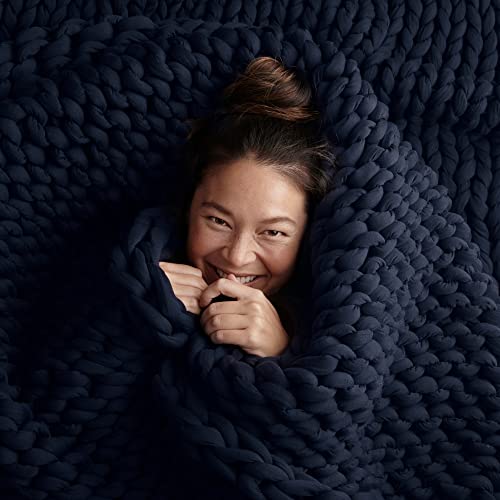
The Bearaby Cotton Hand-Knit Weighted Blankets for Adults – Chunky Knit Blanket – Sustainable brings the second maker rule in the pool: choose around ten percent of your body weight, and if you fall between options, the maker recommends rounding up to feel the full effect of deep touch pressure as a comfort experience. This verified 15-pound, 40-by-72-inch Midnight Blue knit also demonstrates why construction belongs in a weight guide — its open loops ventilate, so its 15 pounds sleep cooler than 15 sealed pounds elsewhere.
Strengths
- Explicit between-sizes guidance removes the commonest sizing hesitation.
- Open-knit construction makes its weight class usable by hot sleepers.
- Even loop distribution means the stated weight is the felt weight, head to toe.
Trade-offs
- Rounding up is wrong advice for very hot sleepers, who should round down or choose ventilation first.
- Narrow personal width concentrates weight on the body — intended, but not for bed-sharing.
- Chunky loops snag; weight plus snagging demands gentle handling.
| Color | Midnight Blue |
| Size | 15 lbs (40”x72”) |
| Weight | 15 pounds |
Reconcile the two maker rules honestly: YnM says ten percent plus a pound; Bearaby says ten percent, rounding up between sizes. Both describe the same neighborhood — the low-to-mid teens for average adults — and both leave the final pound to preference. Let temperature arbitrate: warm sleepers take the lower number in breathable construction; cool pressure-lovers take the higher number in any construction. Choose Bearaby when your weight math lands mid-teens and heat is your constraint. Skip it if you need wide shared coverage.
The Bearaby also exposes a subtlety in the ten-percent rule: it assumes the weight rests on the body, but construction decides how much of the stated weight actually does. A narrow, body-hugging knit delivers nearly all of its fifteen pounds to the sleeper; a wide bead blanket draped over a mattress edge delivers a fraction of its overhang to the bed frame. Hot sleepers comparing the Bearaby’s fifteen pounds against a wider blanket’s fifteen should expect the knit to feel like the fuller weight — one more reason the guide advises them to round down between sizes in this construction. Weight numbers are comparable only when dimensions and drape are comparable, which is why this guide always states size beside weight.
Best for: mid-range weights who sleep hot / Not suited for: couples sharing one blanket
Choose Bearaby for breathable mid-range weight. Check on Amazon
Light Class: Around 10-12 lb Personal Blankets (Prose-Only)
Our badge: Best for Smaller Adults
This prose-only class covers sleepers whose ten-percent math lands near ten to twelve pounds: smaller adults, many teenagers under appropriate guidance, summer versions for mid-range adults, and first-time weighted users who want to learn their preference at gentle pressure. No link or specifications are provided; shop the linked makers’ lighter variants or equivalent listings using the rules in this guide.
Strengths
- Correct pressure for lighter bodies — using a 15-pound blanket here overshoots guidance significantly.
- Easier to wash, move, and store; friendlier summer heat profile.
- Lowest-risk entry point for the weighted-curious.
Trade-offs
- Mid-size adults may find this class underwhelming as a year-round choice.
- Lighter blankets shift more in bed; compartment quality matters more, not less.
- Still adult-supervised territory for any younger user — follow maker age guidance strictly.
If your calculation lands here, resist the social pull of the popular 15-pound listings. Weight is personal equipment, like shoe size; nobody brags about wearing the wrong size well. Choose the light class proudly when the math says so, and revisit after a season if preference grows. Skip it only if your math clearly lands higher.
The light class has a second, quieter constituency: adults recovering from illness or injury whose clinicians have cleared ordinary bedding but who find standard weights fatiguing, and older adults whose guidance math lands mid-range but whose strength for moving a heavy blanket does not. For these sleepers, the operative rule is the independence test from this guide’s safety section — the right weight is the heaviest one the user can lift, position, and remove without effort or help, capped by the ten-percent guidance. A blanket that requires a household effort to make the bed will be quietly abandoned, whatever its comfort in the first hour. Light-class blankets also shine as the household’s guest and couch piece, where unknown preferences argue for gentle pressure.
Best for: lighter adults and summer or starter use / Not suited for: larger adults seeking full guidance weight
Choose the light class when ten percent says ten to twelve. No Amazon link is provided for this prose-only pick by design.
Heavy Class: Around 20 lb Personal Blankets (Prose-Only)
Our badge: Best for Larger Adults
The heavy prose-only class serves adults whose ten-percent math lands near twenty pounds, plus average adults with a strong, tested preference for deep pressure in cool rooms. No link or specifications are offered; Gravity’s line structure (with its 20-pound step) illustrates the class, and YnM’s larger variants follow the same logic — verify any listing’s exact weight and dimensions before buying.
Strengths
- Guidance-correct pressure for larger bodies, where 15 pounds under-delivers.
- Settled, immobile drape that restless sleepers prize in cool bedrooms.
- Personal sizing keeps the full weight on the body where it belongs.
Trade-offs
- Serious laundry weight; confirm machine capacity and your own lifting comfort.
- Heat retention rises with weight — this class belongs in cool rooms.
- Never a sharing shortcut for two lighter people; weight follows one body.
Work up to this class honestly: if you have never used a weighted blanket, a season at guidance weight teaches more than an immediate jump to maximum pressure. Choose twenty when the math or tested preference points there. Skip it as a guess, a gift surprise, or a couple’s compromise.
Heavy-class ownership has logistics that deserve the same honesty as its comfort. A twenty-pound blanket is a two-handed lift, a serious washing-machine load, and a storage commitment; making the bed each morning becomes a small workout that some sleepers enjoy as ritual and others resent within a month. It also concentrates responsibility: a blanket this heavy must never migrate to a smaller household member’s bed, a couch where a child might pull it over themselves, or a guest room without explanation. Label it mentally as personal equipment with a name on it. None of this argues against the class — for the bodies it fits, nothing else delivers the same settled sleep — but it should be bought as the considered equipment it is.
Best for: larger adults and tested deep-pressure fans / Not suited for: beginners guessing, warm rooms, or sharing
Choose the heavy class when the math earns it. No Amazon link is provided for this prose-only pick by design.
Sharing Class: Large Two-Person Blankets (Prose-Only)
Our badge: Best for Couples
Sharing weighted blankets are their own class: oversized dimensions (YnM’s maker guidance names 80-by-87 and 88-by-104 inches for sharing) with weights chosen for two bodies’ combined comfort rather than one body’s ten percent. This prose-only entry exists to prevent the commonest couples’ error — stretching a personal 15-pound blanket across two people and concluding weighted blankets do not work.
Strengths
- Proper coverage and drape for two sleepers under one weighted layer.
- Shared ritual appeal for couples who genuinely share temperature and pressure preferences.
- Large sizes dress the bed like a normal blanket.
Trade-offs
- One weight must suit two bodies — a compromise most couples feel nightly.
- Very heavy total laundry and storage footprint.
- Movement transmits: one partner’s turn adjusts both partners’ pressure.
Most couples in our guidance end at two personal blankets, each correctly weighted, over a shared sheet — all of the closeness, none of the compromise. Choose a sharing blanket only when both partners have tested similar weights and temperatures and still prefer one cover. Skip it as a first weighted purchase for either person.
If a couple does choose the sharing class, two practices make it work as well as it can. First, agree the weight from the lighter partner’s comfort upward, never the heavier partner’s preference downward — the person nearer their limit sets the ceiling, because excess weight cannot be escaped inside a shared blanket while insufficient weight merely feels mild. Second, keep an unweighted throw on the lighter partner’s side as an escape layer for warm nights, so the shared blanket’s all-or-nothing nature has a pressure valve. Even with both practices, most couples should treat a sharing blanket as a second purchase after personal testing has proven both partners love similar weight — a honeymoon conclusion, not a first date.
Best for: tested, like-minded couples / Not suited for: first purchases or mixed-temperature pairs
Choose sharing class only after personal testing. No Amazon link is provided for this prose-only pick by design.
Comparison Table
| Pick | Size | Weight | Sizing logic | Check price on Amazon |
|---|---|---|---|---|
| YnM Weighted Blanket | 60 in x 80 in 15 lb | 15 pounds | 10% + 1 lb, one adult | Check price on Amazon |
| Gravity Weighted Blanket | 15 lbs 48″x72″ | 15 pounds | Stepped line: 15 / 20 / 35 lb | Check price on Amazon |
| Bearaby Cotton Napper | 15 lbs (40”x72”) | 15 pounds | ~10%, round up between sizes | Check price on Amazon |
| Light Class (prose) | Personal | ~10-12 lb class | 10% for lighter bodies | Check price on Amazon |
| Heavy Class (prose) | Personal | ~20 lb class | 10% for larger bodies | Check price on Amazon |
| Sharing Class (prose) | 80×87 / 88×104 class | Two-person class | Shared size guidance | Check price on Amazon |
How to Choose the Best Weight for Weighted Blankets
Do the ten-percent calculation, then adjust once
Multiply your body weight by 0.10. That is your center. Adjust up by a pound or two if you are a cool sleeper who loves pressure and falls between sizes; adjust down if you sleep hot, are new to weighted blankets, or fall between sizes in summer. Make one adjustment, buy, and evaluate over two weeks — endless pre-purchase agonizing predicts nothing that a fortnight of sleep will not settle.
Separate weight from dimensions
A blanket draped over the mattress edge donates its overhang weight to the bed, not to you. Personal weighted blankets should cover your body with modest margin — roughly twin-to-full footprints for most adults — while sharing sizes belong to the sharing class only. If your correct weight in a too-large blanket feels light, the fix is sizing, not more pounds.
Factor season and construction into felt weight
Fifteen ventilated pounds (open knit) feel lighter and cooler than fifteen sealed pounds (plush bead). In summer, felt weight drops a class for most sleepers; in winter, the same blanket feels fuller. Households in swing climates often own a breathable mid-weight and treat it as the year-round answer rather than chasing seasonal poundage.
Apply stricter rules for younger and vulnerable users
Weighted blankets are never for infants or toddlers. For older children, use only products made and sized for them, follow the maker’s age and weight guidance exactly, ensure the user can remove the blanket independently, and supervise introduction. The same independence rule applies to any adult user: if someone cannot remove the blanket freely, the blanket is too heavy or inappropriate, full stop.
Height and build refine the percentage
Ten percent is a starting rule for average builds. Tall sleepers distribute the same weight across more body, so a blanket at exactly ten percent can feel lighter per square inch — one reason dimensions matter beside poundage, and why tall sleepers should prioritize adequate length so the weight they bought actually rests on them rather than ending at the shins. Compact, dense builds feel the same pounds more intensely. None of this overturns the rule; it explains why two people of identical weight can honestly prefer adjacent classes, and why the two-week test outranks the calculator.
Plan for the weight you will be, not only the weight you are
Body weight changes — training, pregnancy and recovery, illness, ordinary years. A blanket bought at the exact center of your range tolerates a few pounds of drift in either direction without becoming wrong; a blanket bought at the very top of your tolerance has no headroom. When your calculation lands between classes and your weight is in a changing season of life, choose the class your near-future self can also use, and remember that pregnancy and medical situations deserve a clinician’s input on weighted use rather than a buying guide’s arithmetic.
How to Test Whether Your Weight Is Right
Give a new weighted blanket fourteen nights: three nights legs-only if you are cautious, then full coverage. Right weight feels like being tucked in — present, even, easy to breathe under, easy to shed half-asleep. Too heavy announces itself through morning leg fatigue, overheating, and relief when you push it off. Too light feels like an ordinary blanket with ambitions. Change one variable at a time (weight class, then construction) and keep notes for the first week; sleep impressions blur without them.
Problem: The blanket feels perfect on the couch but heavy in bed. — Lying flat distributes your body differently and sleep reduces tolerance. Drop a class for bed use or keep this blanket for wind-down only.
Problem: Weight pools in the middle or at your feet. — Distribution, not poundage. Choose smaller compartments or gridded stitching and center the blanket before sleep.
Problem: You and your partner need different weights. — You need two blankets. This is the normal outcome, not a failure of compromise.
Problem: Your weight was right in winter, wrong in July. — Seasonal felt weight is real. Switch to breathable construction or a lighter class until autumn.
Problem: The blanket feels right on your torso but heavy on your legs (or the reverse). — Distribution and body shape, again. Reposition so more of the blanket covers the area that wants pressure, fold a narrow blanket’s excess away from the area that does not, and if the mismatch persists, a different dimension — not a different poundage — is usually the fix.
Keep the test honest in one more way: change nothing else during the fourteen nights. New pillows, new sheets, and a new blanket in the same week produce a verdict about nothing. If the blanket passes its solo trial, it has earned its place; if it fails, you will know the failure was really about weight, and the exchange — lighter, heavier, or different construction — will be obvious rather than guessed.
Weighted Blankets for Children: A Careful Word
This guide’s picks are adult blankets. Children’s weighted products exist as a separate category with their own sizing, and the only safe approach is maker-specific: correct weight for the child’s body weight per that maker’s chart, appropriate age per that maker, independent removal ability, and adult supervision during introduction. Never place an adult weighted blanket on a child, never use any weighted blanket with infants or toddlers, and when guidance is unclear, choose an ordinary blanket — including the gentle options in Best Blankets For Newborns for the youngest children, where weighted products have no place at all. Comfort never outranks these basics.
One practical corollary for parents: a child’s growth quietly invalidates yesterday’s correct choices, in both directions. A blanket that fit a child’s guidance at one age is not automatically appropriate a year later, and an adult blanket never becomes appropriate merely because a teenager has grown tall. Re-run the maker-specific math at each stage, keep adult and child products in separate mental (and physical) categories, and retire outgrown child products rather than passing them informally to younger siblings whose numbers differ. The careful word stays careful precisely because households change.
How Body Weight Maps Across a Household
Households often try to buy one weighted blanket for everyone; the math forbids it. A 120-pound adult centers near 12 to 13 pounds; a 200-pound adult centers near 20 to 21. A shared 15-pound blanket is simultaneously heavy for one and light for the other, and its personal dimensions fit neither properly across two bodies. The economical solution is sequential: buy one correct blanket for the most interested sleeper, learn the household’s real enthusiasm, then add a second correct blanket only if a second sleeper is genuinely converted. Weighted blankets are personal equipment that happen to live on a shared bed.
Budget enters the household math too, and sequencing is the savings. Two correct personal blankets bought a season apart cost the same as two bought together, but the sequential path risks only one purchase on an untested preference — and households discover, often, that only one sleeper actually loves weight. The second-most-common outcome is that both love it but at different classes, which the sequential path also handles gracefully. The genuinely wasteful purchase is the single shared compromise bought first: it teaches nobody their real preference and satisfies nobody’s math.
Common Buying Mistakes
Buying the popular weight instead of your weight
Fifteen pounds is popular because it centers the adult range — not because it fits every adult. Run your own ten-percent math before defaulting to the best-known number.
Confusing blanket dimensions with user size
Queen on the box describes the bed, not the body. Weight follows body weight; dimensions follow coverage intent. Check both numbers on every listing.
Going heavier to feel more effect
More weight is not more comfort past your range — it is more heat, more fatigue, and more blanket on the floor. If pressure feels insufficient at guidance weight, improve distribution and construction before adding pounds.
Gifting a weighted blanket by surprise
Weight, temperature, and pressure preference are intimate variables. Gift weighted blankets only with the recipient’s input or a generous return path, and never for children without the caregivers’ informed choice.
Trusting a listing’s headline weight without checking the variant
Weighted lines sell many weights under one product page, and the variant in the cart — not the headline in the title — is what arrives. Confirm the selected weight and dimensions on the listing before ordering, especially when a household member orders on your behalf. A remarkable share of “wrong weight” stories are wrong-variant stories, and they are the easiest mistake in this entire guide to prevent.
Final Recommendation
Calculate ten percent of your body weight, then buy the closest verified option: the YnM Weighted Blanket for classic mid-range sizing, the Bearaby for the same range with ventilation, or a Gravity step matched to your number — Check on Amazon. Give the choice fourteen nights before judging, and let temperature cast the tie-breaking vote whenever you fall between weights.
One last piece of arithmetic honesty: the ten-percent rule is a comfort heuristic with a good track record, not a physical law, and the makers in this pool phrase it with appropriate softness — “about,” “roughly,” “ideal for.” Treat any seller who presents an exact pound as medically precise with suspicion, and any guide that ignores body weight entirely with more. Your job is to land in the right neighborhood with the right construction, then let fourteen nights of your own sleep cast the deciding vote. That combination — arithmetic first, evidence second, preference last — is the whole method of this guide.
Frequently Asked Questions
What weight weighted blanket should I get?
Start near ten percent of your body weight: YnM’s maker adds a pound for a single adult; Bearaby suggests rounding up between sizes. A 140-pound adult, for example, lands at about 15 pounds — the size of all three linked listings here.
Is it better to go heavier or lighter?
Between sizes, go heavier if you sleep cool and love pressure; go lighter if you sleep hot, are a beginner, or will use the blanket in summer. The blanket you keep on all night is the right weight in practice.
Can a weighted blanket be too heavy?
Yes. Signs include overheating, morning fatigue, feeling restricted, and pushing it off during sleep. Anyone who cannot remove the blanket independently should not use it. Drop a class or discontinue use if any of these appear.
What weight is right for couples?
Usually two personal blankets at two individual weights. True sharing blankets exist in oversized dimensions with combined logic, but they compromise both partners’ ideal pressure and temperature. Test personally first.
Do weighted blanket weights include the cover?
Listings generally state the blanket’s total product weight; a removable cover’s contribution is small but real. Use the maker’s stated weight for the complete product you will sleep under, and re-check if you add a heavy cover of your own.
Should children use the ten-percent rule?
Only within child-specific products and their makers’ own charts and age guidance — never by applying adult blankets or adult rules of thumb. Infants and toddlers must not use weighted blankets at all.
What if I weigh 100 pounds or 250 pounds — does the rule still work?
The arithmetic scales, but the product shelf thins at both ends. At about 100 pounds, your center is near 10 pounds — shop the light class deliberately rather than accepting a 15-pound default that overshoots by half. At about 250 pounds, your center is near 25 pounds, above most personal lines; prioritize adequate dimensions and distribution at the heaviest personal class you can verify, and expect the blanket to feel somewhat lighter than textbook — a distribution and sizing question, not a reason to stack two blankets, which this guide advises against.
Does sleep position change the right weight?
Somewhat. Back sleepers receive weight most evenly and usually thrive at their calculated center. Side sleepers concentrate pressure on shoulder and hip, so the same pounds feel stronger — many side sleepers prefer the lighter side of their range. Stomach sleepers often prefer weight on the legs only, or a lighter class overall. Let position cast a vote alongside temperature when you fall between classes.
Is a heavier blanket harder to wash and carry?
Yes, proportionally — every added class adds laundry weight, drying time, and effort in making the bed. Factor your machine’s capacity and your own lifting comfort into the class decision alongside the percentage math. The right weight is one you can maintain as happily as you can sleep under it.
How do I recheck my weight choice after a few months?
Ask three questions. Do you still use the blanket most nights without deciding to? Do you fall asleep without noticing it — the sign of a weight that has become background? And do you ever wake having pushed it off without remembering? Mostly yes, yes, and no means the class is right. A pattern of nightly shedding means drop a class or change construction; a blanket that has become invisible in a bad way — no sense of pressure at all — means your preference may have graduated a class. Recheck each season, briefly, the way you recheck the rest of the bedding.
Can I use two lighter weighted blankets layered instead of one heavy one?
We advise against it. Layered weighted blankets shift against each other, distribute unpredictably, complicate removal in the night, and can quietly sum past a safe, comfortable total for the sleeper. If your correct class feels unavailable or insufficient, solve it with dimensions and distribution in a single blanket — or accept the nearest single class and let the trial judge. One blanket, one known weight, one clean exit: the principle protects both comfort and safety.
What weight should a first-time buyer in the middle of the adult range choose?
The 15-pound personal class — the size of all three linked listings in this guide — exists precisely for you: it centers the most common adult calculations, every construction style is available in it, and its resale and regifting prospects are the best in the category if your preference surprises you. Buy it in the construction your temperature dictates, run the fourteen-night test, and adjust only on evidence. Mid-range beginners who follow that sequence rarely need a second purchase.
Should I size up because I share the bed with a pet?
No. A pet adds its own migrating weight wherever it settles, which argues for keeping your blanket at or below your calculated center, not above it — and for keeping weighted blankets off pets themselves, particularly small animals. If a dog or cat reliably sleeps on your legs, expect that zone to feel a class heavier and position the blanket accordingly, perhaps higher on the torso. The blanket’s weight follows your body; the pet is weather, not arithmetic.
Does the ten-percent rule apply to weighted throws used on the couch?
Loosely. Couch use is upright, partial-body, and time-limited, so most people enjoy a lighter class than their bed calculation — the light class and lap styles exist partly for this. If one blanket must serve both couch and bed, size it for the bed and accept livelier pressure on the couch, or size it for the couch and accept gentler sleep pressure. The bed’s eight hours should win the argument.
My calculation lands exactly between two weights. What decides it?
Run three tie-breakers in order. Temperature: hot sleepers take the lighter, cool sleepers may take the heavier. Experience: beginners take the lighter, tested pressure fans may take the heavier. Construction: in a sealed, plush design take the lighter; in an open-knit design the heavier remains breathable enough for many sleepers. If all three point the same way, the decision is made; if they split, take the lighter — insufficient pressure is a mild disappointment, while excess weight is a returned blanket.
Can I test weighted blankets before buying?
Informally, yes: a friend’s blanket during an evening wind-down, or a folded heavy quilt over your legs for a few nights, teaches you whether pressure relaxes or annoys you — the preference question. It cannot teach you your exact class, because improvised weights distribute poorly. Treat the home test as a yes-or-no gate, then let the ten-percent math choose the class and the fourteen-night trial confirm it.
How accurate are stated blanket weights?
Treat stated weights as nominal. Fill distribution, cover inclusion, and manufacturing tolerance mean two “15-pound” blankets can differ modestly in hand. What matters more is that the maker’s guidance maps that stated weight to body weights plainly, as the linked makers here do. If a listing hides its total weight or gives only bed-size guidance, consider that a vetting failure regardless of price.


