Disclosure: As an Amazon Associate, this site may earn from qualifying purchases. Product links are provided for convenience; prices, bundles, availability, and specifications can change, so confirm the current listing before buying.
Choosing the best vacuums for cleaning cars is less about chasing the biggest suction number and more about reaching the places where dirt collects. Seat seams, narrow door pockets, carpet edges, cargo-area corners, and the space beside a center console all demand different combinations of reach and control. A compact handheld vacuum may be the easiest tool to keep in the trunk, while a wet/dry unit with a flexible hose can make a better home-garage station. A full-size vacuum with a long hose can also work when you already own it, provided you have the right small attachments.
This guide compares those setups by cleaning task, power source, storage needs, and the surfaces inside a vehicle. It is not a laboratory ranking: the examples below are selected to show the kinds of equipment and tradeoffs shoppers can compare. For each model, check the current manufacturer instructions and Amazon listing, especially whether the battery and charger are included and whether the unit is approved for wet pickup.
Quick picks by car-cleaning situation
| Cleaning situation | Setup to consider | Why it can fit | Check before buying |
|---|---|---|---|
| Quick crumbs and dust between errands | Compact cordless hand vacuum | Easy to lift out, use briefly, and put away | Battery runtime, cup capacity, included crevice tool |
| Seats, floor mats, and tight trim gaps | Hand vacuum with hose and brush attachments | Flexible hose reduces awkward wrist angles; soft brush helps on trim | Hose reach, attachments, filter cleaning and replacement |
| Garage detailing with dry debris and occasional liquid pickup | Small wet/dry vacuum | More capacity and the ability to handle approved wet messes | Wet/dry filter setup, drain/emptying steps, cord or battery needs |
| Several cars or a large SUV | Shop vacuum with a long hose and car nozzle | Less carrying during a full interior clean; larger bin between emptying | Hose length, wheel movement, accessory storage, outlet access |
| Portable vacuum for road trips | 12-volt corded or rechargeable handheld model | Can be stored with travel supplies for small cleanups | Power connection, cord reach, charging method, heat limits |
What makes a vacuum useful inside a car?
Reach matters more than an impressive headline
Car interiors are compact, but their geometry is awkward. A short nozzle may clean the center of a seat and still fail to reach the gap where the seat rail meets the carpet. A vacuum with a long narrow crevice tool can reach between the seat and console, while a flexible hose lets the canister or motor stay outside a cramped footwell. Look at the length of the hose and the usable length of the nozzle rather than assuming that a high airflow figure solves every reach problem. For routine cleaning, the best tool is often the one that can reach under seats without forcing you to twist your wrist or kneel against the sill.
Measure the places you actually need to clean. A minivan owner may value a long hose for the third row and cargo area; a small coupe owner may care more about a narrow nozzle for the seat tracks. If you have child seats, check that the attachment can maneuver around the installed seat without requiring you to remove it every time. For a vehicle with a deep cargo well, a floor nozzle or extension tube may be more useful than a collection of specialty brush heads. Small accessories only help if they are easy to attach, store, and retrieve.
Airflow, suction, and debris type
Manufacturers use different measurements and test conditions, so CFM, air watts, sealed suction, and marketing terms cannot always be compared as if they were a single standardized score. A car vacuum has to lift crumbs, grit, loose soil, and hair from fabric, but performance also depends on the nozzle opening, filter condition, battery charge, and whether the debris is embedded in a dense carpet. A narrow tip can concentrate airflow into a seam; a wide nozzle can cover flat carpet faster. A motorized brush may help agitate fabric, but it can be too aggressive for delicate upholstery or loose trim.
Think about the debris you remove most often. Dry cereal, sand, leaves, and loose dust call for good pickup and a bin that is simple to empty. Pet hair tends to cling to woven upholstery and floor mats, so a brush designed for fabric may matter more than a bare suction claim. Liquid spills require an explicitly wet/dry-rated vacuum and the filter setup described in the manual. Never infer wet capability from the shape of a canister or from an online review. A dry-only model should remain a dry-only model even if a spill seems small.
Filtration and clean maintenance
Vacuuming stirs dust, and the filter helps keep collected material in the machine. Fine-dust filters can be useful for dusty carpets or dried soil, but a filter’s rating applies only under the stated conditions and does not make a vacuum a substitute for proper ventilation. Check whether the filter is washable, how it dries, how often the maker recommends cleaning it, and whether replacement parts are easy to identify. A damp filter can restrict airflow or become unpleasant, so washable does not mean reinstall it while wet.
Emptying design affects how often owners actually maintain a vacuum. A cup that opens without scattering dust is more comfortable for frequent use; a large tank means fewer interruptions on a big vehicle but may be bulkier to carry. Check the path from the intake to the bin for places where hair can wrap or debris can lodge. If you frequently collect sand, compare how the cup releases fine material and whether the filter is protected from a direct cloud when you empty it. Keep a small brush or cloth nearby for cleaning the cup and filter housing according to the manual.
Power choices: cordless, 12-volt, and garage units
Cordless battery models
A cordless hand vacuum is convenient when you want a quick clean without routing a cable around an open door. It is particularly handy for crumbs, leaves, and the occasional spill of dry debris after a trip. Its tradeoffs are runtime, charging, and battery cost. Some power-tool vacuums are sold as bare tools, so the price shown may not include a compatible battery or charger. If you already own batteries in that brand’s platform, that can make the tool a practical add-on. If you do not, calculate the cost of the complete setup rather than comparing bare-tool prices.
For longer cleaning sessions, consider how the manufacturer describes runtime and what battery pack was used to obtain it. Runtime can change with battery capacity, filter condition, and use pattern. A small cup that fills quickly can interrupt cleaning even if the battery lasts a long time. A battery-powered vacuum also needs a storage plan: avoid leaving batteries or electronics in extreme heat, and follow the battery manufacturer’s storage guidance. The closed trunk of a vehicle can become very hot or cold, so a garage shelf or indoor charging location may be better than permanent in-car storage.
12-volt corded models
A 12-volt vacuum that plugs into a vehicle accessory socket can be useful for travel because it does not depend on a separate tool battery. Its practical range is limited by the cord and the location of the socket. Measure whether the cable can reach the rear seats and cargo area without pulling tight or passing through a pinch point. Keep the cord away from moving seat tracks and doors. Confirm how the manufacturer expects the vehicle to be powered; some vehicle outlets switch off with the ignition, while others may remain active.
Do not leave an accessory plugged in unattended or assume the car battery can support extended cleaning. Follow the vehicle manual’s advice about accessory outlets and engine operation. Running an engine in an enclosed garage creates a carbon-monoxide hazard, so never do that to power a vacuum indoors. If the cord is awkward to route around the car, a rechargeable model or a garage vacuum with a long hose may be safer and easier to handle.
Wet/dry and shop vacuums
A wet/dry vacuum can serve more than one household job, and its larger container may suit a thorough garage clean. But it is often heavier and takes longer to set up than a small hand vacuum. Check the exact filter configuration required for wet pickup, whether a float or shutoff is included, how the tank drains, and how the unit should be cleaned after liquids. Some machines require a filter change between wet and dry work. Never pick up fuel, solvents, hot ash, or other prohibited materials; consult the manual because household and automotive liquids can be flammable or chemically hazardous.
A shop vacuum’s hose can provide useful reach while the body stays near the garage wall. The extra hose and larger bin are helpful for a full-size SUV, a work van, or several vehicles in one session. The cord, however, can cross walkways and catch on wheels or door edges. Set the machine on stable ground and route the hose so it does not pull the unit toward the vehicle. If the unit is loud, plan a reasonable time and use hearing protection when the manufacturer or workplace guidance calls for it.
Product examples to compare
The models below illustrate different approaches: a compact wet/dry hand vacuum, a dry hand vacuum with multiple attachments, a familiar compact household hand vac, a corded travel vacuum, and a portable wet/dry garage vacuum. Product cards are examples, not test winners. Always confirm the exact model number, power source, included accessories, current price, and condition of the listing before purchase.
Amazon product examples to compare

ASIN: B01CKIZ8BA

ASIN: B09YXZ4L8T

ASIN: B006LXOJC0
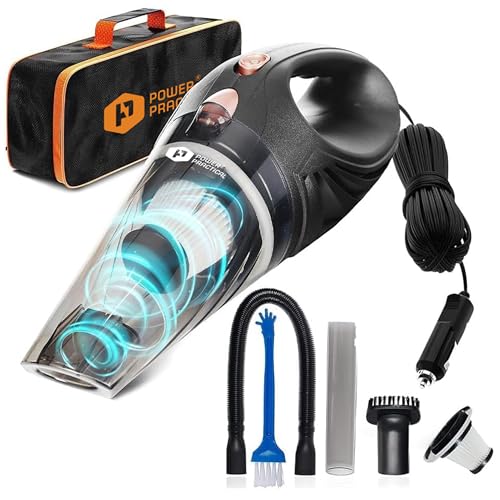
ASIN: B06ZY896ZM

ASIN: B017EOLGJI
How to read the product examples
The DEWALT DCV517B is a compact wet/dry format built around a half-gallon tank, a flexible hose, and a direct utility nozzle. DEWALT says its HEPA wet/dry filter traps 99.97% of dust at 0.3 microns; its official product page also states that the battery and charger are sold separately. Those features make it a candidate for a garage where the owner values portability and approved wet/dry capability. Its small tank is a tradeoff: a full interior can require more stops to empty than a larger garage vacuum. Follow DEWALT’s manual on what can be collected and how the filter must be configured.
The DEWALT DCV501HB illustrates a dry-only tool vacuum with a flexible hose, extension tube, floor nozzle, crevice nozzle, and brush options. DEWALT lists a 46 CFM airflow rating and a runtime estimate tied to a specific battery; neither number should be treated as a guarantee for a different battery or a car-cleaning workload. The range of attachments may be helpful for seats, footwells, and trim, while the dry-only limitation is important for spills. It is a bare tool listing in many bundles, so verify battery inclusion before checking out.
BLACK+DECKER’s compact Dustbuster models show the simpler household-hand-vac approach. They can suit occasional dry cleanups when their included nozzle fits the job, but model variants differ. A rotating nozzle, charging base, pet brush, or battery capacity may be included on one listing and absent from another. Read the model number in the title and product details rather than assuming two Dustbuster listings have identical contents. A smaller vacuum can be easier to lift and store; a small bin also needs more frequent emptying during a deep clean.
ThisWorx’s 12-volt car vacuum represents a corded travel setup. A long cable can reach farther around a vehicle than a very short accessory cord, but it also needs careful routing so it does not catch in a door, seat rail, or wheel. Check the product listing for the supported outlet, included attachments, and operating instructions. A corded device can be ready without a separate battery pack, although it ties the cleaning session to the vehicle’s power outlet. Consider whether that arrangement works with the outlets and power behavior in your specific car.
The RIDGID 4000RV shows the portable wet/dry shop-vac approach. RIDGID describes its 4-gallon model as a compact wet/dry unit for cleanup; the Amazon listing may bundle a car nozzle and other accessories, but bundles can change. The larger tank can reduce emptying on a full-size vehicle, while the body, hose, and power cord take up more floor and storage space. It is a better fit for a garage-centered routine than for a vacuum that lives in a glove box. Verify the exact model and accessories on the current listing.
Match the vacuum to each part of the interior
Carpet, floor mats, and footwells
Start with removable floor mats. Take them outside and shake or tap loose grit away from the vehicle; this prevents the vacuum from immediately filling with sand. Then vacuum the mat from several directions, using a brush only if the mat material tolerates it. Rubber mats need a different approach from deep-pile carpet: grit can gather in molded channels, so a crevice nozzle may help, while delicate carpet fibers can snag if a rotating brush is used aggressively. Allow damp mats to dry fully before reinstalling them.
For footwells, slide the seat only as far as the vehicle allows and keep hands clear of moving tracks. A narrow nozzle reaches along the carpet perimeter and below pedals, but do not vacuum near wiring or force an attachment under a control. Avoid placing a vacuum on a seat where it could fall or scratch trim. Work from the outside edge toward the center, pausing to remove larger debris by hand rather than trying to pull it through a small nozzle. If a floor covering is wet, address the moisture using materials and methods appropriate to the vehicle and vacuum, not a dry-only machine.
Seats and upholstery
Use a soft brush attachment for seat surfaces when the upholstery manufacturer permits it. Brush in short, controlled passes and avoid pressing hard around seams, piping, perforations, or seat-mounted sensors. Leather and synthetic upholstery usually need a gentle touch and a soft tool; vacuuming is only the dry soil-removal step, not a cleaning treatment. Use separate approved products for stains and follow the vehicle or upholstery care instructions. A vacuum nozzle should not be dragged over a surface if its edges could scratch or leave marks.
Seat creases collect crumbs, hair, and dust. A narrow crevice tip can help, but sweep slowly and keep the tool from pulling at stitching or loose fabric. If crumbs are wedged under a child safety seat, follow the child-seat maker’s and vehicle maker’s instructions before removing or reinstalling anything. Never alter a seat belt, anchor, airbag, or electrical connection to make cleaning easier. For pet hair, a brush or rubberized upholstery tool may loosen fibers before vacuuming; check the fabric first in a hidden area and stop if it pills or snags.
Console, door pockets, and vents
Use a small brush to lift dust from hard trim, then vacuum nearby debris with a low-profile attachment. Do not push a hard nozzle into buttons, switches, charging ports, or control seams. Door pockets can contain coins, paper clips, and other objects that may block the vacuum or scratch the interior; remove those items by hand first. For vents, use a soft detailing brush and low suction nearby, rather than forcing a narrow vacuum tip into slats. The vehicle’s electronic components and delicate finishes are easier to protect when cleaning is deliberate instead of rushed.
Keep liquids away from controls and electrical ports. A wet/dry rating does not make a vacuum safe for every liquid, and it does not protect the car’s electronics. If a drink spills into a console or near a connector, follow the vehicle maker’s guidance and consider professional help. Vacuuming loose dry crumbs around a switch is a different task from extracting liquid from a powered component. When you are unsure whether an area is safe to vacuum, stop and consult the vehicle manual.
Trunk and cargo area
The trunk often contains leaves, grit, pet hair, and soil tracked in with groceries or outdoor equipment. Remove cargo before vacuuming and lift removable mats according to the vehicle instructions. A floor nozzle covers flat cargo panels more efficiently than a tiny crevice tool, while a hose helps reach corners around the wheel wells. Check under any removable organizer for trapped debris. Avoid pulling at carpeted panels or exposing spare-wheel compartments unless the design allows routine access.
For a three-row vehicle, minivan, or truck, reach becomes more important because the outlet or vacuum body may be far from the last seating row. A long hose can save repeated repositioning, but a battery hand vacuum avoids dragging a cord through open doors. Place the vacuum where it cannot tip or strike painted bodywork. For tall SUVs, clean from the cargo area toward the front in zones so you do not step on freshly vacuumed areas or lean over seats with a heavy machine.
A careful cleaning sequence that works
- Park safely. Choose a dry, ventilated place with enough room to open the doors. Turn the vehicle off, remove the key or keep the fob away as recommended, and secure the vehicle so it cannot roll.
- Remove loose items. Take out trash, child toys, floor mats, and cargo organizers that are intended to be removable. Check pockets for coins or small objects before vacuuming.
- Choose a dry-debris pass. Pick the nozzle appropriate to the surface. Clean the highest and most accessible areas first, then seats, footwells, and removable mats, collecting loose debris before applying any cleaner.
- Work in small zones. Move the seat using its normal controls and vacuum one footwell at a time. Keep the nozzle clear of pedals, seat tracks, wires, and trim seams.
- Finish the cargo area. Vacuum trunk edges and flat floor surfaces with the wide attachment, then use the crevice tip for corners and seams.
- Maintain the vacuum. Empty the bin before it reaches its fill line, inspect the filter, and clean or replace it as the manual specifies. Store accessories together so they are ready for the next session.
Do not treat a vacuum as an extractor for every stain. Vacuuming removes dry soil; stains, odors, and embedded residue may require a compatible upholstery cleaner or professional detailing. Avoid over-wetting fabrics, because moisture trapped in padding can take a long time to dry. Never mix cleaning chemicals or use a product contrary to its label. If you use a wet/dry vacuum for an approved liquid, follow the machine’s exact wet-use setup and clean it after use.
How to choose by budget and ownership cost
At the lowest price tier, a compact hand vacuum may make sense for occasional crumbs. The biggest risk is buying a device with a nozzle too wide for seat gaps or a battery that does not last through the task. Check the package contents and replacement filter cost. A slightly more expensive model with a hose, brush, and accessible replacement parts can be more useful than a discounted vacuum with no way to reach under seats.
Mid-priced tool-platform vacuums are attractive if you already own compatible batteries. The bare-tool price can look low while the complete kit costs more than expected. Compare the vacuum, battery, charger, and replacement filter as a package. Also check whether the battery can be removed for indoor charging and whether the machine has a comfortable emptying process. If you detail a vehicle regularly, accessories and service support may matter more over time than the initial sale price.
A shop vacuum costs more in storage space and setup time, even when the initial price is reasonable. It can be good value for a household that will also use it in a garage or workshop. If it will only clean one car once a month, a large machine may be unnecessary. Consider the whole ownership cost: filters, bags if required, attachments, battery replacements, extension cords, and the time it takes to move the vacuum into position. The best choice is the one that fits your actual routine, not the one with the largest spec sheet.
Common buying mistakes to avoid
- Buying by peak suction claims alone. Airflow, nozzle shape, filter condition, and the debris itself affect pickup. Look for the attachments and reach you need.
- Assuming every model is wet/dry. Many portable hand vacuums are dry-only. Confirm the exact model and manual before collecting liquid.
- Forgetting battery and charger costs. Tool-only bundles may require a platform battery and charger you do not own.
- Ignoring hose and cord reach. A device that cannot reach the back seat or trunk may be frustrating even when it cleans well up front.
- Expecting pet hair to lift with suction alone. Hair can cling to fabric. A compatible brush or rubber tool may be needed, with care to avoid damaging upholstery.
- Leaving a vacuum in a hot car. Heat can affect batteries and electronics. Follow storage instructions and consider keeping the vacuum indoors.
- Using the wrong filter after wet pickup. Wet/dry machines may require different filter arrangements for liquids and dry debris. Follow the manual exactly.
Maintenance that preserves performance
After each substantial clean, empty the dust cup or tank before storing the vacuum. Hair around the intake can reduce airflow and may wrap around a brush roll, so inspect it and remove debris with the machine switched off and disconnected from power. Clean filters only as directed. If a filter is washable, let it dry completely; if it is disposable, replace it with the specified type rather than washing it. A damaged seal or missing filter can allow dust to bypass the collection system.
Store hoses without sharp kinks and keep small nozzles in a labeled pouch or the accessory bag. A missing crevice tool is a common reason owners stop using a perfectly good vacuum for the places where they need it most. Recharge batteries in a suitable indoor location, check charging indicators, and observe the battery maker’s instructions for long-term storage. If a vacuum develops an unusual smell, heat, noise, or loss of suction, turn it off, unplug or remove its battery if safe, and troubleshoot using the product manual rather than continuing to operate it.
When a professional detailer may be the better option
A household vacuum is well suited to routine dry debris, but it may not remove deeply embedded hair, stains, or material trapped in carpet padding. Professional detailing can be appropriate when a vehicle has extensive pet hair, ground-in sand, mold concerns, a large liquid spill, or delicate surfaces you do not want to risk. It can also make sense before returning a lease vehicle or after a long trip. Ask what process and products will be used, especially if the interior includes leather, delicate coatings, or aftermarket electronics.
For regular upkeep, a small vacuum plus occasional professional service can be a balanced approach. Use the home vacuum for crumbs and surface dust, and reserve more intensive extraction for cases that require suitable equipment and drying time. This avoids forcing a compact consumer machine to do a job outside its design. It also keeps the vacuum’s filter and motor from being overloaded by material the manufacturer says not to collect.
Related cleaning and home guides
If you are cleaning up after pets, see our guide to vacuums for pet messes around the home. For other garage cleanup tasks, compare our shop vacuum examples and selection advice. And for keeping nearby living spaces tidy, our living-room rug guide explains how pile and material affect routine care.
Frequently asked questions
What type of vacuum is best for cleaning a car?
For quick maintenance, a cordless hand vacuum with a crevice tool and soft brush is convenient. For a detailed garage clean, a shop vacuum with a long hose and car nozzle can be easier to use. A wet/dry model is only appropriate for liquids if its instructions explicitly allow that pickup and the correct filter setup is installed.
Is a regular household vacuum strong enough for a car?
Often, yes. A household vacuum with a hose, crevice tool, and upholstery brush can clean car carpets and seats. The challenge is usually reach and portability, not whether the vacuum is labeled for cars. Keep the body stable outside the vehicle and route the hose carefully around the doors.
Are cordless car vacuums worth it?
They can be worth it when convenience matters and the battery lasts long enough for your typical cleanup. They are less appealing if you need to clean several large vehicles in one session or if the model requires batteries you do not own. Compare complete kit price, runtime, cup size, charging time, and filter cost.
Can I vacuum wet spills from car seats?
Only use a vacuum specifically rated for wet pickup and only with the filter arrangement and procedures in its manual. Do not use a dry-only hand vacuum on liquid. For spills near electronics or seat wiring, follow vehicle guidance and seek professional service if needed.
How often should I vacuum my car interior?
Frequency depends on passengers, pets, weather, and how often the car carries food or outdoor gear. Short weekly or biweekly cleanups can prevent grit from accumulating, while a more thorough cleaning can be done when mats, seats, and cargo areas visibly need it. Remove debris promptly if it could interfere with pedals or seat mechanisms.
What attachment is most useful for car cleaning?
A narrow crevice tool is useful for seat gaps and door pockets; a soft brush can help on upholstery and trim; a flexible hose helps reach under seats. A floor nozzle can cover footwells and cargo mats faster. The best set depends on your cabin layout and materials.
Can I leave a cordless vacuum in the trunk?
Check the battery manufacturer’s storage-temperature guidance. A vehicle interior can become very hot or cold, so indoor storage and charging are often better. If you keep a vacuum in the vehicle for travel, secure it so it cannot become a loose object and remove batteries when the instructions recommend it.
Final recommendation
The best vacuums for cleaning cars are the ones that can reach your vehicle’s tight spaces, collect the debris you actually encounter, and remain easy enough to maintain that you use them regularly. Choose a compact cordless model for brief cleanups, a hose-equipped hand vacuum for detail access, or a portable wet/dry shop vacuum for garage-centered work and greater capacity. Verify the exact model, battery inclusion, wet/dry rating, replacement filters, and accessory set before ordering. A thoughtful match between the vacuum and the job will do more for a clean interior than an impressive specification that does not fit your routine.
Certain content that appears on this site comes from Amazon. This content is provided “as is” and is subject to change or removal at any time. Product images and descriptions are supplied through Amazon Creators API; confirm specifications, included accessories, compatibility, and availability on the current listing.