Where to buy
Check the latest price, availability and delivery on Amazon. Orders are placed on Amazon. We may earn a commission from qualifying purchases.
- Best overall: Linkind StarRayS Solar Spotlights, 6 Pack (Warm White) — Check on Amazon
- Best path lights: BEAU JARDIN Solar Pathway Lights, 8 Pack — Check on Amazon
- Best smart pathlight: Ring Solar Pathlight, Single — Check on Amazon
- Best string lights: Brightech Ambience Pro Solar String Lights, 48 ft — Check on Amazon
Two further picks carry a warning. For every pick below, check the current price on Amazon before you buy, as prices and availability change often. The TomCare flame torches need an extra check: their listing has at times shown no featured offer, so buy only if a live, orderable offer appears and lands under this budget.
Read the full guide ↓
Disclosure: As an Amazon Associate, dailyhomedecorating.com earns from qualifying purchases. Links to Amazon on this page are affiliate links; they cost you nothing extra. Listing details such as price and availability change often, so check the current Amazon listing before you buy.
A modern home is the hardest brief a cheap solar light can be handed. The architecture is doing deliberate things — flat planes, long sightlines, landscaping planted in drifts and grids rather than cottage borders — and it tolerates no visual noise. A row of mismatched plastic stakes, each glowing a different color, argues with the house. Solar should suit this architecture — no trench through finished hardscaping, no conduit to hide — and in that one way it does. Light the architecture, not the fixture. Use fewer fixtures than feels safe, spaced on an even rhythm. Hold one color temperature across the whole yard. And judge every fixture twice: for what its light does at night, and for what the object looks like standing in a gravel bed at noon.
The same audit applies here as in Best Solar Garden Lights Under $75, where this tier is ranked for yards in general. Seventy-five dollars is where solar stops being disposable and starts making claims — spotlight six-packs, glass-and-metal path lights, app control, a motion sensor from a brand with a support department. Some of it is real — this is the tier where replaceable batteries come back. Some of it is not. Every lumen figure in this category is a maker’s number with no shared standard behind it, every runtime is quoted for the dimmest mode after the longest day of the year, and even the best pick is accent lighting — none replaces a wired security light.
So, the shape of the tier through a modern lens. The Linkind StarRayS six-pack — check price on Amazon — is the best overall buy, because an aimable spotlight is the one solar tool that builds architectural light. The Ring Solar Pathlight is the pick that fits a modern home as a system rather than an object — app control, a real motion sensor — provided you cost its Bridge honestly, which its review does. The BEAU JARDIN path set is a traditional form a hard-modern scheme should refuse and a warm-modern one can welcome. The Brightech strand and the TomCare torches are the two aesthetic border cases, and the NYMPHY four-pack is the coverage play. Below: the quick picks, six detailed reviews, a comparison table, the choosing discipline, the mistakes, and the questions.
Quick Picks
Check price on Amazon at the pack counts named; brightness and runtime figures are maker claims, labeled as such in the reviews.
| Buyer type | Pick | Why it stands out | Link |
|---|---|---|---|
| Best overall | Linkind StarRayS Solar Spotlights, 6 Pack (Warm White) | Six adjustable spotlights for washing walls and lifting specimen planting, IP67 as listed, two modes, — check price on Amazon | Check on Amazon |
| Best path lights | BEAU JARDIN Solar Pathway Lights, 8 Pack | Glass globes, 16.5-inch stakes and a replaceable AA Ni-MH battery, — check price on Amazon and check live stock | Check on Amazon |
| Best smart / system | Ring Solar Pathlight, Single | Real motion sensing and app control in the Ring ecosystem — check price on Amazon — but the Bridge that unlocks it is sold separately | Check on Amazon |
| Best string lights | Brightech Ambience Pro Solar String Lights, 48 ft | 15 shatterproof S14 bulbs on a 48 ft strand with a detachable panel you can place in the sun, — check price on Amazon — for softened backyards, not hard-minimal terraces | Check on Amazon |
| Best value spotlights | NYMPHY Solar Lights Outdoor, 4 Pack (Warm White) | 56 LEDs per light and an IP68 listing claim — check price on Amazon; two packs wash eight features within this budget | Check on Amazon |
| Best flame effect | TomCare Flickering Flame Solar Torch Lights, 43″, 4 Pack | The most convincing fake flame in the class at 43 inches tall — and the least modern object in this guide; check price on Amazon before buying | Check on Amazon |
How These Picks Were Chosen
The first filter was the budget itself, applied per pack, because pack size changes what a purchase really is. A multi-pack of spotlights and a single smart light can both sit under $75; they are not the same buy, and this guide never lets a large pack and a single fixture trade places without saying so. For every pick, check price on Amazon before you buy — prices and availability in this category move often. Where a listing itself would not hold still, that instability is described in its review rather than hidden. One pick, the TomCare torches, has at times shown no featured offer at all, so it appears with a link and a clear instruction to buy only against a live, orderable offer under this budget.
The second filter is the one this lens adds: an aesthetic audit run as strictly as the budget audit. Each fixture was judged as an object in daylight — silhouette, finish, whether its design language belongs to this architecture or to a cottage garden — and as a source at night: whether its light can be aimed and washed into a layer, or whether it simply glows where it stands. Aimable light scored heavily; decorative glow scored lightly. The color-temperature audit ran alongside: the warm picks cluster at 2700K–3000K, the Ring at a cooler 3500K — a planning fact, not a footnote, since mixed temperatures in one sightline are how a disciplined yard ends up looking accidental. Readers working down the ladder should see Best Solar Garden Lights Under $40 for what the step down buys: smaller packs, sealed batteries, thinner claims, and fixtures harder to defend in front of a modern facade.
The third filter was honesty about what solar numbers mean. Solar lumens and runtime have no shared measurement standard: makers quote output at the LED, in the brightest mode, from a full battery charged under ideal sun, and runtime in the dimmest mode in midsummer. So this guide prints maker figures only as maker figures, never ranks two lights by competing claims, and leans instead on what can be verified from specification fields: the IP rating as listed, the battery type and whether it can be replaced, the panel arrangement, and the materials named in the spec table rather than the title. Where a title and a spec field disagree — and in this category they do, including on one pick below — the spec field wins and the disagreement is printed. What the extra money buys at $75 is not brightness. It is replaceability, build, pack size and, in exactly one case, a sensor and an ecosystem.
That ecosystem case deserves its own paragraph, because it is where this tier hides its real system costs. A smart solar light is not a light with an app; it is a light plus a radio bridge plus an account, and the bridge is rarely in the box. We cost smart picks as light plus hub, in the open, with over-budget outcomes labeled over budget. The Ring pathlight passes that audit only in its standalone configuration — as a motion light on factory settings it is excellent value; as a smart system its starter kit lands over this budget once the Bridge is added, and the review lays that out in the open. One rival was researched and left prose-only: Linkind’s SL5 smart spotlights add color and app control, but voice control runs through a separate Bluetooth mesh hub sold separately. It is mentioned here without a link, for readers who want color and app control beyond what the six picks below offer. If a straightforward in-budget purchase matters more than color-changing, the six picks below fit cleanly.
The 6 Best Solar Garden Lights Under $75
Linkind StarRayS Solar Spotlights, 6 Pack (Warm White)
Who it suits: Modern homes whose planting and walls deserve to be lit as architecture — buyers who want to wash a wall, graze stone or lift a specimen tree out of the dark, and will aim each light by hand.
Architectural lighting is mostly aiming. A wall does not need a brighter light; it needs one placed close and angled so the beam rakes across the surface and lets texture cast shadows. That is why a six-pack of adjustable spotlights is the most modern purchase in this guide: six identical heads, each with ten LEDs behind a lens, a solar panel built into the top of the head, and a mount that pushes into the ground on a stake or screws to a wall or fence. The head pivots — roughly 180 degrees horizontally and 90 vertically per the listing — so beam and panel can be aimed semi-independently. Linkind rates the light at up to 350 lumens; read that with the category rule attached. It is a maker’s figure with no standard behind it, quoted for the high mode — the honest translation is “among the brighter claims in this class,” not a measurement. The specification that matters is the pair of modes: on low, Linkind claims up to twelve hours of runtime; on high, about six — both from a full day’s charge, and both certain to shrink in winter, under trees, or anywhere the panel sees less than the six to eight hours of direct sun every solar light quietly assumes. The listing carries an IP67 rating, the strongest weather claim among the spotlights here, and the housing is ABS per the specification fields — plastic, stated plainly.
Plastic, in this one case, is not the aesthetic problem it sounds like: a modern scheme wants the source to disappear, and a small matte-black head staked low in a bed does — the eye reads the washed wall and the lit tree, not the fixture. Six heads in one pack — check price on Amazon — is also the right count for layering — two on the wall, two on the feature tree, two on the planting blocks, each where its own panel gets sun. That freedom has a constraint: because the panel is part of the fixture, a light that belongs in shade — under a deep eave, in a north-facing courtyard bed — will starve there. The honest limitation is the battery. The StarRayS runs on a built-in lithium cell Linkind does not market as user-replaceable: when the cell fades after some years of daily cycling, the practical options are surgery the maker does not document or a new light. As a multi-light pack within this budget, that trade-off is survivable — but a sealed cell sits awkwardly in a design culture that prefers serviceable objects, and it is recorded as a demerit.
- Six lights in one pack — the most spotlights in a single full-size set here.
- Two modes with maker-claimed runtimes of up to 12 hours (low) and 6 hours (high); IP67 rating as listed.
- Stake it in the ground or screw it to a wall or fence; the head pivots to aim panel and beam separately.
Honest limitation: The battery is built in and not marketed as replaceable, so a faded cell eventually means a replaced light — and the panel is part of the fixture, so shaded placements charge badly no matter how bright the claim on the box.
Choose it if your beds see real sun and you want lit surfaces and specimens, not dots on the ground. Skip it if your garden is a shaded courtyard — no panel-on-fixture spotlight will serve you, and the Brightech strand below, whose panel detaches, solves a different version of that problem.

BEAU JARDIN Solar Pathway Lights, 8 Pack
Who it suits: Warm-modern homes — timber, stone, board-formed concrete, planting with softness in it — that want a classic globe line, and any buyer who values a battery they can replace over a light they must.
Start with the honest tension: this pick’s review is an argument with itself. The BEAU JARDIN eight-pack is a traditional object — a glass globe on a tall stem, about 16.5 inches overall with a globe roughly 4.7 inches across — far more presence than the budget tiers’ 12-inch mini-stakes. Against a hard-modern facade — flat roof, steel window walls, gravel and slab — a row of glowing globes reads as cottage, and no review should pretend otherwise. Against warm modernism, the same row reads as a deliberate softening note — eight warm points on an even rhythm. The verdict depends on which modern your house is. The listing describes glass globes on stainless stems, with the footnote this guide exists for: the listing’s own specification fields have also described the material as an ABS-and-glass combination, so read the construction as glass globes with metal and plastic sharing the stem work, not as an all-metal fixture, and check the spec field on the live listing before you buy.
What is not in dispute is the battery: each light runs on a single AA-size Ni-MH rechargeable cell, 950 mAh per the listing, in a compartment you can open. When a cell fades — and Ni-MH cells in daily-cycle service do fade — the replacement costs very little and takes two minutes. A fixture you service for years fits a philosophy of fewer, better objects far better than a sealed unit on a countdown. Eight lights in one pack is the largest count in this guide — check price on Amazon. The listing’s own text has quoted 10 lumens per light; a specification table for the same product has quoted 6; independent bench testing measured roughly 10 to 12 lumens per fixture. This is a marker light. It draws a dotted line of warm light that dark-adapted eyes follow easily, and it will not light the path’s surface the way a wired fixture or the spotlights above will — which is not a defect but what path lights are for; any set in this tier claiming to flood a walkway is claiming fiction. Runtime is quoted at eight to twelve hours on a full charge, assuming six to eight hours of direct sun per globe — along a tree-lined path the shaded end retires earlier, and in a modern scheme an uneven rhythm of dead and living globes looks like neglect. Stock on the current eight-pack listing has flickered recently — one read found it unavailable while another showed it in stock fulfilled by Amazon — so check price on Amazon and confirm a live offer. Multi-packs in this class occasionally include a dead unit; test all eight the day they arrive. Renters in modern blocks, who cannot trench or hardwire anything, will find this same set ranked for their constraints in Best Solar Garden Lights For Apartments Under $75.
- Eight lights in one pack, standing 16.5 inches tall — the most substantial path-light format under the budget.
- Replaceable AA Ni-MH battery (950 mAh per the listing) — the only pick here whose cell swaps in minutes with an inexpensive standard cell.
- Glass globes per the listing, with run times quoted at 8–12 hours on a full charge in direct sun.
Honest limitation: Output is a maker’s 6–10 lumens depending on which of the listing’s own fields you read — a marker light, not illumination — the globe form fights hard-modern architecture, and the eight-pack’s stock status has flickered recently, so confirm a live, fulfilled offer before ordering.
Choose it if your modern is the warm kind and you want a serviced-for-years path line. Skip it if your facade is glass, steel and right angles — the globes will look borrowed — or if you need to actually see the ground, a spotlight’s job.

Ring Solar Pathlight, Single
Who it suits: Modern homes already running — or honestly planning — a smart platform: buyers who want the front approach to react to people, report to their phone and take schedules, and who understand they are buying infrastructure, not a lamp.
Every other pick in this guide is an object. The Ring pathlight is a node. Its design language is the first clue: a plain, matte, industrial cylinder about 16.8 inches tall with no lantern costume and no faux-anything — visually the most contemporary fixture here, the one that looks drawn by the same hand as the house. Ring rates the output at up to 80 lumens, adjustable, at a 3500K color temperature. The motion sensor covers up to 120 degrees with a detection range of up to 15 feet; both are Ring’s own specifications, quoted as maker numbers like every sensor claim in this category, but published precisely enough to plan around: space the lights so their 15-foot fields overlap and the approach lights up ahead of a walker. Power is the second grown-up detail: the included cell is a standard 3.7V 18650 lithium-ion rechargeable — replaceable, the best battery arrangement in this guide — with a micro-USB port for topping up from a wall charger after a cloudy week. Check the current price on Amazon before you buy. As a single light, it sits in the lower part of this budget — the cost question is the system around it, covered below. A one-year limited warranty and an actual support channel come with it.
The 3500K is this pick’s one real aesthetic liability in a modern-homes guide. The warm picks cluster around 2700K to 3000K; Ring’s neutral-warm 3500K is visibly cooler, and a Ring pathlight in the same sightline as a warm spotlight wash will read as a mistake — two unrelated whites in one composition. The discipline is zoning: give Ring the front approach, the drive edge and the gate, where its crisper light reads as intentional, and keep the warm layer in the garden rooms behind the house.
Then the ecosystem math, done in the open, because it decides whether this pick is a bargain or a trap. Out of the box, with no other hardware, the pathlight works as a motion-activated light on factory settings — it notices movement and lights. Everything that makes it smart is locked behind a bridge the light does not include: Ring’s own listing states that a Ring Bridge or a compatible Echo is necessary for all smart functionality in the Ring app — custom brightness and motion settings, schedules, grouping lights so they fire together, phone notifications, and linking to Ring cameras and doorbells. The Bridge is sold separately. So the honest configurations are these. Two single lights, no Bridge: comfortably inside this budget as motion lights. A starter kit of two lights plus a Bridge: over this budget once the Bridge is added — treat it as a step above this tier, not a fit inside it. One light plus a Bridge: also at or over the top of this budget — check price on Amazon for both pieces and add them together before assuming the pair fits. And if your home already runs a compatible Echo — the fourth-generation Echo or third-generation Echo Show 10 can act as the Sidewalk bridge — the extra hardware cost disappears entirely and the single light is simply the best smart buy in this guide. That last case is common in modern homes, which tend to arrive pre-wired with platforms — read the Bridge, if you need one, as infrastructure for years of devices, not as part of this light alone, but read it in the open either way. As a standalone motion light it earns its place today; as a system, budget above this tier for the starter kit that makes it sing.
- Real motion sensing: up to 120° coverage and 15 ft range per Ring’s specifications, with adjustable output up to 80 lumens — the only reactive light in this guide.
- Replaceable 3.7V 18650 cell included, with a micro-USB top-up port for cloudy weeks — the best power arrangement here.
- The cleanest industrial design in the guide, as a single light — check price on Amazon; Bridge extra, covered above.
Honest limitation: Every smart feature — app control, schedules, grouping, notifications, camera linking — requires a Ring Bridge (sold separately) or a compatible Echo that the light does not include; the two-light-plus-Bridge starter kit lands over this budget — and its 3500K output must be zoned away from the warm-white picks or it will clash.
Choose it if a compatible Echo already lives in your house, or you want two excellent motion lights now and the Bridge as a planned second purchase. Skip it if you want app control inside this exact budget with no existing hardware — no honest product offers it, and the Linkind set above gives you six lights without any ecosystem entry cost.

Brightech Ambience Pro Solar String Lights, 48 ft
Who it suits: Modern homes whose architecture softens at the back — timber decks, planted terraces, pergolas — where an exposed-bulb canopy is a chosen mood rather than a style accident.
String lights are the one solar format where the panel problem has a proper solution, and Brightech’s Ambience Pro line is the established name in it. The strand runs 48 feet with 15 S14 sockets spread over roughly 42 lit feet, each holding a 1-watt LED bulb in a shatterproof plastic shell — drop one on a patio and it bounces. The color is a soft warm white: Target’s listing for the identical strand specifies 2700K, while some Amazon titles describe the same bulbs as 3000K soft white, so expect a warm tone in that neighborhood. The decisive detail is the panel: a separate unit on a ground stake, wired to the strand, so the strand can hang in a pergola’s shade while the panel sits in full sun at the bed’s edge — the only pick here that decouples where the light goes from where the sun is. Brightech quotes roughly five to six hours of light from a full charge, a maker’s figure that winter and a badly placed panel will both reduce, and backs the solar line with a two-year warranty, the longest in this guide. Check the current price on Amazon before you buy: this strand’s price has moved substantially over time, with periods well above its usual position in this tier, and Target also sells the same strand. Treat the live price as something to confirm, not assume.
Now the two-sided aesthetic verdict, because this is where the modern lens cuts both ways. Exposed bulbs on a sagging catenary are café language — relaxed, social, a little boho — and hard modernism’s first lighting rule is that the source should be hidden and only the effect visible. Strung across a minimal concrete terrace under a flat roofline, this strand will fight the architecture all evening; the honest advice for that house is to skip it and spend the money on a second spotlight layer. But most modern homes soften at the back — timber, planting, people — and there a warm canopy over the dining table is not a style error, it is the room’s ceiling. The functional honesty is unchanged: fifteen 1-watt bulbs over 42 feet is atmosphere, not task light — you will dine happily under it and read badly under it, and it contributes nothing to a path or a step. The battery lives inside the panel unit and is not a user-replaceable cell; when it fades after some years of cycling, the service path is a replacement panel from Brightech, not a two-minute swap like the BEAU JARDIN’s AA cell or the Ring’s 18650. The pack math: one strand sits within this budget on its own, while two strands — what a large pergola actually wants — together push over this budget. Buy one strand well, place its panel like you mean it, and let the second strand be a later purchase. Readers lighting the ground outside a bedroom window — where warmth and gentleness matter more than drama — should also see Best Solar Garden Lights For Bedrooms Under $75, where this budget is ranked for that job.
- 48 ft strand, 15 shatterproof S14 LED bulbs over about 42 lit feet — the only atmosphere pick in the guide.
- Detachable solar panel on a stake: hang the strand in shade, park the panel in sun.
- Two-year warranty on the solar line, — check price on Amazon before you buy, as this line’s price moves over time.
Honest limitation: The battery is sealed in the panel unit, so a faded cell means a replacement panel rather than a cheap swap; the exposed-bulb look is off-language for hard-minimal architecture; and the price is volatile, with historical spikes far above this tier — buy it only while the live price sits within this budget.
Choose it if your back garden is the soft room of the house and atmosphere over seating is the brief. Skip it if your terrace is hard and minimal — strings light the ceiling of a yard, not its floor, and the spotlight picks above respect the architecture better.

NYMPHY Solar Lights Outdoor, 4 Pack (Warm White)
Who it suits: Buyers lighting a whole modern garden on this budget — long planting beds, several walls — who will trade claim discipline and battery access for sheer count of washes.
NYMPHY’s four-pack is the volume play of this tier, and at this budget the play is doubling it: check price on Amazon, and note the doubling plan: two packs put eight spotlights in the ground within this budget — the only way under $75 to light eight separate features at once. Contemporary planting is repetitive by design — a drift of one grass, a run of identical shrubs, a colonnade of small trees — and repetitive planting wants repetitive light: the same wash, at the same interval, repeated. Eight matched heads deliver that rhythm. Each light carries 56 LEDs, and NYMPHY’s marketing claims up to 400 lumens per light. Apply the category rule without flinching: a maker’s number with no standard behind it, from a brand whose claims run optimistic — the honest reading is “bright for its class,” not a figure to plan a driveway by. The three lighting modes — low, medium and high steady settings — trade output against runtime, with the maker’s runtime claim spanning six to twenty hours; the twenty-hour end belongs to the dimmest mode after a perfect day, and a northern winter will not see it. The listing claims an IP68 rating, the highest number printed anywhere in this guide, and it gets the standard treatment: IP68 describes continuous submersion under conditions the maker specifies, nothing in the listing’s public materials shows independent certification, so treat these as thoroughly rain-proof lights you do not deliberately submerge. The bodies are ABS per the specification fields — plastic, like everything in this tier that does not say otherwise in its specs.
Two honest costs come with the count. The first is visual: a 56-LED head is a busy object, a small panel of visible diodes that reads as gadget rather than garden architecture — the least designed-looking fixture in this guide in daylight. The defense is real but partial: staked low and aimed at a surface, the head mostly exits the composition, and at night only the wash remains. In gravel beds on long sightlines you will notice them; in dense planting, you will not. The second cost is access. The battery is built in and not marketed as user-replaceable, so each light is a sealed unit with a finite cell life — the same demerit recorded against the Linkind set, at a similar position in this tier, but from a brand with a thinner support trail: the listing’s own warranty field promises a 45-day refund window and twelve months of after-sale service, less than Brightech’s two years or Ring’s infrastructure. The panel sits on the fixture, so these light the features that live in sun. Where the set argues back is arithmetic and aim — eight lights forgive placement experiments a two-light budget cannot, and each head tilts to aim. In a compact modern courtyard, eight small washes genuinely outperform two big ones; readers working with limited outdoor square footage will find the two-pack plan laid out in Best Solar Garden Lights For Small Rooms Under $75. Buy them as what they are: inexpensive, bright-claiming, sealed spotlights whose value and coverage count are the feature.
- Two packs — eight lights — within this budget: the most coverage this budget can buy, and the rhythm repetitive modern planting asks for.
- 56 LEDs per light with three steady brightness modes, and an IP68 rating as claimed on the listing.
- Heads tilt to aim; stake them in beds or screw them to a fence or wall.
Honest limitation: The 400-lumen and IP68 figures are unverified maker claims, the battery is sealed and not replaceable, the 56-LED head is the least designed object in this guide, and the warranty trail is a 45-day refund promise with twelve months of after-sale service — thinner than the branded picks above.
Choose it if coverage count and rhythm are your priorities and you will place the lights where their panels see real sun. Skip it if you want claims you can lean on and a battery you can change — the Linkind six-pack is the more disciplined version of the same idea — check price on Amazon for both before you choose.

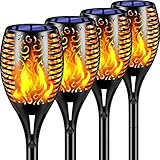
TomCare Flickering Flame Solar Torch Lights, 43″, 4 Pack
Who it suits: Almost no modern home, stated plainly — this pick is here because readers ask for it. It suits tropical, rustic and resort-style planting, pools with a tiki register, and anyone whose brief is pure flame atmosphere with no open flame, no oil and no wiring.
Every other pick in this guide is trying, in some way, to disappear into the architecture or to light it. The TomCare torches are trying to be a fire. On their own terms they are the best in this class: each torch stands 43 inches tall — properly torch height, not the knee-high mini-flame stakes of the budget tiers — and packs 99 LEDs behind a flame-shaped diffuser, animated to flicker in a pattern that, from conversational distance in the dark, reads as a real flame remarkably well. The listing rates the torches IP65, dust-tight and rain-proof as claimed, with automatic on at dusk and off at dawn, a quoted charge time of six to eight hours of direct sun, and a quoted runtime of ten to twelve hours in summer falling to roughly five in winter — all maker figures, and the winter half is the one to believe. A one-year warranty is stated in the listing’s specification fields. The bodies are plastic; TomCare also sells a metal-bodied flame light under a different model, and listings in this category blur the two, so do not assume this model is the metal one on the strength of a title. Four torches frame a short path or a patio’s edge; they outline, they do not illuminate.
Now the style verdict, without hedging. A flickering flame is a quotation from another architecture — the tiki bar, the resort pool, the cottage garden — and modernism does not quote. In a scheme of flat planes and disciplined planting, four animated flames will read as theme, and theme is the one thing the house was designed to refuse. The narrow exception is a modern home with tropical planting around a pool; and a homeowner who simply loves the effect should buy it with open eyes rather than be talked out of it by a style rule. But for modern homes as a class this is the weakest pick in the guide — it stays because the effect has no verified rival under $75. It also carries the guide’s most serious buying warning, about the listing rather than the light. Recent checks of the TomCare torch listings on Amazon — this black four-pack and its bronze sibling alike — have at times shown no featured offer available. So the instruction here is mechanical: check price on Amazon, and buy only if the live listing shows a real, orderable featured offer, sold or fulfilled through a channel with painless returns, at a total under this budget — and if the listing is dark or the offer looks strange, walk away and take the Brightech strand above for the same atmosphere job. The battery is built in and not marketed as replaceable, the standard demerit for the class.
- 43-inch torches with 99 LEDs each — the most convincing flame effect in the class, at real torch height.
- IP65 as listed, automatic dusk-to-dawn operation, and a one-year warranty stated in the listing.
- Maker-quoted runtime of 10–12 hours in summer, honestly falling to about 5 in winter.
Honest limitation: Availability is the weak point — the listing has at times shown no featured offer — the battery is sealed, and the flame language is off-style for modern architecture; buy only against a live, orderable offer under $75, or do not buy.
Choose it if the listing is alive with a live offer inside this budget, your planting runs tropical or resort, and atmosphere is the whole brief. Skip it if the offer is absent or odd — and skip it for a hard-modern scheme, or if you need light to see by, because a flame effect is decoration by definition.
Comparison Table
| Product | Format, power & battery | Best use | Link |
|---|---|---|---|
| Linkind StarRayS Solar Spotlights, 6 Pack (Warm White) | Six spotlights, panel on each fixture; built-in lithium cell, not marketed as replaceable; IP67 as listed | Washing walls and lifting specimen planting in sunny beds, — check price on Amazon | Check on Amazon |
| BEAU JARDIN Solar Pathway Lights, 8 Pack | Eight path lights, 16.5″ tall; replaceable AA Ni-MH cell (950 mAh per listing) | Paths and driveway edges in warm-modern schemes — check price on Amazon | Check on Amazon |
| Ring Solar Pathlight, Single | One smart path light, motion sensor; replaceable 18650 cell with micro-USB top-up | Motion-activated approach lighting and the Ring ecosystem — check price on Amazon; Bridge extra | Check on Amazon |
| Brightech Ambience Pro Solar String Lights, 48 ft | 15-bulb strand, detachable panel on a stake; battery sealed in the panel unit; two-year warranty | Patios, pergolas and softened back gardens, one strand — check price on Amazon | Check on Amazon |
| NYMPHY Solar Lights Outdoor, 4 Pack (Warm White) | Four spotlights, 56 LEDs each; sealed battery; IP68 as claimed on the listing | Maximum coverage — two packs, eight lights within this budget | Check on Amazon |
| TomCare Flickering Flame Solar Torch Lights, 43″, 4 Pack | Four flame torches, 99 LEDs each; sealed battery; IP65 as listed | Pure flame atmosphere for tropical or rustic schemes — check price on Amazon; buy only against a live offer | Check on Amazon |
How to Choose Solar Garden Lights Under $75
- Hold one color temperature per sightline. The warm picks cluster at 2700K–3000K; the Ring burns at 3500K. Either family can carry a scheme, but the two families in the same view read as an accident. Zone them: one temperature for the front, another only where a wall or hedge breaks the sightline.
- Fewer fixtures, evenly spaced. Space lights on the architecture’s own module: equal intervals, aligned to columns or paving joints, and stop one fixture earlier than instinct suggests. A modern scheme fails by excess far more often than by shortage; darkness between lit moments is part of the composition.
- Hide the source, show the effect. Prefer fixtures that aim — a spotlight’s wash on a wall, a graze across stone — over fixtures that glow where they stand. Walk the garden at noon as well as at midnight: if a fixture draws the eye in daylight, it is furniture, and it had better be furniture the architecture would have chosen.
- Name the job before you name a product. Path lights mark a route, spotlights wash a feature, strings light a ceiling, torches decorate, and a motion light reacts. No pick here does two of those jobs well; most disappointment in this category is a marker light asked to illuminate.
- Audit your sun before you audit any listing. Every runtime here assumes six to eight hours of direct sun on the panel; a bed shaded after lunch runs any panel-on-fixture light at half its promise. Shaded courtyards should start with the detachable-panel strand or wired lights, not brighter claims.
- Make the battery a first-order question. A replaceable cell — the Ring’s standard 18650, the BEAU JARDIN’s AA Ni-MH — turns a fading light into a two-minute repair with an inexpensive standard cell. A sealed battery turns it into a replacement light on a two-to-four-year clock. Sealed is a demerit you should accept only for a reason, such as the Brightech’s detachable panel or the NYMPHY’s coverage count.
- Cost smart lights as systems. If a light needs a bridge, hub or gateway, add that hardware to the total before comparing — and if the total breaks the budget, say so, the way the Ring review above does. Also ask what the light does with no hub at all: a light that still works on factory settings is a safer buy than one that goes dumb.
- Read IP ratings from the specification field, and discount them anyway. IP65 means rain and jets; IP67 and IP68 claim immersion resistance. These are listing claims, rarely independently certified in this class — treat the number as a ranking hint between products, not as permission to submerge anything. The same skepticism covers lumens: with no shared measurement standard, a claim of 400 from one brand and 80 from a disciplined brand like Ring can describe similar yards after dark. Buy on format, battery, panel arrangement and pack math; treat both numbers as the maker’s mood, not as data.
Common Buying Mistakes
- Mixing color temperatures in one view. The classic modern error. A warm tree wash behind a cool-white path line makes both look wrong. Pick a temperature family per zone and hold it.
- Collecting fixture styles. A globe on the path, a torch by the pool, a string over the deck and three spotlight brands in the beds: each defensible alone, chaos together. One or two fixture languages per garden is the ceiling; repetition is what makes cheap fixtures look designed.
- Over-lighting. Doubling the pack because a multi-pack looks like good value, then dotting every bed edge until the garden reads as a runway. Buy the smaller plan, live with it a week, and add only where darkness is actually a problem.
- Believing the biggest lumen number. The most common error in this category. Unstandardized claims reward the least honest listing; the disciplined brands quote the smallest numbers. Rank by job fit and construction, not by the claim.
- Staking lights where the light looks good instead of where the sun is. A spotlight placed for its beam with its panel under a shrub is a decoration that works in June and quits in October — and one dead fixture in an even rhythm is visible from the street. Place for the panel first; aim the head second.
- Expecting security-light performance. Even the strongest pick here is accent lighting — tens of honest lumens against a wired floodlight’s thousands. If the job is deterring anyone or lighting a driveway, it belongs to wired fixtures.
Final Recommendation
For most modern homes, buy the Linkind StarRayS six-pack and stop thinking. Check price on Amazon: it puts six aimable, weather-rated spotlights into the beds and borders where solar actually works, within this budget. Accept the sealed battery as the trade-off for that pack value, and place every head for its panel first. For a warm-modern path, the BEAU JARDIN eight-pack is the better-shaped purchase: glass globes, the largest pack count here, and the AA cell that makes it the one set you can keep alive indefinitely with cheap standard cells — provided you catch its listing in stock.
The remaining picks are for specific briefs, honestly bounded. The Ring pathlight is the best light in this guide and the worst budget fit: buy one or two as motion lights for the front zone, or because a compatible Echo already lives in your house, and treat the Bridge, sold separately, as the planned second purchase the over-budget starter kit admits to being. The Brightech strand owns the softened-backyard brief — check price on Amazon — with the detachable panel every shaded yard wants, and should be refused by hard-minimal terraces. The NYMPHY four-pack, doubled to eight lights within this budget, is the rhythm-and-coverage play for repetitive planting. And the TomCare torches are the atmosphere play for the tropical minority — buy them only against a live listing with an offer inside this budget, knowing you are quoting another architecture on purpose. What $75 will not buy, from anyone, is a solar light that replaces a wired one; spend the budget on washes, rhythm and one disciplined temperature.
FAQ
Can solar lights actually suit a modern home, or will they always look cheap? They can suit it, under discipline: aimable fixtures whose sources disappear, one color temperature per sightline, even spacing, and no decorative glow competing with the building. What looks cheap is not solar itself but clutter — mixed styles, mixed temperatures and too many fixtures.
What color temperature should a modern garden use? Warm white in the 2700K–3000K range is the safer default for gardens and seating. A cooler neutral around 3500K — the Ring’s temperature — can read crisp at a front approach or drive. The rule is not which one, but never both in the same view.
Are solar garden lights bright enough to light a path safely? To mark a path, yes — a line of path lights or a few spotlights gives dark-adapted eyes plenty to navigate by. To illuminate the walking surface the way a wired fixture does, no: honest outputs in this class run from a few lumens for markers to a few dozen for spotlights, whatever the claims say. If the path has steps, put one wired light at the hazard rather than expecting solar to cover it.
How many hours of sun do these lights actually need? Plan on six to eight hours of direct sun on the panel for anything like the quoted runtime. Partial shade is not proportional — a panel in dappled light may deliver a third of its promise — and winter shortens both the charging day and the cell’s capacity.
What does the Ring Bridge actually add, and can I skip it? Without a Bridge or a compatible Echo, the Ring pathlight works as a motion-activated light on factory settings. The Bridge unlocks everything adjustable: app control, brightness and sensitivity settings, schedules, grouping lights so they fire together, phone notifications, and linking to Ring cameras and doorbells. Whether you can skip it depends on whether factory settings are the whole of your ambition — for a simple approach, they often are.
Why does this guide tell you to check price on Amazon instead of printing prices? Because prices and availability in this category change often, and a printed figure goes stale quickly. Check the current price on Amazon for every pick before you buy. The TomCare torches need the extra caution described above — their listing has at times shown no featured offer — so that pick comes with buying instructions as well as a link.
Can I leave solar lights out all winter? The housings are built for it, but expect roughly half the summer runtime, and expect the season to age sealed batteries faster than replaceable ones. Lights with swappable cells — the Ring’s 18650, the BEAU JARDIN’s AA Ni-MH — can be topped up indoors during the darkest weeks.