Where to Buy These Solar Garden Lights
- Best for Modern Homes (Architectural Bollard): Gama Sonic GS-214 Stainless Steel Solar Bollard Light, single fixture — check price on Amazon — Check on Amazon
- Best Smart Accent System: Linkind SL5C Smart Solar Spotlights, 8 pack — check price on Amazon — Check on Amazon
- Best Smart Path System: Ring Solar Pathlight, single light — check price on Amazon; a Ring Bridge or Sidewalk coverage is required for smart features — Check on Amazon
- Best String Lights (Back Patio): Brightech Ambience Pro Solar String Lights, 48 ft, 15 bulbs — check price on Amazon — Check on Amazon
- Best Glass Path Set — With a Style Caveat: BEAU JARDIN Solar Pathway Lights, 8 pack — check price on Amazon — Check on Amazon
- The Traditional Statement (Wrong Form for Modern Homes): Gama Sonic Royal Bulb Solar Lamp Post, 87 in cast aluminum post, single head — check the current price on Amazon (specialty retail positioning sits at the top of this category; Amazon’s listing showed no featured offer at research time — see the review before ordering) — Check on Amazon
See 2 more Amazon options
- Gama Sonic Aspen Solar Lamp Post Light, lamp head with 3 in fitter (post or pier mount sold separately) — check price, and confirm a live featured offer before ordering — Check on Amazon
- URPOWER Solar Spotlights, 2 pack, stake or wall mount — check price on Amazon; pricing varies by colorway — Check on Amazon
Disclosure: dailyhomedecorating.com is reader-supported. When you buy through links on our site, we may earn an affiliate commission at no extra cost to you. Prices and availability change constantly on Amazon, so this guide does not print static product prices; check the current price on Amazon for each linked pick, and treat prose-only products as qualitative tier references.
A modern home is the hardest brief in outdoor lighting, and not because of brightness. The architecture is the product: flat planes, large glass, restrained materials, nothing decorative that does not earn its place. Lighting for a house like that has to behave like part of the building — low, geometric, evenly spaced, app-controlled, ideally invisible as hardware while visible as light. Most solar garden lights were designed for the opposite aesthetic: cottage stakes, diamond globes, lamp posts modeled on nineteenth-century gas lamps. This guide reads the verified solar market at a $500 budget through that modern lens, and the lens changes the verdicts: the category’s most expensive fixture is also its most traditional in form — the wrong purchase for a modern facade at any price. What survives the filter is a stainless bollard, two app-controlled systems, and a wired alternative this guide will argue, openly, is the most serious answer of all.
The budget itself needs the same honesty it gets in every version of this guide. No single set of solar garden lights on Amazon costs anywhere near $500. Decorative path sets sit at the low end of the category; the most expensive verifiable set of any kind — an eight-pack of smart spotlights — sits well below this budget; the priciest single fixture with a pinnable Amazon listing is a stainless bollard at the upper end of single-fixture solar pricing. The only solar products that climb higher are full-size lamp posts in historic gas-lamp form: a single-head Gama Sonic Royal Bulb post sits in the upper tier through the maker’s specialty channel (its Amazon listing showed no featured offer during research), and double- and triple-head versions sit above this budget, not pinnable to a live Amazon offer, and stylistically the opposite of modern. The verified Amazon ceiling for one solar purchase sits well below this budget; the ceiling section below documents the full audit.
So what does a $500 solar budget do for a modern home? Less than you would expect, and that is a finding, not a failure. The modern look is restraint: a short rhythm of bollards at the entry, a controlled path system, accents washed up one good wall or tree — a build that lands comfortably inside the budget and leaves the rest unspent. Or the money steps sideways into the technology that genuinely owns the $500 tier: a low-voltage wired system in solid brass, hidden fixtures, published photometrics, a lifetime warranty — landscape lighting as infrastructure rather than accessories. The six picks below are the strongest verified buys a modern facade can actually use, judged on form as rigorously as on output.
One warning belongs up front, and it does not change with the architecture: solar garden lights are fair-weather devices with a daylight budget. Every runtime figure here is a maker’s claim earned under strong sun, and every fixture needs roughly six to eight hours of direct sun to deliver it. Modern homes add a wrinkle of their own — deep eaves, flat roofs and covered entries shade exactly the walkways where the lighting wants to go. A shaded lot, a tree canopy, or a northern December cuts runtimes hard. The picks below were chosen for what survives that reality: glass and metal instead of yellowing plastic, replaceable batteries instead of sealed throwaways, honest lumen figures instead of headline inflation.
Quick Picks
| Pick | Best For | Format | Price | Link |
|---|---|---|---|---|
| Gama Sonic GS-214 Solar Bollard | Modern Homes (Architectural Bollard) | Stainless steel bollard, single fixture | Check price on Amazon | Check on Amazon |
| Linkind SL5C Smart Solar Spotlights | Smart Accent System | 8 pack, app-controlled spotlights | Check price on Amazon | Check on Amazon |
| Ring Solar Pathlight | Smart Path System | Single motion-activated pathlight | Check price on Amazon | Check on Amazon |
| Brightech Ambience Pro Solar | String Lights (Back Patio) | 48 ft strand, 15 Edison-style bulbs | Check price on Amazon | Check on Amazon |
| BEAU JARDIN Solar Pathway Lights | Glass Path Set — Style Caveat | 8 pack, glass and stainless stakes | Check price on Amazon | Check on Amazon |
| Gama Sonic Royal Bulb Solar Lamp Post | Traditional Statement (Not for Modern Facades) | 87 in cast aluminum post, single head | Check price on Amazon | Check on Amazon |
How These Picks Were Chosen
Every pick had to clear the same evidence bar. The ASIN and the product identity had to be pinnable from two independent sources — the Amazon listing itself, the maker’s own store or specification material, a verified deal record, or a major retailer’s listing for the identical product. A product that met the bar gets a link; one that could not be pinned twice is covered in prose with no link. Nothing here carries an invented ASIN or headline specification. One pick — the Royal Bulb lamp post — is check price for a stated reason: its listing exists and its identity is verified, but it showed no featured offer at research time, so its positioning is described qualitatively against the maker’s retail channel, labeled as exactly that.
On top of that evidence bar, this version of the guide applied a form filter the general guide does not: could this fixture sit in front of a flat-roofed, stucco-and-glass house without fighting it? The criteria were geometric simplicity (cylinders, posts and hidden heads pass; scrollwork, carriage lanterns and diamond globes do not), finish discipline (black, stainless and unadorned metal over faux-antique treatments), and control (a modern scheme is dimmed, scheduled and grouped, not left to a photocell and luck). Two picks fail that filter on form while passing it on engineering, and this guide keeps them in — reviewed in full, style verdict stated plainly — because some readers may still want them. What the filter never does is hide a mismatch.
Brightness and runtime were treated as marketing throughout, because in this category they are. There is no shared measurement standard behind a solar light’s lumen figure or its hours-of-light claim: no common test rig, no standard battery state, no regulator. So this guide reports each maker’s figure labeled as a maker’s figure, and judges lights the way owners experience them — decorative glow near 10 lumens that marks a path rather than lighting it, working light in the 80 to 150 lumen class that actually shows the ground. A dusk-to-dawn claim describes a June night after a full sunny day; the reviews say what winter does to it.
Materials and batteries were checked against specification fields and maker documentation, never against titles. The word “stainless” appears in hundreds of solar titles attached to fixtures with plastic lenses that yellow within two seasons; the picks below use real glass where glass is claimed, and where a fixture mixes materials — glass globes on metal stems, ABS elsewhere in the body — the review says so. Batteries were sorted by the only question that decides a solar light’s lifespan: can the cell be replaced when it fades, and with what? A standard AA NiMH under a cap is an inexpensive revival in year three. A proprietary pack is a maker’s spare part on the maker’s terms. A sealed unit is a countdown to the trash, labeled as one.
Finally, the budget itself was audited: the research checked the top of the category directly rather than assuming a $500 solar product exists. Where a plan combines parts, every part is a verified product described by its tier position.
The 6 Best Solar Garden Lights Under $500 for Modern Homes
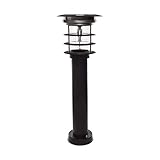
1. Gama Sonic GS-214 Stainless Steel Solar Bollard — Best for Modern Homes
Who it suits: Owners of modern homes lighting a short, important run — entry steps, a driveway edge, the turn in a walkway — where the fixture has to read as architecture and do safety work at the same time. This is the one solar fixture a modern facade can absorb without an apology.
The GS-214 is a bollard: a low cylinder in stainless steel with a glass lens, sold singly at the top of single-fixture solar pricing — check price on Amazon. In form terms it is everything the rest of this category is not: a plain vertical volume, no ornament, no faux-vintage detailing. Its maker-rated output is about 100 lumens — five to ten times the light of a decorative stake, enough to actually read the ground at a step edge. It runs on a lithium battery rated for dusk-to-dawn service after a full charge, and roundups that track this model credit the cell chemistry with a five-to-eight-year service life — a maker-class figure, but the right order of magnitude against the two-to-four years of the NiMH sets. This model’s older listing now redirects to the current ASIN used here.
The way to use bollards on a modern home is rhythm, not coverage. Two fixtures flanking the entry steps, or three at strict equal intervals along a drive edge, read as a designed system; scattered at irregular spacing, the same fixtures read as garden decor — exactly what this architecture avoids. Judge it on output and service life: one bollard sits well above multi-packs of glass path lights in tier, and will outshine and outlast them at the one spot where brightness carries liability. What it cannot do is scale — a long driveway lined with premium bollards exhausts this entire budget in just a few units — so the plans below place bollards only where a missed edge is a fall.
Pros
- The only verified solar fixture whose form belongs on a modern facade without qualification
- Maker-rated 100 lumens — the brightest verifiable solar path fixture here, working-light class rather than glow class
- Stainless steel and glass construction: no plastic lens to yellow, no thin stake to snap
- Sold singly, so brightness and rhythm can be placed exactly at steps and turns instead of spread evenly and thinly
Honest limitation: As a premium single fixture, this is the most expensive light per unit in the guide, and the cost only makes sense where brightness matters — along a flat, safe path it buys output nobody needs. It is also a dumb fixture: no app, no scheduling, no grouping, so in a controlled modern scheme it is the one layer that answers to its photocell alone. Stock has read low in recent checks, so confirm the featured offer before planning a multi-bollard run.
Choose this if you have steps, a slope or a driveway edge that needs real light in a form the architecture can accept. Skip it if you are lining a long decorative path — no budget survives bollard pricing at that scale, and the path runs belong to the systems below.
2. Linkind SL5C Smart Solar Spotlights, 8 Pack — Best Smart Accent System
Who it suits: Modern homeowners who light surfaces rather than paths — the one flat wall that wants a wash, the sculptural tree, the fence plane behind the patio — and want those accents on an app, in scenes, off on a schedule, without running a wire.
The SL5C is the most technically serious solar product in this guide, and its design language suits this lens: small dark heads that disappear against planting and shadow, so what reads at night is the lit surface, not the hardware. Each of the eight spotlights is rated by the maker at 150 lumens with RGB color plus tunable white, sealed to IP67 in the maker’s own specification table — the highest ingress rating claimed by any pick here. The headline technology is MPPT charge control, described by the maker as a first in smart solar lighting, with a claimed charging-efficiency improvement of up to 23.5 percent and a runtime claim of up to about 14 hours. Both figures are maker claims with no independent standard behind them, printed as such — but the engineering targets solar’s genuine weakness, poor-weather charging, and independent coverage of the eight-pack treated it as the category’s smart benchmark. Control runs through the maker’s app, with Alexa and Google Home support in the maker’s spec table; zones let the facade wash, the tree and the patio wall run as separate scenes on separate schedules.
The eight-pack sits at the top of the set tier in this category — check price on Amazon. For a modern scheme, spend it with restraint: four spots on one wall and one tree look more designed than eight grazing everything in the yard. What the money does not buy is permanence: the maker’s spec table lists a one-year warranty, and the batteries are not documented as user-replaceable, so plan on these as a system with a service life, not as fixtures for a decade.
Pros
- Maker-rated 150 lumens per spotlight, tunable white for architectural washes, plus RGB when an occasion calls for color
- IP67 sealing per the maker’s specification table, the strongest rating in this guide
- MPPT charge control aimed at cloudy-weather charging, with app scenes and multi-light zones; Alexa and Google Home support per the maker’s spec table
- Eight-pack positioned at the top of the set tier, with the product verified at both Amazon and the maker’s store
Honest limitation: The one-year warranty is short for a premium smart system, the runtime and charging figures are maker claims, and the batteries are not documented as replaceable — when the cells fade, the fix is a new pack, not an inexpensive standard cell. Spotlights also need their panels in sun even when the surface they light is in shade; a spot under the tree it illuminates never charges.
Choose this if your night look is about washed surfaces and scenes under app control. Skip it if you want set-and-forget white accents for a decade — the basic spotlights in the options box, replaced cheaply, are the franker buy.

3. Ring Solar Pathlight — Best Smart Path System
Who it suits: Households already inside the Ring ecosystem — a Ring doorbell, cameras, an Echo with a built-in bridge — who want the path itself to join the system: lighting on motion, firing in groups, triggering the cameras that watch it.
The Ring Solar Pathlight is a bollard-style stake light, 16.8 inches tall, rated by the maker at up to 80 lumens of 3500K white — working-class output, delivered as motion-triggered bursts over a low dusk-to-dawn glow you can schedule in the app. For a modern home, that control profile matters more than the fixture itself: a path that stays dark until someone walks it, then lights as a group, is designed behavior, not a photocell’s accident. The body is a plain dark polymer post — visually quiet, which suits this lens, though polymer is polymer, and the UV caveat below stands. The specification sheet is the most complete of any pick here: motion detection across a 120-degree field out to about 15 feet, an IP66 rating from the maker’s own technical details, and a power design this guide wishes were universal — a removable 18650 lithium cell that tops up from the panel by day and can be recharged indoors over micro-USB when a cloudy week starves it. That USB fallback is the honest answer to solar’s winter problem, designed in rather than apologized for. The warranty is one year, per the maker’s store.
The ecosystem cost must be counted openly, because it is this pick’s whole catch. The smart features — app control, grouping, schedules, camera linking — require a Ring Bridge, a compatible hub such as certain Echo models, or Amazon Sidewalk coverage where it exists (the maker’s store notes Sidewalk homes may not need the Bridge at all). The Bridge (2nd Gen) is sold through the maker’s store — check the current price on Amazon for the pathlight itself and check the maker’s store for the Bridge. Kit logic is where it gets sensible: a two-pack with the Bridge included is available at the maker’s store, a four-pack with Bridge is also offered, and add-on singles extend the run — check price on Amazon for each configuration. Six lights plus the Bridge — the four-pack kit plus two singles — forms a mid-tier system inside this budget. Judge this pick as that system, never as a single light: without the hub it is a stake with a sensor and no brain.
Pros
- Maker-rated 80 lumens with motion activation and app scheduling — the path stays dark until it is used
- Links to Ring doorbells and cameras: a path event can wake the system, and a camera event can light the path
- Removable 18650 cell with micro-USB indoor charging — the only pick with a designed answer to a sunless week
- IP66 rating and full published technical specifications; one-year limited warranty
Honest limitation: The body is polymer, so UV aging is in its future in a way the glass and steel fixtures escape, and at 16.8 inches with a visible sensor eye it reads as a device, not as architecture — the bollard above is the cleaner object. The smart features are also rented from the ecosystem: no Bridge, compatible Echo or Sidewalk coverage, no app, no grouping, no alerts. And it is a security light first — owners who want a continuous decorative glow along the path all evening will find motion bursts a poor substitute, as the maker says by design.
Choose this if your home already runs Ring and the path is part of your security picture. Skip it if you are not in the ecosystem — the hub toll buys a lot of glass path lights elsewhere in this guide.

4. Brightech Ambience Pro Solar String Lights, 48 Ft — Best String Lights (Back Patio)
Who it suits: Modern homeowners whose back patio, pergola or courtyard is a relaxed outdoor room rather than a formal elevation — the one deliberately informal layer in the scheme, kept behind the house where it belongs.
Let the style verdict be stated plainly first: Edison-style filament bulbs are retro-industrial, and a catenary of them across a front facade would fight a modern elevation as surely as a gas-lamp post would. Over a back patio the calculus changes — the strand reads as warmth and occasion rather than as a claim about the architecture, and nearly every modern house has exactly one zone, the outdoor room out back, where that register is right. Inside that zone, this is the proven product: the Ambience Pro Solar is the solar sibling of the best-known outdoor string light line on Amazon, 48 feet of commercial-grade strand carrying 15 S14 Edison-style LED bulbs at 2700K soft white, shatterproof, in the same heavy-duty build as the plug-in versions. It sits in the lower tier of this guide — check price on Amazon. Pricing for this strand is notably volatile, so check the current price on Amazon rather than assuming any earlier figure.
The solar version’s governing constraint is its panel. Fifteen bulbs drink more than a path stake, and the strand runs on a panel-charged battery sized for an evening’s glow, not an all-night burn: expect the light to fade before dawn on a full charge, and much sooner after a grey day or in December. Placement is the mitigation — the panel needs the sunniest spot you own even when the strand itself hangs in pleasant shade, and a strand bought for a north-facing, tree-covered patio will disappoint in any brand. It is ambiance, not lighting to see by, and the plans below pair it with fixtures that do the work.
Pros
- The proven Ambience Pro strand — 48 feet, 15 shatterproof S14 Edison-style bulbs, 2700K warm white — with no outlet required
- Lower-tier strand pricing — check the current price on Amazon for the identical strand
- Commercial-grade strand construction meant to stay up through weather, unlike seasonal fairy lights
- The fastest transformation for its tier in this guide: one strand turns a back patio into a room
Honest limitation: Runtime is an evening, not a night, and it shrinks with the season — this is the pick most exposed to the winter warning in the introduction. The form is also a deliberate exception to the modern filter: keep it behind the house. Pricing is the most volatile in the guide; if the live listing sits well above its usual lower-tier position, wait — history says it comes back.
Choose this if your back patio has sun for the panel and you want atmosphere without wiring. Skip it if the seating area is in deep shade all day — a plug-in strand on an outlet, outside this guide’s solar scope, will serve you better and honesty requires saying so.

5. BEAU JARDIN Solar Pathway Lights, 8 Pack — Best Glass Path Set, With a Style Caveat
Who it suits: Buyers who need a long, inexpensive path run — side path, back garden walk, service side — where honest materials matter and the silhouette does not. On a modern front elevation, read the caveat before anything else.
The caveat, stated directly: the diamond-cut globe is a traditional form. A row of glowing patterned globes on stems is the visual language of a cottage garden, and along the front walk of a flat-roofed modern house it reads as a mismatch no matter how good the materials are — the same failure as the lamp post below, at a friendlier price. What earns this set its place in a modern guide is everything under the globe. The construction is the category’s reference standard, named the top path set by multiple independent testing roundups: diamond-pattern glass globes on stainless steel stems, 16.54 inches tall, with an IP65 rating in the listing’s own specification fields. Output is maker-rated at 10 lumens per light, translated without flinching: 10 lumens marks a path, it does not light one — what you see at night is a row of glowing globes and the pattern they cast, decorative by design. Each light runs on a 950 mAh NiMH AA cell that is user-replaceable, the single most important lifespan feature in this category: when a light fades in year three, a standard rechargeable AA revives it inexpensively. The listing claims 10 to 13 hours of light after four to six hours of direct sun, offers white, fixed-color and color-cycling modes, and backs the set with a 24-month warranty stated in the listing itself — the longest term of any pick here.
The eight-pack sits in the lower tier of this category — check price on Amazon — verified at an Amazon-fulfilled storefront and matched by independent roundup coverage. Two cautions ride with it. First, stock: one major roundup read this listing as unavailable in mid-November 2026 while an Amazon-fulfilled storefront showed the set in stock days later — the listing rotates by colorway, so confirm the featured offer for the finish you want. Second, quality spread: the owner complaint pattern for this line is duds within a pack — lights that never charge, occasionally two or three across a sixteen-light double order. The rational response is in How to Choose: test one set through a full charge cycle before ordering a long run. Used where form is not on display, this is the best-value honest hardware in the guide; used on a modern front walk, it is a style error bought eight at a time.
Pros
- Real glass globes and stainless stems at a low per-light tier — construction well above what its tier usually buys
- Replaceable AA NiMH cells: the set is serviceable for years with pocket-change batteries
- 24-month warranty stated in the listing, the longest term in this guide
- White, fixed-color and color-cycling modes cover the classic path look and seasonal color from one set
Honest limitation: The form is traditional — that is the headline limitation for this lens, ahead of the usual ones. Ten lumens is also decoration, full stop: on steps or a slope this set is the wrong tool, and the bollard above exists for exactly that reason. The within-pack dud rate is real; test every light in the return window. And the body is not all metal: globes and stems are glass and stainless, with ABS elsewhere in the housing, per the listing’s own material fields.
Choose this if you need a long run where the silhouette is not on display — back garden, side path — and want serviceable hardware cheaply. Skip it if the run fronts a modern facade; save the front for bollards and the smart path system.

6. Gama Sonic Royal Bulb Solar Lamp Post — The Traditional Statement (Wrong Form for Modern Homes)
Who it suits: Honestly, for this lens: almost nobody reading this version of the guide. It suits the owner of a traditional, colonial or Mediterranean house who landed here by mistake — for that reader it remains the strongest statement fixture in solar. For a modern home it is reviewed in full because it is the category’s price ceiling and its most instructive failure: a well-built fixture that is the wrong object.
The facts first, unchanged. The Royal Bulb is a freestanding lamp post 87 inches tall, built from rust-resistant cast aluminum with a powder-coated black finish and beveled glass panels, in a design the maker models on New Orleans street lamps. The light source is Gama Sonic’s patented GS Solar LED Bulb — a bulb-shaped lamp with a cone reflector, rated by the maker at 120 lumens of 2700K warm white. Honest frame: 120 lumens is a glow, not a floodlight, and it is a maker figure like every lumen number here. The integrated panel charges a replaceable lithium-ion battery pack; the maker’s listing rates the pack at roughly 1,000 charges, about three years of nightly cycles, and a replacement pack is available through the maker’s retail channel — built to be serviced, not replaced. As engineering, this is the most respectable object in the guide.
As form, it is a gas lamp. The silhouette — flared head, beveled panes, ornamental post — is a quotation of nineteenth-century street furniture, and on a modern home quotation is the one unforgivable move: the facade’s whole argument is that nothing on it pretends to be from another century. No specification fixes that. The same verdict applies to the Aspen lamp head in the options box, a smaller fitter-mount version of the same historic form: well-made, and wrong here. A modern home that wants a tall statement at the drive should be looking at the bollard’s bigger wired relatives — one more reason the wired plan below is the serious one.
Now the positioning, with its evidence graded in the open. The post’s identity and ASIN are verified from Amazon’s own listing data (model GS-98B-S-BLK, item 98B001), but that listing showed no featured offer when crawled during research — a common state for this maker’s Amazon presence. The maker’s specialty retail channel positions this exact post at the top of the solar category. Treat that as the anchor: check the current price on Amazon, buy only if a live featured offer appears in line with that specialty-retail positioning, and treat anything far above it as a marketplace markup. The double-head and triple-head versions sit above this budget at retail — over this budget, and named here only so the ceiling audit below is complete.
Pros
- 87 inches of cast aluminum and beveled glass — the most substantial construction in this guide
- Replaceable lithium-ion battery pack, rated by the maker at about 1,000 charges, with a replacement pack available from the maker — a serviceable design, not a disposable one
- Maker-rated 120 lumens of 2700K warm white from a bulb-style lamp with a reflector — an even glow, not bare-LED glare
- No wiring, no trenching, no transformer: it installs where a wired post light would need an electrician’s circuit
Honest limitation: For this lens the limitation is the product: a New Orleans gas-lamp form cannot be specified into a modern landscape, and spending the guide’s largest single sum on the one fixture that fights the architecture is the worst allocation at this budget. The practical caveats stand too: the Amazon offer comes and goes, so this pick is check price by necessity — with no featured offer in line with its specialty-retail positioning, wait or buy through the maker’s channel rather than feeding a markup. The panel is fixed to the post, so the post must stand in six to eight hours of direct sun. Warranty terms in the sources checked varied by channel — one year at the maker’s retail listings, two years credited to the post in a lamp-post roundup — so confirm the term on the listing before ordering.
Choose this if your house is traditional and you arrived here by accident — it is a fine flagship there. Skip it if your home is modern, at any price; the bollard pair and the wired kit below are this budget’s honest statements.

Comparison Table
| Product | Maker Output | Battery | Rating | Price | Link |
|---|---|---|---|---|---|
| Gama Sonic GS-214 Bollard | ~100 lumens | Lithium, multi-year | Not published | Check price on Amazon | Check on Amazon |
| Linkind SL5C Spotlights, 8 pack | 150 lumens, RGB + white | Sealed, not documented replaceable | IP67 (maker table) | Check price on Amazon | Check on Amazon |
| Ring Solar Pathlight | 80 lumens, 3500K | 18650, removable, USB backup | IP66 (maker spec) | Check price on Amazon | Check on Amazon |
| Brightech Ambience Pro Solar, 48 ft | 15 × 1W bulbs, 2700K | Panel-charged pack | Weatherproof strand | Check price on Amazon | Check on Amazon |
| BEAU JARDIN Path Lights, 8 pack | 10 lumens | AA NiMH 950 mAh, replaceable | IP65 (listing spec) | Check price on Amazon | Check on Amazon |
| Gama Sonic Royal Bulb Lamp Post | 120 lumens, 2700K | Li-ion pack, replaceable | Not published | Check price on Amazon | Check on Amazon |
How to Choose Solar Garden Lights for a Modern Home
- Judge the silhouette before the spec sheet: On a modern facade, form is the first specification. Cylinders, plain posts and hidden heads pass; carriage lanterns, diamond globes and gas-lamp posts fail at any lumen count. If a fixture would look at home in a cottage garden, it does not belong on a modern house.
- Spend on rhythm and control, not on a single “premium” set: No solar set sits anywhere near this budget’s ceiling. The modern effect comes from repetition and behavior — a matched bollard pair, a path system firing as a group, accents on one schedule — not from one expensive object.
- Audit your sun before your cart: Walk the yard at the hours the panels would charge. Every pick here needs roughly six to eight hours of direct sun; modern architecture makes it harder: deep eaves and covered entries shade the exact runs you want lit. A panel that gets three hours delivers a fraction of its claimed runtime, and north-facing beds are wired-light territory.
- Read lumens as classes, not numbers: There is no common standard behind solar lumen claims. Treat about 10 lumens as path-marking glow, 80 to 150 lumens as working light, and any stake claiming many hundreds of lumens as unverified marketing. Every figure in the reviews is labeled as the maker’s.
- Make the battery the buying question: Replaceable standard cells (AA NiMH, 18650) turn a fading light into a cheap revival. A proprietary pack is acceptable from a maker who sells the pack, like the Royal replacement. A sealed battery with no published replacement is a countdown — treat the fixture as disposable.
- Check IP ratings in the specification fields, never the title: “Waterproof” in a headline means nothing; an IP code in the spec sheet is a testable claim. The picks here span IP65 (jet-resistant, fine for exposed paths), IP66 and IP67. No rating published means covered placement only.
- Compare everything per light and per system: A set’s tier hides the unit position — a large glass path set sits low per light, while a smart spotlight pack sits higher per light. Smart lights add hub costs on top: Ring’s Bridge adds to the total unless a kit or Sidewalk coverage covers you, and that toll belongs in the comparison, not a footnote after checkout.
- Buy the run in two orders: This category has a real within-pack dud rate. Order one set, test every light through a full night, then order the rest inside the first order’s return window. It is the cheapest quality control available — and why the plans below hold money back.
The Honest Ceiling: What $500 Actually Reaches
The research for this guide priced the top of the solar market directly, and the ceiling is low. Decorative path sets — the volume of the category — sit at the low end. Basic spotlight pairs sit in the lower tier. The most expensive verifiable set of any kind is the Linkind eight-pack of smart spotlights, at the top of the set tier. The most expensive single fixture with a pinnable Amazon listing is the GS-214 bollard, at the top of single-fixture pricing. Above that, the only solar products that exist are full-size lamp posts: Gama Sonic’s Aspen lamp head is a check-price option on Amazon (check the current price on Amazon — retail positioning for its fitter version runs higher, so confirm the offer), the Royal Bulb single post sits in the upper tier at specialty retail with its Amazon listing intermittently without a featured offer, and the double- and triple-head Royal posts sit above this budget through the maker’s retail channel. That is the whole ladder. There is a wide empty gap below this budget’s ceiling, no set — of any size, from any brand — priced near $500 on Amazon, and not one product in the ladder’s upper half that a modern facade can use.
Against that ceiling stands the technology this budget actually belongs to. At the largest American maker’s own store, a low-voltage wired kit of four solid-brass spotlights and two solid-brass path lights, transformer included, sits in the middle of this budget at the maker’s own store, with a lifetime warranty and published photometrics — about 350 lumens from each spotlight, 300 from each path light — that no solar stake in this guide approaches. The fixtures are small brass heads that disappear into planting; the light runs on a transformer timer, in shade, in December, for decades — because wired landscape lighting is infrastructure and solar lighting is a battery with a lamp attached. The same maker’s larger kits sit above this budget: that is where the higher landscape-lighting market actually lives. The honest summary: solar is the flexible layer for sunny, movable, accent work; $500 is far more than that layer costs and exactly the entry point of the permanent one.
Three Honest Ways to Spend $500
Plan 1 — The architectural core: Two GS-214 bollards flanking the entry steps or marking the drive’s turn — the matched pair is the architectural move at this budget; check price on Amazon for each bollard — plus the Ring two-pack with Bridge for a controlled path run; check price on Amazon for the kit configuration: bollards for the geometry, a smart system for the behavior, nothing traditional anywhere in it. The combination sits comfortably inside the budget, with headroom deliberately unspent. If the path needs more coverage, swapping the two-pack kit for the four-pack with Bridge plus two add-on singles (six lights and the hub) brings the same scheme close to the whole budget, spent on rhythm and control, not objects. This is the plan this guide would defend first for a modern home staying solar.
Plan 2 — The layered yard, filtered: The general guide’s layered plan with the lamp post removed — the layer a modern home cannot use. Two GS-214 bollards hold the entry (check price on Amazon), one Linkind SL5C eight-pack washes the wall and the tree (check price on Amazon), and one Brightech strand lights the back patio (check price on Amazon) — the one zone where its retro register is welcome. The combination sits inside the budget, with a little left for the first set of spare AA cells. Every layer lit in one order, nothing in it from another century.
Plan 3 — The infrastructure answer: Skip solar for the core system and buy the wired brass kit — four spotlights, two path lights, transformer included — from the maker’s store (VOLT), hence no Amazon link; it sits in the middle of this budget. For a modern home landscaping once, this is the guide’s most serious plan: hidden brass fixtures, published photometrics, a timer instead of a photocell, and a lifetime warranty, at less than half the budget in positioning. Add one BEAU JARDIN set for the back path (check price on Amazon) — where its classic globe is out of the facade’s sightline — and the Brightech strand for the patio (check price on Amazon), and the yard has a permanent wired backbone plus solar where solar is genuinely convenient, still well inside the budget, with headroom still in hand. For a shaded lot, a northern climate, or a forever home, start here.
Common Buying Mistakes
- Buying the flagship because it is the flagship: At this budget the most expensive solar fixture is a gas-lamp reproduction; the premium move is a matched bollard pair and a controlled system — spending the largest sum on the one object that fights the architecture is the tier’s signature error.
- Believing a stake’s lumen claim: A bargain path stake advertising several hundred lumens is advertising, not measuring. There is no standard behind the number; judge by class and construction.
- Planting panels in shade: The spotlight under the tree it lights, the stake behind the shrub, the path light under a deep modern eave — all starve. The panel’s sun matters more than the fixture’s position; no battery size fixes a panel that never charges.
- Buying sealed batteries as if they were fixtures: A solar light whose cell cannot be replaced has a two-to-four-year life designed in. Either choose replaceable cells or treat the purchase as disposable — paying fixture-level money for a countdown is the category’s most expensive habit.
- Counting a smart light without its hub: Ring’s pathlight needs a Bridge, an Echo with the right radio, or Sidewalk coverage on top of the light itself — check price on Amazon for the light and account for the Bridge where a kit does not cover it — or the comparison against dumb glass sets is rigged.
- Lighting steps with decoration: Ten-lumen stakes on a staircase are a hazard in disguise. Steps and slopes get bollard-class output or wired fixtures; the glass sets belong on the flat runs — and, in a modern scheme, on the runs the facade does not show.
- Ordering the whole run at once: Within-pack duds are this category’s documented tax. One set first, a full charge cycle, then the rest — inside the first order’s return window.
Final Recommendation
- For the modern facade: Plan 1 — two GS-214 bollards plus the Ring kit — is the honest solar build — geometry at the entry, control on the path, with headroom kept.
- For the layered yard: Plan 2 — bollards, Linkind washes, the strand out back — lights every zone with nothing traditional in it.
- For shade, northern winters, or a forever home: Plan 3. The wired brass kit is the best landscape-lighting value in this entire guide, and for a modern home landscaping once, it is the answer solar should support rather than compete with.
The short version: solar garden lighting is a low-to-upper-tier category wearing a $500 budget, and a modern home is where that gap shows clearest — the category’s premium objects are period pieces, while its modern-compatible tools are a bollard, two app systems and a string light for out back. Bought with restraint — a bollard pair, one controlled system, the rest kept or given to a wired backbone — $500 lights a modern yard the way the architecture asks: few points of light, evenly placed, all of them deliberate. Bought chasing a premium solar set that does not exist, it buys a markup in a gas lamp’s clothing.
Frequently Asked Questions
Is there really no set of solar garden lights that costs $500?
Correct — not on Amazon, and not in the makers’ own channels either. Verifiable solar sets top out with the Linkind eight-pack at the top of the set tier; decorative path sets sit at the low end. The only solar products in the upper tier are full-size lamp posts in historic gas-lamp form, and even there a single-head post sits well below this budget at specialty retail. The double- and triple-head posts that sit above $500 at retail are posts, not sets, and could not be pinned to a live Amazon offer. Any set presented as approaching this budget is a markup or a stale listing — check the current price on Amazon before trusting it.
Why does this guide recommend against its most expensive pick?
Because the lens is the house. The Royal Bulb lamp post is well built — cast aluminum, beveled glass, a replaceable battery pack — and it is modeled on a New Orleans gas lamp. A modern facade is an argument against historical quotation, so the fixture fails on the criterion this guide exists to apply. On a traditional home the same review reads as a recommendation; the facts did not change, the architecture did.
How long do solar garden lights actually last each night?
As long as the day let them. Every runtime figure here is a maker’s claim under strong sun: the path set claims 10 to 13 hours after four to six hours of charging, the smart spots up to about 14 hours, and results track the sun you actually got. Expect full claims on a sunny June placement, a few evening hours from budget sets in December, and graceful fading rather than a hard cutoff. If a light must burn until dawn in winter, it must be wired — or carry a removable battery you can charge indoors, like the Ring’s.
Solar or low-voltage wired — which should a modern home’s $500 budget buy?
For a permanent modern landscape, wired is the honest core: hidden brass fixtures, published photometrics, timer control, a lifetime warranty, from the maker’s store, positioned in the middle of this budget. Solar wins where wired is weak — sunny movable edges, phased projects, renters, accents you may rearrange next season. Plan 3’s hybrid is what most modern homes here should build: a wired backbone on the permanent runs, solar at the flexible edges, the change kept.