Where to buy
Check the latest price, availability and delivery on Amazon. Orders are placed on Amazon. We may earn a commission from qualifying purchases. One warning before the list: three of the six products below are permanent landscape fixtures that a renter cannot legally install, and this guide says so at each one rather than selling them to you anyway.
- The tier’s flagship — owners only, not a rental purchase: Gama Sonic Imperial III Commercial Solar Post Light, 300 Lumens, Dual Color — Check on Amazon
- Best lamp head for a post you already own: Gama Sonic Aspen Solar Post Light with 3-Inch Fitter — Check on Amazon
- Best apartment coverage: Linkind Smart Solar Spot Lights SL5C, 8-Pack — Check on Amazon
- Best balcony layer: Brightech Ambience Pro Solar String Lights, 48 ft — Check on Amazon
See 2 more Amazon options
- Gama Sonic Stainless Steel Bollard Solar Lamp — a landscape fixture sold singly through the maker’s own Amazon offer (the listing showed no featured offer when we researched it, so check the current price on Amazon): Check on Amazon
- Ring Solar Pathlight — the single-light listing; the purchase that makes sense is the 4-pack + Bridge starter kit on the same product line, described in its review below: Check on Amazon
Read the full guide ↓
Disclosure: As an Amazon Associate, dailyhomedecorating.com earns from qualifying purchases. Links to Amazon on this page are affiliate links; they cost you nothing extra. Listing details such as price and availability change often, so check the current Amazon listing before you buy.
This is the most honest guide in this series, so it starts with the sentence the listings will never print: $300 of solar garden lighting is more than an apartment can absorb. An apartment’s outdoor territory is a balcony, a patio slab, a front step, maybe a narrow strip of planting by the door — room for perhaps eight to twelve lights before it stops looking lit and starts looking decorated for a festival. The products at the top of this tier in this category — essentially one — are commercial post fixtures built to be bolted onto property a renter does not own, on a post a renter cannot install, under a lease that forbids attaching anything to the building’s exterior at all. So this guide does something unusual: it reviews the full $300 tier, with every verified fact from the homeowner version, and then rules on each product twice — once as a product, once as a purchase for someone who rents. Three of the six fail the second ruling outright. The other three saturate an apartment well under this budget, which means the correct outcome for most readers is to spend about half this budget and keep the rest.
Two gates stand in front of every purchase in this guide, and both come before product choice. The first is sun: every solar light here needs six to eight hours of direct sun for a full charge, and an apartment is the hardest sun environment there is — balcony overhangs shade the floor below, railings stripe the light, a north-facing aspect may never see direct sun at all, and the balcony above yours is a roof you did not choose. The second is permission: leases and building rules govern what may be attached, staked, hung or left in shared space, and a light that violates them is not a bargain at any price. Both gates get a full section below.
The solar honesty rules apply unchanged. Brightness and runtime figures are the makers’ own numbers, produced by no shared measurement standard: a light advertised at 400 lumens and one advertised at 40 may differ far less than the figures suggest, and an “up to 14 hours” runtime is the best mode on the best day, not a winter average. Where an output figure comes from a maker’s specification material, this guide says so. And solar lights are consumables in a way wired lights are not — the battery inside even the best fixture here is rated for roughly three years of charge cycles — which, for a renter, cuts both ways: it roughly matches a lease horizon, but a sealed light bought this year carries a built-in end date wherever you live next. If you are reading this guide because you actually own the yard in question, the homeowner treatment of the same six products is Best Solar Garden Lights Under $300; this version is for everyone whose name is on a lease instead of a deed.
Quick Picks
Short on time? Each row names a buyer type and the product that suits it, with the renter’s verdict stated in the row rather than buried in the review. Each pick is tied to the exact configuration named — a single fixture, a pack, or a kit — so check that configuration when you check price on Amazon.
| Buyer type | Pick | Why it stands out | Link |
|---|---|---|---|
| The tier’s flagship (owners only) | Gama Sonic Imperial III Commercial Solar Post Light | The only verifiable single solar fixture at this tier: 300 maker-rated lumens, dual color temperature, commercial cast aluminum — a post-top head at the top of this tier that a renter has no post for | Check on Amazon |
| Best lamp head for an existing post | Gama Sonic Aspen Solar Post Light (3-inch fitter) | 120 maker-rated lumens of warm light with replaceable battery packs — check price on Amazon — excellent on a post you own, unusable without one | Check on Amazon |
| Best premium path fixture (owners) | Gama Sonic Stainless Steel Bollard Solar Lamp | A cast stainless bollard at 100 maker-rated lumens, sold singly — landscape furniture positioned for a yard that is yours; check the current price on Amazon | Check on Amazon |
| Best for a rental’s front step | Ring Solar Pathlight (4-Pack + Bridge Starter Kit) | Motion-activated 80 maker-rated lumens per light, app grouping and camera linking — check the current price on Amazon for the kit; stakes in, stakes out, nothing attached | Check on Amazon |
| Best apartment coverage | Linkind Smart Solar Spot Lights SL5C (8-Pack) | Eight app-controlled color spotlights — check price on Amazon — enough to cover every target a balcony and entry strip can offer | Check on Amazon |
| Best balcony layer | Brightech Ambience Pro Solar String Lights (48 ft) | Commercial-grade Edison strand — check price on Amazon — the single most renter-native product in this guide: it hangs, it leaves with you, it attaches to nothing structural | Check on Amazon |
How These Picks Were Chosen
The first filter was the budget, applied to configurations rather than to headline listings. Solar lights are sold as singles, pairs, packs of four to twenty-four, and starter kits with hubs, and a listing can belong to any of them. Every pick in this guide is tied to the configuration in its heading — one bollard, an eight-pack of spotlights, a four-pack with a bridge — so check price on Amazon for that exact configuration. This guide never lets a pack and a single fixture pretend to be the same kind of purchase.
The second filter was verifiability, and it bit hard at this tier. A pick earns a direct Amazon link only where its listing and identity could be pinned from independent sources. Two of the six picks carry qualifications stated in the open: the Gama Sonic bollard’s Amazon listing showed no featured offer during research — the maker’s own Amazon account sells it through the buying-options list — so it is linked as check price on Amazon; and the Ring link points to the verified single-light listing, with the starter kit described from Ring’s own store, because the kit’s own listing could not be pinned to the same standard. Where a well-known product failed verification entirely — Gama Sonic’s classic Royal Bulb lamp post currently shows no featured offer on Amazon at all — it appears in prose, without a link.
The third filter is the one this lens adds: installability without ownership. Every pick was asked three questions a homeowner never has to ask. Does it attach to the building — a post, a wall, a footing — or does it stand, stake and hang on its own? Can it be removed in an afternoon leaving no trace a deposit inspection would notice? And does its value survive a move, or is it spent into a property someone else owns? The three Gama Sonic fixtures fail the first question; the Ring, Linkind and Brightech picks pass all three. That split is the shape of this guide.
Specifications were taken from makers’ specification material, never from listing titles, and this category is exactly why. The word “waterproof” in a title is marketing; an IP rating in a spec table is a test result. Only three of the six picks below carry a verifiable IP figure — IP65 on the Imperial III, IP66 on the Ring pathlight, IP67 on the Linkind SL5C — and for the other three this guide prints no rating rather than repeat the title’s adjective. The same discipline applies to output: every lumen figure is the maker’s, labelled as such, because no common standard stands behind solar lumen claims. The final filter was total cost in practical terms: the post a lamp head mounts on, the hub a smart light needs, and the battery that fades in about three years are all considered inside the reviews, the way you will actually encounter them.
The Apartment Version of the $300 Question
Before the products, the two gates — because in an apartment they eliminate more purchases than the budget does. Gate one is sun, and it is stricter than renters expect. A solar panel needs six to eight hours of direct sun to fill its battery, and apartment geometry fights it three ways. The balcony above yours overhangs yours, so a covered balcony may get direct sun only on its outer edge, or only in the hours when the sun clears the building’s face. The railing that makes the natural place to hang a string light also throws striped shade across anything behind it. And aspect is destiny: a south- or west-facing balcony charges well, while a north-facing one, or one facing a taller building, may never give a panel a full day in any season. Winter compounds all of it: lower angles, shorter days, and the longest nights of the year. The practical test costs nothing: on a clear day, note where direct sun actually lands on your balcony or step, hour by hour. That map, not the listing’s runtime claim, is your lighting budget.
Gate two is permission, and it has three layers. The lease usually prohibits attaching anything to the building’s exterior, drilling, or altering shared areas — which is why this guide treats anything requiring a post, a footing or a fixed mount as a non-purchase for renters rather than a risk to manage. Building and HOA rules add a second layer: strings of lights across a balcony, lights left in shared courtyards or walkways, and anything visible from the street can all fall under appearance or common-area rules even when nothing is attached. Neighbors are the third layer, and the one with no appeal process: a motion light aimed across a shared path fires for every resident who passes, all night. None of this makes apartment solar pointless — it means the apartment version of this category is its portable end: stake lights in your own planters, a strand on your own railing.
Now the logic of saturation, because it is the heart of this guide. An apartment offers a finite set of lighting targets: the entry step, a run of railing, two or three planters, a small tree or shrub by the door, the patio slab’s edge. Set the systems below against that list and the budget collapses quickly. The Linkind eight-pack puts an aimable spotlight on every target a typical apartment has, with lights to spare. Add the Brightech strand for the railing and the whole territory is lit, in two layers, for barely half the budget. The alternative route, Ring’s starter kit plus the same strand, does the same job through a different system. There is no third layer an apartment can absorb: a second eight-pack has nowhere to aim, and the remaining products in this guide are fixtures for posts and yards. The honest spend for an apartment is therefore well under this budget, and the honest recommendation is to keep a large part of this budget unspent. That is the same discipline the homeowner guide applies to this category, applied to a space a fraction of the size.
There is exactly one condition under which $300 makes sense for the reader of this guide: you are not really lighting your apartment. Renters light other people’s yards all the time — a parent’s house where the family gathers, a partner’s property you maintain as your own project. If the yard is effectively yours to improve and the permission is real, then the flagship fixtures below are legitimate purchases and the homeowner logic applies: one commercial lamp head, a pair of landscape bollards, a built-out smart system. What this guide refuses to do is blur the condition: the moment the post, the footing or the permanent fixture belongs to a landlord, the $300 version of this category stops being a purchase and becomes a donation.
One comparison belongs here because it closes the door on the usual escape route. At this money, wired low-voltage lighting beats solar on output decisively: VOLT’s Basics landscape kit — four brass spotlights and two brass path lights, a 100-watt transformer and 100 feet of cable — is sold at the maker’s store as a premium wired kit in this tier, with each fixture maker-rated at 300 to 350 lumens, fed by mains power that ignores cloudy weeks. For a homeowner that trade is real: brightness and decades of infrastructure against an afternoon of trenching. For a renter it is doubly closed — burying cable in a landlord’s yard and siting a transformer are exactly the alterations a lease forbids — so the wired option at this budget is information, not an option. Solar’s portability is the entire reason the category exists for you. Where an apartment budget genuinely tops out, Best Solar Garden Lights Under $200 covers the tier where most rental lighting is actually bought.
The 6 Best Solar Garden Lights Under $300 — Ruled for Apartments
Every review below keeps the verified facts of the homeowner guide and adds the renter’s ruling.
1. Gama Sonic Imperial III Commercial Solar Post Light — The Flagship a Renter Cannot Install
Who it suits: A homeowner with a driveway entrance, gate or front walk that needs one real lamp on a standard 3-inch post. For a renter, it suits nobody — and this review exists so you can see exactly what you are not missing, and recognize it if you ever shop for a house you own.
As a product, the Imperial III is what the top of the solar market actually looks like: a cast-aluminum post-top fixture, powder-coated black with beveled glass panes, rated by its maker at 300 lumens from 21 SMD LEDs behind a selectable color temperature — 2700K warm or 6000K daylight at the flip of an internal switch. Its 8-watt monocrystalline panel and GS-series battery pack are sized for multi-night storage; Gama Sonic’s commercial catalog rates the Imperial III line at three to six nights of stored duration, and retailer specification tables credit it with up to 72 hours of runtime — maker claims, reported as such. It carries an IP65 rating in its specification material, the strongest weatherproofing evidence in this guide, and at roughly 19.5 inches tall and 9.4 pounds it has the physical presence the plastic sets far below it in the category are imitating.
- 300 maker-rated lumens with dual color temperature (2700K/6000K) — the strongest output claim in this guide, aimed at genuinely lighting an area
- Commercial construction: cast aluminum, beveled glass, IP65 — built like the wired fixtures it competes with
- Multi-night battery storage by design, with a replaceable battery pack and replaceable LEDs
- An 8-watt monocrystalline panel, several times the panel area of a path-light set
Honest limitation: The purchase buys the head only, and the head is a 3-inch fitter fixture — the pole is not in the box, and the complete lamp-post version of this same light is sold separately at a specialist retailer, well above this tier. For a renter the limitation is total rather than financial: installing the post this light requires means setting a fixture into a landlord’s property, which is the alteration every standard lease prohibits. There is no balcony, step or planter version of this purchase.
Choose it if you own the post and the ground under it. Skip it if you rent — which, in this guide, is the ruling: the best solar fixture at this tier is a product you are not permitted to install, and its entire budget buys more light, legally, in the systems below.
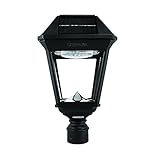
2. Gama Sonic Aspen Solar Post Light — Best Lamp Head, Same Locked Door
Who it suits: Anyone replacing a dead lamp head on an existing 3-inch post at a property they own or permanently maintain — a rented house with a pre-existing post and a landlord’s written blessing is the narrow edge case.
The Aspen is the Imperial III’s residential sibling: the same cast-aluminum, glass-lensed construction language at a size and price a garden can absorb. Gama Sonic rates it at 120 lumens of 2700K warm white — modest next to the flagship, honest next to the category — powered by two lithium-ion 1500 mAh battery packs the maker rates at about 1,000 charges, roughly three years of nights, after which the packs are replaceable rather than the fixture being landfill. A 3.2-watt monocrystalline panel and a high/low brightness setting support a maker-rated runtime of up to 18 hours on a full charge. Check the current price on Amazon for this fixture; a specialist retailer also lists the same fitter fixture, and comparing the two is the honest way to judge its positioning in this tier.
- Cast aluminum with real glass — the construction tier below it is plastic, and the difference is visible from the street
- Replaceable battery packs rated around 1,000 charges: a ten-year fixture with a three-year battery, as it should be
- High/low output settings let you trade brightness for winter runtime instead of accepting whatever the panel harvested
- Positioned in the middle of this tier on Amazon — check price on Amazon — a premium solar fixture whose positioning needs no apology
Honest limitation: Like the flagship, this is a fitter head: the post is sold separately, and the complete Aspen lamp post kit — fixture, pole and anchor base — is sold at Home Depot, over this guide’s budget. On Amazon, Gama Sonic’s EZ-Anchor installation kit for its post lights is also sold separately, and either route adds a substantial second purchase to the head alone. For a renter, every one of those routes ends at the same place: a post installed in someone else’s ground. An existing post at a rental is the landlord’s fixture, and upgrading it at your expense improves their property at your cost.
Choose it if a post you own needs a head, or a family home you maintain has one waiting. Skip it if you rent your home — the Aspen is the guide’s best lamp and its clearest non-purchase at the same time.
3. Gama Sonic Stainless Steel Bollard Solar Lamp — Landscape Furniture at a Premium per Point
Who it suits: A buyer lighting one short, important run on their own land — the front walk, the driveway entrance — who would rather have two fixtures that look like landscape architecture than twelve that look like lawn ornaments.
The bollard is the fixture landscape designers actually specify: a low stainless-steel column, black-finished, with a glass lens and Gama Sonic’s EZ Anchor corkscrew base that twists into the ground and can be repositioned without concrete. The maker rates it at 100 lumens of 2700K warm white from 11 LEDs, running eight to ten hours on a 1000 mAh lithium-ion pack — the runtime band the maker’s own specification sheet prints. The Amazon listing sells it singly and in a two-pack; during research the listing showed no featured offer, and the maker’s own Amazon account offered the single through the buying-options list. The factory two-pack is also sold at a specialist retailer. We therefore present it as check price on Amazon: check the current price for the exact configuration, because the pair is the purchase this tier is really about.
- Stainless steel and glass, sold singly at a premium positioning — the only path fixture in the category built to a landscape-trade standard
- 100 maker-rated lumens is honest output for a bollard: enough to define a walkway edge, claimed as nothing more
- EZ Anchor base installs in minutes and moves when the planting changes — no concrete, no trace when removed
- The two-pack (specialist retailer) is the cleanest single purchase at this tier for an owner: two real fixtures, no accessories required
Honest limitation: The bollard is the only one of the three Gama Sonic fixtures a renter could physically install — the corkscrew anchor leaves no trace — and it still fails this lens on value and place: a premium single purchase buys one point of light, and the pair that makes the product make sense takes essentially the whole budget for two points on a walkway. Place: a bollard is landscape furniture designed to read as permanent architecture in a yard; an apartment offers it a planter or a shared front path, where a premium stainless column is either lost among the pots or sitting in common ground it does not belong in. No IP rating appears in the maker’s specification summary we could verify — for a fixture that lives at sprinkler height, confirm the listing’s current spec field before ordering.
Choose it if the front walk of a home you own is the whole project. Skip it if you rent: removable is not the same as sensible, and this budget buys eight smart lights below instead of a single bollard.
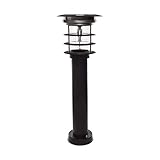
4. Ring Solar Pathlight — Best for a Rental’s Front Step
Who it suits: A renter whose outdoor territory includes a front step, a short private path or a ground-floor patio edge — and who wants those lights to behave like security devices: motion-triggered, grouped in an app, and able to wake the cameras when something walks past at 2 a.m.
Each Ring Solar Pathlight is rated by its maker at up to 80 adjustable lumens of 3500K white, with a motion sensor covering 120 degrees out to about 15 feet, in a 16.8-inch housing sealed to IP66 — a verifiable rating, and the right one for a fixture that lives in mulch. The smart half of the product is the system: the lights need a Ring Bridge (or Amazon Sidewalk coverage, which Ring’s own store notes can substitute in covered areas) to reach the app, where brightness, schedules and motion sensitivity are set per light or per group, and where a pathlight’s motion event can trigger linked Ring cameras and doorbells. For a renter the installation story is the point: the lights stake into the ground, the Bridge is a small box that sits indoors by the router, and the entire system can be pulled up and boxed in twenty minutes on moving day, leaving nothing behind. The battery is a standard replaceable 18650 cell that also tops up by micro-USB — the only pick in this guide whose battery you can buy anywhere and charge indoors during a dark week, which matters where panel sites are compromised. The link below is the verified single-light listing — check price on Amazon; the purchase to make is the starter kit — four pathlights plus the Bridge — also sold in Ring’s own store, so check the current price on Amazon for the kit configuration before you buy.
- Motion activation is the correct behavior for path lights: full brightness when someone is actually on the path, not a dim all-night burn that empties the battery by 4 a.m.
- Nothing attaches and nothing is buried: stakes, an indoor hub, and a system that moves house when you do
- Replaceable 18650 cells with a USB top-up option remove solar’s worst failure mode — the sealed light that dies in December and cannot be helped
- The ecosystem math overshoots an apartment before it overshoots the budget: starter kit plus a second four-pack builds eight lights well within this tier — more lights than most rentals have places for
Honest limitation: Without the Bridge or Sidewalk coverage these are expensive dumb lights, and the app’s value depends on Ring’s platform continuing to support them — a platform risk no cast-aluminum fixture carries. In shared space the motion behavior cuts the other way: a pathlight on a communal walk fires for every neighbor, all night, and building rules about common areas apply to a staked light as much as to an attached one — keep Ring lights on territory that is yours alone. Eighty maker-rated lumens is guidance light, and the cameras a motion event can wake are a further purchase this budget does not include. Kit pricing is also the most variable in this guide, so check the current price on Amazon and buy it on a promotion, not on a deadline.
Choose it if your step or short path is yours alone and you value the motion-and-camera behavior over raw light. Skip it if your only ground is shared, or you want light without an account, an app and a hub.

5. Linkind Smart Solar Spot Lights SL5C, 8-Pack — Best Apartment Coverage
Who it suits: The renter with the actual apartment problem: a shrub to uplight, planters to accent, a patio edge to define — a handful of targets, one modest territory, and an appetite for color at holidays and warm white the rest of the year.
The SL5C is a ground-stake spotlight with a separate-aim head, sold in an eight-pack on Amazon — check price on Amazon; the maker’s own store sells the same configuration — and its low per-light positioning in this tier is what makes this the coverage pick. In an apartment the eight-pack is not a starter quantity; it is close to the whole job. Stake them in planters and the planting strip, aim them from below at the balcony’s green wall or the tree by the door, and the territory is covered with lights left over. Linkind rates each light at 150 lumens, a maker figure we report without endorsing, in RGBTW: full color plus tunable white, controlled from the AiDot app over Bluetooth, with group control for up to 32 lights across eight groups and dynamic scenes for the color you will use twice a year and enjoy both times. The housing is rated IP67 in the maker’s specification material — the strongest printed rating in this guide, and a practical one for lights living in watered planters. Charging is the maker’s MPPT design, and the stated runtime reaches up to 14 hours in energy-saving mode — the best mode on the best day, labelled as the maker’s claim.
- Eight aimable spotlights in one pack is the strongest coverage value in this guide — check the current price on Amazon — and in an apartment, eight is saturation, not a starting quantity
- Stakes live happily in planters, pots and the door-side strip: no soil ownership required, no trace on removal
- Tunable white matters more than color: the same fixture does warm planter wash in October and red-green at Christmas without a second purchase
- IP67 is a real, printed rating — the spotlights can sit in irrigated beds and soaked planters, which is where apartment spotlights live
Honest limitation: The ecosystem has a toll booth: app control over Bluetooth works out of the box, but voice control through Alexa or Google requires Linkind’s BLE Mesh Hub, sold separately — the eight-pack plus hub is the real starting point for the voice-controlled version, and even that combination leaves much of this budget unspent. The listing does not present the battery as user-replaceable, so treat each light as a sealed unit with a finite life; at this per-light positioning that is a fair trade, and for a renter whose horizon is a lease it is arguably the right trade — but it is a trade. The homeowner version (two packs plus the hub, sixteen lights) is mentioned here only to be ruled out: an apartment that needs sixteen spotlights is a house.
Choose it if your balcony, planters and entry strip are the whole project and you want them coordinated, colored and scheduled for the least money per light. Skip it if you dislike app-dependent hardware, or your only outdoor space is a railed balcony with no soil or planters to stake into — the strand below is your pick instead.

6. Brightech Ambience Pro Solar String Lights, 48 ft — Best Balcony Layer
Who it suits: Almost every renter reading this guide. If your outdoor territory is a balcony, this strand is not the finishing layer of your plan — it is most of the plan.
The Ambience Pro is the category’s reference string light: 48 feet of commercial-grade cable carrying 15 shatterproof S14 Edison-style bulbs at 1 watt each in a 3000K soft white, fed by a solar panel that stakes where the sun is while the strand hangs where the people are. On a balcony that separation is the whole design: the strand loops along the railing in the shade you sit in, and the panel rides the railing’s sunny end or a planter at the bright edge. Check the current price on Amazon for this strand — and heed the warning this pick exists to teach: this strand’s pricing is notably volatile, so a low point in its range is a buy moment and a spike is not. No pick in this guide demonstrates the difference between a fair price and a listing’s mood more clearly.
- The most renter-native install in the guide: it hangs from a railing or hooks, attaches to nothing structural, and comes down in minutes with your deposit intact
- Commercial-grade cable and shatterproof bulbs: the strand is built to stay up year-round, which is the entire point of a string light
- The separate solar panel answers the balcony problem honestly — shade for people, sun for the panel — instead of pretending a shaded pergola charges well
- At the low end of this tier it leaves the apartment plan nearly whole: strand plus Linkind pack, or strand plus a Ring kit, both stay well under this budget
Honest limitation: This is decoration, not lighting: fifteen 1-watt bulbs will not make a step safe or a grill usable, and pairing it with a real path or spot light is the plan, not an upsell. Two apartment-specific cautions apply. First, the panel still needs its six to eight hours — a strand whose panel sits in the balcony’s shade is a strand that fades by nine. Second, building rules: some leases and HOAs treat visible strings on railings as an appearance issue, and a strand that crosses to a neighbor’s railing or a shared structure is over the line in most buildings — keep it on your own rail. Runtime is bounded by the panel’s day, and the battery lives in the panel housing as a consumable the listing does not offer as a service part.
Choose it if your territory is a balcony or patio and you are buying at the low end of its price range. Skip it if your building prohibits railing displays, or your space’s problem is darkness rather than atmosphere — spend the money on the Linkind or Ring systems above and add the strand when its price returns to the low end of its range.

Comparison Table
One row per pick, priced by the configuration named, with the renter’s ruling added — the column the homeowner version of this table does not need. Output figures are the makers’ own claims throughout: compare them within a brand cautiously and across brands barely at all.
| Product | Price | Maker-rated output | Weather rating | Battery story | Renter’s ruling | Link |
|---|---|---|---|---|---|---|
| Gama Sonic Imperial III Post Light | Check price on Amazon (head only) | 300 lumens, 2700K/6000K | IP65 | Replaceable pack; multi-night storage claim | Do not buy — needs a post installed in the ground | Check on Amazon |
| Gama Sonic Aspen Post Light | Check price on Amazon (head only) | 120 lumens, 2700K | Not published in maker spec summary | Replaceable packs, ~1,000-charge rating | Do not buy — same post problem at a friendlier price | Check on Amazon |
| Gama Sonic Bollard | Check price on Amazon — single; two-pack via retailer | 100 lumens, 2700K | Not published in maker spec summary | Li-ion pack, 8–10 h maker runtime | Skip — removable, but premium landscape furniture per point of light | Check price on Amazon — see review above |
| Ring Solar Pathlight system | Check the current price on Amazon for the kit | 80 lumens, 3500K, motion-activated | IP66 | Replaceable 18650 cell, USB top-up | Buy — on private ground only, not shared paths | Check on Amazon |
| Linkind SL5C Spot Lights (8-Pack) | Check price on Amazon (8-pack) | 150 lumens per light, RGBTW | IP67 | Sealed per listing; hub for voice sold separately | Buy — the apartment coverage answer | Check on Amazon |
| Brightech Ambience Pro String Lights | Check price on Amazon (48 ft, 15 bulbs) | 1W soft-white bulbs; ambience, not task light | Commercial-grade strand; no IP figure verified | Panel battery is a consumable | Buy — the most renter-native product here | See review above |
How to Choose Solar Garden Lights for an Apartment
- Run the two gates before you open a single listing. Map your direct sun on a clear day — where it lands, for how long, on the balcony floor, the railing and the planters — and read your lease and building rules for exterior attachments, shared-area use and visible displays. A product that fails either gate is not a worse purchase; it is no purchase.
- Count targets, not dollars. Walk your territory and list the actual jobs: step, railing, planters, one shrub, the slab’s edge. Most apartments list five to ten. When a system’s light count passes your target count — the Linkind pack’s eight, a Ring four-pack plus spares — you are saturated, and every further dollar buys decoration density, not light. Saturation, not the $300 ceiling, is your real budget line.
- Apply the moving-day test to everything. Each item must come out in an afternoon, travel in a box, and leave the space exactly as you found it: stakes pull, strands unhook, an indoor hub unplugs. Anything that fails — a post, an anchored fixture, a buried cable — is either prohibited or a gift to your landlord, and usually both.
- Treat your balcony as the small room it is. A balcony obeys small-space logic: short distances, close walls, nowhere for excess to hide. The layout thinking in Best Solar Garden Lights For Small Rooms Under $300 — fewer lights, placed deliberately, brightness judged at arm’s length rather than across a yard — transfers to a balcony almost unchanged.
- Price the whole system, including the second purchase. Lamp head plus post, smart lights plus hub, fixture plus its replacement battery in year three. In this lens the post is not merely an extra cost but a disqualifier; the hubs (Ring’s Bridge inside its kit, Linkind’s sold separately) are small indoor boxes and pass the moving-day test easily.
- Match the battery story to your lease horizon. A sealed light with a three-year battery is a poor ten-year purchase and a perfectly rational two-year one — which is why the Linkind pack’s sealed units trouble this guide less than they would a homeowner. Replaceable cells (Ring’s 18650, with its indoor USB top-up) still win wherever sun is scarce, because they let you cheat a bad charging week.
- Mind the bedroom window — yours and your neighbors’. A motion light outside a sleeping space fires at 2 a.m. for every passerby and animal, and in an apartment building the passerby is often heading to the window next to yours. If your terrace opens off a bedroom, weigh the dusk-to-dawn behavior in Best Solar Garden Lights For Bedrooms Under $300 before defaulting to motion activation.
- Let owners buy the architecture. The Gama Sonic fixtures in this guide are genuinely good products — as permanent design elements of a property. The design-first treatment of this tier, where cast aluminum and bollards are scored as architecture rather than ruled on as tenancy risks, is Best Solar Garden Lights For Modern Homes Under $300. Read it the year you buy the house.
Common Buying Mistakes
- Buying a lamp head for a post you do not own. The two best fixtures in this guide are fitter heads. Installing the post is the landlord’s alteration to make, not yours — and paying to upgrade a post that already stands at your rental is improving their asset with your money. Price the assembly, then ask whose it is.
- Spending $300 because the budget says $300. An apartment saturates at eight to twelve lights. A second eight-pack, a bollard pair, a flagship head — each is a way to convert unspent money into objects with nowhere to go. The unspent part of the budget is not a failed plan; it is the plan working.
- Installing in the shade the light is meant to decorate. The most common solar failure is a panel under the thing it lights — and the apartment version is a panel under the balcony above. If the spot has no sun, the honest options are a fixture with a separate or generous panel (the Brightech strand), a motion light that sips power (Ring), or a replaceable cell you can charge indoors (also Ring).
- Lighting the shared path. A staked light in common ground is still an installation in common ground, and a motion light there performs for the whole building. Keep every fixture on territory your lease actually gives you.
- Paying a spike price for a commodity strand. The Brightech string light sits at the low end of this tier at its best, with a tracked history of spiking sharply upward. Commodity solar swings violently with promotions; flagship fixtures barely move. Spend patience on the former and money on the latter.
Final Recommendation
For an apartment, the recommendation is the Linkind eight-pack — check price on Amazon: it puts an aimable, app-controlled spotlight on every target a balcony, planter row and entry strip can offer, with nothing attached, nothing buried and nothing left behind when you move. Add the voice hub, sold separately, or add the Brightech strand for the railing instead, and the combination still stays well under this budget. If your territory is a front step rather than a balcony, the Ring starter kit — bought on promotion, after you check the current price on Amazon — is the alternative: motion light where you walk, a hub that lives indoors, cells you can charge at the kitchen counter. The three Gama Sonic fixtures are this guide’s honest exclusions: the Imperial III is the best solar fixture at this tier and the Aspen is its best value, and both are ruled out by a post you do not own, while the bollard pair spends the whole budget on two points of someone else’s walkway. They become recommendations again under one condition — the yard is your family’s and the permission is real — and not before. Hold the discipline this guide was built on: the budget is a ceiling, not a target, and an apartment lit well for about half this budget, with the rest unspent, beats an apartment forced to absorb $300 of the wrong light.
FAQ
Can renters install solar lights at all?
Yes — the portable end of the category is made for you. Stake lights in your own planters and ground, strands hung on your own railing, and systems whose hub sits indoors all install without altering the property and remove without a trace. What a renter cannot do is the permanent end: setting a lamp post, anchoring fixtures into the ground or facade, or burying cable. That line — not price — is what removes three of this guide’s six products, including its flagship.
Will solar lights work on a covered or north-facing balcony?
Weakly, and honesty requires saying so plainly. Every fixture here needs six to eight hours of direct sun for a full charge; a balcony roofed by the unit above, or facing away from the sun’s path, may deliver a fraction of that, and runtime shrinks in proportion — worst in winter, when nights are longest. Mitigations that actually help: a separate panel you can place at the balcony’s one sunny edge (the Brightech strand’s design), motion activation that spends power only when someone is present (Ring), and a replaceable cell you can top up indoors by USB (also Ring). A balcony with no direct sun at all is not a solar space, and no price tier changes that.
How much should an apartment actually spend on solar lighting?
Well under the full budget, by the logic of saturation. The Linkind eight-pack — check price on Amazon — covers the typical apartment’s full target list by itself; adding the Brightech strand completes the second layer; the Ring starter kit plus the strand does the same through a different system. Beyond that, additional lights have nowhere to aim. Keep a large part of a $300 budget unspent — even homeowners rarely absorb the full tier productively, and an apartment is a fraction of a yard.
Are motion-activated pathlights a problem in shared spaces?
They can be, on two grounds. Practically, a motion light on a shared path fires for every resident, visitor and animal that passes, all night — including outside your neighbors’ windows. Formally, common areas belong to the building, and placing fixtures there, even staked ones that leave no mark, can fall under lease and HOA rules about shared space. Keep motion lights on ground that is exclusively yours — a private patio, your own front step — and let shared walkways stay the building’s problem.
Solar or low-voltage wired at $300 — which should a renter choose?
On output, wired wins decisively: a low-voltage kit at this money (VOLT’s Basics kit — four brass spotlights and two path lights, transformer and cable included, sold at the maker’s store as a premium kit in this tier) rates every fixture at 300 to 350 maker lumens and feeds them from the mains, while the best solar fixture here claims 300 for a single head. But the wired kit’s installation — a buried cable run and a sited transformer — is exactly the alteration a lease forbids, so for a renter the comparison decides itself. Solar is not the weaker choice in an apartment; it is the only legal one, and its portability is worth more than the lumens you give up.
What if I am buying for my parents’ house or a family yard?
Then you are the exception this guide keeps naming, and the $300 tier opens up. If the yard is effectively yours to improve — family property you maintain, with permission that is real rather than assumed — the flagship logic applies: the Imperial III for one post location, the Aspen head plus its post as a complete assembly, a bollard pair for the front walk, or a built-out Ring or Linkind system for coverage. Read the reviews above with the renter’s rulings switched off. The category’s ceiling does not change: even for a family yard, $300 is a coverage budget or a one-fixture budget, because the market stocks almost nothing in the upper part of this tier below the ceiling.