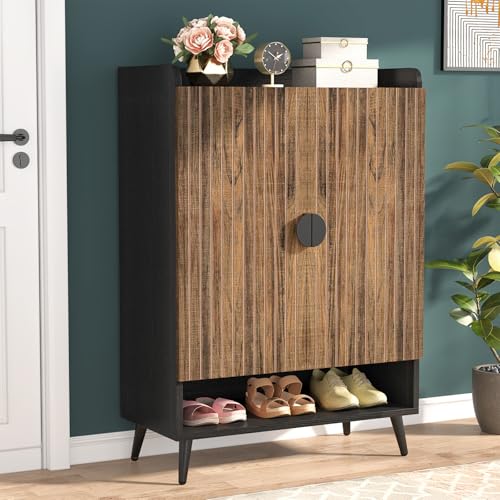
Where to buy
Check the latest price, availability and delivery on Amazon. Orders are placed on Amazon. We may earn a commission from qualifying purchases.
- Tribesigns 7-Tier Shoe Cabinet with Doors (Rustic Brown) — Check on Amazon
- Tribesigns 5-Tier Shoe Cabinet with Sliding Doors (Grey and Brown) — Check on Amazon
- Tribesigns 6-Tier Shoe Cabinet with Doors (White and Gold) — Check on Amazon
- VASAGLE LIRY Collection 3-Tier Shoe Cabinet (Rustic White, ULBC038W01) — Check on Amazon
- Haotian Slim Shoe Cabinet FSR151-W (2 Flip Drawers) — Check on Amazon
- IKEA STÄLL Shoe Cabinet with 4 Compartments — sold direct by IKEA (no Amazon link; see its review below)
Read the full guide ↓
Disclosure: As an Amazon Associate, dailyhomedecorating.com earns from qualifying purchases. Links to Amazon on this page are affiliate links; they cost you nothing extra. Listing details such as price and availability change often, so check the current Amazon listing before you buy.
Finding the best shoe cabinet for small apartments under $700 is really a search for a cabinet that ends the entryway shoe pile without creating a new problem — a door that cannot open, a tier your boots cannot enter, or a box so flimsy it wobbles every time it is touched. This guide compares six closed shoe cabinets across the three formats that matter at this budget: tall shelf cabinets, slim flip-drawer cabinets and design-led statement pieces. Every pick hides shoes completely behind doors, because a cabinet with closed storage is the entire point of the category; open racks and cubbies were excluded on principle.
Apartment entries are usually not entries at all — the front door opens into the living room, the hall is a corridor the landlord counts as a room, and every piece of furniture is visible from the sofa. A shoe cabinet in an apartment therefore has three jobs at once: hide the shoes, survive lease rules that forbid drilling into anything structural, and earn its floor area by doubling as the surface where keys, post and bags land. This guide favours slim depths, renter-realistic anchoring, and cabinets that look deliberate from across the room, because in a small apartment you will be looking at it all evening.
Think about how shoes actually arrive at a door. They come in wet, gritty and mismatched, carried by people who are thinking about dinner, homework or the train they nearly missed. A cabinet that demands ceremony — two hands, a particular order, a delicate mechanism — will be bypassed within a fortnight, and the shoes will colonise the floor beside it in silent protest. The cabinets that survive family life, apartment life and small-space life share one trait: the easiest action is also the correct one. Open, drop, close. Everything in this guide was judged against that three-second test before it was judged on anything prettier.
In this guide
Quick picks: the best shoe cabinet for small apartments under $700 shortlist
Six cabinets survived the format, capacity and build checks described below. The table is the whole story in miniature; the reviews that follow explain who each one suits and, just as honestly, who should walk past it.
| Cabinet | Best for | Buying route |
|---|---|---|
| Tribesigns 7-Tier Shoe Cabinet with Doors (Rustic Brown) | Best overall capacity | Check price on Amazon |
| Tribesigns 5-Tier Shoe Cabinet with Sliding Doors (Grey and Brown) | Best modern statement | Check price on Amazon |
| Tribesigns 6-Tier Shoe Cabinet with Doors (White and Gold) | Best bright, formal entryway | Check price on Amazon |
| VASAGLE LIRY Collection 3-Tier Shoe Cabinet (Rustic White, ULBC038W01) | Best compact closed cabinet | Check price on Amazon |
| Haotian Slim Shoe Cabinet FSR151-W (2 Flip Drawers) | Best ultra-slim profile | Check price on Amazon |
| IKEA STÄLL Shoe Cabinet with 4 Compartments | Best Scandinavian slim classic — sold direct by IKEA | Sold direct by maker |
Ventilation deserves more respect than it gets. Closed cabinets protect shoes from dust and protect rooms from shoes, but a sealed box of warm trainers can develop the kind of smell that greets guests before you do. Look for cabinets with back-panel gaps, louvered or woven fronts, or simply leave doors ajar overnight after wet days. A small sachet of cedar or bicarbonate inside the cabinet does quiet, unglamorous work. None of the picks here is hermetically sealed, which in practice is a feature, not a flaw.
How these picks were chosen
True depth came first, measured honestly including handles, because six inches of hallway is the difference between passing comfortably and turning sideways. Second was lease realism: freestanding stability, anti-tip kits that work with minimal fixing, and nothing that demands built-in installation. Third was double duty — a flat, usable top surface — and fourth was move-ability, since apartment furniture gets carried up stairs and out again at the end of the lease.
Two rules applied to every candidate. First, closed storage only: if shoes remain visible, it is a rack or an organiser, not a cabinet, and it does not belong in a guide with cabinet in the title. Second, verifiability: dimensions, materials, capacities and load limits had to come from the maker or the Amazon listing itself, and any pick whose maker sells direct without a first-party Amazon US listing is presented honestly as prose-only rather than dressed up with a third-party link. Recalled products were excluded outright, and no pick was carried on the strength of a popularity score, because scores move and construction does not.
Measure your largest pair before you measure your wall. A men’s size-13 trainer is close to a foot long and surprisingly tall at the heel collar; a heeled boot needs vertical clearance that flat tiers cannot offer. Adjustable shelves earn their keep precisely here: remove one shelf and a cabinet that held twenty pairs of flats becomes a cabinet that holds twelve mixed pairs including boots, which is the honest trade most households actually need. Fixed-geometry flip drawers cannot make that trade, which is why they suit some households perfectly and others not at all.
Detailed reviews
Tribesigns 7-Tier Shoe Cabinet with Doors (Rustic Brown)
Who it suits: Households that have outgrown a bench and a boot tray and want one tall, fully closed cabinet that swallows the whole family rotation in one footprint.
Key specifications: 7 tiers behind two hinged doors; adjustable shelves; E0-grade particleboard with 0.59-inch boards; maker-stated capacity up to 24-30 pairs depending on configuration; 200 lb weight limit; model HL870 / HOGA-HL060.
Pros
- Tallest closed storage in this guide, so seasonal shoes can live in the same cabinet as daily pairs
- Adjustable shelves let one tier take boots while the others stay tight for flats and trainers
- Thicker boards and a stated 200 lb limit give it a sturdier feel than thin flat-pack rivals
- Countertop works as a proper entryway landing strip for keys, post and bags
Honest limitation: It is a big, heavy build: allow two people and a clear afternoon, and anchor it to the wall before loading the top tiers.
Choose it if: Choose it if your shoe count is the problem and you have one honest wall run to give it. Skip it if: Skip it if your entry is a narrow passage where a tall cabinet would crowd the door swing.
Check price on Amazon — see the current listing for the Tribesigns 7-Tier Shoe Cabinet with Doors (Rustic Brown).
Measure your largest pair before you measure your wall. A men’s size-13 trainer is close to a foot long and surprisingly tall at the heel collar; a heeled boot needs vertical clearance that flat tiers cannot offer. Adjustable shelves earn their keep precisely here: remove one shelf and a cabinet that held twenty pairs of flats becomes a cabinet that holds twelve mixed pairs including boots, which is the honest trade most households actually need. Fixed-geometry flip drawers cannot make that trade, which is why they suit some households perfectly and others not at all.
Tribesigns 5-Tier Shoe Cabinet with Sliding Doors (Grey and Brown)
Who it suits: Design-led homes that want the shoe cabinet to read as furniture, not storage, and hallways where a hinged door cannot swing.
Key specifications: 5 tiers with adjustable shelves; sliding doors with rhombus geometric fronts; maker-stated capacity 20-25 pairs; model CHR-NY141 / HOGA-141.
Pros
- Sliding doors need zero swing clearance, so it works flush in tight hall runs
- Geometric door fronts genuinely look like a sideboard rather than a shoe rack
- Adjustable shelves handle a mix of heels, trainers and ankle boots
- Wide top surface displays like a console table
Honest limitation: Sliding tracks collect dust and grit from shoe soles, so the runners need a vacuum pass more often than hinged rivals.
Choose it if: Choose it if looks and door clearance matter as much as capacity. Skip it if: Skip it if you want to see every pair at once, because a sliding door always hides half the cabinet.
Check price on Amazon — see the current listing for the Tribesigns 5-Tier Shoe Cabinet with Sliding Doors (Grey and Brown).
The top of the cabinet is prime real estate and should be planned, not discovered. A tray corrals keys and sunglasses. A small bowl takes coins and hair ties. Post should land and leave within a day, or the cabinet becomes a filing system with shoes underneath. If the cabinet stands in a living area, treat the top as you would a sideboard: one practical layer, one pleasant object, and clear space. That discipline is what separates furniture from storage in rooms where guests actually sit.
Tribesigns 6-Tier Shoe Cabinet with Doors (White and Gold)
Who it suits: Bright, formal or glam-leaning entryways that need serious capacity without a dark, heavy-looking box.
Key specifications: 6-7 tiers behind two doors depending on shelf layout; E1 MDF with metal legs and gold pulls; maker-stated capacity up to 30 pairs; supports up to 220 lb; model C0702-3 / HOGA-J0232; walnut sibling ASIN B0DLB628LX measures 29.52 x 13.77 x 43.3 in and weighs 75 lb.
Pros
- Raised metal legs keep the base clear of mop water and robot vacuums
- Gold hardware lifts it into console-table territory visually
- High stated load capacity suits dense collections of leather shoes and boots
- Light finish makes a windowless hallway feel less crowded
Honest limitation: White MDF shows scuffs from dark soles quickly, so it needs a wipe-down routine the rustic finishes forgive.
Choose it if: Choose it if your entryway doubles as a first impression and you entertain often. Skip it if: Skip it if muddy boots are a daily reality and you do not want to clean a light finish.
Check price on Amazon — see the current listing for the Tribesigns 6-Tier Shoe Cabinet with Doors (White and Gold).
Assembly is part of the product whether brands admit it or not. Flat-pack cabinets in this class arrive as panels, cams and a booklet, and the honest expectation is one to two hours for the tall models with a second person for the door-hanging stage. Work on a rug or blanket to protect finishes, keep the anti-tip hardware instead of discarding it as optional, and do not fully tighten every fixing until the frame is square. Doors that hang slightly crooked are almost always a frame that was tightened out of square, not a defect.
VASAGLE LIRY Collection 3-Tier Shoe Cabinet (Rustic White, ULBC038W01)
Who it suits: Smaller households and secondary doors — a back door, a closet wall, a guest entry — where a full-height cabinet would dominate.
Key specifications: 13.8 in deep x 31.5 in wide x 27.6 in high; engineered wood; 3 tiers with the upper shelf adjustable across 5 holes spaced 1.2 in apart; maker manual rates 9-12 pairs; 165 lb maximum static load; anti-tip kit included; elevated base.
Pros
- Low profile doubles as a bench-height surface for bags and post
- Adjustable upper shelf means one tier can take taller shoes
- Anti-tip kit is in the box, which is not universal at this size
- Shallow learning curve: the simplest assembly in this guide
Honest limitation: At 9-12 pairs it is a daily-rotation cabinet, not whole-collection storage; overflow still needs a home.
Choose it if: Choose it if you need closed storage for the pairs you actually wear every week. Skip it if: Skip it if four people are feeding one entryway; you will outgrow it in a month.
Check price on Amazon — see the current listing for the VASAGLE LIRY Collection 3-Tier Shoe Cabinet (Rustic White, ULBC038W01).
Finally, plan the overflow before it happens. No entryway cabinet, at any budget, holds a whole household’s whole collection through every season. The system that works is a division of labour: daily pairs at the door, occasional and seasonal pairs in a closet, and sports kit with the sports kit. The cabinet’s job is to make the daily rotation effortless. Judge it on that job and it will not disappoint you; judge it as total storage and even the largest pick here will eventually lose an argument with a pair of ski boots.
Haotian Slim Shoe Cabinet FSR151-W (2 Flip Drawers)
Who it suits: The narrowest halls, studio entries and behind-door gaps where even a 12-inch cabinet is too deep to live with.
Key specifications: 7.5 in deep x 19.7 in wide x 35.8 in high; engineered wood; two flip drawers with adjustable internal shelf; hollowed-out handles; raised bottom edge; a 3-drawer sibling (FSR151-H-W, ASIN B0C9T5VRQQ) stands 50.8 in high in the same footprint.
Pros
- At 7.5 inches deep it fits where no hinged-door cabinet in this guide can
- Flip drawers keep the closed, dust-free look without door swing
- Small footprint makes it easy to place in pairs for left-right household splits
- Raised base keeps the lowest pairs off cold, damp floors
Honest limitation: Flip drawers trade capacity for slimness: bulky trainers and high-tops fight the drawer geometry, and realistic capacity is modest.
Choose it if: Choose it if depth, not height or width, is your hard constraint. Skip it if: Skip it if your rotation is mostly chunky trainers or boots; pick a shelf cabinet instead.
Check price on Amazon — see the current listing for the Haotian Slim Shoe Cabinet FSR151-W (2 Flip Drawers).
Think about how shoes actually arrive at a door. They come in wet, gritty and mismatched, carried by people who are thinking about dinner, homework or the train they nearly missed. A cabinet that demands ceremony — two hands, a particular order, a delicate mechanism — will be bypassed within a fortnight, and the shoes will colonise the floor beside it in silent protest. The cabinets that survive family life, apartment life and small-space life share one trait: the easiest action is also the correct one. Open, drop, close. Everything in this guide was judged against that three-second test before it was judged on anything prettier.
IKEA STÄLL Shoe Cabinet with 4 Compartments
Who it suits: Minimalist and Scandinavian-leaning homes that want the slimmest possible closed cabinet from a maker with decades of spare-part support.
Key specifications: 37.75 in wide x 6.75 in deep x 35.375 in high in the 4-compartment version; particleboard; four tilt-out compartments; IKEA states it must be wall-anchored; sold direct by IKEA in white and oak veneer finishes.
Pros
- At 6.75 inches deep it is the slimmest closed cabinet in this guide
- Tilt-out compartments are fast for daily grab-and-go pairs
- IKEA’s long product runs mean doors and fittings stay replaceable for years
- Neutral finishes disappear against pale walls
Honest limitation: It is sold direct by IKEA rather than through a first-party Amazon US listing, so there is no Amazon link here; it also holds fewer and smaller shoes than the shelf cabinets above.
Choose it if: Choose it if you are already ordering from IKEA and depth is everything. Skip it if: Skip it if you need Amazon delivery or you wear large, bulky footwear.
Sold direct by the maker — see the buying notes in the review below; there is no Amazon link for this pick.
Ventilation deserves more respect than it gets. Closed cabinets protect shoes from dust and protect rooms from shoes, but a sealed box of warm trainers can develop the kind of smell that greets guests before you do. Look for cabinets with back-panel gaps, louvered or woven fronts, or simply leave doors ajar overnight after wet days. A small sachet of cedar or bicarbonate inside the cabinet does quiet, unglamorous work. None of the picks here is hermetically sealed, which in practice is a feature, not a flaw.
Comparison table
| Cabinet | Role | Headline specification |
|---|---|---|
| Tribesigns 7-Tier Shoe Cabinet with Doors (Rustic Brown) | Best overall capacity | 7 tiers behind two hinged doors |
| Tribesigns 5-Tier Shoe Cabinet with Sliding Doors (Grey and Brown) | Best modern statement | 5 tiers with adjustable shelves |
| Tribesigns 6-Tier Shoe Cabinet with Doors (White and Gold) | Best bright, formal entryway | 6-7 tiers behind two doors depending on shelf layout |
| VASAGLE LIRY Collection 3-Tier Shoe Cabinet (Rustic White, ULBC038W01) | Best compact closed cabinet | 13.8 in deep x 31.5 in wide x 27.6 in high |
| Haotian Slim Shoe Cabinet FSR151-W (2 Flip Drawers) | Best ultra-slim profile | 7.5 in deep x 19.7 in wide x 35.8 in high |
| IKEA STÄLL Shoe Cabinet with 4 Compartments | Best Scandinavian slim classic — sold direct by IKEA | 37.75 in wide x 6.75 in deep x 35.375 in high in the 4-compartment version |
Read the table by format first and brand second. The format decides what living with the cabinet feels like — how it opens, how much it holds, how it handles boots — while the brand decides finish, hardware and how well the doors are likely to hang in year three.
The top of the cabinet is prime real estate and should be planned, not discovered. A tray corrals keys and sunglasses. A small bowl takes coins and hair ties. Post should land and leave within a day, or the cabinet becomes a filing system with shoes underneath. If the cabinet stands in a living area, treat the top as you would a sideboard: one practical layer, one pleasant object, and clear space. That discipline is what separates furniture from storage in rooms where guests actually sit.
How to choose a shoe cabinet under $700
Start with the mechanism, not the finish. Hinged shelf cabinets hold the most and accept every shoe shape, but they need a clear swing arc. Sliding doors hold nearly as much and need no arc, at the cost of always hiding half the interior. Flip and tilt drawers are the slimmest by a wide margin and the fastest for daily pairs, but they ration capacity and dislike bulky footwear. Once the mechanism fits your space, check tier geometry against your tallest shoes, then confirm the depth honestly — wall to handle front, not the panel depth in the headline. Finish and hardware come last, and they should match the room the cabinet will actually be seen in, which for most of us is the room guests enter first.
Assembly is part of the product whether brands admit it or not. Flat-pack cabinets in this class arrive as panels, cams and a booklet, and the honest expectation is one to two hours for the tall models with a second person for the door-hanging stage. Work on a rug or blanket to protect finishes, keep the anti-tip hardware instead of discarding it as optional, and do not fully tighten every fixing until the frame is square. Doors that hang slightly crooked are almost always a frame that was tightened out of square, not a defect.
Finally, plan the overflow before it happens. No entryway cabinet, at any budget, holds a whole household’s whole collection through every season. The system that works is a division of labour: daily pairs at the door, occasional and seasonal pairs in a closet, and sports kit with the sports kit. The cabinet’s job is to make the daily rotation effortless. Judge it on that job and it will not disappoint you; judge it as total storage and even the largest pick here will eventually lose an argument with a pair of ski boots.
Common mistakes to avoid
- Buying a full-depth family cabinet for a studio entry and losing the only clear path to the kitchen.
- Anchoring nothing at all because the lease discourages holes, then stacking a tall slim cabinet that genuinely needs fixing; use the included kits and removable-anchor solutions, and tell your landlord.
- Counting the cabinet as shoe storage only and then adding a separate key table the apartment has no room for.
One more, because it is the most expensive: ordering before checking how the cabinet arrives. Tall cabinets ship flat and heavy, and the box needs a route from the delivery point to the room. Measure the stairwell turn and the doorway as carefully as the wall.
Final recommendation
For most households the Tribesigns 7-Tier cabinet is the safest answer to the best shoe cabinet for small apartments under $700 question: the most closed capacity, flexible shelves and a build that feels like furniture. If design leads, take the sliding-door Tribesigns; if brightness leads, the white-and-gold model. For small footprints the VASAGLE and Haotian solve opposite problems — modest width versus minimal depth — and the IKEA STÄLL remains the slim classic for buyers happy to order direct. Check price on Amazon for the top pick, and confirm dimensions on the listing before ordering.
Placement playbook for apartment entries
Most apartment entries offer one of four placements, and each favours a different pick. The wall beside the door suits the slim flip cabinet or the IKEA design, because both leave the passage visually open and neither asks the door for swing room it may not have. The wall opposite the door suits a hinged cabinet used as the room’s landing strip, provided the door’s own swing clears it. The living-room wall — often the only long wall an apartment offers — suits the sliding-door and white-and-gold picks, which read as sideboards and can hold the overflow a true entry wall cannot. And the bedroom or closet wall suits the compact VASAGLE as a secondary cabinet, taking seasonal pairs out of the entry system entirely.
Renters should think about the move-out as well as the move-in. Slim cabinets travel well: they are light, they fit in lifts, and they sell quickly second-hand because every apartment dweller recognises the problem they solve. Tall cabinets are better furniture and worse luggage. If the lease is short, weight the shortlist toward the slim picks even if the capacity tempts you the other way; if the home is settled for years, buy the cabinet the household actually needs.
Small-apartment systems around the cabinet
A cabinet alone does not finish an apartment entry; it anchors a small system. A hook or two above or beside it takes the daily bag and the dog lead. A mirror makes the zone feel intentional and doubles light in windowless halls. A washable runner protects the floor the landlord will inspect at the end of the tenancy, and it defines the entry as a place in a home where the door otherwise opens straight into the living room. Each element is cheap beside the cabinet, and together they convert a corridor problem into the apartment’s most organised square metre.
Keep the system’s discipline visible: shoes in the cabinet, one pair per person allowed out on the mat, everything else with a home elsewhere. Small apartments do not fail from lack of space so much as from lack of assignment — objects without an assigned place migrate to the floor. The cabinet’s real product is assignment: a fixed, closed, obvious place where shoes belong, close enough to the door that using it is easier than not using it.
Care, cleaning and keeping doors true
Engineered-wood cabinets ask for three habits. First, soles: knock grit off at the mat and let wet shoes dry on a tray before they go in, because trapped moisture is what swells board edges and sours the air inside a closed cabinet. Second, surfaces: a barely damp cloth for scuffs, a dry one after, and no soaking sprays on edges or joints. Third, mechanics: once a season, check hinge screws and sliding tracks, vacuum the runners, and confirm the anti-tip fixing is still firm. Five minutes twice a year is the entire maintenance contract for furniture in this class, and it is the difference between doors that hang true in year five and doors that sag in year two.
Smell management is simpler than the internet suggests. Air the cabinet with doors open on a dry day each month, keep a cedar block or an open box of bicarbonate on a top shelf, and deal with the one genuinely smelly pair at the source rather than perfuming the whole cabinet. If a cabinet smells musty from new, that is packaging and finish curing; a week of open doors in a ventilated room clears it. Persistent chemical smell that does not fade is a reason to contact the seller, not a reason to seal shoes inside it.
A worked sizing example
Take a typical mixed rotation: six pairs of trainers and casual shoes, three pairs of flats or loafers, two pairs of heels, two pairs of ankle boots and one pair of tall boots. In a shelf cabinet with adjustable tiers that is roughly twenty inches of shelf for the trainers, a shared tier for flats and heels, and one tall section made by removing a shelf for the boots — comfortably inside the tall Tribesigns models, tight but possible in the six-tier, and impossible in any flip-drawer cabinet, where the tall boots and half the trainers would be exiled. Run your own count the same way before ordering: list the pairs that must live at the door, group them by height, and match the groups to tiers. Ten honest minutes with a tape measure beats a return.
Children’s shoes distort pair counts in the other direction: small shoes pack two to a slot that takes one adult pair, which is why maker capacities quoted in adult pairs understate what a young family’s cabinet will swallow — and why those same cabinets seem to shrink as the children grow. Buy for the shoe sizes you will have in three years, not the ones you have today, if the cabinet is meant to last the decade.
Delivery, assembly and the first week
Expect a flat, heavy box, a hardware bag worth counting before you start, and instructions that reward being followed in order. Build the cabinet where it will live if the doorway allows; moving a finished tall cabinet through a tight hall is harder than assembling it in place. Two people for the tall models is not a suggestion — one holds panels square while the other drives fixings, and doors hang straighter for it. Once built, load it gradually over the first week rather than filling every tier on day one, and re-check the wall fixing after the first full load, because that is when any settling shows itself.
Keep the spare hardware, the instructions and a note of the model number in the cabinet itself. Hinges, handles and shelf pegs are standard enough to replace years later if you know the model; without it, a five-dollar part becomes a research project. A photograph of the maker’s label, saved with your household documents, is the cheapest insurance in this entire guide.
Closed cabinet, open rack or bench: an honest comparison
Because this guide insists on closed cabinets, it owes you the case for the alternatives. An open rack is cheaper, lighter, ventilates perfectly and lets you see every pair at a glance; in a garage, a utility room or the inside of a closet, it is often the right answer and this guide’s insistence on doors would be snobbery. A storage bench adds seating, which small entries genuinely need, and hides a modest number of pairs under the seat; its weakness is capacity and the daily friction of lifting a seat with shopping in your arms. A closed cabinet wins specifically where shoes are on display in living space, where dust and pet hair settle, where smells matter, and where the household wants the door to close on the subject — literally. If none of those conditions describes your home, spend less than this guide assumes and buy the rack without guilt.
Hybrids exist in real homes even if categories pretend otherwise: a closed cabinet at the main door for the daily rotation, an open rack inside a closet for the rest, a tray for the wet pair of the day. That layered system is what most tidy households actually run, and it is why this guide keeps steering overflow out of the entry cabinet rather than pretending a bigger box abolishes the need for one.
What to check on the listing before you order
Marketplace titles compress and sometimes flatter, so verify five things on the listing itself. One: the full dimensions, and whether depth includes handles. Two: the material named in the specifications, not the adjectives in the title. Three: the capacity basis — pairs of what size, counted by whom. Four: whether wall anchoring hardware is included, and what wall types it suits. Five: the delivery weight and box count, because a two-box delivery arriving on different days is a known flat-pack experience and planning for it removes the panic. If any of the five cannot be found, treat that absence as information: careful makers publish specifications, and the picks in this guide were chosen partly because theirs could be checked.
Photographs deserve the same scepticism as titles. Lifestyle images stretch rooms and shrink furniture; the dimension diagram, dull as it looks, is the honest page. Compare the cabinet’s stated width against a door or tile in the photograph if you must use images at all, and trust the tape-measure numbers in the specification table over both.
Sustainability, longevity and end of life
Furniture in this class is not heirloom timber, and honesty about lifespan serves buyers better than romance. A well-kept engineered-wood cabinet in a dry hallway should give a decade of daily service; the same cabinet against a damp external wall or in a steamy utility space will age faster at its edges and joints. Longevity is mostly environment and handling: keep it dry, keep it anchored, do not drag it loaded, and lift rather than slide when it moves rooms. Those four habits matter more than any difference between the reputable makers in this guide.
When a cabinet does reach the end — a door damaged beyond adjustment, a household outgrowing the format — the orderly exits are resale, donation and repurposing, in that order. Slim cabinets resell quickly because the problem they solve is universal. A retired shoe cabinet also makes a perfectly good garage or laundry storage unit, where its second life is measured in paint cans and cleaning bottles rather than pairs. Panels that are truly finished go out with bulky-waste collection in most cities; keeping one cabinet in service for a decade and then passing it on beats cycling through three cheap ones, for the wallet as much as for the landfill.
The one-page buying checklist
Before ordering, run the list. Measure the spot in three dimensions and write down the smallest figure in each. Count the pairs that must live at the door and group them by height. Choose the door format the space can actually open. Confirm the maker’s dimensions, material and capacity basis on the listing. Check that anchoring hardware is included or order it with the cabinet. Plan the delivery route from the street to the spot. Decide the overflow rule — which pairs live elsewhere — before the cabinet arrives, not after it fills. And keep the receipt, the model number and a photograph of the maker’s label. Eight small acts, none of them shopping, that decide whether the purchase solves the problem or merely relocates it.
Seasonal rotation: the habit that makes any cabinet feel bigger
Twice a year, when the weather turns, give the cabinet an hour. Everything comes out. Pairs that will not be worn for six months are cleaned, dried, stuffed loosely to hold their shape if they are leather, and moved to their off-season home — a closet shelf, a lidded box under a bed, the top of a wardrobe. Pairs coming back into service get the same inspection in reverse: soles checked, laces replaced, leather fed if it needs it. The cabinet is wiped inside, the tracks and hinges get their seasonal once-over while it is empty anyway, and the zones are re-assigned if the household has changed — a child up a shoe size, a new job with different footwear, a sport started or abandoned.
This single habit is worth more than the next size of cabinet. Most entryway clutter is not excess shoes; it is last season’s shoes occupying this season’s space. Households that rotate find a mid-sized cabinet generous. Households that never rotate find the largest cabinet in this guide full by February, because it is storing sandals in the snow and boots in the heatwave with equal dedication. Rotation also forces the honest conversation about pairs nobody wears: the donation bag by the door during rotation week collects more shoes, more painlessly, than any decluttering campaign, because the evidence is already out on the floor in front of everyone.
Photograph the cabinet’s interior when the rotation is done and it looks right. Six months later, when the zones have drifted and the overflow has crept back, the photograph is the standard to restore — a small, slightly smug reminder of what the system looks like when it works, and proof that it did work, in this house, with these people and these shoes.
A note on pets, children and real hallways
Real hallways contain muddy paws, scooter wheels, school bags dropped at speed and at least one resident who treats every closed door as a personal challenge. Closed cabinets cope with all of it better than open storage: shoes stay cleaner, chewable leather stays behind a door, and the visual calm survives the weekday. Anchor tall and slim cabinets, keep the heaviest pairs low, and accept that the finish nearest the floor will live the hardest life — a washable runner in front of the cabinet takes the grit that would otherwise sand the bottom edge every time the door opens. None of this is in the makers’ brochures, and all of it decides how the cabinet looks in year three.
One last practical thought: buy the cabinet for the household you have on a wet weekday in November, not the household in a Sunday-morning photograph. Count the shoes that actually arrive, in the weather that actually happens, carried by the people who actually live there, and let that honest census choose the format. Every guide in this series repeats the point because every disappointed buyer skipped it: the right cabinet is the one whose doors close, calmly, on an ordinary bad day.
Frequently asked questions
What depth shoe cabinet suits a small apartment?
Seven to ten inches is the sweet spot for halls; the slim flip-drawer and IKEA picks here sit at 7.5 and 6.75 inches. Deeper cabinets belong against a living-room wall, not in the passage.
Can renters anchor a shoe cabinet?
Usually with a single small fixing, and many landlords accept it for tall furniture. If drilling is impossible, choose the lowest, widest pick and load the bottom tiers heaviest.
Is one slim cabinet enough for an apartment?
For one or two people, yes, if seasonal shoes rotate to a closet. Couples with big collections should consider two matching slim units side by side.
Related guides
Keep planning the entryway with these companion guides: Best Shoe Cabinet Under $700, Best Shoe Cabinet For Families Under $700, Best Shoe Cabinet For Modern Homes Under $700.
For other budgets and rooms, see also Best Shoe Cabinet For Small Spaces Under $700, Best Console Table Under $700, Best Shoe Cabinet Under $300.


