Where to buy
Check the latest price, availability and delivery on Amazon. Orders are placed on Amazon. We may earn a commission from qualifying purchases.
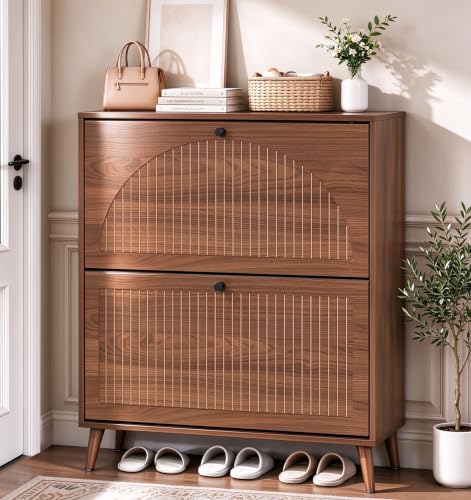
- Best for modern homes: Fsbecl Shoe Cabinet with 2 Flip Drawers, Fluted Panel, Walnut — Check on Amazon
- Maupvit Large Rattan Shoe Cabinet with 4 Flip Drawers, Beige — Check on Amazon
- Maupvit Shoe Cabinet with 3 Flip Louvered Doors, Noble Blue Gray — Check on Amazon
- BORNOON Shoe Cabinet with 3 Flip Drawers, White — Check on Amazon
- Tribesigns Shoe Cabinet with Doors, 7-Tier, Wood and Gold — Check on Amazon
See 1 more Amazon option
- IRONCK Shoe Cabinet with 2 Flip Drawers and Rattan Doors, Oak — Check on Amazon
Read the full guide ↓
Disclosure: As an Amazon Associate, dailyhomedecorating.com earns from qualifying purchases. Links to Amazon on this page are affiliate links; they cost you nothing extra. Listing details such as price and availability change often, so check the current Amazon listing before you buy.
The best shoe cabinet for modern homes under $300 has to pass a test that ordinary shoe storage never faces: it will be looked at, every day, by people who chose the rest of the room carefully. In a modern entryway the shoe cabinet is not tucked into a closet — it is the console, the first surface a guest sees, the place the keys and the mail and the one good tray live. So this guide judges the category the way a modern room judges furniture: silhouette first, then surface, then hardware, and only then capacity — while keeping the hard rule of the whole series, that a pick must be a genuinely closed cabinet, doors or flip drawers shut over every pair. An open rack in a modern entry is not minimalism; it is twenty pairs of visual noise wearing a minimalist label.
The good news is that the current generation of slim flip-drawer cabinets has quietly become design furniture. The format’s shallow depth — about nine and a half inches — produces the long, low, wall-hugging profile that modern rooms are built around, and makers have started dressing that profile properly: fluted fronts that catch raking light, woven rattan that warms a white room, louvers that read as architectural slats, flat white panels that disappear entirely. Our top pick, the Fsbecl in walnut, leads with its fluted fronts — the single most current furniture detail in the category — while the Maupvit rattan cabinet offers the organic counterpoint for rooms that lean warm-modern or Japandi. What this budget does not buy is solid timber or designer provenance: every pick here is engineered wood, honestly finished, and the reviews say so, because in a design-led room a well-finished MDF front reads perfectly — until the day someone expects oak and taps it.
Below: the quick picks ranked by design role, how the selection was made, detailed reviews that treat each cabinet as a piece of furniture first and a shoe store second, a comparison table, a styling and sizing guide for modern entries, the design mistakes that date a room, and the questions modern-home buyers ask. One deliberate exclusion to note up front: the VASAGLE LIRY cabinet that appears in our other guides is absent here, not because it is a poor cabinet but because its rustic farmhouse finish answers a different room — and a guide for modern homes that includes it anyway would not be doing its job.
In this guide
Quick Picks
Short on time? Each row names a modern design role and the cabinet that fills it.
| Design role | Pick | Why it stands out | Link |
|---|---|---|---|
| Best overall for modern homes | Fsbecl Shoe Cabinet, 2 Flip Drawers, Walnut | Fluted fronts and black handles — the current furniture look, slim depth | Check on Amazon |
| Warm modern / Japandi | Maupvit Large Rattan Shoe Cabinet, 4 Flip Drawers | Woven rattan fronts soften a minimal room; widest storage here | Check on Amazon |
| Architectural slatted look | Maupvit Shoe Cabinet, 3 Flip Louvered Doors | Louvered fronts read as slatted architecture and ventilate | Check on Amazon |
| Gallery-minimal white | BORNOON Shoe Cabinet, 3 Flip Drawers, White | Flat white fronts that vanish against a white wall | Check on Amazon |
| Modern with metal accents | Tribesigns Shoe Cabinet with Doors, 7-Tier | Wood-and-gold finish, hinged doors, raised metal legs | Check on Amazon |
| Compact organic accent | IRONCK Shoe Cabinet, 2 Flip Drawers, Oak | Hand-woven rattan in a smaller footprint for a styled corner | Check on Amazon |
How These Picks Were Chosen
The closed-cabinet rule applied first, as always: doors or flip drawers over every pair, no open racks or cubbies regardless of how sculptural the listing photography made them look. The budget rule followed — real Amazon listings with research sightings inside the ceiling; check price on Amazon for the current figure on any pick.
Then the modern filters, which reordered the category substantially. We scored silhouette: low, horizontal and wall-hugging beats tall and boxy in a modern entry, and slim depth is a design feature here, not just a space saving. We scored surface: fluting, rattan, louvers and honest flat panels all have a place in current interiors; faux-distressed farmhouse finishes and barn-door detailing do not, which is why the capable VASAGLE LIRY was set aside for this guide specifically. We scored hardware and legs — black bar handles, hidden pulls and metal legs read modern; chunky rustic knobs do not. And we checked that the design survives its own top surface, because a modern entry cabinet will be styled — a lamp, a bowl, a piece of art leaning behind it — and a flimsy top or a raised back lip ruins the composition.
We did not live with these cabinets. Design judgments are ours, made from listing photography and specifications; construction facts — dimensions, materials, drawer counts, capacities — come from maker listings and manuals, cross-checked against independent records, with maker capacity claims reported as claims and discounted in the buying guide.
The 6 Picks for the Best Shoe Cabinet for Modern Homes Under $300
Fsbecl Shoe Cabinet with 2 Flip Drawers, Fluted Panel, Walnut
Who it suits: Modern-home buyers whose entryway is a designed space — walnut, black hardware, clean lines — and whose shoe rotation is a personal one, not a family’s.
Fluting is the detail that separates a 2026 furniture front from a 2019 one: vertical grooves that turn a flat panel into a play of light and shadow as the day moves across it. The Fsbecl builds its whole design on that detail — fluted walnut-finish fronts on two flip drawers, black handles, a freestanding engineered-wood carcass about 31.5 inches wide, 9.4 inches deep and 35.4 inches high, standing with about 4.72 inches of clearance beneath it so the unit floats slightly and a robot vacuum passes under. It holds, by the maker’s count, about twelve to sixteen pairs across two double-layer drawers with removable shelves — a single person’s or a couple’s curated rotation, which is the honest scale of the piece. As a designed object it is the most resolved in this guide: the grooves align across both drawers, the handles are the right black, and the proportions — wider than tall, low to the ground — are console proportions.
The compromises are capacity and presence. Two drawers is a wardrobe edit, not a collection, and households that cannot edit to sixteen pairs should not buy a cabinet that demands it. The walnut finish is a printed and lacquered surface over engineered wood; in raking light it reads convincingly, under a fingertip it reads as what it is. The brand is a small marketplace maker, with support to match. For pricing, check price on Amazon — deal coverage during research placed this model in the lower-middle of the budget, which for the most design-current piece here is a pleasant surprise. Styled with a round mirror above it, this is the cabinet that makes visitors ask where the console is from; the fuller entryway scheme is in Best Entryway Bench For Modern Homes Under $300.
- Fluted walnut fronts — the defining modern furniture detail, done well.
- Black handles and a low, wide console silhouette.
- About twelve to sixteen pairs in two double-layer drawers.
- Raised clearance lets a robot vacuum pass beneath.
- Slim 9.4-inch depth keeps the profile architectural.
Honest limitation: Capacity suits an edited rotation only, and the walnut is a finish over engineered wood, not timber.
Choose it if the entryway is a designed moment and your rotation fits two drawers. Skip it if you need family capacity — the Maupvit below stores more than twice as much.
Maupvit Large Rattan Shoe Cabinet with 4 Flip Drawers, Beige
Who it suits: Warm-modern, Scandinavian and Japandi rooms that need real capacity without a cold white box.
Rattan is how a modern room admits texture without admitting clutter, and this Maupvit is the texture pick at full scale: four flip drawers across about 47 inches of width and only about 9.45 inches of depth, fronts woven in a half-round rattan pattern over MDF, on metal legs with hidden handles. The maker’s capacity claim for the rattan line is roughly thirty to thirty-eight pairs — discount it in the usual way and it still holds a serious household rotation, which makes this the rare design pick that does not ask you to choose between the look and the storage. In a room of pale wood, white walls and one black accent, this cabinet is the warm layer; the woven fronts also pass a little air, a practical bonus for daily-worn shoes that purely decorative picks cannot offer.
The design cautions: real woven rattan has natural variation, so the fronts will not be machine-identical — in a room that prizes precision, look at the louvered or fluted picks instead. The beige tone is warm; against cool gray floors it can read yellow, and sample-checking your light matters. Assembly is the longest here. Check price on Amazon; sightings put the rattan line mid-budget.
- Four drawers of storage behind woven rattan fronts.
- The warm-texture anchor for minimal rooms.
- Slim depth with sideboard proportions and metal legs.
- Adjustable panels flex between shoe styles.
Honest limitation: Natural rattan varies front to front, and the warm beige can clash with cool-toned floors.
Choose it if your modern room leans warm and organic. Skip it if you want machine precision or a cool palette.
Maupvit Shoe Cabinet with 3 Flip Louvered Doors, Noble Blue Gray
Who it suits: Modern homes with a color story — white walls, blue-gray or slate accents, brass or black hardware — and anyone who likes slatted architecture.
Louvers are the oldest trick in this guide and the most architectural: a wall of fine horizontal slats that reads as texture from across the room and as joinery up close. This Maupvit’s three flip doors are louvered in a blue-gray finish the maker calls Noble Blue Gray, on a cabinet about 31.5 inches wide, 9.45 inches deep and 47.24 inches tall, with metal hinges specified at a thickened 0.4 inches. Behind the slats sit three double-layer drawers rated by the maker at twenty-four to thirty-two pairs, the bottom one extended to about 15.75 inches for larger shoes. The louvers do double duty — they are the design and the ventilation, passing air to the shoes inside — which makes this the rare modern pick whose signature detail is also its best engineering.
Color commitment is the price: blue-gray is a decision the whole entry scheme must agree with, and it will fight warm wood floors and orange-toned lighting. Louvers also collect dust in their grooves and ask for a brush rather than a cloth. Check price on Amazon for the current figure.
- Louvered fronts: slatted texture plus real ventilation.
- Three drawers; maker-rated twenty-four to thirty-two pairs.
- Extended bottom drawer for larger shoes.
- Blue-gray finish pairs with white walls and black or brass hardware.
Honest limitation: The color is a scheme-wide commitment, and louver grooves need brushing, not wiping.
Choose it if your palette has room for blue-gray and you value the slatted look. Skip it if your entry is warm-toned throughout.
BORNOON Shoe Cabinet with 3 Flip Drawers, White
Who it suits: Gallery-minimal and all-white modern interiors, where the correct design move for storage is disappearance.
Not every modern cabinet should be a feature. In a white-on-white entry — white walls, pale floor, one piece of art — the BORNOON’s flat white fronts do the most sophisticated thing available: they vanish, leaving a clean rectangular volume about 31.5 inches wide, 9.45 inches deep and 47.2 inches high that the eye reads as architecture rather than furniture. Inside are three flip drawers with two compartments each and a realistic capacity, per independent coverage, of eighteen to twenty-four pairs — the largest storage in this guide that comes with zero visual weight. The top surface is a clean stage for a single object, and because there is no grain, no weave and no color, whatever you place there owns the composition entirely.
Disappearance has maintenance terms: flat white MDF prints every scuff, and in a busy modern home the fronts will need the occasional melamine-sponge pass to stay gallery-clean. The design is also deliberately anonymous — if your room wants the cabinet to contribute character, the fluted and rattan picks contribute more. BORNOON is a small brand with basic hardware. Check price on Amazon; sightings sat in the lower half of the budget, making this the value route to a minimal entry — compare Best Shoe Cabinet For Modern Homes Under $150 if the budget tightens further.
- Flat white fronts disappear against white walls.
- Three drawers, realistic eighteen to twenty-four pairs.
- Clean top surface stages a single styled object.
- Slim depth preserves the room’s clean lines.
Honest limitation: White fronts show scuffs, and the look is intentionally anonymous.
Choose it if your modern scheme is minimal and pale. Skip it if you want the cabinet itself to add texture or color.
Tribesigns Shoe Cabinet with Doors, 7-Tier, Wood and Gold
Who it suits: Modern homes with warm metal accents — brass, gold, bronze — and shoes too tall or long for flip trays.
This is the guide’s hinged-door cabinet: two doors over seven adjustable shelves in a carcass about 29.6 inches wide, 14.6 inches deep and 43.3 inches high, finished in wood tones with gold-tone legs and hardware, built from E0-grade MDF with 0.59-inch boards. The modern credential is the metal: in rooms already speaking brass — the mirror frame, the lamp, the door furniture — the gold legs make the cabinet rhyme with the scheme instead of merely sitting in it. The depth that comes with doors is also the functional story: shelves take boots, high-tops and large sizes that the slim flip cabinets refuse, and a shelf removes entirely for a tall row. The maker’s capacity differs between its US (up to thirty pairs) and Canadian (twenty-four) listings; plan on the lower figure.
At 14.6 inches deep it is a piece of furniture in the round, not a wall panel — in a narrow modern hall that projection breaks the flush line the other picks preserve. Shelves also need styling discipline inside: doors hide the shoes, but a modern eye will know. Check price on Amazon; research sightings placed it mid-budget.
- Wood-and-gold finish rhymes with brass-accented schemes.
- Hinged doors and shelves take boots and large shoes.
- Adjustable and removable shelves for flexible rows.
- Raised metal legs give a light, furniture stance.
Honest limitation: The deepest footprint here, and the warm gold palette suits only schemes already using warm metals.
Choose it if brass accents and boots both live in your entry. Skip it if your hall demands a flush, slim profile.
IRONCK Shoe Cabinet with 2 Flip Drawers and Rattan Doors, Oak
Who it suits: Smaller modern spaces — a studio entry, a styled corner by the door — that want the organic note at a smaller scale.
The IRONCK takes the rattan idea down to accent size: two flip drawers behind hand-woven rattan fronts in an oak finish, each drawer double-layered with an adjustable or removable center divider. The maker’s specific claim — men’s shoes to US size 11.5 fit without removing the panel — is the kind of detail that makes a small cabinet usable rather than decorative, and while the headline capacity claim runs optimistic, a realistic load in the high teens of pairs covers a modern apartment’s edited rotation. In design terms it is the Maupvit rattan pick’s smaller sibling: same warmth, same woven shadow-play, sized for the wall a studio actually has.
Two drawers is a firm ceiling, and rattan remains the most delicate front material here — a design-led home without small children or scooter traffic will keep it beautiful; a chaotic one will not. Check price on Amazon; sightings put it in the lower-middle of the budget. For the base comparison across all styles, see Best Shoe Cabinet Under $300.
- Hand-woven rattan fronts in warm oak — organic modern texture.
- Two double-layer drawers with adjustable dividers.
- Maker states up to US 11.5 fits without panel removal.
- Compact width for studio and apartment entries.
Honest limitation: Small capacity and delicate fronts — a styled piece, not a workhorse.
Choose it if you want the rattan accent at apartment scale. Skip it if you need household capacity.
Comparison Table
| Product | Type | Best modern use | Link |
|---|---|---|---|
| Fsbecl, 2 Flip Drawers, Walnut | Fluted fronts, 9.4 in deep | The designed console entry | Check on Amazon |
| Maupvit Large Rattan, 4 Flip Drawers | Rattan fronts, ~47 in wide | Warm modern with real capacity | Check on Amazon |
| Maupvit Louvered, 3 Flip Doors | Louvered fronts, blue-gray | Slatted architectural texture | Check on Amazon |
| BORNOON, 3 Flip Drawers, White | Flat white fronts | Gallery-minimal disappearance | Check on Amazon |
| Tribesigns 7-Tier with Doors | Hinged doors, wood and gold | Warm-metal schemes; boots | Check on Amazon |
| IRONCK Rattan, 2 Flip Drawers | Rattan fronts, compact | Organic accent, small spaces | Check on Amazon |
How to Choose a Shoe Cabinet for a Modern Home
- Start with the room’s temperature. Warm modern (oak floors, brass, cream) points to rattan, walnut fluting and the wood-and-gold Tribesigns. Cool modern (concrete, chrome, gray) points to flat white and blue-gray louvers. A cabinet in the wrong temperature fights every other object in the entry.
- Let one detail lead. Fluting, rattan, louvers and gold legs are each a complete design statement. Choose the cabinet whose detail your room already speaks once — in a mirror frame, a lamp, a chair weave — and let everything else stay quiet.
- Protect the flush line. Modern entries depend on clean wall planes. The 9.4-inch flip cabinets preserve that plane; the 14.6-inch door cabinet interrupts it deliberately, like a piece of furniture. Either can be right; mixing the expectation is what looks wrong.
- Style the top as a composition, not a shelf. One tray for keys, one object with height, negative space between them. The cabinet top is the room’s first still life — and the moment it becomes general storage, the modern effect is gone regardless of which cabinet you bought.
- Anchor invisibly. Modern rooms forgive no visible straps or brackets. Fit the anti-tip kit as the maker intends, into the wall, before styling — the safety hardware should be the only invisible engineering in the room.
- Size the edit honestly. Design-led cabinets reward edited rotations. Count the pairs you actually wear monthly; if the number exceeds twenty-four, take the four-drawer Maupvit or the shelved Tribesigns rather than a beautiful two-drawer piece that will overflow onto the floor it was bought to clear.
- Check hardware against your door furniture. Black handles with black door levers, gold legs with brass fittings — the cabinet joins the room’s metal family or it looks borrowed. Listings show hardware clearly; compare before ordering.
- Check the live price before judging the design premium. This guide prints no fixed prices; the fluted design pick has appeared in deal coverage at a lower-middle tier, and sale weeks compress the gap between the plainest and the most designed cabinets considerably. Compare current prices on Amazon on the day you buy.
Styling the Cabinet Top: A Short Course for Modern Entries
Because the modern shoe cabinet doubles as the entry console, its top deserves the same discipline as its fronts. The composition that works in almost every modern entry has three elements and a lot of restraint: a horizontal anchor (a shallow tray or a low stack of two books) that gives keys and mail a defined landing strip at one end; a vertical element (a small lamp, a vase with a single stem, a piece of art leaned against the wall) that lifts the eye at the other; and deliberate emptiness between them, which is what makes the arrangement read as design rather than storage. Mirrors belong above these cabinets more than art does — a round mirror over a fluted or rattan front is the category’s most reliable composition, because the circle forgives the cabinet’s long horizontal and the reflection doubles the entry’s light.
Two styling errors undo modern entries reliably. The first is symmetry addiction: identical objects at both ends of a 47-inch cabinet turn a console into a hotel corridor. Offset everything. The second is surface creep — the slow migration of parcels, gym bags and paperwork onto a surface that was styled in week one. The defense is structural, not willpower: the tray defines the only legal landing zone, and anything that does not fit the tray does not live on the cabinet. Modern rooms are not maintained by tidier people; they are maintained by surfaces with rules.
Materials, Honestly: What Engineered Wood Means in a Design Room
Every cabinet in this guide is engineered wood — MDF, particleboard, or a blend — and a design-conscious buyer deserves the unvarnished account of what that means over a decade, because the listings will not provide it. The virtues are real and they are why the material owns this tier: panels arrive flat, true and dimensionally stable, so drawers align with the precision modern design demands; finishes print, lacquer and emboss convincingly, so fluting runs crisp and walnut grain repeats without a join; and the cost of the carcass leaves budget for the details that show — woven rattan, metal legs, decent hinges. A solid-timber cabinet with this fit and finish would cost several times this guide’s entire budget, and at that price it would be bought once a decade, not once a design phase.
The limits are equally real. Engineered panels dislike water at their edges: a mop pushed against the base weekly will swell a particleboard plinth within a couple of winters, which is one quiet reason the leg-raised designs in this guide age better in entryways than plinth-based ones — legs keep the carcass out of the wet zone entirely. Screw fixings in particleboard hold well once and poorly twice, so a cabinet that is disassembled for every house move loosens a little each time; these are furnish-one-home pieces, not flat-pack nomads. And a deep impact that would dent timber will chip a printed finish, revealing the substrate in a way that touch-up pens disguise at a distance and never quite erase up close. None of this disqualifies the material — it defines the care contract. Keep the base dry, move the cabinet assembled and upright, and treat impacts as the enemy, and an engineered-wood cabinet will hold its lines and its looks for the full span of a design phase. Judge it as what it is, and it will not disappoint you; judge it as oak, and it will, through no fault of its own.
Light, Scale and the Entryway as a Room
Two design variables decide whether a well-chosen cabinet actually lands in a real modern entry, and neither appears on a specification sheet. The first is light. Entryways are the worst-lit rooms in most homes, and surface details behave accordingly: fluting needs a raking light source — a window to the side, a lamp at one end — to perform its shadow play, and in a flat, dim hall it can read as mere striping; rattan warms under warm light and grays under cold; the blue-gray louvers are at their best in daylight and can go almost charcoal under a single warm bulb in the evening. Before ordering, hold the finish decision up against your entry’s actual light at the hour you come home, not against the listing’s studio photography, which was shot in conditions your hallway will never see.
The second variable is scale against the door itself. A standard interior door is about thirty-two inches wide, and a cabinet that matches or modestly exceeds that width reads as intentional architecture, while one that stops a few inches short reads as an approximation. This is why the 31.5-inch cabinets in this guide sit so comfortably in real entries — they rhyme with the door leaf — and why the 47-inch Maupvit needs a genuinely long wall to earn its width. Height plays the same game: a cabinet top at or just below the height of the door handle keeps the composition in one calm band, and art or a mirror hung with its center at standing eye level completes a wall that was designed, in every sense, rather than accumulated. Measure for these relationships with the same care you measure for shoes; in a modern home, they are the purchase.
What a Modern Entry Asks of You After Delivery
A design-led cabinet changes the obligations of the room around it, and it is fair to know them before the delivery rather than after. The first is editing, permanently. A modern entry reads as calm because everything in it has been chosen, and the shoe cabinet enforces that standard daily: the rotation that fits the drawers is the rotation that exists at the door, and pairs that no longer earn their place migrate to a closet or out of the house. Owners who treat the cabinet’s capacity as a hard editorial line find the room stays exactly as composed as the day it was styled. Owners who treat it as a suggestion end up with a beautiful cabinet and a row of shoes beside it, which is the one composition no designer can save.
The second obligation is surface discipline at the top, already covered in the styling section, but with a maintenance edge: the objects that live on a modern cabinet should be few enough to lift with one hand while you dust with the other, because a styled surface that cannot be cleaned in ninety seconds will not be cleaned at all, and dust is the natural enemy of every finish in this guide — it settles into fluting, dulls rattan and prints itself across flat white. The third obligation is honesty about light bulbs. Entryways in modern homes often run cool, bright downlights that flatter chrome and punish warm finishes; if your rattan cabinet looks gray-green in the evening and golden at noon, the cabinet is not inconsistent — your lighting is two different rooms sharing one space, and a single warm bulb in the entry lamp will reconcile them more cheaply than any return.
None of this is a burden unique to shoe cabinets; it is simply the standing contract of a designed room, applied to the hardest-working object in it. The buyers who thrive with the picks in this guide are the ones who wanted that contract. The buyers who merely wanted the shoes gone should take the BORNOON, whose anonymity asks the least of its room, and be happy — that, too, is a legitimate modern decision.
How Long Will the Look Last? Finishes Across a Design Cycle
Modern interiors move in cycles of roughly five to seven years, and a fair question for any design-led purchase is whether the piece survives the cycle or dates with it. Judged honestly, the picks in this guide split into two camps. The flat white BORNOON and the louvered Maupvit are cycle-proof in the way good basics are: white flat fronts were correct twenty years ago and will be correct in twenty more, and slatted wood-tone and painted surfaces belong to an architectural vocabulary older than the trend cycle itself. The rattan pair sits in the middle — woven cane has cycled in and out for a century and currently sits near a peak, so a rattan cabinet bought today should be bought because you like it in your room’s light, not because it is fashionable this season; liked for itself, it will still please you when the cycle turns.
The fluted Fsbecl is the honest fashion piece of the guide, and there is no shame in that: fluting is this period’s signature the way hairpin legs were a previous one’s, and furniture that captures its moment well becomes the period charm of the next. The practical implication is about pairing, not avoidance. Let the fashionable piece be the entry’s one statement and keep its companions — mirror, lamp, tray — in the timeless camp, so that when you eventually tire of the statement, one cabinet changes and the room survives. That is also the final argument for this budget tier: at under $300, a design cycle is an affordable thing to participate in. The mistake is not buying the fashionable cabinet; it is buying five fashionable objects at once and having to replace them all together.
Common Buying Mistakes
- Buying a farmhouse or barn-door cabinet for a modern room because the storage specs looked good — the style mismatch is visible every day, the specs are not.
- Mixing design details: fluted fronts, rattan, louvers and gold legs in one small entry, so the room reads as a showroom of samples.
- Choosing a warm beige or oak finish against cool gray floors without checking the pairing in your own light.
- Letting the cabinet top become general storage within a month, deleting the design you paid for.
- Ordering a two-drawer design piece for a twenty-five-pair rotation and discovering the overflow lives on the floor.
- Ignoring the room’s existing metals, so the cabinet’s hardware argues with every door lever in sight.
- Skipping the wall anchor because the cabinet looks too styled to drill behind — the anchor is invisible and non-negotiable.
- Expecting solid timber at this budget and judging honest engineered wood as a defect rather than the category’s material.
Final Recommendation
- Most modern entries: Fsbecl Shoe Cabinet, 2 Flip Drawers, Fluted Walnut.
- Warm modern with capacity: Maupvit Large Rattan Shoe Cabinet, 4 Flip Drawers.
- Architectural texture: Maupvit Shoe Cabinet with 3 Flip Louvered Doors.
- Minimal white schemes: BORNOON Shoe Cabinet, 3 Flip Drawers, White.
- Warm metals and boots: Tribesigns Shoe Cabinet with Doors, 7-Tier.
- Small styled spaces: IRONCK Shoe Cabinet, 2 Flip Drawers, Oak.
Our first recommendation for a modern home is the Fsbecl, because fluting is the detail this design moment is made of and this cabinet executes it — proportions, handles, stance — better than anything else under the budget, provided your rotation fits its two drawers. Where capacity rules, the rattan Maupvit is the design pick that refuses to compromise, and it is the one we would place in a warm-modern family entry without hesitation. The louvered Maupvit, the disappearing BORNOON, the brass-rhyming Tribesigns and the compact IRONCK each own a specific modern dialect; the guide’s job has been to match dialect to room. Decide your room’s temperature, let one detail lead, anchor the piece invisibly, check the current price on Amazon, and style the top like you mean it.
Frequently Asked Questions
What makes a shoe cabinet look modern rather than just new?
Three things: a low, horizontal silhouette that hugs the wall; a single confident surface detail — fluting, rattan, louvers — instead of applied decoration; and hardware and legs that match the room’s metal family. Tall, boxy cabinets with ornate knobs read traditional at any age. Every pick in this guide was chosen against those criteria, which is why some capable cabinets from our other guides were excluded here on style grounds alone.
Is rattan too traditional for a modern home?
No — woven cane and rattan are central to current warm-modern and Japandi interiors precisely because they add organic texture to otherwise smooth rooms. The distinction is in the frame: rattan inside a clean, handle-less, straight-lined carcass reads modern, while rattan on a distressed, ornate frame reads cottage. Both rattan picks here use the clean carcass, which is why they belong in this guide.
Can a shoe cabinet really work as an entry console?
Yes — the slim flip cabinets are console-proportioned by accident of engineering: 31 to 47 inches wide, about 35 to 48 inches tall, under ten inches deep, with a flat top at a useful height. Style the top with a tray, one vertical object and empty space, keep the landing zone disciplined, and guests will read the piece as a console that happens to contain shoes. The four-drawer Maupvit is the strongest console substitute because its width matches a standard entry console.
Fluted, louvered or flat fronts — which ages best?
Flat fronts age slowest, because they make no claim on a trend; a white flat-front cabinet will look correct in a decade. Fluting is the current detail and will date the piece to this design period eventually — beautifully, the way good mid-century pieces are dated. Louvers sit between: an older, architectural motif that cycles rather than expires. Choose flat for permanence, fluted for the present moment, louvers for texture with ventilation as a bonus.
How do I keep a styled shoe cabinet top from becoming cluttered?
Give the clutter a legal home and make it small: one tray, sized for keys, sunglasses and a day’s mail, is the entire landing zone. Everything else — parcels, bags, paperwork — needs a different destination decided in advance. Modern entries stay modern through surface rules, not daily effort, and the rule has to be set the week the cabinet arrives, before the first parcel lands.
What if my modern entry has no wall long enough for these cabinets?
Then the answer is to split the function, not to force the fit. A two-drawer cabinet on the longest available wall holds the daily rotation — the pairs that justify entry space — while the remainder of the collection moves to a closet solution, where a deeper shelved cabinet can work unseen. Modern rooms tolerate, and even reward, this kind of distribution, because the entry keeps only what it can hold beautifully. What a modern entry cannot absorb is an over-long cabinet bending around a corner or a too-wide unit crowding the door swing; proportion is the whole game, and a smaller cabinet in correct proportion will always look more designed than a larger one apologizing for its dimensions.
Does a modern shoe cabinet need anchoring if it looks stable?
Yes. These are tall, shallow cabinets whose center of gravity moves sharply when a loaded drawer tips open, and modern rooms offer no visual forgiveness for a fallen cabinet or a damaged wall of art. The anti-tip kits included with these models install invisibly behind the carcass — ten minutes during assembly, undetectable afterward, and the only part of the styling that is not optional.


