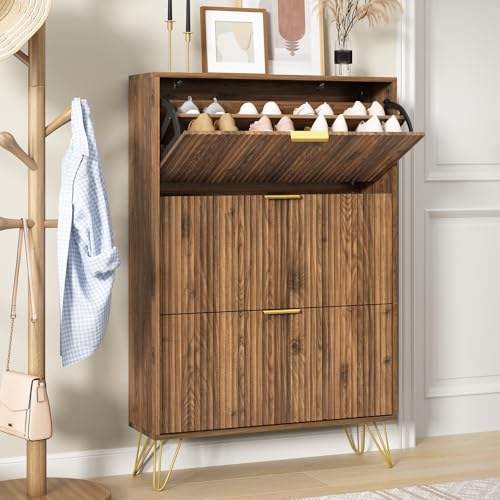
Where to buy
Check the latest price, availability and delivery on Amazon. Orders are placed on Amazon. We may earn a commission from qualifying purchases.
- Best for modern homes overall: Sscaktu Shoe Storage Cabinet with 3 Flip Drawers, Fluted, Natural — Check on Amazon
- Best warm-modern texture: IRONCK Shoe Cabinet with 2 Flip Drawers, Rattan Doors, Oak — Check on Amazon
- Best flat-front cupboard: VASAGLE LIRY Collection Shoe Cabinet, 3-Tier with Hinged Doors — Check on Amazon
- Slimmest minimal profile: Haotian Slim Shoe Cabinet with 2 Flip Drawers, FSR151 — Check on Amazon
- Best transitional rustic: Maupvit Shoe Storage Cabinet with 2 Flip Drawers, Rustic Brown — Check on Amazon
- IKEA HEMNES Shoe Cabinet with 4 Compartments — prose-only pick, sold by IKEA directly; see the review below for why there is no Amazon link
Read the full guide ↓
Disclosure: As an Amazon Associate, dailyhomedecorating.com earns from qualifying purchases. Links to Amazon on this page are affiliate links; they cost you nothing extra. Listing details such as price and availability change often, so check the current Amazon listing before you buy.
The best shoe cabinet for modern homes under $1000 has one job the other cabinets in this series do not: it must be invisible as storage and visible as design. In a modern interior — flat planes, restrained palettes, every object earning its place — an entryway cabinet is judged the way a sideboard is judged. Does the front have intention? Do the proportions sit quietly against the wall? Can it stand in a living room, beside the sofa’s sightline, without a single guest reading it as shoe storage? This guide applies that standard to six verified closed cabinets, and it is a stricter standard than capacity or price. Two of our six picks earn their place on texture, one on architectural flatness, one on sheer slimness, and one — honestly — as the transitional option for homes that are modern-leaning rather than modern-pure.
First, the format rule that governs everything here: cabinet, not rack. Open shelving is the enemy of the modern entry, because modern rooms depend on uninterrupted surfaces and a rack of footwear is a permanent interruption. Every pick below closes completely — flip drawers or hinged doors — so the visual field stays calm and the shoes, with their logos and laces and color, simply cease to exist until needed. Second, the budget truth: modern design at this tier does not require modern-designer money. Every linked pick was sighted far below the $1000 ceiling. What the headroom buys is not a label; it is the freedom to choose the front, the finish and the proportions your room actually wants, and to pair the cabinet with the mirror and lighting that complete the composition.
Modern homes also impose two practical disciplines the reviews respect. Depth discipline: modern hallways and open-plan entries are often planned to the inch, and a cabinet that protrudes wrongly breaks the sightline it was bought to protect — so depths here run from about 7.5 inches to a deliberate, console-like 13.8, each with its place. And styling discipline: the top of a modern shoe cabinet is a curated surface, not a dumping strip, so each review notes what the top can genuinely hold and how the piece photographs against the palettes modern homes actually use — warm white, natural oak, walnut, matte black accents. Below: the quick picks, the selection reasoning, full reviews, a comparison table, a how-to-choose written for design-led buyers, the mistakes that cheapen a modern entry, and a designer’s FAQ.
In this guide
Quick Picks: Best Shoe Cabinet for Modern Homes Under $1000
Each row matches a modern interior situation to its cabinet. Use check price on Amazon to confirm the live listing before you buy; prices move with coupons and seasonal sales.
| Modern situation | Pick | Why it stands out | Link |
|---|---|---|---|
| Best for modern homes overall | Sscaktu Shoe Storage Cabinet, 3 Flip Drawers | Fluted natural front — genuine texture and shadow play, three hidden drawers | Check on Amazon |
| Best warm-modern texture | IRONCK Shoe Cabinet, Rattan Doors, Oak | Hand-woven rattan warms minimal rooms and ventilates behind closed doors | Check on Amazon |
| Best flat-front cupboard | VASAGLE LIRY Collection Shoe Cabinet | Hinged doors, flat adjustable shelves — reads as a low sideboard | Check on Amazon |
| Slimmest minimal profile | Haotian Slim Shoe Cabinet, FSR151 | About 7.5 inches deep with a completely flush front — near-invisible storage | Check on Amazon |
| Best transitional rustic | Maupvit Shoe Storage Cabinet, 2 Flip Drawers | Rustic brown warmth for modern-farmhouse and transitional schemes | Check on Amazon |
| Best Scandi benchmark | IKEA HEMNES Shoe Cabinet, 4 Compartments | The original slim Scandinavian cabinet — covered prose-only, sold by IKEA | See review |
How These Picks Were Chosen
Design was the first filter, but never the only one. A pick had to close fully — open racks, cubbies and spinning towers were excluded regardless of how sculptural their marketing photos looked — and it had to be a verifiable Amazon listing: confirmable ASIN, specifications cross-checked against maker manuals or independent coverage, and a dated price sighting far under the $1000 ceiling. Check price on Amazon before ordering; sightings prove the tier, not today’s figure. It then had to earn its place in a modern room on at least one honest design merit: a textured front with real depth, a flat front with true proportions, a profile slim enough to disappear, or a finish that anchors a recognized modern-adjacent scheme.
We did not use these cabinets ourselves, and no hands-on claims are made. We compared the specifications that decide whether a piece reads as furniture in a modern interior: front construction (woven, fluted, flat), leg treatment (raised metal, plinth, flush), depth against the wall, top-surface usability, and how the finish behaves in the palettes modern homes use. Capacities were derated to working figures, because a modern entry that must be supplemented by shoes lined up beside the cabinet has failed at its only job. Where listings were internally inconsistent about dimensions, the product was dropped rather than guessed at.
One pick is prose-only on principle. The IKEA HEMNES is the Scandinavian benchmark for this entire category, but IKEA sells it directly and Amazon carries only third-party resellers at markups without IKEA’s support — so it is reviewed in full, with no link, and the honest advice to buy it from IKEA. Designer cabinets sold only through their own makers were excluded entirely: a guide built on Amazon links should not pad a modern shortlist with pieces you cannot reach from it. If your modern space is also a small one, our Best Shoe Cabinet For Small Apartments Under $1000 guide re-ranks this same verified pool by footprint first.
Detailed Reviews
Sscaktu Shoe Storage Cabinet with 3 Flip Drawers — Best for Modern Homes Overall
Who it suits: Modern, Japandi and warm-minimalist homes that want the entry cabinet to contribute texture rather than merely occupy the wall. The Sscaktu Shoe Storage Cabinet fronts three flip drawers with vertical fluting in a natural finish across a 31.5-inch width — and fluting is the rare trend texture that genuinely improves a storage piece, because it gives a large flat front light, shadow and scale without adding a single visual object to the room.
Stand in front of it at different hours and the front changes: morning light rakes across the reeding, evening lamplight softens it. That is what separates real fluting from the printed wood-grain foil that covers most cabinets at this tier — the texture is physical, and the eye knows. Behind the front, three flip drawers stack two levels each, zoning a household’s rotation invisibly: nothing about the exterior announces footwear at all. The natural finish is the correct modern neutral — warmer than white, calmer than walnut stain, and forgiving of dust in a way gloss surfaces never are. The cabinet is sold through the Raysom Home storefront on Amazon, and Sscaktu’s fluted range includes a larger hinged-door sibling with the same front language, so a second piece in another room can match rather than merely coexist.
Pros: The strongest front design in this guide at any price we could verify. Three hidden zones keep the modern promise — order without visible systems. Slim flip depth preserves open-plan sightlines. The top runs a full styled width for a lamp, a tray and one object with intent. Natural finish pairs with oak floors, limewash walls and black accents alike.
Honest limitation: Fluting is a texture commitment: in an ultra-flat, gallery-minimal interior it may read as busy, and it wants a soft brush for dusting rather than a dragged cloth. The flip format keeps its standard limits on tall boots and the largest sizes. And a natural finish, while warm, will not match a cool grey-and-chrome scheme — those rooms should look at the flat-front VASAGLE or the flush Haotian instead.
Choose it if your modern room runs warm and textured. Skip it if your scheme is cool, flat and gallery-quiet, or boots dominate your footwear. Check price on Amazon — its sightings sit far below this guide’s ceiling, which makes the design-per-dollar here difficult to argue with.
IRONCK Shoe Cabinet with 2 Flip Drawers, Rattan Doors — Best Warm-Modern Texture
Who it suits: The modern home that felt a little cold until someone added something woven. The IRONCK Shoe Cabinet fronts two flip drawers with hand-woven rattan over MDF panels in oak, on metal legs — a combination that has become the warm-modern signature precisely because it softens architecture without cluttering it.
The cabinet measures about 9.25 inches deep, 23.6 inches wide and 39.6 inches tall, at roughly 45 pounds. In modern terms its virtues are proportion and air: the raised metal legs give it the floating lightness modern rooms prefer over plinth bases, the weave introduces an organic grid that echoes cane webbing on designer chairs, and — functionally — the fronts ventilate, so shoes dry behind closed doors instead of sealing in the day. Each drawer carries two levels divided by a panel that adjusts or removes, and the wider sibling in the range is specified for men’s sizes up to 11.5 without panel removal, with three panel positions. An anti-tipping device is included; assembly is a two-person job the manuals put well under an hour.
Pros: Real woven texture, not a print — the difference is visible across a room. Ventilation is a genuine functional edge dressed as a style choice. The compact width suits the short entry walls of modern apartments and townhouses. Raised legs keep sightlines and robot vacuums moving. Oak-and-rattan pairs with the exact palette — white walls, pale floors, black details — that modern homes default to.
Honest limitation: Rattan is a commitment to the warm organic register; in a strict monochrome interior it reads as boho, not modern. Natural weave varies slightly in tone panel to panel, which perfectionists should accept before ordering, not after. Capacity is compact — a curated rotation, not a collection — and the woven front, while fully concealing at normal viewing, is not the flat plane some modern schemes demand.
Choose it if your modern room needs warmth and your shoes need air. Skip it if your scheme is cool monochrome or your rotation is large. Check price on Amazon to confirm the current listing.
VASAGLE LIRY Collection Shoe Cabinet — Best Flat-Front Cupboard
Who it suits: Modern homes with the depth to run a real sideboard. The VASAGLE LIRY is a low, wide, hinged-door cabinet — about 13.8 inches deep, 31.5 inches wide and 27.6 inches high — and in a modern entry it reads not as shoe storage but as the console the room was missing.
Flat fronts, a rustic white finish and an elevated base give it the calm, architectural presence modern schemes reward, while the interior is the most capable in this guide: three flat tiers, the upper shelf adjustable through five holes about 1.2 inches apart, so boots, high-tops and large sizes store the way they do in a wardrobe — flat, visible, a whole row revealed when the doors open. VASAGLE’s manual figures are nine to twelve pairs and a 165-pound maximum static load, with an anti-tip kit included. For the modern buyer the decisive trait may be the top: at nearly fourteen inches deep it is a genuine styling surface, deep enough for a lamp with a real base, a stack of books and a ceramic tray, composed the way a sideboard top should be.
Pros: The most furniture-like silhouette here — a sideboard that happens to hold shoes. Adjustable flat shelves end every negotiation with tall or large footwear. Doors reveal a full row at once, keeping the morning routine as calm as the room. The deep top is the best styling surface in the guide. Low, wide and stable, with fixing hardware included.
Honest limitation: Depth and door swing are real requirements: a narrow modern hallway planned to the inch may not have fourteen inches plus swing to give, and in that room this is simply the wrong cabinet. Rustic white is a warm white — against a blue-white gallery wall it can read cream. And its honest capacity is lower than the tall flip cabinets, because flat storage spends volume on flexibility.
Choose it if you have a true entry wall and want the cabinet to anchor it. Skip it if depth is scarce or your palette is cool-white strict. Check price on Amazon — it is discounted often enough that the check is always worthwhile. Styled with one of the Best Decorative Wall Mirror Under $500 picks above it, the composition is complete.
Haotian Slim Shoe Cabinet, FSR151 — Slimmest Minimal Profile
Who it suits: The modern interior where the correct amount of visible storage is none. At about 7.5 inches deep with hollowed-out handles that leave the front completely flush, the Haotian FSR151 is less a piece of furniture than a thickening of the wall — and in a minimal scheme, that is the highest compliment available.
The cabinet measures about 7.5 by 19.7 by 35.8 inches in engineered wood, with two flip drawers, an adjustable shelf detail and a raised bottom. Nothing protrudes: no knobs, no handles, no plinth shadow-gap theatrics — just a clean white plane that happens to open. Independent apartment coverage put realistic capacity at about six pairs, which frames its modern role precisely: this is the daily-rotation cabinet for a one- or two-person household whose remaining shoes live in the wardrobe, as modern storage doctrine says they should. A taller three-drawer sibling in the same range serves minimal homes with more height than depth.
Pros: The slimmest verified closed cabinet in this series — it preserves corridors and sightlines nothing else can. The flush front is genuinely minimal, not minimal-styled. Its modest sighted price makes it the rational choice even in a generous budget, freeing funds for the lighting and mirror that modern entries are actually made of. White finish disappears against white walls, the default modern condition.
Honest limitation: Six pairs is a doctrine, not a flaw — but households unwilling to live by the rotation rule will overflow it and blame the cabinet. Shallow buckets squeeze the largest sizes and exclude tall footwear. The tall, slim, light body makes wall fixing essential, and its top is a ledge for keys, not a styling surface.
Choose it if minimalism is a practice in your home, not just a palette. Skip it if your rotation is large or your sizes are. Check price on Amazon — the most affordable linked pick in this guide by a wide margin.
Maupvit Shoe Storage Cabinet with 2 Flip Drawers — Best Transitional Rustic
Who it suits: Modern-farmhouse, transitional and warm contemporary homes — the large territory between strict modern and traditional, where a rustic brown cabinet is not a compromise but the brief. The Maupvit Shoe Storage Cabinet is included in a modern guide honestly and on those terms.
Two flip drawers with two levels each sit in an MDF body about 9.45 inches deep, on metal legs that keep the stance light and contemporary even as the finish speaks farmhouse. That leg treatment is what earns it a hearing in modern-adjacent rooms: raised, clean-lined, with clearance beneath, it avoids the heavy plinth look that dates rustic pieces. The brown finish anchors pale modern schemes the way a walnut sideboard does, and it brings a practical modern virtue — it does not document every scuff and drip the way the pale surfaces around it do. Independent long-term coverage measured the same shallow depth class and found the drawers happiest with the everyday rotation: trainers, loafers, flats, ankle boots with the divider managed.
Pros: Warmth and grounding for pale modern rooms, with a contemporary raised stance. The most forgiving finish here for real daily use. Slim flip depth suits modern hallways. Metal legs tolerate wet entries and mopping. A sighted price that leaves the budget for the pieces modern rooms actually showcase.
Honest limitation: In a strict modern interior — flat, cool, monochrome — this reads as country, and no styling will fully convert it; those rooms should take the Sscaktu, VASAGLE or Haotian. Flip limits on tall boots and largest sizes apply. MDF tops want coasters and trays, like every cabinet here.
Choose it if your scheme is transitional or modern-farmhouse. Skip it if your modern is strict. Check price on Amazon for the live figure.
IKEA HEMNES Shoe Cabinet with 4 Compartments — The Scandi Benchmark (Prose-Only)
Who it suits: Buyers who want the reference design. The HEMNES four-compartment cabinet — about 42.1 inches wide, 8.6 inches deep and 39.8 inches high — is the slim cabinet as Scandinavian design defined it: plain fronts, honest proportions, a top surface at console height, and a decade-long presence in real hallways that no trend cycle has displaced. IKEA’s buying-guide dimensions and independent measurements agree on the footprint; realistic capacity is around eight pairs.
It is prose-only because IKEA sells it directly and there is no official IKEA listing on Amazon US — only third-party resellers at markups, without IKEA’s delivery, returns or spare-parts support. A design-led guide should not route you to a worse deal for a link’s sake, so: buy it from IKEA, where it has been sighted at a modest price.
Pros: The benchmark silhouette — quieter than the fluted fashion, and likely to outlast it. Four compartments zone a small household elegantly. Slim depth with real substance. IKEA’s parts and instructions ecosystem is the category’s best, which matters for a piece meant to stay a decade.
Honest limitation: It must be wall-fixed — two front legs, not freestanding — which some modern rentals cannot accommodate. Its plainness is the point, but buyers wanting texture should take the Sscaktu or IRONCK. Capacity is modest, and the flip format limits tall and very large footwear as always.
Choose it if you prize the original and can fix it to the wall. Skip it if you need Amazon delivery, texture, or maximum capacity. It remains the cabinet the modern end of this category is measured against — which is why it is here, link or no link.
Comparison Table
Capacities are conservative working figures. Prices are never printed here — use check price on Amazon on each review’s link for the live figure.
| Pick | Format | Dimensions (D × W × H) | Working capacity | Design register |
|---|---|---|---|---|
| Sscaktu 3-Flip Fluted | 3 flip drawers | Slim class; 31.5 in wide | Three zoned drawers | Fluted natural — warm modern texture |
| IRONCK Rattan | 2 flip drawers | ~9.25 × 23.6 × 39.6 in | Compact rotation | Woven rattan and oak — organic modern |
| VASAGLE LIRY | Hinged doors, flat shelves | ~13.8 × 31.5 × 27.6 in | 9–12 pairs (maker figure) | Flat-front sideboard — architectural |
| Haotian FSR151 | 2 flip drawers | ~7.5 × 19.7 × 35.8 in | ~6 pairs | Flush white plane — minimal |
| Maupvit 2-Flip | 2 flip drawers | ~9.45 in deep class | Daily rotation | Rustic brown — transitional warmth |
| IKEA HEMNES 4 | 4 flip compartments | ~8.6 × 42.1 × 39.8 in | ~8 pairs | Plain Scandi — the benchmark |
Read the table by register first, because in a modern home the wrong register cannot be fixed by the right dimensions. Warm and textured: Sscaktu or IRONCK. Flat and architectural: VASAGLE. Near-invisible: Haotian. Transitional warmth: Maupvit. Timeless Scandi: HEMNES, from IKEA. Then check depth — the modern hallway forgives many things but not a cabinet that breaks its sightline — and only then capacity, which every pick here covers for a disciplined rotation. Households whose modern space is also a family space should cross-read our Best Shoe Cabinet For Families Under $1000 guide, where the same pool is ranked by zoning and durability instead.
How to Choose a Shoe Cabinet for a Modern Home
Choose the front before the footprint. In modern rooms the front is the design decision: fluted for shadow and texture, woven for organic warmth, flat for architecture, flush for disappearance. Stand in your entry and decide what the wall wants; then find the depth and capacity that fit behind that front. Reversing the order is how modern entries end up with competent cabinets that nobody likes looking at.
Respect the sightline. Measure depth against the room’s visual corridors, not just its floor. A cabinet under ten inches deep keeps an open-plan entry reading as one space; the fourteen-inch sideboard format belongs on a true entry wall where a console would naturally stand. Check door swing and flip-drawer clearance against the front door’s own arc — modern floor plans overlap these more often than drawings admit.
Plan the top as a composition. Three objects, maximum, with a tray to gather the small ones. The VASAGLE’s deep top supports a lamp; the wide flip cabinets support a lamp or a plant, not both plus clutter; the Haotian’s ledge supports keys and nothing else — which is its own kind of discipline. If your household cannot keep a top curated, choose the cabinet whose top you will mind least, because an overloaded surface undoes a modern room faster than any front can save it.
Match finish temperature to the room. Warm whites, natural oak and rustic browns belong with warm schemes; cool greys and blue-whites need flat, cooler fronts. Order the finish decision before the product decision, and be honest about which modern your home actually is — the Maupvit is an excellent cabinet in the wrong register for a gallery-minimal flat, and the Haotian is a dull one in a warm rustic room.
Fix it, level it, light it. Modern rooms expose wobble and tilt mercilessly, so use the adjustable feet, fit the anti-tip kit — slim cabinets require it for safety regardless of style — and consider the wall above the cabinet part of the purchase: a mirror or a single artwork, lit well. Our Best Wall Sconce Under $300 picks cover the lighting layer that makes an entry composition feel finished rather than merely tidy.
Common Mistakes in Modern Entries
Buying an open rack for a modern room. No styling survives visible footwear. If the shoes show, the room is storage with furniture in it, not the reverse. Closed fronts are the entire premise — verify doors or flip drawers in the specification, not the lifestyle photo.
Choosing a print instead of a texture. Rattan-look foil and fluted-look print collapse at conversational distance, and modern rooms are viewed at exactly that distance. The picks here use woven and reeded fronts because the premium in a modern home is precisely the last three feet of viewing.
Overloading the top. A cabinet styled as a dumping strip reads as clutter with a lid. Tray the small things, cap the composition at three objects, and give the overflow a drawer or a hook elsewhere.
Ignoring finish temperature. A warm rustic cabinet in a cool minimal scheme — or a stark white slab in a warm one — grates daily and subtly, the worst kind of design error. The register column in the comparison table exists to prevent exactly this.
Skipping the wall fixing for looks. A slim cabinet unfixed is a hazard with good PR. Fit the anti-tip kit; on a finished wall the fixing is invisible, and the HEMNES cannot stand without it at all.
Spending the whole budget on the cabinet. Modern entries are compositions: cabinet, mirror, light, one object. Every pick here leaves most of a $1000 budget for the rest of the composition — spending it all on storage alone produces a tidy wall, not a designed one. The tier logic is the same one tier down in our Best Shoe Cabinet For Modern Homes Under $700 guide.
Styling the Modern Entry: Three Worked Compositions
Abstract advice about registers becomes useful when it is composed. Here are three complete modern entry compositions built on this guide’s cabinets, each within the budget’s spirit — the cabinet as one element among mirror, light and object — so you can see how the picks behave as design rather than as storage.
The warm gallery. The fluted Sscaktu against a warm-white or limewash wall, natural side down. Above it, a single large round mirror in a thin black frame, hung so its center sits at standing eye height; the fluting’s vertical rhythm and the mirror’s circle are the room’s whole conversation, and it is enough. On top: a low black tray holding keys and sunglasses, one ceramic vessel, nothing else. Light comes from a single wall sconce to the mirror’s side rather than a ceiling glare, so the reeding rakes in shadow each evening. Floor: a flatweave runner in undyed wool tones. The shoes, the coats, the bags — all elsewhere or inside. This composition suits the Japandi and warm-minimalist home, and it works in a rental because every element except the sconce is movable or surface-mounted without consequence.
The organic corner. The rattan IRONCK in the corner beside the door of a living-room entry, where a larger cabinet would crowd the sofa’s sightline. Above it, not a mirror but a single framed print with a wide mount — woven texture below, quiet paper above. On top: a small potted trailing plant in a matte stoneware pot, on a cork coaster, and a shallow wooden bowl for the day’s pocket contents. The palette is the cabinet’s own — oak, cane, warm white — extended into the room’s textiles so the corner reads as the room’s softest point rather than its storage annex. This is the composition for modern homes that entertain in the same room they enter: guests read a styled corner, never a shoe store.
The architectural sideboard. The VASAGLE LIRY centered on a true entry wall, treated exactly as a sideboard. A long horizontal artwork or a pair of matching frames above, aligned to the cabinet’s width, not the wall’s. On top, composed in threes: a lamp with a real base at one end, a stack of two large-format books, and a sculptural object — a stone, a vase, a brass piece — at the other, with the center left deliberately empty for the day’s post and keys to land without breaking the composition. In a cool scheme, paint the wall the cabinet’s own warm white and let the piece disappear into it, leaving only the composition visible; in a warm scheme, let the rustic white stand a half-tone lighter than the wall. Either way, visitors will ask where you keep your shoes. That question is the review this cabinet was designed to earn.
Notice what all three compositions share: the cabinet is never the most expensive element by design intent, the top carries three things or fewer, and light is treated as a material. That is the modern lesson of this entire guide — the storage is solved, cheaply and verifiably, by every pick here; the design is what you compose around it, and the budget’s headroom belongs to the composition.
Living With Each Front: A Year of the Four Finishes
Design writing loves the first photograph; ownership is the fiftieth week. Each front in this guide ages differently, and a modern buyer — whose whole premise is that the room should look composed indefinitely — should choose with the year in mind, not the unboxing.
Fluted fronts, the Sscaktu’s reeding, age by accumulation: dust settles in the grooves at the rate your home generates it, and in a sunlit entry the grooves announce it in raking light long before a flat front would. The maintenance is trivial but specific — a soft brush attachment monthly, a damp cloth quarterly — and the reward is that the texture itself hides the small scuffs and knocks of daily life inside its shadow pattern. A fluted front at week fifty looks like a fluted front at week one, provided the brush lives nearby. Choose it if your cleaning rhythm is regular and your light is kind.
Woven rattan, the IRONCK’s signature, ages by character. The weave relaxes almost imperceptibly, the tone deepens a half-shade toward honey, and the panels acquire the slight irregularity that distinguishes a natural material from its imitation — which is precisely what its buyers wanted. Its vulnerabilities are specific too: a cat that scratches, a toddler who picks, a plant pot watered carelessly above it. In a pet-free, plant-disciplined home it is the warmest aging of any front here; in a home with a determined cat, choose another pick and weave your warmth in elsewhere.
Flat lacquered fronts, the VASAGLE’s rustic white, age by evidence: every scuff is recorded, every drip line documented, until the first thorough clean restores them completely. That is the flat front’s bargain — it demands the most frequent wiping and rewards it with the most complete restoration, because there is no texture for grime to retire into. In a household with a weekly cleaning rhythm, a flat front at year three can look newer than any other finish here. In a household without one, it will look like a diary of the year. Be honest about which household you are.
Rustic stained fronts, the Maupvit’s brown, age by camouflage: marks join the finish’s existing variation and vanish socially, if not literally. It is the lowest-maintenance register in this guide and the one whose week-fifty photograph differs least from its first — at the price of the register itself, which no amount of aging will make minimal. And the benchmark’s plain fronts, the HEMNES, age by patina of use around the handles, the honest wear of a piece designed to be kept — the finish that asks to be judged at year ten, where its spare-parts cupboard and unchanged silhouette make their case.
The modern conclusion is unfashionable and true: there is no best front, there is only the front whose aging contract matches your household’s habits. The budget buys any of them. The year will judge the match.
One last aging factor belongs to the room rather than the cabinet: light. South-facing entries fade natural finishes unevenly, with the top surface taking the strongest sun; a tray or runner across the sun line is not fussiness but conservation, and it doubles as the styling discipline this guide recommends anyway. Rotate a plant, move the tray seasonally, and the finish ages as one surface instead of two. Modern rooms are maintained, not merely bought — the cabinet is simply where that truth becomes visible first.
Hardware and the Last Five Percent
Modern rooms are judged at the distance where hardware lives, so a final word on the smallest parts of these cabinets. The picks here mostly avoid applied hardware altogether — hollowed-out handles on the Haotian, integrated drawer pulls on the flip cabinets, plain door fronts on the VASAGLE — and that absence is itself the modern choice: nothing to date, nothing to clash with the door furniture, nothing to catch the eye at the wrong moment. Where a cabinet does show metal — the IRONCK’s and Maupvit’s legs — it is structural rather than decorative, which ages better than any finish-matched knob. If your scheme demands a hardware accent, achieve it beside the cabinet, not on it: the tray, the lamp, the mirror frame are replaceable when taste moves; drilled handles are not. Level the legs until a marble would stay on the top, align the cabinet’s front plane with the wall’s other furniture, and step back to the doorway — the view every guest gets — before declaring the composition done. The last five percent of a modern entry is alignment and restraint, and it costs nothing but the ten minutes most people skip. Spend those ten minutes with a level, a tape and a step back to the doorway, and the entry will hold its composition long after the delivery boxes are forgotten.
Final Recommendation
For the warm modern home, buy the Sscaktu: its fluted front is the best design-per-dollar in this guide and its three drawers keep the modern promise of invisible order. For organic warmth and air, the IRONCK; for a true entry wall, the sideboard-format VASAGLE; for strict minimalism, the flush Haotian; for transitional schemes, the Maupvit without apology. Keep the HEMNES — from IKEA, wall-fixed — as the benchmark it has always been. Then spend what remains of the budget on the mirror and the light, because in a modern home the cabinet is only ever half the composition.
FAQ
What style of shoe cabinet suits a modern home best? Closed fronts with one clear idea: fluted texture, woven rattan, flat architectural planes or a fully flush minimal front. Avoid printed textures, ornate hardware and open formats. The register matters more than the price — every pick here was sighted far below the ceiling.
Can a shoe cabinet work in a living room, not just an entry? Yes — that is the point of the closed format. Choose a front in your room’s register, style the top as a sideboard, and the piece reads as furniture. The VASAGLE’s deep top and the Sscaktu’s fluted front are the strongest living-room candidates here.
Fluted, rattan or flat — which modern front ages best? Flat fronts age slowest and suit strict schemes; fluting is the current texture with the best chance of lasting because it is architectural rather than decorative; rattan is a long-cycle natural material that suits warm rooms permanently. Choose by your room’s temperature, not by the trend calendar.
How slim can a modern shoe cabinet be? The Haotian FSR151 closes fully at about 7.5 inches deep, and the HEMNES benchmark at about 8.6. Below that, closed cabinets effectively do not exist — anything slimmer is an open rack wearing a cabinet’s name.
Do modern shoe cabinets hold boots and large shoes? Flip formats struggle with both; that is format physics, not a brand flaw. Modern homes with boots in daily rotation should take the hinged-door VASAGLE, whose adjustable flat shelves accept them, and keep the slim cabinets for the standard rotation.
What should I do with the wall above the cabinet? Treat it as part of the purchase. One mirror or one artwork, aligned to the cabinet’s width rather than the wall’s, lit deliberately, completes the composition; a gallery of small frames above a storage piece reads as clutter defying gravity. If the cabinet is fluted or woven, let the wall stay quieter — texture below, calm above — and if the cabinet is flat-fronted, the wall can carry the room’s single expressive piece. Either way, decide the wall when you decide the cabinet, because a modern entry is judged as one photograph, not as furniture plus decoration.
Is a designer label worth paying for at this budget? The verified evidence here says the design value — real texture, true proportions, honest finishes — is available far below the ceiling, while direct-sale designer pieces could not even be linked from a guide like this. Spend on the front, the mirror and the light, in that order.


