Where to buy
Check the latest price, availability and delivery on Amazon. Orders are placed on Amazon. We may earn a commission from qualifying purchases.
- Best for families: Maupvit Large Rattan Shoe Cabinet with 4 Flip Drawers, Beige — Check on Amazon
- Tribesigns Shoe Cabinet with Doors, 7-Tier, Wood and Gold — Check on Amazon
- VASAGLE LIRY Shoe Cabinet with 3 Flip Drawers, Rustic White — Check on Amazon
- BORNOON Shoe Cabinet with 3 Flip Drawers, White — Check on Amazon
- Maupvit Shoe Cabinet with 3 Flip Louvered Doors, Noble Blue Gray — Check on Amazon
See 1 more Amazon option
- IRONCK Shoe Cabinet with 2 Flip Drawers and Rattan Doors, Oak — Check on Amazon
Read the full guide ↓
Disclosure: As an Amazon Associate, dailyhomedecorating.com earns from qualifying purchases. Links to Amazon on this page are affiliate links; they cost you nothing extra. Listing details such as price and availability change often, so check the current Amazon listing before you buy.
The search for the best shoe cabinet for families under $300 is really a search for a system, because a family does not have a shoe problem — it has a people problem multiplied by shoes. One adult’s tidy pair count becomes four people’s school shoes, work shoes, trainers, football boots, wellies, the shoes a toddler outgrows between breakfast and lunch, and the single mysterious shoe whose partner has entered another dimension. A cabinet that works for a family therefore has to do three things a cabinet for one person does not: give every person a place that is unambiguously theirs, swallow objects of wildly different sizes in the same week, and survive being operated by a seven-year-old who opens drawers with the gentle precision of a burglar. Every pick in this guide is a closed cabinet — doors or flip drawers that hide the whole cheerful mess — because an open rack in a family entryway is not storage, it is a display of chaos at eye level.
Capacity is where family shoppers get misled first, so let us be direct: makers count pairs using small shoes, and a family contains the full size range from toddler to a teenager in men’s size 12. The honest way to read this guide is to plan on roughly two-thirds of any headline figure, then assign drawers by person before you order. Four drawers is the natural family size — one per person in a four-person household, or two for adults and two shared by children whose shoes are small enough to double up. That arithmetic is why the four-drawer Maupvit rattan cabinet leads this guide: it is the only pick that gives a family of four a drawer each in a single unit under ten inches deep. Families whose lives involve boots — rural families, winter families, horse families — should read the Tribesigns review just as carefully, because its hinged doors and shelves take the tall, muddy, irregular footwear that flip trays simply refuse.
Safety is the second family-specific filter, and it is not decorative. A tall cabinet with a top drawer full of shoes, pulled open by a child standing on tiptoe, is a physics problem with one correct answer: anchor it to the wall, using the anti-tip kit, on the day it is built. Every pick here includes or supports anchoring, and the reviews note the provisions for each. Below you will find the quick picks, how the choices were made, detailed reviews written around family use — per-person capacity, child-operable drawers, wipe-clean realities — a comparison table, a family sizing method, the mistakes family buyers make, and the questions parents actually ask.
In this guide
Quick Picks
Short on time? Each row names a family situation and the cabinet that suits it.
| Family situation | Pick | Why it stands out | Link |
|---|---|---|---|
| Family of four | Maupvit Large Rattan Shoe Cabinet, 4 Flip Drawers | Four drawers — one per person — in a slim 9.45-inch depth | Check on Amazon |
| Boots and muddy footwear | Tribesigns Shoe Cabinet with Doors, 7-Tier | Hinged doors over shelves; deepest cabinet here, takes boots | Check on Amazon |
| Teenagers with big feet | VASAGLE LIRY Shoe Cabinet, 3 Flip Drawers | Maker-rated to US size 14; established brand support | Check on Amazon |
| Simple wipe-clean white | BORNOON Shoe Cabinet, 3 Flip Drawers, White | Flat fronts a parent can wipe in seconds; three drawers | Check on Amazon |
| School and sports shoes daily | Maupvit Shoe Cabinet, 3 Flip Louvered Doors | Louvered fronts air out hard-working shoes behind closed doors | Check on Amazon |
| Small family, short wall | IRONCK Shoe Cabinet, 2 Flip Drawers, Oak | Two generous drawers for two or three people | Check on Amazon |
How These Picks Were Chosen
The closed-storage rule came first, as it does in every guide in this series: a pick qualifies only if all its shoes sit behind doors or flip drawers. Open cubby towers and racks were excluded even when their pair counts looked tempting, because in a family entryway an open organizer displays the mess instead of ending it — and because this guide’s promise is a cabinet. The budget filter followed: each pick is a real Amazon listing with research sightings inside this guide’s ceiling; check price on Amazon for the current figure, since furniture prices move sharply around sale events.
The family filters came next, and they changed the ranking. We weighted drawer count as per-person capacity, because a drawer per person is the only organization system that survives a school morning. We weighted stated maximum shoe sizes, because a teenager’s size 12s are the pair most likely to be left on the floor — not from laziness, but because they physically do not fit. We checked anti-tip provisions on every model. And we read the capacity claims the way a parent should: a maker’s thirty pairs might be twenty adult pairs, but it might equally be thirty pairs when half of them are children’s sizes — one of the few cases where the maker’s arithmetic and a real household briefly agree.
We did not assemble these cabinets or hand them to actual children. We worked from maker listings, manuals and specification tables, compared drawer dimensions, divider systems and materials, and flagged every claim that comes from the maker alone. Where sources disagreed — the Tribesigns pair count differs between its own US and Canadian listings — the review says so and plans around the smaller number.
The 6 Picks for the Best Shoe Cabinet for Families Under $300
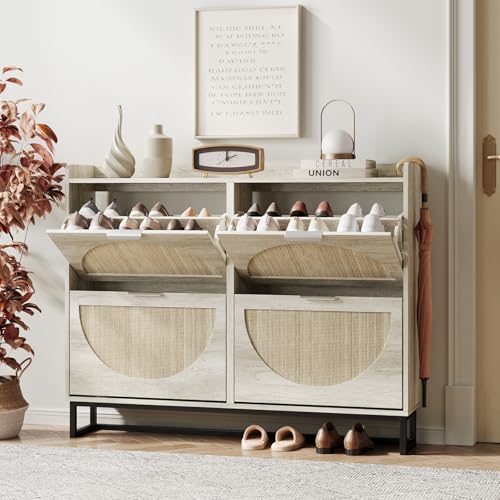
Maupvit Large Rattan Shoe Cabinet with 4 Flip Drawers, Beige
Who it suits: Families of three to five who can give the cabinet about four feet of wall and want a drawer per person.
Four flip drawers is the configuration family life asks for, and this Maupvit is the widest closed cabinet in the guide at about 47 inches across while staying only about 9.45 inches deep. The family arithmetic works like this: each drawer holds two layers of shoes, the maker’s capacity claim for the rattan line runs to roughly thirty to thirty-eight pairs, and a realistic family load — two adults’ everyday shoes plus children’s smaller pairs stacked more efficiently — lands comfortably in the mid-twenties with a drawer left breathing. Assign the top drawer to the smallest child, who can reach it standing flat-footed; put the teenager’s trainers in the extended lower space; keep one drawer, if you can spare it, as the guest-and-overflow drawer that absorbs football boots in season and sandals out of it. The woven rattan fronts on metal legs make the unit read as a sideboard, which matters when the entryway is the room guests actually see.
The family-specific cautions are real. Rattan is the most delicate front in this guide: it will not love a scooter driven into it, and a determined toddler can poke at a weave in a way they cannot poke at MDF. Flip trays also assume a rough shoe conformity — the family’s tall wellies will not live here, and pretending otherwise ends with wellies living beside the cabinet instead, which is at least a defined place. Assembly is the longest in the guide, an evening’s project for one adult or a faster one for two. Check price on Amazon; research sightings put the rattan line in the middle of this budget.
- Four double-layer flip drawers — a drawer per person for a family of four.
- Slim 9.45-inch depth keeps hallways passable at family rush hour.
- Adjustable and removable panels flex between child and adult shoes.
- Anti-tip device included — fit it the day you build it.
- Rattan fronts hide the mess behind a furniture finish.
Honest limitation: Rattan fronts are the least toddler-proof in the guide, and tall boots still need a home elsewhere.
Choose it if your family needs per-person drawers in one unit. Skip it if your children are at the furniture-climbing stage and cannot be kept off it, or boots dominate your footwear.
Tribesigns Shoe Cabinet with Doors, 7-Tier, Wood and Gold
Who it suits: Families whose footwear includes boots, wellies and big teenage sizes — and households that think in shelves, not drawers.
Where the flip cabinets ask shoes to conform, this Tribesigns simply opens two doors on seven shelves and lets family life in. The carcass is about 29.6 inches wide, 14.6 inches deep and 43.3 inches high — the deepest here by roughly five inches — built from E0-grade MDF with 0.59-inch boards, raised on gold-tone legs that keep the base out of mop water and meltwater. Shelves adjust, and a shelf can come out entirely, which is how a row of family wellies or a pair of riding boots gets a home no flip tray can offer. The maker’s capacity is stated as up to thirty pairs on the US listing and twenty-four on the Canadian one; plan on the lower figure and treat the shelves as zones — one per person, read top to bottom like the family itself.
Shelves demand a system, because a shelf has no opinion about whose shoes are whose. The families who succeed with this cabinet assign shelves by person and put the smallest person’s shelf at the bottom, where small arms reach without climbing — climbing a shelved cabinet is exactly what the anti-tip anchor exists to prevent, so fit it. The depth is the other honest cost: in a narrow hall, 14.6 inches of cabinet is furniture you walk around. Check price on Amazon for the current figure; it sat mid-budget in research sightings. If your entryway also needs a place to sit small children while shoes go on, pair this with Best Entryway Bench For Families Under $300.
- Two hinged doors over seven adjustable shelves — the boot-friendly pick.
- About 14.6 inches deep: shoes lie flat, tall footwear fits.
- Removable shelf creates a tall row for wellies and boots.
- Raised legs keep the carcass clear of wet floors.
Honest limitation: Shelves organize nothing by themselves, the footprint is the deepest here, and the maker’s pair count differs between its own listings.
Choose it if boots and big sizes rule your entryway. Skip it if your hall is narrow or your family needs drawers to keep the peace.
VASAGLE LIRY Shoe Cabinet with 3 Flip Drawers, Rustic White
Who it suits: Families with teenagers, whose shoe sizes are the ones that break slim cabinets.
Every family with a teenager knows the pair that lives permanently beside the cabinet because it fits nowhere inside it. VASAGLE addresses that pair directly: the maker rates this cabinet for shoes up to US size 14, with each drawer’s shelf adjustable between three positions so a long shoe can lie flatter in the tray. The cabinet holds a stated eighteen to twenty-four pairs across three flip drawers, measures about 9.4 inches deep, 34.3 inches wide and 48.7 inches tall, and arrives in a rustic white farmhouse finish from one of the category’s most established brands — which brings a real manual, an included anti-tip kit and support channels that exist after the sale. For a family, that backing matters more than it does for a single buyer, because family furniture gets used hard and asked questions of.
The size-14 fit is a configuration, not a default: set a drawer for the teenager’s trainers and that drawer holds fewer of everyone else’s shoes. The farmhouse finish is also a household decision — it suits a family kitchen-entry beautifully and a minimalist hall not at all. Three drawers for a family of five means sharing, so assign by category (school, sport, everyday) rather than by person if your household is larger. Check price on Amazon; research sightings placed it mid-budget.
- Maker-rated to US size 14 — the teenage-feet solution.
- Three drawers with three-position adjustable shelves.
- Established brand: proper manual, anti-tip kit, real support.
- Slim 9.4-inch depth for busy hallways.
Honest limitation: Configuring a drawer for very large shoes costs capacity, and three drawers serve a big family only with category sharing.
Choose it if large teenage sizes are your overflow problem. Skip it if you need a drawer per person for five people — that is the Maupvit above.
BORNOON Shoe Cabinet with 3 Flip Drawers, White
Who it suits: Families who want the system without the styling — flat white fronts that wipe clean and disappear against a white hall.
Family entryways are cleaned with a cloth in one hand and a child on a hip, and the BORNOON is built for that reality: three flip drawers with two compartments each, flat white engineered-wood fronts with nothing to snag a cloth, in a cabinet about 31.5 inches wide, 9.45 inches deep and 47.2 inches high. Independent coverage puts its realistic capacity at eighteen to twenty-four pairs — for a family, read that as two adults plus one or two children’s rotations, or a smaller family’s whole everyday collection. The flat fronts take a label, a name sticker or a picture for a pre-reader, which is the most effective family organization technology ever invented: a drawer with a dinosaur on it gets used by the dinosaur’s owner.
White shows the evidence. Toe scuffs, scooter marks and the grey arc of a vacuum cleaner all print clearly on flat white MDF, and the cabinet’s small-brand hardware is functional rather than refined. The flip trays share the format’s limits on tall boots. None of this stops it being the pragmatic family pick: the price sightings during research sat in the lower half of the budget — check price on Amazon — and a family that outgrows it has lost less than most. Families working with a tighter budget overall should compare Best Shoe Cabinet For Families Under $150 before stretching.
- Three flip drawers, flat fronts — wipe-clean in seconds.
- Realistic eighteen to twenty-four pair capacity.
- Fronts take name labels for young children.
- Slim depth; plain white suits rented family homes.
Honest limitation: White fronts show every scuff, and the small brand’s hardware and support are basic.
Choose it if you want a labeled drawer system at a lower tier. Skip it if your entryway is a high-scuff mudroom — a wood finish hides family life better.
Maupvit Shoe Cabinet with 3 Flip Louvered Doors, Noble Blue Gray
Who it suits: Families whose shoes work hard — school shoes, football boots, work shoes — and come home needing air, not a sealed box.
A family cabinet concentrates more daily-worn footwear per cubic foot than any other in this series, and sealed cabinets of hard-working shoes develop a smell that greets you before the children do. This Maupvit’s louvered flip fronts let air move through the doors themselves, so three double-layer drawers ventilate passively while keeping every pair hidden. The maker rates it at twenty-four to thirty-two pairs, in a cabinet about 31.5 inches wide, 9.45 inches deep and 47.24 inches high, and extends the third drawer to about 15.75 inches for larger shoes — put the teenager’s trainers in the bottom drawer and the school shoes above them, where small hands and the best airflow meet. The blue-gray finish hides scuffs better than white and looks deliberate against family hallway clutter.
Louvers pass dust as well as air, so a home on a dusty road should choose a solid front instead. Ventilation is also not magic: boots that come home soaked need a night outside any cabinet, on a tray, before they earn a drawer. And the color is specific — wonderful with white walls, less so against warm wood everywhere else. Check price on Amazon for the current figure.
- Louvered fronts ventilate school, sport and work shoes.
- Three double-layer drawers; maker-rated twenty-four to thirty-two pairs.
- Extended bottom drawer for the household’s largest shoes.
- Blue-gray finish hides family scuffs well.
Honest limitation: Louvers admit dust, and no cabinet — ventilated or not — should receive dripping-wet footwear.
Choose it if odor from daily-worn family shoes is your problem. Skip it if your entry is dusty or you need boot storage above all.
IRONCK Shoe Cabinet with 2 Flip Drawers and Rattan Doors, Oak
Who it suits: Families of two or three, or a children’s-only cabinet paired with an adult solution elsewhere.
Not every family entryway needs four drawers, and this IRONCK is the honest smaller unit: two flip drawers, each with two levels and an adjustable or removable center divider, behind hand-woven rattan fronts in an oak finish. The maker states men’s shoes up to size 11.5 fit without removing the panel — a specific claim we value — and while the headline capacity claim runs high, a realistic adult load is in the high teens of pairs, which covers a couple plus a child’s rotation, or all the children’s shoes in a house where the adults keep theirs in a bedroom closet. Used that second way, it is a genuinely good family pattern: one cabinet, at child height, that belongs entirely to the small people and their small shoes.
Two drawers is a hard ceiling: the family that grows into a third child or a dog with opinions about shoes will outgrow it. The rattan fronts, as noted with the larger Maupvit, are the least impact-resistant in the guide. Check price on Amazon — sightings during research put it in the lower-middle of the budget, the right tier for a cabinet a family may replace as it grows. For the next size up in the same spirit, Best Shoe Cabinet Under $300 compares the full range.
- Two double-layer drawers with adjustable dividers.
- Maker states up to US 11.5 fits without panel removal.
- Works as a dedicated children’s shoe cabinet.
- Warm oak and rattan finish suits family living spaces.
Honest limitation: A hard capacity ceiling for growing families, and rattan fronts dislike impacts.
Choose it if your family is small or the cabinet is for the children. Skip it if four-plus people need daily storage in one unit.
Comparison Table
| Product | Type | Best family use | Link |
|---|---|---|---|
| Maupvit Large Rattan, 4 Flip Drawers | Flip drawers, ~47 in wide, 9.45 in deep | A drawer per person, family of four | Check on Amazon |
| Tribesigns 7-Tier with Doors | Hinged doors, shelves, 14.6 in deep | Boots, wellies, big sizes | Check on Amazon |
| VASAGLE LIRY, 3 Flip Drawers | Flip drawers, size 14 rated | Teenagers with large feet | Check on Amazon |
| BORNOON, 3 Flip Drawers, White | Flip drawers, flat white fronts | Wipe-clean labeled drawers | Check on Amazon |
| Maupvit Louvered, 3 Flip Doors | Flip drawers, louvered fronts | Airing school and sports shoes | Check on Amazon |
| IRONCK Rattan, 2 Flip Drawers | Flip drawers, compact | Small families; children’s cabinet | Check on Amazon |
How to Choose a Shoe Cabinet for a Family
- Count people before pairs. The working unit of family storage is the drawer per person (or shelf per person). Count your people, then choose the cabinet whose divisions match — capacity in pairs is a secondary check, not the headline.
- Size for the largest feet in the house. The teenager’s size 12s decide whether a slim flip cabinet works at all. Look for a written maximum size, an extended drawer, or choose hinged doors and shelves where length rarely matters.
- Plan the boot answer separately. Wellies and tall boots defeat almost every flip tray. Either choose the shelved Tribesigns, or accept a boot tray beside a flip cabinet as part of the system — decided in advance, not discovered in November.
- Anchor it. No exceptions, no “later.” Fit the anti-tip kit during assembly, into a stud where possible. A child will eventually pull a top drawer open and lean; the anchor is what makes that a story instead of an accident.
- Put the youngest child’s drawer at the bottom. Reach decides use. A drawer a four-year-old can operate alone gets used; one they cannot becomes your job forever. Bottom drawers and shelves belong to small people.
- Choose fronts for your cleaning reality. Flat fronts wipe fastest; wood finishes hide scuffs best; louvers ventilate hardest-working shoes; rattan looks warmest and forgives least. Pick the trade your household actually lives.
- Leave one drawer unassigned if you can. Guests, seasonal swaps and the inexplicable extra shoes of family life need somewhere to go that is not the top of the cabinet. An overflow drawer is the difference between a system and a hope.
- Check the live price on the day you buy. This guide prints no fixed prices because furniture figures swing with sale events; the cabinet that looks mid-budget today may be the value pick on Friday. Compare the current price on Amazon for your shortlist.
A Family System That Survives the School Year
The cabinet is hardware; the system is what happens in the first two weeks. Start by assigning every drawer or shelf an owner, physically — a label, a name, a picture for a pre-reader — on the day the cabinet is built, not once the pile has formed. Set the house rule that defines the cabinet’s contents: most families do best with two pairs per person in the entryway — the daily pair and the activity pair — with everything else living in bedroom closets. A cabinet asked to hold every shoe a family owns will fail at any size in this budget; a cabinet asked to hold the rotation succeeds at three drawers.
Then build the two supporting habits. First, a boot and wet-shoe station beside the cabinet — a tray, nothing grander — so that the things the cabinet cannot take have a legitimate home that is not the floor in front of it. Second, a five-minute reset at the weekend: out-of-season pairs migrate to closets, outgrown children’s shoes leave the house entirely, and the overflow drawer is emptied back to empty. Families are not disorganized; they are high-throughput. The cabinet that works is the one whose system assumes throughput — arrivals, growth, seasons — rather than a static collection that only ever grows.
The Mudroom Test: What Family Footwear Does to a Cabinet in One Winter
Specifications are written for dry shoes in a clean room, and family life is neither. It is worth tracing what a single winter does to each format, because the cabinet that wins in November is not always the one still winning in March. The first assault is water. School shoes and work boots come home wet several times a week, and in a flip-drawer cabinet that water has nowhere honorable to go: the trays are angled, shallow and enclosed, so a genuinely wet pair either soaks its neighbors or waits on the mat. Families solve this with the tray-beside-the-cabinet pattern described above, and it works, but it means the flip cabinet’s true winter capacity is its dry capacity — the wet rotation lives outside it for a night at a time. The shelved Tribesigns handles the same week more gracefully, because a shelf takes a boot tray inside the cabinet and the doors close on the whole arrangement, at the price of one shelf’s worth of storage surrendered to drainage.
The second assault is grit. Children’s shoes import a measurable quantity of the playground, and in a flip cabinet that grit migrates to the hinge line of each tray, where it grinds quietly every time the drawer tips. By mid-winter an unmaintained flip drawer feels sandy to open; a two-minute brush-out per drawer, monthly, is the entire cure, and families who build it into the weekend reset never notice the problem. In a shelved cabinet the same grit simply falls to the shelf and the floor of the carcass, where it is visible — which is its own kind of maintenance prompt — and sweeps out in seconds. Neither format is fragile; they merely ask for their ten minutes in different places.
The third assault is growth, and it is the one no specification sheet mentions. A child’s shoe size changes roughly every few months in the early years, which means the family cabinet’s contents turn over faster than any other furniture in the house. Drawers sized perfectly in September are tight by spring, not because the cabinet shrank but because the feet did the opposite. This is the practical argument for adjustable dividers and removable shelves — the VASAGLE’s three-position shelves and the IRONCK’s removable center panel are not features for the day of purchase, they are features for the third growth spurt. When you compare cabinets, you are not really choosing for the family you have this month. You are choosing for the family eighteen months from now, whose shoes are bigger, whose sports have multiplied, and whose smallest member can suddenly reach the second drawer. Buy the adjustability, and the cabinet ages with them instead of against them.
When One Cabinet Is Not Enough: Two-Unit Family Layouts That Work
Some households will read the capacities in this guide, count their people honestly, and conclude that no single cabinet under this budget holds the family. They are often right, and the correct response is not a bigger single unit — the category thins out quickly above this tier — but a two-unit layout with divided duties. The pattern that works best in practice puts the high-turnover cabinet at the door and the deep-storage cabinet somewhere drier and calmer: a three-drawer flip cabinet in the entryway holding two pairs per person, and a shelved cabinet in a utility room, garage wall or bedroom corridor holding the season’s bench — the boots in summer, the sandals in winter, the sport-specific pairs that play once a week. Each unit does the job its format is good at, and neither is asked to be the family’s entire shoe infrastructure.
The second pattern splits by person rather than by season: a dedicated children’s cabinet at child height — the IRONCK’s two drawers are the natural candidate — placed where children actually enter, and an adult cabinet wherever the adults enter, which in many houses is a different door entirely. Families with a front door for guests and a back door for life often discover their shoe problem was really a door problem: all the footwear was migrating to the ceremonial entrance because that is where the only storage stood. One modest cabinet at the working door ends the migration more completely than a large cabinet at the formal one.
Whichever pattern you choose, keep the rules consistent across both units: the same per-person assignment, the same two-pair discipline at the main door, the same weekend reset. Two cabinets with one system behave like a single large cabinet. Two cabinets with two systems behave like two smaller piles that happen to have doors. And when you price the layout, price it as a layout — check price on Amazon for each unit on the same day, because the sale rhythm of this category means the pair is often cheaper bought together in an event week than separately across a season.
Assembly Day and the First Month: A Family Field Guide
Build the cabinet on a day when the children are elsewhere, not because the work is dangerous but because flat-pack hardware is a hundred small, shiny, swallowable invitations and the instructions require the one resource parents cannot manufacture: uninterrupted attention. Lay the panels on a rug — engineered-wood faces scratch during assembly more easily than at any later point — tighten cams by hand, and fit the anti-tip strap before the first shoe goes in, while the empty cabinet can still be tilted with one hand. If the cabinet’s home is a rented house, photograph the wall before you drill and keep the anchor hardware when you move; the hole fills in five minutes, and the photograph settles any deposit conversation about what was there before you.
The first month decides whether the system lives. Week one is novelty: everyone uses their drawer, including the adult who previously believed shoes belonged wherever they stopped moving. Week two is the test, because novelty expires precisely when the first pair of football boots comes home muddy and the first argument about drawer territory begins. Hold the two rules — two pairs per person in the cabinet, wet things on the tray — and concede everything else. By week four the behavior that remains is the behavior the cabinet will see for years, which is why the weekend reset matters most in the first month: it is not cleaning, it is training, for the whole household including the adults. Families who treat the first month as installation — of the habit, not the furniture — report the pile never returns. Families who treat delivery day as the finish line are shopping for a bigger cabinet by spring, and the bigger cabinet will fail the same way, because the constraint was never cubic inches.
Common Buying Mistakes
- Buying pair capacity instead of per-person divisions, and ending with one giant shared drawer of chaos.
- Forgetting the teenager’s shoe size until the trainers live permanently on the mat.
- Skipping the wall anchor because the cabinet “feels stable” when empty and closed.
- Giving the youngest child a top drawer they cannot reach, then wondering why their shoes live on the floor.
- Trying to store tall wellies in a flip tray and blaming the cabinet in November.
- Choosing delicate rattan fronts for a hallway that doubles as a scooter park.
- Asking one cabinet to hold every shoe the family owns, including out-of-season and outgrown pairs.
- Buying two drawers for five people because the smaller cabinet was on sale.
Final Recommendation
- Family of four: Maupvit Large Rattan Shoe Cabinet, 4 Flip Drawers.
- Boots and big sizes: Tribesigns Shoe Cabinet with Doors, 7-Tier.
- Teenage feet: VASAGLE LIRY Shoe Cabinet, 3 Flip Drawers.
- Wipe-clean simplicity: BORNOON Shoe Cabinet, 3 Flip Drawers, White.
- Hard-working shoes: Maupvit Shoe Cabinet with 3 Flip Louvered Doors.
- Small families: IRONCK Shoe Cabinet, 2 Flip Drawers, Oak.
For most families our recommendation is the four-drawer Maupvit, because a drawer per person is the only system that enforces itself at 8 a.m. on a school day, and it does so in under ten inches of hallway depth. The exception is the boot-wearing, big-footed family, for whom the Tribesigns’ doors and shelves are not a preference but a fit requirement. Everything else in the guide tunes the same decision: the VASAGLE for the teenager, the BORNOON for the label-and-wipe household, the louvered Maupvit for the sports-kit family, the IRONCK for the family still small enough to be honest about it. Assign the drawers before the cabinet arrives, anchor it the day it is built, check the current price on Amazon, and the entryway pile becomes a solved problem rather than a daily negotiation.
Frequently Asked Questions
How big a shoe cabinet does a family of four need?
Think in divisions, not pairs: four drawers, or four to five shelves, so each person has their own. In capacity terms that means a cabinet realistically holding twenty to thirty mixed pairs — two pairs per person in the entryway rotation, plus an overflow space. The four-drawer and seven-tier picks in this guide are sized for exactly that; three-drawer cabinets serve a family of four only if some shoes live in bedrooms.
Are flip drawers safe for children to use?
Yes, with the cabinet anchored. A flip drawer tips toward the user and closes with a push, and children old enough to dress themselves can operate one — put their drawer at the bottom so they are never reaching or climbing. The genuine hazard is not the drawer but the unanchored tall cabinet, which is why every pick here includes or supports an anti-tip kit and why we repeat the instruction in every review.
Where do wellies and muddy boots go?
Not in a flip tray. Tall boots need a shelved cabinet with a shelf removed — the Tribesigns pattern — or a boot tray beside the cabinet for the wettest pairs, with the cabinet holding everything else. Deciding this before you order matters more than which cabinet you choose, because the boot problem arrives with the first rain, not with the delivery.
How do we stop the family shoe cabinet smelling?
Ventilation and rotation. Louvered or rattan fronts pass air passively; shoes given an hour to air before going away smell less in any cabinet; and a two-pair rotation means no pair is worn and stored damp on consecutive days. Charcoal bags in the drawers help at the margin. What does not work is sealing a whole family’s daily shoes in an unventilated box and adding fragrance on top.
Can children reach and use a tall shoe cabinet?
The bottom half, yes — and the system should be designed so the bottom half is all they need. Young children’s drawers and shelves go at the bottom, adults take the top, and nobody climbs: climbing is both a tip risk and a sign the assignment is wrong. If a child cannot reach their drawer standing on the floor, move their shoes down, not the child up.
What about grandparents, guests and the shoe overflow at holidays?
Plan for the surge rather than improvising it. A visiting grandparent needs one accessible, low drawer — which is another reason the youngest child’s bottom drawer system should be flexible enough to lend. Holiday gatherings add six pairs in an hour; the overflow drawer’s job is exactly this, and when it is full, a boot tray by the door for guests beats a pile, because a tray reads as hospitality and a pile reads as surrender. After the visit, the reset takes five minutes precisely because every resident pair has an assigned home to return to — the system, not the cabinet size, is what absorbs guests gracefully.
How long does assembly take, and can one person do it?
One to two hours depending on drawer count, and one adult can manage every model here, though a second person speeds up squaring the carcass and fitting the anti-tip strap. Build it where it will stand if you can — a loaded, anchored cabinet is not something you want to carry through the house — and keep children out of the assembly area, because flat-pack hardware includes small parts and every loose screw will be found by a toddler first.


