Where to buy
Check the latest price, availability and delivery on Amazon. Orders are placed on Amazon. We may earn a commission from qualifying purchases.
- Best overall: TWODRAPES Natural Triple Pinch Pleat Linen Semi Sheer Curtains, 2 Panels, 40″W x 84″L — Check on Amazon
- MIULEE Pinch Pleated Linen Curtains, 2 Panels, 40″W x 90″L — Check on Amazon
- LAMIT Linen Semi Sheer Curtains, 2 Panels, 52″W x 96″L — Check on Amazon
- TWODRAPES Pinch Pleated Linen Curtains, 2 Panels, 40″W x 108″L — Check on Amazon
Two further picks in this guide — the Vision Home pinch pleat semi sheer pair and the made-to-measure TWOPAGES Flynn sheer — are covered in prose only, with no Amazon link, because we could not pin their exact listings to the two-source standard this site requires before linking. The reviews below explain what we could verify about each and where to look for them.
Read the full guide ↓
Disclosure: As an Amazon Associate, dailyhomedecorating.com earns from qualifying purchases. Links to Amazon on this page are affiliate links; they cost you nothing extra. Listing details such as price and availability change often, so check the current Amazon listing before you buy.
Here is the honest headline of this tier, before any product names: on Amazon, sheer curtains top out far below $200. We went looking for the designer end of this market — European linen, tailored pinch pleats, made-to-measure panels — and priced every verifiable offer we could pin down. The ready-made sheer pairs we could verify at the standard 84-inch length sit in the lower part of this budget — check price on Amazon for the current figure on each. Stretch to a 108-inch drop and the verified pairs sit higher in the tier. Go extra-wide and pinch-pleated semi-sheer pairs sit higher still within this budget. Even the best-known made-to-measure sheer sold direct by its maker sits in the middle of this budget for a tailored two-panel window before add-ons. True designer linen — a 100% Belgian linen pinch-pleat panel from a designer’s own store — is positioned well above this budget for a single panel, but it is not sold on Amazon at all, and no verifiable Amazon offer comes anywhere near that position.
So treat $200 as an allocation budget, not a product price. Spent well, it buys the best ready-made sheer pair in this guide, a separate privacy liner for the hours when sheers cannot protect you, and the rod and hardware that no curtain in this guide includes — with money left over. Spent naively, it buys the same basic pair of panels at a markup, because at the top of the Amazon sheer market the extra money mostly buys width, length and pleating, not a different class of fabric. Every pick in this guide is tied to a stated size, and our reference size throughout is a pair of two panels, each 52 inches wide by 84 inches long. Where a pick is sold as a single panel, or in narrower or longer panels than the reference, we say so in plain language and spell out the per-window implication, because panel-versus-pair sizing is the oldest trick in this category.
One more truth belongs up front, because it shapes every recommendation below: a sheer curtain gives you no privacy at night. None of them do, at any price. In daylight, a dense semi-sheer weave blurs shapes and softens a room; after dark, with your lights on, anyone outside can see in — silhouettes, movement, the outline of furniture. Doubling your budget does not change the physics. If nighttime privacy matters in the room you are dressing, the correct purchase is a sheer for the day plus a liner or a second, opaque layer for the night, and this guide budgets for exactly that. Below you will find the quick picks, how they were chosen, detailed reviews of all six, a comparison table, a measuring and choosing checklist, the mistakes that waste money in this category, and answers to the questions sheer shoppers ask most.
Quick Picks
Short on time, or comparing several options at once? Each row below names a buyer type and the product that suits it. For linked picks, check price on Amazon for the size named in the row.
| Buyer type | Pick | Why it stands out | Link |
|---|---|---|---|
| Best overall | TWODRAPES Natural Triple Pinch Pleat Linen Semi Sheer Curtains, 2 Panels, 40″W x 84″L — check price on Amazon | Triple pinch pleats and a heavy 380 GSM maker-rated weave at the standard length, with hooks and rings in the box | Check on Amazon |
| Best value pinch pleat | MIULEE Pinch Pleated Linen Curtains, 2 Panels, 40″W x 90″L — check price on Amazon | The tailored pleated look in a longer 90-inch drop | Check on Amazon |
| Best full-width classic pair | LAMIT Linen Semi Sheer Curtains, 2 Panels, 52″W x 96″L — check price on Amazon | True 52-inch-wide panels — the fullest coverage here — with rod pocket and back tab hanging options | Check on Amazon |
| Best for tall windows | TWODRAPES Pinch Pleated Linen Curtains, 2 Panels, 40″W x 108″L — check price on Amazon | A 108-inch drop for high ceilings, at the top end of the standard ready-made range here | Check on Amazon |
| Best daytime privacy | Vision Home Pinch Pleated Semi Sheer Curtains, 2 Panels, 42″W x 84″L — middle of this budget tier in White | The densest verified weave of the group, from a spec sheet that actually states its fiber blend | Prose only — see review |
| Best made-to-measure route | TWOPAGES Flynn Airy Sheer Curtain, custom panel — custom entry tier per panel | Cut to your exact width and length with your choice of pleat style, from the maker’s own store | Prose only — see review |
How These Picks Were Chosen
The first filter was verifiability. Every linked product in this guide is a real Amazon listing whose ASIN we pinned from two independent sources — trackers reading Amazon’s own data, the maker’s own pages, retailer listings of the same product, or registry and editorial sources — before a link was allowed. Two genuinely good products failed that test for their exact size and color: the Vision Home semi sheer pair and the custom TWOPAGES Flynn. Rather than drop them, we review them in prose, describe only the positioning that two sources agree on, and say openly why there is no link. Anything we could not verify at all — and this category is full of handsome listings with no traceable listing history — was left out entirely.
The second filter was the size discipline described above. Sheer pricing is a shell game of panel widths: a “pair” can mean two 52-inch panels, two 40-inch pinch-pleat panels, or two panels whose width is measured flat before pleating, so the finished, gathered width is far less. We standardized on the two-panel, 52-by-84-inch pair as the reference, then admitted picks in other sizes only when the size is printed in the product’s row everywhere it appears and the per-window implication is stated. Four of the six picks are pinch-pleat pairs with 40- or 42-inch panels; that is not an accident, because at this budget the tailored pleated header is what the step up from a basic voile actually buys — but it means fullness math matters, and the buying guide below does it for you.
The third filter was fiber honesty. “Linen” in a curtain title can mean 100% flax, a 20% linen blend, or a polyester fabric with a linen-look weave and no flax in it at all. We read specification fields and maker material lines, not titles. Where a maker publishes a blend — LAMIT’s 20% linen and 80% polyester, Vision Home’s 90% recycled polyester and 10% linen — we print it. Where a maker publishes only a weight and a fiber family, as TWODRAPES and MIULEE do with their 380 GSM linen-blend fabrics, we say exactly that and do not invent percentages. Finally, a note on light claims: there is no shared measurement standard for how much light a sheer filters, so the percentages in curtain marketing are just that — marketing. We describe density in terms of weave weight and what you can expect in a room, and we do not repeat percentage figures as if they were test results.
The 6 Best Sheer Curtains Under $200
TWODRAPES Natural Triple Pinch Pleat Linen Semi Sheer Curtains, 2 Panels, 40″W x 84″L
Who it suits: Anyone who wants the tailored, hotel-drapery look at a standard window — formal living rooms, dining rooms, and primary bedrooms where a flat voile panel reads as unfinished.
This is the most expensive ready-made sheer pair we could verify at the standard 84-inch length, and what the money buys is construction. The header is a true triple pinch pleat — three folds pinched and sewn at each pleat point — which is the pleat style custom workrooms charge the most to produce, and the fabric is the maker’s heavy linen-blend weave, which TWODRAPES markets at 380 grams per square meter across this range. For scale, a basic voile sheer is a fraction of that weight; a 380 GSM semi-sheer hangs in defined folds, keeps its pleats, and blurs a daytime view through the window far better than a gauzy panel does. The maker describes the blend as flax linen, cotton and polyester; the exact percentages do not appear in the specification data we could verify, so we will not guess at them — what is verifiable is the weight, the pleating, and the hardware: unusually for this category, the box includes adjustable hooks and rings, sixteen of each by the maker’s listing text, so the panels can hang from a rod’s rings or a track the day they arrive. The pleats are also memory-trained — heat-set at the factory, per the maker’s description — so the folds arrive shaped rather than needing weeks of tying and training.
Now the size honesty, because it decides whether this pick fits your window. Each panel is 40 inches wide measured flat, and a pinch-pleated panel’s finished, gathered width is meaningfully less than its flat width. A pair gives you 80 flat inches, which dresses a window up to roughly 48 inches wide with modest fullness; on a 60-inch or wider window the pair will look stretched and thin, and the honest fix is two pairs — still a straightforward way to stay inside this budget; check the current price on Amazon before you order — and worth knowing before you order one pair and judge the look unfairly. Care, in the maker’s own words from its listing information: machine wash in cold water, tumble dry on low, and iron on the lowest setting if needed — gentler handling than most pleated drapery allows, though we would still remove the hooks and rings first and wash the panels inside a mesh bag to protect the pleat stitching.
On privacy, be clear-eyed: this is the densest weave in the guide alongside the Vision Home below, so daytime privacy is as good as a sheer gets — shapes blur, details disappear. At night, with lamps on inside, it is as transparent as every other sheer ever made. Budget for a liner if the room faces a street or a neighbor.
- True triple pinch pleat header — the most tailored construction available ready-made on Amazon.
- Heavy maker-rated 380 GSM linen-blend weave; memory-trained pleats that arrive pre-shaped.
- Hooks and rings included in the box; the rod itself is not.
Honest limitation: The panels are 40 inches wide, not the 52-inch reference width, so wide windows need two pairs; and the maker’s fiber percentages are not published in the spec data, only the blend family and weight.
Choose it if you want the closest thing to custom drapery that Amazon sells ready-made. Skip it if your window is wide and you do not want to buy two pairs — the LAMIT below covers more width in a single pair.

MIULEE Pinch Pleated Linen Curtains, 2 Panels, 40″W x 90″L, Natural
Who it suits: Buyers who want the pinch-pleat look on a longer drop — nine-foot ceilings, windows where an 84-inch panel ends awkwardly above the floor, or anyone who likes a slight puddle.
MIULEE’s pinch-pleat pair sits below the TWODRAPES above within this budget tier — check price on Amazon to compare them — while keeping most of what makes that pick appealing. The fabric is the maker’s 380 GSM blend of linen, cotton and polyester — the listing text for this line describes it in exactly those terms — with memory-trained pleats and a choice of hanging by the back tab or by the included hooks on rings you supply. At 8.42 pounds for the pair, this is a substantial curtain, not a floaty voile, and the weight is what makes the pleats hang in clean vertical lines instead of billowing. The verified offer is the 90-inch length, six inches longer than this guide’s reference size; on a standard eight-foot ceiling with the rod mounted high, that extra length is the difference between a panel that kisses the floor and one that hovers — but measure before you celebrate, because on a low ceiling it means hemming or a deliberate puddle.
The width caveat from the TWODRAPES review applies identically: these are 40-inch panels, so a pair covers a standard window with modest fullness and a wide window thinly. MIULEE itself sells the same curtain as a four-panel set — check price on Amazon for that configuration — which is the configuration to choose for a wide living-room window — and note what that tells you about this whole tier: doubling the most tailored ready-made sheer in the guide still sits comfortably inside a $200 allocation. On care, follow the sewn-in label; the fabric is a natural-fiber blend with heat-set pleats, so treat heat as the enemy — a hot dryer is how memory-trained pleats relax and how linen blends shrink unevenly. The maker’s care line on the listing is the authority, and it is worth a look before the first wash rather than after.
Privacy performance matches the TWODRAPES: genuinely good in daylight for a sheer, thanks to the dense weave; nonexistent at night. If this pair is headed for a bedroom, pair it in your budget with a liner or plan a blackout layer behind it — the pinch-pleat header hangs happily on a double rod made for exactly that layering.
- Pinch pleats and a 380 GSM linen, cotton and polyester blend, positioned as an accessible entry among the pleated picks — check price on Amazon.
- 90-inch drop suits tall windows and high-mounted rods where 84 inches falls short.
- Back tab or hook hanging; a four-panel set covers wide windows — check price on Amazon.
Honest limitation: The verified listing is for the 90-inch length, not the 84-inch reference length, and the panels are 40 inches wide; the maker does not publish the blend’s exact percentages.
Choose it if you want the tailored look and your windows can use the extra length. Skip it if you need an exact 84-inch drop with no hemming — that is the TWODRAPES above.
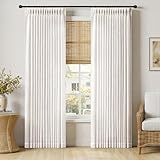
LAMIT Linen Semi Sheer Curtains, 2 Panels, 52″W x 96″L, Cream
Who it suits: Anyone dressing a standard or wide window who values coverage and a soft, flat hang over pleats — farmhouse, boho and relaxed living rooms, and renters who hang curtains on a plain rod.
LAMIT is the only pick in this guide that gives you the full reference width: each panel is a true 52 inches, so the pair puts 104 flat inches across your window, which is what proper two-times fullness on a standard window actually requires. No pleats are sewn in; the header is a rod pocket with back tabs, so you can slide the panel straight onto a rod for a gathered, casual look or use the tabs for cleaner folds — and because there is no pleat structure to protect, this is also the easiest pick here to live with. The fabric is where LAMIT earns an honesty point most brands dodge: its specification states the blend outright — 20% linen, 80% polyester. That is a linen-look fabric with a minority of real flax in it, and you should buy it with eyes open: the polyester majority is why it wrinkles less and washes easily — check price on Amazon for the current figure — while the linen fifth is what gives the weave its slubbed, natural texture. The verified offer is the 96-inch length, a foot longer than the reference drop; the same line is sold at 84 inches, but we could not pin that size’s current Amazon price from two sources, so the link goes to the size we verified, and the extra length is yours to hem, puddle or hang high.
The maker sells these as machine washable, and the listing copy describes straightforward care; as always, the sewn-in label governs, and a cold, gentle wash is the right default for a linen blend. In the room, the weave is a classic semi-sheer: it takes the glare off a bright window, keeps daytime shapes soft, and — repeat it with us — provides no privacy after dark. What it does better than the pleated picks is disappear: no header hardware, no pleat shadows, just a flat wash of filtered light, which is exactly what layered window treatments want from their sheer layer. If you plan to hang a heavier drape over the top for the night hours, this is the under-layer we would buy.
- True 52-inch-wide panels: the fullest, most forgiving coverage in the guide.
- Published fiber spec — 20% linen, 80% polyester — instead of a vague “linen” title.
- Rod pocket and back tab header: hangs on any plain rod with no extra hardware.
Honest limitation: The verified listing is for the 96-inch length, and with only a fifth of the fabric being linen, buyers chasing a natural-fiber curtain should know they are mostly buying polyester.
Choose it if you want maximum width, minimum fuss, and a sheer that layers well. Skip it if the tailored pleat is the whole point — that is what the two picks above exist for.

TWODRAPES Pinch Pleated Linen Curtains, 2 Panels, 40″W x 108″L, Natural
Who it suits: Rooms with nine- to ten-foot ceilings, floor-to-ceiling glass, and sliding patio doors — anywhere an 84- or 90-inch panel ends in mid-air.
We include a second TWODRAPES pair in a $200 guide for a specific reason: it marks the top end of the standard ready-made market in this guide. This 108-inch pair sits at the top of that ready-made range — check the current price on Amazon — and the reason for its position is not a better fabric or a designer label. It is length. The construction is the same maker’s pinch-pleated linen-blend range as our best-overall pick, in the double-pleat version of the header, with back tab hanging and hooks and rings included per the maker’s listing text; the same ASIN is sold through Amazon’s UK storefront as a semi-sheer, light-filtering curtain, which is where its opacity class is stated in plain spec language. Nine feet of pleated, memory-trained fabric per panel is simply more curtain than the 84-inch version, and its position in the tier rises with that extra drop. That pattern — position rising mainly with extra feet of drop, across the whole ready-made market — is the single most useful sizing fact in this guide, because it tells you the top of this market is a fabric-by-the-yard calculation, not a luxury ladder.
Everything else about the pair matches the family: 40-inch panels, so width math is unchanged; a dense semi-sheer weave that behaves well in daylight; and no nighttime privacy whatsoever. Care follows the maker’s published guidance for the range — machine wash cold, tumble dry low, lowest iron setting if needed — with the practical note that a 108-inch panel is a lot of wet fabric, so wash one panel per load and rehang it damp to let its own weight pull the pleats straight. If your ceilings are standard height, this pick is not a premium upgrade for you; it is simply the wrong size, and the honest move is the 84-inch pair instead. If your windows are genuinely tall, it is the opposite: this is the pick that saves you from the made-to-measure quote, sitting well below the custom route per window.
- A true 108-inch drop, ready-made — the size most sheer lines simply do not sell.
- Same maker’s pinch-pleat construction and included hooks and rings as the 84-inch pick.
- Sits at the top end of the standard ready-made sheer range we found — check price on Amazon.
Honest limitation: On a standard ceiling this length pools on the floor whether you want it to or not, and the panels remain 40 inches wide — tall and wide windows together still mean two pairs.
Choose it if your windows are tall enough that standard drops fail. Skip it if you are shopping for standard ceilings and mistaking the higher price for higher quality — it is the same curtain, longer.

Vision Home Pinch Pleated Semi Sheer Curtains, 2 Panels, 42″W x 84″L
Who it suits: Privacy-conscious buyers dressing street-facing living rooms and bedrooms, who want the densest daytime blur a sheer can offer and a spec sheet that says what the fabric actually is.
Vision Home earns its place on evidence, and it is also this guide’s demonstration of why some products appear without a link. The curtain itself is compelling: a pinch-pleated semi-sheer pair whose Amazon listing text states its fiber content outright — 90% recycled polyester and 10% linen — with seven pinch pleats per panel and hooks included in the package, rings not included. That recycled-polyester-heavy blend, woven densely, is the privacy specialist of the group: of all the picks here, this is the one whose daytime screening is strongest, the one where a passerby gets the least information. The pair is sold at the reference 84-inch length with panels listed at 42 inches wide — though we flag one discrepancy honestly: the maker’s own text for this curtain family measures its panels at 40 inches, so treat the true width as 40 to 42 inches and plan fullness on the cautious figure.
On positioning, two independent editorial sources place the White colorway of this pair in the middle of this budget tier, and we describe it on their agreement. The Natural colorway has been seen positioned lower, in registry listings, but a single source family is not enough for us to be more specific. And the link is absent for the mirror-image reason: we could not pin this exact size and color’s Amazon ASIN from two independent sources, and this site does not attach affiliate links it cannot verify. Search the product name exactly as written above and you will find the listing; check that the size reads 42″W x 84″L, 2 panels, before you buy, because this maker’s blackout and lined curtains wear very similar names and sit in a higher tier.
The limitations are the family traits: pleated panels of about 40 inches gather down to less, so wide windows need two pairs; hooks are included but the rings and rod are on you; and the privacy crown is a daytime crown only. After dark this is a sheer, and sheers do not do privacy at night at any density or any price. Within those limits, if your window stares straight at a sidewalk, this is the pair we would start with.
- Densest verified weave of the six picks — the strongest daytime privacy here.
- Fiber content stated in the listing: 90% recycled polyester, 10% linen.
- Seven pinch pleats per panel, hooks included; positioned in the middle of this budget tier in White, based on two sources.
Honest limitation: No Amazon link, because the exact listing’s ASIN could not be pinned to our two-source standard; the maker’s width figures also disagree with each other (40 vs 42 inches) across its own pages.
Choose it if daytime privacy is your top priority and you are willing to find the listing by name. Skip it if you want one-click certainty — the TWODRAPES triple pleat is the linked alternative with similar density.
TWOPAGES Flynn Airy Sheer Curtain, Custom Panel
Who it suits: Owners of odd-sized windows — very wide, very tall, arched or angled — and anyone who has priced a workroom and wants made-to-measure without the workroom quote.
Every other pick in this guide is a rectangle the factory chose. This one is cut to the measurements you type in. TWOPAGES is the best-known direct-to-consumer custom curtain maker selling to US buyers, and its Flynn is the sheer of the range: a 90 GSM fabric — genuinely light, a true voile-class sheer rather than a dense semi-sheer — specified by the maker as 100% polyester. Note what that means against the title language of this category: the custom route at this price does not buy you natural fiber. It buys you fit and finish — your exact width and drop, and a choice of eight header styles on the maker’s header menu, including double and triple pinch pleat, tailor and French pleats, with hooks supplied and rods and rings sold separately. The maker positions a Flynn panel at the entry end of its custom range, a positioning an independent review of the brand confirms, before the add-ons that the maker’s own pricing approach applies for width, length, header style and any liner. A standard two-panel window therefore sits higher in this budget and climbs with size; ready-configured Flynn pairs sold through Target’s marketplace sit across the middle of this budget depending on size, which brackets the same reality from a second direction.
Two honest warnings define this pick. First, made-to-measure means made for you and nobody else: the maker’s policy, confirmed by the same independent review, is that custom panels are non-returnable if they match the measurements you supplied, so a measuring error is yours to keep. Order the maker’s swatches first, measure twice, and be conservative — a panel a half-inch too long can be hemmed, but a panel too short is a lesson. Second, at 90 GSM this is the most transparent fabric in the guide: glorious for a north-facing room that needs every lumen, the weakest for daytime privacy, and — like everything here — wholly without privacy at night. What the custom premium genuinely buys is the end of compromise sizes: no hemming a 96 down to 91, no gap at the side of a 118-inch window wall. Set against the designer-retail alternative — a 100% Belgian linen designer panel sold only through the designer’s own store and positioned well above this budget for one panel — a Flynn pair in the middle of this budget is the rational version of the splurge, and it still leaves this budget with change.
- Made to your exact width and length, with eight pleat and header styles to choose from.
- Maker-specified fabric: 90 GSM, 100% polyester — a true lightweight sheer.
- Custom entry tier per panel before size, header and liner add-ons; hooks included, rod and rings not.
Honest limitation: Custom panels are non-returnable when made to your measurements, the per-panel pricing climbs quickly with add-ons, and the fabric is the most transparent in this guide.
Choose it if your window fits nothing ready-made, or you want a specific pleat style at an exact size. Skip it if your windows are standard sizes — the ready-made picks above deliver the same look from a lower tier position, with returns allowed.
Comparison Table
| Product | Size | Price | Header | Fabric (verified) | Link |
|---|---|---|---|---|---|
| TWODRAPES Triple Pinch Pleat Semi Sheer | 2 panels, 40″W x 84″L | Check price on Amazon | Triple pinch pleat | Linen/cotton/polyester blend, maker-rated 380 GSM | Check on Amazon |
| MIULEE Pinch Pleated Linen | 2 panels, 40″W x 90″L | Check price on Amazon | Pinch pleat, back tab | Linen/cotton/polyester blend, maker-rated 380 GSM | Check on Amazon |
| LAMIT Linen Semi Sheer | 2 panels, 52″W x 96″L | Check price on Amazon | Rod pocket, back tab | 20% linen, 80% polyester (maker spec) | Check on Amazon |
| TWODRAPES Pinch Pleated, 108″ | 2 panels, 40″W x 108″L | Check price on Amazon | Pinch pleat, back tab | Linen-blend range, semi-sheer per spec | Check on Amazon |
| Vision Home Pinch Pleated Semi Sheer | 2 panels, 42″W x 84″L | Middle of this budget tier (White) — see review | Pinch pleat, hooks included | 90% recycled polyester, 10% linen (maker spec) | Prose only |
| TWOPAGES Flynn Custom Sheer | Per panel, made to measure | Custom entry tier per panel — see review | 8 header styles, incl. pinch pleat | 100% polyester, 90 GSM (maker spec) | Prose only |
How to Choose Sheer Curtains at This Budget
Start with the window, not the product. Measure the width of the area you want covered — rod length, not glass — and the drop from rod to where the panel should end. Sheers look right at one-and-a-half to two times fullness, meaning the flat fabric width should total at least 1.5 times the rod width. That arithmetic is why panel width dominates every decision in this guide: a pair of 52-inch LAMIT panels gives you 104 flat inches and dresses a rod up to about 60 inches handsomely, while a pair of 40-inch pinch-pleat panels gives you 80 flat inches that gather down further once pleated — lovely on a 36- to 48-inch window, stretched on anything wider. When in doubt, buy the second pair; in this category it costs less than returning the first.
Choose the header for the look, and price the hardware honestly. Pinch pleats give the tailored, evenly-spaced folds of a dressed window and hang from hooks on rings or a track; rod pockets and back tabs give a softer, gathered look on a plain rod. No pick in this guide includes the rod, and only the TWODRAPES pairs include rings — everyone else includes hooks at most. If you are starting from bare walls, the rod, brackets, rings and finials are a real second purchase, and a sensible share of a $200 budget: the curtain is not the whole window.
Read the fiber line, never the title. In this guide alone, “linen” curtains turned out to be a 20% linen blend, a 10% linen blend, two blends whose makers publish weight but not percentages, and a 100% polyester custom sheer. None of that makes any of them bad — polyester is why several of these wash well and cost what they cost — but pay for the fabric that is actually in the spec field. The related trap is light-filtering percentages: there is no shared standard behind them, so treat any percentage on a listing as decoration and judge density by weave weight and by whether the maker calls the curtain sheer or semi-sheer.
Plan the night layer before you buy the day layer. Decide now how the room will be private after dark: a separate liner panel behind the sheer on a double rod, a blackout drape layered over it, or blinds that already exist. If a liner is in the plan, it belongs in this budget from the start — that, plus hardware, is precisely where the difference between the best pair here and your $200 ceiling should go. Shoppers who skip this step end up buying the sheer twice: once for looks, once again in a heavier fabric when the first evening’s silhouette show disappoints.
Match the care to your life. Pleated, memory-trained panels reward gentle handling — the TWODRAPES maker’s own care text allows a cold machine wash and low tumble dry, which is about as easy as pleated drapery gets — while flat rod-pocket panels like the LAMIT are the low-maintenance choice. Custom panels add a further consideration: they cannot be returned, so their care instructions are a commitment, not a suggestion.
Common Buying Mistakes
Comparing a panel price to a pair price. Custom and wide-panel sheers are often sold per panel. A single panel is only part of a window before add-ons; an extra-wide single panel — a configuration trackers show for the widest ready-made sheers — is likewise only part of a window. Always convert to the full window before comparing anything.
Trusting the flat width of a pleated panel. A pinch-pleat panel’s width is measured flat. Once pleated and gathered on the rod, it covers far less — buyers of pleated pairs regularly report a panel covering barely half what they expected. Do the fullness math in the section above, and size up.
Believing “linen” and light percentages. Both are marketing until a spec field backs them. One widely sold “luxe linen” custom sheer from a direct-to-consumer workroom turns out, in its own fabric description, to be 5% linen and 95% polyester — a perfectly decent sheer wearing a very expensive adjective. Read the fiber line; ignore the adjective.
Expecting privacy after dark. The most expensive sheer in the world is transparent from outside when the lights are on inside. If a listing implies otherwise, the listing is the problem, not your expectations — buy the liner.
Forgetting the rod. Curtains are sold as fabric. Rods, brackets, rings and tracks are separate, always, and at this tier they are a planned part of the budget — not a surprise at checkout.
Measuring once for custom. A made-to-measure panel that matches your (wrong) measurements is non-returnable at the best-known custom maker. Swatches first, two measurements, and a second pair of eyes are the cheapest insurance in this guide.
Final Recommendation
For most windows, buy the TWODRAPES triple pinch pleat pair — check price on Amazon — and stop shopping for fabric. It is the most tailored ready-made sheer we could verify, its dense weave gives the best daytime screening a sheer can offer, and its maker publishes care instructions you can actually follow. Then spend the rest of the budget the way this tier demands: on the privacy liner the sheer cannot replace, and on a rod and rings that do the pleats justice. That complete window — sheer, liner, hardware — is what $200 is really for, and it will look and behave better than any single $200 curtain purchase this market can offer you, because the market, verified offer by verified offer, simply does not sell one.
Choose the MIULEE pair if your windows want the 90-inch drop, the LAMIT if width and easy care matter more than pleats, and the 108-inch TWODRAPES if your ceilings are tall. Look up the Vision Home by name if daytime privacy outranks convenience, and go custom with the Flynn only when your window’s size leaves ready-made no honest answer. Whichever you choose, keep the discipline this guide used: size first, fiber from the spec field, full-window thinking — and no illusions about the night.
FAQ
Do sheer curtains give you privacy at night?
No. This is the most important fact in the category. In daylight, a dense semi-sheer blurs shapes and blocks detail; at night, with lights on inside, sheers are effectively transparent from outside — silhouettes and movement are clearly visible. No price, density or brand changes this. For nighttime privacy you need a second layer: a liner, a heavier drape, or blinds.
Why does nothing here actually cost $200?
Because the verified Amazon market sits well below that ceiling: a standard-length pleated pair sits in the lower part of this budget — check price on Amazon — a 108-inch drop sits higher, extra-wide pairs and four-panel sets sit higher still, and a made-to-measure pair from the best-known custom maker sits in the middle to upper part of this budget. Designer linen above that level exists — a 100% Belgian linen panel positioned well above this budget — but it is sold per panel through designers’ own stores, not in verifiable Amazon offers. At this budget, the smart spend is the best sheer plus liner plus hardware.
What size sheer should I buy for a standard window?
Start from the rod: total flat panel width of at least 1.5 times the rod width, and a drop that ends at the sill, just below it, or at the floor. The reference pair in this guide — two 52-by-84-inch panels — suits a rod up to about 60 inches on a standard ceiling. Pinch-pleat pairs are narrower (40 to 42 inches per panel), so they suit windows up to about 48 inches, or need doubling.
Are linen sheers really linen?
Usually only partly. Verified spec fields in this guide alone show blends of 20% linen and 80% polyester, and 90% recycled polyester with 10% linen, alongside blends whose makers publish fabric weight rather than percentages. A linen-look polyester can still be a good curtain — it washes well and resists wrinkles — but read the material specification before paying a natural-fiber price.
What does a light-filtering percentage mean?
Less than it appears to. There is no common measurement standard for sheer light filtering, so percentages on listings are marketing figures produced by each seller’s own method, and they cannot be compared across brands. Judge by fabric weight and weave: a heavy semi-sheer around 380 GSM dims and blurs far more than a 90 GSM voile, whatever either listing claims.
Can I wash pinch pleat sheers?
Follow the maker’s care text for your exact curtain. The TWODRAPES range, for example, is sold with instructions to machine wash in cold water, tumble dry on low, and iron on the lowest setting if needed — remove hooks and rings first. Memory-trained pleats and linen blends both dislike heat, so when a label is silent, cold and gentle is the safe default, and rehanging panels slightly damp lets their weight restore the folds.
Should I buy one wide panel or a pair?
A pair, in almost every case. Pairs part in the middle, frame the window symmetrically, and are usually the more straightforward route per inch of width than the extra-wide single panels sold for specialty hangs — two of those can quietly push a “sheer under $200” search toward the top of this budget. Singles make sense for one-way sliding doors and asymmetric layouts, chosen with your eyes open.