Where to buy
Check the latest price, availability and delivery on Amazon. Orders are placed on Amazon. We may earn a commission from qualifying purchases.
- Best overall for small apartments: Shintenchi 79-Inch Convertible Sectional — Check on Amazon
- Best apartment classic: HONBAY Linen L-Shaped Sectional — Check on Amazon
- Best sleeper for studio guests: Yaheetech L-Shaped Sleeper Sectional with USB — Check on Amazon
- Best budget apartment pick: Best Choice Products 3-Seat Sectional — Check on Amazon
See 2 more options
- Best storage sleeper for apartments: HONBAY Modular Sleeper Sectional — Check on Amazon
- Premium direct-sale apartment pick: Burrow Nomad Sectional — sold direct by the maker, see the detailed review below
Read the full guide ↓
Disclosure: As an Amazon Associate, dailyhomedecorating.com earns from qualifying purchases. Links to Amazon on this page are affiliate links; they cost you nothing extra. Listing details such as price and availability change often, so check the current Amazon listing before you buy.
Shopping for the best sectional sofa for small apartments under $1500 means fighting for inches and functions at the same time. In an apartment, the sectional is never just a sofa: it is the seating, the guest bed, the storage unit and usually the room divider, all inside a footprint that still has to leave room to walk, work and breathe. The good news is that this budget is generous for apartment scale — the best apartment sectionals cluster well under the ceiling, so the money can go to the features that matter in small homes: reversible chaises that fit either corner, pull-out beds for guests, storage inside the seats, and designs that arrive in boxes an elevator can actually carry.
Apartment buying has its own physics, and this guide respects it. Overall width is only the first measurement; the decisive ones are the largest single piece versus your door and hallway, the chaise depth versus your walking path, and the back height versus your windowsills, because apartment light is precious and a tall sofa back can steal a third of it. Every pick below is 79 to about 81 inches wide or modular enough to arrive in apartment-friendly pieces, and each review states plainly what the design gives up to earn its footprint — because in a small home, an honest trade-off beats a feature list.
Renters get specific attention here. Reversible and modular layouts lead the list because your next apartment’s corner is unknowable; flat-pack and box-friendly designs lead because walk-ups and small elevators are real; and nothing in this guide requires wall mounting, floor fixing or anything a landlord could object to. Check price on Amazon for your chosen colorway, and check the delivery options twice — in apartment buildings, the difference between doorstep and in-room delivery is the difference between a good day and a memorable one.
In this guide
Quick Picks
| Pick | Best for | Key facts | Price |
|---|---|---|---|
| Shintenchi 79-Inch Convertible Sectional | Best overall for small apartments | 79 in wide, 3 seats, reversible chaise, dark grey | Check price on Amazon |
| HONBAY Linen L-Shaped Sectional | Best apartment classic | Compact L for small spaces, reversible chaise, dark beige | Check price on Amazon |
| Yaheetech L-Shaped Sleeper Sectional with USB | Best sleeper for studio guests | 80.5 in wide, pull-out bed, storage chaise, USB ports | Check price on Amazon |
| Best Choice Products 3-Seat Sectional | Best budget apartment pick | 78 in, reversible ottoman bench, 680 lb capacity | Check price on Amazon |
| HONBAY Modular Sleeper Sectional | Best storage sleeper for apartments | Modular L, pull-out bed, storage seat bases | Check price on Amazon |
| Burrow Nomad Sectional | Premium direct-sale apartment pick | Modular, boxes fit elevators, tool-free assembly | Direct from maker |
How These Picks Were Chosen
Apartment picks had to pass the small-home tests first. Footprint: every fixed-frame pick is around 78 to 81 inches wide, sized for the 10-to-12-foot walls typical of apartment living rooms. Access: each design is flat-packed, modular or compact enough for standard doors, stairs and elevators — no one-piece giants. Flexibility: reversible chaises and modular layouts were favored heavily, because renters move and corners change. Function density: in small homes every piece must multitask, so sleepers and storage earned their places over purely decorative virtues.
The same verification rules as the rest of this series apply underneath: genuine L-shaped or modular sectionals only, specifications from the maker’s Amazon listing or manual, dated price sightings in the sources file confirming each linked pick under the $1500 ceiling, and no printed star ratings or review counts — figures that change too fast to help a decision this size.
We also ranked for apartment light and sound, the unglamorous realities of small-home life. Low backs preserve window light. Fabrics were chosen in mid and dark tones that forgive the dust small spaces generate faster. And assembly was treated as part of the product: a sectional you can build alone in an evening, in the room, without a corridor full of packaging, is a genuinely better apartment product than the same sofa shipped as a freight event.
The 6 Best Sectional Sofas for Small Apartments Under $1500
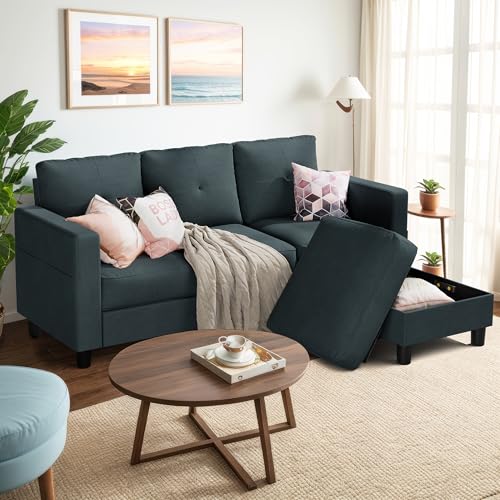
Shintenchi 79-Inch Convertible Sectional — Best overall for small apartments
Who it suits. apartment dwellers who want a true sectional — corner seat, chaise, the whole gesture — inside a footprint that respects a small living room. It is the balanced default for a one-bedroom or a generous studio.
Size, build and comfort. 79 in wide 3-seat L-shape; reversible chaise; linen-look dark grey upholstery; compact depth made for apartments and small rooms as listed; removable back cushions; assembly required. Seventy-nine inches is the apartment sweet spot: long enough for two people to sit and one to stretch on the chaise, short enough to leave the room a room. The reversible chaise is the renter’s insurance policy — whichever corner this apartment offers, and whichever the next one does, the L can match. The low profile keeps the back below most windowsills, so the sofa does not tax the light, and the dark grey linen-look fabric hides the accelerated dust-and-lint cycle of small-space living.
In daily use. Day to day it works as the apartment’s everything seat: work from the upright end, film night from the chaise, a friend perched on the corner. It assembles from apartment-friendly boxes and can be carried out again the same way — a sentence that matters more with every lease you sign.
Pros
- True L-shaped lounge in a 79-inch footprint
- Reversible chaise fits this apartment and the next
- Low back preserves precious window light
- Dark grey fabric forgives small-space dust
Honest limitation. there is no bed and no storage, so guests still need an air mattress and blankets still need a closet shelf. In a studio where the sofa must also be the guest room, the sleeper picks below are the smarter spend.
Choose it if your apartment needs real sectional comfort without sleeper or storage duties. Skip it if your sofa must double as the guest bed or the linen closet.
Check on Amazon — check price on Amazon for the current configuration, color and delivery window before you order.
HONBAY Linen L-Shaped Sectional — Best apartment classic
Who it suits. renters who want the proven, simple answer: a compact linen-look L designed from the start for small spaces, in a warm dark beige that works with the white walls and pale floors of almost every rental ever built.
Size, build and comfort. Compact L-shaped footprint made for small spaces, model HB010181HB010182#-DB; reversible chaise that can sit on the left or right; linen-look dark beige upholstery; simple two-piece layout; assembly required. The design brief is right there in the maker’s own positioning — a sectional for small space — and the execution matches: a compact footprint, a reversible chaise, and a simple two-piece layout that one person can assemble and, crucially, disassemble at the end of a lease without a engineering degree. The dark beige tone is warmer than the greys that dominate this category, which matters in rentals where you cannot paint: the sofa brings the warmth the walls are not allowed to.
In daily use. Living with it is calm and uncomplicated. It seats two properly and three socially, the chaise takes the evening stretch, and the whole thing reads as a considered piece of furniture rather than a compromise — guests will not guess it was chosen for its dimensions. When the lease ends, it comes apart, goes down the stairs, and re-forms around the next apartment’s opposite corner.
Pros
- Designed and sized specifically for small spaces
- Warm dark beige suits unpaintable rental walls
- Simple two-piece build moves easily between leases
- Reversible chaise for either corner
Honest limitation. like the pick above it, there is no sleeper and no storage — it is a seat, done well. The compact chaise is a leg-stretch for most adults rather than a full-length nap for taller ones.
Choose it if you want the straightforward, move-friendly apartment sectional in a warm neutral. Skip it if you need the sofa to sleep guests or store bedding.
Check on Amazon — check price on Amazon for the current configuration, color and delivery window before you order.
Yaheetech L-Shaped Sleeper Sectional with USB — Best sleeper for studio guests
Who it suits. studio and one-bedroom households whose guests currently sleep on the floor. At 80.5 inches wide it packs a pull-out bed for two, storage under the chaise and built-in charging into the footprint of an ordinary small sofa — the highest function density in this guide.
Size, build and comfort. 80.5 in wide x 51.5 in deep x 33.5 in high as listed; pull-out bed for two; storage space under the chaise; one USB-A and one Type-C charging port built in; polyester fabric over foam with engineered wood and metal frame parts as listed; reversible chaise. The numbers tell the apartment story: 51.5 inches of total depth means the chaise does not annex the room, the 33.5-inch height keeps the profile low, and the bed that pulls out of it sleeps two adults at a size an air mattress cannot match for comfort or dignity. The storage chaise holds the bedding, so the conversion is self-contained — open, pull, make, sleep. The USB-A and Type-C ports end the extension-cord archaeology that small apartments specialize in, since the one free outlet is never behind the sofa.
In daily use. As a daily sofa for one or two people it is upright and supportive, suiting the apartment pattern of eating, working and watching from the same seat. Black upholstery anchors a studio’s sleeping zone visually — a subtle room-dividing trick — though it will show lint and ask for the roller kept, conveniently, in the chaise storage.
Pros
- Pull-out bed for two in an 80.5-inch footprint
- Chaise storage keeps guest bedding inside the sofa
- Built-in USB-A and Type-C charging
- Low depth and height respect studio proportions
Honest limitation. black shows every speck of lint and light pet hair — the price of the sharp look. The bed, like all pull-outs at this level, suits guests for nights at a time rather than a permanent sleeper.
Choose it if your studio or one-bed hosts guests and you want bed, storage and charging in one compact piece. Skip it if you have light-colored pets, or a separate guest room already exists.
Check on Amazon — check price on Amazon for the current configuration, color and delivery window before you order.
Best Choice Products 3-Seat Sectional — Best budget apartment pick
Who it suits. first apartments and tight budgets. It delivers a genuine L with a published weight capacity at the lowest tier in this guide, leaving most of the $1500 ceiling for the rest of the home — which, in a first apartment, is a long list.
Size, build and comfort. About 78 in long x 54 in wide x 34 in high in retailer measurements; 3-seat L-shape; reversible ottoman bench that works as chaise or footrest; listed weight capacity 680 lb; linen-look gray upholstery; assembly required. At about 78 inches long with a reversible ottoman bench instead of a fixed chaise, it is the most flexible footprint here: dock the ottoman left or right to form the L, or undock it entirely as a footrest, a coffee-table stand-in with a tray, or extra seating when friends crowd in. The listed 680 lb capacity is a reassuring piece of engineering honesty at this level, and the gray upholstery lands in the forgiving middle for rental living.
In daily use. Daily life suits a single person or a couple: a proper seat each and a chaise to negotiate for. Assembly is a one-person evening job, the boxes are apartment-scale, and if the sofa’s second life is a guest room or a first house’s den, it moves and re-forms without drama. Spending less here is not settling; it is allocating.
Pros
- Lowest tier in the guide — budget left for the rest of the home
- Ottoman bench docks either side or works standalone
- Published 680 lb capacity
- Apartment-scale boxes, one-person assembly
Honest limitation. the cushions are the thinnest-feeling in this guide under long daily use, and three seats is the honest limit — this is a couple’s sofa with a guest perch, not a crowd’s. Heavy daily use by a full household will age it faster than the picks above.
Choose it if you are furnishing a first apartment and want a real sectional while keeping most of the budget for everything else. Skip it if it will be a busy household’s only sofa for many years.
Check on Amazon — check price on Amazon for the current configuration, color and delivery window before you order.
HONBAY Modular Sleeper Sectional — Best storage sleeper for apartments
Who it suits. apartment households that need the full multitask: a modular L by day, a pull-out bed by night, and storage in the seat bases for the bedding and the blankets — the one-bed apartment’s answer to not having a guest room or a linen closet.
Size, build and comfort. L-shaped modular layout, model WS985-BCEF-DG; pull-out bed hidden under the seat row; storage inside the seat bases; linen-look dark grey upholstery; sections can be rearranged as the room changes; assembly required. The modular construction is the apartment feature hiding in plain sight: sections carry through doors and up stairs that would defeat a one-piece sleeper, and the layout can run smaller in this apartment and fuller in the next. Storage in the seat bases is rarer and more useful than chaise storage alone — it distributes the load and keeps the guest kit with the bed. The dark grey linen-look fabric is the practical apartment choice, hiding the week between cleans.
In daily use. In daily form it is a comfortable, upright-ish family L for two or three; in guest form it converts without fetching anything from anywhere else in the home. For apartments, that self-containment is the luxury: the whole guest experience lives inside one piece of furniture against one wall.
Pros
- Modular sections defeat apartment doors and stairs
- Pull-out bed plus storage in the seat bases
- Layout can grow or shrink between apartments
- Dark grey fabric suits rental life
Honest limitation. modular seams are felt when lying across the seats, and the full conversion is a few minutes of work rather than seconds — fine for planned guests, less ideal for the impromptu midnight arrival. As with all pull-outs here, add a topper for longer stays.
Choose it if your apartment must seat, sleep and store, and you want one piece of furniture to do all three. Skip it if you never host and would rather have uninterrupted deep seats.
Check on Amazon — check price on Amazon for the current configuration, color and delivery window before you order.
Burrow Nomad Sectional — Premium direct-sale apartment pick
Who it suits. renters in walk-ups and elevator buildings who have ever measured a stairwell turn and despaired. The Nomad’s modules ship in separate boxes, carry like luggage, and latch together without tools — it is the sectional designed by people who have clearly lived in apartments.
Size, build and comfort. Modular sectional sold only through the maker’s own store; tool-free assembly with latch connectors; pieces ship in separate boxes that fit through standard doors and elevators; stain-resistant fabric options in the maker’s range; chaise can be added or moved. Every apartment pain point is answered: boxes that fit elevators, assembly that needs no tools and no second pair of hands, a chaise that can start on either side and move later, and a system you can extend with another module when the next place is bigger — or split when it is smaller. The maker’s fabric options lean stain-resistant, and the proportions are apartment-scaled rather than suburban furniture shrunk in a photo editor.
In daily use. The daily experience is firmer and tidier than the sink-in Amazon picks — a tailored sit that suits smaller rooms where the sofa is also the office and the dining room. The costs are the direct-sale ones: no Amazon checkout or returns machinery, delivery on the maker’s timeline, and a premium position that buys logistics and design rather than a bed or storage.
Pros
- Boxes fit elevators and stairwells; tool-free assembly
- Modular system grows, shrinks and flips with each move
- Apartment-scaled proportions and stain-resistant fabric options
- Replacement modules orderable if one is damaged
Honest limitation. no Amazon listing exists — ordering, delivery and returns are the maker’s own. There is also no sleeper or storage, so guest duty still needs a plan B.
Choose it if you move often, your building defeats normal furniture delivery, and you want a sectional that treats moving as normal. Skip it if you want Amazon delivery and returns, or a built-in guest bed.
This one is sold direct by the maker rather than through an Amazon listing, so there is no Amazon link for it here; order and delivery are handled on the maker’s own site.
Comparison Table
| Model | Shape / seats | Sleeper | Storage | Standout trait |
|---|---|---|---|---|
| Shintenchi 79-Inch Convertible Sectional | Compact L, 3 seats | No | No | 79 in, reversible chaise, low back |
| HONBAY Linen L-Shaped Sectional | Compact L, 3 seats | No | No | Small-space design, warm beige |
| Yaheetech L-Shaped Sleeper Sectional with USB | Compact L, 3 seats | Yes — pull-out | Chaise | USB charging, studio-ready |
| Best Choice Products 3-Seat Sectional | Compact L, 3 seats | No | No | Ottoman bench, 680 lb capacity |
| HONBAY Modular Sleeper Sectional | Modular L, 4 seats | Yes — pull-out | Seat bases | Modular sleeper + storage |
| Burrow Nomad Sectional | Modular L | No | No | Elevator-friendly boxes, tool-free |
Every Amazon-linked pick above sits in the tier noted in its review, and every one of them was verified against a live-style Amazon listing for this guide. Prices move too often to print responsibly, so use the check-price links rather than any number you may have seen in an older screenshot or a shared post.
How to Choose a Sectional for a Small Apartment
Measure three things, in this order: the wall, the route, and the light. The wall gives you the maximum width — for most apartment living rooms that lands between 78 and 100 inches, which is why this guide’s picks cluster there. The route — door width, hallway turn, elevator depth, stairwell landing — gives you the maximum piece size, and it eliminates more sectionals than taste ever will; if the route is tight, modular and flat-pack designs stop being a preference and become the requirement. The light check is the one everyone forgets: stand at the window and note the sill height, then keep the sofa’s back at or below it, so the sectional does not tax the daylight the whole apartment depends on.
Assign the sofa its jobs before choosing the model. In an apartment the sectional’s job list is the buying brief: seats for how many, most evenings? Guest bed — how many nights a year, honestly? Storage — for what, exactly: bedding, blankets, or the general overflow of a small home? A sofa-bed with storage, like the Yaheetech and HONBAY sleeper picks, answers all three jobs in 80 inches; a simple L answers the first job best and leaves the others to furniture you may not have room for. Write the job list down; it will settle every argument the listings try to start. Studios should also read the Best Sleeper Sofa For Small Apartments Under $1000 guide, which goes deeper on the bed-first brief.
Plan the room around the L, not the other way round. The chaise should land on the side away from the main walking path, so the room flows around the open side. Leave 14 to 18 inches to the coffee table — or skip the table for a docked ottoman and a tray, the small-apartment classic — and keep at least 24 inches of clear path past the chaise end. A rug one size larger than feels safe visually expands the zone; the Best Living Room Rug For Small Apartments Under $200 guide sizes rugs for exactly these footprints.
Finally, rehearse the move-out. Apartments end, and the sectional’s second journey matters: can it come apart, do the pieces fit the route out, and will the layout work in a different corner? Reversible chaises and modular systems are the insurance. Keep the hardware and instructions in the sofa’s own storage or taped under a seat, and photograph the assembled layout — future you, in a new living room, will be grateful for both.
Studio Apartments: One Room, Three Jobs
In a studio, the sectional is also the room divider, and placement is the design. Run the L perpendicular to the long wall, chaise pointing into the room, and the back of the sofa becomes the wall between living and sleeping zones — the single most effective studio layout there is. The picks with low backs do this without darkening the bed zone, and a storage design swallows the bedding that a studio has nowhere else to keep. A rug under the living zone and a different light temperature over the bed zone complete a separation that costs no floor space at all.
Guest duty in a studio deserves honesty: a pull-out bed in the sectional is the difference between hosting and not hosting, and the self-contained designs — bedding stored in the same piece — are worth their premium in a home with one closet. If guests are rare, choose the simpler L and keep a good air bed; if they are monthly, the sleeper picks in this guide are not indulgences, they are the guest room.
Apartment Delivery Day: Getting Boxes to the Right Room
Choose the delivery option like it matters, because in a building it does. Doorstep delivery of a five-box sectional to a third-floor walk-up is a workout and a half; in-room delivery, where offered, is worth it precisely in the buildings where it is hardest to provide. Check your building’s rules before the day — freight elevator bookings, loading dock hours and packaging disposal rules have ambushed more furniture purchases than any tape measure.
Once the boxes are in, assemble in the room, in position, and break the packaging down as you go: apartment floor space disappears under cardboard with astonishing speed. Keep the hardware pouch until the final cushion is placed, photograph the frame labels for the warranty file, and keep the boxes flattened in a closet for the first week in case a return becomes necessary. Then sit down. The first evening on a sectional that fits — in every sense — is one of apartment life’s genuine upgrades.
Small Apartment, Big Comfort: the Supporting Cast
A sectional carries a small living room, but two supporting pieces decide whether it feels generous or cramped. The first is the rug: one size up from your instinct, low pile, defining the seating zone so the eye reads a room within the room. The second is lighting at the chaise end — a slim floor lamp or a wall-mounted light that does not consume floor — because the chaise corner is where reading and laptop life happens. The Best Floor Lamp For Small Apartments Under $150 guide covers lamps with footprints small enough for these corners.
Resist the third piece. In small apartments every additional item taxes the sectional’s comfort by crowding its approaches. A docked ottoman instead of a coffee table, a tray instead of a side table, storage inside the sofa instead of a blanket basket — the discipline of one piece doing two jobs is the entire secret, and it is why the multitasking picks lead this guide.
The Apartment Numbers That Actually Matter
Four numbers decide an apartment sectional, and only one of them is the width on the box. The second is the depth of the largest single piece, measured against your door’s clear opening — doors are usually a few inches narrower than their nominal size once the door itself is open against the frame, and that difference has ended more deliveries than any other figure in furniture. The third is the chaise depth against your room’s short dimension: in a 10-foot-wide room, a 60-inch chaise leaves a genuine living zone in front of the sofa, while a 65-inch one quietly annexes it. The fourth is the packaged weight of the heaviest box, because in a walk-up, you are the delivery mechanism for the last flight, and a box one person cannot safely carry is a box that lives in the hallway until a friend visits.
Run those four numbers for any pick in this guide and the shortlist sorts itself: the compact fixed designs pass on width and chaise depth, the modular and sleeper designs pass on piece size, and the direct-sale system passes on all four at a premium. This is also why the guide insists on the tape test with the walking path included — apartments do not have spare circulation space to donate to a sofa, and a path squeezed below about 24 inches makes the whole home feel like an obstacle course by the end of the first week. Renters furnishing a bedroom corner too will find the Best Loveseat For Small Apartments Under $500 guide useful for the second, smaller seat.
Landlord-Friendly, Deposit-Safe Sectional Living
Renters carry a constraint owners forget: the sofa must leave no trace. Every pick in this guide is free-standing — nothing mounts, nothing fixes to floor or wall — and the practical additions are the renter’s kit: felt pads under every foot from day one, because hardwood scratches are deposit money; a rug under the whole arrangement, which protects the floor and defines the zone in a home you cannot repaint; and a throw over the traffic seat, which converts the most common damage claim — a stained cushion — into a laundry event. Keep the purchase paperwork and a photo of the room’s floor before the sofa goes down, and the sectional becomes the most deposit-neutral large object you own.
The same logic governs the end of the lease. Designs that disassemble into carry-able pieces, with hardware that stores in the sofa itself, leave the way they came: quietly, in an afternoon, without a disposal fee or a listing for a free sofa that nobody can move. In apartment life, that exit is not a footnote to the purchase — for anyone on a one or two-year lease, it is half the product, and it is priced into the rankings above.
One-Bedroom, Two Jobs: the Sectional as Office and Lounge
The modern apartment pattern — work from home at the sofa’s upright end, lounge at its chaise — deserves a direct word, because it changes which pick is right. Upright ends need seat depth at the shallower end of the range and a back that supports a working posture for an hour at a time; the compact linen picks and the Shintenchi serve this pattern best, while the deep loungers punish it. A laptop table that slides over the seat, a charger at the built-in ports where a pick offers them, and a cushion reserved as the work backrest turn the arrangement from a compromise into a system.
The boundary ritual matters as much as the furniture: at the day’s end, the work kit goes into the storage or the basket, the throw comes out, and the chaise reclaims the evening. Apartments that run this ritual keep one room feeling like two homes; apartments that do not, feel like an office with a bed problem. Choose the sectional that supports both halves of the day and the smallest home works like a larger one.
Studio Layout Masterclass: Three Floor Plans That Work
Plan A, the divider: the sectional runs perpendicular from the long wall, chaise toward the room’s center, its back forming the living room’s fourth wall with the bed zone behind it. It needs a low back — the Shintenchi and HONBAY linen picks qualify — and a rug that stops at the sofa’s back line, so the zones read as two rooms. Plan B, the wallflower: the L hugs the longest wall in the classic arrangement, chaise away from the door swing, everything else in the room kept low and light. It is the safest plan and the one the compact fixed picks were born for. Plan C, the corner studio: in a square room, the L wraps the corner diagonally opposite the bed, and the diagonal sightline across the room makes the studio feel at its largest; a modular pick helps here, because square rooms punish fixed proportions.
All three plans share the same supporting rules: keep the kitchen and bathroom paths completely clear of the chaise, put the room’s tallest storage against the bed zone’s wall rather than the living zone’s, and let one mirror or one large piece of art do the visual expansion work that a dozen small decorations cannot. Studios fail by accumulation and succeed by zoning — and the sectional, chosen at apartment scale with the right back height, is the zoning tool that costs no floor at all.
The Two-Person Apartment: When the Household Is a Couple
Couples furnishing a first shared apartment have a specific sectional trap: buying for the dinner parties they imagine rather than the evenings they live. Two people use a sectional as two territories — an upright end and a chaise — plus a shared middle for films, and an 80-inch L serves that pattern perfectly; the 110-inch upgrade mostly adds a third territory that hosts cushions. The money saved by sizing honestly funds the things couples actually use daily: the better rug, the lamp at the chaise end, the storage that keeps two people’s overflow from colonizing the seats. If the household grows — a child, a dog, a parent moving in for a season — the modular and reversible picks in this guide adapt furthest before replacement enters the conversation, which is the real couple-proofing: not size for a hypothetical crowd, but flexibility for a certain evolution.
The First Month: Settling Into an Apartment Sectional
Give the sofa its settling month before judging it. Foam reaches full shape over the first days, fabric relaxes into its seams over the first weeks, and your own habits — which end is yours, where the throw lives, how the chaise gets claimed — take about a month to become the apartment’s new normal. Rotate the cushions at the two-week mark, tighten any connectors the modular designs settle into, and only then decide whether the layout is final. Apartments reward this patience: the sectional that felt large on delivery day is, by week four, simply the room — provided the measurements were honest at the start, which is what this guide’s tape tests are for.
Common Buying Mistakes
Ordering the suburban size for an apartment wall. A 110-inch sectional in a 10-foot room leaves no margins and no mercy. Apartment scale is 78 to 100 inches for most living rooms — measure the wall, then subtract the life that also has to fit along it.
Forgetting the elevator and the stair turn. More apartment sectionals die on the route than in the room. Measure the largest single piece against every pinch point, and favor modular or flat-pack designs when the route is tight.
Blocking the window with a tall back. Apartment light is a finite resource. A back that rises above the sill line dims the whole home for the sake of a silhouette nobody sees from the front.
Buying a fixed chaise for a rental. You do not know your next apartment’s corner. Reversible and modular layouts are not features for renters; they are the whole point.
Skipping storage in a home without closets. In a small apartment, storage inside the sofa is storage you do not have to find floor space for. It is the closest thing furniture offers to a free closet.
Final Recommendation
Most small apartments should start with the Shintenchi: a true L at 79 inches, a reversible chaise, a low back that respects the light. Studios and guest-heavy one-beds should step to the Yaheetech or the HONBAY sleeper for the bed and storage; budget-first renters to the Best Choice Products pick; and frequent movers should seriously consider the direct-sale Burrow despite leaving Amazon to get it.
Measure the wall, the route and the sill; write the sofa’s job list; then check price on Amazon and order with the delivery option that gets the boxes into the room, not just the building. In a small apartment, the right sectional does not just fit the space — it multiplies it, every single day you live with it.
And if the budget has room left after the right apartment-scale pick — it usually does at this ceiling — spend the remainder where small homes feel it most: the rug that defines the zone, the lamp that serves the chaise, and the storage that keeps the sofa’s surfaces clear. An apartment is not made generous by one large purchase; it is made generous by a system of right-sized ones, with the sectional as its anchor.
Frequently Asked Questions
What size sectional fits a small apartment?
Most apartment living rooms suit 78 to 100 inches of width. Keep total depth in mind too — a chaise around 50 to 60 inches deep preserves walking space — and keep the back at or below windowsill height to protect the light. Tape the footprint before ordering.
Can a sectional work in a studio apartment?
Yes, and it can be the best purchase in the home: an L run perpendicular to the wall divides living and sleeping zones, and a sleeper design with storage replaces a guest bed and a linen closet. Choose low backs and apartment-scale footprints like the picks in this guide.
Is a reversible chaise important for renters?
It is close to essential. You cannot know the next apartment’s corner orientation, and a reversible or modular chaise guarantees the layout survives the move. Fixed-chaise designs are a gamble renters do not need to take.
Will a large sectional fit through my apartment door?
If it is modular or flat-packed, almost certainly — the largest single piece is what matters, not the assembled size. Measure your door and tightest turn, compare with the piece dimensions in the listing, and choose modular designs when the route is tight.
Sleeper sectional or air bed for apartment guests?
If guests stay more than a few nights a year, a pull-out sectional bed is flatter, faster and kinder than an air bed, and storage models keep its bedding inside the sofa. For once-a-year guests, save the money and the seat comfort, and keep a good air bed instead.
How do I stop a small apartment looking crowded with a sectional?
Low back, legs or a low plinth that lets the floor show, a rug that defines the zone generously, and storage that keeps surfaces clear. Crowding is usually clutter and blocked light, not the sofa itself.


