Where to buy
This guide to the best refrigerator organizer for small kitchens under $50 collects the picks in one place: check the latest price, availability and delivery on Amazon. Orders are placed on Amazon. We may earn a commission from qualifying purchases.
- Best overall: iDesign Linus Slim Stackable Storage Bin — Check on Amazon
- YouCopia RollOut Fridge Caddy, 6-Inch — Check on Amazon
- YouCopia RollOut Fridge Drawer, 8-Inch — Check on Amazon
- HOOJO Refrigerator Organizer Bins, 8-Pack — Check on Amazon
- Copco Non-Skid Turntable, 12-Inch — Check on Amazon
- madesmart 2-Tier Organizer with Sliding Baskets — Check on Amazon
Disclosure: As an Amazon Associate, dailyhomedecorating.com earns from qualifying purchases. Links to Amazon on this page are affiliate links; they cost you nothing extra. Listing details such as price and availability change often, so check the current Amazon listing before you buy.
Finding the best refrigerator organizer for small kitchens under $50 is less about buying plastic boxes and more about ending a daily, low-grade frustration: a fridge where food hides, topples, expires unseen and turns every meal into a small excavation. If you are shopping for the best refrigerator organizer for small kitchens under $50, you already know the symptoms. The good news is that fridge organisation is one of the cheapest home fixes that actually works, provided you match the organiser to the problem instead of buying whatever a photo made look tidy.
A small kitchen usually means a small fridge, and a small fridge punishes wasted space like nothing else. Every organiser has to earn its footprint: slim bins that use the dead strip beside the milk, rolling caddies that recover the unreachable back third, and turntables that turn a deep corner into front-row storage. Bulky systems designed for a French-door giant are worse than useless here. This guide favours narrow, vertical and pull-forward designs that give a compact fridge the organisation of a much bigger one.
Under $50 is the budget of the complete reset: a full bin system, an assorted set for the second shelf or the pantry overflow, an egg holder, a rolling drawer and a two-tier organiser, with money left for the discipline of labels. This guide builds you a zoned fridge, drinks, produce, dairy, deli, leftovers, eggs, where every category has a container shaped for it, and explains which piece to drop if your fridge is smaller than the full plan.
Start by emptying one shelf at a time, not the whole fridge at once. Working shelf by shelf keeps cold food out of the danger zone, lets you wipe each surface while it is clear, and shows you exactly what categories you actually store, in what quantities, before you assign a single bin. Most people discover their fridge holds three categories in bulk and five in tiny amounts, which is why uniform guesses fail and measured, mixed systems work.
Measure before you buy, and measure the right things. Shelf depth from the back wall to the inside of the closed door, shelf height to the shelf above, and the width left after your tallest bottles claim their strip. Write the three numbers in your phone. An organiser that is half an inch too deep does not merely fit badly; it holds the door ajar, warms the fridge and quietly spoils food, which is the opposite of the job you bought it for.
Zones are what turn containers into a system. Give the fridge a drinks zone, a produce zone, a dairy zone, a deli zone and a leftovers zone, and put raw meat alone in a contained bin on the lowest shelf where nothing can drip onto ready-to-eat food. Zones work because they answer the only question that matters at 7 a.m.: where does this go, and where is the thing I need. Any household member can maintain a system that answers that question at a glance.
Related guides on this site: Best Refrigerator Organizer Under $50 — the full roundup at this budget without the lens; Best Airtight Food Storage Containers Under $50 — sealed storage for the dry goods and leftovers your fridge bins cannot help; Best Refrigerator Organizer For Meal Prep Under $50 — the meal-prep layout if you portion food for the week.
In this guide
Best refrigerator organizer for small kitchens under $50: the quick picks
| Pick | Best for | Key spec | Price |
|---|---|---|---|
| iDesign Linus Slim Stackable Storage Bin | Narrow gaps and vertical stacking | Slim tall narrow clear bin, BPA-free recycled plastic, stackable, built-in handles, fridge, freezer, pantry and cabinet use | Check price on Amazon |
| YouCopia RollOut Fridge Caddy, 6-Inch | Reaching the back without the dig | 6 in wide rolling fridge caddy with soft-spinning wheels, adjustable dividers and sturdy handles, no assembly required | Check price on Amazon |
| YouCopia RollOut Fridge Drawer, 8-Inch | A drawer where your fridge forgot one | 8 in wide rolling fridge drawer, clear BPA-free plastic, adjustable dividers, wheels and handles for pull-forward access | Check price on Amazon |
| HOOJO Refrigerator Organizer Bins, 8-Pack | A whole-fridge reset in one order | Eight clear bins, each 12.5 x 6.3 x 3.5 in, BPA-free shatter-resistant plastic, built-in front handles, hand wash only | Check price on Amazon |
| Copco Non-Skid Turntable, 12-Inch | Deep-shelf corners and condiment crowds | 12 in diameter rotating turntable, non-skid liner, raised 3/8 in rim, smooth-glide rotation, for refrigerator, cabinet, pantry or countertop | Check price on Amazon |
| madesmart 2-Tier Organizer with Sliding Baskets | Two layers in one footprint | Two-tier organiser with two slide-out baskets, adjustable dividers, handles, BPA-free plastic, dry-erase labelling space on the front | Check price on Amazon |
Every linked pick below tells you to check price on Amazon rather than printing a figure, because listing prices move constantly and a printed price is a stale price. The budget in the title is your ceiling and your framing: use it to judge which of these picks deserves your money first.
How these picks were chosen
We researched refrigerator organisers sold by established kitchen brands, verified each linked product against its Amazon listing and the maker’s specifications, and recorded every source in the notes that accompany this article. Dimensions, materials and care instructions in the reviews come from those listings, not from roundups copying roundups. Products we could not verify were either described without a link or left out entirely.
- Footprint discipline: slim and narrow picks ranked first; anything wide had to justify every inch.
- Back-third recovery: wheels, handles and turntables that make the deepest part of a small fridge usable.
- Vertical thinking: stackable and two-tier designs that build up instead of spreading out.
- Door-closing honesty: depths checked against compact shelves, because a bin that stops the door sealing is a food-safety problem, not an organiser.
A note on how verification worked for this guide, because it shapes what you are reading. Each linked product was checked against its live Amazon listing as indexed in search, and, where available, the maker’s own product page or a major retailer’s listing for the same model. When sources disagreed on a dimension, the maker’s figure won. When a product could not be pinned to a single confident listing, it was demoted to a prose-only mention or dropped, even when it was popular. That is why this page links fewer products than the internet’s noisier roundups, and why the ones it does link can be trusted to be the products described.
We also weighted the a small kitchen reality throughout: an organiser that wins in a showroom fridge but fails small-kitchen households in a normal week did not make this list, however popular it is.
Clean in lifts, not in items. The hidden dividend of bin-based organisation arrives on cleaning day: instead of unloading forty loose jars onto the counter, you lift out five or six containers, wipe the empty shelves in minutes, and put everything back in its zones. Spills stay contained inside bins instead of migrating across shelves, and a leaked sauce becomes a one-bin rinse rather than a full-fridge event.
Rotate stock like a shop, because your fridge is one. New groceries go to the back of each bin, older items come to the front, and leftovers live in the front-most zone with the shortest clock. Organisers make rotation physical: a bin you can pull out is a bin you can load correctly. This single habit, first in and first out, does more against waste than any gadget, and it is free.
Leave breathing room. A fridge packed solid cannot circulate cold air, so food near the walls freezes while food in the middle warms. Organisers should group food, not compress it: if a bin is stuffed so full that nothing can be removed without a fight, the category needs two bins or a cull, not more pressure. Aim for bins you can see into and reach into without excavation.
The picks in detail
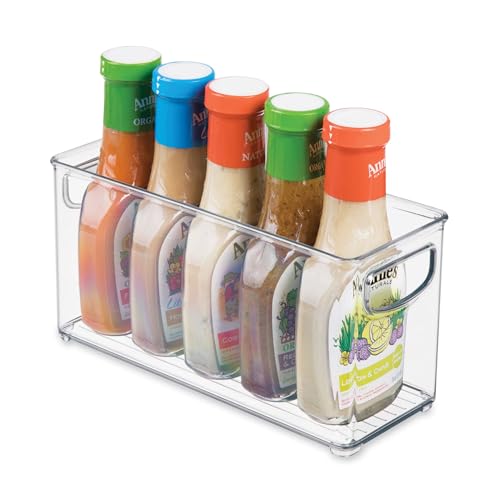
iDesign Linus Slim Stackable Storage Bin
Key spec: Slim tall narrow clear bin, BPA-free recycled plastic, stackable, built-in handles, fridge, freezer, pantry and cabinet use. Best for: narrow gaps and vertical stacking.
Anyone with a narrow fridge, a dorm or office mini fridge, or one awkward vertical gap beside the milk where nothing standard fits. The slim footprint slides into spaces other bins waste, and it stacks to use height instead of width.
In daily use the slim bin earns its place in the gap nobody else can use: beside the milk, between the water filter housing and the wall, or as the second layer stacked on a wider bin. It suits bottles of dressing, tubes, and tall narrow jars that tip over loose. Because it stacks, it is often the second purchase people make after a basic set, the piece that recovers the last wasted strip of a shelf they thought was full.
Pairing advice: treat the slim bin as the gap-filler in a system built from wider pieces. It pairs with any standard set, sliding into the leftover strip the set cannot use, and with a rolling caddy on the shelf below, where the two narrow mechanisms together organise a compact fridge better than one wide set ever could. Buy it after your main bins, when you can see exactly which gap it needs to fill.
Fit and care: Check the dimensions in the spec line against your own shelf measurements before ordering; a half-inch matters in a fridge. Keep the organiser out of the dishwasher unless the maker explicitly allows it, wash by hand in warm soapy water after spills, and dry it fully before reloading so moisture is not trapped against food packaging. Loaded sensibly and washed this way, rigid organisers like this one last for years rather than seasons.
What we like:
- Slim profile fits narrow fridges and the dead space beside tall bottles
- Stackable design builds upward when shelf width runs out
- Built-in handles make a tall, loaded bin easy to lift out
- BPA-free recycled plastic is clear, sturdy and easy to wipe clean
Honest limitation: The narrow width rules out wide items, and stacking a heavy bin on top makes the bottom one awkward to access quickly.
Choose it if: Choose it when width, not depth, is your scarce resource.
Skip it if: Skip it if your shelves are wide and shallow, where a standard bin uses the space better.
Check on Amazon for the current price, sizes and availability.
YouCopia RollOut Fridge Caddy, 6-Inch
Key spec: 6 in wide rolling fridge caddy with soft-spinning wheels, adjustable dividers and sturdy handles, no assembly required. Best for: reaching the back without the dig.
Anyone whose fridge is deep enough that the back third is effectively a food archive. The caddy rolls the whole back row forward on soft wheels, so the sauce you stored in March is one pull away instead of a excavation project.
In daily use the caddy quietly deletes the phrase ‘I thought we were out of that’. The bottles at the back, soy, sauces, the good mustard, ride forward on their wheels whenever you pull the handle, so the back of the shelf stops being an archive. It pairs naturally with a turntable on the opposite shelf and with bins in front: three different mechanisms, each solving the shelf shape it suits, which is what a mature fridge system looks like.
Pairing advice: the caddy solves depth, so pair it with the pieces that solve width and scatter: standard bins in front of it, a divided bin for the small things its dividers cannot separate finely enough. On a very deep shelf, two caddies side by side turn the whole back half of the fridge into pull-forward storage, which is the single biggest quality-of-life upgrade a deep fridge can get.
Fit and care: Check the dimensions in the spec line against your own shelf measurements before ordering; a half-inch matters in a fridge. Keep the organiser out of the dishwasher unless the maker explicitly allows it, wash by hand in warm soapy water after spills, and dry it fully before reloading so moisture is not trapped against food packaging. Loaded sensibly and washed this way, rigid organisers like this one last for years rather than seasons.
What we like:
- Wheels roll heavy, loaded contents forward smoothly
- Adjustable dividers create compartments sized to your bottles
- Sturdy handles make a full caddy easy to lift to the counter
- Narrow 6 in width fits beside, not instead of, your main bins
Honest limitation: Wheels need a flat, clear shelf to roll well, and the narrow width limits it to bottles, cans and small jars.
Choose it if: Choose it when depth, not width, is your fridge problem.
Skip it if: Skip it for wire shelves or very uneven fridge floors where wheels cannot roll.
Check on Amazon for the current price, sizes and availability.
YouCopia RollOut Fridge Drawer, 8-Inch
Key spec: 8 in wide rolling fridge drawer, clear BPA-free plastic, adjustable dividers, wheels and handles for pull-forward access. Best for: a drawer where your fridge forgot one.
Anyone whose fridge has shelves but no usable crisper space for deli meats, cheeses or snacks. This rolling drawer adds the missing layer: a clear, divided, pull-forward compartment that behaves like the drawer the manufacturer skipped.
In daily use the drawer becomes the deli department: cheese, cold cuts, butter and the opened packs that used to slide around in their plastic. Because it is clear, you see the state of the cheese before the shop, not during the sandwich. The dividers keep a strong blue cheese from perfuming the butter’s compartment, and the glide means a child can serve themselves without dragging a bin across the shelf and everything on it.
Pairing advice: the drawer pairs with open bins above and below it, because a fridge of only drawers is slow and a fridge of only open bins is chaotic. Put the drawer at waist height for the daily deli category, bins above for produce, and the heavy drinks low. It also pairs with the rolling caddy from the same maker for a matching pull-forward shelf, if a uniform look matters to you.
Fit and care: Check the dimensions in the spec line against your own shelf measurements before ordering; a half-inch matters in a fridge. Keep the organiser out of the dishwasher unless the maker explicitly allows it, wash by hand in warm soapy water after spills, and dry it fully before reloading so moisture is not trapped against food packaging. Loaded sensibly and washed this way, rigid organisers like this one last for years rather than seasons.
What we like:
- Adds a genuine drawer to a fridge that lacks one
- Clear BPA-free walls keep deli and snack contents visible
- Adjustable dividers separate cheese, meats and small tubs
- Wheels and handles make a loaded drawer glide instead of scrape
Honest limitation: At 8 inches wide it is a one-category drawer, not a whole-shelf solution, and it needs flat shelf space to roll.
Choose it if: Choose it when one category, usually deli or snacks, needs its own pull-out home.
Skip it if: Skip it if your fridge already has good drawers and your problem is shelf clutter instead.
Check on Amazon for the current price, sizes and availability.
HOOJO Refrigerator Organizer Bins, 8-Pack
Key spec: Eight clear bins, each 12.5 x 6.3 x 3.5 in, BPA-free shatter-resistant plastic, built-in front handles, hand wash only. Best for: a whole-fridge reset in one order.
Anyone starting from a bare, chaotic fridge who wants one uniform system instead of a drawer full of mismatched containers. Eight identical bins line up shelf after shelf, so yogurts, produce, condiments and leftovers each get a labelled home.
In daily use the uniformity is the feature. Because every bin is the same, you stop thinking about which container goes where and start thinking in categories: this bin is dairy, that one is produce, the front one is tonight’s dinner ingredients. On shopping day you pull each bin to the counter, refill it, and slide it back, and the fridge resets in minutes. The handles matter more than expected; a full bin of jars is heavy, and a proper grip turns a two-handed lift into a one-handed pull.
Pairing advice: this set is the foundation, so pair it with specialists, not more bins. A can dispenser beside it ends the drink sprawl, a turntable opposite handles the jars the bins hold badly, and one divided bin catches the small items that rattle around inside a big uniform bin. Bought in that order, the four mechanisms divide the fridge between them with almost no overlap, which is exactly what a system is supposed to do.
Fit and care: Check the dimensions in the spec line against your own shelf measurements before ordering; a half-inch matters in a fridge. Keep the organiser out of the dishwasher unless the maker explicitly allows it, wash by hand in warm soapy water after spills, and dry it fully before reloading so moisture is not trapped against food packaging. Loaded sensibly and washed this way, rigid organisers like this one last for years rather than seasons.
What we like:
- Eight identical bins create a uniform, repeatable layout on every shelf
- Built-in handles turn each bin into a pull-out drawer for deep shelves
- Clear walls keep contents visible, so food gets used before it expires
- BPA-free, shatter-resistant plastic survives daily sliding and cold
Honest limitation: The bins nest for shipping but do not stack securely when loaded, and they are hand wash only, so a full set is a sink job, not a dishwasher job.
Choose it if: Choose it when you want the whole fridge organised in one purchase and your shelves are at least 13 inches deep.
Skip it if: Skip it if your fridge is a shallow counter-depth model or you need lidded, stackable storage instead of open bins.
Check on Amazon for the current price, sizes and availability.
Copco Non-Skid Turntable, 12-Inch
Key spec: 12 in diameter rotating turntable, non-skid liner, raised 3/8 in rim, smooth-glide rotation, for refrigerator, cabinet, pantry or countertop. Best for: deep-shelf corners and condiment crowds.
Anyone with a deep shelf where sauces, jars and dressings disappear behind each other. One spin brings the back row to the front, which ends the excavation that knocks three bottles over to reach one.
In daily use the turntable owns the condiment crowd. Mustards, dressings, pickles and sauces live on it, and one spin replaces the old routine of removing four bottles to reach the fifth. It is also the diplomat of the fridge: in shared households, a turntable ends the territorial shelf disputes, because everything on it is equally reachable by everyone. Keep the load balanced and the bottles below the rim, and it simply works for years.
Pairing advice: a turntable pairs with bins the way a lazy Susan pairs with cupboards: the bins hold the big categories in rows, the turntable holds the many-small-things category in a circle. It also pairs with itself; two turntables, one for sauces and one for jars and pickles, organise a deep top shelf better than any bin arrangement, provided the shelf width swallows two 12 inch circles side by side.
Fit and care: Check the dimensions in the spec line against your own shelf measurements before ordering; a half-inch matters in a fridge. Keep the organiser out of the dishwasher unless the maker explicitly allows it, wash by hand in warm soapy water after spills, and dry it fully before reloading so moisture is not trapped against food packaging. Loaded sensibly and washed this way, rigid organisers like this one last for years rather than seasons.
What we like:
- Rotation turns a deep, dark shelf corner into front-row storage
- Non-skid liner keeps jars in place while it spins
- Raised rim stops a bottle sliding off the edge mid-spin
- Works in the fridge, then moves to pantry or cabinet if your layout changes
Honest limitation: A round tray in a rectangular fridge always wastes the corners, and tall bottles can topple if you spin it carelessly.
Choose it if: Choose it when one deep shelf holds a crowd of jars and bottles you rotate through daily.
Skip it if: Skip it in a narrow fridge where a 12 inch circle eats more space than it saves.
Check on Amazon for the current price, sizes and availability.
madesmart 2-Tier Organizer with Sliding Baskets
Key spec: Two-tier organiser with two slide-out baskets, adjustable dividers, handles, BPA-free plastic, dry-erase labelling space on the front. Best for: two layers in one footprint.
Anyone with one tall shelf and too many small things. The two sliding baskets double the useful layers in a single footprint, the dividers stop categories mixing, and each basket pulls out like a drawer instead of asking you to reach past everything.
In daily use the two tiers behave like the drawer your fridge or pantry shelf never had. The top basket takes the small, daily items, packets, tubes, portion cups, while the lower basket holds the bulkier backup stock. The dividers stop the slow mixing that turns every container into a jumble by week two, and the label space on the front, humble as it sounds, is what lets a whole household put things back in the right tier without a briefing.
Pairing advice: the two-tier organiser is a vertical piece, so pair it with horizontal ones. Bins on the neighbouring shelf, a dispenser for cans, and the tier unit standing where height is wasted, usually beside tall bottles. In a pantry-led kitchen it pairs with stackable bins to build a full wall of layers; in the fridge it pairs with one flat bin under the shelf lip for the overflow it cannot hold.
Fit and care: Check the dimensions in the spec line against your own shelf measurements before ordering; a half-inch matters in a fridge. Keep the organiser out of the dishwasher unless the maker explicitly allows it, wash by hand in warm soapy water after spills, and dry it fully before reloading so moisture is not trapped against food packaging. Loaded sensibly and washed this way, rigid organisers like this one last for years rather than seasons.
What we like:
- Two sliding tiers double storage in one shelf footprint
- Adjustable dividers let you size compartments to your actual groceries
- Baskets pull out fully, so nothing hides at the back
- Dry-erase front lets you label contents for the whole household
Honest limitation: It needs a tall shelf to fit both tiers, and the baskets are not lidded, so very tall bottles still need another home.
Choose it if: Choose it when one tall fridge or pantry shelf is doing too many jobs at once.
Skip it if: Skip it if all your shelves are closely spaced, where two tiers simply will not fit.
Check on Amazon for the current price, sizes and availability.
One-minute verdicts
- iDesign Linus Slim Stackable Storage Bin: buy it for narrow gaps and vertical stacking; walk away if the honest limitation in its review describes your fridge.
- YouCopia RollOut Fridge Caddy, 6-Inch: buy it for reaching the back without the dig; walk away if the honest limitation in its review describes your fridge.
- YouCopia RollOut Fridge Drawer, 8-Inch: buy it for a drawer where your fridge forgot one; walk away if the honest limitation in its review describes your fridge.
- HOOJO Refrigerator Organizer Bins, 8-Pack: buy it for a whole-fridge reset in one order; walk away if the honest limitation in its review describes your fridge.
- Copco Non-Skid Turntable, 12-Inch: buy it for deep-shelf corners and condiment crowds; walk away if the honest limitation in its review describes your fridge.
- madesmart 2-Tier Organizer with Sliding Baskets: buy it for two layers in one footprint; walk away if the honest limitation in its review describes your fridge.
Seasonal adjustments worth making
Summer changes the fridge’s job. Drinks multiply, salad ingredients arrive in bulk, and the door opens twice as often in the heat. Give drinks a dedicated, contained home in summer, a dispenser or one strict bin, so the cold snack sprawl does not push the week’s produce into the warm corners. Produce bins earn a liner change twice a week in summer, because warm air plus moisture is where good lettuce goes to die, and a thirty-second liner swap is cheaper than a second shop.
Winter and the holiday season stress the system differently: the fridge fills with big, irregular things, a turkey’s leftovers, party trays, batch-cooked soups in tall tubs. This is where one extra-large, undivided bin proves itself, swallowing the awkward loads that defeat a neat grid of small containers. Clear a whole shelf zone for the season rather than distributing the chaos, and let the everyday categories compress temporarily into their organisers, which is, after all, what the organisers are for.
Comparison table
| Pick | Best for | Spec | Price |
|---|---|---|---|
| iDesign Linus Slim Stackable Storage Bin | Narrow gaps and vertical stacking | Slim tall narrow clear bin, BPA-free recycled plastic, stackable, built-in handles, fridge, freezer, pantry and cabinet use | Check on Amazon |
| YouCopia RollOut Fridge Caddy, 6-Inch | Reaching the back without the dig | 6 in wide rolling fridge caddy with soft-spinning wheels, adjustable dividers and sturdy handles, no assembly required | Check on Amazon |
| YouCopia RollOut Fridge Drawer, 8-Inch | A drawer where your fridge forgot one | 8 in wide rolling fridge drawer, clear BPA-free plastic, adjustable dividers, wheels and handles for pull-forward access | Check on Amazon |
| HOOJO Refrigerator Organizer Bins, 8-Pack | A whole-fridge reset in one order | Eight clear bins, each 12.5 x 6.3 x 3.5 in, BPA-free shatter-resistant plastic, built-in front handles, hand wash only | Check on Amazon |
| Copco Non-Skid Turntable, 12-Inch | Deep-shelf corners and condiment crowds | 12 in diameter rotating turntable, non-skid liner, raised 3/8 in rim, smooth-glide rotation, for refrigerator, cabinet, pantry or countertop | Check on Amazon |
| madesmart 2-Tier Organizer with Sliding Baskets | Two layers in one footprint | Two-tier organiser with two slide-out baskets, adjustable dividers, handles, BPA-free plastic, dry-erase labelling space on the front | Check on Amazon |
Read the table by mechanism first and brand second. A fridge needs its shapes covered, bins for bulk, division for small things, rotation or wheels for depth, a dispenser for cans, protection for eggs, before it needs any particular logo twice. When two picks cover the same mechanism, the tie-breakers are the honest ones in the reviews: exact dimensions against your shelves, care requirements against your habits, and capacity against your real weekly shop.
Finally, remember that the best system is the one your household actually maintains on its worst week, not the one that photographs best on its first afternoon.
One pattern in the table deserves emphasis: the cheapest way to waste money in this category is to buy the same mechanism twice, two open bins for one category while the deep shelf still hides everything. The second-cheapest is to buy for the fridge in the photograph rather than the one in your kitchen. Every pick above lists its real dimensions precisely so you never have to do either. Measure once, buy by mechanism, and the table becomes a checklist you complete rather than a catalogue you browse.
How to choose a refrigerator organizer under $50
Plan the raw meat zone first
Food safety outranks tidiness. Raw meat and seafood belong in a contained, easy-wash bin on the lowest shelf, below everything ready-to-eat. Build the rest of the layout around that fixed point, and never let a prettier arrangement move meat upward.
Buy in stages and live with each stage
Add one or two pieces, use them for two weeks, then reassess. Fridges reveal their real problems slowly, and staged buying means the second purchase fixes the problem you actually have, not the one you imagined in the shop. This is also the only sensible way to shop the lowest budgets in this series.
Measure your shelves like you mean it
Record depth, width and shelf height for every shelf and the door bins. Bring the numbers shopping, in your phone, and reject any organiser that exceeds them, however good it looks. Check the longest picks in any set against your shallowest shelf, not your deepest.
Count categories before containers
List what your fridge actually holds on a normal week: drinks, produce, dairy, deli, condiments, leftovers, eggs, raw meat. Buy for those categories in that order of pain. The category that causes the daily mess gets the first and best organiser; the tidy categories can wait.
Match the mechanism to the problem
Scatter needs bins. Depth needs wheels, handles or a turntable. Cans need a dispenser. Eggs need protection. Small items need dividers. Buying a bin for a depth problem gives you a bin you still cannot reach the back of, which is how good money gets wasted on the wrong shape of solution.
Decide your care tolerance honestly
Many clear organisers are hand wash only, because dishwasher heat can cloud or warp them. If you know you will never hand wash a bin, choose wipe-clean designs and fewer, larger pieces, and read the care line in each review here before you buy, because we state it plainly for every pick.
Rotate stock like a shop, because your fridge is one. New groceries go to the back of each bin, older items come to the front, and leftovers live in the front-most zone with the shortest clock. Organisers make rotation physical: a bin you can pull out is a bin you can load correctly. This single habit, first in and first out, does more against waste than any gadget, and it is free.
Leave breathing room. A fridge packed solid cannot circulate cold air, so food near the walls freezes while food in the middle warms. Organisers should group food, not compress it: if a bin is stuffed so full that nothing can be removed without a fight, the category needs two bins or a cull, not more pressure. Aim for bins you can see into and reach into without excavation.
Common mistakes to avoid
- Copying a big-fridge setup into a compact fridge, where one oversized set eats half the shelf space.
- Blocking the fridge’s air vents with tall stacks, which creates warm spots and spoils food faster.
- Buying wide bins for a narrow fridge and losing the strip of space beside them that slim bins would have used.
- Organising once and never resetting: Every system drifts. Put a five-minute reset into an existing habit, while the weekly shop is unpacked, say, and the fridge stays organised for years. Without the reset, any system in this guide is a photograph by March.
- Skipping the declutter first: Bins organise whatever you put in them, including the sauce that expired last spring. Empty, judge and bin the losses first; organise only what survives. An organiser full of expired food is a museum, not a system.
- Trusting the product photo’s fridge, not yours: Listing photos show cavernous French-door fridges. Your shelves are smaller. The dimensions in every review here come from the maker’s listing, so use them against your own measurements before anything else.
- Stacking heavy on light: A stack is only stable if the heaviest bin sits at the bottom and every layer below is rigid. Yogurt on eggs is a mess waiting for a Tuesday. Keep heavy drinks low, light produce high, and never stack on a lidded egg holder beyond light items.
- Forgetting the door bins exist: Door shelves are the warmest part of the fridge and the best home for condiments, not milk or eggs, whatever the cartoon on the carton suggests. Use organisers to free door space for what belongs there and move the perishables inside.
Final recommendation
Start with the iDesign Linus Slim Stackable Storage Bin if you only buy one thing from this page. It fixes the most common version of the problem for small-kitchen households, it is properly made, and it will still be earning its shelf space in five years. Add the YouCopia RollOut Fridge Caddy, 6-Inch next if a second problem, the one described in its review, sounds like your fridge. Build from there one zone at a time, measure before every purchase, and let a fortnight of real use, not a shopping session, decide what you need next.
One last piece of advice from every organised fridge that stays organised: photograph your finished layout and keep the measurements of every shelf in the same note on your phone. The photograph ends household debates about where things go, and the measurements make every future purchase, a replacement bin, a seasonal addition, a gift request, a thirty-second decision instead of a fresh research project. Systems that are documented get maintained; systems that live in one person’s memory quietly dissolve.
Revisit the related guides as your system grows: Best Refrigerator Organizer Under $50 and Best Airtight Food Storage Containers Under $50 cover the neighbouring budgets and the sealed-storage side of the same kitchen.
A week with this system: what actually changes
The school-run morning is the real test, and it is where handled bins and pull-forward caddies prove themselves. Lunch items live together, at child height where that is safe, in one bin that comes out to the counter and goes back whole. Nobody excavates. Nobody leaves the door open for three minutes cooling the kitchen. The fridge’s hardest five minutes of the day become its easiest, which is a benefit no product photograph can show you.
The dinner-party test comes rarely but tells the truth: a fridge that can absorb a party shop, trays, bottles, desserts, without collapsing into chaos is a fridge whose system has spare capacity and clear zones. Guests helping in the kitchen can find and return things without instruction, because the fridge explains itself. That legibility, to your household every day and to a stranger in five seconds, is what you actually bought.
Monday, shopping day. The shop lands on the counter and, instead of the usual shelf Tetris, each bag empties into its organiser on the counter first: produce into its bin, dairy into its bin, drinks into the dispenser. The loaded organisers slide home in under five minutes, oldest stock already pulled to the front of each one. The fridge closes on a system, not a pile, and the week’s food is visible in one look, which quietly decides half the week’s menus for you.
On living with the system long-term: expect to edit it twice a year. Households change, children grow, diets shift, and a category that needed two bins in January needs one in July. The reset is painless precisely because the system is modular: move a bin, swap two zones, retire one piece to the pantry. A fridge organised this way is never finished, and that is its strength. It adapts in minutes because it was built from honest, movable parts.
Frequently asked questions
What is the single best organiser for a small fridge?
A rolling caddy or a slim stackable bin, depending on your shape of problem. Caddies recover depth; slim bins recover the narrow wasted strip beside tall bottles.
How do I organise a small fridge without buying much?
Start with one handled bin for the category that causes the most mess, live with it for two weeks, then add one piece at a time. Small fridges reward slow, measured systems.
Will a turntable work in a compact fridge?
A 12 inch turntable fits many compact fridges but always measure first, including the door swing. If the circle crowds the shelf, a narrow rolling caddy usually serves a small fridge better.
Should organisers have lids or be open?
Open for daily categories, because a lid is friction you will eventually refuse; lidded or drawered for strong smells, raw items that need containing, and anything stacked upon. Most good systems mix both, exactly as the picks in this guide do. If a category is opened five times a day, lid it only if hygiene demands it, and choose a lid that comes off with one hand.
How do I keep an organised fridge organised?
Attach a five-minute reset to a habit you already have: when the weekly shop is unpacked, new items go behind old ones in each bin, anything expired leaves, and each organiser returns to its zone. Systems fail from drift, not from design, and a tiny regular reset is the entire maintenance contract.
Are clear organisers better than opaque ones?
For the fridge, yes, almost always. You cannot eat what you cannot see, and clear walls turn every door opening into a stock check. Opaque organisers have their place in a pantry for visual calm, but inside a fridge, visibility is the feature that pays for the whole system in food you use instead of waste.
How much should I spend on a refrigerator organizer?
Spend enough for rigid, food-safe plastic from a maker that publishes real dimensions, and no more. Below this article’s budget there are excellent single pieces; above it you are buying systems and convenience, not better plastic. Check price on Amazon for each pick, because listings change, and judge value by whether the piece fixes a problem you have every week.
More ways to check these picks
Quick links for readers comparing the shortlist:
- iDesign Linus Slim Stackable Storage Bin — Check on Amazon
- YouCopia RollOut Fridge Caddy, 6-Inch — Check on Amazon


