Disclosure: As an Amazon Associate, dailyhomedecorating.com earns from qualifying purchases. Links to Amazon on this page are affiliate links; they cost you nothing extra. Prices and availability change often, so check the current Amazon listing before you buy.
Shopping for the best pillows for cpap users means sorting honest engineering from label language, and this guide does the sorting for you. We compared the strongest verified options for this exact need – their construction, their adjustability, and the positions and people they genuinely suit – and ranked six picks below, each with its trade-offs stated plainly. If you only read one section, make it the Quick Picks table; if you read two, add the buying guide, because fit matters more than brand in this category.
CPAP therapy and ordinary pillows are natural enemies: roll onto your side and the pillow shoves the mask, the seal breaks, and the leak – not the therapy – wakes you. CPAP-friendly pillow design is about giving the mask and hose somewhere to go: cutouts at the edges, contours that keep the head still, or moldable fills you can hollow out where the mask sits. The right choice depends on your mask style and how much you move, which is why this guide includes a clearly flagged specialist prose pick alongside the linked contour designs.
We judged mask clearance first – what happens to the seal at 3 a.m. on your side – then neck support, because a pillow that saves the seal and wrecks the neck solves nothing. Readers working through the wider topic often pair this guide with our coverage of Best Pillows For Hemorrhoids, which approaches the same sleep setup from a different angle.
Where to Buy
Every linked pick in this guide is sold on Amazon, where you can check the current price, availability and delivery options on the listing itself. We do not print prices here because they change too often to stay honest. Prose-only picks – included where our verified pool has a genuine gap for this topic – are covered in full below but carry no purchase link, and they are flagged as prose picks wherever they appear.
- ZAMAT Adjustable Cervical Memory Foam Pillow – Best Overall. Check on Amazon
- CPAP Pillow with Mask Cutouts (Prose-Only Pick) – Best Budget. Prose-only pick: no purchase link (see review below).
- EPABO Contour Memory Foam Pillow (Firm, Queen) – Best Premium. Check on Amazon
- Royal Therapy Memory Foam Pillow (Queen) – Best Tunable Contour. Check on Amazon
- Eli & Elm Side Sleeper Pillow (Queen) – Best Versatile. Check on Amazon
- Adjustable Shredded-Fill CPAP Pillow (Prose-Only Pick) – Best Moldable Option. Prose-only pick: no purchase link (see review below).
In this guide
Quick Picks
| Pick | Badge | Why it earns its place |
|---|---|---|
| ZAMAT Adjustable Cervical Memory Foam Pillow | Best Overall | Adjustable height via a removable base piece. |
| CPAP Pillow with Mask Cutouts (Prose-Only Pick) (prose pick) | Best Budget | Cutouts protect the mask seal during side sleeping. |
| EPABO Contour Memory Foam Pillow (Firm, Queen) | Best Premium | Shaped contour supports head, neck, shoulders and back alignment. |
| Royal Therapy Memory Foam Pillow (Queen) | Best Tunable Contour | Contour shape with a removable layer for adjustable loft. |
| Eli & Elm Side Sleeper Pillow (Queen) | Best Versatile | U-shape lets the shoulder settle in while the neck stays level. |
| Adjustable Shredded-Fill CPAP Pillow (Prose-Only Pick) (prose pick) | Best Moldable Option | Moldable hollow fits any mask style. |
Key Takeaways
- Pillow pressure breaking the mask seal is the leak cause pillows can fix
- Side sleepers need clearance engineering; back sleepers mostly need comfort
- Match strategy to mask: cutouts for full-face, contours or moldable for nasal
- Treat mask and pillow as one system – change one, re-check the other
- Pillows support therapy comfort; apnea treatment stays with your clinician
How These Picks Were Chosen
We started from a verified product pool for this series – every linked pick below is a real, checkable listing with confirmed specifications – and scored candidates against the criteria that decide success for best pillows for cpap users. Products that could not explain their benefit in mechanical terms, or whose verified details contradicted their marketing, were cut. Our wider research notes on adjacent sleep topics, including Best Cushions For Sofas, informed the criteria but never the rankings.
- Mask clearance: The decisive test: what happens to the mask and seal when you roll onto your side at 3 a.m. Cutouts, contours and moldable fills were scored on the room they give the mask.
- Neck support retained: A pillow that saves the seal and abandons the neck fails the night. Support in the user’s actual sleep position was required, not traded away.
- Mask-style versatility: Full-face, nasal and nasal-pillow masks occupy different space. Designs adaptable across mask styles scored above single-mask solutions.
- Sleep-position honesty: Back-sleeping CPAP users need less specialization than side sleepers. Picks are labeled by the position and mask style they genuinely serve.
We excluded lofty hotel pillows that shove masks sideways and any product claiming to treat sleep apnea – pillows manage mask mechanics and comfort; therapy is your clinician’s domain. One specialist design appears as a clearly flagged prose-only pick because our verified pool, while strong on contours, contains no carved CPAP pillow.
The 6 Best Pillows For CPAP Users – Reviewed

ZAMAT Adjustable Cervical Memory Foam Pillow
Our badge: Best Overall
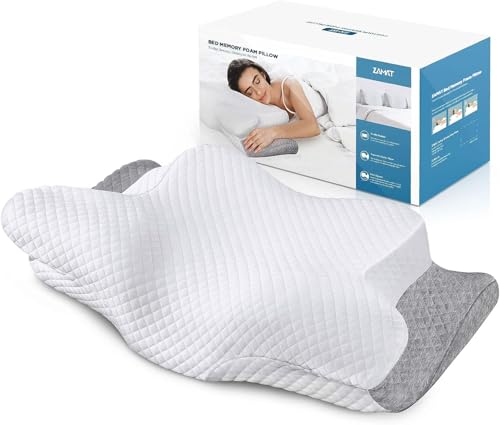
The ZAMAT Adjustable Cervical Memory Foam Pillow is a butterfly-shaped cervical pillow with a neck contour, a central cavity for the head, armrest wings, and a removable bottom piece that lets you adjust the height – in odorless CertiPUR-US certified memory foam.
Every design element answers a specific complaint. The central cavity cradles the head so it stays aligned with the body; the contour holds the neck at a supported height; the butterfly wings give side sleepers somewhere natural for their arms; and the removable base piece means the height adapts to your shoulders instead of the other way around. The foam is notably odorless for memory foam, which matters if off-gassing smells have put you off foam pillows before. The bamboo and polyester outer cover wicks moisture, breathes well, and zips off for machine washing, with a stretchy liner protecting the foam – remember the foam itself should never be laundered. ZAMAT suggests giving yourself a few nights to ease in, which is fair for any shaped pillow. The wings take up width on the bed, and the look is more orthopedic than decorative, but as a problem-solving pillow it is one of the most thoughtfully shaped options in this pool.
The ZAMAT’s party trick is how many sleepers it can be re-tuned for: set tall for your side-sleeping weeks, drop the base piece for back-sleeping stretches, and the same pillow serves a partner with narrower shoulders on guest duty. The wings, often mistaken for decoration, give the top arm a shelf that stops the shoulder roll many side sleepers fight. Keep the foam away from water entirely and let the double covers do the hygiene work; the liner means the outer cover can be washed without exposing the core. Odor-sensitive buyers consistently rate this among the least offensive new-foam arrivals.
ZAMAT Adjustable Cervical Memory Foam Pillow makes its case for best pillows for cpap users by giving the mask somewhere to be. That sounds simple until you have spent a night negotiating between foam and silicone; designs that end the negotiation earn their ranking.
Consider also where ZAMAT Adjustable Cervical Memory Foam Pillow sits in your wider setup for best pillows for cpap users. A pillow is one third of a system – mattress and bedding complete it – and the picks here were chosen to cooperate with ordinary mattresses and standard cases rather than demanding a whole new sleep wardrobe. If a pick underperforms in week one, adjust the system around it once before blaming the pillow itself.
Strengths
- Adjustable height via a removable base piece
- Butterfly wings and central cavity suit side and back sleeping
- Odorless CertiPUR-US foam; washable moisture-wicking cover
Trade-offs
- Wide winged shape takes up bed space
- Orthopedic look will not suit every bed styling
- Foam core must never be washed – cover care only
| Color | White and Light Grey |
| Size | 24 x 14 x 3.74 inches |
| Dimensions | 24 x 14 x 0.0393700787 inches |
| Product Group | Home |
| Binding | Home |
Best for: Side and back sleepers who want a shaped pillow they can fine-tune / Not suited for: Minimalists and anyone who wants a classic rectangular pillow
Choose this pick if its strengths match your situation above; skip it if its trade-offs touch your deal-breakers. Check on Amazon
CPAP Pillow with Mask Cutouts (Prose-Only Pick)
Our badge: Best Budget
A contoured foam pillow with cutouts carved at the edges, giving a CPAP mask and hose room so side sleeping does not push the mask out of seal.
Prose-only pick: this type is not in our verified product pool for this series, so it is covered honestly without a purchase link, invented specifications or a spec box.
Standard pillows and CPAP masks fight all night: the pillow presses the mask, the mask leaks, the leak wakes you. Cutout pillows end the fight geometrically – when you roll to your side, the mask sits in the carved recess instead of against foam, so the seal survives position changes. Look for cutouts on both edges, a height that still supports the neck, and a cover that does not bridge the recess. It is a specialist pillow with a firmer, more structured feel than hotel-style pillows, and back sleepers gain less from it, but for side-sleeping mask users it addresses the actual failure point.
Before ordering, photograph your mask from the side lying on your current pillow: the photo shows exactly how much clearance your mask style needs and where, which tells you whether a cutout’s depth will actually reach it. Keep your old pillow for travel until the new one’s leak performance is proven across a full week.
Readers shopping for best pillows for cpap users should evaluate This pillow as equipment, not bedding: it has a mechanical job in the therapy setup, and its success is measurable in leak-free, uninterrupted nights.
In practice, This pick shows its character in the second week, not the first night: the novelty fades and what remains is whether your mornings changed. Owners who keep a simple better-same-worse note across a fortnight consistently make better keep-or-return decisions than owners who rely on a single night’s impression, and every pick in this guide rewards that patience.
Strengths
- Cutouts protect the mask seal during side sleeping
- Structured support keeps the neck aligned
- Both-edge cutouts suit turners
Trade-offs
- Specialist shape feels firm to soft-pillow lovers
- Back sleepers use the cutouts less
- Must match cutout position to your mask style
Best for: Side-sleeping CPAP users fighting mask leaks / Not suited for: Back-sleeping CPAP users happy on a standard pillow
Choose this type if its strengths match your situation above; skip it if its trade-offs touch your deal-breakers. It is covered in prose only, so compare models carefully wherever you shop.
EPABO Contour Memory Foam Pillow (Firm, Queen)
Our badge: Best Premium
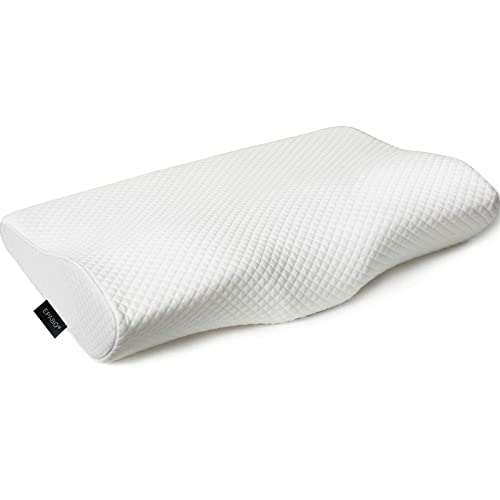
The EPABO Contour Memory Foam Pillow (Firm, Queen) is a firm ergonomic contour pillow with a shaped profile that cradles the head while a raised ridge supports the neck, finished with a breathable hypoallergenic pillowcase that is included in the box.
The contour does the work that a flat pillow cannot: the central dip keeps the head settled while the front ridge fills the curve of the neck, so side, back and even stomach sleepers wake up with the head where they left it. The firm density holds that shape under load instead of collapsing by morning. EPABO is upfront that the first couple of weeks can feel like an adjustment while your body gets used to a more aligned position – that honesty matches how contour pillows actually behave. The memory foam is breathable enough to circulate air better than old-school foam, and the rayon-polyester case feels silky and stays cooler against the skin. A 30-day satisfaction guarantee softens the risk of trying a shaped pillow for the first time. The firm feel is the dividing line: if you love sinking into softness, this will feel strict. If your current pillow leaves your head unsupported, strict is the point.
Ownership of a firm contour is a routine: same orientation every night, case changed weekly, and a standing rule that nobody borrows it for the sofa, because contours tuned to your neck stop being tuned when they live elsewhere. The included case’s smooth finish helps your head glide into the cradle rather than catching, a small detail that matters during the adjustment fortnight. If you wake and find yourself on the pillow’s flat back side, you have rotated it in your sleep – a sign the firmness may be more than your neck wants, and the guarantee window is the time to act on that information.
For best pillows for cpap users, EPABO Contour Memory Foam Pillow is judged at the mask’s edge: does the seal survive your sleep position until morning? Its geometry protects the seal without surrendering neck support – the dual requirement that defines this entire category.
Consider also where EPABO Contour Memory Foam Pillow sits in your wider setup for best pillows for cpap users. A pillow is one third of a system – mattress and bedding complete it – and the picks here were chosen to cooperate with ordinary mattresses and standard cases rather than demanding a whole new sleep wardrobe. If a pick underperforms in week one, adjust the system around it once before blaming the pillow itself.
Strengths
- Shaped contour supports head, neck, shoulders and back alignment
- Firm density keeps its profile all night
- Included breathable case and a 30-day satisfaction guarantee
Trade-offs
- Firm feel is a real adjustment – allow up to two weeks
- Fixed shape and loft; nothing to adjust
- Contour ridge can feel intrusive to committed soft-pillow sleepers
| Color | White |
| Size | Queen(24*15*4.8 inches) |
| Dimensions | 15.2 x 9 x 6.1 inches |
| Weight | 1.95 pounds |
| Product Group | Furniture |
| Binding | Kitchen |
Best for: Neck-focused sleepers ready to commit to a shaped, firm pillow / Not suited for: Softness seekers and anyone unwilling to allow an adjustment period
Choose this pick if its strengths match your situation above; skip it if its trade-offs touch your deal-breakers. Check on Amazon

Royal Therapy Memory Foam Pillow (Queen)
Our badge: Best Tunable Contour
The Royal Therapy Memory Foam Pillow (Queen) is a contoured cervical memory foam pillow with a three-layer design – remove the middle layer to lower the loft – in a washable bamboo-derived rayon cover.
Layered adjustability inside a contour shape is a smart combination: you get the neck ridge and head cradle of a cervical pillow, but the height adapts to your shoulder width instead of forcing one fixed profile. The medium-firm foam works with body temperature to soften where you press and stay supportive where you need holding, and the ventilated engineering keeps it from feeling like the dense foam blocks of a decade ago. The bamboo rayon cover wicks moisture and washes easily, and the foam is CertiPUR-US certified. Royal Therapy designs for side, back and stomach sleepers, though the contour suits the first two best. Expect the usual contour adjustment period, and note the queen contour footprint is narrower than a standard bed pillow, which some restless sleepers notice. For a shaped pillow you can actually tune, it earns its place near the top of several guides in this series.
The three-layer system rewards methodical owners: photograph your settings, change one layer at a time, and keep the removed layer in the linen cupboard rather than the trash, because a new mattress can change your ideal height overnight. The bamboo-derived cover is the comfort sleeper hit here – smooth, moisture-wicking, and noticeably less clammy than basic polyester shells against a warm neck. Contour veterans will find the footprint familiar; contour newcomers should budget the standard adjustment fortnight and judge by week two’s mornings. It is also one of the better-traveling contours, holding its shape in a suitcase without special packing.
Royal Therapy Memory Foam Pillow makes its case for best pillows for cpap users by giving the mask somewhere to be. That sounds simple until you have spent a night negotiating between foam and silicone; designs that end the negotiation earn their ranking.
In practice, Royal Therapy Memory Foam Pillow shows its character in the second week, not the first night: the novelty fades and what remains is whether your mornings changed. Owners who keep a simple better-same-worse note across a fortnight consistently make better keep-or-return decisions than owners who rely on a single night’s impression, and every pick in this guide rewards that patience.
Strengths
- Contour shape with a removable layer for adjustable loft
- Medium-firm CertiPUR-US foam with a ventilated design
- Moisture-wicking bamboo rayon cover is washable
Trade-offs
- Narrower contour footprint than a standard pillow
- Adjustment period while you adapt to the shape
- Stomach sleeping on a contour is a compromise at best
| Color | White |
| Size | Queen 24 x 14 x 5″ |
| Dimensions | 24 x 14 x 5 inches |
| Weight | 1.15 pounds |
| Product Group | Home |
| Binding | Kitchen |
Best for: Neck-focused side and back sleepers who want a tunable contour / Not suited for: Sleepers who toss across the whole pillow all night
Choose this pick if its strengths match your situation above; skip it if its trade-offs touch your deal-breakers. Check on Amazon

Eli & Elm Side Sleeper Pillow (Queen)
Our badge: Best Versatile
The Eli & Elm Side Sleeper Pillow (Queen) is a U-shaped ergonomic pillow designed specifically for side sleeping, filled with cooling latex noodle fill and down-like fiber that you can add or remove to set your own loft.
The curved cutout is the insight: your shoulder rests into the contour instead of being pushed up by a rectangular edge, while the raised body of the pillow fills the gap between head and mattress so the neck stays level with the spine. It is a geometry fix rather than just a firmer pillow, and side sleepers feel the difference in the shoulder first. The zippered liner lets you remove fill for a lower profile or keep it full for broader shoulders. The latex noodle fill is open-cell and breathable, moving air far better than solid foam, and the materials carry OEKO-TEX and CertiPUR-US certifications. The latex build springs back instead of slowly sinking, which suits sleepers who shift between their side and their back. At over six pounds it is a substantial pillow that stays put, but it is a specialist: back and stomach sleepers will not use the shape as designed, and the premium tier reflects the single-purpose engineering.
This pillow changes how a side sleeper uses the whole bed: with the shoulder slotted into the curve, most people stop bunching a second pillow under the first, and the bed gets simpler. The latex fill’s spring makes position changes easy – there is no waiting for foam to release you – and the adjustable liner means the pillow can be re-tuned as your mattress changes over the years. It is a poor fit for a restless all-position sleeper and an excellent fit for the committed side sleeper who has measured their gap and wants it filled by design rather than by stacking. Keep the removed fill; shoulder and mattress changes may want it back.
Readers shopping for best pillows for cpap users should evaluate Eli & Elm Side Sleeper Pillow as equipment, not bedding: it has a mechanical job in the therapy setup, and its success is measurable in leak-free, uninterrupted nights.
Consider also where Eli & Elm Side Sleeper Pillow sits in your wider setup for best pillows for cpap users. A pillow is one third of a system – mattress and bedding complete it – and the picks here were chosen to cooperate with ordinary mattresses and standard cases rather than demanding a whole new sleep wardrobe. If a pick underperforms in week one, adjust the system around it once before blaming the pillow itself.
Strengths
- U-shape lets the shoulder settle in while the neck stays level
- Adjustable fill for a personalized loft
- Breathable latex fill; OEKO-TEX and CertiPUR-US certified materials
Trade-offs
- Specialist shape – wasted on back and stomach sleepers
- Premium tier pricing for a single pillow
- Heavier than standard pillows at over six pounds
| Color | Pillow |
| Size | Queen (U.S. Standard) |
| Dimensions | 28.99999997042 x 16.99999998266 x 0.0393700787 inches |
| Weight | 6.39 pounds |
| Product Group | Home |
| Binding | Kitchen |
Best for: Dedicated side sleepers who wake with shoulder pressure and a tilted neck / Not suited for: Back and stomach sleepers and budget-first shoppers
Choose this pick if its strengths match your situation above; skip it if its trade-offs touch your deal-breakers. Check on Amazon
Adjustable Shredded-Fill CPAP Pillow (Prose-Only Pick)
Our badge: Best Moldable Option
An adjustable shredded-fill pillow marketed for CPAP users, which can be molded away from the mask and hose by hand before sleep.
Prose-only pick: this type is not in our verified product pool for this series, so it is covered honestly without a purchase link, invented specifications or a spec box.
Instead of carved cutouts, this approach uses moldability: push the fill away from where your mask sits, and the pillow holds that hollow while the rest of it supports your head and neck. It adapts to full-face, nasal and pillow-style masks alike, and the loft adjusts by removing fill for back sleeping or adding it for side sleeping. The hollow needs re-molding when you change sides, and shredded fill near a mask can feel less precise than a cutout. For users whose mask style changes, or who split the night between back and side, the flexibility is the point.
Keep a small bag for removed fill and label it – CPAP setups evolve with masks and machines, and the fill you remove today is the adjustment you will want after the next equipment change. Re-mold the hollow with the mask on, lying in your true sleep position, rather than guessing from the edge of the bed.
For best pillows for cpap users, This pillow is judged at the mask’s edge: does the seal survive your sleep position until morning? Its geometry protects the seal without surrendering neck support – the dual requirement that defines this entire category.
In practice, This pick shows its character in the second week, not the first night: the novelty fades and what remains is whether your mornings changed. Owners who keep a simple better-same-worse note across a fortnight consistently make better keep-or-return decisions than owners who rely on a single night’s impression, and every pick in this guide rewards that patience.
Strengths
- Moldable hollow fits any mask style
- Loft adjusts for back and side sleeping
- One pillow adapts as equipment changes
Trade-offs
- Hollow needs re-shaping when you turn over
- Less precise than a carved cutout
- Shredded fill needs regular fluffing
Best for: CPAP users who switch positions or mask styles / Not suited for: Set-and-forget sleepers who never want to arrange a pillow
Choose this type if its strengths match your situation above; skip it if its trade-offs touch your deal-breakers. It is covered in prose only, so compare models carefully wherever you shop.
Comparison Table
Side by side, the six picks differ less in quality than in job description. Readers comparing across this series may also find our guide to Best Pillows For All Sleeping Positions useful, since the two topics share several of the same products with different rankings.
| Pick | Badge | Size | Color | Weight | Check price on Amazon |
|---|---|---|---|---|---|
| ZAMAT Adjustable Cervical Memory Foam Pillow | Best Overall | 24 x 14 x 3.74 inches | White and Light Grey | See listing | Check price on Amazon |
| CPAP Pillow with Mask Cutouts (Prose-Only Pick) | Best Budget | Varies by model | Varies by model | Varies by model | Check price on Amazon |
| EPABO Contour Memory Foam Pillow (Firm, Queen) | Best Premium | Queen(24*15*4.8 inches) | White | 1.95 pounds | Check price on Amazon |
| Royal Therapy Memory Foam Pillow (Queen) | Best Tunable Contour | Queen 24 x 14 x 5″ | White | 1.15 pounds | Check price on Amazon |
| Eli & Elm Side Sleeper Pillow (Queen) | Best Versatile | Queen (U.S. Standard) | Pillow | 6.39 pounds | Check price on Amazon |
| Adjustable Shredded-Fill CPAP Pillow (Prose-Only Pick) | Best Moldable Option | Varies by model | Varies by model | Varies by model | Check price on Amazon |
How to Choose the Best Pillows For CPAP Users
The buying decisions below decide whether any pillow – including the six above – actually works for you. Work through them in order; each one narrows the field more honestly than brand or price tier does. Our guide to Best Pillows For Back Sleepers With Neck Pain covers a neighboring version of the same decision process.
Start With Your Sleep Position
Back sleepers need a moderate height with a dip for the head and a rise under the neck. Side sleepers need more height – enough to span the shoulder – plus an edge that does not push the shoulder forward. Stomach sleepers should go as low as possible or reconsider the position for their neck’s sake. Buy for the position you actually sleep in, not the one you intend to adopt, and if you split the night, prioritize the position you fall asleep in, since that is where you spend the deepest early hours.
Measure Your Shoulder Gap
For side sleeping, the target loft is roughly the distance from the side of your head to the tip of your shoulder, minus how much your shoulder sinks into the mattress. Narrow frames often land near four inches of effective loft; broad shoulders can need six or more. Soft mattresses shrink the gap because the shoulder sinks; firm mattresses keep it honest. Measuring beats guessing, and it explains why a pillow that transformed a friend’s sleep does nothing for you.
Understand Contour Versus Adjustable
A fixed contour is a bet on one geometry: wonderful when it matches you, useless when it does not. Adjustable designs – removable layers, add-or-remove fill, water levels – trade a little elegance for forgiveness, letting you close the last centimeter yourself. First-time shaped-pillow buyers, and anyone whose neck has rejected pillows before, should usually start adjustable. Committed contour fans who already know their height can buy fixed with confidence.
Give Any Shaped Pillow Two Weeks
Your neck has habits, and a new alignment can feel strange before it feels right. Judge a contour or adjustable pillow across ten to fourteen nights, changing only one variable at a time – height first, then position – and keep notes each morning. Discomfort that steadily decreases is adjustment; discomfort that grows, or any numbness or radiating symptoms, is a stop signal, not a perseverance test.
Plan Care Before You Buy
Foam cores generally cannot be washed, so a removable washable cover – and ideally a protector – is part of the support system, because a pillow you cannot keep clean gets replaced or endured. Shredded fills need fluffing; solid foams need airing. Match the maintenance to the effort you will honestly sustain, and check the return or trial terms before the first night, not after the fourteenth.
How to Set Up a Cervical Pillow Correctly
Placement is half the product. For a contour pillow, the higher ridge goes under your neck and the dip cradles your head – reversed, the same pillow feels like a doorstop. On your side, pull the pillow so its edge meets your shoulder, letting the shoulder rest against or into the pillow’s edge rather than on top of it; on your back, center the head in the cradle and check that your chin is neither tipped to your chest nor pointed at the ceiling.
Set the height before the first night if your pillow adjusts. Side sleepers start at the higher setting, back sleepers at the lower, and everyone changes one step at a time across nights rather than rebuilding the pillow hourly. A mirror or a partner’s eyes help: from the side, your ear, shoulder and hip should form a roughly straight line when side sleeping, and your forehead and chin should sit level when on your back. For a related setup walkthrough, see Best Cushion Choice For Kincaid Sofas.
Protect the setup. Use a smooth, not-too-thick pillowcase so the contour’s shape reaches your neck instead of being bridged by fabric, keep a protector under it for foam cores you cannot wash, and fluff or redistribute adjustable fills weekly so the support you tuned stays tuned. Replace the pillow when the fill no longer recovers its shape after a night off – support materials age even when covers look new.
Hose routing is the silent second front. A pillow setup that lets the hose drape without crossing the mask’s exhaust or pulling at angles reduces both leaks and wake-ups; some users add a hose holder, which pairs with any pick in this guide.
Position still rules: a side sleeper with any mask needs clearance engineering; a committed back sleeper may need nothing more exotic than a comfortable medium pillow and good hose routing. Buy for your actual combination, not the category’s worst case.
Pillowcases deserve more credit than they get. A thick or rough case can blunt a pillow’s designed feel, bridge over a contour, or trap heat against your face; a smooth, breathable case lets the pillow work as engineered. Whatever you buy from this guide, pair it with a case that matches its job – and keep a spare, because laundry day should never dictate your sleep setup.
Sizing is a quiet source of returns. Standard, queen and king pillows differ by inches that matter for fit in your cases and for how the pillow behaves on your bed; a pillow compressed by an undersized case sleeps firmer and taller than designed. Check your existing cases before ordering, and when in doubt match the pillow size to the bed size – queen pillows on a queen bed is the combination most bedding is designed around.
If you share a bed, treat pillow buying as a two-person decision even when the pillows differ. Partners wake each other with restless rearranging, and a pillow that one of you fights all night becomes both of your problems. Buying different pillows for each side is normal and sensible; buying matched trial periods – and keeping both sets of packaging until both verdicts are in – is the professional move.
Budget honestly across the whole setup. A protector, a spare case and, for adjustable pillows, a storage bag for removed fill are part of the real cost, and they protect the main purchase. Readers who plan the full setup in one order consistently report fewer returns than readers who buy the pillow alone and improvise the rest – the accessories are where good pillows go to succeed or fail.
When a pillow in this guide tempts you, read its trade-offs list twice. Strengths are what you are buying; trade-offs are what you are agreeing to live with – the adjustment period, the care routine, the bed space, the fixed loft. Most pillow regret is not a bad product but an unread trade-off, and every pick here states its costs in plain language precisely so you can agree with your eyes open.
A final practical note on trialing any pillow in this guide: change one thing at a time, and give each change several nights. Sleep is noisy data – stress, room temperature, a late meal and a hard workout all move the needle – so a pillow judged on a single night is a pillow judged on noise. A week of mornings, briefly noted, is the smallest sample worth trusting, and it is the method behind every ranking on this page.
Problem: The contour feels too high – Remove a layer or some fill, or rotate the pillow to its lower edge for a few nights while your neck adapts; height complaints are the most common and the most fixable.
Problem: You wake with the pillow pushed away – Your body is voting against the setup – usually height or firmness. Change one variable, and check that the pillow is not sliding on a satin case or an undersized pillow sham.
Problem: Your arm keeps going numb on your side – The shoulder is bearing weight it should not. Raise the loft slightly, use a design with arm space, or place a thin pillow under the forearm so the shoulder can relax.
Problem: The new-pillow smell lingers – Air foam pillows in a ventilated room for a day or two before first use, and wash the cover; certified low-odor foams fade fastest.
Why Pillows Break Mask Seals: The Mechanics
A mask seals against your face with light pressure; a pillow applies its own pressure from the other side, and where they meet, the seal loses. Side sleeping concentrates the conflict: the mask’s edge presses into foam, the foam pushes back, and a leak channel opens – usually announced by air on the eyeball at 3 a.m. Every CPAP-friendly design is a strategy for removing foam from that meeting point: carve it away (cutouts), shape it away (contours), or push it away (moldable fills).
Matching Pillow Strategy to Mask Style
Full-face masks occupy the most territory and benefit most from carved cutouts at the pillow’s edge. Nasal masks need moderate clearance and pair well with contours. Nasal-pillow masks are the least demanding and often work on moldable or even standard medium pillows. Changing mask style is a legitimate reason to change pillow strategy – the two are one system.
Common Buying Mistakes
Buying the tallest, firmest option ‘for maximum support’
Support is alignment, not altitude. An over-tall pillow cranks the neck sideways all night; match height to your frame and position instead.
Judging a shaped pillow on night one
Contours need an adjustment period. Decide across two weeks of mornings, adjusting one variable at a time, unless symptoms escalate – then stop.
Sleeping on a contour backwards
The ridge belongs under the neck, the dip under the head. Reversed placement is the most common setup error and the easiest to fix.
Stacking a second pillow ‘just in case’
Two pillows destroy the geometry one good pillow creates. If you need height, raise the pillow’s own setting rather than adding a wobbling layer.
Ignoring the mattress
A shoulder that sinks deep into a soft mattress needs less pillow; the same sleeper on a firm mattress needs more. Change one and you may need to re-tune the other.
Final Recommendation
Start with the ZAMAT Adjustable Cervical Memory Foam Pillow: it is the pick we would buy first for best pillows for cpap users, because it answers the topic’s central problem with the fewest compromises. If its trade-offs hit your deal-breakers, the runner-up is one click away – Check on Amazon – and the reviews above explain exactly who should choose which. If your neck has rejected pillows before, choose the most adjustable pick first – a pillow you can tune beats a pillow you must obey. Keep the packaging until two weeks of mornings have voted. For the neighboring question most readers ask next, see Best Cushions For Sofas.
Frequently Asked Questions
What makes a pillow CPAP-friendly?
Room for the mask: cutouts, contours or moldable fill that keeps pillow pressure off the mask so the seal survives position changes – while still supporting your neck in your sleep position.
Are CPAP pillows only for side sleepers?
Mostly. Back sleepers’ masks rarely meet the pillow, so they can usually choose on comfort and support alone. Side sleepers – and restless sleepers who end up there – gain the most from specialist designs.
Can a pillow reduce mask leaks?
It can remove a common leak cause – pillow pressure breaking the seal – which for many side sleepers is the main one. Fit, straps and mask condition still matter; if leaks persist, your equipment provider is the next stop.
Do I need a different pillow if I change masks?
Possibly. A move from nasal pillows to a full-face mask enlarges the clearance you need; moldable and cutout designs adapt best. Treat mask and pillow as one system whenever either changes.
Is a contour pillow enough for CPAP use?
For nasal and nasal-pillow masks, often yes – the shaped edges reduce mask contact. Full-face side sleepers usually need the deeper clearance of a cutout or moldable design.
Should my CPAP pillow be firm?
Structured enough to hold its shape and clearance all night; soft pillows collapse into the mask’s space. Medium-firm shaped designs are the common sweet spot for this audience.


