Where to buy
Check the latest price, availability and delivery on Amazon. Orders are placed on Amazon. We may earn a commission from qualifying purchases.
- Best flagship, if you can wire it: House of Troy Direct Wire Classic Traditional LED Picture Light, 14-Inch, Mahogany Bronze (DTLEDZ14-81) — sold on Amazon through the maker’s marketplace channel, but we could not pin its listing to the verification standard explained below, so it is covered in prose with no link; search the exact model number on Amazon.
- Best for large artwork: Situ Lighting Plug-in Vision Series, Color Tuning 2700K–4000K — sold in Situ’s own Amazon store, but we could not pin the exact listing to the verification standard explained below, so it is covered in prose with no link; search the exact name on Amazon.
- Best wired-or-plug-in flexibility: Cocoweb Tru-Slim Wall Mounted Picture Light, 16-Inch — Check Price on Amazon
- Best cordless light for real art: Situ Lighting Rechargeable Micro Series Picture Light, Short 8-Inch, Brushed Brass, 2700K — Check Price on Amazon
- Best ceiling-mounted option: Method Lights ML200 Plus Wireless Picture Light — Check Price on Amazon
- Best traditional battery bar: House of Troy Classic Battery Operated LED Picture Light, 24-Inch, Antique Brass (BTLED24-71) — Check Price on Amazon
Read the full guide ↓
Disclosure: As an Amazon Associate, dailyhomedecorating.com earns from qualifying purchases. Links to Amazon on this page are affiliate links; they cost you nothing extra. Listing details such as price and availability change often, so check the current Amazon listing before you buy.
Here is the honest headline for this tier, and it is not the one the budget suggests: $500 does not buy you a better class of picture light on Amazon — it buys you access to the professional class that Amazon only partly stocks. The fixtures that genuinely live at this level exist and are verifiable: a direct-wire LED picture light from House of Troy sits in the upper part of this budget at the maker; a larger hardwired Cocoweb sits in that same upper reaches at its maker; Situ’s rechargeable flagship line sits at and above the top of this budget at the maker’s own store. But when we went to pin those products to live Amazon listings confirmed from two independent sources — the standard every pick in this guide has to meet — the upper part of this budget on Amazon turned out to be effectively empty of verifiable single-fixture offers. The highest single-light positioning we could verify in Situ’s own Amazon store still sat well below the top of this budget. The direct-wire House of Troy reaches Amazon, when it reaches it at all, through rotating marketplace and dropship offers. The rechargeable Situ flagship is maker-direct. The designer names above this tier — Visual Comfort’s Cabinet Maker’s line in its wired and cordless forms, and House of Troy’s own larger direct-wire models — are sold through lighting retailers, not Amazon. So read this budget the way the evidence supports: $500 is one flagship bought carefully, with room left for the electrician — or a two-light system for a gallery wall — or a single premium light positioned in the middle of this budget with much of the budget unspent. Anyone who shows you a neat row of top-of-budget Amazon picture lights with tidy offers is reading titles, not offers.
The picks split first on power source, because at this level the power decision is also a permanence decision. Two picks are wired or wire-optional (the House of Troy direct-wire flagship and the Cocoweb, which can plug in or be direct-wired); one plugs in (the Situ Vision); three are cordless (the Situ Micro and the Method Lights on rechargeable cells, the big House of Troy bar on replaceable batteries). The second split is bar length against frame width — the working rule is a bar roughly one-half to two-thirds the width of the frame — with one deliberate exception: the Method Lights is a ceiling-mounted spotlight, not a bar, and covers wide art by throw distance instead of bar length. The third split is the one this tier exists for: published color data. Every pick below has a CRI figure its maker is willing to sign — 90 CRI from House of Troy’s spec sheet, 93 to 95+ CRI across Situ’s line, a 95+ CRI claim from Method Lights — except the big battery House of Troy, whose maker publishes no CRI for that model, and we say so in its review rather than letting the brand’s reputation imply one. The fourth split is materials, and it is where the money actually goes: exactly one pick in this guide is specified in solid brass, and the rest are honest metal or aluminum with applied finishes, which the reviews name as such.
Quick Picks
Short on time, or comparing several options at once? Each row below names a buyer type and the product that suits it, with a link to the listing where we could verify one.
| Buyer type | Pick | Why it stands out | Link |
|---|---|---|---|
| Best flagship (hardwired) | House of Troy Direct Wire Classic Traditional LED, 14-Inch (DTLEDZ14-81) — flagship in the upper part of this budget at the maker | A real direct-wire gallery fixture with a signed spec sheet: 2700K, 90 CRI, 360 lumens (maker figures), made in the USA | Search Amazon by model number (see review) |
| Best for large artwork | Situ Lighting Plug-in Vision Series, Color Tuning — positioned in the middle-to-upper part of this budget in Situ’s Amazon store | Tunes 2700K–4000K from the remote at 93–95+ CRI (maker figures), sized for art up to 40 inches wide and beyond | Search Amazon by name (see review) |
| Best wired-or-plug-in flexibility | Cocoweb Tru-Slim Wall Mounted, 16-Inch — check price | One fixture that plugs in today and direct-wires later; 2700K, 90+ CRI (maker figures), remote dimming | Check Price on Amazon |
| Best cordless for real art | Situ Lighting Rechargeable Micro Series, Short 8-Inch — check price on Amazon | Solid C360 brass and hard-anodized aluminum, 93+ CRI (maker figure), rests on the frame — no mounting at all | Check Price on Amazon |
| Best ceiling-mounted option | Method Lights ML200 Plus — check price on Amazon | A ceiling spotlight instead of a bar: 450 lumens, 95+ CRI (maker figures), 11 color-temperature settings, rechargeable | Check Price on Amazon |
| Best traditional battery bar | House of Troy Classic Battery, 24-Inch (BTLED24-71) — check price | The widest battery bar from a heritage maker: 24-inch shaded fixture, 320 lumens (listing figure), remote control | Check Price on Amazon |
How These Picks Were Chosen
The first filter was the budget, applied to a named configuration. Every pick in this guide is tied to a specific bar length, finish and power option — a 14-inch direct-wire fixture in mahogany bronze, a 16-inch wall-mounted bar, an 8-inch frame-top light in brushed brass — because premium listings love to headline the smallest size and feature the one in the photograph. Each product’s ASIN then had to be verified from at least two independent sources before it earned a link. At this tier, that standard did real work. Four picks are linked as check-price picks: their ASINs are confirmed on Amazon, so check the current price on Amazon on the live listing, one click away. Two picks are prose-only. The House of Troy direct-wire flagship is firmly positioned in the upper part of this budget at the maker but reaches Amazon only through rotating dropship offers we could not pin; the Situ Vision is sold in Situ’s own Amazon store but as a multi-size listing family we could not pin to one ASIN. Both are real, current, and central to what $500 means in this category, so both are here — honestly labeled, without links.
The second filter was published data, and it is the filter this tier is for. We required a spec sheet or a maker’s published figures for color temperature and CRI — the two numbers that decide whether a light serves a painting or merely illuminates it — and we print those numbers only as maker figures, because no independent lab data exists for any fixture in this category. That filter is why this guide contains no marketplace “brass” bars with four-figure lumen claims: at $500 there is no reason to accept a fixture whose maker will not sign its numbers. The third filter was materials honesty. A finish is not a material. Where a maker’s own specification says aluminum with a brass-tone finish, the review says aluminum; the one fixture specified in solid brass says so in its maker’s own listing data, and we print that too. The fourth filter was the ceiling test: we checked what actually sits above these picks — the same makers’ larger direct-wire models positioned above this budget at their makers, and the designer lines positioned above this budget through lighting retailers — so that the conclusion this guide draws about the empty upper reaches of this budget on Amazon rests on the whole market, not on the six products below.
The 6 Best Picture Lights Under $500
House of Troy Direct Wire Classic Traditional LED Picture Light, 14-Inch, Mahogany Bronze (DTLEDZ14-81)
Who it suits: A homeowner with one important painting on a settled wall — a portrait over a mantel, an oil in a dining room — who can put a junction box above the frame and wants the fixture galleries actually use: wired in, switched from the wall, invisible in operation.
This is the flagship of the tier and the reference point for everything else in the guide, so start with its paperwork. House of Troy has built lighting in Vermont since 1947, and the DTLEDZ14-81 is its 14-inch direct-wire LED picture light in the Classic Traditional line: a metal shade in a mahogany bronze finish, hardwired to a junction box, with an integrated 4.5W LED the maker’s data publishes at 2700K, 90 CRI and 360 lumens — maker figures, printed here because this maker signs them on a proper spec sheet, ETL listing and all. The fixture is made in the USA. Fourteen inches is the right bar for frames roughly 21 to 28 inches wide, and the direct-wire format is the entire point: no cord down the wall, no battery to feed, no remote to lose — the light is simply on the wall switch, forever, which is why this format is the default in galleries and in homes where the art does not move. Its positioning needs its label up front: at the maker this model sits in the upper part of this budget, published on House of Troy’s own site. That is the honest anchor for the tier — a real designer-grade direct-wire picture light, from the category’s heritage maker, positioned within this budget.
Now the disclosure that defines this pick, and this tier. We could not pin this model to a verifiable Amazon listing: House of Troy’s Amazon presence runs through a dropship channel (its battery models are listed that way, as the BTLED24 review below shows), and offers on the direct-wire LED line rotate through marketplace sellers at prices no second source would confirm for us. So there is deliberately no link. Search Amazon by the exact model number — DTLEDZ14-81 for mahogany bronze; the finish code changes with the finish — and treat any offer within this budget as the flagship buy it is, while treating offers positioned well above the maker’s own positioning as the marketplace markup they are. Two ownership notes belong in the open. First, installation is a real cost: if there is no box above your frame, an electrician’s visit belongs in the budget thinking, and the fixture plus an electrician can carry the project past this budget — the tier’s money works harder as fixture-plus-installation than as fixture alone. Second, dimming: integrated-LED fixtures are dimmer-sensitive, and House of Troy’s LED spec sheets specify dimmer types model by model, so confirm the exact dimmer class — standard forward-phase or ELV — with the maker’s sheet for this model before your electrician wires it, rather than discovering a buzz or a truncated range afterward.
- Direct-wire format: no cord, no battery, no remote — wall-switch operation for the life of the fixture.
- Published maker specifications: 2700K, 90 CRI, 360 lumens, 4.5W LED (maker figures); ETL listed; made in the USA.
- 14-inch metal shade suits frames roughly 21–28 inches wide; positioned in the upper part of this budget at the maker.
Honest limitation: No pinnable Amazon offer — it reaches Amazon through rotating dropship and marketplace listings, so you buy it by model number and verify the live offer yourself; and its upper-budget positioning at the maker leaves little of the $500 for the electrician most walls will need.
Choose it if your wall is settled, your frame is a keeper, and you want the one fixture in this guide that behaves like architecture. Skip it if you cannot open the wall — the Cocoweb below gives you the same maker’s-class light with a plug-in start — or if your frame is wider than about 28 inches, because House of Troy’s larger direct-wire LED models are positioned above this budget (the 24-inch ball-motif version sits well above this tier at the maker).
No link for this pick, by the verification policy explained above — search the exact model number on Amazon.
Situ Lighting Plug-in Vision Series Picture Light, Color Tuning 2700K–4000K
Who it suits: A collector with one large or tall piece — art up to 40 inches wide in the standard sizes, taller in the extended ones — who wants to tune the light to the artwork rather than accept a fixed 2700K, and who has an outlet within cord’s reach.
Situ Lighting is a small specialist maker in Sarasota, Florida that builds nothing but art lights, and the Vision is its flagship bar: a slim plug-in fixture whose remote tunes the color temperature continuously across 2700K to 4000K and steps through more than fifty brightness settings, with the remote programmable to run several Situ lights together — the seed of a whole-wall system from one maker. The color data is the reason it leads the plug-in field: Situ publishes 93 to 95+ CRI across all of its color temperatures, maker figures we print because this maker signs them across its whole line rather than in one listing’s title. In Situ’s own Amazon store the Color Tuning Vision is sold as a family — eight sizes, with positioning varying by size and finish — against a broad maker-direct range across the plug-in Vision line that spans from well below this budget to above it. Read that correctly: the storefront covers the listing family, and the size your artwork needs may sit higher or lower within the range than another size, which is one reason this pick is prose-only — we could verify the product and the store, but not pin one ASIN for one configuration to linking standard. Search the exact name in Amazon’s Situ store and select by your artwork’s dimensions.
The limitations are structural. It plugs in: the cord has to go somewhere, and Situ’s answer — a recessed outlet behind the frame — is an electrician’s job if you do not already have one, though a plain visible cord run works on day one. Dimming and tuning live on the remote, not on a wall dimmer; this is a self-contained lighting system, and it should be bought as one. The optics deserve a decision, too: Situ sells the Vision in standard and tall-art optical configurations, because a bar that washes a 30-inch-tall canvas evenly will hotspot a 55-inch one — measure your artwork’s height before ordering, not just its width. And a note on the family tree, because it matters at this budget: Situ also sells a Direct Connect (hardwired) version of the Vision direct, and a Rechargeable Vision direct that sits at and above the top of this budget — neither of which we could find in its Amazon store, so if you want the cordless flagship, the maker’s own store is the channel, and it is a near-budget or over-budget buy before delivery. Within Amazon, the plug-in Color Tuning Vision, positioned in the middle-to-upper part of this budget, is the strongest large-art light this tier verifiably offers.
- Color tuning 2700K–4000K and 50+ brightness steps from one remote, programmable across multiple Situ lights.
- 93–95+ CRI published by the maker across all color temperatures (maker figures).
- Sized for artwork up to 40 inches wide in standard form, with optics options for taller pieces; made in the USA.
Honest limitation: Prose-only — the Amazon storefront covers a size family, not one configuration, and we could not pin a single ASIN; it is also plug-in only in this listing, with a cord to manage and remote-only dimming.
Choose it if your artwork is large, your color standards are high, and an outlet is nearby. Skip it if you need hardwired invisibility without buying the maker-direct Direct Connect version, or if your art is small — the Micro below serves a single modest frame better and leaves money unspent.
No link for this pick, by the verification policy explained above — search the exact product name on Amazon.
Cocoweb Tru-Slim Wall Mounted Picture Light, 16-Inch
Who it suits: Anyone who wants a specialist maker’s wired-class light without committing to the wiring on day one — plug it in now, direct-wire it at the next renovation — over a frame roughly 24 to 32 inches wide.
Cocoweb is a California picture-light specialist, and the Tru-Slim is its signature form: a slim 16-inch tube shade that rotates 90 degrees to aim the wash, in a wall-mounted version the maker sells as either plug-in or direct-wired — the only pick in this guide that lets you change your mind about power after purchase. The maker’s published figures are 2700K warm white and a CRI of 90+, with output published as a family range of 160 to 640 lumens depending on size rather than a per-size figure — maker figures, printed as the range the maker actually signs. The body is aluminum, and the brass-look versions are finishes on that aluminum; Cocoweb’s own specification says so, and at this budget you should know the difference between that and the Situ Micro’s solid brass below. For current pricing, check price on Amazon — it is linked as a check-price pick on the Amazon listing. It sits in the lower-to-middle part of this budget, so it leaves much of a $500 budget unspent, which is precisely its role here: it is the two-for-one pick, since two of them can light a gallery wall inside one budget.
The limitation that matters most is a dimming trap, and the maker states it plainly: this light must not be put on a wall dimmer — Cocoweb warns it can flash repeatedly — because dimming is handled by its own remote. Buyers wiring it direct and picturing a Lutron on the wall should re-plan around the remote or choose the House of Troy flagship instead. The rotating shade locks with adjustment screws, which is a genuinely gallery-grade touch, but the install is a real bracket-and-screws job on the wall (frame mounting is also offered in the line), and the plug-in version’s cord needs the usual management. Finally, the per-size lumen gap cuts both ways: Cocoweb publishes the family range rather than the 16-inch figure, so we print the range and do not invent the middle of it. What you are buying is the specialist’s fixture, a two-year maker warranty, and the plug-in-to-hardwired upgrade path — a combination nothing else in this guide offers.
- Plug-in or direct-wire from the same fixture — the only power-flexible pick here.
- 2700K, 90+ CRI (maker figures); output published as a 160–640 lumen family range by size.
- 90-degree rotating shade, remote dimming, 2-year maker warranty; aluminum body with applied finishes.
Honest limitation: Never put it on a wall dimmer — the maker warns it will flash; dimming is remote-only. And the “brass” versions are finishes over aluminum, not solid brass.
Choose it if you want wired-class light with an exit ramp, or two matched lights for a gallery wall inside one budget. Skip it if wall-dimmer control is non-negotiable — that is the House of Troy flagship’s home ground — or if solid brass is the point of the purchase, which is the Micro’s.

Situ Lighting Rechargeable Micro Series Picture Light, Short 8-Inch, Brushed Brass, 2700K
Who it suits: A collector with one modest, valuable piece — art up to about 18 inches wide and 24 tall for this size — who wants the best color data in the cordless class and zero installation: no screws, no bracket, no cord, nothing touching the wall.
The Micro is the most unusual object in this guide. It does not mount at all: the 8-inch light rests on top of the artwork’s frame, lifts off one-handed for recharging, and goes back the same way — the only pick here a renter, a borrower of wall space, or an owner of a frame too fine to drill near can use without a second thought, which is why it anchors our thinking for the compact walls in Best Picture Light For Small Rooms Under $500 as well. Its materials are the tier’s honesty benchmark: Situ’s own listing data specifies solid C360 brass and Type II hard-anodized 6061-T6 aluminum — a named alloy, not the word “metal” — and its color figure is the maker’s 93+ CRI, published across the line. Situ publishes a runtime of roughly 45 hours per charge for this series as a maker figure, and makes one design decision we wish more makers would copy: the Micro is deliberately not remote-controlled, because Situ states that a remote receiver’s parasitic drain shortens battery life and can damage the pack — you trade the remote for battery health, knowingly, and a five-hour automatic shut-off covers the night you forget it. It is sold in Situ’s own Amazon store, positioned in the middle of this budget, and it is linked here on its Amazon listing as a check-price pick — check the current price on Amazon — for the reason given in its limitation below.
That limitation is availability, stated plainly: a later check of this listing showed no featured offers available, which is the recurring condition of premium art lighting on Amazon — the listing exists, and the live offer comes and goes. Buy it when a live offer is present — check price on Amazon at that moment; do not chase a marketplace markup on a light whose maker also sells it direct. Two spec cautions belong in the open. The Amazon spec table’s brightness field for this light reads 800 lumens, a figure Situ’s own materials do not corroborate for an 8-inch frame-top light — treat it as listing data, not a maker specification, and expect a focused wash for small art rather than a flood. And the format itself is the constraint: resting on the frame means it suits frames with a real top edge, covers small-to-medium art only (larger Micro configurations exist in the line, positioned higher in the range), and puts a rechargeable cell’s routine — lift, charge, replace — into your month, a few times a year at the maker’s runtime figure.
- Solid C360 brass and hard-anodized 6061-T6 aluminum — the only solid-brass specification in this guide.
- 93+ CRI (maker figure); rests on the frame top — no mounting, no holes, no cord.
- About 45 hours per charge (maker figure); no remote by design, to protect the battery; 5-hour auto shut-off.
Honest limitation: Availability on Amazon is intermittent — the listing has shown no featured offer — so buy on a live offer and check price on Amazon at that moment, or buy maker-direct; and the listing’s 800-lumen field is not corroborated by the maker.
Choose it if the artwork is small, real, and not to be drilled around. Skip it if your frame is wide — the Vision above is the large-art Situ — or if a remote is a must-have rather than a battery liability.

Method Lights ML200 Plus Wireless Picture Light
Who it suits: Anyone whose artwork is wide, high, or hung where no bar belongs — a large canvas, a piece over a tall mantel, a gallery corner — and who likes the museum solution instead: a small spotlight on the ceiling, aimed down at the art, with nothing attached to the frame or the wall above it.
Method Lights breaks the category’s shape, and in modern rooms that is the point — there is no brass tube announcing itself above the frame, which is why this is the pick we reach for in Best Picture Light For Modern Homes Under $500. The ML200 Plus mounts to the ceiling and throws its light down at the artwork from a distance you choose, which solves the bar-length rule entirely: coverage is set by mounting position and aim, not by a shade width. The maker’s published figures are 450 lumens and a CRI of 95+, and its party trick is color temperature: eleven settings spanning roughly 2700K to 7000K, dialed from the remote, so the same light can flatter a warm oil at 2700K or give a cool photograph a neutral 4000K. It runs on a rechargeable lithium-ion pack; the maker’s runtime figures — quoted in its materials at up to about 25 hours of intermittent use at maximum output and far longer at low settings — are maker claims of the intermittent kind, and should be read as evenings-per-charge in the dozens at gallery brightness, not as continuous hours. It is positioned in the middle of this budget: check price on Amazon, where it is linked as a check-price pick on the Amazon listing, currently the practical channel since a specialty lighting retailer that also carries it showed it sold out.
The honest costs are ergonomic. A ceiling-mounted rechargeable light has to come down or be reached to recharge — an eight-hour charge, on the maker’s figures — and the maker sells an extendable charging pole for exactly this problem, separately, as a separate accessory owners describe as a considered extra purchase; a step ladder is the cheaper accessory. Aiming is a one-time fiddle with a real payoff, but a spotlight’s beam is a pool, not a wash: on a very wide canvas the edges will fall off sooner than a long bar’s would, and on glossy or glass-covered art a ceiling angle can throw a reflection a bar would not — test the angle before you commit the mount. And its 95+ CRI, while published by the maker and repeated by reviewers, has no independent lab verification behind it, the same caveat as every CRI in this guide. Bought with those eyes open, it is the only pick here that lights art the way a gallery’s track system does, well inside this budget.
- Ceiling-mounted spotlight — no bar above the frame; coverage set by distance and aim, not shade width.
- 450 lumens and 95+ CRI (maker figures); 11 color-temperature settings, about 2700K–7000K, by remote.
- Rechargeable lithium-ion pack; positioned in the middle of this budget — check price on Amazon; maker’s life claim of 50,000 hours or 500 charge cycles.
Honest limitation: Recharging a ceiling fixture means a ladder or the maker’s separately sold charging pole; runtime figures are intermittent-use maker claims; and a spotlight’s pool of light cannot match a long bar’s edge-to-edge wash on very wide art.
Choose it if your art is large, your ceilings are workable, and you want the fixture invisible. Skip it if you want a traditional over-frame profile — that is the two House of Troy picks — or if ceiling mounting is impossible in your room.

House of Troy Classic Battery Operated LED Picture Light, 24-Inch, Antique Brass (BTLED24-71)
Who it suits: Anyone with a wide frame in a traditional room — a 36- to 48-inch landscape over a sofa or sideboard — who wants a real shaded fixture from a heritage maker, with no wiring and no cord, and accepts a battery routine as the price.
Scale is this pick’s argument. At 24 inches it is the widest battery bar in the guide, in the classic form the category was built on: a proper metal shade in an antique brass finish on a wall bracket, lit by an integrated LED the Amazon listing rates at up to 320 lumens — a listing figure, printed as one — and run from a remote control. It comes from the same Vermont maker as the flagship above, sold on Amazon through the maker’s dropship channel, and it carries a 1-year manufacturer warranty. The battery system is the old, honest kind: a 6-volt pack of replaceable cells (not included, per the listing), which means a dead light is a two-minute battery swap rather than a charging errand, and the light can sit over a frame in a room with no outlet and no USB discipline at all. For the wide, traditionally framed pieces that anchor a living room — the exact walls our guide to Best Picture Light For Bedrooms Under $500 treats more gently — nothing else in this guide covers the width without a cord.
Two disclosures keep this pick honest, and both are about paperwork rather than hardware. The first is color data: House of Troy publishes a signed 90 CRI sheet for its wired LED line, but we could find no published CRI figure for this battery model, so none is printed — buy it for its form, width and maker, not as a measured color instrument, and if your wide piece is an original whose colors matter, the Situ Vision’s published 93–95+ CRI is the safer spend. The second is current pricing: we could confirm this exact listing on Amazon but could not pin a current figure from two independent sources, so it is linked as a check-price pick — check the current price on Amazon on the Amazon listing and hold the line at this budget. A listing-data warning from experience with this maker’s Amazon pages: the auto-filled spec table for this product contains obvious errors (it describes a battery LED fixture as corded electric, with an E26 bulb base, for use with a ceiling fan), so trust the model number and the maker’s documentation over the table’s fields.
- 24-inch traditional shaded bar — the widest cordless pick, for frames roughly 36–48 inches wide.
- Up to 320 lumens (listing figure), remote control, replaceable-cell battery power — swaps in minutes.
- Heritage maker, 1-year warranty, antique brass finish.
Honest limitation: No CRI figure is published for this model, and we could not verify a current figure to rely on — check price on Amazon before counting it in this budget; heavy nightly use means a steady appetite for batteries.
Choose it if your frame is wide, your room is traditional, and your nearest outlet is across the room. Skip it if published color data matters — the Vision — or if you will light it every night and would rather recharge than swap cells.
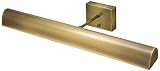
Comparison Table
| Pick | Bar / coverage | Power source | Published output / color data | Mounting | Price basis |
|---|---|---|---|---|---|
| House of Troy DTLEDZ14-81 | 14 in bar; frames ~21–28 in | Direct wire (hardwired) | 360 lumens, 2700K, 90 CRI — maker figures from a published spec sheet | Junction box above frame (electrician for most walls) | Prose-only — positioned in the upper part of this budget at the maker; Amazon offers rotate through dropship/marketplace sellers |
| Situ Plug-in Vision, Color Tuning | Bar sizes for art up to 40 in wide, taller options | Plug-in cord, remote control | 93–95+ CRI across 2700K–4000K tuning (maker figures); 50+ brightness steps | Wall/frame bracket (screws) | Prose-only — sold in Situ’s Amazon store as a size family; positioning varies by size and finish |
| Cocoweb Tru-Slim Wall Mounted 16-Inch | 16 in bar; frames ~24–32 in | Plug-in or direct wire | 2700K, 90+ CRI (maker figures); output published as 160–640 lumen family range | Wall bracket (screws); 90° rotating shade | Check price on Amazon |
| Situ Rechargeable Micro, Short 8-Inch | 8 in; art up to ~18 in wide × 24 in tall | Rechargeable, lifts off to charge | 93+ CRI (maker figure); listing’s 800-lumen field not corroborated by the maker | Rests on top of the frame — no mounting | Check price on Amazon — sold in Situ’s Amazon store; offers intermittent |
| Method Lights ML200 Plus | Ceiling spotlight; coverage by distance/aim | Rechargeable lithium-ion | 450 lumens, 95+ CRI (maker figures); 11 CCT settings ~2700K–7000K | Ceiling mount | Check price on Amazon |
| House of Troy BTLED24-71 | 24 in bar; frames ~36–48 in | Replaceable batteries (6V pack, not included) | Up to 320 lumens (listing figure); CRI not published for this model | Wall bracket (screws) | Check price on Amazon |
How to Choose the Right Picture Light Under $500
Decide what the $500 is actually buying first. The evidence in this guide supports three honest shapes for this budget. One: a single flagship — the House of Troy direct-wire, positioned in the upper part of this budget at the maker — with the understanding that an electrician may carry the installed total past the number. Two: a system — two Cocoweb Tru-Slims inside one budget (check price on Amazon for each), or a Situ Vision for the big piece and room left toward a second light — which is how galleries actually spend, one wall at a time. Three: one premium light positioned in the middle of this budget (the Micro, the ML200 Plus, the Vision) with the rest unspent, which is the right answer more often than the budget implies. What the budget does not buy, on Amazon, is a single fixture at the very top of this budget with a stable, verifiable offer — that shelf is empty, and a listing that seems to fill it deserves the model-number check this guide keeps recommending. Readers working a smaller budget to the same standard will find the verified picks in our guide to Best Picture Light Under $300.
Match the power source to the wall’s future. Direct wire is the best light and the worst flexibility: it belongs over art that will hang in the same place for a decade, in a home you own — renters should start from the cordless picks and the rental-safe logic in Best Picture Light For Apartments Under $500. Plug-in is the middle term: permanent brightness, a cord to hide, no electrician unless you add a recessed outlet. Rechargeable suits art you light in evenings and can reach; replaceable-cell battery suits art you light occasionally and cannot reach easily, because a swap beats a charging routine you will not keep.
Size the bar to the frame, and the optics to the height. The working rule is a bar one-half to two-thirds the frame’s width: 14 inches for a 21-to-28-inch frame, 16 for 24-to-32, 24 for 36-to-48. Height is the forgotten half: a tall canvas needs either a longer throw, an optic designed for tall art (the Vision’s tall configuration), or a ceiling spotlight’s distance (the ML200 Plus). A short bar over a tall painting lights the top third and abandons the rest, at any price.
Buy color data, not color adjectives. At this budget, require a CRI figure the maker publishes — 90 or above — and a stated color temperature. Treat every CRI that appears only in a listing title as unproven, every lumen figure as a maker figure, and any fixture whose maker publishes neither as furniture, not lighting. Warm 2700K flatters oils and traditional frames; a tunable 2700K–4000K light earns its premium when your collection mixes oils, photographs and works on paper.
Settle the dimming question before the wiring question. Integrated-LED fixtures are dimmer-specific: some want a standard forward-phase dimmer, some an ELV/reverse-phase unit, and some — the Cocoweb and both Situ picks — must not sit on a wall dimmer at all, because they dim from their own remotes. Read the model’s own spec sheet, confirm with the maker if the sheet is silent, and never let an electrician guess.
Common Buying Mistakes
Paying a marketplace markup for a maker-direct light. The premium end of this category reaches Amazon through dropship and marketplace sellers whose offers rotate and drift above the maker’s own positioning. The defense is comparison: know how the maker positions the model (House of Troy positions the DTLEDZ14 in the upper part of this budget; Situ publishes its lines’ ranges) and treat any Amazon offer positioned far above that as a markup, not a market norm — for linked picks, check the current price on Amazon against the maker’s own channel before you buy.
Buying “brass” that is a finish. At every price in this category, most brass is a tone applied to aluminum or steel. That is not a defect — the Cocoweb is an excellent light — but it is a fact to buy knowingly. If solid brass is what you are paying for, buy the one fixture whose maker specifies it (the Situ Micro, solid C360 brass) and be suspicious of every other use of the word.
Wiring a remote-dimming light to a wall dimmer. Cocoweb states plainly that its wall-mounted light can flash on a wall dimmer; Situ’s plug-in lights dim from their remotes; integrated LEDs generally each have a dimmer class they accept. The mistake is made once, by an electrician working from habit, and lived with for years.
Sizing by width alone. A bar matched to a frame’s width but blind to its height leaves the bottom of a tall canvas dark. Check the maker’s coverage by height — Situ publishes artwork dimensions for exactly this reason — and consider a ceiling spotlight when the piece is taller than it is wide.
Trusting the auto-filled spec table. Amazon’s spec fields for premium picture lights contain flat errors — battery fixtures described as corded, ceiling fans listed as a use case, an 800-lumen field the maker never claimed. Verify against the maker’s own documentation by model number before ordering, especially finishes and sizes, where a wrong code digit buys the wrong light.
Final Recommendation
Start with the wall, not the catalog. If one important painting hangs where it will hang for years and you can wire to it, the House of Troy DTLEDZ14-81 is the flagship this budget was invented for: a published 90 CRI sheet, a real direct-wire format, and upper-budget positioning at the maker — bought by model number, with the electrician counted honestly in the project cost. If your art is large or your collection mixes media, the Situ Plug-in Vision with color tuning is the strongest verifiable option in the maker’s own Amazon store, positioned in the middle-to-upper part of this budget: published 93–95+ CRI at every temperature it tunes to, sized by your artwork’s actual dimensions. If you want wired-class light without the wiring commitment — or two lights for a gallery wall inside one budget — the Cocoweb Tru-Slim wall-mounted is the flexible specialist pick in the lower-to-middle part of this budget; check price on Amazon. For one small, real artwork you will not drill around, the Situ Micro is the connoisseur’s answer: solid brass, 93+ CRI, and no installation at all, positioned in the middle of this budget when its Amazon offer is live — check price on Amazon. The Method Lights ML200 Plus is the modern room’s route — a ceiling spotlight positioned in the middle of this budget that makes the fixture disappear; check price on Amazon — and the big House of Troy battery bar remains the traditional wide-frame answer where no outlet exists; check the current price on Amazon before it counts against the budget. The tier’s lesson is the one the research kept teaching: on Amazon, $500 is not a shelf, it is a strategy — one flagship bought by model number, one system built from verified parts, or one premium light with money honestly left over.
Frequently Asked Questions
Is there really no top-of-budget picture light on Amazon? There are listings positioned in the upper part of this budget, but none we could verify to this guide’s standard — an ASIN confirmed from two independent sources. The fixtures that legitimately sit in that upper band at their makers (House of Troy’s direct-wire LED flagship and Cocoweb’s larger hardwired Classic) reach Amazon through rotating marketplace offers or not at all, and the highest single-light positioning we could verify in a maker’s own Amazon store still sat well below the top of this budget. The upper part of this budget is where this market moves to lighting retailers; buy there by model number, or buy the verified lights positioned in the middle of this budget here — check price on Amazon for the linked picks — and keep the change.
Hardwired, plug-in or battery at this budget — which ages best? Hardwired, and it is not close: a direct-wire fixture has no battery to age, no cord to manage and no remote to lose, and its LED module is the only consumable. Its cost is commitment — it belongs to one wall. Plug-in ages nearly as well and moves house with you. Rechargeable batteries are the aging item in every cordless pick: expect the pack, not the light, to set the fixture’s practical lifespan, which is one reason Situ’s no-remote, low-drain design and House of Troy’s replaceable cells are both defensible answers.
What CRI do I actually need for real artwork? Ninety or above, published by the maker. Below that, reds and deep blues shift visibly on original paint and dyed textiles; at 93 to 95+ — the Situ and Method Lights figures — color error stops being the limiting factor for home display. What you should not do is pay a premium for a CRI that appears only in a listing’s title: in this category that number is a claim, and the makers who can prove theirs publish it in their own documentation.
Can these lights go on a wall dimmer? It depends on the model, and the differences are absolute. The Cocoweb must not — its maker warns it will flash; it dims by remote. Both Situ picks dim from their remotes, not wall dimmers. The House of Troy direct-wire is the wall-control pick, but confirm the exact dimmer class (standard or ELV) from the model’s spec sheet before wiring. There is no safe default: check the sheet for the exact model you buy.
How do I light a gallery wall for $500? As a system, not a flagship. Two Cocoweb Tru-Slims can fit inside one budget — check price on Amazon for each — matched bars, one remote pattern, two frames done properly. Alternatively, one Situ Vision over the anchor piece, positioned in the middle-to-upper part of this budget in Situ’s Amazon store, plus a mid-tier light over the second frame keeps the wall’s hierarchy honest. What does not work is spreading $500 thinly across five unverified bars: five fixtures with unpublished color data light a wall the way five guesses light a wall.