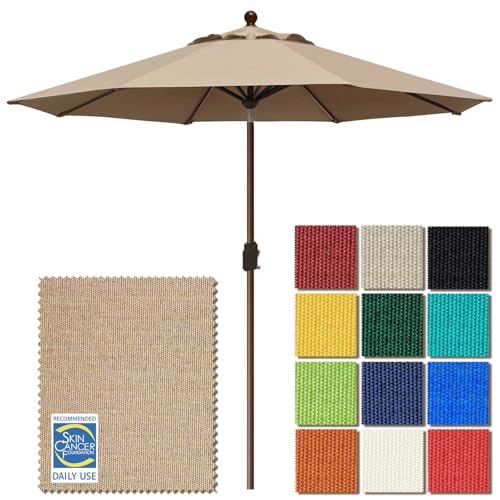
Best patio umbrella for apartments under $300
Where to buy
Check the latest price, availability and delivery on Amazon. Orders are placed on Amazon. We may earn a commission from qualifying purchases. Patio umbrella bases are almost always sold separately — budget for the base as well as the umbrella.
- Best overall for balconies: EliteShade USA 9Ft Market Patio Umbrella — Check on Amazon
- Best value upgrade: Abba Patio 9FT Lyon Outdoor Patio Umbrella — Check on Amazon
- Best for renters who move: Sunnyglade 9′ Patio Umbrella with Tilt and Crank — Check on Amazon
See more Amazon options
- Best simple table umbrella: Blissun 9′ Outdoor Patio Umbrella — Check on Amazon
- Best offset option — check your lease first: Grand Patio 10Ft Cantilever Umbrella with Cross Base — Check on Amazon
- Best buy-it-for-years pick (prose): California Umbrella 9 ft Market Umbrella with Sunbrella Fabric — check price on Amazon (see the review below for why this pick is listed without a direct link)
Read the full guide ↓
Disclosure: As an Amazon Associate, dailyhomedecorating.com earns from qualifying purchases. Links to Amazon on this page are affiliate links; they cost you nothing extra. Listing details such as price and availability change often, so check the current Amazon listing before you buy.
Shopping for the best patio umbrella for apartments under $300 starts with a document most buying guides never mention: your lease. An apartment balcony or terrace is borrowed outdoor space, and the rules attached to it — in the lease, in the building’s house rules, and sometimes in local fire code — decide what kind of umbrella you may have long before your taste or budget gets a vote. The good news is that under $300 is a genuinely comfortable budget for apartment shade once the rules are satisfied: it covers every good 9-foot market umbrella worth owning, better fabrics than the entry tier, and even entry-level cantilever umbrellas for the larger terraces where they are allowed.
Start with the three apartment questions. First: does your lease or building allow a freestanding umbrella at all, and does it say anything about attaching things to the railing? Many buildings prohibit clamping or bolting anything to balcony railings, and some prohibit freestanding umbrellas on upper floors entirely because of wind risk to the balconies and street below. Second: how exposed is your balcony? A second-floor terrace sheltered by the building is a gentle environment; a tenth-floor corner balcony is a wind tunnel with a view, and it will test an umbrella and its base in ways a ground-floor patio never does. Third: where does the umbrella go in winter, or when you move? Apartment storage is measured in inches, and an umbrella that folds into the corner of a storage cage is worth more to a renter than a marginally better canopy with nowhere to live.
This guide therefore ranks apartment umbrellas on a renter’s criteria: nothing that requires drilling, bolting or permanent fixing; folded size and carry weight for storage and moving day; base options that work on a balcony without marking decking or tiles; and wind behavior, because the consequences of a tipped umbrella are different when there are neighbors below. Where a pick needs a caveat — and the cantilever in this list needs a real one — the review says so plainly rather than letting you discover it in a letter from building management.
One more apartment-specific note before the picks: bases. On a balcony you cannot use the in-ground or deck-bolted options available to house owners, and you should not use a clamp on a railing your lease says to leave alone. Your tools are weight and furniture: a heavy low-profile base, the table the pole passes through, and the discipline to close the umbrella when you come inside. Every pick below works within those limits.
In this guide
Quick Picks
| Pick | Best for | Canopy | Key feature |
|---|---|---|---|
| EliteShade USA 9Ft Market Patio Umbrella | Most apartment balconies | 9 ft | Fade-resistant performance fabric |
| Abba Patio 9FT Lyon Outdoor Patio Umbrella | A first upgrade from a cheap umbrella | 9 ft | Sturdier 8-rib frame |
| Sunnyglade 9′ Patio Umbrella with Tilt and Crank | Renters who move often | 9 ft | Light aluminum pole |
| Blissun 9′ Outdoor Patio Umbrella | Simple balcony table setups | 9 ft | Crank + push-button tilt |
| Grand Patio 10Ft Cantilever Umbrella with Cross Base | Large terraces, where allowed | 10 ft offset | 360-degree rotation |
| California Umbrella 9 ft Market Umbrella with Sunbrella Fabric | Long-term renters and owners | 9 ft | Sunbrella options, replaceable parts |
How These Picks Were Chosen
We filtered for apartment life first and umbrella specs second. Any model that required permanent fixing was out. Any model whose folded length or weight made storage-cage life miserable was marked down. We favored standard 1.5-inch poles because they fit the universal bases and the umbrella holes of the small balcony tables renters actually own, and we favored crank lifts because a pulley-and-pin umbrella is a two-handed wrestling match in a space where you are already standing between the railing and the table.
Each candidate’s specifications were checked against the maker’s own information, and listings were confirmed before linking: picks verified through the Amazon Creators API carry direct links, and picks whose exact variant could not be confirmed are presented in prose with the reason stated, so you search the model name and choose the exact configuration yourself. Every candidate was also screened against US patio-umbrella recall records; recalled models — most notably the widely sold solar-battery umbrella recalled for a fire hazard — are excluded from this guide entirely and are not named among the picks.
The under $300 ceiling was applied honestly: it is the umbrella budget, and because apartment rules rule out cheap fixing shortcuts, we repeatedly remind you that the base is a separate purchase. A top-of-budget umbrella in a featherweight base is a worse apartment umbrella than a mid-tier umbrella in a proper base, on any balcony, in any building.
The Picks in Detail
EliteShade USA 9Ft Market Patio Umbrella — Best overall for balconies
Who it suits: the apartment dweller who will live with this umbrella for years — the solution-dyed fabric resists the fade that makes a balcony look tired, and the commercial-grade frame shrugs off daily open-close cycles.
EliteShade builds this 9-footer around its fabric: a solution-dyed acrylic performance canopy that the maker backs with a 10-year non-fading claim and rates UPF 50+. Solution-dyed means the color runs through the fiber rather than sitting on the surface, which is why this class of fabric resists the chalky fade that cheap polyester shows after one hard summer. The frame is a commercial-grade build with crank lift, tilt, and a vented top.
Key specs: 9 ft canopy, solution-dyed acrylic performance fabric, UPF 50+, crank and tilt, vented top.
Pros:
- Solution-dyed performance fabric with a long non-fading claim from the maker
- UPF 50+ shade, meaningful on a sun-exposed balcony with no other cover
- Vented top calms the canopy in the gusts balconies funnel
- Crank and tilt: shade follows the sun across fixed balcony furniture
Honest limitation: It is a premium-priced 9-footer, so measure your balcony’s open circle before buying — and note the base is separate, as with every umbrella here.
Choose it if you are settled in this apartment and want the balcony to look deliberate, not improvised. Skip it if you are on a short lease and will likely leave the umbrella behind — the value picks below make more sense.
Abba Patio 9FT Lyon Outdoor Patio Umbrella — Best value upgrade
Who it suits: the renter graduating from a first cheap umbrella that faded, fluttered or bent — this is the step up in frame and fabric weight without leaving the sensible price zone.
The Lyon is Abba Patio’s mainstream 9-foot market umbrella: eight ribs, a crank lift, a push-button tilt, and a canopy the maker rates for UV protection and water resistance. The frame geometry is a touch sturdier than the very cheapest 9-footers, with a thicker feel to the rib arms, and the canopy fabric is a heavier polyester that holds its shape better in a breeze instead of fluttering at the edges.
Key specs: 9 ft canopy, 8 ribs, push-button tilt, crank lift, UV-protective waterproof canopy.
Pros:
- Eight-rib frame with a sturdier feel than entry-tier umbrellas
- Heavier canopy fabric holds its shape on a breezy balcony
- Full crank lift and push-button tilt
- UV-protective, water-resistant canopy
Honest limitation: Still a polyester canopy, so manage fade expectations over multiple seasons; and like all picks here it needs a real base on a balcony.
Choose it if you want a noticeable quality step without paying premium-fabric prices. Skip it if fabric longevity is your top priority — that is the EliteShade above.
Sunnyglade 9′ Patio Umbrella with Tilt and Crank — Best for renters who move
Who it suits: the serial renter: light enough to carry down in the elevator on moving day, rust-proof aluminum for balconies where it will live outside, and cheap enough to leave behind without pain if the next place has no balcony.
The Sunnyglade pairs a 9-foot polyester canopy with an aluminum pole, which matters anywhere the umbrella lives outdoors year-round because aluminum does not rust the way painted steel can once the finish chips. It opens with a crank, tilts with a push button, and the canopy is a waterproof-coated polyester with a small vent at the top. The whole umbrella is noticeably lighter than steel-pole rivals, which makes it easier to lift in and out of a base or table hole.
Key specs: 9 ft canopy, aluminum pole, push-button tilt, crank lift, waterproof polyester canopy.
Pros:
- Aluminum pole: no rust, and light to carry
- Easy one-person lift in and out of the base
- Crank and push-button tilt, the full basic set
- Coated polyester canopy sheds light rain
Honest limitation: Light is a virtue for moving and a vice in wind — on an upper or exposed balcony, pair it with the heaviest base your space accepts and close it whenever you go in.
Choose it if you move every year or two and everything you own must earn its moving-van space. Skip it if your balcony is high and exposed; choose a heavier build and budget for serious base weight.
Blissun 9′ Outdoor Patio Umbrella — Best simple table umbrella
Who it suits: the classic apartment setup — a small balcony table for two or four, umbrella through the middle — where standard fittings and a fair price beat fancy features.
The Blissun is a classic center-pole market umbrella: a 9-foot octagonal polyester canopy on eight ribs, opened with a crank and angled with a push-button tilt. The pole is about 1.5 inches in diameter, so it drops through the umbrella hole of a standard patio table and into most universal bases. The canopy fabric is a solution-tinted polyester that sheds light rain and is treated for UV resistance; the vent at the peak lets hot air escape and reduces the sail effect in a breeze.
Key specs: 9 ft canopy, 8 ribs, push-button tilt, crank lift, polyester canopy, 1.5-inch pole.
Pros:
- Standard 1.5-inch pole fits balcony tables and universal bases
- 9-foot canopy shades a small table setting completely
- Crank lift, push-button tilt, vented peak
- Straightforward assembly, nothing to engineer
Honest limitation: Polyester canopy will fade gradually in strong sun, and the tilt is a simple push-button affair rather than a fine-adjust mechanism.
Choose it if you want the proven, uncomplicated option for a balcony table. Skip it if you have no table and need a freestanding solution with maximum stability per dollar.
Grand Patio 10Ft Cantilever Umbrella with Cross Base — Best offset option — check your lease first
Who it suits: the large apartment terrace — a penthouse deck, a ground-floor patio, a wide top-floor terrace — where a cantilever’s pole-free shade is transformative and the building’s rules allow a weighted freestanding base.
This Grand Patio model hangs its 10-foot canopy from a side arm, so no pole stands in the middle of your seating. The mast rotates a full 360 degrees — you follow the sun by swinging the canopy rather than moving chairs — and the canopy tilts to block low morning or evening sun. It stands on a cross base, which is only a frame: it must be weighted with base weight plates or sand bags, sold separately, before the umbrella is safe to open.
Key specs: 10 ft offset canopy, 360-degree rotation, tilt adjustment, steel frame, cross base (weights sold separately).
Pros:
- No center pole: shade over a sectional or loungers with nothing in the middle
- 360-degree rotation follows the sun without moving furniture
- 10-foot canopy covers a real seating area
- Cross base included as a frame — weight plates or sand bags are separate
Honest limitation: Two honest caveats. First, many leases and buildings restrict or ban cantilever umbrellas on balconies; confirm yours in writing before ordering. Second, the cross base is not a base until it is weighted — a cantilever needs heavy ballast, typically well over 150 lb across its plates, and an under-weighted cantilever on a balcony is a genuine hazard to people below.
Choose it if you have a large terrace, written permission, and room for a properly weighted base. Skip it if you have a standard balcony, an unresponsive landlord, or any doubt about the rules — take any market umbrella above instead.
California Umbrella 9 ft Market Umbrella with Sunbrella Fabric — Best buy-it-for-years pick (prose)
Who it suits: the long-term renter or condo owner who is done with disposable umbrellas and wants one with replaceable ribs and canopies, in fabrics including Sunbrella, from a specialist maker.
California Umbrella is a long-running US umbrella specialist. Its 9-foot market umbrellas are sold in many frame finishes and canopy fabrics, including Sunbrella, and are built around replaceable parts — ribs, caps and canopies can be swapped when one piece wears out instead of replacing the whole umbrella. That parts support is the real difference between this brand and the disposable end of the market.
Key specs: 9 ft canopy, Sunbrella fabric options, push-button tilt, crank or pulley lift depending on configuration (maker listings).
Pros:
- Specialist maker with replaceable parts support
- Sunbrella canopy options — the benchmark fade-resistant fabric class
- Many frame finishes and configurations to match a considered balcony
- Built to be repaired rather than replaced
Honest limitation: Configurations vary widely — lift type, tilt and fabric differ by exact model — which is why this pick is prose-only: search the maker and choose the exact 9-foot configuration on the listing rather than trusting a single link.
Choose it if you keep apartments for years and maintain your things. Skip it if you want one click and no decisions; the linked picks above are simpler.
Check price on Amazon by searching the model name — we list this pick without a direct buy link because we could not confirm the exact listing variant at review time, and we would rather send you to search than to the wrong product page.
Comparison Table
| Umbrella | Size | Type | Fabric class | Tilt | Base note |
|---|---|---|---|---|---|
| EliteShade USA 9Ft Market Patio Umbrella | 9 ft | Center pole | Solution-dyed performance | Crank + tilt | Base sold separately |
| Abba Patio 9FT Lyon Outdoor Patio Umbrella | 9 ft | Center pole | Polyester, heavier weave | Push-button | Base sold separately |
| Sunnyglade 9′ Patio Umbrella with Tilt and Crank | 9 ft | Center pole, aluminum | Polyester, coated | Push-button | Base sold separately; weight it well |
| Blissun 9′ Outdoor Patio Umbrella | 9 ft | Center pole | Polyester | Push-button | Base sold separately |
| Grand Patio 10Ft Cantilever Umbrella with Cross Base | 10 ft | Cantilever | Polyester | Tilt + rotate | Cross base frame included; weights separate, 150 lb+ |
| California Umbrella 9 ft Market Umbrella with Sunbrella Fabric | 9 ft | Center pole | Sunbrella options | By configuration | Base sold separately |
Apartment and Balcony Rules: Read This Before You Order
Leases regulate umbrellas in three ways, and it is worth checking all three. The first is attachment: most leases prohibit drilling, bolting or clamping anything to the building, which rules out railing clamps and deck-bolted bases — every setup in this guide is freestanding and weight-based for exactly that reason. The second is appearance: some buildings and HOAs specify umbrella colors or prohibit visible items on balconies, which is a boring rule that is nonetheless cheaper to obey by choosing a neutral canopy now than by replacing a bright one later. The third is safety and liability: a minority of buildings ban freestanding umbrellas on upper floors outright, and some require them to be closed when unattended. If your building has a resident portal or a management email, one short message — ‘freestanding patio umbrella in a weighted base, no attachments’ — gets you a written answer you can rely on.
Fire code deserves a mention too. Balconies are escape routes in some building designs, and local rules in a number of cities restrict what may be stored on them and require clearance from the wall and any grill. Keep the umbrella’s folded storage spot out of the doorway path, never store it against a heat source, and be skeptical of any solar-battery umbrella accessory with unclear charging instructions — the one major patio-umbrella recall of recent years was a solar LED model whose battery puck overheated, which is why no pick in this guide depends on a battery puck and why we advise following maker charging guidance to the letter on any lighted umbrella.
Wind is the apartment umbrella’s real exam. Balconies channel wind along the building face and around corners, and a gust that a garden would shrug off can arrive at a fifth-floor railing doubled. The defenses are unglamorous: a base at the heavy end of the recommended range, the umbrella closed whenever you are not under it, and a strap or tie around the closed canopy so a gust cannot belly it open. If your balcony is high and corner-exposed, treat the market umbrellas in this guide as fair-weather shade and close them early and often; no umbrella in this price class is rated to stand open in a storm, whatever the listing implies.
How to Choose an Apartment Patio Umbrella
Get the rules in writing first. Lease, house rules, and one email to management if anything is ambiguous. This single step decides whether a cantilever is even a candidate.
Measure the balcony like a room. Open-circle clearance for the canopy, ceiling clearance to the balcony above for the opening sweep, and a folded-storage corner measured in inches. Apartment umbrellas fail on storage more often than on shade.
Choose the base for the floor you have. On tiles or decking you cannot mark, a flat low-profile steel base or a resin base with a smooth underside is kinder than a rough cast base. Add furniture pads under it. On an exposed balcony, choose weight over elegance every time.
Prefer crank lift and standard poles. Cranks work one-handed in tight quarters; a 1.5-inch pole fits the tables and bases you already own or can buy anywhere, which matters when you move and the new balcony is a different shape.
Spend the budget in order: permission, base, fabric, features. A permitted umbrella in a heavy base with mid-tier fabric beats a premium umbrella a complaint removes, or a light base drops onto the railing.
Common Apartment Umbrella Mistakes
Clamping the umbrella to the railing. It feels clever and is usually a lease violation, a rust stain, and a weaker anchor than a proper base, all at once.
Assuming the photo’s base is included. It almost never is. Renters discover this on delivery day and improvise with a plant pot, which is how umbrellas end up in the parking lot.
Leaving it open while at work. Weather changes during the day; a closed umbrella is a safe umbrella. Make closing it part of locking the door.
Buying for the balcony you wish you had. An 11-foot canopy over a 6-foot balcony shades the neighbor’s airspace and scrapes your wall. Measure, then buy the 9-footer.
Ignoring the move. If you cannot picture the umbrella in your next apartment’s storage, in the elevator, and in a car or van, it is the wrong umbrella for a renter — choose the lighter pick.
Final Recommendation
For most apartments under $300, buy the EliteShade 9Ft for its fade-resistant fabric and sturdy frame, stand it in the heaviest low-profile base your balcony accepts, and close it when you come in. Budget-conscious renters should take the Abba Lyon; frequent movers, the light aluminum Sunnyglade. Only reach for the Grand Patio cantilever if your terrace is genuinely large and your building has said yes in writing — and if you plan to stay for years, the prose-listed California Umbrella rewards the extra homework with parts support and Sunbrella options.
Setting Up on a Balcony Without Marking, Drilling or Annoying Anyone
Apartment setup has one rule that houses do not: everything you do must be reversible without a trace. Begin with the base, because on a balcony the base is both the anchor and the floor’s only protection. Put furniture pads or a rubber mat under any metal base before it touches tile, composite decking or painted concrete — a season of tiny movements grinds grit into finishes, and ‘the umbrella did it’ is a deposit conversation nobody wins. Position the base, load it to weight, and only then bring the umbrella out; a loaded base is awkward to slide, and sliding a loaded base is exactly how floors get scored.
Raise the pole into the base and lock it, keeping the canopy tied. Balconies add a vertical hazard houses lack: the balcony above. Open the canopy a quarter-turn of the crank at a time and watch the finial’s path, because the opening sweep of a 9-foot umbrella rises as it spreads, and a finial that kisses the upstairs balcony’s floor on day one will do it every day. If clearance is genuinely tight, open the umbrella at its tilt setting or assemble it at a slight angle and straighten it once open — and if it still does not clear, that is the building telling you the umbrella is too tall, which is a return, not a challenge.
Think about the neighbors as part of the setup. Your canopy’s edge should not drip onto the balcony below after rain — a small point of drainage etiquette that prevents the most common umbrella complaint in multi-unit buildings — and your closed umbrella, tied and vertical, should not lean against the railing where wind can work it loose. If your balcony has a storage box, the umbrella’s winter home is already solved; if not, measure the indoor corner it will occupy in January before the box it ships in becomes the only thing that fits it.
Finally, photograph the arrangement and keep the management email that approved it, if you asked. Balconies get inspected, staff change, and memories differ; the renter with a photo and a one-line written approval never has the argument at all.
Moving Day, Storage Cages and the Renter’s Umbrella Life Cycle
An apartment umbrella lives three lives — balcony, storage, and moving van — and the picks in this guide were chosen to survive all three. For storage-cage life, the details that matter are unglamorous: a canopy that folds without a fight, a pole that separates into two sections short enough for the cage’s door diagonal, and a weight you can carry down a corridor without a dolly. Before storing, clean and fully dry the canopy — a storage cage is a dark, still-air box, and a canopy folded damp in September is a mildew farm by March. A breathable cover keeps the dust of other people’s storage off the fabric; skip sealed plastic, which traps the very moisture you dried it to avoid.
Moving day is where the aluminum-pole picks earn their keep. A market umbrella is long, light and awkward — the classic stairwell problem — so plan its route like furniture, not like luggage: measure the elevator diagonal, carry it vertically in stairwells, and never let it ride on top of a car without proper padding and ties, because a canopy abraded against a roof rack arrives pre-faded in stripes. The base is the real moving decision. A sand-filled base is a dead weight no mover loves; many renters sell or gift the base at each move and buy fresh at the destination, which is rational economics for heavy, cheap objects, and one more reason to keep the umbrella itself — the part with the fabric you chose and the mechanism you like — in the light, durable class.
End-of-lease thinking belongs in the purchase too. If there is a real chance you leave the umbrella behind — a furnished sublet, a move abroad — the value picks in this guide are the honest choice, and their lower price is a feature. If you are signing for three years in a building you love, the fabric and parts-support picks repay you every season and move with you gracefully. The mistake is mixing the horizons: premium money on a one-year balcony, or disposable quality on a five-year terrace. Match the umbrella to the lease, and apartment shade stops being a recurring problem and becomes a solved one.
Fabric, Frames and Mechanisms: What Apartment Buyers Are Really Paying For
Strip away the marketing and an apartment umbrella is three purchases in one: a fabric, a frame, and a mechanism, and the under $300 tier is where each of the three stops being the cheapest available version. The fabric ladder runs from surface-dyed polyester, which colors only the outside of the fiber and fades accordingly, through heavier solution-tinted polyesters, up to solution-dyed acrylics — Sunbrella and the performance fabrics in this guide — where the color is in the fiber itself. On a balcony, fabric choice has a social dimension houses never face: your canopy is part of your neighbors’ view and your building’s face, and a chalk-faded umbrella reads as neglect from the street. Renters planning to stay should weight fabric higher than any other line in the budget.
The frame ladder is about cycles and corrosion. Balcony umbrellas open and close daily — more often than yard umbrellas — because a renter’s outdoor space doubles as a corridor, a laundry route, a bike park. Crank housings, tilt joints and rib arms accumulate cycles fast, and commercial-grade builds are rated for that life in a way entry builds are not. Corrosion is the balcony’s second tax: rain reaches a balcony umbrella from three sides, and coastal or winter-salted air reaches it from a fourth. Aluminum poles and stainless or coated hardware are not upgrades in that environment; they are the difference between a mechanism that works in year three and one that seizes in year two.
The mechanism ladder is the shortest: pulley-and-pin at the bottom, crank in the middle where every pick in this guide sits, and auto-tilt at the top, where the tilt continues as you crank. For apartment use the crank is the sweet spot — one-handed, operable in the gap between table and railing, understandable by any guest or housesitter. What the extra money above a crank buys is not a better mechanism but smoother, longer-lived versions of the same one: metal gears instead of plastic, a tilt joint that holds its angle instead of creeping. Judge listings accordingly — a premium umbrella and an entry-tier umbrella may list identical features while differing entirely in the materials those features are made of, and the reviews in this guide call out which picks spend their price on substance.
One last apartment-specific material note: weight is a feature with two faces. A heavy frame feels planted and survives balcony gusts; a light frame survives moving day and storage-cage Tetris. Neither is wrong — but know which life your umbrella is actually going to live, and buy the face of weight that matches it.
Three Apartment Situations, Three Right Answers
The fifth-floor balcony with a table for two
The classic renter’s balcony: six feet deep if you are lucky, a bistro table, two chairs, and a railing between you and a long drop. The umbrella is a 9-foot market model through the table — the EliteShade if the lease is long, the Blissun if it is not — in a low-profile base with floor pads under it, closed whenever you are not sitting under it, because fifth-floor wind does not send warnings. What this balcony must not host is a cantilever, however tempting the pole-free photos look: the ballast footprint alone would eat the floor, and the building’s answer, if asked honestly, would very likely be no.
The ground-floor terrace of a garden apartment
Ground-floor terraces live closer to house rules than to balcony rules: more space, real furniture, often a sectional, and wind that behaves like a yard’s. This is the one apartment situation where the Grand Patio cantilever can be the right answer — with management’s written blessing, a level pad, and its cross base filled completely. The terrace’s other honest option is the two-umbrella strategy: a strong market umbrella over the table and the light Sunnyglade wherever the week’s layout wants shade. Either beats the single oversized compromise, and both stay inside the budget with the bases priced in.
The short-lease studio balcony
Eleven months, a storage locker downstairs, and a move already visible on the calendar: this balcony wants the Sunnyglade or the Blissun, a base you can sell with the couch, and zero emotional investment in permanence. The discipline here is financial rather than technical — every dollar of premium fabric is a dollar spent on the next tenant’s shade. Buy the honest value pick, enjoy a genuinely pleasant balcony for the lease’s length, and let the umbrella be the easiest item on the moving inventory: light, standard, and priced to leave behind without a second thought if the next place has no outdoor space at all.
Renting Well: Deposits, Documentation and the End-of-Lease Test
Apartment shade succeeds or fails on paperwork as much as on hardware, and the renter who treats it that way never loses money to a misunderstanding. Before the umbrella arrives, save three things: the lease clause or house rule that governs balcony items, the management reply if you asked, and a dated photograph of the balcony’s floor and railing as they were. After setup, add a photograph of the installed umbrella in its weighted base. That small file answers almost every question a building can later ask — what was installed, how it was anchored, and what condition the surfaces were in before it arrived — and it costs four minutes to assemble.
During the tenancy, the deposit risks are specific and avoidable. Rust weep from a steel base stains pale balcony floors in a pattern that cleaning rarely fully lifts, which is why this guide insists on pads or a mat under every base and favors aluminum poles. A canopy that drips onto the balcony below after rain generates the complaint that gets umbrellas banned for the whole stack, so after storms, tilt a wet canopy to shed its water onto your own floor’s drain path before opening it fully. And the closed umbrella should live vertical and tied within your balcony’s footprint — never leaning on the railing, where a gust can walk it and where the building sees an object stored against a structure it owns.
Apply the end-of-lease test at purchase time and the whole category simplifies: could you, on moving day, return this balcony to its photographed condition in one hour, carrying everything you installed down in the elevator yourself? The picks in this guide were chosen to pass that test — freestanding, weight-anchored, floor-protected, light enough to move. An umbrella that passes it is a renter’s asset. One that fails it is a liability with a canopy, whatever its fabric, and the time to discover the difference is before the delivery, not during the inspection.
Final Checks Before You Click Buy
Run this short list against the exact listing you are about to order, because apartment purchases fail in the details more often than in the decision. Confirm the canopy diameter in the listing’s specification table, not its headline, and confirm the pole diameter matches the base and table you own — the standard is about an inch and a half, and a mismatch discovered on delivery day costs a renter a return trip with an eight-foot box. Confirm what the box contains: umbrella only, or umbrella plus a cross base frame, and whether any weight is included at all — it almost never is. Confirm the folded length against your storage corner and your elevator, in numbers, from the listing’s dimensions rather than from a guess.
Then read the maker’s own care and wind guidance on the listing page, because that page — not any review, including this one — is the document your warranty will be judged against. Note the closing guidance, the storage guidance, and any statement about wind; an umbrella used inside its maker’s instructions is an umbrella whose maker stands behind it. Finally, order the base in the same basket if you do not already own a proper one, and order it at the weight this guide recommends for your floor and exposure rather than the lightest the listing suggests. The two boxes arriving together is the difference between a balcony shaded this weekend and a pole leaning in the hallway awaiting its anchor — and for a renter, that hallway week is exactly when umbrellas get damaged, borrowed against, and regretted.
FAQ
Does a patio umbrella come with a base?
Usually not. Most market and cantilever umbrellas on Amazon are sold as the umbrella only, and the product photos that show a handsome weighted base are showing an accessory you buy separately. Always check the listing’s ‘what is included’ line, and budget for the base before you compare umbrella prices, because a safe base can cost a meaningful share of the umbrella itself.
How heavy should an umbrella base be?
As a working rule, a 9-foot market umbrella used freestanding wants at least 50 lb of base weight, and more — 70 to 90 lb — if it stands alone in an exposed, breezy spot rather than through a heavy table. A 10- or 11-foot canopy needs more again, and a cantilever needs substantially more than a center-pole umbrella of the same size because the load hangs off to one side: plan on filling all four weight plates of a cross base, typically 150 lb or more of sand or water in total. When in doubt, go heavier; a base that is too heavy costs money once, while a base that is too light can cost an umbrella, a table, or worse.
Should I leave my patio umbrella open all the time?
No. Close it when you are not using it, and always close it ahead of wind. An open umbrella is a sail, and most umbrella damage — bent ribs, snapped poles, tipped bases — happens to umbrellas left open and unattended in gusts. Closing it also keeps the canopy cleaner and slows fabric fading, so the habit pays twice.
Are patio umbrellas allowed on apartment balconies?
Often yes, but it depends on your lease, your building’s house rules, and sometimes local fire code. Freestanding umbrellas in weighted bases, with nothing attached to the railing or building, are the most commonly permitted setup. Some buildings restrict colors, require umbrellas to be closed when unattended, or ban them on upper floors. Check your documents and, if anything is unclear, get a short written answer from management before you buy.
Can I clamp an umbrella to my balcony railing instead of using a base?
We advise against it. Most leases prohibit attaching anything to railings, clamps can damage finishes and leave you liable, and a clamp is a weaker, single-point anchor than a properly weighted base. A heavy low-profile base plus, where you have one, a table the pole passes through is both permitted in more buildings and safer in wind.
What size umbrella works on a typical apartment balcony?
A 9-foot market umbrella is the apartment standard: it shades a small table and two to four chairs, and its open circle fits most balconies with clearance. Measure before assuming — pace the open diameter and check the sweep against the wall, the railing and the balcony above as it opens. Very small balconies may need a 7.5-foot umbrella; large terraces are the only apartment spaces where 10- and 11-foot canopies make sense.
Related Guides
- Best Patio Umbrella Under $300
- Best Patio Umbrella For Beginners Under $300
- Best Patio Umbrella For Small Yards Under $300
- Best Patio Umbrella Under $150
- Best Patio Umbrella For Homeowners Under $150


