Where to buy
Check the latest price, availability and delivery on Amazon. Orders are placed on Amazon. We may earn a commission from qualifying purchases.
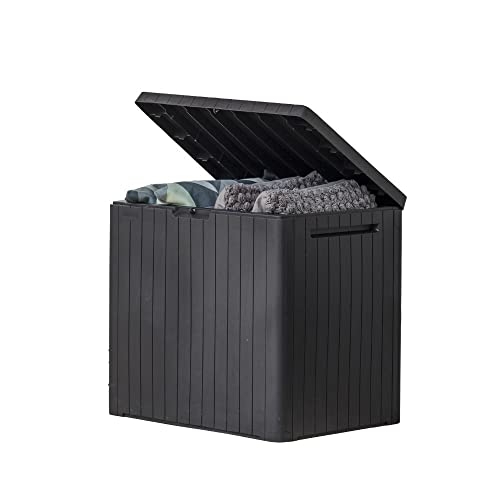
- Best overall for small patios: Keter City 30 Gallon Outdoor Storage Box, Grey — Check on Amazon
- Suncast 22 Gallon Small Deck Box, Java — Check on Amazon
- EAST OAK Outdoor Storage Box, 31 Gallon, Brown — Check on Amazon
- Devoko 30 Gallon Resin Deck Box, Black — Check on Amazon
- Keter Kentwood 50 Gallon Outdoor Storage Box, Grey — Check on Amazon
- EAST OAK Outdoor Storage Box, 60 Gallon, Grey — Check on Amazon
Read the full guide ↓
Disclosure: As an Amazon Associate, dailyhomedecorating.com earns from qualifying purchases. Links to Amazon on this page are affiliate links; they cost you nothing extra. Listing details such as price and availability change often, so check the current Amazon listing before you buy.
Finding the best outdoor storage box for small patios under $75 is an exercise in respecting arithmetic, because on a small patio every object is audited by the space itself. A chair earns its square footage by being sat in daily; a planter earns its corner by being looked at; a storage box — the largest single object most small patios will ever host — must earn its footprint twice: once for what it holds, and once for what its top does while it is holding it. The boxes that fail small patios are rarely bad boxes. They are good boxes bought by dimension-blind optimism: two inches too deep for the walking line, a lid that cannot open against the wall it was pushed against, a footprint that looked modest in a listing photograph taken in a warehouse-sized yard. This guide exists to make those mistakes impossible, by ranking the under-$75 field on the measurements and dual-duty tests that small spaces actually impose.
The first test is depth, and it is not close. Small patios — townhouse slabs, courtyard corners, the paved patch outside a garden flat — typically offer one usable wall run and a walking line that cannot be negotiated with. A box around 17 inches deep preserves that line; a box 24 inches deep consumes it and converts the patio from a room into a corridor with furniture. The second test is the lid’s second job. On a small patio, the winning box’s top is a side table, a plant stand, a serving surface or a seat — ideally at the height those jobs want, which for a side table beside standard patio chairs means roughly 21 to 22 inches. The third test is honesty of volume: small-space buyers cannot afford the category’s generous capacity math, because a box bought for 30 gallons that honestly holds 24 has not saved space, it has wasted the scarcest resource in the purchase. Every pick below publishes interior figures this guide could stand behind.
The short version: most small patios should start with the Keter City, the 30-gallon box whose footprint disappears beside a chair and whose lid lands at exact side-table height — check price on Amazon. The tightest corners belong to the Suncast 22, the smallest quality box here. And small patios with one long wall should not overlook the EAST OAK 60 at the end of this guide: it sounds like a big-patio box, but its shallow 17-inch depth makes it, paradoxically, one of the most small-patio-friendly designs in the field. All six picks are verified current listings inside this budget tier, cross-checked through Amazon’s own catalog data before earning their place.
In this guide
Quick Picks
Short on time, or comparing several options at once? Each row below names a small-patio situation and the product that suits it, with a link to the listing.
| Buyer type | Pick | Why it stands out | Link |
|---|---|---|---|
| Best overall for small patios | Keter City 30 Gallon Outdoor Storage Box, Grey | Side-table height, honest gallons, a footprint that vanishes beside a chair — check price on Amazon | Check on Amazon |
| Best for tightest corners | Suncast 22 Gallon Small Deck Box, Java | The smallest quality footprint here, with a reinforced lid and five-year warranty | Check on Amazon |
| Best shallow profile | EAST OAK Outdoor Storage Box, 31 Gallon, Brown | 31 gallons in a slim body that hugs the wall and frees the floor | Check on Amazon |
| Best budget compact | Devoko 30 Gallon Resin Deck Box, Black | The cheapest lockable 30 gallons, light enough to shift for every sweep | Check on Amazon |
| Best bigger-box compromise | Keter Kentwood 50 Gallon Outdoor Storage Box, Grey | 50 gallons that grow along the wall instead of out into the room | Check on Amazon |
| Best long-wall solution | EAST OAK Outdoor Storage Box, 60 Gallon, Grey | Family capacity at compact depth — for small patios with one long wall | Check on Amazon |
How These Picks Were Chosen
The small-patio filter ran before the price filter. A box was cut if its depth broke the 17-to-18-inch class that preserves a walking line, if its lid could not open fully in the against-the-wall position small patios force, if its top could not plausibly work as a surface, or if its capacity claim collapsed when its own interior dimensions were checked. Survivors then faced this site’s standard verification: a real, current Amazon listing inside this $75 tier, with the ASIN cross-checked through Amazon’s own catalog data so the link is the product, size and colorway the review describes. One candidate deserves an honest footnote: the YITAHOME 31 Gallon delivery-and-storage box is a real, catalog-confirmed product in this class, but Amazon’s catalog data returned no current price for it during this guide’s checks, so it is mentioned here in prose only, without a purchase link — if it appears on your own search, verify its live listing carefully before buying. Listings change, so check the current price on Amazon for every linked pick before you buy.
We have not lived with these boxes on our own patios, and this guide does not pretend otherwise. The small-space judgments — depth against walking lines, lid arcs against walls, heights against chair arms — are reasoned from published dimensions with the tape-measure skepticism this category demands, and the guide gives you the same measurements so you can repeat the reasoning against your own patio’s numbers before spending anything. That is the correct way to buy for a small space: the patio decides, the guide merely narrows the field to boxes the patio will not reject. Readers whose small space is a balcony rather than a ground-level patio will find the same field judged under lease and railing rules in Best Outdoor Storage Box For Apartments Under $75, and the same products judged purely as deck boxes in Best Deck Box For Small Patios Under $75.
The 6 Best Outdoor Storage Boxes for Small Patios Under $75
Keter City 30 Gallon Outdoor Storage Box, Grey
Who it suits: The typical small patio — two chairs, a bistro set or a single lounger — where the storage box must disappear into the furniture arrangement instead of dominating it.
The City is the small-patio benchmark because its dimensions read like they were designed by someone who had measured one. The footprint, about 22.7 × 17.3 inches, fits the dead spaces small patios actually have: beside a chair, at the end of a bench, against the wall between the door and the planter. The height, about 21.7 inches, is the masterstroke — exact side-table altitude — so the box’s top works every day as the surface for coffee, books and the candle, while the honest 30 gallons beneath it (interior roughly 21 × 16 × 20 inches) hold the cushions, throw and supplies that would otherwise live on the chairs themselves. The lid carries a maker-stated 220 lb rating, the body locks, and Keter’s two-year warranty backs the whole arrangement. It sits in the lower-middle of this tier — check price on Amazon — and on a small patio it does not feel like a compromise purchase; it feels like the missing piece of furniture.
Placement is the small-patio skill, and the City rewards it simply: against the wall with its lid arc clear, ideally with the small shelter of an eave, loaded so the lid closes flush. Owners’ recurring notes — patient snap-together assembly, and keeping an exposed box sensibly loaded — apply on a patio exactly as elsewhere, and neither involves structural failure. What small-patio owners report most, though, is the disappearance effect: a box at table height beside the seating stops reading as storage within a week, and the patio gains a room’s worth of order without losing a square foot of living space. If your patio can host exactly one box, this is the one it can host happily.
- 22.7 × 17.3 in footprint and 21.7 in side-table height — the small-patio dimensions, exactly.
- Honest 30-gallon interior with a maker-rated 220 lb lockable lid.
- Disappears into the furniture arrangement instead of dominating the space.
Honest limitation: It prefers a little shelter from driving rain, and 30 gallons is a small patio’s load — not a family’s overflow.
Choose it if your patio has chairs and clutter but no spare square meter. Skip it if your corner is tighter still — the Suncast below is the smaller footprint — or your load is a full dining set’s cushions.
Suncast 22 Gallon Small Deck Box, Java
Who it suits: The tightest small patios — the corner by the door, the end of a narrow slab, the space between planter and wall — where the box must be small first and everything else second.
The Suncast is what small-patio buyers should choose when the tape measure has already made most of the decision. At about 22 × 17 × 20.5 inches it is the smallest footprint in this guide, and its 22 gallons are honestly accounted — interior near 20.5 × 15.5 × 17 inches — enough for two chairs’ cushions, the throw, and the patio’s small working kit. What elevates it above every other truly small box is construction: US-made resin, a reinforced lid with a maker-stated 200 lb load, and a five-year limited warranty (register within 90 days) that doubles the confidence of anything else at this size. On a small patio that warranty matters doubly, because the box is always in view and always in use — its lid will hold plant pots, trays and lanterns daily, and a reinforced top is the difference between a surface and a worry. The deep Java finish blends with decking and planters, the colors small patios are actually made of. It sits mid-tier in this budget — check price on Amazon — buying build and coverage rather than gallons, which on a tiny patio is the correct trade.
The cautions are capacity and paperwork, and both are manageable with honesty. Twenty-two gallons will not grow: if your cushion pile measures bigger, believe the pile, not the hope, and take the Kentwood’s compromise below. And register the warranty the week the box arrives — the five-year headline depends on it. Within its size, this box has survived the toughest independent scrutiny of any pick here and carries the thinnest complaint profile in the guide. For the small patio whose corner is genuinely small, it is not the fallback pick; it is the correct one.
- Smallest footprint in the guide — 22 × 17 in — for corners nothing else fits.
- Reinforced lid with a stated 200 lb load: a true daily surface, not a lid you tiptoe around.
- Five-year limited warranty and US-made resin (registration required).
Honest limitation: Only 22 gallons, and the warranty needs registration — measure your cushion pile before choosing build over volume.
Choose it if your space is genuinely tight and you want it solved for years. Skip it if your load needs 40-plus gallons — small patios punish undersized boxes daily.
EAST OAK Outdoor Storage Box, 31 Gallon, Brown
Who it suits: Narrow small patios — the long, thin slab behind a townhouse, the side-return patio — where depth is the binding constraint and every box must line up against the wall in single file.
The EAST OAK 31’s small-patio case rests on one number: depth. At about 22 × 17.3 × 21.1 inches, it delivers 31 gallons while staying in the shallow class that leaves a narrow patio walkable, and its proportions — taller than it is deep — suit the way small patios actually store: watering can, spray bottles, hand tools and the folded throw, standing upright instead of stacked in a rummage pile. The brown finish suits the wood-decked, planter-heavy small patios where grey plastic reads as equipment, and the construction is EAST OAK’s established pattern of UV-resistant, lockable resin with quick snap assembly. The model’s family listing states a generous seat-load figure for the lid; this guide reports that the way it should be reported — as a family-listing claim to confirm on the live listing for this exact variant before relying on it as daily seating. As storage with a useful flat top, no caveat applies. It sits low in this tier — check price on Amazon — within reach of the budget picks while coming from a larger outdoor brand.
For small patios specifically, this is also the natural second-box geometry: one EAST OAK by the door for shoes, deliveries and cleaning supplies, one City or Suncast by the seating for cushions — two shallow stations that together organize a small patio better than any single deep box could, because each load lives where it is used and neither box breaks the walking line. If your patio’s problem is specifically narrowness, start your shortlist here and measure everything else against its depth.
- Shallow ~17-inch depth — 31 gallons that keep a narrow patio a room, not a corridor.
- Tall interior that stores the patio’s working kit upright.
- Warm brown finish and lockable, UV-resistant resin at the low end of the tier.
Honest limitation: The headline seat figure comes from the model’s family listing — confirm it on the live listing for this variant before treating the lid as rated seating.
Choose it if your patio is long and narrow. Skip it if you need one box to hold a dining set’s cushions — that is the Kentwood’s compromise, next.
Devoko 30 Gallon Resin Deck Box, Black
Who it suits: Budget-first small patios and renters of small spaces — anyone who needs real storage now, at the lowest cost, in a box light enough to rearrange the patio around on a whim.
On a small patio, lightness is a layout feature, and the Devoko is the lightest serious box here — under nine pounds empty by most listings, in a 22 × 16 × 21-inch body holding 30 gallons. That combination lets a small patio breathe: the box shifts for sweeping, rotates for guests, follows the sun-season from the shaded wall to the open corner, all one-handed, all without a plan. The essentials survive the price — weather-resistant resin, a lockable lid with a maker-stated 220 lb rating, side handles — and the price itself sits at the very bottom of this tier. Check the current price on Amazon; at this level, small-patio owners regularly solve two stations for the price of one premium box, cushions by the chairs and tools by the door, which is the correct small-space architecture anyway. The black finish hides the dust that small, hard-surfaced patios generate constantly.
The trade-offs are known and proportionate: thinner panel feel than the Keter and Suncast class, assembly that rewards alignment over force, and a smaller brand’s less certain parts support in later years. On a small patio there is one more: a light box in an exposed, windy corner should live loaded or sheltered, because weight is stability and this box brings the least of it. None of that changes the verdict for its role. Small patios punish expensive mistakes most — there is no room to hide a wrong purchase — and the Devoko’s low cost, true compact size and easy movement make it the lowest-risk way to learn what your patio actually needs from storage.
- 30 gallons in a 22 × 16 in footprint, at the lowest price in this guide.
- Under nine pounds empty — rearrange the patio one-handed, sweep behind it in seconds.
- Lockable lid with a maker-stated 220 lb rating; dirt-hiding black finish.
Honest limitation: Thinner panels and the least wind stability when empty — keep it loaded or in a sheltered corner, and assemble it patiently.
Choose it if budget and flexibility lead. Skip it if you want the decade-long, warranty-backed fixture — the Suncast above is that purchase at this size.
Keter Kentwood 50 Gallon Outdoor Storage Box, Grey
Who it suits: Small patios with a bigger load — the four-chair set on a compact slab — where 30 gallons genuinely will not do and the box must grow along the wall rather than out into the room.
The Kentwood is the small patio’s capacity compromise, and its geometry is the argument: 50 gallons in a body about 32 × 17.5 × 22.75 inches, holding the shallow depth class of the compact picks while nearly doubling their volume. On a small patio that is the only direction growth is allowed — along the wall, under the railing line, in the strip that was never going to be living space. The wood-look panels do small-patio work too: at this scale the box is always in the sightline from indoors, and a textured, furniture-reading finish keeps the view composed where a plain utility box would dominate it. Assembly is tool-free, the lid lock-ready, and the price sits mid-tier — check the current price on Amazon — with the grey finish linked here the verified in-tier configuration.
The standing caution applies with small-patio weight: Keter publishes no seat-load rating for this lid, so on a patio where every surface gets sat on, plan the Kentwood’s broad top as a serving and display surface — drinks, trays, planters — and give the seating jobs to the rated lids elsewhere in this guide. Measure the wall run before ordering, including the lid’s full opening arc against the wall; 32 inches is modest, but a small patio’s wall is often interrupted by doors, steps and drains, and the box needs its run uninterrupted. For the small patio whose load has honestly outgrown the compacts, this is the growth that does not cost the room.
- 50 gallons at compact-class depth — capacity that grows along the wall only.
- Wood-look finish that keeps the indoor sightline composed.
- Under-railing height and tool-free assembly, from Keter’s established range.
Honest limitation: No maker-published seat-load rating, and it needs an uninterrupted 32-inch wall run with lid clearance.
Choose it if your load is big but your patio is not. Skip it if rated seating matters or your wall run is broken by doors and steps — the compacts fit interrupted spaces better.
EAST OAK Outdoor Storage Box, 60 Gallon, Grey
Who it suits: The small patio with one long, unbroken wall — the courtyard, the walled garden room — where a single shallow run of storage can replace every other container the space was juggling.
This pick sounds like a contradiction and is actually the guide’s most useful insight: a 60-gallon box can be a small-patio box if its depth behaves. The EAST OAK’s body, about 42 × 17 × 21.6 inches, keeps the same 17-inch depth class as the smallest picks here — it simply extends along the wall, converting a dead strip into the patio’s entire storage system: cushions, tools, toys and the seasonal overflow in one run, behind one lockable lid that doubles as a long bench or serving surface when the patio hosts. For a walled small patio, that consolidation is transformative — three mismatched containers become one line of furniture, and the floor they occupied becomes living space again. The resin is UV resistant, assembly is the quick snap pattern of this range, and the price sits in the upper-middle of this tier — check the current price on Amazon.
The conditions are strict, and this guide states them as conditions, not footnotes. The wall run must be genuinely unbroken for about 42 inches, with the lid’s arc clear of shelves, rails and planters above. The patio must still breathe with the box in place — if the run leaves the space feeling like a corridor, the Kentwood’s shorter length is the honest choice. And a long lid prefers even loading, heavy items toward the ends, so its seal stays true. Meet those three conditions and this is the most storage a small patio can hold without apology; fail any one and the compacts above will make you happier. Small patios working to a tighter ceiling will find this field trimmed to it in Best Outdoor Storage Box Under $50, and those with room to grow into bigger budgets can compare the next tier in Best Outdoor Storage Box For Small Patios Under $150.
- 60 gallons at 17-inch compact depth — the entire storage system in one wall run.
- Long lockable lid that benches and serves when the patio hosts.
- Consolidates three mismatched containers into one line of furniture.
Honest limitation: Needs about 42 inches of unbroken wall and a patio that still breathes afterward — measure both before believing in it.
Choose it if your small patio has one long wall and many small containers to replace. Skip it if the wall run is interrupted or the space would feel corridor-like — take the Kentwood or a compact instead.
Comparison Table
| Product | Capacity | Best use | Link |
|---|---|---|---|
| Keter City Outdoor Storage Box | 30 gal | The typical small patio — side-table storage | Check on Amazon |
| Suncast Small Deck Box | 22 gal | Tightest corners — smallest quality footprint | Check on Amazon |
| EAST OAK Outdoor Storage Box, 31 Gallon | 31 gal | Narrow patios — shallow, upright storage | Check on Amazon |
| Devoko Resin Deck Box | 30 gal | Budget compact that moves with the layout | Check on Amazon |
| Keter Kentwood Outdoor Storage Box | 50 gal | Bigger loads growing along the wall | Check on Amazon |
| EAST OAK Outdoor Storage Box, 60 Gallon | 60 gal | One long wall — the whole system in one run | Check on Amazon |
How to Choose the Best Outdoor Storage Box for Small Patios Under $75
Measure three numbers before you shop: depth, run, and arc. Depth is the distance from your wall to the walking line you refuse to surrender — for most small patios it lands near 17 to 18 inches, which is why this guide’s picks cluster there. Run is the uninterrupted wall length available, breaks for doors and drains included in the calculation, not wished away. Arc is the lid’s opening path: stand at the wall, imagine the lid rising, and check nothing above or behind steals its travel. A box that passes all three numbers fits; a box that fails any one will annoy you daily, however good its reviews.
Demand the second job. On a small patio the box’s top is prime real estate. Side table at chair-arm height, plant stand, serving surface, rated seat — pick the second job your patio actually needs and let it rank the shortlist. The picks here were ordered largely by this test, and it is why a 30-gallon box with a perfect top outranks a 40-gallon box with a useless one at this scale.
Trust interior dimensions over gallons. Small-space buyers pay the highest price for capacity inflation, because the missing gallons were the whole purchase. Compare interiors, load your real cushion pile mentally against them, and remember that a box filled past its lid line stops sealing — on a small patio, where the box lives in full view, a propped-open lid is a daily confession of a buying mistake.
Think in stations when one box is not enough. Two shallow boxes — one by the seating, one by the door — organize a small patio better than one deep box, because each load lives where it is used and neither station breaks the walking line. Price the pair, not the unit; the budget picks here exist to make the pair affordable.
Keep the drain and the door swing sacred. A box over the patio drain turns the first storm into a flood at your threshold, and a box in the door’s swing turns every exit into a negotiation. Both mistakes are common, both are free to avoid, and both outrank every other consideration in this section.
Common Mistakes Small-Patio Buyers Make
Judging size from listing photographs. Product photos are shot in yards the size of your whole home. The tape measure is the only honest camera: measure your space, then the box, in that order.
Buying depth you cannot afford. Two extra inches of box depth is two inches of walking line, forever. Depth discipline is the entire small-patio game.
Forgetting the lid needs somewhere to go. A box wedged under a shelf or rail that its lid cannot clear becomes a box you open sideways, forever. Check the arc before the order, not after the delivery.
Overfilling a small box. Small boxes tempt owners to treat capacity as a challenge. A lid strained against springy cushions bows, stops sealing, and the box gets blamed for a loading decision.
Blocking drainage or the door. Covered above because it is the mistake with consequences beyond annoyance — water at the threshold and a door that cannot open are safety issues, not storage preferences.
Small-Patio Scenarios: Matching the Box to the Space You Actually Have
The bistro patio. Two chairs, a small round table, a slab the size of a parking space — the classic urban small patio. Storage here is a precision problem: cushions for exactly two chairs, a throw, the watering can for the pots that line the edge. Volume beyond 30 gallons is waste; the competition is for the corner. This scenario is the Keter City’s home ground, with the box standing in for the side table the bistro set never had room for — coffee on the lid in the morning, cushions out of it by evening, the patio’s entire soft furnishing in one 22-inch square of floor. The Suncast takes the same corner when the corner is meaner. Bistro owners should resist every upsell: on this patio, the right box is the one whose absence of bulk you feel every single day.
The family townhouse patio. A compact slab doing heavy duty — dining set for four, children’s outdoor toys in rotation, a grill at the edge. The load is a family’s; the space is not. This is the scenario the shallow-growth picks were ranked for: the Kentwood’s 50 gallons along the wall, or the EAST OAK 60’s full run where the wall allows, because the family’s storage cannot be solved by a compact and must not be solved by depth. Toy discipline decides success here: the box works when the toys’ home is the box and the reset is a nightly two minutes, and fails when the box becomes the place toys are theoretically kept while actually living on the slab. Family buyers should also weight the lock highest among the small-patio virtues — a lockable box on a family patio is child-safety equipment as much as storage.
The gardener’s courtyard. Enclosed, planted, worked daily — a small patio that is really a potting yard with a chair in it. The storage load is tools, pots, mix and feed; the aesthetic standard is the garden’s own; and the box is seen at arm’s length all day. Upright interior height and scuff-hiding texture dominate this scenario — the EAST OAK 31’s tall, shallow body and the Kentwood’s wood-look panels are its natural finalists — and the routine is a working one: tools wiped before they go in, mix bags sealed, the box swept around weekly because a courtyard shows its corners. Courtyard gardeners should also plan the seasonal inversion explicitly: the box that holds tools in summer holds the tender plants’ fleece, pots and winter protection in autumn, and deciding which load owns it in which month prevents the courtyard’s version of the rummage pile.
The rental patio. Small, borrowed, and governed by someone else’s rules — the ground-level cousin of the balcony problem. Freestanding, light, movable in minutes, nothing fixed and nothing staining the slab: the Devoko’s low commitment and the City’s proven footprint lead this scenario, and the purchase logic is the renter’s logic of exit cost — the box must be worth carrying to the next home, or cheap enough to leave without pain. Rental buyers should photograph the patio before the box arrives, place the box on a mat or pavers rather than bare slab where staining is a deposit risk, and keep the assembly instructions; the box that flat-packs out as easily as it came in is the one that survives the move.
Living With the Box: The Small-Patio Routine
Small patios reward a light-touch routine because everything is close enough to touch. Sweep behind the box monthly — the hidden strip collects leaves and grit that hold moisture against the panels — a job the lighter picks here make trivial. Wipe the lid before guests without being asked by the calendar; on a small patio the box is always in the photograph. Once a season, empty it fully, check the lid still closes flush and the lock turns, and evict whatever insects have prospected the seams. And protect the walking line like a religion: the box’s success on a small patio is measured by how completely the space forgets it is storage, and that forgetting is a habit, renewed every time something is put inside rather than beside. Do those small things and a small patio with the right box feels larger than a big patio with the wrong one — which is, in the end, the entire promise of buying storage by measurement instead of by hope.
Materials and Finishes at Small Scale
Small patios see their furniture at reading distance, which makes finish a functional decision rather than a decorative one. Smooth, light-colored resin shows everything a small hard-surfaced space produces — dust, pollen, water spots, the scuff of a chair leg — and on a patio where the box is never more than a few feet from a seated eye, that evidence is always visible; the wipe-down habit in this guide’s routine section is the price of a pale box, and owners who know they will not pay it should buy dark or textured. Textured and wood-look finishes, like the Kentwood’s, forgive the same evidence almost entirely, which is why they punch above their price in small spaces: they keep the sightline from the kitchen window composed on the days nobody has cleaned anything. Color interacts with heat as well — a black box in a sun-trap courtyard runs noticeably warmer inside than a grey one, a consideration for anything stored that dislikes heat, from candles to aerosol garden sprays — while pale finishes in shaded patios can mildew-spot if they are never wiped. None of this outweighs the dimensional tests that lead this guide; a perfectly finished box that breaks the walking line is still the wrong box. But between two boxes that both fit, at small scale, finish is the difference between storage that disappears and storage that announces itself every day — and disappearing is the whole art of the small patio.
When the Small Patio Outgrows Every Box Here
An honest guide ends by naming its own boundary. If your load includes long-handled tools, a folded lounge set, or the equipment of a serious hobby, no box in this guide — or at this budget — will hold it, and forcing the purchase produces the propped lid and the overflow pile this guide exists to prevent. The correct moves at that point are structural, not hopeful: a narrow vertical storage cabinet against the wall for the long and tall things, a small shed where the plot allows one, or a deliberate decision to store the seasonal layer indoors and keep the patio box for the daily layer only. Most small patios, honestly audited, discover their true load fits the daily-layer definition comfortably — cushions, throws, tools of the hand, the evening’s equipment — and for that load the six boxes above are not a compromise at all. They are the right size of answer, in the right depth, at the right height, which is all a small patio has ever asked of anything placed on it.
Final Recommendation
For most small patios, buy the Keter City: the footprint that vanishes, the lid at side-table height, the honest 30 gallons — check price on Amazon. Take the Suncast for the tightest corner and the longest warranty, the EAST OAK 31 for a narrow patio’s shallow run, and the Devoko when budget and flexibility lead. Grow to the Kentwood only along the wall, and to the EAST OAK 60 only when one long unbroken wall invites it. Measured honestly and placed with the lid’s arc in mind, any of the six will make a small patio feel bigger — the rarest trick in this entire category.
Frequently Asked Questions
What size storage box is best for a small patio?
Most small patios are best served by 22 to 31 gallons in a shallow body around 17 inches deep. That class stores two chairs’ cushions and the patio’s working kit while preserving the walking line. Larger loads should grow along the wall — 50 to 60 gallons at the same shallow depth — never outward into the room.
How deep can a storage box be on a small patio?
Measure from your wall to the walking line you refuse to give up; for most small patios that allows roughly 17 to 18 inches of depth. Every pick in this guide was filtered against that class of depth for exactly this reason.
Can a storage box double as a table on a small patio?
Yes — it is the defining small-patio strategy. A box around 21 to 22 inches tall, like the Keter City, lands at side-table height beside standard patio chairs, so its lid works daily as a surface while the interior stores.
Is one big box or two small boxes better for a small patio?
Usually two shallow stations — one by the seating, one by the door — because each load lives where it is used and neither breaks the walking line. The exception is the small patio with one long unbroken wall, where a single shallow 60-gallon run consolidates everything elegantly.
How do I stop a small patio storage box looking like clutter?
Choose furniture-reading finishes, keep the lid closed and wiped, and never let items accumulate on top of it between uses. A box that is treated as furniture looks like furniture; a box used as a shelf looks like storage.
Should a small patio storage box sit on the slab or on a mat or pavers?
On a mat, pavers or decking tiles whenever the slab is bare concrete — the small elevation keeps the floor panel out of standing water after rain, protects rental slabs from marks, and makes the monthly sweep-behind genuinely easy. On an already paved or decked patio, the box can sit directly on the surface; just keep the spot level so the lid keeps sealing square.
What should I store in a small patio box first?
Start with whatever currently lives on the chairs: cushions and throws first, then the items that migrate indoors every night — candles, the watering can, plant supplies. When those have a home, add the seasonal layer. The discipline that keeps a small box working is subtraction: anything that has not been used outdoors this season belongs in the garage, not in the patio’s scarcest square feet.


