Where to buy
Check the latest price, availability and delivery on Amazon. Orders are placed on Amazon. We may earn a commission from qualifying purchases.
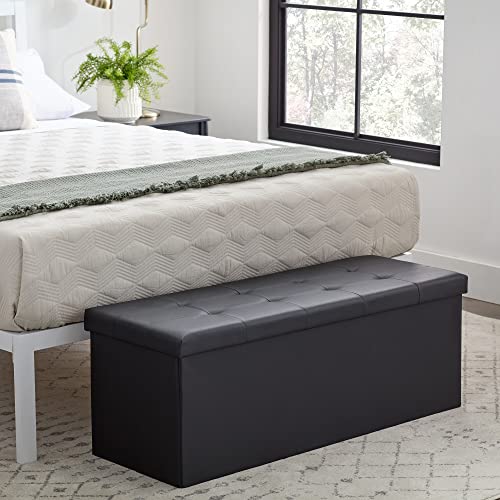
- Best for families overall: Edenbrook 43″ Bench Storage Ottoman, Black Faux Leather — Check on Amazon
- SimpliHome Harrison 36″ Lift-Top Storage Ottoman, Chocolate Brown — Check on Amazon
- Christopher Knight Home Ottilie Fabric Storage Ottoman, Dark Blue — Check on Amazon
- HomePop Luxury 32″ Square Storage Ottoman, Slate Gray — Check on Amazon
- SimpliHome Harrison 40″ Lift-Top Storage Ottoman, Midnight Black — Check on Amazon
- Poly & Bark Napa Ottoman, Midnight Blue — Check on Amazon
Read the full guide ↓
Disclosure: As an Amazon Associate, dailyhomedecorating.com earns from qualifying purchases. Links to Amazon on this page are affiliate links; they cost you nothing extra. Listing details such as price and availability change often, so check the current Amazon listing before you buy.
Finding the best ottoman for families under $1000 is less about finding an ottoman — any search returns hundreds — and more about deciding what an ottoman at this level has to do in your room. For a family room, the brief changes completely: the ottoman will be a footrest, a fort component, a snack table, a toy vault and occasionally a stage, sometimes before lunch. Under $1000, you can buy ottomans built honestly enough for that life — published weight capacities, wipe-clean surfaces, hinged storage that survives daily opening — and you can also buy beautiful leather pieces that will record every juice box in their grain. This guide sorts the category by family reality first and looks second, using only verified listings and maker-published numbers.
Three family tests decided this list. First, can it be cleaned at 9pm with a cloth and no research? Vegan and faux leathers pass instantly; fabrics pass with prompt blotting; full-grain leather passes with character — it survives, but it remembers. Second, can it be sat on, climbed on and perched on without a wince? Published capacities and bench forms lead here. Third, does its storage match family clutter, which is bulky, daily and endless? Long benches and lift-tops beat small cubes every time. Every pick below passed at least two of the three tests outright, and the one that trades cleanability for heirloom leather says so plainly.
Our short answer for families: start with the Edenbrook bench — a published capacity, wipe-clean faux leather and 43 inches of storage — or the SimpliHome Harrison 36-inch if a lift-top coffee-table form fits your room better. The Ottilie swallows the blanket collection whole, the HomePop suits smaller family rooms, and the Napa is the one grown-up leather piece for households past the spill-every-hour years. Each review below is honest about which family stage each ottoman truly suits. If your budget is actually lower, our companion guide to Best Ottoman Under $700 covers the tier below, and if storage is the whole point, Best Storage Ottoman Under $1000 goes deeper on concealed capacity.
In this guide
Quick Picks: best ottoman for families under $1000
In a hurry? This table matches each ottoman to the job it does best. Every linked pick sits under the $1000 ceiling — check the live listing for the current price before you buy, and note the one direct-sale pick, which is priced on the maker’s own site.
| Buyer type | Pick | Why it stands out | Link |
|---|---|---|---|
| Best for families overall | Edenbrook 43″ Bench Storage Ottoman, Black Faux Leather | 43-inch bench; tufted faux leather; stated 330 lb capacity; model EH0002OST43FK | Check on Amazon |
| Best lift-top for family rooms | SimpliHome Harrison 36″ Lift-Top Storage Ottoman, Chocolate Brown | 36-inch square; vegan leather; lift-top hidden storage; model AXCOT-265-DTP-P | Check on Amazon |
| Best blanket storage | Christopher Knight Home Ottilie Fabric Storage Ottoman, Dark Blue | 51.5″W x 17.75″D x 15.75″H; fabric storage bench; model 299824 | Check on Amazon |
| Best for smaller family rooms | HomePop Luxury 32″ Square Storage Ottoman, Slate Gray | 32-inch square; lift-off lid storage; model K8561-F2182 | Check on Amazon |
| Best for sectionals | SimpliHome Harrison 40″ Lift-Top Storage Ottoman, Midnight Black | 40-inch square; vegan leather; lift-top hidden storage | Check on Amazon |
| Best leather for older kids | Poly & Bark Napa Ottoman, Midnight Blue | Full-grain semi-aniline Italian-tanned leather; model PB-LR-700-BLU | Check on Amazon |
How we chose these ottomans
Family selection started with safety and honesty checks: a published weight capacity where the maker offers one, no product subject to a CPSC recall, and dimensions verified against the listing so the piece that arrives matches the plan. We required storage in most picks, because family living rooms generate exactly the clutter — throws, games, chargers, toy overflow — that an ottoman is uniquely placed to hide, and we favored wipe-clean surfaces in all but one deliberate exception.
That exception is the Poly & Bark Napa, included because families are not a single stage. Households with older children, or a family room that doubles as the good room, may rationally choose full-grain leather and accept its care. We also kept one direct-sale benchmark, the Burrow Nomad, prose-only because it has no official Amazon US listing to link — its modular, replaceable-part logic is genuinely family-friendly thinking. Prices move, so check the current price on Amazon for every linked pick; all were under the $1000 ceiling when verified.
The 6 best ottomans under $1000, reviewed
1. Edenbrook 43″ Bench Storage Ottoman, Black Faux Leather — best for families overall
The Edenbrook 43″ — the Edenbrook is a 43-inch tufted bench ottoman in black faux leather with a stated 330 lb capacity — a number the maker publishes, and the kind of honesty that matters when an ottoman will be sat on, stood on to reach a shelf, and generally treated as household infrastructure. The bench form stores along its length, the faux leather wipes clean, and the black finish shrugs off the scuffs that family life delivers daily.
Who it suits: households needing a bench that is rated, wipeable and long enough for the whole blanket-and-toy economy.
Pros: published 330 lb capacity — engineered margin you can verify; 43-inch bench storage; wipe-clean faux leather in forgiving black; tufted top keeps its shape under sitting.
Honest limitation: faux leather is the pragmatic surface, not the luxurious one — it will not age like the full-grain picks — and a 43-inch bench needs its wall or sofa length measured before ordering.
Choose it if you want a rated, wipeable bench the whole family can use hard. Skip it if you want genuine leather above all. Check on Amazon
A published capacity is family paperwork: it tells you the frame was engineered for sitting, perching and the occasional ill-advised stand, not just for feet.
A bench with a published capacity invites a different kind of use: it becomes the household’s utility seat — the place to sit while putting on shoes, the perch for a laptop during a call, the extra dining seat at a crowded table. That versatility is exactly why the stated figure matters, and why we weight it heavily in family contexts. Treat the number as a ceiling with margin, not a target, and the frame will repay the respect with years of unremarkable, dependable service.
2. SimpliHome Harrison 36″ Lift-Top Storage Ottoman, Chocolate Brown — best lift-top for family rooms
The Harrison 36″ — the Harrison 36-inch is the practical heart of this guide: a square coffee-table ottoman in chocolate brown vegan leather whose top lifts on a hinge mechanism to reveal hidden storage, so you can reach the blankets without clearing the tray, the remotes and the book off the surface first. SimpliHome builds it on a solid and engineered wood frame with high-density foam padding and stitched tufting, and the 36-inch square top is the classic coffee-table footprint for a standard three-seat sofa.
Who it suits: families whose coffee table must hide clutter and open without unloading snacks and homework.
Pros: lift-top storage you can open without unloading the surface; 36-inch square coffee-table footprint; vegan leather wipes clean in seconds; stitched tufting reads tailored rather than plain.
Honest limitation: vegan leather, however good, will not develop the patina of the full-grain picks and typically shows wear sooner under heavy daily use; the lift mechanism also means the top is a working surface, not a seat you should park on the edge of.
Choose it if your family room needs a lift-top table and vault in one. Skip it if you need bench length for two sitters. Check on Amazon
Daily storage needs a daily mechanism — a lift-top that opens without unloading the surface is the difference between storage used and storage ignored.
The 36-inch square is the most measured footprint in furniture: it matches the classic coffee-table proportion for a three-seat sofa, leaves standard legroom on both long sides, and fits the majority of living-room rugs without swallowing them. Within that proven outline, the Harrison’s contribution is the mechanism and the vault beneath it. Judge it as infrastructure — the piece that quietly ends the nightly migration of blankets, remotes and game controllers back to their cupboards.
3. Christopher Knight Home Ottilie Fabric Storage Ottoman, Dark Blue — best blanket storage
The Ottilie Ottoman — the Ottilie is a long fabric storage bench — 51.5 inches wide, 17.75 inches deep and 15.75 inches high — in a dark blue upholstery that works at the foot of a sofa, under a window or at the end of a bed. The whole seat lifts to reveal storage along its full length, which makes it the best blanket-and-throw vault in this guide, and the bench form seats two in a pinch in a way no square ottoman can. Christopher Knight Home (GDF Studio) publishes full dimensions for it, which is the honesty we require at any price.
Who it suits: blanket-heavy family rooms, window seats and end-of-sofa placements where two kids need to perch at once.
Pros: 51.5-inch length stores more than any cube here; bench form doubles as window or entry seating; published dimensions (51.5 x 17.75 x 15.75 inches) let you plan precisely; dark blue fabric hides everyday soil well.
Honest limitation: fabric needs vacuuming and prompt spill attention where vegan leather just wipes, and the long, low form is a footrest and bench rather than a coffee-table surface — trays sit less securely than on the square picks.
Choose it if blankets and throws are your main clutter. Skip it if you need a flat tray surface daily. Check on Amazon
Family clutter is long and soft: throws, cushions and costume pieces fit a bench interior in a way they never fit a cube.
A bench earns its place along edges: the foot of a sofa, the length of a window, the end of a bed. In each position its shallowness is the feature — under eighteen inches of depth buys back floor that a cube would consume — while its length returns the storage and seating the depth surrendered. If you are choosing between this bench and a square of similar price, ask where the piece will live: against a length, choose the bench; in the center of a rug, choose the square.
4. HomePop Luxury 32″ Square Storage Ottoman, Slate Gray — best for smaller family rooms
The HomePop 32″ — the HomePop Luxury square is a 32-inch storage ottoman with a lift-off lid, in slate gray — the size sweet spot for apartments and smaller living rooms where a 36- or 40-inch piece crowds the rug. The lid lifts straight off to a storage interior sized for throws, games and the remote collection, the gray upholstery is the easiest color in the guide to match to an existing sofa, and HomePop’s long history in accent furniture shows in the finishing details.
Who it suits: smaller family rooms and apartments where a 32-inch footprint must still store and seat.
Pros: 32-inch footprint fits rooms the bigger picks overwhelm; lift-off lid storage; slate gray matches almost any existing sofa; an established accent-furniture maker with a published model number (K8561-F2182).
Honest limitation: a lift-off lid must go somewhere while you dig inside — the lift-top Harrisons are slicker for daily access — and 32 inches is a coffee table for a loveseat, not for a wide sectional.
Choose it if your family room is compact but still needs storage. Skip it if you have a wide sectional to balance. Check on Amazon
In a smaller family room the winning move is density — one 32-inch piece doing three jobs beats three pieces doing one each.
Thirty-two inches is the footprint that respects small rooms while still behaving like furniture: two people can share it as a seat, a tray sits securely, and the interior takes the standard throw-and-games load. Its other virtue is neutrality — slate gray is the tone least likely to fight an existing sofa, a landlord’s wall color or next year’s cushions — which is why this pick recurs across our small-space guides as the default recommendation.
5. SimpliHome Harrison 40″ Lift-Top Storage Ottoman, Midnight Black — best for sectionals
The Harrison 40″ — the Harrison in its 40-inch size and Midnight Black finish is the big-room version of the same idea: a large square lift-top ottoman in vegan leather with hidden storage, a sturdy base and the scale to sit in front of a sectional without looking lost. Black is the most forgiving color in a busy household — crumbs, scuffs and pet hair all show less — and the larger top swallows a serving tray, a laptop and feet simultaneously, which is the real test of a coffee-table ottoman.
Who it suits: sectional family rooms needing the largest wipe-clean storage top in this guide.
Pros: the largest storage footprint in this guide; lift-top access to hidden storage; black vegan leather is the lowest-maintenance finish here; scale suits sectionals and open-plan rooms.
Honest limitation: scale cuts both ways — a 40-inch square needs a room that can carry it, plus clearance for the lifting top — and as with the 36-inch, the upholstery is vegan leather rather than genuine hide.
Choose it if you run a sectional and need the biggest wipe-clean top. Skip it if your room is small. Check on Amazon
Black wipe-clean upholstery is the family-room camouflage: crumbs, scuffs and pet hair all show less, and the 40-inch top hosts homework and trays together.
Forty inches is where an ottoman stops being an accessory and becomes the room’s center of gravity, and that is a deliberate choice rather than an upgrade. In a sectional layout it restores proportion — smaller pieces read as footstools lost in a landscape — and its storage volume absorbs the oversized, awkward clutter that defeats smaller interiors. The discipline it demands is clearance: walkways, the lift arc and rug borders all need their inches, measured before ordering, not negotiated after delivery.
6. Poly & Bark Napa Ottoman, Midnight Blue — best leather for older kids
The Napa Ottoman — the Napa is the genuine-leather anchor of this guide. Poly & Bark upholsters it in full-grain, semi-aniline, Italian-tanned leather — the grade that keeps the hide’s natural grain, develops patina instead of peeling, and justifies spending toward the top of an under-$1000 budget. The Midnight Blue finish is deep enough to read almost neutral in low light while still giving a room a deliberate color note, and the low, tailored profile pairs with the matching Napa sofa line or stands alone in front of almost any three-seater.
Who it suits: households with older children who want one genuine-leather piece that will outlast the toy years.
Pros: full-grain Italian-tanned leather that ages rather than flakes; a color with real depth that still behaves like a neutral; construction from a maker that publishes its materials honestly; a silhouette that works as footrest, extra seat and tray table in turn.
Honest limitation: genuine aniline-family leather shows marks honestly — water spots, scratches and sun fading are part of ownership, it wants conditioning a couple of times a year, and there is no hidden storage inside, so if concealed blanket space is the priority, look at the lift-top picks below.
Choose it if your kids are older and you want heirloom leather. Skip it if your household is still in the spill-every-hour years. Check on Amazon
Genuine leather in a family home is a stage decision, not a quality one: past the constant-spill years it becomes the most durable surface in this guide.
Ownership rhythm matters with a piece like this. In the first month, the leather will take the room’s light unevenly and may look patchy in photographs; by the third month the tones even out as the surface oxidizes uniformly, and by the end of the first year the top will carry a soft sheen exactly where feet and trays land. That timeline is the product working as designed. Households who want day-one uniformity forever should choose a corrected or vegan surface instead — an honest preference, and one this guide serves with other picks.
Comparison table
| Pick | Size | Upholstery | Seat height | Stated capacity | Best for |
|---|---|---|---|---|---|
| Edenbrook 43″ | 43″ bench | Faux leather | — | 330 lb | Best for families overall |
| Harrison 36″ | 36″ square | Vegan leather | — | Per listing | Best lift-top for family rooms |
| Ottilie Ottoman | 51.5″ x 17.75″ x 15.75″ | Fabric | 15.75″ | Per listing | Best blanket storage |
| HomePop 32″ | 32″ square | Fabric (slate gray) | — | Per listing | Best for smaller family rooms |
| Harrison 40″ | 40″ square | Vegan leather | — | Per listing | Best for sectionals |
| Napa Ottoman | Full-grain leather | — | Per listing | Leather footrest / seat | Best leather for older kids |
Read the size column first. An ottoman’s footprint decides whether it serves the room or colonizes it, and the dimensions above are the verified figures from each listing or maker — where a listing does not publish a figure, we say so rather than inventing one, and that gap is your cue to confirm on the live page before ordering.
How to choose: best ottoman for families under $1000
Start with the job, not the shape. Decide which of the four ottoman jobs leads: footrest, coffee table, storage or extra seating. A footrest wants a height within about an inch of your sofa’s seat height and a top soft enough for heels. A coffee-table ottoman wants a flat, stable top of at least 32 inches and benefits from a tray habit. Storage wants a mechanism you will actually open daily — lift-top beats lift-off for frequency. Seating wants a published capacity and a firmer top. Naming the lead job first eliminates most of the catalogue honestly.
Spend the budget on surface and structure. At under $1000 the money should be visible in two places: the upholstery grade and the frame. Full-grain leather, feather-blend tops and solid or rubberwood frames are what this tier exists to buy. Be suspicious of any listing at this level that will not name its frame material or its leather grade — vagueness at a premium price is a decision, and it is not being made in your favor. Published dimensions and model numbers, as on every pick here, are the paperwork of an honest product.
Match height and footprint to the sofa. Tape the footprint on the rug before ordering: a coffee-table ottoman should leave roughly 14 to 18 inches between its edge and the sofa for legs, and walkways around it should stay near 24 inches where the room allows. Height matters as much — a footrest noticeably higher than the sofa seat pushes knees up, and one much lower turns into a trip ledge. The verified dimensions in the comparison table above are the numbers to tape with.
Plan the surface strategy. Upholstered tops and drinks coexist through trays: a rigid tray with a lip turns any pick here into a stable table and comes off in one hand when the piece returns to footrest duty. Households with toddlers often prefer the round Ascot for its corner-free circulation; households with laptops often prefer the square Harrisons for their flatter, larger tops. Neither is wrong — the room’s traffic pattern decides.
Common mistakes when buying an ottoman at this level
Buying the photograph instead of the dimensions. Furniture photography shrinks rooms and stretches ottomans. A 40-inch piece that looks modest online can dominate a real rug. Every pick here publishes dimensions — tape them on the floor and live with the outline for a day before ordering.
Paying premium prices for unnamed materials. At this tier, ‘leather’ without a grade and ‘wood frame’ without a type are red flags. Full-grain, bonded and vegan leathers are three different products at three different lifespans; the listing should tell you which one your money buys.
Forgetting that storage has a mechanism cost. A lift-off lid is fine for seasonal storage and irritating for daily storage, because the tray and drinks must move every time. Match the opening mechanism to how often you will honestly open it.
Ignoring capacity because ‘it is only an ottoman’. Ottomans get sat on, perched on and occasionally stood on. A published capacity — like the Edenbrook bench’s stated figure in our family guide — signals an engineered frame. Silence on capacity at this price deserves a question, not a shrug.
Matching the sofa exactly. An ottoman that perfectly matches the sofa fabric reads as a set and ages as one too. Contrast in texture — leather against fabric, cognac against gray — is what makes the piece look chosen, and it frees the ottoman to move rooms later.
Final recommendation
For most families, durability paperwork beats beauty: a published capacity, a surface that wipes clean and storage that opens with one hand will be thanked every single day, while delicate finishes will be apologized to. Start with the Edenbrook 43″ if you want the safest all-round answer, and consider the Harrison 36″ as the strong alternative for the opposite priority. Whichever you choose, tape the footprint on your floor, confirm the current price on Amazon before you buy, and keep the packaging until the piece has survived a week of real evenings.
Ottoman forms, explained
Shopping this category gets easier once the forms have names, because the name predicts the ownership experience. The pouf and the tailored footrest — the Porto and the Napa here — are pure comfort pieces: no storage, no mechanism, nothing to fail, and a softness-first top. The coffee-table ottoman — the Ascot and the Harrisons — trades some of that softness for a flat, stable, table-sized top, and usually hides the storage the footrest lacks. The bench — the Ottilie — trades table geometry for length, seating and long-item storage. The modular ottoman — the Burrow — trades all of the above for reconfigurability. None is superior; they are answers to different first questions.
Visual weight matters as much as form. A leather pouf is physically modest and visually quiet; a 40-inch round ottoman is physically large and, being corner-free and low, visually calmer than a square of the same size. Rooms with heavy sofas usually want the ottoman to lighten the composition; rooms of light, leggy furniture can absorb — and often need — the grounding mass of a big upholstered centerpiece. Photograph your room from the doorway and judge the ottoman’s outline there; the doorway view is the one you will live with.
Care and longevity at this price tier
A premium ottoman should be maintained like the long-term furniture it is. Full-grain leather wants dusting with a dry cloth and a conditioner roughly twice a year, more in dry or sunlit rooms; small scratches usually buff into the patina rather than needing repair. Vegan and faux leathers ask less — a damp cloth, no solvents, distance from radiators — and give less back in lifespan. Fabric benches want weekly vacuuming with an upholstery tool, because grit worked into a weave is what dulls it, and spills blotted, never rubbed.
Structure needs a moment of attention too. Check glides and feet twice a year, rotate how a favorite ottoman is used so foam recovers evenly, and respect any published capacity as a real engineering limit rather than a suggestion. Treated this way, the leather picks in this guide should give a decade or more of service — which is the actual math of the under-$1000 tier: divided by years of evenings, the premium ottoman is the cheapest seat in the house.
What the under-$1000 tier buys — and what it does not
It helps to know where this budget sits. The tier below, covered by our under-$700 guide, buys competent ottomans with engineered frames and honest fabrics. The under-$1000 tier is where the compromises start disappearing: full-grain leather instead of exclusively faux, feather-blend tops, lift mechanisms, published capacities and established makers competing directly. Construction you cannot see in a photograph — corner blocking, high-resilience foam, real hinge hardware — lives in this tier and the one above it.
Above this tier, designer and heritage brands charge multiples more for provenance and hand-finishing. Some of that premium is real and some is the name. The honest summary is that under $1000 captures most of the functional quality available in an ottoman while leaving the collectible premium unpaid. What it does not buy: custom upholstery programs, made-to-order sizes, or exemption from checking specs. Vague listings exist at every price, and the discipline of verifying dimensions, materials and capacities matters as much here as at a third of the budget.
Delivery, assembly and the first-week check
Ottomans at this level arrive in three formats, and knowing which one you ordered prevents a disappointed first evening. Fully finished pieces — the leather poufs and the Burrow in this guide — need only unboxing and a level floor. Legs-only assembly, common on the storage squares and benches, is a ten-minute job: work on a rug to protect both floor and finish, start every bolt by hand before tightening any of them, and tighten in a cross pattern so the frame pulls down square. Pieces with lift mechanisms need one extra check at the door: open and close the top several times before the delivery window closes, because a hinge that binds on day one will not improve by day thirty.
The first-week check takes five minutes and catches nearly every problem while it is still the seller’s problem. Sit, perch and shift your weight side to side: movement should come from the cushion, not the frame, and any creak localized to a joint deserves a bolt check before it deserves a complaint. Run a hand along seams and welting for skipped stitching, check that a lift-top opens to its full arc without fouling the wall behind it, and confirm the piece sits level — a rock on a hard floor usually means a glide needs adjusting, not that the frame is warped. Photograph the ottoman on arrival day, too. If a finish flaw emerges later, a dated photo settles whose problem it is. Keep the box and packaging until the piece has survived a week of real evenings; returns of large upholstered furniture without packaging range from awkward to impossible.
Styling the ottoman in a real room
An ottoman succeeds or fails as part of a small system, and the system has three other members. The first is the rug: an ottoman should sit fully on the rug or fully off it, never half and half, and in most layouts the front legs of the sofa and the whole ottoman share the rug’s field, which is what makes the grouping read as one place rather than furniture in transit. The second member is a tray. Choose one with a lip, sized to the ottoman’s top with margin to spare, in a material that contrasts with the upholstery — wood on leather, metal on fabric — because that contrast is what turns a soft surface into a deliberate table. The third member is light: a footrest beside a reading chair needs a lamp behind the shoulder, and a coffee-table ottoman needs enough ambient light that its surface works after dark.
Color discipline is the last styling skill, and it is mostly restraint. The ottoman should share exactly one strong relationship with the room — the sofa’s color family, the rug’s accent tone, or the wood finish of the side tables — and be free in every other respect. That single link is what makes cognac read as chosen against a gray sofa, or midnight blue read as depth against white walls. Resist the second and third links; each one you add moves the piece from accent toward set, and sets are what dates a room fastest. When in doubt, change the texture and keep the tone: a leather ottoman against a fabric sofa in a neighboring shade will look intentional in every photograph you ever take of the room.
Ottoman materials, decoded
Listings use leather vocabulary loosely, so here is the honest ladder this guide’s picks sit on. Full-grain leather is the hide’s original surface, grain intact, nothing sanded away. It is the strongest upholstery material in this category, it breathes, and it is the only one that develops patina — the deepening sheen that makes a five-year-old piece look better than a new one. Semi-aniline finishing adds a whisper of pigment and protection to that full-grain surface; it is the practical luxury grade, and it is what the Poly & Bark picks in this guide use. Top-grain leather has been lightly corrected for uniformity — a legitimate material, one step below full-grain in character and price.
Below those sit the engineered surfaces, and they are not dishonest — they are different products. Bonded leather is leather fibre reconstituted in a binder with a finished surface; it looks tailored and costs less, and its lifespan under hard use is shorter. Vegan and faux leathers are synthetic surfaces — usually polyurethane over a backing — engineered to wipe clean, resist soaking and hold color uniformly. They will never develop patina and will eventually wear at edges and folds, but for spill-dense years of a household’s life they are frequently the rational choice, which is why this guide recommends them without apology in the family and storage roles. Fabric upholstery — the Ottilie bench and the slate HomePop — trades wipe-clean ease for softness, silence and color range, and asks for vacuuming and prompt blotting in return.
Inside the upholstery, two more materials decide how an ottoman ages. The first is the frame: solid wood and rubberwood frames, corner-blocked where makers bother, outlast pure engineered-board frames under sitting loads, and a maker’s willingness to name the frame material is the cheapest quality signal in any listing. The second is the fill. High-resilience foam holds its shape for years; low-density foam feels wonderful in the showroom month and hollows by the second year. A feather-blend topper, as on the Ascot, is not the structure — it is the comfort layer over a foam core, and the combination is what premium pricing at this tier is actually buying. When a listing names its leather grade, its frame and its fill, you are reading an honest product. When it names none of them, you are reading an advertisement.
Measuring your room for an ottoman: a worked method
Every mistake section in this series returns to the same failure — ordering from a photograph — so here is the method that prevents it, start to finish. First, measure the sofa: its seat height, and the length of the front the ottoman will serve. Second, lay painter’s tape on the rug at the exact footprint of the ottoman you are considering, using the verified dimensions from this guide’s comparison table — not the rounded numbers in a listing’s headline. Third, live with the tape for a full day of normal use. Walk the routes you actually walk: sofa to door, chair to kitchen, the path a child takes at speed. If the tape interrupts a route, the furniture will too, only heavier.
Fourth, test the heights with substitutes. Stack cushions or books to the ottoman’s stated height in front of the sofa and rest your feet at that level for an evening; an inch too high announces itself in your knees within twenty minutes, and an inch too low turns the piece into a ledge you step over rather than use. Fifth, for storage models, act out the mechanism: a lift-top needs its arc clear of the sofa front and any tray habit you keep, and a bench needs a wall or sofa length that matches its own, plus a hand’s width at each end so the lid opens without argument. Sixth, measure the journey, not just the destination: door widths, the hallway turn, the stairwell angle. The verified dimensions in this guide exist so that all six steps can happen before money moves — the cheapest design tool in furniture is still a roll of tape and one honest evening.
A note on value over time
The fairest way to judge an ottoman at this tier is cost per year of evenings. A piece that serves daily for a decade — as the full-grain leather and honestly framed picks in this guide are built to do — costs less per year than a budget ottoman replaced three times, and it avoids the quiet waste of furniture that fails young. That math only holds, however, if the first purchase is the right one: the right size for the room, the right surface for the household, and the right form for the job it will actually do. Every section above exists to make that first decision the final one — the measurements taped, the materials named, the limitations stated before the box arrives rather than discovered after it. Buy once, buy verified, and the under-$1000 ceiling stops looking like a splurge and starts looking like what it is: the price of not thinking about ottomans again for ten years.
FAQ
What is the most durable ottoman surface for kids? Wipe-clean faux and vegan leathers lead, because spills, markers and snacks come off with a damp cloth and nothing soaks in. Performance fabrics are the next tier. Full-grain leather survives family life but records it — scratches and spots become patina — so it suits older-child households best.
How much weight should a family ottoman hold? Look for a maker-published capacity and treat it as the real limit; the Edenbrook bench in this guide publishes a 330 lb figure, which is the kind of engineered margin a household piece should state. Where no capacity is published, use the ottoman as a footrest first.
Are lift-top ottomans safe around small children? Hinged lift-tops should be opened and closed by adults, and the storage inside should not hold anything a child should not reach. Keep fingers-clear habits from day one, and never let a child sit inside a storage ottoman or on a raised lid.
What size storage ottoman suits a family room? Match storage volume to the clutter: a household blanket collection alone fills a small cube. Benches of 43 inches and up, and 36-inch lift-top squares, are the sizes that actually end the evening tidy-up argument in most family rooms.
Can a family ottoman replace a coffee table? Yes, with a tray habit for drinks and a top of at least 32 inches. The lift-top picks here are designed for exactly that double duty, and their storage is the bonus a wooden table can never offer.
Where should I look for matching pieces? Start with the seating group around the ottoman: Best Coffee Table Under $1000 if you are comparing table-versus-ottoman layouts, and Best Accent Chair Under $1000 for the seat that pairs with it.


