Disclosure: As an Amazon Associate, dailyhomedecorating.com earns from qualifying purchases. Links to Amazon on this page are affiliate links; they cost you nothing extra. Prices and availability change often, so check the current Amazon listing before you buy.
Shopping for the best neck pillows for airplane means sorting honest engineering from label language, and this guide does the sorting for you. We compared the strongest verified options for this exact need – their construction, their adjustability, and the positions and people they genuinely suit – and ranked six picks below, each with its trade-offs stated plainly. If you only read one section, make it the Quick Picks table; if you read two, add the buying guide, because fit matters more than brand in this category.
Airplane seats are engineered for sitting, not sleeping: upright backs, narrow headrests, and a neighbor’s elbow at exactly head height. The result is the familiar travel-neck – hours of your head tipping, sliding and jolting awake. Our verified pool for this series is bed pillows, so we are transparent below about which picks are true travel products described in prose and which bed-pillow pick doubles for the road; the travel-specific designs are covered honestly without purchase links rather than pretending a bed pillow belongs in a cabin.
We judged travel designs on the two failure directions – forward drop and sideways slide – plus packability, and we flagged every prose-only pick clearly in the sources file. Readers working through the wider topic often pair this guide with our coverage of Best Pillows For Allergies, which approaches the same sleep setup from a different angle.
Where to Buy
Every linked pick in this guide is sold on Amazon, where you can check the current price, availability and delivery options on the listing itself. We do not print prices here because they change too often to stay honest. Prose-only picks – included where our verified pool has a genuine gap for this topic – are covered in full below but carry no purchase link, and they are flagged as prose picks wherever they appear.
- Memory Foam U-Shaped Travel Neck Pillow (Prose-Only Pick) – Best Overall. Prose-only pick: no purchase link (see review below).
- Weekender Cooling Gel Memory Foam Pillow (Queen) – Best Budget. Check on Amazon
- Wrap-Style Travel Pillow / Support Scarf (Prose-Only Pick) – Best Premium. Prose-only pick: no purchase link (see review below).
- Inflatable Travel Neck Pillow (Prose-Only Pick) – Best Pack-Light. Prose-only pick: no purchase link (see review below).
- Headrest-Strap Travel Pillow (Prose-Only Pick) – Best Versatile. Prose-only pick: no purchase link (see review below).
- Chin-Support Travel Pillow (Prose-Only Pick) – Best for Forward-Nodders. Prose-only pick: no purchase link (see review below).
In this guide
Quick Picks
| Pick | Badge | Why it earns its place |
|---|---|---|
| Memory Foam U-Shaped Travel Neck Pillow (Prose-Only Pick) (prose pick) | Best Overall | Supports the head in both failure directions – forward and sideways. |
| Weekender Cooling Gel Memory Foam Pillow (Queen) | Best Budget | Gel infusion plus ventilation holes for real airflow through foam. |
| Wrap-Style Travel Pillow / Support Scarf (Prose-Only Pick) (prose pick) | Best Premium | Holds the head at a natural lean without bulk. |
| Inflatable Travel Neck Pillow (Prose-Only Pick) (prose pick) | Best Pack-Light | Packs down to almost nothing. |
| Headrest-Strap Travel Pillow (Prose-Only Pick) (prose pick) | Best Versatile | Physically stops head movement instead of cushioning it. |
| Chin-Support Travel Pillow (Prose-Only Pick) (prose pick) | Best for Forward-Nodders | Directly prevents the forward chin-drop. |
Key Takeaways
- Diagnose your failure direction first: forward nod or sideways slide
- The best travel pillow is the one you will actually carry – plan the carry method
- Wraps and straps beat classic U-shapes for sideways sliders and light sleepers
- Travel-specific picks here are prose-only and flagged; the pool is bed pillows
- Wash the cover after every trip – the pillow lives against your face
How These Picks Were Chosen
We started from a verified product pool for this series – every linked pick below is a real, checkable listing with confirmed specifications – and scored candidates against the criteria that decide success for best neck pillows for airplane. Products that could not explain their benefit in mechanical terms, or whose verified details contradicted their marketing, were cut. Our wider research notes on adjacent sleep topics, including Best Cushions For Sofas, informed the criteria but never the rankings.
- Head-movement control: Upright sleep fails by movement: forward nod, sideways slide. We scored each design on which failures it physically prevents, not on plushness.
- Packability: A travel pillow you leave home is worthless. Compressed size, weight, and clip-or-strap carry options counted heavily.
- Seat compatibility: Headrest wings, seat width and neighbor etiquette vary by cabin. We favored designs that work in ordinary economy seats, not just premium cabins.
- Honest sourcing: Our verified pool is bed pillows. Travel-specific designs are covered as prose picks with no purchase links, clearly flagged, rather than dressed up as something they are not.
We excluded novelty pillows with no structural support and any bed pillow pretending to be cabin equipment. One pool pick appears because its maker offers a travel size of the same model; everything else travel-specific is prose-only by design, and the sources file for each article says exactly which picks carry links and which do not.
The 6 Best Neck Pillows For Airplane – Reviewed
Memory Foam U-Shaped Travel Neck Pillow (Prose-Only Pick)
Our badge: Best Overall
The classic wraparound travel pillow: a U of memory foam that supports the chin and sides of the head so it does not fall forward or sideways in an upright seat.
Prose-only pick: this type is not in our verified product pool for this series, so it is covered honestly without a purchase link, invented specifications or a spec box.
Upright sleeping fails in two directions – the head tips forward or slides sideways – and a good U-pillow blocks both. Memory foam versions mold to your jaw and neck, and the better designs raise the back slightly so your head is not pushed forward off the headrest. Look for a washable cover, a snap closure that keeps it clipped to your bag, and foam firm enough to hold a sleeping head, since the decorative soft ones collapse within an hour. It will not turn economy into business class, but it converts broken dozing into actual rest on long sectors.
Buy the U-pillow before the trip, not at the gate: one evening on the sofa wearing it while watching a film tells you whether the back thickness pushes your head forward, while there is still time to exchange it. A compressible model with a stuff sack keeps it clean in transit and halves its footprint in your bag.
For best neck pillows for airplane, This pillow is judged on movement control and packability – the two currencies of cabin sleep. Its design answers a specific failure mode of upright sleeping, and the review names that mode plainly so you can match it to your own.
In practice, This pick earns its packing space across a whole trip, not one flight: the red-eye out, the unfamiliar hotel bed, the train day, the flight home. Versatility across those settings – or honest specialization in one of them – is stated plainly in its review so you can pack with your eyes open.
Strengths
- Supports the head in both failure directions – forward and sideways
- Clips to a carry-on; cover usually washable
- Memory foam molds to different neck shapes
Trade-offs
- Bulky unless it compresses into a stuff sack
- Can feel warm around the neck on hot cabins
- Pushes some heads forward if the back is too thick
Best for: Long-haul passengers who sleep in upright economy seats / Not suited for: Window-seat leaners who prefer a flat pillow against the cabin wall
Choose this type if its strengths match your situation above; skip it if its trade-offs touch your deal-breakers. It is covered in prose only, so compare models carefully wherever you shop.

Weekender Cooling Gel Memory Foam Pillow (Queen)
Our badge: Best Budget
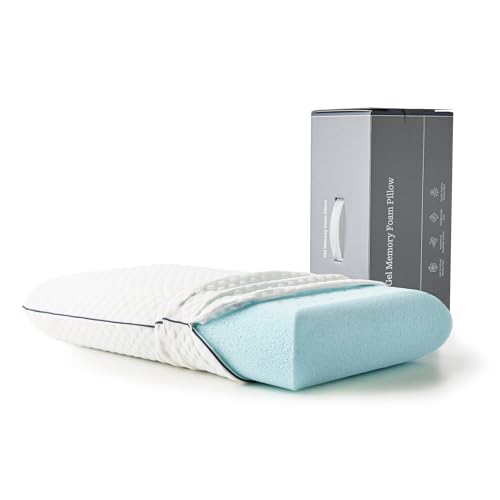
The Weekender Cooling Gel Memory Foam Pillow (Queen) is a ventilated, gel-infused memory foam pillow with a medium-firm contouring feel and a machine washable zippered cover, backed by a three-year warranty.
Two cooling mechanisms work together: gel infused through the foam and precision ventilation holes that let air move through the pillow instead of stagnating under your head. The result is a foam pillow that stays noticeably more comfortable across the night than traditional solid foam. The medium-firm foam contours to the head, neck and shoulders and supports alignment for side, back and stomach sleepers, with the queen size giving side sleepers the width to stay centered. The zippered cover removes and machine washes, and the pillow ships compressed – unbox it and allow 24 to 48 hours to expand fully. Weekender also makes this model in a travel and camping size, which matters for the travel guides in this series. Solid foam still sleeps warmer than shredded or latex fills for the hottest sleepers, and the loft is fixed, but for a washable, warrantied cooling foam pillow at a sensible tier, it is an easy recommendation.
The Weekender’s warranty and washable cover make it the low-drama cooling option: buy it, wash the cover monthly, and forget it. Its medium-firm contour is at its best for back and side sleepers who want foam’s held feeling without foam’s heat penalty; the ventilation holes genuinely move air when you shift position, a small pumping effect solid blocks cannot replicate. Give it the full expansion time out of the box before judging height – foam judged at hour two is shorter than the same foam at hour forty-eight. The travel size sibling is worth knowing about if you camp or road-trip with your own pillow.
Weekender Cooling Gel Memory Foam Pillow earns its place for best neck pillows for airplane by respecting the constraint every travel product lives under: it must be carried. Support that stays home helps no one, and this design’s carry story is part of its engineering.
The honest test of Weekender Cooling Gel Memory Foam Pillow is a real itinerary: the airport carry, the seat you actually get, the neighbor you actually draw. Designs in this guide were judged against that itinerary rather than a showroom sit, because travel gear fails in the field, not in the hand. For best neck pillows for airplane, buy early enough to trial the fit at home on the sofa – the exchange window is a feature, use it before departure.
Strengths
- Gel infusion plus ventilation holes for real airflow through foam
- Medium-firm contouring suits side, back and stomach sleepers
- Washable zippered cover and a three-year warranty
Trade-offs
- Solid foam feel is not adjustable
- Can still feel warm to the very hottest sleepers
- Needs 24-48 hours to expand after shipping
| Color | Blue |
| Size | Queen |
| Dimensions | 29 x 16 x 5 inches |
| Weight | 2 pounds |
| Product Group | Home |
| Binding | Kitchen |
Best for: Hot sleepers who like memory foam contouring but not its heat / Not suited for: Sleepers who want to add or remove fill
Choose this pick if its strengths match your situation above; skip it if its trade-offs touch your deal-breakers. Check on Amazon
Wrap-Style Travel Pillow / Support Scarf (Prose-Only Pick)
Our badge: Best Premium
A fleece wrap with an internal support structure that holds the head upright against one shoulder, worn like a scarf rather than clipped around the neck.
Prose-only pick: this type is not in our verified product pool for this series, so it is covered honestly without a purchase link, invented specifications or a spec box.
Wrap-style supports solve the U-pillow’s two annoyances: bulk and the sideways slide. The internal brace props your head against your shoulder at a natural angle, and the soft wrap keeps it there through turbulence and seatmates’ elbow negotiations. It packs flatter than foam U-pillows and looks like clothing rather than gear. The support is one-sided – you choose a side per flight segment – and the wrap can feel warm in a hot cabin. For travelers who always fall asleep leaning one way, it is often the first design that actually keeps them asleep.
The wrap doubles as an actual scarf in cold terminals and on chilly night flights, which is one less thing to pack. Practice the fit at home once: the brace sits against the side of the head, and the wrap tension – snug, not tight – is a thirty-second skill worth learning before you are tired and airborne.
Readers weighing options for best neck pillows for airplane should see This pillow as a specialist: excellent at the job it was shaped for, ordinary outside it. Travel gear rewards that honesty – buy the specialist that matches your flight, not a generalist that matches none.
In practice, This pick earns its packing space across a whole trip, not one flight: the red-eye out, the unfamiliar hotel bed, the train day, the flight home. Versatility across those settings – or honest specialization in one of them – is stated plainly in its review so you can pack with your eyes open.
Strengths
- Holds the head at a natural lean without bulk
- Packs flat and looks like a scarf
- Stops the sideways head-slide that wakes most flyers
Trade-offs
- Supports one side at a time
- Fleece wrap can feel warm
- Internal brace feel is unusual for the first flight
Best for: Side-leaning sleepers who hate bulky U-pillows / Not suited for: Travelers who switch sides constantly while sleeping
Choose this type if its strengths match your situation above; skip it if its trade-offs touch your deal-breakers. It is covered in prose only, so compare models carefully wherever you shop.
Inflatable Travel Neck Pillow (Prose-Only Pick)
Our badge: Best Pack-Light
An air-filled U-pillow that packs to pocket size and inflates at the seat, letting you set the firmness by how much air you add.
Prose-only pick: this type is not in our verified product pool for this series, so it is covered honestly without a purchase link, invented specifications or a spec box.
For pack-light travelers, nothing beats the inflatable’s party trick: deflated, it disappears into a jacket pocket or personal item; inflated in a few breaths, it is a full-size neck pillow. Partial inflation is the pro move – cabin pressure changes make a fully inflated pillow feel firmer at altitude, and a slightly soft fill molds better anyway. The compromises are feel and fragility: air chambers can feel bouncy rather than cradling, valves are the usual failure point, and a puncture ends its trip. As a backup or minimalist option, though, its packability is unmatched.
Carry the inflatable deflated in the same pocket as your earplugs and mask, and the sleep kit assembles itself at the seat. At altitude, let a little air out rather than adding more – cabin pressure does the inflating for you – and never inflate it fully on the ground unless you enjoy a very firm pillow at cruising height.
For best neck pillows for airplane, This pillow is judged on movement control and packability – the two currencies of cabin sleep. Its design answers a specific failure mode of upright sleeping, and the review names that mode plainly so you can match it to your own.
The honest test of This pick is a real itinerary: the airport carry, the seat you actually get, the neighbor you actually draw. Designs in this guide were judged against that itinerary rather than a showroom sit, because travel gear fails in the field, not in the hand. For best neck pillows for airplane, buy early enough to trial the fit at home on the sofa – the exchange window is a feature, use it before departure.
Strengths
- Packs down to almost nothing
- Firmness adjustable via air level
- Costs little and weighs almost nothing
Trade-offs
- Bouncier, less cradling feel than foam
- Valve or seam failure ends its usefulness
- Needs re-inflation as cabin pressure changes
Best for: Carry-on-only travelers and as a backup pillow / Not suited for: Anyone who wants a plush, set-and-forget pillow
Choose this type if its strengths match your situation above; skip it if its trade-offs touch your deal-breakers. It is covered in prose only, so compare models carefully wherever you shop.
Headrest-Strap Travel Pillow (Prose-Only Pick)
Our badge: Best Versatile
A compact pillow or eye-mask system that straps your head gently to the seat’s headrest wings, stopping the forward nod and sideways slide.
Prose-only pick: this type is not in our verified product pool for this series, so it is covered honestly without a purchase link, invented specifications or a spec box.
Strap systems attack the real problem: your head moves because nothing holds it, not because the pillow is the wrong shape. By anchoring to the adjustable headrest wings most long-haul seats have, they keep your head in one position so you can finally relax your neck muscles completely. They pack tiny and pair with earplugs for a genuinely dark, still sleep setup. The caveats: they need a headrest with wings to work, some travelers dislike anything across the face, and you must unclip before standing – obvious, and still forgotten at 35,000 feet.
Strap systems pair best with an aisle-seat strategy of sleeping in one long block: clip in after the meal service, unclip when you wake. If your airline seats lack winged headrests, this design drops off your list entirely – check your aircraft’s seat photos when you book, not at the gate.
This pillow earns its place for best neck pillows for airplane by respecting the constraint every travel product lives under: it must be carried. Support that stays home helps no one, and this design’s carry story is part of its engineering.
In practice, This pick earns its packing space across a whole trip, not one flight: the red-eye out, the unfamiliar hotel bed, the train day, the flight home. Versatility across those settings – or honest specialization in one of them – is stated plainly in its review so you can pack with your eyes open.
Strengths
- Physically stops head movement instead of cushioning it
- Packs extremely small
- Works with the seat’s own headrest wings
Trade-offs
- Useless in seats without adjustable headrest wings
- Face-strap feel is not for everyone
- Must be removed every time you get up
Best for: Light sleepers whose head movement keeps waking them / Not suited for: Basic economy seats without winged headrests
Choose this type if its strengths match your situation above; skip it if its trade-offs touch your deal-breakers. It is covered in prose only, so compare models carefully wherever you shop.
Chin-Support Travel Pillow (Prose-Only Pick)
Our badge: Best for Forward-Nodders
A wraparound design with a raised front section that supports the chin and jaw, specifically built to stop the forward head-drop.
Prose-only pick: this type is not in our verified product pool for this series, so it is covered honestly without a purchase link, invented specifications or a spec box.
If your signature travel injury is waking with a jolt as your chin hits your chest, this is your shape. The raised front shelf catches the jaw before the drop, while the sides keep the head from rolling. Better models adjust with a toggle or Velcro so the fit is snug without pressure on the throat – fit matters more here than in any other travel design, so measure and read sizing notes carefully. It is bulkier than a basic U and looks unconventional, but for forward-nodders it solves the exact problem the classic shape only half addresses.
Chin-support designs benefit from a mirror fitting at home: the shelf should meet the jaw without pressing the throat, and you should be able to swallow and yawn comfortably. If your jaw clicks or aches generally, choose a softer U instead – this shape’s firmness is a feature only for the forward-drop problem it solves.
Readers weighing options for best neck pillows for airplane should see This pillow as a specialist: excellent at the job it was shaped for, ordinary outside it. Travel gear rewards that honesty – buy the specialist that matches your flight, not a generalist that matches none.
The honest test of This pick is a real itinerary: the airport carry, the seat you actually get, the neighbor you actually draw. Designs in this guide were judged against that itinerary rather than a showroom sit, because travel gear fails in the field, not in the hand. For best neck pillows for airplane, buy early enough to trial the fit at home on the sofa – the exchange window is a feature, use it before departure.
Strengths
- Directly prevents the forward chin-drop
- Adjustable closure fine-tunes fit
- Side support included for rolling heads
Trade-offs
- Fit is critical – wrong size means throat pressure
- Bulkier than minimalist travel pillows
- Unconventional look draws glances
Best for: Forward-nodders who wake themselves with every head drop / Not suited for: Travelers who dislike anything snug around the jaw
Choose this type if its strengths match your situation above; skip it if its trade-offs touch your deal-breakers. It is covered in prose only, so compare models carefully wherever you shop.
The honest test of This pick is a real itinerary: the airport carry, the seat you actually get, the neighbor you actually draw. Designs in this guide were judged against that itinerary rather than a showroom sit, because travel gear fails in the field, not in the hand. For best neck pillows for airplane, buy early enough to trial the fit at home on the sofa – the exchange window is a feature, use it before departure.
In practice, Weekender Cooling Gel Memory Foam Pillow earns its packing space across a whole trip, not one flight: the red-eye out, the unfamiliar hotel bed, the train day, the flight home. Versatility across those settings – or honest specialization in one of them – is stated plainly in its review so you can pack with your eyes open.
The honest test of This pick is a real itinerary: the airport carry, the seat you actually get, the neighbor you actually draw. Designs in this guide were judged against that itinerary rather than a showroom sit, because travel gear fails in the field, not in the hand. For best neck pillows for airplane, buy early enough to trial the fit at home on the sofa – the exchange window is a feature, use it before departure.
In practice, This pick earns its packing space across a whole trip, not one flight: the red-eye out, the unfamiliar hotel bed, the train day, the flight home. Versatility across those settings – or honest specialization in one of them – is stated plainly in its review so you can pack with your eyes open.
Comparison Table
Side by side, the six picks differ less in quality than in job description. Readers comparing across this series may also find our guide to Best Travel Pillows For Long Flights useful, since the two topics share several of the same products with different rankings.
| Pick | Badge | Size | Color | Weight | Check price on Amazon |
|---|---|---|---|---|---|
| Memory Foam U-Shaped Travel Neck Pillow (Prose-Only Pick) | Best Overall | Varies by model | Varies by model | Varies by model | Check price on Amazon |
| Weekender Cooling Gel Memory Foam Pillow (Queen) | Best Budget | Queen | Blue | 2 pounds | Check price on Amazon |
| Wrap-Style Travel Pillow / Support Scarf (Prose-Only Pick) | Best Premium | Varies by model | Varies by model | Varies by model | Check price on Amazon |
| Inflatable Travel Neck Pillow (Prose-Only Pick) | Best Pack-Light | Varies by model | Varies by model | Varies by model | Check price on Amazon |
| Headrest-Strap Travel Pillow (Prose-Only Pick) | Best Versatile | Varies by model | Varies by model | Varies by model | Check price on Amazon |
| Chin-Support Travel Pillow (Prose-Only Pick) | Best for Forward-Nodders | Varies by model | Varies by model | Varies by model | Check price on Amazon |
How to Choose the Best Neck Pillows For Airplane
The buying decisions below decide whether any pillow – including the six above – actually works for you. Work through them in order; each one narrows the field more honestly than brand or price tier does. Our guide to Best Pillows For Scoliosis covers a neighboring version of the same decision process.
Start With Your Sleep Position
Back sleepers need a moderate height with a dip for the head and a rise under the neck. Side sleepers need more height – enough to span the shoulder – plus an edge that does not push the shoulder forward. Stomach sleepers should go as low as possible or reconsider the position for their neck’s sake. Buy for the position you actually sleep in, not the one you intend to adopt, and if you split the night, prioritize the position you fall asleep in, since that is where you spend the deepest early hours.
Measure Your Shoulder Gap
For side sleeping, the target loft is roughly the distance from the side of your head to the tip of your shoulder, minus how much your shoulder sinks into the mattress. Narrow frames often land near four inches of effective loft; broad shoulders can need six or more. Soft mattresses shrink the gap because the shoulder sinks; firm mattresses keep it honest. Measuring beats guessing, and it explains why a pillow that transformed a friend’s sleep does nothing for you.
Understand Contour Versus Adjustable
A fixed contour is a bet on one geometry: wonderful when it matches you, useless when it does not. Adjustable designs – removable layers, add-or-remove fill, water levels – trade a little elegance for forgiveness, letting you close the last centimeter yourself. First-time shaped-pillow buyers, and anyone whose neck has rejected pillows before, should usually start adjustable. Committed contour fans who already know their height can buy fixed with confidence.
Give Any Shaped Pillow Two Weeks
Your neck has habits, and a new alignment can feel strange before it feels right. Judge a contour or adjustable pillow across ten to fourteen nights, changing only one variable at a time – height first, then position – and keep notes each morning. Discomfort that steadily decreases is adjustment; discomfort that grows, or any numbness or radiating symptoms, is a stop signal, not a perseverance test.
Plan Care Before You Buy
Foam cores generally cannot be washed, so a removable washable cover – and ideally a protector – is part of the support system, because a pillow you cannot keep clean gets replaced or endured. Shredded fills need fluffing; solid foams need airing. Match the maintenance to the effort you will honestly sustain, and check the return or trial terms before the first night, not after the fourteenth.
How to Set Up a Cervical Pillow Correctly
Placement is half the product. For a contour pillow, the higher ridge goes under your neck and the dip cradles your head – reversed, the same pillow feels like a doorstop. On your side, pull the pillow so its edge meets your shoulder, letting the shoulder rest against or into the pillow’s edge rather than on top of it; on your back, center the head in the cradle and check that your chin is neither tipped to your chest nor pointed at the ceiling.
Set the height before the first night if your pillow adjusts. Side sleepers start at the higher setting, back sleepers at the lower, and everyone changes one step at a time across nights rather than rebuilding the pillow hourly. A mirror or a partner’s eyes help: from the side, your ear, shoulder and hip should form a roughly straight line when side sleeping, and your forehead and chin should sit level when on your back. For a related setup walkthrough, see Best Cushion Choice For Kincaid Sofas.
Protect the setup. Use a smooth, not-too-thick pillowcase so the contour’s shape reaches your neck instead of being bridged by fabric, keep a protector under it for foam cores you cannot wash, and fluff or redistribute adjustable fills weekly so the support you tuned stays tuned. Replace the pillow when the fill no longer recovers its shape after a night off – support materials age even when covers look new.
Diagnose your own failure direction from your last flight – forward jolter or sideways slider – and buy the shape that blocks your motion. The most common travel-pillow disappointment is an excellent pillow solving the other problem.
Hygiene travels too: pick a washable cover, and wash it after each trip. Cabins are shared air and shared surfaces, and the pillow lives against your face and neck for hours.
If you share a bed, treat pillow buying as a two-person decision even when the pillows differ. Partners wake each other with restless rearranging, and a pillow that one of you fights all night becomes both of your problems. Buying different pillows for each side is normal and sensible; buying matched trial periods – and keeping both sets of packaging until both verdicts are in – is the professional move.
Budget honestly across the whole setup. A protector, a spare case and, for adjustable pillows, a storage bag for removed fill are part of the real cost, and they protect the main purchase. Readers who plan the full setup in one order consistently report fewer returns than readers who buy the pillow alone and improvise the rest – the accessories are where good pillows go to succeed or fail.
When a pillow in this guide tempts you, read its trade-offs list twice. Strengths are what you are buying; trade-offs are what you are agreeing to live with – the adjustment period, the care routine, the bed space, the fixed loft. Most pillow regret is not a bad product but an unread trade-off, and every pick here states its costs in plain language precisely so you can agree with your eyes open.
A final practical note on trialing any pillow in this guide: change one thing at a time, and give each change several nights. Sleep is noisy data – stress, room temperature, a late meal and a hard workout all move the needle – so a pillow judged on a single night is a pillow judged on noise. A week of mornings, briefly noted, is the smallest sample worth trusting, and it is the method behind every ranking on this page.
Pillowcases deserve more credit than they get. A thick or rough case can blunt a pillow’s designed feel, bridge over a contour, or trap heat against your face; a smooth, breathable case lets the pillow work as engineered. Whatever you buy from this guide, pair it with a case that matches its job – and keep a spare, because laundry day should never dictate your sleep setup.
Sizing is a quiet source of returns. Standard, queen and king pillows differ by inches that matter for fit in your cases and for how the pillow behaves on your bed; a pillow compressed by an undersized case sleeps firmer and taller than designed. Check your existing cases before ordering, and when in doubt match the pillow size to the bed size – queen pillows on a queen bed is the combination most bedding is designed around.
Problem: The contour feels too high – Remove a layer or some fill, or rotate the pillow to its lower edge for a few nights while your neck adapts; height complaints are the most common and the most fixable.
Problem: You wake with the pillow pushed away – Your body is voting against the setup – usually height or firmness. Change one variable, and check that the pillow is not sliding on a satin case or an undersized pillow sham.
Problem: Your arm keeps going numb on your side – The shoulder is bearing weight it should not. Raise the loft slightly, use a design with arm space, or place a thin pillow under the forearm so the shoulder can relax.
Problem: The new-pillow smell lingers – Air foam pillows in a ventilated room for a day or two before first use, and wash the cover; certified low-odor foams fade fastest.
The Two Failure Directions of Upright Sleep
Every airplane sleep failure is one of two motions: the head drops forward – chin to chest, wake with a jolt – or it slides sideways until it meets a shoulder, a neighbor, or the cabin wall at a bad angle. Designs specialize: raised-front pillows catch the chin, wraps brace the sideways lean, straps abolish both motions by anchoring to the headrest, and the classic U does a bit of both imperfectly.
Packing Strategy: Wear It, Clip It, or Compress It
The best travel pillow is the one on the plane. U-pillows clip to carry-on handles; wraps wear around the neck through the terminal like a scarf; inflatables vanish into a pocket; strap systems hide in a personal item. Choose by your luggage reality, not your aspirations – a carry-on-only traveler and a checked-bag traveler should buy different pillows.
Common Buying Mistakes
Buying the tallest, firmest option ‘for maximum support’
Support is alignment, not altitude. An over-tall pillow cranks the neck sideways all night; match height to your frame and position instead.
Judging a shaped pillow on night one
Contours need an adjustment period. Decide across two weeks of mornings, adjusting one variable at a time, unless symptoms escalate – then stop.
Sleeping on a contour backwards
The ridge belongs under the neck, the dip under the head. Reversed placement is the most common setup error and the easiest to fix.
Stacking a second pillow ‘just in case’
Two pillows destroy the geometry one good pillow creates. If you need height, raise the pillow’s own setting rather than adding a wobbling layer.
Ignoring the mattress
A shoulder that sinks deep into a soft mattress needs less pillow; the same sleeper on a firm mattress needs more. Change one and you may need to re-tune the other.
Final Recommendation
Start with the Weekender Cooling Gel Memory Foam Pillow (Queen): it is the pick we would buy first for best neck pillows for airplane, because it answers the topic’s central problem with the fewest compromises. If its trade-offs hit your deal-breakers, the runner-up is one click away – Check on Amazon – and the reviews above explain exactly who should choose which. If your neck has rejected pillows before, choose the most adjustable pick first – a pillow you can tune beats a pillow you must obey. Keep the packaging until two weeks of mornings have voted. For the neighboring question most readers ask next, see Best Cushions For Sofas.
Frequently Asked Questions
What is the best travel pillow shape for long flights?
The shape that blocks your failure motion: chin-support designs for forward nodders, wrap or U designs for sideways sliders, strap systems for the lightest sleepers. There is no universal winner – there is a correct match to how your head actually falls.
Are inflatable travel pillows worth it?
For pack-light travelers, yes: they inflate to full size, adjust firmness by air level, and disappear into a pocket afterward. They feel bouncier than foam and a puncture ends them, so foam fans and one-pillow minimalists may prefer compressible memory foam.
Can I use a regular bed pillow on a plane?
You can, and some travelers hug one happily, but it eats your personal-item allowance and works poorly upright. One pick in this guide offers a travel size of a bed-pillow model; dedicated travel designs exist precisely because bed pillows travel badly.
How do I sleep in a middle seat with no wall to lean on?
Prioritize sideways support and head anchoring: a supportive U, a wrap brace, or a strap system paired with a good eye mask. The middle seat is where head-movement control matters most, since there is nothing to lean against.
Do travel pillows help with neck stiffness after flights?
They reduce the hours your neck spends at bad angles, which is the main pillow-controllable factor in travel stiffness. Hydration, movement breaks and seat choice matter too – a pillow is one part of arriving well.
Should I buy a travel pillow at the airport?
Airport selection is the leftovers of exactly this decision made hastily. If you fly more than once a year, choosing deliberately – shape matched to your sleep failure, cover washable, carry method planned – pays for itself in one rested arrival.


