Where to buy
Check the latest price, availability and delivery on Amazon. Orders are placed on Amazon. We may earn a commission from qualifying purchases.
- Best overall for small spaces: Furinno JAYA Simple Design Corner TV Stand — Check on Amazon
- Furinno Moretti 3-Tier Metal Frame TV Stand — Check on Amazon
- Furinno JAYA TV Stand for up to 55-Inch TV with Storage Bins — Check on Amazon
- Yaheetech TV Stand for TVs up to 65 Inch, 55-Inch Gray — Check on Amazon
See 2 more Amazon options
- VASAGLE TV Stand for TV up to 70 Inches, 63-Inch 3-Tier Console — Check on Amazon
- Yaheetech Farmhouse TV Stand, 58-Inch with Sliding Barn Doors — Check on Amazon
Read the full guide ↓
Disclosure: As an Amazon Associate, dailyhomedecorating.com earns from qualifying purchases. Links to Amazon on this page are affiliate links; they cost you nothing extra. Listing details such as price and availability change often, so check the current Amazon listing before you buy.
Finding the best media console for small spaces under $150 is a problem of inches and honesty. A small space — a bedroom that fits the bed and little else, a shared house’s single room, a den converted from a dining nook, the corner of a living room that is all the television gets — does not forgive furniture that was sized by optimism. In a large room a too-big console is an aesthetic shrug. In a small space it is a daily tax: a shin met in the dark, a drawer that cannot open, a door that swings into the stand, a walkway narrowed to a shuffle. The discipline this guide applies is therefore stricter than our apartment guide’s, and deliberately so. Where an apartment still thinks in rooms, a small space thinks in zones measured in inches: the footprint the console takes, the airspace its tiers use, the storage it provides per square foot of floor it consumes, and whether it can do a second job — nightstand overflow, book storage, charging station — because in a small space every piece of furniture that does only one thing is a piece you may not have room for.
Three strategies survive that discipline at this budget. The first is the corner claim: a stand shaped to occupy the one volume no other furniture uses, turning dead angle into media center — our lead pick is built exactly for it. The second is vertical thinking: in small spaces the floor is exhausted but the wall height is free, so a three-tier open frame that stacks the media system upward, in full view and full airflow, stores more per square foot than any low, wide cabinet. The third is the compact all-rounder: a sub-four-foot console with bins that swallows the small room’s homeless objects, because in a small space clutter has nowhere to hide and a console that cannot absorb it will be buried by it. The two large consoles from our main list appear here at the end with their conditions stated in plain language — there are small-space situations, a long narrow room chief among them, where a low wide plane genuinely works — but they are the exception in this guide, not the headline, and we will tell you exactly where the line falls.
Our short answer is this. Start with the Furinno JAYA corner stand if your space has a corner — most small spaces do, and it is usually the only volume going free. Start with the Moretti if your space is a rectangle with one short wall and a stack that needs vertical storage and air. Start with the JAYA with bins if the room’s problem is as much clutter as size. The reviews below measure every pick against the small-space rubric — footprint, depth, storage per square foot, second jobs, and the discipline of firm size ceilings — because in a small space the most important specification is the one that tells you when to stop. Readers whose small space is a whole apartment will find the roomier version of this thinking in Best Media Console For Small Apartments Under $150, and the unrestricted list in Best Media Console Under $150.
In this guide
Quick Picks
In a hurry? This table matches each console to the small-space situation it handles best.
| Buyer type | Pick | Why it stands out | Link |
|---|---|---|---|
| Best overall for small spaces | Furinno JAYA Simple Design Corner TV Stand | Claims the corner nobody else can use; four tiers for TVs up to 46 inches | Check on Amazon |
| Best vertical storage | Furinno Moretti 3-Tier Metal Frame TV Stand | Three open tiers stack the whole system upward on a frame’s footprint | Check on Amazon |
| Best compact all-rounder | Furinno JAYA TV Stand for up to 55-Inch TV with Storage Bins | Under four feet wide with bins that absorb a small room’s clutter | Check on Amazon |
| Best for a narrow room’s long wall | Yaheetech TV Stand for TVs up to 65 Inch, 55-Inch Gray | 14-inch depth hugs the wall in rooms where every inch of passage counts | Check on Amazon |
| Best for long, low rooms | VASAGLE TV Stand for TV up to 70 Inches, 63-Inch 3-Tier Console | A 20.5-inch height keeps a wide console under the sight line — long rooms only | Check on Amazon |
| Best for total concealment | Yaheetech Farmhouse TV Stand, 58-Inch with Sliding Barn Doors | Doors hide everything — only for small spaces that are wide, not tiny | Check on Amazon |
How These Picks Were Chosen
Budget discipline came first, as in every guide in this series: each console is a genuine Amazon listing chosen to fit the under-$150 budget — check the current price on Amazon before you buy, because prices move, and the farmhouse cabinet’s street price drifts around this tier’s ceiling, which is one reason it appears here last and conditionally. The small-space filters came next and they are the strictest in this series. Footprint first: every pick’s width and depth were read as a claim on floor the reader does not have, and picks earn their ranking by how little they claim or how cleverly — a corner’s angled volume counts for less than the same inches on a flat wall, because the corner was unusable anyway. Storage efficiency second: shelves, tiers and bins were judged per square foot of floor consumed, since a small space cannot afford a console that stores less than the floor it takes would have stored as open room.
We did not hands-on test these consoles. We compared manufacturer specifications — dimensions, stated television sizes, load ratings, unit weight and assembly method — against the documented geometry of small rooms. Depth was capped in our thinking at 16 inches, because beyond that a console in a small space starts taxing the passage in front of it. Height was read two ways: as viewing geometry, since small spaces seat viewers close and low, and as storage volume, since tiers are the only expansion a small footprint allows. Weight and assembly mattered because small spaces get rearranged — the room that is a den this year is a nursery or an office next year — and furniture that one person can move in ten minutes survives those transitions while furniture that cannot, does not. Second jobs counted openly: a console whose top can host a lamp, whose shelves can take books, whose bins can hold the charging station is worth more in a small space than its media specifications alone suggest.
The engineering honesty of our other guides applied with extra force, because small spaces remove the margins that forgive errors elsewhere. A console whose claimed screen size exceeds its top width is flagged with the size we would stop at. A corner stand’s 35-pound top rating is treated as a ceiling, not a challenge. And the two wide consoles are labeled with the room shapes that justify them, rather than recommended generally and regretted specifically. The result is a short list with a strict order: corner first, vertical second, compact third, and width only where the room’s shape — long, narrow, low — makes width the honest answer. Shoppers whose small space must also survive small children will find the safety-first ordering of the same consoles in Best Media Console For Families Under $150.
The 6 Best Media Consoles for Small Spaces Under $150
Furinno JAYA Simple Design Corner TV Stand
Who it suits: Any small space with a corner — bedrooms, dens, shared-house rooms and living-room corners — running a television up to 46 inches and needing the floor back.
Every small space has one volume that no furniture claims: the corner. Chairs do not fit it, shelves waste it, and the floor lamp exiled there only proves the point by standing in it alone. This stand is the only pick in the guide designed to occupy that volume as a media center. Its angled sides push into a 90-degree corner, its shelves curve at the front to soften the profile, and the whole unit measures 42.04 inches wide by 15.55 deep by 22.75 high — dimensions that sound mid-sized until you realize most of that width lies along walls the room was not using, in a wedge the seating already ignored. The top is rated for televisions up to 46 inches with a 35-pound load limit, stated plainly by the manufacturer, and four open tiers below take the small space’s stack: streaming box, compact console, a row of games or books, a basket on the curved side shelves. In storage-per-square-foot terms — this guide’s core metric — the corner stand is unbeatable, because its square footage was free.
The diagonal it creates is the second gift. Small spaces rarely offer a straight wall facing the seating; they offer a bed angled toward a corner, a desk chair that swivels, a sofa along one wall and an armchair along another. A corner screen meets all of them halfway, and in bedrooms it solves the classic problem of the television that must be watched from a bed that cannot face the only wall. Assembly is Furinno’s tool-free twist-and-stack, about ten minutes, and at 27.8 pounds the stand can be carried to the other corner when the room changes its mind — small spaces change their minds constantly, and furniture that cannot follow gets left behind. The rounded corners the design builds in matter in exactly the tight clearances a small space specializes in. It sits at the budget end of this guide — check the current price on Amazon — leaving the rest of the budget for the screen it serves.
Now the firm ceilings, because this guide’s promise is honesty about stopping points: 46 inches is the largest screen this stand should carry, 35 pounds is the top’s load, and neither number improves with optimism. If your television is bigger, this is not your pick, and no arrangement of the room makes it so — look at the JAYA with bins below instead. Corner placement also wedges the back into the angle, so route the power strip out to one side before the stand goes in, and anchor the unit despite the corner’s apparent shelter; a corner stand with a television is still a front-heavy object in a room where people pass close. Within its ceilings, though, this is the small-space pick in its purest form: it takes nothing the room was using and gives back a working media center.
- Corner geometry stores a full stack on floor that was previously unusable.
- Four tiers plus curved side shelves — the best storage per square foot in the guide.
- Tool-free, 27.8-pound build that relocates as fast as small rooms rearrange.
Honest limitation: Firm ceilings of 46 inches and 35 pounds on top; rear cable access is wedged, so cables must be planned to the side before placement.
Choose it if your space has a corner and a TV of 46 inches or under. Skip it if your screen is larger — no corner justifies an overloaded stand.
Furinno Moretti 3-Tier Metal Frame TV Stand
Who it suits: Small rectangular spaces with one short wall — rooms that cannot spare width but have height to spend, and stacks that need air as much as storage.
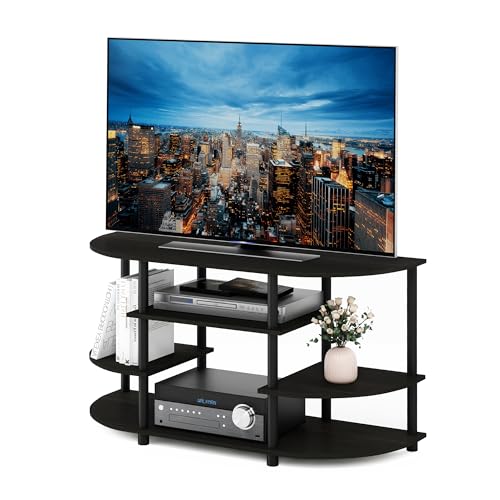
When the floor is finished giving, the only direction left is up, and the Moretti is this guide’s vertical thinker. A black metal frame carries three tiers of Columbia walnut-tone shelving, from a line sold for televisions up to 65 inches, and the arrangement stacks a complete media system — screen above, soundbar and console on the upper tiers, router and library below — inside a footprint that a single low cabinet would consume for half the storage. The open frame is the other small-space virtue: you can see the wall through it, daylight crosses it, and the room’s sense of volume survives the addition of a full media stack. In a small space, that transparency is not a style preference. It is the difference between a room that holds a media center and a room that has been replaced by one.
The tiers also solve the small space’s heat problem, which is worse than a large room’s for a simple reason: everything is closer to everything else, soft furnishings included, and warm air has nowhere to go. Open shelving gives each device its own air, and the frame’s rear uprights give cables a straight vertical route down to a single strip — in a small space, where the outlet is always visible, that vertical discipline is what keeps the wall from looking wired. The frame disassembles flat, wipes clean, and sits in the lower-middle of this guide’s budget — check the current price on Amazon — frequently below its list price. As a second job, the top tier beside a smaller television takes the room’s lamp or its books without apology; few consoles here moonlight as gracefully.
Conditions, stated as this guide states them: the open frame displays everything at the close range a small space imposes, so the shelves must be edited like a shop window — one device per zone, cables vertical, nothing homeless. The printed walnut finish rewards the room’s distance and not the fingertip’s, and in a small space both distances occur daily; the black frame, happily, carries the look. Shelf loads must be respected with heavy items centered over the uprights, and the whole unit anchored, because a tall stack in a small room is passed closely by everyone who lives there. For the small rectangle with height to spend, this is the most storage the budget buys per square foot of floor.
- Three vertical tiers store a full stack on a compact footprint.
- Open frame preserves the room’s light and sense of volume.
- Straight vertical cable runs keep small walls from looking wired.
Honest limitation: Total exposure at close range — the shelves must stay edited — and the printed finish is less convincing at the distances small spaces impose.
Choose it if your space is a small rectangle with height free and a stack that runs warm. Skip it if you need any part of the system hidden.
Furinno JAYA TV Stand for up to 55-Inch TV with Storage Bins
Who it suits: Small spaces with one straight short wall and a clutter problem — rooms where the console must hold a TV up to 55 inches and also be the place everything else lives.
If the corner stand is the small-space specialist and the Moretti its vertical thinker, the JAYA with bins is the compact generalist: the largest capability that still respects a small footprint. Its large configuration measures 47.63 inches wide by 15.55 deep by 22.79 high, the top is rated for televisions up to 55 inches, and beneath the screen the open tiers and two removable fabric bins divide the small room’s entire media life between them — equipment on the shelves, everything else in the bins. That division is the pick’s real argument. In a small space, clutter cannot be sent to another room, because there is no other room; it lives where it falls, and it falls on the console. A console with built-in bins gives the remotes, controllers, chargers, headphones and mail a designated volume, which is the only form of tidiness a one-room life can actually sustain.
The rest of the formula is small-space orthodoxy executed well. Tool-free assembly in about ten minutes, because small spaces are usually furnished by one person with no workshop. A light frame that one person can shift for cleaning or rearrangement — and small rooms are rearranged constantly, as each new object renegotiates the whole. Rounded corners, built into the design, for the close passes and tight turns the room imposes daily. A price at the budget end of this guide — check the current price on Amazon — because small spaces usually come with small budgets attached, and the money saved here buys the screen, the rug or the blackout curtain the room also needs. As a second job, the JAYA’s top beside a smaller TV serves as the room’s surface of last resort: lamp, books, the plant that has nowhere else to stand.
The limits deserve the same clarity as the virtues. Load ratings are modest — the stated TV size is the ceiling, per-shelf loads are real, and a small space’s habit of stacking everything on the one available surface must be resisted consciously with this stand. The open shelves cannot hide cables, so route them down the back into a covered strip and accept the ten minutes as part of the purchase. And at just under four feet wide, this is the largest of this guide’s three headline picks: if your wall’s honest remainder is three feet, the corner stand is your answer and this one is a shin injury with shelves. Measured against the right wall, though, this is the compact all-rounder: the most conventional capability in the smallest honest package.
- Under four feet wide with bins that give a one-room life its only clutter system.
- Tool-free, light and rounded-cornered — built for rooms that rearrange and bump.
- Top doubles as the room’s spare surface beside a smaller television.
Honest limitation: Modest load ratings under a small space’s stacking habits, open cables to manage, and a width that still exceeds genuinely tiny walls.
Choose it if you have one straight short wall and a TV up to 55 inches. Skip it if your wall’s remainder is under about four feet — take the corner stand.
Yaheetech TV Stand for TVs up to 65 Inch, 55-Inch Gray
Who it suits: Long, narrow small spaces — shotgun bedrooms, converted dining rooms, studio living ends — where the console must hug one long wall as shallowly as possible.
Room shape, not room size, is this pick’s brief. A long narrow space — the bedroom in a railroad flat, the living end of a rectangular studio — has wall to spare along its length and nothing to spare across its width, so the console it needs is the shallowest full-size one available. At 55 inches long, only 14 deep and 24 high, this Yaheetech is the slimmest substantial console in the guide: two inches shallower than most rivals, which in a narrow room is two inches of passage returned at every crossing, every day. The gray wood-and-metal design suits the neutral palettes small spaces use to stay calm, the metal frame gives it a planted feel the tube stands cannot match, and the open shelves ventilate the stack in rooms where air does not circulate generously.
The 24-inch height needs a small-space reading. Viewers in small spaces sit close — often six feet or less from the screen — and at close range a screen center near seated eye level matters more, not less, because the vertical viewing angle steepens as distance shrinks. This console’s height centers a 55-inch screen kindly for a sofa or bed at small-space distances, where the lowest stands would leave viewers looking down and the tallest cabinets would crane them up. It sits in the middle of this guide’s budget — check the current price on Amazon — and its frame construction makes it the most durable-feeling pick per dollar in this guide for a room whose furniture gets brushed past hourly.
The flag from our other guides applies with small-space emphasis: the listing rates this console for TVs up to 65 inches, but a 65-inch panel is roughly 57 inches wide, wider than this 55-inch top — and in a small space, where the console is passed at elbow distance, feet near the top’s edge are an accident with a short fuse. The honest pairing is a 55-inch television, which this top fits exactly. Choose this pick for its depth and its shape, respect its width ceiling, and it will serve a narrow room better than any headline pick above it.
- 14-inch depth — the shallowest full console here — returns passage in narrow rooms.
- Metal frame durability for furniture that is brushed past hourly.
- 24-inch height centers the screen at close small-space viewing distances.
Honest limitation: A 65-inch TV overhangs the 55-inch top, an amplified risk where everyone passes within elbow distance.
Choose it if your small space is long and narrow with a 55-inch TV. Skip it if your space is square and tiny — the corner and compact picks serve it better.
VASAGLE TV Stand for TV up to 70 Inches, 63-Inch 3-Tier Console
Who it suits: Long, low small spaces — basement dens, wide shallow rooms, living ends of rectangular studios — where width is available but height and depth are not.
This pick appears in a small-space guide for one geometric reason: some small spaces are small in the wrong dimensions for the headline picks. A basement den with a low ceiling, a wide shallow room under a slope, a rectangular studio whose living end is a long low wall — these spaces cannot use a corner elegantly and do not need vertical storage, because their constraint is height, not width. The VASAGLE answers with the lowest profile in the guide: 63 inches long but only 20.5 high and 15.4 deep, a steel-framed, three-tier plane rated for televisions up to 70 inches. Under a low ceiling or a sloped wall, that ground-hugging line fits where taller furniture argues, and the three full-length tiers give a small space the one thing it chronically lacks — a long, organized surface where the entire system and the room’s books can live in a single register.
There is also a viewing argument unique to small, low rooms. Seating in them is low — futons, floor cushions, a sofa on a platform — and a 20.5-inch console keeps a large screen’s center near that low eye line, where taller stands would float the picture above the room’s whole way of sitting. The open tiers ventilate, the frame carries real loads, and the unit sits at the upper end of this guide’s budget — check the current price on Amazon — buying the small space a console it will not outgrow at the next screen size.
The conditions must be stated as firmly here as anywhere: 63 inches is a great deal of console, and in a conventionally small room — a ten-by-twelve bedroom, a square studio — it will consume the wall, the passage and the point. This pick is for spaces that are long and low, verified by a tape measure, not for spaces that are merely small and wishful. It is also the heaviest carry in the guide, which matters in walk-up buildings. If your room’s shape matches its geometry, nothing else here does its job. If it does not, the tape has saved you, and the picks above are waiting.
- Lowest profile in the guide at 20.5 inches high — fits low ceilings and sloped walls.
- Three full-length tiers create one long organized surface for system and books.
- Rated for TVs up to 70 inches, keeping big screens at low seating’s eye line.
Honest limitation: Its 63-inch width overwhelms conventionally small rooms; it suits only verified long, low spaces, and it is the heaviest carry here.
Choose it if your small space is long, low and measured. Skip it if your room is square, small in every dimension, or up several flights of stairs.
Yaheetech Farmhouse TV Stand, 58-Inch with Sliding Barn Doors
Who it suits: The larger end of small — compact one-bedrooms and wide studio living ends — where the media stack must disappear completely and the room has the width to pay for the disappearance.
We end with the concealment option and its condition attached. There are small spaces whose problem is not storage but sight: the studio where the bed faces the television wall, the compact living room where a guest bed unfolds nightly, the room where the equipment’s lights and cables are simply the last thing a tired person wants to see. For those rooms, a cabinet whose sliding barn doors close across a 58-inch front — hiding console, router, strip and stack behind a warm walnut face, with adjustable shelves inside — offers something no open pick can: a media wall that turns off visually. At 58 inches long, 16 deep and 28 high, rated for TVs up to 65 inches, it is a full-size cabinet, and in a small space that is a serious allocation of the room’s scarcest resources, which is why it is recommended here only where the room is wide enough that the allocation reads as furnishing rather than occupation.
Where it fits, it also works as the room’s storage wall: the closed shelves take the overflow that small spaces generate — the board games, the spare bedding for the guest bed, the seasonal things — behind the same doors that hide the gear, and the top serves as the room’s display surface. It sits at the top of this guide’s budget when the live price cooperates — check the current price on Amazon, because this model’s street price drifts around the tier’s ceiling and it belongs in an under-$150 guide only while the listing sits under it.
The small-space cautions are the sharpest in the guide, and we will not blunt them. Sixteen inches of depth in a small room is a passage tax paid daily. Twenty-eight inches of height lifts the screen above the eye line of the low seating small spaces favor. Sliding doors drift on uneven floors, and small old rooms have the most uneven floors of all. Closed doors trap heat around the very consoles small spaces run hardest. And this is the heaviest, hardest exit in the guide when the room changes. If, after all that, your wide small space still wants its media invisible — buy it with open eyes and a level floor. Otherwise, the corner, the frame and the bins above solve small spaces the way small spaces ask to be solved: lightly.
- Total concealment behind sliding doors — the media wall that turns off.
- Closed shelves double as the small space’s overflow storage wall.
- Warm front and display-worthy top for rooms that host and sleep in one view.
Honest limitation: The deepest, tallest, heaviest pick here; in a genuinely tiny room it taxes passage, sight lines and moving day all at once, and its live price drifts around the tier ceiling.
Choose it if your small space is wide, level-floored and desperate for invisibility. Skip it if the room is tiny in any dimension — the headline picks exist for you.
Comparison Table
| Product | Type | Best use | Link |
|---|---|---|---|
| Furinno JAYA Corner Stand | Corner stand | Claiming dead corner volume for TVs up to 46 inches | Check on Amazon |
| Furinno Moretti 3-Tier | Open metal-frame stand | Vertical storage on a compact footprint | Check on Amazon |
| Furinno JAYA 55-Inch with Bins | Open tool-free stand | Compact all-rounder with clutter bins | Check on Amazon |
| Yaheetech 55-Inch Gray Console | Open industrial console | Long narrow rooms needing a shallow profile | Check on Amazon |
| VASAGLE 63-Inch 3-Tier Console | Open steel-frame console | Long, low rooms and low seating | Check on Amazon |
| Yaheetech 58-Inch Farmhouse Cabinet | Closed barn-door cabinet | Wide small spaces needing total concealment | Check on Amazon |
How to Choose the Best Media Console for Small Spaces Under $150
- Start with the room’s free volume, not the catalog. Small spaces offer specific geometries — a corner, a short wall, height above a low line, a long shallow wall. Inventory yours first, in inches, and let it nominate the console type before you look at a single product.
- Price storage per square foot. Divide what a console stores by the floor it consumes. Tiers, bins and corner volumes raise the ratio; deep, low, single-shelf cabinets lower it. In a small space this ratio is the closest thing to a value score that exists.
- Cap depth at 16 inches — and prefer 14. Depth is passage. Every inch beyond the wall line is an inch taken from the route everyone walks, in the dark, half asleep. Shallow consoles are the small space’s non-negotiable.
- Respect firm size ceilings. A stand rated for a 46-inch TV and 35 pounds is telling you the truth about itself. In a small space there is no margin around the furniture to forgive an overload, so treat ratings as walls, not guidelines.
- Give the console a second job. Lamp surface, book storage, charging station, plant stand beside a smaller screen — in a small space, single-purpose furniture is a luxury the floor cannot fund. Choose the pick whose top and shelves moonlight best.
- Keep visual weight below physical weight. Open frames, low heights and mid-tone finishes let a small room keep its sense of air. The smaller the space, the more a solid cabinet costs in perceived room — budget for that cost consciously if you choose concealment.
- Plan cables for a room with nowhere to hide them. In a small space every cable is visible from somewhere. Run them vertically, bundle them, collect them in one covered strip placed before the furniture goes in — retrofitting cable order in a small room means moving everything you own.
- Check the viewing angle at your real distance. Small spaces seat viewers close, which steepens angles. A console between about 20 and 24 inches high centers most screens for sofas, beds and floor seating at close range; measure from where you actually sit, including the bed.
- Anchor it — small rooms pass closest. Everyone in a small space brushes the furniture daily. A wall strap on a console carrying a television is not caution; it is the admission price of the arrangement, and it disappears behind the unit.
The Small-Space Tape Test: Proving the Fit Before It Ships
Small spaces punish returns more than any other rooms — the box blocks the hallway, the assembled stand blocks the door — so prove the fit with tape before anything ships. Outline the console’s footprint on the floor with painter’s tape, at full width and depth, exactly where it would stand. Then live inside the outline for a full day and evening. Walk every route the room requires: bed to door, sofa to kitchen, desk to window, in daylight and in the dark. Open every door and drawer that swings near the outline. Sit in every seat and look at the wall where the screen would be; stand where a guest would stand. The tape will tell you truths no measurement list can — that the corner outline eats the reading chair’s swivel, that the 16-inch depth outline meets the foot of the bed, that the long console’s outline crosses the path you take a dozen times a night.
Then run the vertical half of the test, the one small spaces make essential. Mark the screen’s proposed center height on the wall with a strip of tape, and the console’s top line beneath it. Sit, lie and lounge in the room’s real positions and check the angle to that tape line: from the bed, from the floor cushion, from the desk chair turned around. Small spaces forgive width errors more readily than height errors, because you cannot move farther from a screen that is too high — the wall behind you is already there. Finally, check the second-job sight lines: if the console’s top will host a lamp, confirm the lamp will not glare into the screen from your seat; if its shelves will hold books, confirm you can reach them without moving the room. Twenty minutes of tape buys the certainty that the console, when it arrives, is a solution arriving — not a new problem in a box. Households whose small space is a family room will find the companion safety routine in Best Media Console For Families Under $150.
Common Buying Mistakes
- Sizing by the room’s largest wall instead of its free volume. The free corner, the short wall remainder and the low line under the slope are the real sites; the big wall is usually already spoken for.
- Buying depth you cannot afford. In a small space, two extra inches of console depth are a permanent narrowing of every route through the room.
- Ignoring the stand’s stated ceilings. A 46-inch, 35-pound corner stand loaded with a 55-inch television is not a hack; it is a failure being scheduled.
- Choosing a solid cabinet to “hide the smallness.” Visual weight makes small rooms smaller. Concealment is for wide small spaces, not tiny ones.
- Letting the console do only one job. Single-purpose furniture is how small spaces fill up. If it cannot store beyond the media stack, it is competing with pieces that can.
- Skipping the tape test. An outline on the floor for one day prevents the most expensive small-space outcome: an assembled console that fits the room only by evicting something you needed.
- Forgetting that close viewers see everything. At six feet, cables, dust and a printed finish are all in high definition. Plan the cable runs and the shelf edit as part of the purchase.
- Anchoring nothing because the room feels sheltered. Small rooms pass closest to the furniture. The strap matters most exactly here.
Final Recommendation
- Most small spaces: Furinno JAYA Simple Design Corner TV Stand.
- Vertical storage on a small footprint: Furinno Moretti 3-Tier Metal Frame TV Stand.
- Compact all-round duty: Furinno JAYA TV Stand for up to 55-Inch TV with Storage Bins.
- Long, narrow rooms: Yaheetech TV Stand for TVs up to 65 Inch, 55-Inch Gray.
- Long, low rooms: VASAGLE TV Stand for TV up to 70 Inches, 63-Inch 3-Tier Console.
- Wide small spaces needing concealment: Yaheetech Farmhouse TV Stand, 58-Inch with Sliding Barn Doors.
Our top two for small spaces are the corner JAYA — the only pick that stores a media center on floor the room was not using, the purest small-space transaction in this guide — and the Moretti, whose open vertical frame stores the most system per square foot while letting the room keep its light. The JAYA with bins is the compact generalist for the straight short wall, the gray Yaheetech hugs the long narrow room’s wall, and the two wide pieces close the list with their geometries printed on them, for the long-low and wide-small rooms that genuinely match them. Tape the outline, check the ceiling heights and the load limits, verify the live price, and let the room’s free volume — not the catalog — choose.
Frequently Asked Questions
What is the best media console shape for a really small room?
A corner stand is usually the best shape for a genuinely small room, because it occupies volume no other furniture can use and leaves the room’s center and straight walls free. If the room has no usable corner, an open three-tier frame stores the most per square foot by going vertical. Both shapes appear at the top of this guide for those reasons; low, wide cabinets are the last resort in tiny rooms.
How big a TV can a small space handle?
Most small spaces seat viewers four to eight feet from the screen, where 43- to 55-inch televisions are comfortable for most people. The stand must match the panel: a 46-inch ceiling on a corner stand, a top at least as wide as the panel on a straight console. Measure your viewing distance first and let it size the screen, rather than maximizing the diagonal and forcing the room to cope.
How do I add storage in a small space without more furniture?
Make the console do the storing: choose tiers, bins or shelves sized for the room’s homeless categories — games, books, chargers, spare bedding — and count the storage per square foot of floor the console takes. A corner stand with four tiers or a framed stand with three can absorb what would otherwise require a separate bookcase the room has no floor for.
Is an open or closed console better for a small space?
Open, in most small spaces: open frames and shelves preserve light and sight lines, ventilate equipment in warm rooms, and cost less visual volume than they occupy. Closed cabinets suit only the wider end of small, where the room can pay the depth and visual weight for total concealment. If you choose closed, plan ventilation for hot gear and check the floor is level enough for sliding doors.
Where should cables go in a small room?
Straight down the back of the console into one covered power strip, bundled vertically, with no runs crossing the floor. In a small room every cable is visible from somewhere, so the routing has to be designed before the furniture is placed — especially behind a corner stand, where access after placement means moving the unit.
Can a media console double as other furniture in a small space?
Yes, and in a small space it should. A console top beside a smaller TV can carry a lamp or a plant; open tiers can hold books and baskets as readily as equipment; bins can run the room’s charging station. Choosing a console whose surfaces and shelves moonlight is how a small space avoids a second piece of furniture entirely — judge the picks here partly by the second job each can do in your room.