Where to buy
Check the latest price, availability and delivery on Amazon. Orders are placed on Amazon. We may earn a commission from qualifying purchases. Three picks below carry live Amazon listings we could verify; three are covered in prose because their makers sell mainly direct or their Amazon listings showed no live offer when we checked — each review says which, and why.
- Best for most apartment balconies: Vivere Double Cacoon Hanging Chair — Check on Amazon
- Best no-drill complete set: Vivere Double Cotton Hammock with Space Saving Steel Stand — Check on Amazon
- Best portable hammock: ENO DoubleNest Hammock — Check on Amazon
- Best full-size bed, if your balcony allows it: LA SIESTA Brisa Classic Hammock, King — covered in prose below
- Best premium fabric: Kammok Roo Double — covered in prose below
- Best handwoven statement piece: Yellow Leaf Handwoven Hammock, Double — covered in prose below
Read the full guide ↓
Disclosure: As an Amazon Associate, dailyhomedecorating.com earns from qualifying purchases. Links to Amazon on this page are affiliate links; they cost you nothing extra. Listing details such as price and availability change often, so check the current Amazon listing before you buy.
Finding the best hammock for apartments under $1500 runs into a truth that money cannot fix: an apartment hammock is limited by square footage, lease clauses and balcony rules, not by budget. No hammock bed from any reputable maker costs even a fifth of this ceiling, so the full $1500 was never going to be spent on the hammock itself — and in an apartment, it should not be spent trying. What a generous budget genuinely buys a renter is freedom from the two compromises that ruin apartment hammocking: a stand that needs no drilling, no permanent fixings and no landlord negotiation, and gear good enough that the balcony corner feels like a deliberate room rather than a camping accident. This guide ranks six picks by how well they respect the real constraints — footprint, fixings, storage, neighbours and building rules — and it tells you plainly where the leftover money should go instead.
Start with the rules, because they outrank every product below. Most leases prohibit drilling into balcony structures, and most building rules prohibit hanging anything from a balcony railing — a railing is a guard, not an anchor, and it is not engineered for the swinging, multiplied loads a hammock generates. Freestanding stands and genuinely structural ceiling or beam points (with written permission) are the renter-safe routes. Weight matters too: a stand has to come up in a lift or stairwell and live somewhere in winter. And a hammock that overhangs a small balcony, drips onto the neighbours below after rain, or swings into the railing with every shift of weight will generate complaints no matter how premium its fabric is. If your building bans balcony hammocks outright, the honest recommendation is a portable hammock for the park — one pick below exists exactly for that reader — plus our Best Hammock For Apartments Under $700 guide, which covers the tier where apartment-appropriate sets are actually priced.
For most renters, the answer is the Double Cacoon if your balcony has one trustworthy overhead point or room for a tripod, and the Vivere steel-stand set if it does not. The ENO DoubleNest is the pick for renters whose buildings say no. Below: the quick picks, how we chose them, full reviews, a comparison table, an apartment-specific buying guide, the mistakes that cost renters their deposits, and the questions apartment readers ask us most.
In this guide
Quick Picks: The Best Hammock for Apartments Under $1500 at a Glance
Every pick here was judged first on whether it can legally and physically live in an apartment, and only then on comfort. Linked picks have live Amazon listings we verified; prose-only picks are labelled with the reason in their reviews. Check the current price on Amazon before you buy.
| Buyer type | Pick | Why it stands out | Link |
|---|---|---|---|
| Best for most balconies | Vivere Double Cacoon Hanging Chair | A two-person hanging nest on a single anchor point, 440 lb capacity, with a ground footprint a few feet across — the premium pick that fits apartment geometry — check price on Amazon | Check on Amazon |
| Best no-drill complete set | Vivere Double Cotton Hammock with Space Saving Steel Stand | A double cotton bed on a 9 ft space-saving steel stand: nothing drilled, nothing fixed, breaks down into its carry bag for storage — check price on Amazon | Check on Amazon |
| Best portable / building says no | ENO DoubleNest | A 19 oz gathered-end double that packs into its own pocket-sized sack — for parks, courtyards and travel, with straps sold separately — check price on Amazon | Check on Amazon |
| Best full-size bed | LA SIESTA Brisa Classic Hammock, King | A 5 ft 11 in wide weatherproof bed, 440 lb capacity — superb on a long balcony with the maker’s wall-mount kit and permission to use it | Prose-only — Amazon listing had no live offer at research time |
| Best premium fabric | Kammok Roo Double | Recycled 40D ripstop testers call the softest in its class, 500 lb capacity, lifetime warranty — a fabric upgrade, not a space solution | Prose-only — no verifiable Amazon ASIN found |
| Best handwoven piece | Yellow Leaf Handwoven Hammock, Double | Artisan-woven, 400 lb capacity in Double size — the beautiful indoor-outdoor option for a large living room or long balcony | Prose-only — Amazon listing had no live offer; maker sells mainly direct |
How We Chose These Picks
Apartment suitability is a filter before it is a ranking. We required every pick to have at least one renter-realistic way to hang it: a freestanding stand that fits a balcony, a single-point hang from structure, a maker’s wall-mount system for readers with permission, or full portability for readers with a ban. We verified each product’s identity and specifications — dimensions, materials, maker-stated capacity — from maker pages, Amazon listing text and independent testers, and we checked CPSC recall records for every brand named; none of the makers in this guide has a recall, and the category’s recall history is concentrated in stand hardware from other brands, which is why stand quality gets so much weight here. Links follow the same rule as everywhere in this batch: a pick is linked only when its Amazon listing identity and a price sighting for that exact product, comfortably inside this tier, could both be verified. Three picks failed that test for honest reasons — no live offer, or no verifiable listing — and are covered in prose rather than linked to a dead page.
We also weighted the unglamorous apartment specs that listings bury: packed size and storage, stand weight for lift-and-stair reality, whether the bed can come indoors in seconds when a storm hits the balcony, and how the setup behaves in wind — an empty hammock on a high balcony is a sail, and a responsible guide says so. Finally, the budget framing: because no apartment-appropriate hammock approaches this ceiling, we judged picks on what they let you do with the surplus — a stand that doubles indoors, a second portable hammock, proper storage — rather than on how much of $1500 they consume.
The Six Picks in Detail
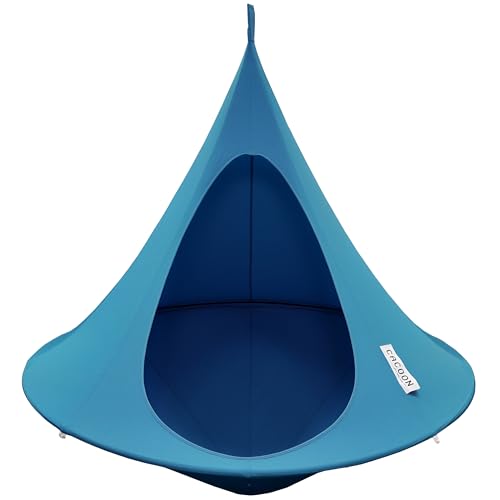
1. Vivere Double Cacoon Hanging Chair — the balcony-shaped flagship
Who it suits: Renters with a small or awkward balcony and one trustworthy overhead point — a structural beam, a concrete ceiling with permission for a proper fixing, or room for a tripod stand — who want a premium lounging spot that does not consume the whole balcony floor.
The Cacoon is a hanging tent-chair in polyester canvas, rated by its maker to 440 lb, suspended from a single point by the included 18-foot rope and carabiner. Its geometry is why it leads this guide: a conventional hammock claims a rectangle nine to thirteen feet long, while the Cacoon claims a circle a few feet across and uses the vertical space apartments actually have spare. Inside the canvas walls you sit reclined rather than lying flat, shaded from glare and sheltered from the balcony breeze, which makes it a reading and coffee seat of a quality no flat bed on a small balcony matches. Price tracking on its Amazon listing places it in the sensible premium band — which, at this budget, means it leaves most of your $1500 for the rest of the corner.
What we like: One anchor point is one conversation with a landlord instead of two walls’ worth; the whole chair unclips and comes indoors in under a minute when weather turns; and it reads as furniture, which matters in a space that is also your living room’s view. It is also the pick guests fight over.
Honest limitation: The single point must be genuinely structural — a joist, a beam, a concrete fixing installed correctly — and never, ever a balcony railing or a decorative pergola slat. Swing multiplies load. You also sit rather than stretch out, and the enclosed canvas runs warm on still, hot afternoons.
Choose it if your balcony is small, your overhead structure is real, and you lounge sitting-up as much as lying-down. Skip it if you have no structural anchor and no room for a tripod — the stand set below solves your problem instead. Check on Amazon
2. Vivere Double Cotton Hammock with Space Saving Steel Stand — the deposit-safe set
Who it suits: Renters who want a true, lie-flat double hammock with zero fixings: nothing drilled, nothing clamped, nothing for a landlord to object to — the set stands on its own feet and leaves with you when the lease ends.
The combo pairs a double cotton bed (63 by 94 inches) with a nine-foot space-saving steel stand at a 450 lb maker capacity. The stand’s footprint is the apartment-relevant spec: at nine feet it fits long balconies and living rooms where a thirteen- or fifteen-foot frame never could, it assembles without tools, and it breaks down into an included carry bag that slides into a closet or under a bed — the storage answer most apartment gear never has. Indoors, the same set turns a spare corner into a reading nap spot through winter, which is how a purchase at this level earns its keep in a small home: it works in two rooms and two seasons.
What we like: It is the lowest-risk apartment purchase in this guide — a long-sold, tester-praised design (OutdoorGearLab singles out exactly this freestanding convenience), with replacement beds easy to source when the cotton eventually tires. Cotton is also the kindest fabric against skin for indoor use.
Honest limitation: Nine feet is still nine feet: measure your balcony’s usable length, including door swing, before ordering. Cotton should come in during wet weather, and on a high, windy balcony the empty set should be taken down or the bed removed — wind loads on balconies are real, and an unloaded hammock catches them.
Choose it if you want lie-flat comfort with a clean conscience at inspection time. Skip it if your balcony is under nine feet of clear length — the Cacoon’s footprint was designed for you. Check on Amazon
3. ENO DoubleNest — the answer when the building says no
Who it suits: Renters whose lease or building rules ban balcony hammocks entirely, and anyone whose real hammock life happens in the park, the courtyard garden (where permitted), campsites and holidays.
The DoubleNest is the category’s reference portable: a gathered-end double in 70-denier nylon taffeta, 9 feet 6 inches by 6 feet 4 inches, 400 lb maker capacity, weighing 19 ounces and packing into its own attached sack. Between two trees with the maker’s Atlas straps — sold separately, and that separation is the honest catch in its pricing — it sets up in minutes and gives a genuinely wide, comfortable double lie. Its two-year maker warranty is the strongest paper among the portable names, and its fabric has the longest real-world track record in this guide.
What we like: It converts a ban from a dead end into a different lifestyle: the hammock lives in a drawer, weighs less than a water bottle, and is ready for every green space your city offers. For apartment dwellers, that drawer-sized storage is not a minor spec — it is the whole product.
Honest limitation: It needs two proper anchors and cannot help you on a balcony without them; straps are a second purchase; and nylon is a travel fabric, not a leave-outside one — sun and damp degrade it if it lives on a railing between uses, which is also, in most buildings, against the rules anyway.
Choose it if your building bans balcony hanging or your hammock life is mobile. Skip it if you specifically want a home fixture — that is what the two picks above are for. Check on Amazon
4. LA SIESTA Brisa Classic Hammock, King — the long-balcony luxury
Who it suits: The minority of apartment readers with a genuinely long balcony or terrace — twelve feet of clear span or more — and, for wall mounting, a landlord who will agree in writing. For them, this is the finest bed in the guide.
The King Brisa is a gathered-end bed 5 feet 11 inches wide with 92 suspension cords spreading the load, in weather-resistant polypropylene, handmade in Colombia, with a 440 lb capacity. It needs a minimum span of about 11 feet 10 inches. The maker’s own mounting ecosystem is the apartment story: its wall-and-ceiling suspension kit exists precisely for masonry balconies and terraces, and its steel stand offers a no-fixing route for readers whose span comes from a terrace rather than a balcony. Left outdoors, the polypropylene shrugs off the showers that would ruin cotton — the pragmatic choice for a bed that cannot easily be brought inside.
What we like: Width is luxury in a fabric hammock, and no apartment-compatible bed gives a couple more of it; the cord count makes the lie feel supported rather than saggy; and the whole bed rolls to pillow size for winter storage.
Honest limitation: Most balconies simply cannot host it — measure before you dream. Wall mounting means drilling into structure, which most leases forbid without written permission, and the bed alone includes no suspension, so the kit is a necessary second line on the order.
Choose it if you have the span and, for mounting, the permission. Skip it if either is missing — a cramped, over-sagged king bed is worse than a right-sized smaller one. This pick is prose-only because its Amazon listing showed no live offer at research time; specialist hammock retailers stock it.
5. Kammok Roo Double — the fabric connoisseur’s portable
Who it suits: Buyers who care about fabric feel above all — the reader who has tried a basic nylon hammock, found it crackly and clammy, and wants the premium version of the portable idea for parks, travel and a spare-room hang.
The Roo Double is built from GravitasX, a 40-denier diamond ripstop woven from fully recycled, Bluesign-approved yarn, at 10 feet by about 5 feet 9 inches in its current listing, with a 500 lb maker capacity and a lifetime warranty that is the strongest in this guide. Independent testers at OutdoorGearLab rated it their best everyday lounger and describe the fabric as the softest they have tested — the rare premium claim that survives contact with reviewers. Like the DoubleNest it packs small and stores in a drawer, which keeps it apartment-honest.
What we like: The fabric genuinely is a class above, the recycled construction is verifiable rather than vibes, and the lifetime warranty suits a buy-it-for-a-decade budget like this one.
Honest limitation: Its suspension straps are a separate purchase, its Amazon presence is thin enough that we could not verify a listing identity to link — most buyers will purchase it from the maker or outdoor retailers — and it solves fabric quality, not apartment geometry: it still needs two anchors.
Choose it if you want the best-feeling portable and buy once, for years. Skip it if you need a link-and-done Amazon purchase or a stand — see the Vivere set. This pick is prose-only for the listing reason stated above.
6. Yellow Leaf Handwoven Hammock, Double — the indoor statement piece
Who it suits: Design-led renters with a large living room, a sunroom or a long balcony, who want the hammock to be the most beautiful object in it — and who like knowing exactly whose hands made it.
Yellow Leaf’s hammocks are handwoven by artisan weavers in Thailand from a weather-tolerant performance yarn the brand developed for exactly this indoor-outdoor life; the Double size carries a 400 lb maker capacity (the Family size is rated higher still). The weave is dense, soft and unusually supportive — reviewers who have lived with one consistently describe a lie closer to a woven bed than to a sheet of fabric — and the colours are the kind that anchor a room’s whole palette. Indoors on a stand, it is the one pick in this guide that interior-minded guests photograph.
What we like: It is the rare premium hammock whose premium is visible and tactile rather than spec-sheet deep, and its weather tolerance forgives balcony life better than cotton does. The brand’s artisan model is documented and specific, not marketing mist.
Honest limitation: Beauty still needs geometry: it is a full-size gathered-end bed that needs a proper span or a stand, neither included. And the brand sells mainly through its own store — its Amazon listing showed no live offer when we checked — so this is a direct purchase, with the maker’s own guidance on sizing worth reading first.
Choose it if the hammock is a design decision as much as a comfort one. Skip it if you want the cheapest route to a good lie — that is the DoubleNest or the Vivere set. This pick is prose-only for the sales-channel reason stated above.
What We Left Out, and Why
An apartment guide earns its credibility from its exclusions, so here are the famous names you will not find above. The big wooden arc combos — beautiful fourteen-foot furniture arcs of the kind our main guide recommends for gardens — fail the apartment test on footprint alone: they claim more clear floor than most balconies contain, they arrive in pieces that challenge narrow stairwells, and they cannot come indoors for winter in any realistic floor plan. If your apartment is a penthouse terrace, shop them in the Best Hammock Under $1500 main guide; for everyone else they are a photograph, not a purchase.
Classic spreader-bar rope hammocks were excluded for a related reason: they need fourteen to sixteen feet of span hung taut and level, a geometry almost no balcony offers, and their open weave is the least forgiving lie for new users in a confined space where a tip means a railing, not a lawn. The no-name stand sets that flood marketplaces at suspicious prices were excluded on evidence rather than snobbery: the category’s CPSC recall history is a story of stand welds, hooks and hardware failing on exactly this class of product, and in an apartment — hard floors, close neighbours, a drop beyond the railing — the cost of a hardware failure is higher than anywhere else. Every stand and fixing recommended above comes from a maker with a published capacity, a track record and replacement parts, which at any budget is the floor, not the ceiling, of what to accept.
Finally, we left out the entire genre of hammocks marketed as balcony-ready because they clamp to railings. No reputable maker in our research sells a railing-clamp hammock, and that absence is the market quietly agreeing with the safety rule stated throughout this guide.
Side-by-Side Comparison
| Pick | Apartment hang route | Space it claims | Maker capacity | Storage story | Amazon link |
|---|---|---|---|---|---|
| Vivere Double Cacoon | One structural overhead point, or tripod stand | A few feet of floor circle | 440 lb | Unclips and comes indoors in a minute | Check on Amazon |
| Vivere Steel Stand Combo | Freestanding — no fixings at all | 9 ft stand footprint | 450 lb | Breaks down into included carry bag | Check on Amazon |
| ENO DoubleNest | Two trees/anchors, straps separate | None at home — drawer-sized | 400 lb | Packs into its own sack, 19 oz | Check on Amazon |
| LA SIESTA Brisa King | Maker wall kit (permission) or stand | ~11 ft 10 in minimum span | 440 lb | Rolls to pillow size | Prose-only |
| Kammok Roo Double | Two anchors, straps separate | None at home — packs small | 500 lb | Packs to about a jar’s footprint | Prose-only |
| Yellow Leaf Double | Stand or two anchors (not included) | Full double-bed span | 400 lb | Folds away; a design piece when up | Prose-only |
For apartment readers, the “hang route” column is the whole decision. Comfort differences between these six are real but second-order; a hammock you are not allowed — or not able — to hang has no comfort at all.
How to Choose a Hammock for an Apartment
Read your lease before any listing. Look for clauses on drilling, balcony alterations and items overhanging the railing. If wall or ceiling mounting is even a possibility, get permission in writing and keep it with your lease paperwork. Freestanding and portable picks exist precisely so most readers never need that conversation.
Measure three things. Clear balcony length (door swing included), clear width for a stand’s feet or a Cacoon’s swing circle, and the height and structure of anything overhead. Then compare honestly against the table above: the Brisa King needs its twelve feet; the Vivere stand needs nine; the Cacoon needs a few feet of floor and one honest anchor. If your space fails all three, your hammock life is portable — embrace the DoubleNest answer rather than forcing a fixture. Readers furnishing the rest of a small balcony will find the matching constraints in our Best Adirondack Chair For Apartments Under $1500 and Best Camping Chair For Apartments Under $1500 guides.
Respect the railing rule absolutely. Never hang any part of any hammock from a balcony railing, a balustrade, or a fence panel. These are guards, not structures; hammock loads are dynamic and multiplied at shallow angles; and a failure drops a person over or through the very barrier meant to protect them. This is the one rule in this guide with no exceptions and no budget large enough to soften it.
Plan wind and water. On higher floors, remove fabric beds in storm weather — an empty hammock is a sail and a stand can walk. Choose weather-tolerant fibres (the Brisa’s polypropylene, the Cacoon’s canvas) if the setup will live outside, and keep a Best Deck Box For Apartments Under $1500 or an indoor storage spot in the plan for cushions and covers.
Spend the surplus on dual-use. At this budget, the smart apartment purchases after the hammock are the ones that work twice: a stand set that moves indoors for winter, a portable second hammock for the park, a cover that keeps the balcony set inspection-clean. Our Best Hammock For Small Patios Under $1500 guide applies the same thinking to patio spaces a step larger than a balcony.
Setting Up Safely in a Rental: The Details That Matter
Balcony structure is a real limit. A hammock setup concentrates loads in ways ordinary balcony furniture does not. Two adults in a bed hung at a shallow angle can put several times their combined weight of tension through the anchor points, and a freestanding stand spreads its load through four small feet. On older balconies, on timber decks of unknown condition, and anywhere the structure is questionable, the stand-based picks are the conservative choice because their loads are predictable and distributed — and if you have any doubt about a balcony’s capacity, the correct move is to ask the building, not to test it with people. Keep the loaded bed low: a hammock you step into from a near-sitting position is both the comfortable geometry and the safe one, since a failure from eighteen inches is an embarrassment, while a failure from railing height is an emergency.
Overhead points need proof, not optimism. For the Cacoon or any ceiling-hung piece, the fixing must land in structure — a joist found with a stud finder and confirmed, or a concrete ceiling with the correct anchor for the material — installed to the hardware maker’s instructions. Plasterboard, decorative beams and pergola slats are not structure. If you cannot verify what is behind the surface, treat the point as unavailable and use a stand. This is also why written landlord permission matters for fixed points: it converts a guess about the building into a shared, documented decision.
Wind discipline is part of ownership. Balconies accelerate weather. An empty fabric hammock in a storm gust acts as a sail, loads its anchors cyclically, and can walk a lightweight stand across a deck. The routine that prevents all of it takes ninety seconds: bed off, chair unclipped, stand folded or weighted, when severe weather is forecast. Weather-tolerant fabrics forgive rain; nothing forgives being left rigged in a gale.
Noise and drip etiquette. Stand feet on hard balcony surfaces transmit sound to the unit below; a cheap outdoor mat under the stand quiets both the feet and the neighbours’ ceiling. After rain, let a bed drip-dry over your own balcony floor, not over the edge.
The Apartment Budget, Honestly Allocated
Because no pick in this guide comes close to the ceiling, the useful question is what a complete, renter-safe apartment hammock corner actually consists of. In order of importance: the hammock or chair itself; the stand or rated mounting hardware that makes it legal in your home; a cover or storage solution that keeps it clean enough for a small space; and only then comfort extras such as a pillow. Bought in that order from the makers in this guide, the whole corner typically consumes a modest fraction of $1500 — and the remainder is genuinely better spent on the balcony around it: shade, a small side table, the mat under the stand. A budget this large, in a space this small, is mostly an instruction to buy quality once and stop.
Common Mistakes Apartment Hammock Buyers Make
Hanging from the railing. Covered above because it bears repeating: it is the dangerous mistake, the lease-breaking mistake and the deposit-losing mistake in one.
Drilling first, asking later. Masonry fixings for a wall kit are permanent alterations in most leases. Permission in writing, or a freestanding stand — there is no third option worth its risk.
Buying the biggest bed the budget allows. At $1500 the temptation is a king bed; in a ten-foot balcony it becomes a sagging wall-to-wall obstruction you climb over to reach the door. Right-sized beats flagship in small spaces, every time.
Forgetting the neighbours. A hammock that swings into the railing, drips through the balcony floor after rain, or hosts loud late sessions will draw complaints regardless of its price. Low hangs, contained footprints and weather discipline are good citizenship as much as good hammocking.
Leaving nylon out all season. Portable hammocks stored on the balcony degrade in sun and damp and can breach rules about balcony storage. They live in a drawer; that is their design.
The Second Life: Hammocks Indoors
An apartment purchase at this level should justify itself in January as well as July, and this is where the stand-based and portable picks quietly out-earn the fixed installations. The Vivere steel-stand set moves from balcony to living room in minutes and turns a spare corner into the household’s contested nap spot; its cotton bed is at its best indoors, away from the weather that is its one weakness. The Cacoon unclips from its balcony point and rehangs from any indoor structural point or tripod, becoming a reading chair that takes less floor than an armchair. The DoubleNest and Roo Double, meanwhile, stop being balcony equipment entirely and become travel gear — the hammock that goes to the park in spring, the coast in summer and the drawer in between.
Indoor hanging has its own discipline. Wall studs and ceiling joists are the only honest anchors; the maker’s wall-mount kits are engineered for masonry and timber structure, not for plasterboard. Keep indoor hangs lower than you would outdoors — furniture is closer, floors are harder, and the geometry that feels airy on a balcony feels reckless beside a bookcase. And mind the swing radius: a hanging chair indoors needs clearance on every side, which is a tape-measure question, not a vibes question.
This dual-use reality should shape the purchase itself. In a house, a hammock can be a single-purpose garden object. In an apartment, every large object must audition for two jobs, and the picks in this guide were ranked with that audition in mind: the stand set and the Cacoon pass it, the portables pass it by disappearing, and the big fixed beds pass it only in the minority of apartments with the span to spare. When you read the price tags in that light, the apartment tier’s arithmetic resolves itself — you are not buying a $1500 hammock, you are furnishing a flexible corner of a small home, and most of the budget rightly stays in your pocket.
Renters’ Pre-Purchase Checklist
Before any money moves, work through this list in order. One: photograph your balcony’s clear floor rectangle and write down its length, width and door swing. Two: re-read the lease clauses on alterations, drilling and balcony use, and note exactly what is prohibited. Three: identify your hang route from the comparison table — freestanding, single-point, wall kit with permission, or portable — and eliminate every pick that needs a route you do not have. Four: if a fixed point is involved, locate the structure behind the surface and get permission in writing. Five: plan storage for the bed, the stand and the cushions in the off-season, in the apartment you actually have. Six: only then compare comfort and fabric among the surviving picks. Renters who run this checklist buy once; renters who skip it buy a return label. The checklist also explains this guide’s structure — every review above is organised around the route, the footprint and the storage story first, because in an apartment those are the specs that decide whether the hammock gets used two hundred times or twice.
Final Recommendation
For the typical renter, the Cacoon and the Vivere steel-stand set are the two honest flagships of this guide — one for small footprints with a real anchor, one for zero-fixing lie-flat comfort — and both leave most of a $1500 budget unspent, which in an apartment is not a compromise but the correct outcome. If your building bans balcony hanging, the DoubleNest turns the ban into a park habit for a fraction of the budget. The Brisa, Roo and Yellow Leaf are the connoisseur options for the specific readers each review names. However you choose, measure your balcony one more time before you order.
Frequently Asked Questions
Can I hang a hammock from my balcony railing?
No. A railing is a safety guard, not a load-bearing anchor; hammock forces are dynamic and multiply at shallow hang angles, and railing fixings are not designed or rated for them. Use a freestanding stand, a genuinely structural overhead point, or a portable hammock elsewhere.
Will a hammock stand fit on a small balcony?
The nine-foot space-saving steel stand in this guide fits many apartment balconies, but measure your clear length including the door swing first. If nine feet is too much, a single-point hanging chair claims only a few feet of floor and is usually the better small-balcony answer.
Do I need my landlord’s permission for a hammock?
For a freestanding stand or a portable hammock, typically not — nothing is altered. For any drilling, wall kit or ceiling fixing, get written permission first; most leases treat fixings as alterations, and the deposit you save is worth more than any hammock.
What if my building bans balcony hammocks?
Then the honest best buy is a quality portable hammock for parks and trips, which is why the DoubleNest and Roo Double are in this guide. A ban does not end hammock ownership; it relocates it.
How much of the $1500 should an apartment hammock actually cost?
Far less than the ceiling — every pick in this guide sits in the low hundreds or below, and the complete, stand-inclusive apartment setups still leave a large surplus. Spend the remainder on dual-use pieces (a set that moves indoors, storage, a portable second hammock) or simply keep it.
Is a hanging chair as comfortable as a hammock bed?
It is a different comfort: reclined sitting, reading and napping rather than lying flat. On small balconies it is often the more usable comfort, because it fits the space properly instead of dominating it.
Can I use an apartment hammock indoors in winter?
Yes, and at this budget you should — dual use is how the purchase earns its place in a small home. Stand sets move indoors without tools, and hanging chairs rehang from any verified structural point. Keep indoor hangs low, confirm the anchor is in a joist or masonry rather than plasterboard, and check the swing clearance on every side before the first sit.
What is the best hammock for a balcony with no overhead structure?
A freestanding stand set — in this guide, the Vivere steel-stand combo — because it asks nothing of the building at all. If its nine-foot footprint is too long for your balcony, the remaining honest option is a portable hammock used elsewhere; no safe product hangs a bed from a railing or a lightweight frame wedged into a corner.
How do I keep a balcony hammock clean in a small apartment?
Choose fibres that forgive the life available: weather-tolerant beds can be hosed down on the balcony and dried in place, while cotton and nylon pieces should be washed, dried fully indoors, and stored in the carry bag or drawer they came with. A small lidded storage box on the balcony keeps straps, covers and pillows together and inspection-tidy — in a small home, the storage plan is part of the product.
Can a hammock stand damage a balcony floor?
Stand feet concentrate load on small contact patches, so on timber or tiled balconies use the maker’s feet caps, a mat or pads under each foot, and check the surface after the first weeks of use. Keep the setup off any balcony whose structure you have reason to doubt, and remember the stand spreads weight far more kindly than any wall fixing concentrates it.
What about weight — can a balcony hold a hammock, a stand and two people?
Modern balconies are engineered for loads well beyond ordinary furniture, but the honest answer is that only your building’s documentation or management can confirm your balcony’s rating, and older or visibly deteriorated structures deserve a question before a purchase. The stand-based picks spread their load across four feet, which is the gentlest arrangement available; if management cannot confirm the balcony is sound, the portable-hammock answer in this guide is the responsible one.
Which hammock is best for a studio apartment with no balcony at all?
The stand set, used indoors: it needs a nine-foot run along a wall and nothing else, and in a studio it doubles as the reading chair, the nap bed and the guest’s fascination. If nine feet does not exist, the hanging chair on a verified ceiling joist claims the least floor of any lounging furniture you can buy — measure the swing circle, keep it low, and the smallest home in this guide still gets its hammock.


