Where to buy
Check the latest price, availability and delivery on Amazon. Orders are placed on Amazon. We may earn a commission from qualifying purchases.
- Best overall: MEATER Block WiFi Smart Meat Thermometer, 4-Probe — Check on Amazon
- Keter Unity XL Outdoor Prep Table and Storage Cabinet — Check on Amazon
- Weber 2290 22-Inch Charcoal Kettle Rotisserie — Check on Amazon
- MEATER Plus Smart Wireless Meat Thermometer — Check on Amazon
- ThermoWorks Thermapen ONE Instant-Read Thermometer — Check on Amazon
Read the full guide ↓
Disclosure: As an Amazon Associate, dailyhomedecorating.com earns from qualifying purchases. Links to Amazon on this page are affiliate links; they cost you nothing extra. Listing details such as price and availability change often, so check the current Amazon listing before you buy.
The best grill accessories for outdoor entertaining under $300 are chosen by a test no other grilling situation applies: does this product give the host their evening back? Entertaining outdoors fails in a specific way that has nothing to do with food quality. The food is often fine. It is the host who disappears — stationed at the grill, lifting lids, cutting into chicken to check it, making the apologetic trips for the tray, the tongs, the sauce, the clean plate — while the gathering happens somewhere else. Every pick in this guide was scored against that failure. The accessories that earn a place here either supervise the cook so the host can leave the grill, turn the cooking itself into part of the entertainment, or collapse the logistics — the surfaces, storage and serving infrastructure — that otherwise consume the evening in trips and balancing acts.
Read the $300 budget the way hosts actually spend it: mostly as a collection. One anchor — a four-probe wireless thermometer system that watches dinner while you pour drinks — surrounded by the supporting cast: a prep-and-serving station that works as a bar when the cooking ends, a rotisserie that makes the main course a slow, golden piece of theater, a single-probe thermometer for the steak-to-order problem, and the professional instant-read that lets you verify a dozen pieces of chicken in the time it takes a guest to ask if it is ready. One further system is covered in prose only, honestly labeled, because its list position sits above this guide’s ceiling even though sale events have brought it under. And one safety rule governs the whole list: no wire-bristle grill brush is recommended here, at any price, because federal regulators have recalled millions of them — Weber, Cuisinart and Nexgrill among them — after loose bristles were swallowed and caused serious injuries. When you cook for guests, that responsibility doubles; the cleaning guidance in this guide is bristle-free throughout. Guests, meanwhile, need somewhere to sit while all this happens — see Best Adirondack Chair For Outdoor Entertaining Under $300.
In this guide
Quick Picks
Short on time? Each row names a hosting situation and the accessory that suits it, with a link where one was verified.
| Buyer type | Pick | Why it stands out | Link |
|---|---|---|---|
| Best overall | MEATER Block, 4-Probe | Four proteins supervised by WiFi while the host hosts | Check on Amazon |
| Best serving infrastructure | Keter Unity XL Prep Table | Prep surface by day, serving and drinks station by evening | Check on Amazon |
| Best centerpiece | Weber 2290 Kettle Rotisserie | A turning, self-basting bird is dinner and theater at once | Check on Amazon |
| Best for steaks to order | MEATER Plus | One wire-free probe for the guest whose steak matters most | Check on Amazon |
| Best verifier | ThermoWorks Thermapen ONE | Checks a whole tray of pieces in seconds, no cutting open | Check on Amazon |
| Best splurge (prose only) | MEATER Pro XL | Four heat-proof probes and a display dock — list price sits above this tier | See review |
How These Picks Were Chosen
The first filter was verification, applied strictly: a pick carries an Amazon link only if its ASIN was confirmed against an independent record of the Amazon listing and a price sighting for that exact ASIN sat at or under $300 at research time. The MEATER Pro XL failed the second half of that test at list price — its documented sale prices dip under the ceiling, but a budget guide links what it can verify inside the budget — so it appears in prose, clearly framed, with no link. Because grill gear pricing is seasonal, this article prints no fixed figure for any product: check price on Amazon for the number that will apply to your order.
The second filter was the host test described above. Candidates were scored on the minutes they return to the host: monitoring systems score highest, because unattended confidence is the scarcest resource at a gathering; serving infrastructure scores next, because trips are the second thief; spectacle scores honestly too, because a rotisserie’s turning bird genuinely entertains in a way a closed lid never will. Pure cooking-quality upgrades that demand the host’s constant presence scored lowest here, however fine they are in other guides. We did not use these products ourselves; we compared maker listings, specifications and independent price records, and weighted the hosting specifications — probe count, display options that free the host from a phone, storage volume, serving surface — as heavily as raw cooking performance.
The third filter was safety, with guests in mind. Wire-bristle grill brushes have been recalled in the millions by the U.S. Consumer Product Safety Commission after bristles detached, stuck to grates and food, and were swallowed — in some cases requiring surgery. A host serving other people’s families does not get to treat that record as a technicality. No wire brush, and no tool set containing one, is recommended in this guide; cleaning guidance is bristle-free only.
The 6 Best Grill Accessories for Outdoor Entertaining Under $300
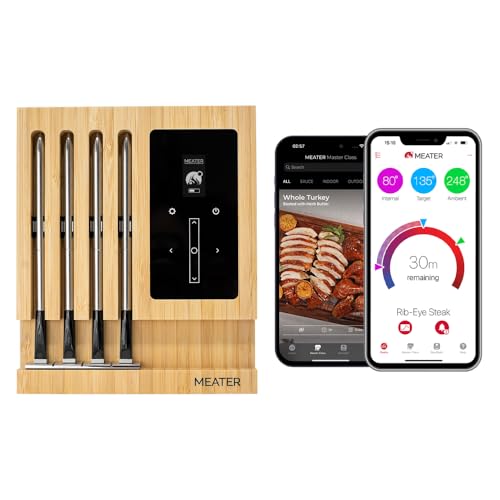
MEATER Block WiFi Smart Meat Thermometer, 4-Probe
Who it suits: The host whose menu runs to several proteins at once — the pork shoulder that started at noon, the chicken joining at five, the salmon and the steaks that finish the evening — and who intends to be at the table for most of it.
Entertaining is a scheduling problem disguised as a cooking problem. Everything must finish near a moment, the cook must somehow also be a person at their own gathering, and the traditional solution — hovering, guessing, cutting things open to look — sacrifices either the food or the host. The Block attacks the problem with simultaneity. Four wire-free probes, each reading a cut’s internal temperature and the air temperature around it, report to a wooden dock with its own display and a standalone mode, and the dock’s built-in WiFi relays everything to the app on your phone wherever in the house or yard you happen to be hosting from. Four finish-time estimates, four target alerts: the shoulder announces its stall window while you are making the salad, the chicken calls you out with minutes to spare, and the host’s trips to the grill become short, purposeful visits instead of a second residence.
The hosting details matter as much as the headline. Standalone mode means the dock on the prep station shows the cook to anyone who wanders past — guests find a live dashboard genuinely interesting, and the host is freed from phone-checking at the table. The probes’ ratings — 212°F internal, 527°F ambient — suit the roasting and indirect work that entertaining menus are built on, with direct searing handed to the instant-read below. Probe range shortens through heavy steel, so the dock lives near the grill and WiFi does the traveling. Check price on Amazon: the Block sits in the upper half of this budget, and for a host it is best understood not as a thermometer purchase but as the evening’s staffing budget — the hire that lets you attend your own party.
- Four wire-free probes with internal and ambient sensors.
- WiFi plus a standalone dock display — the cook, visible to host and guests alike.
- Finish-time estimates and alerts per probe turn hosting into scheduling.
- Dishwasher-safe probes for a faster post-party cleanup.
Honest limitation: The 527°F ambient ceiling keeps probes out of direct searing, four probes is wasted on a two-person dinner, and the system rewards hosts who plan menus around it — improvised single-item cooks gain little.
Choose it if your gatherings run to multiple proteins and a timetable. Skip it if your entertaining is a single grill load of burgers and dogs — the Plus and the Thermapen cover that evening for far less.
Keter Unity XL Outdoor Prep Table and Storage Cabinet
Who it suits: Hosts whose grill area has no counter, no storage and no serving surface — which means the kitchen island is doing all three jobs, through a door, all evening.
Count a host’s trips and you find the evening’s hidden labor: out with the raw tray, back for the tongs, out with the sauce, back for the clean plate, in with the cooked tray, out with the serving bowls. The Unity XL collapses that relay into a station. Its stainless steel top is a working surface with genuine room — marinating trays, a cutting board, resting meat, and later the carved platter — and its weather-resistant resin body stores 78 gallons of the entertaining arsenal, 54 of them enclosed: fuel, drip pans, the rotisserie kit, serving tools, covers, cleaning gear, all at the point of use instead of distributed between the garage and a kitchen drawer. Hooks hold the tools, a holder takes the paper towels that every cookout consumes by the dozen, and the bottle opener is exactly where a host wants it.
Its second shift is what earns it this guide’s slot over a merely good cart. When the cooking ends, the same station becomes the serving and drinks surface — the place the platter lands, the salads line up, and guests help themselves without entering the cook’s workspace at all. On casters, it rolls from grill-side to seating-side as the evening changes phase. The honest notes are the familiar ones: it is a large piece of furniture that wants a real patio or yard, assembly takes an unhurried hour with a helper, the materials are practical rather than luxurious, and hot pans deserve a trivet. Check price on Amazon — upper-middle of this budget — and judge it as hosts should judge all infrastructure: by the trips it deletes, which over a season of gatherings is measured in miles.
- Stainless worktop: prep space during the cook, serving space after it.
- 78 gallons of storage — 54 enclosed — for the whole entertaining kit.
- Weather-resistant resin body on casters; repositions as the evening changes.
- Hooks, paper towel holder and bottle opener built in.
Honest limitation: Furniture-scale footprint, an hour of assembly, and practical materials — it serves the party superbly without pretending to be outdoor-kitchen cabinetry.
Choose it if your hosting involves a kitchen-door relay. Skip it if your patio already has counters and storage, or if your gatherings are small enough that a tray table suffices.
Weber 2290 22-Inch Charcoal Kettle Rotisserie
Who it suits: Kettle-owning hosts who understand that at a gathering, the main course can be the entertainment — a bird turning slowly over coals, bronzing in public, is a better centerpiece than anything that happens under a closed lid.
The rotisserie is the oldest spectacle in outdoor cooking, and the Weber 2290 brings it to the most common grill in America. Weber’s own kit for the 22-inch kettle — a porcelain-enameled ring that raises the rim, a stainless spit, clamping forks and an electric motor — turns a whole chicken, a pork loin or a leg of lamb continuously over the coals, so the food bastes itself in its own juices and browns on every side. The cooking virtues are real: evenness no static grate matches, self-basting that forgives a host’s divided attention, and a drip pan underneath catching the makings of a sauce. But the entertaining virtue is the one this guide is scoring: guests gather around a turning roast the way they gather around a fire. It gives the cook a stage, the evening a focal point, and the reveal — the motor off, the spit lifted, the bird carved at the station — a small ceremony that a tray of burgers cannot offer.
The hosting discipline is simple and worth rehearsing once before guests depend on it. Truss the bird tightly and balance the load, because a flopping roast is comedy of the wrong kind. Bank the coals to the sides, set the drip pan below, confirm the motor’s cord reaches an outdoor outlet without crossing the guest traffic, and let a probe thermometer — the Block above was born for this — tell you when the turning masterpiece is done, since a rotisserie bird cannot be checked by prodding. Check price on Amazon: the kit sits mid-budget, which is remarkable for an appliance that is also a show. One rehearsal chicken, eaten by family, is the entire learning curve.
- Factory Weber kit for 22-inch kettles: ring, spit, forks and motor.
- Self-basting, evenly browned centerpiece cooking — dinner as theater.
- Forgiving of a host’s divided attention once the load is turning.
- Stores flat between gatherings.
Honest limitation: Fits 22-inch Weber kettles only, needs an outlet within cord reach, and depends on trussing and balancing that take one practice cook to learn.
Choose it if your gatherings deserve a centerpiece and your kettle can host one. Skip it if your grill is gas or another size — or if your hosting style is buffet-casual rather than sit-down.
MEATER Plus Smart Wireless Meat Thermometer
Who it suits: The host facing the steak-to-order problem: six guests, four doneness preferences, one grill, and a reputation riding on the difference between medium-rare and medium.
Every host knows the moment: the steaks are on, the requests were called out over drinks — rare, medium-rare, two mediums, one well-done for the guest you love anyway — and the grill offers no labels. The MEATER Plus is the single-probe answer with the best hosting manners in this guide. Its wire-free probe — internal sensor at the tip, ambient sensor at the handle — goes into the most consequential steak, the thickest or the rarest, and its bamboo charger, which hides a Bluetooth repeater stretching the link to a maker-rated 165 feet, relays the cook to the app in your pocket while you are at the table. The app’s finish-time estimate does the quiet miracle: it tells you when to put the well-done steak on so that it and the rare one finish together, which is the whole art of steak night expressed as a notification.
Its limits shape its role honestly. One probe means one tracked steak; the others are managed by order, thickness and the instant-read below — a system, not a gap. The probe’s 527°F ambient ceiling means it rides the indirect phase and the resting carryover, not the direct sear; pull it before the final blaze and verify with the Thermapen. Everything runs through the phone, which at a party is either in your pocket or being used for music — plan accordingly. Check price on Amazon: the Plus sits at the accessible end of this budget, and paired with the Thermapen it forms the two-piece temperature kit that most hosts, most evenings, actually need — the Block above is for the menus that outgrow it.
- Single wire-free probe with internal and ambient sensors.
- Repeater in the charger extends range to a maker-rated 165 feet.
- Finish-time estimates synchronize steaks of different donenesses.
- Dishwasher-safe probe; stores in a drawer between parties.
Honest limitation: One probe tracks one steak, the ambient ceiling excludes the sear itself, and the experience lives on your phone.
Choose it if steak night with preferences is your signature gathering. Skip it if your menus run to several proteins at once — that is the Block’s table.
ThermoWorks Thermapen ONE Instant-Read Thermometer
Who it suits: The responsible host — the one serving chicken, pork and burgers to other people’s children, who needs every piece verified and refuses to verify by cutting it open on the serving platter.
Entertaining multiplies the verification problem exactly as it multiplies everything else. A Tuesday cook checks two chicken thighs; a Saturday host checks fourteen, plus burgers of varying thickness, plus the sausages that split attention at the end. The Thermapen ONE is built for that arithmetic: ThermoWorks’ professional flagship, reading in about a second with competition-grade accuracy, moving piece to piece at walking pace so the whole tray gets certified in the time a lesser thermometer spends thinking about one thigh. Nothing gets cut open, no juices are lost to inspection, and the host’s answer to “is the chicken done?” is a number rather than a hope — which, when you are feeding guests, is a form of hospitality in itself.
It is also the gathering’s quiet problem-solver beyond the grill: the holding pan checked before serving, the reheated side verified, the guest’s steak confirmed at the board before it crosses the yard. It folds into a pocket, needs no pairing or charging, and its display rotates to whichever hand reaches with it. Check price on Amazon — a modest share of this budget — and consider it the insurance policy of the entertaining kit: the least glamorous pick in this guide, and the one whose absence would be noticed first.
- Professional-grade instant readings — a whole tray verified in seconds.
- No cutting pieces open to check; juices and presentation survive.
- Folding, pocketable, no app or charging — always ready at a party.
- Verifies holding and reheating temperatures at serving time.
Honest limitation: It verifies only while you stand there — no monitoring, no alerts — so it partners with a leave-in probe rather than replacing one.
Choose it if you serve poultry, pork or mixed loads to guests. Skip it if — for hosts, honestly, do not; this is the kit’s conscience.
MEATER Pro XL (Prose Only — Read the Framing)
Who it suits: The serious host-smoker who cooks over open flame as well as indirect heat, and who is shopping with sale-season patience.
This pick is prose-only for a reason this guide will state as plainly as it states everything else: the Pro XL’s list position sits above the $300 ceiling of this guide. Documented sale events have brought it under that line — which is why it is mentioned at all — but we could not verify an Amazon ASIN and an under-ceiling price sighting together to the standard the linked picks above had to meet, so there is no link here and no recommendation to buy it “under $300” as a matter of course. Check price on Amazon if you shop for it, and buy it only on a day when the listing itself respects the budget.
What the product is, for the host who catches that day: MEATER’s four-probe flagship, with probes rated to far higher ambient temperatures than the Block’s — open-flame territory — each carrying multiple internal sensors, a dock with WiFi and its own display for standalone cooking, and USB-rechargeable probes. For the host whose signature is a mixed fire — searing and roasting in the same service — it removes the Block’s one real constraint. Whether that removal is worth waiting for a sale is a judgment this guide leaves, transparently, to you and the listing in front of you.
- Four wire-free probes rated for open-flame ambient temperatures.
- WiFi dock with display and standalone mode.
- Multiple sensors per probe; USB-rechargeable.
- List price above this guide’s ceiling — a sale-day purchase only.
Honest limitation: Prose-only because its list price exceeds $300 and no under-ceiling Amazon sighting could be verified for a specific ASIN; hosts who need a four-probe system today, in budget, should buy the Block.
Choose it if a verified sale brings it into budget on the day you shop. Skip it if you are buying at list — at that point it belongs to a different guide’s tier.
Comparison Table
| Product | Type | Best use | Link |
|---|---|---|---|
| MEATER Block, 4-Probe | Wire-free thermometer system, WiFi | Scheduling a multi-protein menu while hosting | Check on Amazon |
| Keter Unity XL | Prep table and storage cabinet | Prep surface that becomes the serving station | Check on Amazon |
| Weber 2290 Kettle Rotisserie | Charcoal kettle rotisserie kit | A self-basting centerpiece on a 22-inch Weber kettle | Check on Amazon |
| MEATER Plus | Single wire-free probe | Steaks to order, synchronized by finish estimates | Check on Amazon |
| ThermoWorks Thermapen ONE | Instant-read thermometer | Verifying every piece served to guests | Check on Amazon |
| MEATER Pro XL | Wire-free thermometer system, WiFi | Open-flame four-probe cooking (prose only — over ceiling at list) | See review |
How to Choose Grill Accessories for Outdoor Entertaining
- Score every purchase in host-minutes returned. Monitoring that frees you, surfaces that delete trips, storage that ends the scavenger hunt — entertaining accessories pay in time and presence, not just cooking quality.
- Match probe count to menu count. One protein, one probe. A shoulder, a chicken and steaks on one timetable is a four-probe menu. Buy for the gatherings you actually host, not the ones in magazines.
- Plan the raw-to-cooked traffic. Separate trays, separate tongs, a landing surface that keeps the two streams apart — the prep station earns its place as a food-safety device before it earns it as furniture.
- Let spectacle carry some weight. A turning rotisserie genuinely entertains. When two purchases cook equally well, the one guests gather around is the better entertaining buy.
- Verify for a crowd, fast. Serving others raises the stakes on doneness. An instant-read that certifies a whole tray in seconds is a host’s duty, not a luxury.
- Clean bristle-free — your guests are the reason. Wire-bristle brushes have been recalled in the millions after swallowed bristles caused serious injuries. No host should run that risk on food served to other families; coils, steam heads and wood scrapers only.
- Rehearse the new gear once. A rotisserie’s first bird and a probe system’s first big menu should feed family, not guests. Every system in this guide has one small ritual to learn, and a rehearsal is the cheapest tuition in hosting.
- Check the live price before judging value. Entertaining gear is seasonal to an extreme; the same station costs differently in May and October. This guide prints no fixed prices — check price on Amazon when you buy.
The Entertaining Workflow: Before, During, After
The picks above assemble into a workflow worth describing, because hosting succeeds or fails as a sequence. Before guests arrive, the station does the work: everything staged in its cabinet, the worktop laid out as a line — raw trays at one end, tools in the middle, the clean landing zone at the other — and the long cook already running under probe supervision, its finish estimate setting the evening’s clock. During the gathering, the host’s grill visits become cameos: out at an alert to turn, baste or add the next wave, back to the table while the dock and the app keep the watch. The rotisserie, if it is running, holds the guests’ attention in the cook’s absence, which is not a small thing — it is the difference between a grill that empties the party and a grill that anchors it.
After the food lands, the same kit closes the evening down. The instant-read certifies the holding tray before seconds are served. The station becomes the serving surface, then the clearing surface. Probes go into the sink or dishwasher, tools into the cabinet, and the grate gets its bristle-free cleaning while it is still warm and the conversation is still going — a five-minute ritual that means the next gathering starts from clean. Hosts who run this sequence a few times discover what the accessories were really for: not better grilling, though the grilling is better, but a party at which the person who cooked also got to attend.
Menu Design: Building a Gathering Around the Probes
The thermometer systems in this guide quietly rewrite what a host can promise on a menu, and it is worth designing for that explicitly. The classic entertaining menu — one hero protein, cooked in one big batch — exists because it was the only menu a lone cook could supervise. A four-probe timetable dissolves that constraint. The shoulder that needs five hours starts at noon and reports its stall by phone. The chicken that needs one hour joins in the late afternoon, probed, its finish estimate slotted against the shoulder’s. Vegetables and sausages, the fast finishers, need no probes at all — they ride the instant-read and the final twenty minutes. Dessert, if it grills, is a Thermapen matter of seconds. The menu that emerges is staggered rather than batched: food arriving in waves, each wave certified, the host conducting rather than scrambling.
Two design rules keep the system honest. First, probe the proteins whose failure would be noticed — the expensive, the thick, the poultry — and let cheap, forgiving items ride on timing and spot checks; probes are attention, and attention should be allocated like money. Second, build the menu’s clock backwards from the hero item’s estimate, not forwards from the guests’ arrival, because the estimate moves and the arrival does not. Hosts who internalize those two rules find that the accessories stop feeling like gadgets within a single season: they become the reason the ambitious menu — the one with the shoulder and the chicken and the steaks to order — is the easy one to host.
The Station’s Second Shift: Serving, Drinks and the Long Evening
A gathering outlasts its dinner, and the prep station’s design anticipates the whole arc. During the cook it is a workstation. At service it becomes the buffet line, its steel top wiped and relaid with the platter, the salads and the bread, at a height and reach that lets guests serve themselves without crossing the cook’s zone. After service it becomes the bar — bottles, ice, glasses — because a station with enclosed storage below can hold the evening’s second act in the same footprint as its first. This triple duty is why the Unity XL, rather than a narrower grill cart, is this guide’s infrastructure pick for entertainers: a cart stores tools, but a station hosts phases.
The same long-evening logic applies to the smaller picks. Probes that survive dinner go on supervising the holding tray’s temperature while dessert happens. The instant-read certifies the reheated second helping. The dock’s display, still glowing on the station, becomes a small piece of the evening’s ambiance — the cook, officially over, still quietly accounted for. None of this requires another dollar. It requires buying the pieces as a system in the first place, which is the entire argument of this guide: at $300, the entertaining budget buys an evening’s choreography, and the products are simply where the choreography lives.
Feeding Everyone: Doneness, Allergies and the Guest List
Entertaining means cooking for people whose needs you did not choose, and the accessory kit earns its keep here in ways that never appear on a specification sheet. Doneness preferences are the visible layer — handled, as the MEATER Plus review describes, by probe tracking and finish estimates rather than by memory. Beneath it sits the separation layer: the guest who cannot eat what the others are eating, for reasons of allergy, health or conviction, needs food that has not shared a grate zone, a board or a pair of tongs with everything else. The prep station’s two-stream layout — raw and cooked, theirs and everyone else’s, kept physically apart on a surface big enough to make separation easy — is what turns that requirement from a scramble into a routine. A dedicated set of tools for the separated stream costs little; the surface that makes using them natural is the real purchase, and it is already in this guide.
Temperature discipline completes the picture. Guests graze, return, and eat across an evening rather than at a single sitting, which means food lives in the holding zone longer at a gathering than at any family dinner. The instant-read’s least glamorous job — certifying that the holding tray is still properly hot before seconds are served, and that the reheated portion for the late arrival is reheated in fact rather than in hope — is the one that protects the people who trusted your invitation. Hosts sometimes feel that all this verification is the opposite of hospitality’s relaxed spirit. The guests experience it differently: as the quiet confidence of eating at the house where the chicken is always juicy, the steaks arrive as ordered, and nobody’s evening ends in a story about the barbecue. That reputation is the true return on this budget, and it compounds with every gathering.
Common Buying Mistakes
- Buying cooking upgrades that chain the host to the grill — presence is the entertaining specification.
- Serving guests from a grate cleaned with a wire-bristle brush; the category is recalled in the millions, and the risk is now yours to explain.
- Under-buying probes for a multi-protein menu, then juggling doneness by memory and hope.
- Skipping the rehearsal cook with new gear and learning the rotisserie in front of an audience.
- Letting raw and cooked food share trays, boards or tongs because no landing surface was planned.
- Checking chicken by cutting it open on the platter — buy the instant-read and keep the juices and the presentation.
- Filling the budget with matching novelty sets instead of the monitoring and surfaces that return the host to the party.
- Trusting a review’s price for seasonal entertaining gear — verify on the listing on buying day.
Final Recommendation
- Most hosts: MEATER Block, 4-Probe.
- The trip-deleter: Keter Unity XL Prep Table.
- The centerpiece: Weber 2290 Kettle Rotisserie.
- Steak nights: MEATER Plus.
- The conscience: ThermoWorks Thermapen ONE.
- The patient splurge: MEATER Pro XL (prose only, sale days only).
If the budget allows two purchases, the host’s pair is the Block and the Thermapen ONE: one watches dinner, the other certifies it, and between them the host spends the evening where a host belongs. Add the Unity XL and the evening gains a stage manager; add the rotisserie and it gains a show. That is the honest promise of this tier for entertainers — not more gear, but more party, for the person throwing it.
Weather, Timing and the Host’s Backup Plans
Outdoor entertaining adds one variable no accessory can delete: the sky. The kit in this guide is, quietly, a weather-resilience kit. Probe supervision matters most exactly when the host is driven indoors by a shower — the cook continues, monitored, while the party regroups under cover and the station’s enclosed cabinet keeps the serving gear dry between phases. The rotisserie’s covered, turning cook tolerates a passing sprinkle better than an open grate of steaks that must be attended in the rain. And the finish-time estimates that structure the menu also flex it: when the weather compresses the evening, the host who knows — numerically, per protein — what is twenty minutes out and what is two hours out can resequence the menu instead of apologizing for it. None of this appears in a specification table. All of it is what experienced hosts are actually buying when they buy monitoring, surfaces and storage: not better cooking in perfect conditions, but a party that survives imperfect ones with its host still smiling at the table.
A Final Note on Budget Honesty for Hosts
Hosts are marketed to harder than any other cooks, because a gathering has a date and a guest list and therefore a deadline that loosens wallets. This guide’s structure is the antidote: every linked pick verified inside the budget, the one glamorous system that lives above it labeled in prose rather than smuggled into the table, and no fixed prices printed anywhere — because the figure that matters is the one on the listing on the day you buy, in the season you buy it. If a sale moves the Pro XL into this tier on your buying day, the guide has already told you what it is and who it suits. If it does not, the Block hosts the same evening without apology. Either way, the budget survives contact with the marketing — which, for a host with a party to fund as well as a grill to equip, is the whole point of having one.
Setting the Table: Where the Accessories End and Hosting Begins
One last honesty: no accessory in this guide sets a table, remembers a birthday or notices that a guest’s glass is empty. What the kit buys is margin — the monitored cook, the deleted trips, the certified tray — and margin is what a host spends on the human parts of the evening. Buy the kit for the margin, then spend the margin on your people. That exchange, repeated across a season of gatherings, is the entire return on this budget, and it is a good one.
Frequently Asked Questions
What is the single best accessory for a grill host?
A multi-probe wireless thermometer, because hosting’s scarce resource is the host’s attention. Four probes with finish-time estimates convert a multi-protein menu from a juggling act into a schedule with alerts, and the host rejoins the gathering between short, purposeful trips to the grill. If your gatherings are single-protein, the single-probe version returns the same freedom at a lower tier.
How do I keep steaks of different donenesses straight?
With a system, not memory. Put the wire-free probe in the most consequential steak and let its finish estimate set the timetable; start thicker and more-done steaks earlier by the intervals the estimate teaches you; verify each steak with an instant-read in its final minute; and rest them in a known order on the board. Doneness chaos is a tracking failure, and tracking is exactly what these tools sell.
Is it safe to serve guests food from a grill cleaned with a wire brush?
We would not. Regulators have recalled millions of wire-bristle brushes after detached bristles contaminated food and were swallowed, causing serious injuries, and they advise against the category entirely. A host feeding other families should clean with bristle-free tools — coils, steam heads or wooden scrapers — and inspect whatever tool they use before every cook.
Does a rotisserie really make hosting easier, or is it more work?
Both, in sequence. The first cook is more work: trussing, balancing, learning your coal layout. Every cook after that is less work than the static equivalent, because the turning food bastes itself, cooks evenly without rotation management, and entertains the guests while it does. Rehearse once for family and the rotisserie becomes the easiest centerpiece a host owns.
What should I buy first for entertaining: the station or the thermometers?
Thermometers first — they fix the food and free the host, the two things guests actually experience. The station second, when the trips and tray-balancing become the evening’s visible friction. Hosts who reverse the order own a beautiful surface on which to watch dinner overcook.
Can one $300 budget really outfit an entertaining setup?
Yes, as a collection: a probe system or a probe-plus-instant-read pair, the cleaning replacement, and the everyday tools fit comfortably, with the station or rotisserie added as the anchor in place of — not on top of — the full thermometer stack. The reviews above are framed so you can build either the monitoring-first or the infrastructure-first version without overspending the tier.


