Where to buy
Check the latest price, availability and delivery on Amazon. Orders are placed on Amazon. We may earn a commission from qualifying purchases.
- Best overall for small rooms: Glass Full Length Wall Mirror Tiles, 14 x 12 Inch, 4 PCS — Check on Amazon
- Mirrotek Over The Door Mirror, 13.7 x 48 Inch — Check on Amazon
- EVENLIVE Frameless Glass Mirror Tiles, 12 x 12 Inch, 4 PCS — Check on Amazon
- quegau Acrylic Mirror Tiles, 12 x 12 Inch, 4 PCS, 1/8 Inch Thick — Check on Amazon
- ROYALAY Foldable Full Length Mirror with Handle, 47 x 13 Inch — Check on Amazon
See 1 more Amazon option (over budget, labeled on purpose)
- Antok Arch Floor Mirror, 58 x 18 Inch, Champagne — Check on Amazon
Read the full guide ↓
Disclosure: As an Amazon Associate, dailyhomedecorating.com earns from qualifying purchases. Links to Amazon on this page are affiliate links; they cost you nothing extra. Listing details such as price and availability change often, so check the current Amazon listing before you buy.
A small room changes the mirror question completely, and it changes it in a direction most roundups never mention. In a normal bedroom, you choose a mirror by how it looks and how true the reflection is. In a small room, the first question is cruder: where does the thing physically go? Every square foot of floor is already spoken for — bed, desk, dresser, the one chair — and a mirror that stands on the floor is not decorating your room, it is competing with your furniture for territory it will lose. That is why this guide is ranked by footprint before it is ranked by anything else. The winners here cost zero floor space: tile columns that live on a wall or the back of a door, and a one-piece panel that hangs over the door itself.
The second small-room problem is geometry, and it is the one shoppers discover only after the mirror is mounted: full length is a function of mirror height and standing distance. A 46- to 48-inch reflective surface shows a typical adult head to toe only if you can stand roughly three to four feet back from it. Large rooms hand you that distance for free. Small rooms often cannot — the bed is two feet from the only free wall, the desk eats the rest, and the “dressing spot” turns out to be a eighteen-inch slot between the wardrobe and the door swing. Stand eighteen inches from a 48-inch mirror and you will see yourself in slices: head, or torso, or shoes, never the outfit. The counterintuitive consequence, which drives the ranking below, is that in a small room a taller mirror matters more, not less: the 56-inch tile column in this guide keeps working at the close distances a small room forces on you, long after a 48-inch panel has started cropping. Buyers with a bigger budget and the same tight geometry will find the taller formats compared in Best Full Length Mirror For Small Rooms Under $40; this guide solves the problem inside $30.
Two more honesty notes before the picks, because this category buries both. First, sizes: the headline dimensions on a framed mirror are the outside of the frame, not the glass. The door mirror below is sold as “48 inches” and reflects through a panel of roughly 46 inches; the standing arch is sold as 58 inches and frames about 56 inches of glass. Tile sets state the honest number — the tile itself — but their “full length” is a column you assemble, and this guide counts them by the column they actually build. Second, materials: glass reflects flat and true and can break; acrylic — sold as “shatterproof,” “unbreakable,” “plexiglass” or the trap phrase “acrylic glass” — cannot shatter, weighs about half as much, scratches more easily and bends your reflection if the panel flexes.
And the famous claim — a mirror makes a small room look bigger — gets its honest paragraph here rather than in the marketing copy. It is half true. A mirror doubles whatever it faces: face it toward a window or an open stretch of room and it genuinely lends depth and light; face it, as small rooms usually force, toward a bed three feet away or a wall of storage boxes, and it doubles the clutter instead. A 12-inch-wide column is a slit of reflection, useful for dressing, useless as a vista.
Quick Picks
Short on time, or comparing several options at once? Each row below names a buyer type and the product that suits it, with a link to the listing.
| Buyer type | Pick | Why it stands out | Link |
|---|---|---|---|
| Best overall for small rooms | Glass Full Length Wall Mirror Tiles, 14 x 12 Inch, 4 PCS | Real glass, zero floor space, and the tallest column here — 56 inches — which keeps working at the close standing distances small rooms force — check price on Amazon | Check on Amazon |
| Best zero-footprint one-piece (check price) | Mirrotek Over The Door Mirror, 13.7 x 48 Inch | One finished panel on the back of the door — the surface a small room wastes most — fully assembled at 7.5 lb; the panel is acrylic — check the current price on Amazon | Check on Amazon |
| Best frameless glass | EVENLIVE Frameless Glass Mirror Tiles, 12 x 12 Inch, 4 PCS | Real frameless glass at zero floor space — check price on Amazon — but its 48-inch column needs step-back room a small room may not have | Check on Amazon |
| Best shatterproof for tight, busy rooms | quegau Acrylic Mirror Tiles, 12 x 12 Inch, 4 PCS, 1/8 Inch Thick | Extra-thick acrylic that cannot shatter, sitting at the top end of this budget — check price on Amazon — the safe choice where elbows, bags and chair backs constantly pass within inches | Check on Amazon |
| Best disappearing mirror (check price) | ROYALAY Foldable Full Length Mirror with Handle, 47 x 13 Inch | Folds to briefcase size and stores in a drawer or closet — the only pick whose footprint is zero even when you count storage | Check on Amazon |
| Best mirror, worst footprint (over budget) | Antok Arch Floor Mirror, 58 x 18 Inch, Champagne | The best object here — real glass, 58 x 18 — sitting over budget, labeled on purpose, and the only pick that stands on your floor — check price on Amazon | Check on Amazon |
How These Picks Were Chosen
The first filter was the budget, applied to the exact configuration this guide recommends — not the cheapest variant on a listing whose photograph shows the largest one. Every pick is a real Amazon listing in that recommended configuration. For every linked pick, check price on Amazon and check the current price on Amazon before you buy, because listing prices change. The Mirrotek door mirror and the ROYALAY foldable sit near the edge of this budget, so both are labeled “check price” wherever they appear, and the instruction is literal — buy only if the live price fits this guide’s budget when you click. The sixth pick breaks the budget on purpose and says so in its title: the Antok arch, sitting over budget, kept because it is the lowest-positioned verified free-standing mirror in real glass in our research — and because a small-rooms guide should show you exactly what the standing format costs in money and floor space before you romanticize it.
The second filter was this guide’s own: floor space consumed, counted honestly. Wall- and door-mounted picks consume none. The foldable consumes none even in storage, which in a small room is a real category — a mirror that lives in a closet is spending closet, and closets in small rooms are not free either; the ROYALAY folds flat enough to spend almost none of it. The standing mirror consumes the most by a wide margin: an easel footprint, plus the clearance its lean needs, plus the step-back distance in front of it, which in a small room is not empty air but the middle of your only walkway.
We did not hang these mirrors ourselves. We read the maker listings and specification pages, third-party roundups, and favored products whose construction is stated plainly enough to check. That mattered most on materials, because this category hides them better than any other: “shatterproof,” “unbreakable,” “HD mirror” and “safety mirror” are all code for acrylic, and “acrylic glass” is code for “not glass.” Where a maker’s specification says glass, we call it glass; where it says acrylic, PMMA or plexiglass, we call it acrylic, however the title phrases it. The Mirrotek is the worked example: its marketing says “shatterproof mirror materials,” and independent coverage of the brand’s door mirrors confirms the panel is acrylic — so its review says acrylic in the first paragraph, not in a footnote. Where a listing was vague about panel size or weight, we say so rather than guess, and the checklist below tells you how to read any mirror listing’s dimensions before you order. Readers furnishing a whole rental around the same constraints will find the door-hardware angle covered in Best Full Length Mirror For Apartments Under $30.
The Small-Room Math: Footprint and Step-Back Distance
Two measurements decide whether a mirror works in a small room, and neither is the one printed largest on the listing. The first is floor footprint, and it is brutally simple. Tiles and door panels: zero square inches. A folding mirror: zero, plus a drawer slot. An easel mirror: roughly two square feet of stand and lean clearance, permanently removed from a room that may only have sixty square feet of open floor in total — the equivalent of deleting a nightstand to gain a reflection. In a large room that trade is invisible.
The second measurement is step-back distance, and it works against you twice in a small room. A mirror shows your whole body when its reflective span, at the distance you stand, covers the angle from your eyes to your feet and above your head. In practice: a 56- to 58-inch surface works from about two feet away; a 48-inch surface needs roughly three to four feet; and anything shorter is a part-body mirror at any distance a small room offers. Now measure your room honestly. The gap between your bed and the facing wall, minus the door swing, minus the laundry basket, is your true step-back distance — and in most small bedrooms it is two to three feet, not four. That is the arithmetic that promotes the 56-inch glass tile column to first place here and demotes the prettier 48-inch frameless set to third: at two feet of standing room, the taller column still shows an outfit and the shorter one shows a torso.
Finally, the expansion effect, priced honestly. A mirror lends a small room depth only when it reflects something worth doubling: a window, a lit corner, the longest axis of the room. Mounted on the one free wall most small rooms have — usually facing the bed at close range — a mirror mostly reflects the bed, closer than it already was. The picks below earn their places on dressing utility at zero footprint.
The 6 Best Full Length Mirrors for Small Rooms Under $30
Glass Full Length Wall Mirror Tiles, 14 x 12 Inch, 4 PCS
Who it suits: Small-room owners who need a true head-to-toe view in the two feet of standing space they actually have — and who would rather spend wall than floor.
This set wins this guide on both small-room tests at once. The footprint test is trivial: four tiles of real glass, each 14 by 12 inches, mount flat to a wall or door and consume no floor whatsoever. The geometry test is where it pulls away from the field. Stacked on their long edges, the four tiles build a reflective column 56 inches tall and 12 inches wide — the tallest in-budget surface in this guide — and height is exactly what a small room needs, because height substitutes for the standing distance the room cannot give you. At the two-foot gap between a bed and a wall, a 56-inch column still frames most adults head to toe; the 48-inch sets below start cropping at the same distance.
The compromises are a tile set’s compromises, and a small room sharpens two of them. Four tiles mean three horizontal seams across your reflection; careful alignment makes them faint at standing distance, but in a small room your standing distance is close, and your eye will find the seams at the edge of your silhouette more often than it would across a big bedroom. The edges are unprotected glass edges — handle each tile like the sheet of glass it is during installation, and keep the maker’s notably strong foam packaging until every tile is up. Mounting is adhesive: no drilling, workable on walls and doors, but adhesive lets go eventually on textured, dusty or freshly painted surfaces, and here the small room adds its own rule — in a small room, every wall is near a bed, a desk chair or a walkway, so there is no fall zone that lands on nothing. Mount on a clean, flat, fully cured surface, press each tile home across its whole face, and never install glass tiles on the wall above a headboard. Judged as what it is — the raw material of a mirror, arranged tall — nothing under $30 serves a small room better.
- Real glass tiles: a flat, undistorted reflection no acrylic set in this guide matches.
- Four 14 x 12 tiles stack into a 56 x 12 inch column — the tallest view here, and the one that works closest up.
Honest limitation: It is four pieces, not one mirror: three seams cross the reflection — more visible at small-room distances — the glass edges are unprotected during handling, and the installation depends entirely on adhesive holding on your wall.
Choose it if your standing space is two to three feet and you want the truest reflection under $30. Skip it if your only surface is textured or freshly painted, or seams at close range will bother you daily — the door mirror below asks nothing of your walls.
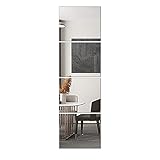
Mirrotek Over The Door Mirror, 13.7 x 48 Inch — Check Price
Who it suits: Small rooms where the back of the door is the only free vertical surface left — which, in most small rooms, it is.
Every small room has exactly one large, flat, unused surface, and it is the back of the door. This mirror is built for it: a single finished panel, 48 inches tall and 13.7 inches wide overall, in a wood-finish frame, arriving fully assembled at about 7.5 pounds and hanging over the door on adjustable-height hooks — up, level and usable in minutes, with no adhesive, no drilling, no seams, and no floor. Now the fact this guide exists to say out loud: the reflective panel is acrylic, not glass. The brand’s language is “shatterproof mirror materials,” and independent coverage of Mirrotek’s door mirrors states plainly that the panel is 100% shatterproof acrylic.
What acrylic costs you: the reflection is good but not glass-true. A rigidly mounted acrylic panel reflects cleanly at standing distance, but acrylic is less optically flat than glass, scratches more easily, wants a soft cloth and no abrasive or ammonia-heavy cleaners, and wobbles visibly if the panel flexes — and a door is the most-flexed mounting in any home, slammed and bumped daily. Small rooms add a geometric caution: the 48 inches is the outside of the frame, so the panel inside reflects roughly 46 inches, and 46 inches needs its three to four feet of step-back to show a whole adult. Behind most small-room doors is a wall, a wardrobe or the bed — measure the actual standing slot before you count on a head-to-toe view, and use the adjustable hooks to hang the panel as high as the door allows, which buys back reflection height that distance would otherwise provide. Then the price, which is why this pick carries its label: Mirrotek’s 13.7 x 48 door mirrors sit near the edge of this budget, and the aluminum-frame and wood-finish versions do not sit in exactly the same place within the range. So the rule is literal — check price on Amazon, and buy only if the version you want fits this guide’s budget on the day you click. When the live price fits the budget, it is the easiest recommendation in this guide. When it sits above the budget, the glass tiles above are waiting.
- One finished panel, fully assembled, about 7.5 lb — over the door and level in minutes.
- Zero floor space and zero wall commitment: the back of the door is the one surface a small room wastes.
- The panel is acrylic: shatterproof and light, with a slightly softer reflection than glass.
Honest limitation: Acrylic optics and scratch sensitivity, on the most-slammed surface in the home — and its live price moves around this guide’s budget line, so it is only an in-budget pick on the days the listing says so — check the current price on Amazon. Its roughly 46-inch panel also needs more step-back than many small rooms have.
Choose it if the door back is your only free surface and the live price fits this guide’s budget — check price on Amazon. Skip it if you want glass-true reflection, or your standing slot behind the door is under two feet — build the taller glass tile column on a wall instead.

EVENLIVE Frameless Glass Mirror Tiles, 12 x 12 Inch, 4 PCS
Who it suits: Small modern rooms that want the frameless, floating-glass look on a wall — and that happen to have the step-back distance its shorter column needs.
The EVENLIVE set is the same tile idea as our top pick at a neater scale and a cleaner finish: four frameless tiles of real glass, 12 by 12 inches each, stacking into a 48-inch-tall, 12-inch-wide column — or arranging into a 24-by-24-inch square for a vanity-style patch of wall. The maker’s specification is unusually plain about the material: real glass with a double-layer primer backing, and its own copy makes the correct argument for glass in this category — real glass does not deform, so the reflection stays true in a way flexible panels cannot promise. The frameless edges are the aesthetic point, and in a small modern room they matter more than in a big one: there is so little wall that whatever hangs on it is always in view, and a clean column of glass that disappears into the wall is worth more than a frame you have to look at from three feet away all day. Check price on Amazon for the current listing price, and like every tile set here it consumes zero floor.
Its demotion to third place is pure small-room geometry, and it is worth stating in numbers. Twelve-inch tiles build a 48-inch column — eight inches shorter than the top pick’s 56 — and a 48-inch surface needs roughly three to four feet of standing distance to show a full adult. A small room that has that distance should absolutely consider this set; a small room with a two-foot slot between bed and wall will watch this mirror crop heads and shoes that the taller column catches. Everything else about the tile bargain applies unchanged: three seams across the reflection, adhesive mounting that demands a clean, flat, fully cured surface, glass edges to respect during installation, and the small-room fall rule — never above a headboard, never where a dropped tile lands on a sleeper. One more honest note: this is a younger, less-reviewed listing than the 14-inch set above, so its long-term buyer record is thinner.
- Frameless real glass with a double-layer primer backing, per the maker’s specification.
- Four 12 x 12 tiles build a 48 x 12 inch column or a 24 x 24 inch square, at zero floor space.
- Sits at the lower end of this budget — check price on Amazon — and is the cleanest-looking glass option here.
Honest limitation: The column is 48 inches, not 56 — in the close quarters this guide is written for, that is the difference between a full outfit and a cropped one — and the listing’s review history is much thinner than the top pick’s.
Choose it if the frameless look matters and your room genuinely offers three-plus feet of standing distance. Skip it if your dressing slot is tight — in this guide’s home terrain, the 56-inch column above is the honest answer.

quegau Acrylic Mirror Tiles, 12 x 12 Inch, 4 PCS, 1/8 Inch Thick
Who it suits: Small rooms that are also busy rooms — a child’s small bedroom, a compact home gym corner, anywhere bodies and objects pass within inches of the wall all day.
In a large room, a mirror can be placed out of harm’s way. In a small room it cannot: the dressing wall is also the walkway, the gym corner is also the doorway, and anything on the wall will eventually be clipped by an elbow, a bag or a chair back swung around in a space too tight for it. That is the room this set is for. The quegau tiles are acrylic plexiglass, four 12-by-12-inch panels at a full 1/8 inch thick — the listing’s own model name leads with “Extra Thick 1/8″” — stacking into a 48-by-12-inch full-length column or mounting separately wherever a safe reflective surface is wanted. Acrylic at this thickness does not shatter, does not crack into shards, and if a panel ever comes off the wall it falls as a light plastic sheet rather than a blade of glass. In a room where a falling glass tile would land on the bed, the desk or a bare foot — which in a small room is every room — that is not a minor spec. The set sits at the very top of this budget for the four-piece 12-inch configuration, positioned there for the thickest acrylic tiles in the guide — check price on Amazon for the current price. Confirm the live price for the 4-piece 12″ x 12″ set fits this guide’s budget before you buy.
Now the cost, because acrylic always collects one. A plexiglass panel is a flexible material pretending to be a rigid one, and its reflection is only as flat as its mounting: stuck to a perfectly flat wall or door and fully supported, these tiles reflect well; stuck over the slightest bow, texture or dust bump, the panel follows the surface and your reflection bends with it. Small rooms raise the stakes on that flaw, because you view the mirror from closer than in any other setting — the softness and any mounting bend are right in front of you, not across a room. The 1/8-inch thickness is the mitigation, roughly twice the substance of the thinnest sticker-style sheets, and it is why this set costs what it does. Even mounted perfectly, expect a reflection a degree softer than the glass sets above, and treat the surface gently: acrylic scratches, and a scratched panel cannot be polished back the way glass can be cleaned.
- Acrylic plexiglass at a full 1/8 inch thick — cannot shatter, crack or shed shards.
- Four 12 x 12 tiles build a 48 x 12 inch column at zero floor space; tape mounting included in the set.
- Sits at the top end of this budget for the 4-piece 12-inch set — positioned for the thickness, not the brand; check price on Amazon and confirm the live price.
Honest limitation: Acrylic reflects a degree softer than glass — a flaw a small room’s close viewing distance shows at its worst — and it bends if the mounting surface is not flat, scratches more easily, and sits at the very top of the budget.
Choose it if the mirror lives where children play, weights swing or traffic brushes the wall, and safety outranks optical perfection. Skip it if you want the truest reflection for dressing — the glass tiles above reflect better.

ROYALAY Foldable Full Length Mirror with Handle, 47 x 13 Inch — Check Price
Who it suits: The smallest rooms of all — the studio corner, the dorm single, the shared room — where even a wall may not be available, and a mirror has to exist only while it is being used.
Every other pick in this guide asks for a permanent surface. This one asks for a hook and a drawer. Open, the ROYALAY is a 47-by-13-inch mirror in three folding panels; closed, it folds to about 15.7 by 12.6 inches — briefcase footprint — with a handle that carries it and hangs it from a door hook, a hanger, a towel rack or a curtain rod when it is time to dress. In a small room, that storage math is the entire argument: this mirror’s floor footprint is zero, its wall footprint is zero, and its closet footprint is a flat slot among the linens. The panels are high-definition acrylic, per the maker’s own description — chosen, as acrylic always is in portable gear, because it survives being packed, dropped and moved in a way no glass panel of this size will.
The honest costs are the format’s, and a small room should weigh two of them carefully. Forty-seven inches is the shortest view in this guide, and it is a view with two vertical hinge lines in it: fine for checking a hem, a costume or a dance line, less fine as a daily dressing mirror. And the geometry problem of this guide bites hardest here — 47 inches is a panel that wants its full step-back distance, in the rooms least able to give it; hung high on a door it serves most adults from a few feet back, but as a close-up dressing mirror it will crop. Acrylic panels in a folding frame flex more than tiles glued flat to a wall, so expect the reflection to be serviceable rather than true, especially at the hinges. It also carries this guide’s second check-price label: check price on Amazon and check the current price on Amazon before you buy, because this listing’s price has not been stable. Comparable foldable acrylic mirrors sit in the lower to middle part of this budget range. It belongs in this guide only when the live price fits this guide’s budget — check before you buy, and if it has drifted above the line, the tile sets above are the in-budget answer for any room that has a wall to give.
- Tri-fold acrylic panels open to 47 x 13 inches and fold to about 15.7 x 12.6 inches.
- The handle carries it closed and hangs it open — hook, hanger, towel rack or door.
- The only pick whose footprint is zero three ways: floor, wall and all but a slot of storage.
Honest limitation: The shortest, softest reflection in the guide, with two hinge lines in the view and a step-back appetite small rooms struggle to feed — plus an unstable listing price that makes it an in-budget pick only when the live price cooperates — check price on Amazon.
Choose it if your room cannot give a mirror any permanent surface at all. Skip it if you have a wall or a door to spare — every other pick here is a better daily mirror in this guide.

Antok Arch Floor Mirror, 58 x 18 Inch, Champagne — Over Budget, and Wrong for Most Small Rooms
Who it suits: The small-room owner with one genuinely free corner and a tall-ceilinged layout — the exception that proves this guide’s rule.
Let us be fair to this mirror before we rank it last, because on mirror quality alone it ranks first. The Antok is a genuine floor mirror: 58 inches tall and 18 inches wide, real glass in a slim champagne aluminum-alloy frame with an arched top, on an easel stand that also lets it lean against a wall or hang. Its reflective surface — about 56 inches of glass inside the frame — is the largest single unbroken view in this guide, its 18 inches of width show a whole dress, two people, or the room’s light, and it is the only pick a tall adult can use standing close. That positioning is the honest floor for a free-standing mirror in real glass in our research: framed glass door mirrors from known brands, such as the SCWF-GZ 47 x 14, sit above this guide’s budget, and the bigger standing brands sit higher still, including BEAUTYPEAK’s 56-inch floor mirror, which sits well above this budget. So the Antok breaks this budget, and it is labeled over budget everywhere it appears in this guide — check price on Amazon for its current price.
For a small room, though, the money is the smaller problem. The Antok is the only pick that stands on your floor: an easel footprint of roughly two square feet once lean clearance is counted, in a room where two square feet is a nightstand, a laundry basket and the space to open the wardrobe door. It also needs what every mirror needs in front of it — step-back room — and unlike a wall column it cannot borrow the wall’s plane to save space; it projects into the room’s scarcest dimension. And a standing mirror is the one format that can fall into the room: place it in a settled corner, out of traffic, and use an anti-tip strap to the wall if children or large dogs share the space. If your small room genuinely has that corner — some do, usually the angle between a wardrobe and a window wall — the Antok is a lovely purchase and this guide will not pretend otherwise. If it does not, buying it means evicting something else, and a reflection is rarely worth a dresser. That is why it sits last here and near the top of the general guide at Best Full Length Mirror Under $30: same mirror, different room, different verdict.
- Real glass, 58 x 18 inches — the largest unbroken reflection in the guide, and the only true free-standing pick.
- Easel stand, leaning or wall-hung, in a champagne arch frame.
- Sits over budget — check price on Amazon — and is the lowest-positioned honest standing mirror in real glass we found in our research.
Honest limitation: It sits over budget, full stop — check price on Amazon — and it is the only pick that spends floor space, demands clearance in front of it, and can tip into the room. In most small rooms those three facts outweigh its better glass.
Choose it if your small room has one truly free corner and the standing mirror is the actual goal. Skip it if floor space is the constraint that brought you to this guide — the glass tile column above delivers the same head-to-toe view at the lower end of this budget — check price on Amazon — and no floor at all.

Comparison Table
| Product | Stated size | Actual reflective surface | Material | Floor footprint | Link |
|---|---|---|---|---|---|
| Glass Mirror Tiles, 14 x 12, 4 PCS | 14 x 12 in per tile | 56 x 12 in column, 3 seams | Real glass | None — adhesive, wall or door | Check on Amazon |
| Mirrotek Over The Door Mirror | 48 x 13.7 in overall | ~46 in panel inside frame | Acrylic, wood-finish frame | None — over-door hooks, 7.5 lb | Check on Amazon |
| EVENLIVE Mirror Tiles, 12 x 12, 4 PCS | 12 x 12 in per tile | 48 x 12 in column, 3 seams | Real glass, frameless | None — adhesive, wall or door | Check on Amazon |
| quegau Acrylic Mirror Tiles, 4 PCS | 12 x 12 in per tile | 48 x 12 in column, 3 seams | Acrylic, 1/8 in thick | None — adhesive tape, wall or door | Check on Amazon |
| ROYALAY Foldable Mirror | 47 x 13 in open | 47 x 13 in, 2 hinge lines | Acrylic, tri-fold | None — hangs by handle, folds to a drawer slot | Check on Amazon |
| Antok Arch Floor Mirror (over budget) | 58 x 18 in overall | ~56 in glass inside frame | Real glass, aluminum frame | ~2 sq ft — easel stand, lean or hang | Check on Amazon |
How to Choose a Full Length Mirror for a Small Room Under $30
- Spend wall, not floor. In a small room the footprint ranking is the quality ranking: tiles and door panels consume no floor, the foldable consumes no anything, and a standing mirror consumes the scarcest resource you own. Start from zero-footprint formats and only leave them for a stated reason.
- Measure your step-back distance before you measure mirrors. Pace out the gap between your bed or desk and the facing surface, subtract the door swing, and be honest about the number. Two to three feet demands the 56-inch column; three to four feet opens up the 48-inch sets; under two feet, no panel in this guide shows a whole adult at once, and mounting height becomes your only lever.
- Mount high to buy back height. A shorter column or panel hung with its top edge several inches higher reflects more of you at close range. The door mirror’s adjustable hooks exist for exactly this; with tiles, simply start the column higher on the wall.
- Read the reflective surface, not the headline size. On framed mirrors the stated dimensions are the outside of the frame — the “48-inch” door mirror reflects about 46 inches — and on tile sets the full length is a column you assemble. Find the panel or tile size in the specification table and do the stacking arithmetic yourself.
- Decide glass or acrylic before you decide anything else. Glass reflects flat and true and can break; acrylic cannot shatter, weighs about half as much, scratches more easily and bends your reflection if it flexes. The words that mean acrylic are “shatterproof,” “unbreakable,” “plexiglass,” “PMMA” and the trap phrase “acrylic glass.” In a small room, add one consideration: you will view the mirror closer than anyone else, so acrylic’s softness is more visible to you — and glass’s fall risk lands closer to your bed.
- Plan the fall, because in a small room everything is a fall zone. There is no wall in a small room that is not near a bed, a chair or a walkway. Adhesive glass tiles go on clean, flat, fully cured surfaces only, never above a headboard; a standing mirror gets a settled corner and an anti-tip strap; a door mirror gets hooks that let the door still latch.
- Check what the mirror will face. The room-expanding effect is real only if the reflection is worth doubling — a window, a lit corner, the room’s long axis. Facing a bed three feet away, expect a dressing mirror, not a vista, and do not let the promise of spaciousness talk you into a wider, costlier format your floor cannot house.
- Count the seams and hinges as part of the price. Tiles interrupt the reflection three times; the foldable twice. At small-room distances you will see them. For outfit and form checks they are cosmetic; for a dressing mirror you scrutinize daily at arm’s length, they are the honest reason to save for a single panel.
- Check the configuration in the cart. Every product here sells in other sizes and counts — 6-packs, 16-inch tiles, larger door mirrors — and the variant in the listing photo is often the one that blows the budget. Confirm the size and count match the configuration this guide reviewed.
- Respect the check-price labels. Two picks sit near the edge of this budget because their listing prices move. The label is the deal: when the live price fits this guide’s budget — check price on Amazon — buy with confidence; above it, the other picks in this guide are the honest substitutes.
Common Buying Mistakes
- Buying a standing or leaning mirror for a room with no free corner, then spending a year stepping around the easel — the footprint was the spec that mattered, and it was knowable in advance.
- Expecting a 48-inch mirror to work at arm’s length. Full length is a function of height plus distance; a small room’s two-foot slot needs the 56-inch column, hung high.
- Reading the frame’s outside dimensions as the mirror size, then discovering a “48-inch” door mirror reflects about 46 inches — in a room where those two inches were the margin.
- Buying acrylic by accident because the listing said “shatterproof,” “unbreakable” or “acrylic glass” — then blaming the mirror for a soft reflection the material always promised, viewed from closer than any other buyer views it.
- Sticking glass tiles to textured, dusty or freshly painted walls, and meeting the set again at 3 a.m. when the adhesive lets go — onto the bed that, in a small room, is always underneath something.
- Mounting acrylic tiles over a bowed wall or an uneven door, which bends the panel and manufactures the funhouse distortion people attribute to acrylic itself.
- Counting on the “mirrors make rooms bigger” effect while mounting the mirror opposite a cluttered wall two feet away — it doubles what it faces, and it faced your storage.
- Hanging an over-the-door mirror on a door that no longer latches with the hooks fitted, then living with the rattle until the panel works loose.
- Ordering the default variant — the 6-pack, the 16-inch tiles, the larger door mirror in the photo — at well over the guide’s budget for the configuration reviewed.
- Cleaning acrylic with glass cleaner and a paper towel, which scratches and hazes the panel; a soft microfiber cloth and mild soap is the whole method.
Final Recommendation
- Most small rooms: Glass Full Length Wall Mirror Tiles, 14 x 12 Inch, 4 PCS.
- Only the door back is free, if the live price fits the budget: Mirrotek Over The Door Mirror, 13.7 x 48 Inch — check price on Amazon.
- The modern, frameless look, with room to step back: EVENLIVE Frameless Glass Mirror Tiles, 12 x 12 Inch, 4 PCS.
- Kids’ rooms, gym corners and high-traffic walls: quegau Acrylic Mirror Tiles, 12 x 12 Inch, 4 PCS, 1/8 Inch Thick.
- No permanent surface at all: ROYALAY Foldable Full Length Mirror with Handle, 47 x 13 Inch.
- A genuinely free corner and room above this guide’s budget: Antok Arch Floor Mirror, 58 x 18 Inch, Champagne — check price on Amazon.
Our top two are the 14-inch glass tiles — the tallest reflection here, at zero floor space, at the lower end of this budget; check price on Amazon — and the Mirrotek door mirror for the rooms whose only free surface is the door itself, recommended with its two labels attached: acrylic panel, moving price. The EVENLIVE set is the prettier glass and the wrong geometry for tight dressing slots; the quegau is the safety pick for walls that take daily knocks; the ROYALAY is the disappearing act for rooms that cannot host a mirror at all. The Antok remains the best mirror in the list and the wrong purchase for most of this guide’s readers, which is exactly the kind of sentence a small-rooms guide exists to print. If your room is a bedroom first and a small room second, Best Full Length Mirror For Bedrooms Under $30 covers the beside-the-wardrobe placements in detail; if it is a modern room whose look the mirror must protect, see Best Full Length Mirror For Modern Homes Under $30.
Frequently Asked Questions
What is the best type of full length mirror for a small room?
A wall- or door-mounted one, and it is not close. Tiles and over-door panels consume zero floor space, which in a small room is worth more than any optical advantage a standing mirror offers. Among the zero-footprint formats, choose by your step-back distance: a tall tile column (56 inches) if your standing slot is two to three feet, a 48-inch panel or column if you have three to four feet, and a foldable only if no permanent surface exists at all.
Will a mirror really make my small room look bigger?
Sometimes — it depends entirely on what the mirror faces. Reflecting a window, a lit corner or the room’s longest axis genuinely lends depth and light. Reflecting a bed three feet away or a wall of storage just doubles the clutter at closer range. The narrow formats in this guide — 12 to 14 inches wide — are dressing tools, not vistas; expect them to check outfits superbly and expand the room modestly at best.
How tall does a mirror need to be if I can only stand two feet away?
Taller than you would guess. Full length is produced by mirror height plus standing distance together: at roughly two feet, you need a reflective surface around 56 inches, mounted with its top edge high, to frame a typical adult head to toe. A 46- to 48-inch surface at the same distance shows you in slices.
Is a 48-inch mirror really full length?
For most adults, yes — provided you can stand a few steps back from it. A 48-inch reflective surface hung at the right height shows a typical adult head to toe from about three to four feet away. Where it fails is exactly where small rooms live: at close range and for taller users.
Are the cheap full length mirrors glass or acrylic?
Both, and the listings work hard to blur which you are getting. Glass picks in this guide: the two tile sets and the Antok. Acrylic picks: the Mirrotek door mirror, the quegau tiles and the ROYALAY foldable. The vocabulary gives it away once you know it — “shatterproof,” “unbreakable,” “plexiglass,” “PMMA” and “acrylic glass” all mean an acrylic panel, which cannot shatter and weighs about half as much as glass, but reflects a degree softer and bends if it flexes. In a small room the trade cuts both ways: you view acrylic’s softness from closer than anyone, and glass’s fall risk lands closer to your bed.
Will adhesive mirror tiles damage my walls or fall down?
They hold well on the surfaces they are designed for — clean, flat, smooth, fully cured paint, tile, glass or varnished wood — and poorly on everything else: texture, dust, grease and fresh paint all defeat the adhesive, sometimes months later. Removal can lift paint, so treat tiles as semi-permanent and test one tile in an inconspicuous spot first. In a small room, add the local rule: every wall is near a sleeper, a chair or a walkway, so mount glass tiles where a fall lands on floor, never above a headboard.
What is the cheapest way to get a free-standing full length mirror?
Honestly: look first at the Antok arch in this guide — check price on Amazon for its current price. It sits over this guide’s budget, and in our research it was the lowest-positioned true free-standing mirror in real glass we could verify; every lower-positioned “standing mirror” listing we examined turned out to be a leaning panel, an acrylic sheet or a smaller mirror photographed large.