Best DEWALT Table Saws
The best DEWALT table saw depends on which part of the brand’s lineup fits your work: compact portability, a larger jobsite table and fence, a rolling stand package, or cordless operation on the FLEXVOLT platform. Brand-specific shopping can simplify comparisons because models share design cues and support channels, but it is still important to compare exact model numbers. Similar-looking saws may differ in blade size, fence reach, stand inclusion, power source, package contents, and regional availability.
This guide focuses on DEWALT table saw model-line tradeoffs and buyer scenarios. It is distinct from our broad table-saw guide, which covers the category, and from our portable and beginner guides. Here, the practical question is which DEWALT configuration suits a shop corner, a frequently moved jobsite, larger sheet breakdown, or cordless work. This is a research-based guide, not a hands-on test. We did not test or rank saws, measure cut accuracy, or compare current prices. Product pages and bundles can change, so verify the exact SKU, manual, and current package listing before purchase.
For an overall category overview, see best table saws. For transport, setup, and jobsite portability across brands, read best portable table saws. For a first purchase and learning-focused choices, see best table saws for beginners.
Affiliate disclosure: This article may contain affiliate links. If you buy through one, DailyHomeDecorating.com may earn a commission at no extra cost to you. Model comparisons should be based on current manufacturer information and your intended work.
Amazon product examples to compare

ASIN: B0842QDW95
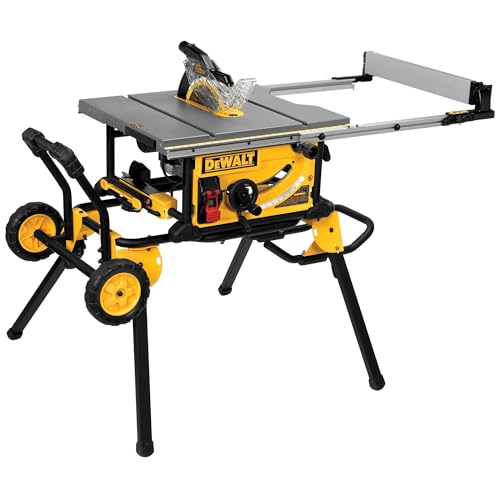
ASIN: B00F2CGXGG

ASIN: B08ZH2HG6G
Certain content that appears on this site comes from Amazon. This content is provided “as is” and is subject to change or removal at any time. Product examples and images are supplied through Amazon Creators API; confirm specifications and availability on the current listing.
Quick answer: compare model configuration, not just the yellow housing
DEWALT’s current U.S. table-saw category has included several distinct configurations: the compact 8-1/4-inch DWE7485, the 10-inch DWE7491 family with different stand packages, and cordless 60V FLEXVOLT DCS7485 models. These names are useful starting points, not an evergreen availability statement; check the current official lineup and regional market before deciding. The product family page distinguishes the saws by blade size, power source, rip capacity, and whether a stand is included.
If frequent transport and compact storage matter most, begin with the compact saw and verify that its capacity covers your stock. If wider sheet goods or longer rips are common, compare the larger jobsite family and confirm fence reach and support. If you need to work away from reliable power and already use compatible FLEXVOLT batteries, compare cordless DCS7485 configurations and the full battery system cost. If the saw will stay in one workshop, stand convenience may matter less than table, fence, dust, and service needs.
Do not choose by wattage or rip-capacity headline alone. Compare exact model number, supplied fence and guard components, stand, blade, included accessories, regional plug, and manual. DEWALT support notes that some model suffixes refer to included stand packages or regional differences, which makes exact SKU checks important.
How to read the DEWALT table-saw lineup
DEWALT’s official table-saw category organizes models around portable jobsite use and offers corded and cordless configurations. Product designations contain useful clues, but they are not a substitute for the complete product page. A suffix can identify a stand bundle or package, and the same basic saw may be sold with different accessories through different retailers or regions.
Start with three questions:
- Is the model compact, full-size jobsite, or cordless?
- What is included in the particular SKU: saw only, stand, battery and charger, blade, guard, fence, and push stick?
- Does the regional version match your outlet, battery ecosystem, replacement parts, and warranty needs?
Model names such as DWE7485, DWE7491RS, DWE7491X, DCS7485T1, and DCS7485B are examples that DEWALT has listed in its U.S. table-saw lineup. The suffixes matter. For example, DEWALT support explains that DWE7491 and DWE7492 are similar saws with a regional plug difference, and that “RS” denotes the rolling-stand package in that comparison. Verify current details with the manufacturer because revisions and region-specific bundles can change.
Compact portable models: DWE7485 family
The DWE7485 is an 8-1/4-inch compact portable jobsite saw in DEWALT’s lineup. Its likely appeal is its smaller footprint and easier movement compared with larger table saw configurations. The compact format may suit a garage shop where the saw is brought out for occasional work or a contractor who needs a portable tool. Confirm actual dimensions, weight, rip capacity, and included accessories on the current product page.
The main tradeoff is work envelope. A compact table and shorter fence travel may be limiting for wide panels, large cabinet components, or repetitive long rips. The size of the saw does not remove the need for full support of both the incoming stock and the cutoff. If you’re regularly breaking down sheet goods, plan a safe support method or consider a guided circular/track saw for initial panel cuts, then use the table saw for narrower finishing rips.
Compare DWE7485 bundles carefully. A package may include a stand or adapters, while a bare saw may require a compatible bench or separately purchased stand. DEWALT’s support material lists stand compatibility and adapter requirements for certain compact models. Confirm that your exact model and stand fit together and that all required brackets are present.
Who should consider a compact DEWALT saw?
- DIY users with limited floor space who can support the saw securely on a bench or compatible stand.
- Remodelers and trim workers who value quick setup and transport.
- Users whose common cuts fit the model’s stated capacity and table size.
- Owners who want a corded compact machine and do not need cordless operation.
It may be a poor fit for frequent wide-panel ripping, very heavy daily production, or a shop that needs extensive outfeed capability from the saw itself. Those tasks may require a larger table or an auxiliary support system.
Larger jobsite models: DWE7491 family
The DWE7491 series includes 10-inch jobsite table saw configurations, with packages such as the DWE7491RS with rolling stand and other stand arrangements depending on the SKU. The larger format is designed around jobsite portability while providing a different cut envelope from a compact bench saw. DEWALT’s official pages and manuals give the current cut capacities, table features, package contents, and safe setup instructions for each model.
The DWE7491RS is a saw-and-rolling-stand configuration. The stand can make it easier to move and set up on an appropriate surface, but it also adds weight and storage footprint. Check how it folds, how the saw is mounted, whether the stand locks securely, and whether you can move the assembly safely. A stand does not eliminate the need for level ground and stable infeed and outfeed support.
Compare DWE7491 variants rather than assuming that every suffix means the same thing. Check voltage, plug type, included stand, fence and extension components, warranty, and regional model identity. DEWALT’s own support FAQ says certain DWE7491/DWE7492 variants are the same saw except for plug/regional differences; that statement should be read in its specific regional context, not generalized across all saw suffixes.
Who should consider a larger jobsite model?
- Users who often rip wider stock or panels within the saw’s rated capacity.
- Carpenters who want a jobsite machine with a transport-oriented stand package.
- Home workshops with room to deploy the stand and provide material support.
- Buyers who value a 10-inch blade ecosystem and accept the added size and weight.
It may be unnecessary for small craft parts, occasional narrow rips, or a storage area where the folded saw cannot be kept safely. Do not buy the larger model simply because its capacity is higher; make sure the work and available space benefit from it.
Cordless DEWALT FLEXVOLT options: DCS7485
DEWALT has offered the DCS7485 as a 60V MAX FLEXVOLT table saw, in tool-only and kit configurations. Cordless operation can be useful where power access is limited or moving a cord would interfere with a jobsite workflow. The saw’s compatibility with a battery platform may be attractive to users who already own compatible batteries, but verify the exact battery system and kit contents.
Battery runtime depends on battery capacity, material, blade, cut length, and technique. A large battery adds cost and weight; a bare-tool bundle may not include a battery or charger. Compare the saw’s runtime claims only when you know the test conditions, and consult the manual for approved battery packs. Do not assume a battery from another DEWALT product line will be compatible because it shares the brand.
Cordless convenience is especially valuable for setup flexibility, but jobsite planning still matters. Bring charged batteries, a spare if the workload requires it, and a charging plan. Evaluate table and fence capacity just as carefully as you would on a corded saw. Cordless operation does not make the saw more portable if its stand and stock support are difficult to move.
Who should consider DCS7485?
- Tradespeople who often cut where mains power is unavailable or inconvenient.
- Owners of compatible FLEXVOLT batteries who understand the added battery cost and runtime tradeoff.
- Users who want to reduce cord routing around a busy workspace.
If your shop has dependable power and the saw remains stationary, a corded model can be simpler and may avoid battery purchase and charging costs. Compare the complete setup, not just the bare-tool model.
DEWALT table-saw model-line comparison
| Line/configuration | Primary appeal | Tradeoff to check | Best-fit scenario |
|---|---|---|---|
| DWE7485 compact portable | Smaller portable format and compact storage | Table and rip capacity may limit wider stock; stand bundle varies | Small shop, occasional use, mobile work with modest stock |
| DWE7491 with stand variant | Larger jobsite format; stand package can simplify movement | More footprint and weight; confirm exact suffix and stand | Frequent framing, shelving, and wider rips within rated capacity |
| DCS7485 cordless | FLEXVOLT battery operation for locations without convenient mains power | Battery and charger costs, runtime, and pack compatibility | Mobile work where cordless setup offers real value |
This table summarizes use-case questions rather than giving performance rankings. It does not claim that one line is universally best. DEWALT’s current lineup, model availability, and packages vary by retailer and region. Check official specifications for the exact product and read its manual before use.
Fence, rip capacity, and project fit
Rip capacity matters when the fence must move far from the blade to guide a wide board or panel. Compare the capacity on both sides of the blade and understand whether the extension is part of the table, fence rail, or support system. A capacity number does not tell you how easy the fence is to set, how stable the work is at full extension, or how well the support handles a large panel.
Fence usability is central to a brand-specific comparison. Look at how it clamps, whether it moves smoothly, how the measurement scale is read, and whether there is a fine adjustment. Check DEWALT support documents and manuals for calibration procedures. If the scale is not accurate after setup, follow the maker’s process rather than relying on a painted marking.
Consider the material size you can safely handle. Full sheets of plywood and OSB are unwieldy; a single operator may struggle to control them while keeping them flat against a fence. Use a safe breakdown strategy and suitable supports. A track saw or circular saw with a guide can make initial sheet cuts easier, then the table saw can perform more manageable follow-up rips.
Blade size and depth also vary. A 10-inch saw and an 8-1/4-inch saw differ in maximum cutting depth and compatible accessories, but the exact capacity is model-specific. Compare at 90 degrees and bevel settings. Use only blades compatible with the saw’s arbor and speed and with the correct riving knife.
Stand, transport, and package compatibility
When comparing a DEWALT saw with a stand package, verify whether the stand is included in the exact SKU. DEWALT publishes compatibility guidance for some stand and saw combinations, including where adapters may be required. Never assume a separate stand fits a saw without the proper mounting hardware. An incorrectly mounted saw can tip or shift.
For the rolling stand, consider wheel type, folding procedure, handle location, and whether the assembled package fits your vehicle and storage space. Lift with a safe technique and get help if the assembly is too heavy or awkward. Do not hang heavy objects from a stand handle unless the manual specifically allows it; DEWALT warns against certain loading that can destabilize the stand.
If the saw stays in a shop, a rigid bench or mobile base may make more sense. Secure it as the manual instructs and leave an appropriate opening for dust where required. A portable saw mounted on an unstable bench can be less safe than a heavier saw on a proper base.
Safety system and setup: model-specific but non-negotiable
Table saw safety depends on guards and the correct setup. DEWALT manuals describe the blade guard assembly, riving knife, and anti-kickback pawls for through-cutting operations. The components must be installed, aligned, and suited to the blade and operation. Check the exact manual for the DWE7485, DWE7491, or DCS7485 rather than assuming the assemblies are interchangeable.
OSHA describes kickback as stock catching on the blade and being thrown back toward the operator. Proper material support, blade condition, guard components, and work practices reduce hazards. Use push sticks or blocks for appropriate cuts, keep hands away from the blade path, stand out of the likely kickback line, and don’t cut stock that is cracked, warped, or otherwise unsuitable. Do not operate a saw with a malfunctioning guard, fence, or switch.
Never treat the brand or a safety feature as a guarantee. A riving knife does not prevent every kickback, and a blade guard does not replace safe feeding. Read the manual, learn the saw’s controls while disconnected, and get hands-on instruction if you are new to table saws. Do not make a cut that the manual does not explain or that you cannot support safely.
Buying checklist for DEWALT table saws
- Confirm the exact model number and region. Record the complete SKU, voltage, and plug.
- Choose compact, larger jobsite, or cordless. Let transport and work demands decide.
- Verify package contents. Check stand, battery, charger, guard, fence, blade, push stick, and adapters.
- Compare capacity. Match rip width, blade size, depth, and bevel range to the actual stock.
- Inspect fence operation. Review lock design, rail extension, scale, and calibration procedure.
- Plan the base and supports. Measure storage and operating space; include infeed and outfeed support.
- Review battery economics. For cordless models, include compatible battery packs, charger, and expected runtime needs.
- Check safety parts. Confirm guard, riving knife, anti-kickback assembly, and replacement-part support.
- Read the manual before purchase. Note assembly, electrical, blade, service, and safety details.
- Compare total cost. Add accessories, blade, stand, dust extraction, and transportation.
Research method and official sources
This is a model-line research guide, not a hands-on comparison. We consulted DEWALT’s current U.S. table-saw category, product pages, support materials, and manuals, along with OSHA safety guidance. We did not measure accuracy, cut speed, runtime, or durability and do not claim current price leadership. Product names and availability can change; verify current information at purchase.
DEWALT’s official table saw category page lists the current product families and distinguishes compact, 10-inch jobsite, and 60V cordless options. Its product pages for the DWE7485, DWE7491RS, and DCS7485 kit provide model-specific specifications and included-component information. Confirm the exact current package in the listing you intend to buy.
DEWALT support’s article on DWE7491 and DWE7492 differences explains that plug and regional configurations can differ. Its table-saw stand compatibility page identifies adapter considerations for selected models. These are useful reminders to compare complete model numbers and stand hardware rather than assuming accessories fit across the range.
For safety, OSHA’s table-saw guidance covers guarding, kickback, material support, blade condition, and hand placement. DEWALT’s DWE7485 manual and DWE7491 manual provide model-specific safety and setup instructions. Always use the manual for the exact saw you own.
Ownership, service, and maintenance
Keeping a DEWALT saw in service depends on more than the motor. Keep the table and fence rails clean, inspect the guard and riving knife, and keep the blade sharp and free of damage. Verify fence alignment after moving or transporting the saw. Follow the manual’s schedule for cleaning, lubrication, and adjustment. Do not apply lubricants or solvents to surfaces or mechanisms unless the manufacturer allows them.
For corded models, inspect the cord and plug before use. For cordless models, use compatible battery packs and chargers and follow storage and charging instructions. Remove the battery or unplug the saw before adjustments, blade changes, cleaning, and maintenance. If the saw has a fault, use authorized service or the manufacturer’s support guidance rather than bypassing a switch or safety part.
Replacement parts and manuals matter particularly for a saw used for years. Check that guard assemblies, inserts, fence components, and stand hardware are available for the exact model. Keep the model and type number recorded; product families can have revisions. When buying used, confirm all safety components are present and functional and that the saw has not been modified.
Frequently asked questions
Which DEWALT table saw is best for most homeowners?
There is no universal best. A compact model may suit limited space and smaller stock; a larger jobsite model may fit wider cuts; cordless can help away from outlets. Match exact capacities and setup to your projects and workshop.
What is the difference between DWE7485 and DWE7491RS?
They represent different configurations: the DWE7485 is a compact 8-1/4-inch portable saw, while the DWE7491RS is a 10-inch jobsite saw packaged with a rolling stand. Compare current specifications, capacity, weight, package contents, and manual for the exact versions.
Is the DWE7491RS stand included?
The RS package name is associated with the rolling stand, but verify the exact listing and SKU. Retail bundles and regional packages can differ. DEWALT’s support documentation also notes compatibility and adapter details for some separately purchased stands.
Is the DCS7485 cordless saw worth it?
It may suit work where cord-free setup has practical value, especially if you own compatible batteries. Compare battery and charger cost, runtime, battery weight, and the same capacity and fence details you would check on a corded model.
Can I use one DEWALT stand with every DEWALT table saw?
No. Stand compatibility can depend on model and adapter brackets. Check DEWALT’s current compatibility information and the saw and stand manuals before mounting. Do not operate a saw that is not firmly secured to its stand or bench.
Are DEWALT table saws suitable for beginners?
They can be, if the user learns the safety system and follows the manual. Beginners should practice on suitable stock, use guards and push devices, and avoid unsupported or complex cuts. The brand does not replace training or careful setup.
What blade comes with a DEWALT table saw?
Included blade details vary by model and package. Check the current product listing and manual. If you need a different blade, verify diameter, arbor, kerf, speed, material, and compatibility with the riving knife.
How do I choose between a compact and 10-inch DEWALT saw?
Compare the maximum stock size and cut depth you need, plus portability and storage. The compact format may be easier to handle but can constrain wider cuts; a 10-inch jobsite saw may provide a larger work envelope with added weight and space needs.
How do I choose among the best DEWALT table saws?
Choose by model line and scenario: compact portability, larger jobsite capacity and stand, or cordless FLEXVOLT access. Then verify exact model number, fence, capacity, safety parts, package, stand compatibility, and current manual. Do not select by brand name alone.
Final buying perspective
The best DEWALT table saw is the configuration that matches your work and setup: compact portability, a larger jobsite platform, or cordless flexibility. The model suffix, stand bundle, battery kit, and regional version can materially change what arrives in the box. Check the current official listing and manual, compare fence and capacity against real materials, and plan stable support and dust management. DEWALT offers recognizable model lines, but good results still depend on proper setup, sharp blades, working guards, and safe feeding practices.