Best Compact Circular Saws: How to Choose a Smaller-Blade Saw
The best compact circular saws reduce bulk for selected cuts in sheet goods, dimensional lumber, trim, and repair work. Most use a smaller blade than a common full-size circular saw, but “compact” is not a fixed technical category. A compact tool may still have a conventional shoe and handle layout, while a mini circular saw may use an inline grip or another small-body design. The smaller blade usually means less maximum cut depth, so the right choice depends on what thickness and bevels you need to cut.
This guide compares compact circular saws by blade diameter and fit, cut depth, bevel range, battery or corded power, weight, shoe, line visibility, dust control, and workpiece support. It explains the limits of one-hand claims and how compact saws differ from both standard circular saws and mini models. It is a research-based buyer guide, not a hands-on product ranking or a claim that a specific model performs better. Verify the exact manual, blade compatibility, package contents, and current product listing before buying.
Affiliate disclosure: DailyHomeDecorating.com may earn a commission from qualifying purchases through links in this article. This does not change the price you pay.
Amazon product examples to compare

ASIN: B0FSSBPV5V
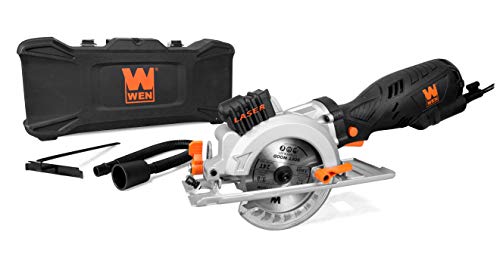
ASIN: B07PX8LHKV

ASIN: B084VV5Z85

ASIN: B0C3H6V6DY
Certain content that appears on this site comes from Amazon. This content is provided “as is” and is subject to change or removal at any time. Product examples and images are supplied through Amazon Creators API; confirm specifications and availability on the current listing.
Table of contents
- Quick comparison
- Compact, mini, and standard saws
- How to choose
- Blade fit and cut capacity
- Battery and corded power
- Setup and safety
- FAQs
Quick comparison: compact circular saw priorities
| Need | Compare | Trade-off |
|---|---|---|
| Short trim cuts and repair work | Weight, shoe visibility, guard movement, blade availability | Reduced depth can limit thicker stock |
| Frequent cutting away from outlets | Battery platform, battery weight, runtime, charge time | Battery kits add cost and may add bulk |
| Long cuts on sheet goods | Base stability, straightedge compatibility, cutline visibility | A compact saw may need a guide or second tool for full sheets |
| Bevel cuts | Bevel range, depth at angle, shoe scale and lock | Available depth decreases as the blade tilts |
| Occasional shop use | Blade fit, cord access or battery platform, dust port | A full-size saw may be more suitable for repeated deep cuts |
“Compact” and “mini” are market labels rather than universal standards. Compare the blade diameter, maximum depth at 90 and bevel, shoe design, weight definition, and intended materials for each exact model. Do not assume that two small circular saws share blades or cut capacity.
Compact, mini, and standard circular saws
Compact circular saws
Compact models commonly use smaller blades than a traditional full-size saw and reduce the overall body size or weight. They may retain a shoe, upper and lower guards, front grip area, and trigger layout similar to a standard handheld circular saw. The reduced package can be easier to carry and position in close quarters, but cut depth and supported blade sizes are specific to the tool.
Many compact saws are designed for crosscuts and rips in common building materials within their rated capacity. A model may include a rip guide, dust adapter, LED, or bevel adjustment, but these features vary. Verify whether the battery, charger, blade, and accessories are included or sold separately. A compact frame does not necessarily mean a tool is designed for one-hand operation.
Mini circular saws
Mini saws often have especially small blades or a different inline grip and shoe. The term is used inconsistently. Some are intended for thinner stock or crafts, while others may cut a specified range of construction materials. Check maximum depth, blade compatibility, guard behavior, and the intended task. Do not infer capacity from the compact shape or a product photo.
A mini saw can feel light but still produce a strong reaction if the blade binds. Small size does not remove kickback, pinch, or blade-contact risk. Read the manual to see how the tool is meant to be gripped, whether it calls for two hands, and which workpiece support is required.
Standard circular saws
A standard circular saw with a larger blade is generally better suited to deeper cuts and some repeated framing or sheet-goods work. The larger blade can cut thicker material in one pass, subject to the saw’s rated depth. It may weigh more and require more room, but the tool’s size may fit the work better. Compare the site’s table saw guide for stationary straight-cut workflows, and the hand saws for gardening guide for manual outdoor cutting—each serves a different use case.
Compact tools are not automatically replacements for a table saw, miter saw, track saw, or full-size circular saw. They can complement other tools for accessible cuts, small repairs, or tight spaces. The right tool depends on the cut, support, material, and operator’s experience.
How to choose among the best compact circular saws
1. Start with material and cut dimensions
List the materials and thicknesses you plan to cut: plywood, dimensional lumber, trim, plastic, or another material. Check that both the saw and blade maker approve the material. Note the deepest straight cut, bevel angle, and number of cuts you expect. A small blade may cut through a thin panel comfortably but fail to reach through a thicker board in one pass.
Consider whether you need a clean visible edge, a rough framing cut, a rip along the grain, a crosscut, or a bevel. Those tasks can need different blades and guides. A compact saw may be useful for a short repair but frustrating for a large project if its depth or guide compatibility is limited. If the work requires long, repeated, highly consistent cuts, a different saw or a straightedge system may be more suitable.
2. Compare actual cut depth at 90 and bevel
Manufacturers may list maximum depth of cut at 90 degrees and one or more bevel angles. Check those figures in the manual and compare them with stock thickness. A saw’s maximum depth at 90 does not tell you its capacity at a bevel; tilting the blade usually reduces available depth. If you need to cut a board in one pass, allow a margin rather than choosing a tool that is just at the limit.
Depth adjustment should lock securely and be easy to read. Check the shoe scale and whether the saw can be set to a shallow depth for specific operations as the manual directs. Avoid adjusting depth with the blade moving or the battery connected when the manual requires power isolation. Never set the blade deeper than the material and task require.
3. Evaluate bevel range and shoe stability
Some compact saws support bevel cuts; others have limited or no bevel adjustment. Verify the maximum angle and depth at the angles you use. A clear angle scale and a positive lock can simplify setup, but the scale still needs to be checked against a square when precision matters. Examine whether the shoe remains stable when tilted and whether the guard retracts and returns correctly.
The shoe should sit flat on the material without rocking. Check its material, stiffness, flatness, and view around the blade. A thin or flexible shoe can be harder to guide if pressure changes. A stable shoe is especially important for bevel cuts and long straight cuts. Do not rely on a laser or printed line to compensate for an unstable base or a poorly marked cut.
4. Decide between battery and corded power
A battery saw offers mobility and avoids routing a cord across a cut path. Compare the battery system, capacity, charge time, included pack, and compatibility with tools you already own. Battery runtime depends on material, blade, battery condition, temperature, cut length, and feed rate. A published “cuts per charge” figure uses a defined test condition; it is not a universal guarantee.
A corded compact saw can work continuously near a suitable outlet, but cord placement must be planned. The cord should stay behind the saw and away from the blade, workpiece, and operator’s feet. Use only an extension cord that meets the manual’s gauge and length guidance. Never use a damaged cord or remove grounding features. If your work is outdoors or remote, a cord can create extra hazards.
Compare total system cost. A bare-tool listing may not include a battery or charger; a kit may contain a smaller pack than expected. A corded saw may cost less initially but need safe power access. Decide based on real job location and frequency rather than assuming one power source is always stronger or cheaper.
5. Check weight, balance, and grip
Find out whether the listed weight includes a battery, blade, or accessories. A bare tool can feel different once a battery is installed. Check trigger reach, handle size, grip surface, front handhold, balance, and how the saw sits on the work. If possible, handle a comparable tool while unplugged or with its battery removed and follow store rules.
Do not choose a compact saw solely because a retailer says it can be used one-handed. Tool design and instructions differ. A small, light saw can still twist or kick back if a blade binds. Use the grip specified in the model manual and two hands when the tool provides two intended hand positions or the instructions require it. Never sacrifice control to hold material, catch an offcut, or reach around an obstruction.
6. Assess cutline visibility
Blade side, shoe shape, guard profile, lighting, and the user’s stance affect how clearly the cut line is visible. Left-blade and right-blade layouts can feel different depending on the operator’s dominant hand and material orientation. A built-in LED can illuminate the work area, but it does not guarantee that the blade tracks the marked line. Dust, shadows, and shoe edges can also obscure a mark.
Check the manufacturer’s sightline references and use a test cut on scrap to learn how the blade aligns with the shoe. A guide rail or straightedge can help maintain a line when compatible, but it must be secured and must not interfere with the guard or cord. Do not lean over the blade or move your hand to an unsafe position to see the line better.
7. Review dust control and cleanup
Some compact saws include a dust port or adapter. Check the port size, compatible collector, and whether the adapter obstructs the line of sight or shoe movement. A dust port can reduce debris but does not capture everything. Use suitable ventilation and respiratory protection for the material and work conditions. Certain materials may require specific controls.
Keep vents and guards clear. Do not operate the saw in a way that blows dust toward your face or bystanders. If a vacuum hose restricts movement or pulls on the tool, change the setup rather than forcing the cut. Check the manual for cleaning and never use compressed air or liquids on electrical parts unless permitted.
8. Verify blade fit and availability
Blade compatibility requires more than matching diameter. Confirm arbor or mounting style, maximum RPM, blade body thickness, kerf, direction of rotation, material rating, and saw maker approval. A blade that physically fits may still exceed the machine’s speed or be incompatible with the guard and depth adjustment. Use the exact manual and blade documentation.
Check whether replacement blades are easy to obtain and whether the tool uses a common size. A less common diameter can limit choice, but specialized blades may still be available. Read the intended tooth count and application. A blade designed for wood may not be suitable for metal, fiber cement, plastics, or masonry. Use a blade explicitly rated for the material and saw.
Blade fit and cut capacity
The blade diameter largely determines the maximum depth the saw can reach, but shoe geometry, arbor position, bevel angle, and guard design also affect usable capacity. Read the manual’s figures rather than deriving capacity from diameter alone. If the workpiece is too thick, do not tilt the saw or make an improvised second cut from the opposite side unless the manufacturer’s guidance and a safe setup support that method.
Tooth count and blade design influence cut finish and feed. A blade with fewer teeth may cut quickly in some applications but produce a rougher edge; a finer tooth pattern may improve finish on certain materials but can load or heat if used incorrectly. Match the blade to the material, thickness, and cut direction using the blade maker’s chart. Sharpness matters: a dull blade can increase effort and encourage pushing.
Compact saws can have different blade positions, arbor designs, and guard clearances. Never remove or modify the guard to fit a larger blade. Do not use an adapter unless the saw or blade manufacturer explicitly approves it. Keep the blade wrench and any special hardware with the tool so changes are made correctly.
One-hand claims and practical limits
Some marketing language emphasizes compactness or a trigger shape that allows a user to reposition a hand for certain applications. That does not mean every cut should be made one-handed. The blade can bind, the saw can rotate, and the workpiece can shift. A smaller tool may give the impression that it is easier to control, but it is still a powered circular blade.
Read the exact operator’s manual for required grip and operating posture. If the tool has a front handle or second grip, use the hand positions described by the manufacturer. Do not cut while holding the material against your body, balancing it in one hand, or reaching across the blade. Support the stock on a stable bench, saw horses, or a sacrificial surface with the cut path clear of supports. Clamp small pieces when appropriate and verify the clamp cannot obstruct the shoe or blade.
A compact saw does not make overhead cutting, ladder work, or awkward reaches safe. If the saw cannot stay flat on the material or you cannot maintain a stable grip and stance, stop and change the setup. For repeated or deep cuts, a larger tool with appropriate capacity and support may provide better control. If material is too large or difficult to manage, ask for help or use a different method.
Battery runtime, charging, and cord management
Battery runtime varies with the cut. Short crosscuts through thin stock may use less energy than continuous ripping in dense material. Battery age, temperature, charge state, and blade sharpness also matter. Compare runtime claims only when the test material and method are similar. If the work requires extended use, a second battery can reduce waiting but adds weight and cost.
Use only batteries and chargers approved for the exact tool platform. Inspect packs for cracks, swelling, leakage, or damaged terminals and stop using a defective pack. Follow charging temperature and storage guidance. Remove the battery before changing the blade, adjusting the saw, clearing debris, or performing maintenance when the manual directs. Keep battery contacts dry and protected from metal objects.
With a corded saw, plan where the cord will travel before making the cut. Keep it behind the saw and away from the blade, workpiece, feet, and support stands. Use only the electrical supply and extension cord specified by the manufacturer. Avoid using the saw in wet conditions unless explicitly rated and instructed for that environment. Do not pull the cord to unplug or carry the tool.
Workpiece support and safe setup
Portable circular saws need a stable workpiece. Support the material so the offcut can separate without pinching the blade and so the saw shoe remains flat. For long sheets, use a proper support surface or guide system. Do not balance a panel on narrow scraps or hold it with a hand near the cut. Make sure sawhorses or foam supports are outside the blade’s path and cannot tip when the cut reaches the end.
Mark the line, verify the depth and bevel settings, and rehearse the cut with the saw off. Check which side of the line is waste, where the cord or vacuum hose will move, and where the tool will go after the cut. Make sure the lower guard moves freely and returns as designed. Confirm the blade is installed in the right direction and the shoe and blade are secure.
Use eye protection and hearing protection appropriate to the tool and material. Keep bystanders away from the blade path and flying debris. Wear clothing that cannot catch in the tool, and avoid gloves if the tool maker warns against them. Follow the manual and workplace rules for respiratory protection and dust controls. Do not operate with a defective guard, damaged switch, cracked blade, loose shoe, or abnormal vibration.
Kickback and binding
Kickback can occur if the blade binds, pinches, or catches in the workpiece. A supported, stable cut and sharp compatible blade help reduce some causes, but no feature removes the hazard. Keep both hands in the specified positions, maintain a firm stance, and avoid the blade’s line of travel. Do not force a slow cut or twist the saw to correct a drifting line while the blade is engaged.
If the blade binds, release the trigger and hold the saw still until it stops. Do not pull a running saw backward through the cut. After the blade stops, disconnect power or remove the battery as directed before inspecting the workpiece and setup. OSHA’s guidance for portable saws emphasizes functioning guards, correct blades, and keeping the blade directed away from nearby people. Read the OSHA handheld saw guidance and the exact manual.
Maintenance and storage
Disconnect the cord or remove the battery before cleaning, blade changes, and service as directed by the manufacturer. Brush away sawdust from the shoe, guards, vents, and dust port. Do not force the lower guard open or leave it tied back. If it sticks, clean or service it according to the manual before using the saw.
Inspect the blade for cracks, missing teeth, warping, resin, and wear. Replace damaged blades. Use the correct blade wrench and tightening procedure; do not overtighten or use a substitute fastener. Check the shoe, bevel lock, depth lock, handle, and switch for looseness or damage. An adjustment that will not lock securely is a reason to stop using the tool.
For a battery saw, store batteries and the tool according to their manuals, away from heat and moisture. For a corded saw, inspect the cable and strain relief before each use. Keep the saw in a case or stable storage spot where the blade cannot contact other tools. Remove the blade or use a guard if the manufacturer recommends it for transport.
Research-based comparison method
A useful comparison records exact model number, blade diameter and compatible types, maximum cut depth at 90 and bevel, bevel range, weight with and without battery, power source, battery platform or cord requirements, shoe dimensions, guard layout, dust port, rip-guide compatibility, and package contents. Use the manual and manufacturer’s specifications for these facts. Confirm whether the listing is tool-only or includes a battery and charger.
Then match those details to the actual project: material, thickness, cut length, required bevel, available support, and work location. A smaller blade may be easier to carry but cannot cut as deeply as a larger blade within its rated design. A battery tool may be convenient away from an outlet, while a corded model may avoid battery charging for stationary work. This guide does not claim to have tested products or measured cutting performance.
For example, manufacturer pages for compact tools illustrate how blade size, cut-depth figures, bevel range, and included accessories are reported. The DEWALT compact circular saw page is one product-specific reference; specifications apply only to that exact model. Consult the selected saw’s manual for actual limits and safety steps. The maker’s Milwaukee compact circular saw manual is another example of model-specific warnings and setup guidance.
Common buying mistakes
Assuming compact means full-size capacity
A smaller blade usually reduces maximum depth, and bevel cuts reduce depth further. Check the manual’s numbers against your stock before buying.
Buying a bare tool by accident
Listings may show a saw without battery or charger. Verify the exact package and count the accessories needed to operate it.
Using a blade because the diameter matches
Arbor, speed, body, kerf, material, and guard compatibility matter too. Use only approved blades and follow the manual.
Relying on a laser or LED for accuracy
A light or laser can help visibility, but it does not prove that the shoe is square or that the blade follows the marked line. Verify with a test cut and guide.
Making one-handed cuts because the tool is small
Compact size does not eliminate kickback or material movement. Use the grip and support method in the exact manual, and do not hold stock with the free hand near the blade.
Ignoring support and dust collection
Long sheet cuts need a stable support plan, and dust ports need compatible collection. Include the workspace and accessories in the decision.
Where compact circular saws fit in a home workshop
A compact circular saw can complement a table saw or miter saw by making portable cuts, trimming installed materials, or handling a repair where a large tool is awkward. It is not a universal replacement. For cabinet projects, a compact saw can help with selected breakdown or fit adjustments, while a stationary fence saw may be better for repeated precise rips. For final painting after assembly, our guide to paint sprayers for cabinets covers finishing equipment.
For outdoor pruning or branch work, a circular saw is not the right tool. Choose a hand saw, lopper, pole saw, or chain saw designed for that material. The site’s battery chain saw guide covers branch-cutting equipment as a separate category. Keep saws matched to the job they were designed for.
Frequently asked questions
What is a compact circular saw?
It is a handheld circular saw designed around a smaller package or blade than many standard models. “Compact” is not a universal size standard, so compare the exact blade diameter, depth, dimensions, and intended material.
What is the difference between a compact and mini circular saw?
The names are used differently by manufacturers and retailers. Compact often describes a reduced-size conventional saw, while mini may refer to a smaller blade or alternate grip layout. Check the manual, guard design, cut depth, and intended use rather than relying on the label.
Can compact circular saws cut 2-by lumber?
Some models are designed to cut certain dimensional lumber at specified angles; others have less depth. Verify the exact maximum cut depth at 90 degrees and bevel in the manufacturer’s manual. Do not infer capacity from blade diameter alone.
Are compact circular saws one-hand tools?
Not universally. Follow the exact saw’s operating instructions and use the handles as designed. Compact size does not remove kickback or binding risk. Keep the workpiece secured and your free hand away from the blade path.
Should I choose a battery or corded compact saw?
Choose based on job location, cut frequency, battery platform, runtime needs, and cord management. Battery models are mobile but require charged packs; corded models need a suitable outlet and safe cable routing. Compare the exact models and total kit contents.
Does a compact circular saw make bevel cuts?
Some models have bevel adjustment and others do not. Check the allowed angle, depth at that angle, and how the shoe locks. Test the setup on scrap and follow the manual.
Can I use a regular circular saw blade on a compact saw?
Only if the blade is specifically compatible with the saw’s diameter, arbor, speed, body thickness, kerf, material, and guard. A physically fitting blade is not necessarily safe or approved.
How do I support material for a compact saw?
Use a stable surface that supports both the retained piece and offcut without pinching the blade. Keep supports outside the cut path and clamp material when appropriate. Follow the saw’s instructions for stock and guide setup.
Are compact circular saws good for plywood?
They can make selected cuts in sheet goods if the blade and saw are rated for the material and the panel is supported. Large panels can be difficult to manage. A straightedge guide, track saw, or panel-cutting service may be better for long cuts.
What blade is best for a compact saw?
There is no universal blade. Match the saw-approved diameter, arbor, speed, kerf, and tooth pattern to the material and cut. Follow the blade maker’s chart and replace damaged or dull blades.
How do I reduce kickback risk?
Use a sharp, compatible blade; support the work; keep the guard in working order; use the specified grip; and avoid twisting or forcing the saw. Keep people clear of the blade path. Follow the manual and stop if the blade binds.
Final decision: compare capacity before convenience
The best compact circular saws combine useful capacity, compatible blades, a stable shoe, clear cutline visibility, controllable weight, and a power source that fits the job. Start with the material and deepest cut, then compare 90-degree and bevel capacity, battery or cord requirements, guard operation, weight definition, and package contents. A compact tool may be easier to carry but cannot automatically replace a full-size saw for deeper or repeated cuts.
Use the tool according to its manual, support stock securely, keep guards functional, and do not let one-hand marketing or a light housing encourage awkward work. If the saw cannot remain stable and controlled, stop and choose a better setup or a different tool.
This guide is general product research, not a substitute for the manufacturer’s instructions, formal power-tool training, or applicable workplace safety requirements.