Disclosure: Daily Home Decorating participates in the Amazon Services LLC Associates Program. As an Amazon Associate, we earn from qualifying purchases.
Miniature work asks for a kind of accuracy that a full-size chop saw is not designed to provide. A model railway builder may need a repeatable cut in a small wood strip. A dollhouse maker may want matching lengths for trim. A hobbyist working with brass or aluminum tube may need a compact, clamped cut without setting up a construction-site saw. The right miniature chop saw can make repetitive small cuts easier, but only when its blade, vise, capacity, and fence suit the material and scale of the project.
For many model-making benches, a compact benchtop cut-off saw with an adjustable angle and positive work clamp is the most practical powered option. The VEVOR J1F-DC50 is a useful example: its manufacturer lists a 90-watt motor, a 2-5/16-inch blade, and miter adjustment from zero to 45 degrees. A small hobby saw can be convenient for short stock, but its small blade does not make it suitable for large lumber, structural material, or every kind of metal. If your work is mostly thin wood and plastic, a miniature hand saw with a miter box may offer more control, less noise, and simpler dust management.
This guide compares compact saw examples and explains how to judge their stated capacity before you buy. It does not claim that products were tested side by side. Product examples are based on verified Amazon catalog records and published listing or manufacturer specifications. Check the current listing, included blade, electrical rating, and manual because sellers can revise bundles and models.
Quick answer: what miniature-work buyers should prioritize
Start with the largest piece you expect to cut, not the saw’s headline motor speed. Measure the actual cross-section of your strip, rod, tube, or trim and compare it with the manufacturer’s capacity for that material. Next, check whether the tool holds small stock securely without placing your fingers near the blade. A miniature chop saw should have a stable base, an effective clamp, a fence that can be squared, and a blade intended for the material.
- For mixed hobby stock and angled cuts: consider a compact miter cut-off saw such as the VEVOR J1F-DC50, after confirming capacity against your stock.
- For model-making scale: look at smaller 2-inch-class cut-off saws, but examine vise opening, fence, blade availability, and return policy closely.
- For frequent clean wood cuts: compare a small table saw or hand-saw-and-miter-box setup. A chop saw is not automatically the most accurate tool for every miniature project.
- For occasional work and a limited budget: a fine-tooth razor saw can be more economical and quieter than a powered tool.
Read the owner manual before buying if you plan to cut material beyond ordinary wood strips. Blade compatibility, guard design, and allowed workpiece sizes matter more than a broad product title saying “cuts wood, metal, and plastic.”
What counts as a chop saw for miniature work?
Here, a miniature chop saw means a compact benchtop machine with a small circular blade or abrasive cutoff wheel that lowers into a restrained workpiece. Hobby sellers also call these tools mini miter saws, micro chop saws, mini cut-off saws, or craft saws. The names are used loosely, so compare the mechanism instead of relying on the listing title.
A small cutoff machine can help when a job involves many pieces of similar length or repeated angles. Its fence and clamp can hold stock consistently, and its base takes less bench space than a full-size miter saw. That can be convenient for model railways, architectural miniatures, dollhouse trim, craft frames, and small non-ferrous metal parts.
Miniature work includes a wide range of materials and dimensions. A saw that handles a 12-millimeter-deep cut in soft wood strip may not have enough capacity for a square hardwood molding of the same nominal width. A piece narrow in one direction can still be too tall or long for the clamp; round tube can roll if the vise is not shaped to hold it. Think about the full cross-section and how the stock sits on the table.
Do not confuse a micro chop saw with a full-size abrasive chop saw used for steel framing and construction. Full-size models use larger discs and are designed for stock with much greater dimensions. A miniature tool is a specialist choice for small parts; it does not make standard stock cutting automatically safer.
Compact chop saws to compare
These examples span small-saw formats. Their “best for” labels describe the buyer who may want to investigate each listing, not a lab ranking. Check the current item page and manual for exact inclusions before ordering.
1. VEVOR Mini Miter Cut-Off Chop Saw — best all-around hobby format

Compact 110-volt hobby saw listing with a 2-5/16-inch blade and adjustable miter fence.
View on Amazon
VEVOR identifies this machine as model J1F-DC50 and lists a 90-watt motor, 110-volt supply, 2-5/16-inch blade, and no-load speed of 7,800 rpm. The manufacturer describes angle adjustment from zero to 45 degrees and says the package includes more than one blade; verify the current bundle because accessories can change.
Published capacity varies by material. VEVOR lists up to 12 millimeters for non-metal material, 10 millimeters for soft metal, and 4 millimeters for ferrous metal. Those values are not interchangeable. Do not assume the wood capacity applies to steel, or that an angle setting means the tool safely holds every piece of stock. Model parts are often slender, so stability may matter more than maximum capacity.
Good fit: a hobbyist making repeated short cuts in material within the tool’s limits who wants a powered fence-and-clamp arrangement. Check first: confirm blade type for your stock, vise grip on thin pieces, replacement blade availability, and the longest piece your bench can support. This is a compact hobby tool, not a full-size miter saw or metalworking machine.
VEVOR says the base can be clamped to a work surface and describes a protective blade housing. Those features help, but do not remove the need to keep the guard intact, use the provided clamp where required, and follow the manual. See the manufacturer’s J1F-DC50 specifications before deciding if its cut depth matches your work.
2. SI FANG Mini Miter Cut-Off Chop Saw — best to investigate for model cuts
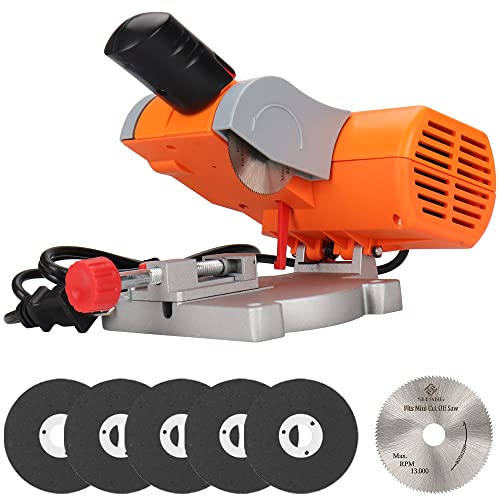
Amazon catalog listing describes a compact saw for model-making stock and adjustable cuts.
View on Amazon
The catalog title explicitly mentions miniature compound cutting and model making, which makes this tool relevant to dollhouse, railway, and craft work. It is a small powered saw, not a conventional compound miter saw. The listing describes 45-degree adjustment and mentions metal, plastic, brass, and wood. It also claims a maximum cut around one-half inch, but the stock shape and blade fitted affect whether a piece can be held safely.
Because the name and specifications are from a marketplace listing rather than a detailed manufacturer manual we could confirm, treat each compatibility statement as a prompt to verify, not a guarantee. Before purchase, check the included blade, outside diameter and arbor, replacement blades, distance from blade to fence, and whether the clamp holds the smallest pieces you intend to cut. Ask the seller for a manual if the listing does not explain adjustments and rated materials.
Good fit: a model maker who needs a compact powered cutoff saw and will confirm the exact kit and blade before using it. Potential drawback: replacement parts and documentation may be less straightforward than with an established specialty-tool brand. For repeated work, make sure the fence has a square setting you can check with an angle square.
3. Ageanbri 4-inch Mini Miter Saw — compare for a larger compact blade
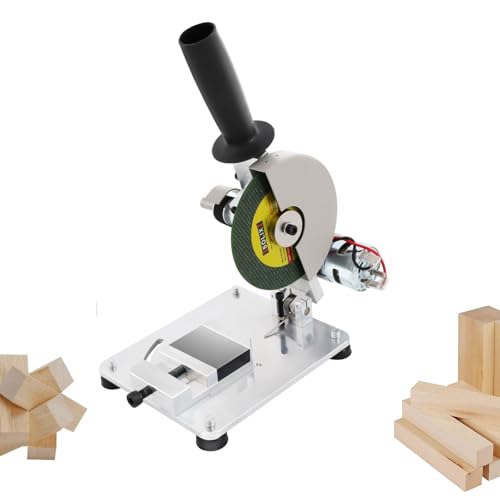
Compact powered saw listing with adjustable angle for small DIY cuts.
View on Amazon
This Amazon catalog item is presented as a 4-inch mini miter saw for small metal, wood, and plastic cutting. Its title states 110 volts, 9,000 rpm, and angle adjustment from zero to 45 degrees. A larger blade can be useful when projects use deeper stock than a two-inch micro saw can accommodate, but blade diameter alone does not establish safe capacity. The guard, table opening, fence, clamp, and specified cut depth all matter.
Good fit: someone comparing a compact saw with a larger-than-micro blade whose pieces remain within the stated capacity. Check first: ask for a manual and confirm cut depth in wood, plastic, and each metal type. Broad material language should not be read as permission to use one blade for everything. Verify arbor and blade specifications, particularly if replacements matter long term.
For model makers, this size may be too much tool for delicate stripwood but a better fit for somewhat larger repeated cuts. If your project uses tiny rail, narrow trim, or thin styrene, a hand miter box may give more tactile control. For brass or aluminum tubing, a clamp that prevents rotation is essential; round tube can shift if the vise does not seat it securely.
4. Mini Miter Cut-Off Saw for Model Making — compact footprint option

Amazon listing describes a 1.97-inch blade and compact benchtop footprint.
View on Amazon
This marketplace product title describes a 110-volt, 90-watt machine with a 1.97-inch blade and a maximum depth close to 0.47 inch. It is marketed for miniature model making and small materials. That places it in the micro-saw category: the small footprint can appeal if your bench is shared with paints, plans, and storage, but a smaller saw also has a narrower range of stock it can accommodate.
Good fit: very small workpieces and occasional cuts where published depth and the supplied clamp cover the task. Check first: replacement blade availability for your material, how the fence adjusts, and what the seller’s documentation says about limits. The listing alone does not establish parts availability or accuracy after repeated use. If you cannot confirm a blade for your material, choose another tool or a compatible hand saw.
A blade close to two inches across cannot cut a deep piece simply because the machine is advertised for several materials. Confirm stock height and width as it sits on the table, not just piece length. Leave room for the fence and clamp to hold the work without the cut running into an unsupported edge.
Mini chop saw versus a miter box, table saw, or bandsaw
| Tool type | Where it can help | What to check |
|---|---|---|
| Mini chop or cutoff saw | Repeated short crosscuts and simple angles in small stock | Material-specific depth, blade type, vise grip, fence accuracy, guard |
| Hand saw and miniature miter box | Occasional trim, thin stripwood, quiet bench work | Slot width, saw kerf, guide wear, ability to secure tiny stock |
| Mini table saw | Ripping narrow material when a proper fence and guard are included | Guarding, fence parallelism, minimum safe stock size, push devices |
| Mini bandsaw | Curves and irregular profiles a chop saw cannot make | Blade width, tracking, throat capacity, guard and tension procedure |
These tools solve different geometry problems. A chop saw makes crosscuts and angles across stock presented to its blade. A table saw is oriented toward ripping stock along its length. A bandsaw can follow curves. A hand saw and miter box may be simplest for only a few trim pieces. Our guides to standard chop saws and benchtop table saws cover larger tools, while miniature work needs smaller capacities and different handling.
Do not put a miniature workpiece on a full-size saw unless its manual describes a suitable fixture and safe method. Small pieces are difficult to hold by hand near a large blade. A tool with less capacity is not automatically safer, but the correct scale can make proper clamping and repeatable positioning easier.
How to choose a compact saw for model making
Measure the stock in three dimensions
Write down stock height, width, and length, then identify how it will sit on the table. For square strip, critical cut depth may be the height presented to the blade. For tube, outside diameter and tendency to roll matter. For decorative trim, how it contacts the fence affects angle and finished length.
Do not treat the largest listing number as universal capacity. A maker may specify separate limits for wood, soft metal, and ferrous material. A 45-degree cut can have less capacity than a straight cut. Guard or fence may also limit useful length or width. Choose margin rather than planning to work at the edge of the stated limit.
Examine the clamping arrangement
Miniature parts are hard to hold consistently with fingertips. A positive clamp or vise can keep stock against the fence, but it must fit the stock. Look for clamping surfaces wide enough to avoid crushing soft wood and adjustable enough to hold a rod or thin strip. For round tubing, check for a V-shaped support or another feature that prevents rolling.
Do not improvise a method that places fingers near a moving blade or uses a loose part that can be pulled into the cutting area. If the saw clamp cannot secure a piece, use another tool or a fixture described by the manufacturer. Support the work without blocking the guard or preventing the saw head from moving as intended.
Match blade construction to the material
Abrasive wheels, high-speed steel blades, carbide-tipped blades, and specialty discs behave differently. A thin abrasive disc can cut metal but may leave a different finish than a toothed blade. A fine-tooth blade can produce cleaner cuts in some plastics and nonferrous metals but can be damaged if material, feed, or speed is wrong. A blade intended for wood should not be assumed suitable for steel.
Before ordering a replacement, confirm outside diameter, arbor hole, thickness, speed rating, and permitted material. Fit on the arbor is only the first check; the blade must also be approved for the saw model and guarded properly. Our guide to diamond hole saws illustrates why blade types are specialized by material and task, although a hole saw is a different tool.
Check fence accuracy and repeatability
Model parts are small, so an error of a few degrees or a fraction of an inch can show once parts are assembled. Look for a fence that locks firmly and can be checked at zero. Detents speed common settings, but a detent is not proof that the blade is square. A scale helps with rough setting; a suitable square helps check the relationship between blade and fence.
Notice whether the fence slips when the clamp tightens. If you mainly make 90-degree crosscuts, a stable square setting may matter more than many detents. If your project requires matching miters, repeatability and clamping are central criteria.
Confirm electrical and bench setup
Most small powered hobby saws are corded. Confirm the rating matches the voltage and plug at your bench, and follow the manual’s extension-cord and power requirements. A compact machine still needs a stable surface. If its base is designed to be clamped or bolted down, use that method. Vibration can shift a lightweight tool and change the cut.
Plan for dust and debris. Wood dust, plastic particles, and metal fragments need different cleanup. Do not assume a small saw’s dust port captures everything. Keep the work area clear and follow cleaning instructions. If material has an unknown coating or composition, confirm it is suitable to cut and consider whether dust or fumes require controls your hobby bench does not provide.
Check service support and consumables
The lowest purchase price may not mean the lowest total cost if replacement blades are hard to obtain. Check how many blades the tool uses, whether replacements are sold individually, and whether arbor and blade specifications are documented. Look for a manual, parts diagram, warranty route, and brand or seller contact details.
For an established tool maker, a higher price may be worthwhile when parts and accessories are stable. For occasional projects, a basic model can be adequate if its listing is clear and returns are straightforward. Avoid paying extra for speed figures or broad material claims you do not need.
Material-by-material considerations
Stripwood and balsa
Thin softwood and balsa are common in model making. They can crush under a clamp or splinter if the blade is coarse, dull, or poorly matched. A fine-tooth blade and light, secure support are more important than raw motor power. If the saw cannot hold a narrow strip without excessive pressure, a hand razor saw and miter box may be the better option. Before making a set of identical pieces, check a scrap for tear-out and verify that the fence holds it square.
Styrene, acrylic, and other plastics
Different plastics respond differently to cutting. Some may melt, chip, or crack depending on blade speed and tooth geometry. The product title’s word “plastic” does not tell you which resin types are supported or how thick a piece can be cut. Check the manual and test only on a scrap of the same material. If plastic is unknown, brittle, coated, or likely to produce hazardous dust, do not assume a hobby saw will cut it safely.
Brass, copper, and aluminum
Small nonferrous stock is useful for model fittings, handrails, pipework, and frames. It needs a blade intended for that metal and a clamp that prevents sliding or rolling. Thin tubing can deform if clamped too aggressively; round stock can rotate if the vise does not cradle it. Verify capacity and blade recommendations for the exact metal rather than relying on a general “metal cutting” label. Metal chips can be sharp, and cutting may create heat.
Do not use an abrasive wheel or toothed blade outside its rated materials. If the machine’s instructions do not explicitly cover the stock, contact its manufacturer or select a tool with suitable documentation. The marketplace listing is not a substitute for the manual.
Ceramic, tile, stone, and composites
Some specialty miniature machines accept diamond or abrasive discs for ceramic and mineral materials, but the disc and saw must be designed for that operation. Cutting masonry-like material can produce fine dust and a different hazard profile from wood. A generic compact chop saw should not be assumed to have a water-feed system, sealed motor, or dust controls. Use a dedicated tool and follow its manual.
How to get consistent miniature cuts
Consistency begins before the blade turns. Confirm the fence is set for the intended angle, the workpiece rests flat, and the clamp can hold it without shifting. Use a measurement method that accounts for kerf: the blade removes material, so the cut line is not the same as the final length. For repeated pieces, a stop block can help only if the manufacturer allows it and it does not trap the offcut or interfere with the guard.
Make a test cut on scrap from the same material and compare the angle and length with your project requirement. If the result is not square or repeatable, stop and recheck alignment and support rather than compensating blindly on every piece. Small errors accumulate across a miniature frame or repeated trim set.
Different materials may need different blade choices, speed settings, or support. Use only adjustments available in the manual. A miniature saw is not a universal precision instrument; accuracy depends on alignment, blade condition, clamping, material, and setup. Choose a machine that can securely and repeatedly hold the stock you use.
Safety: a compact blade still needs full attention
Small tools can still cause serious injuries. OSHA identifies saw contact and flying chips as hazards and recommends eye and face protection for saw operations. Keep the guard in place, use the work-holding method provided by the manufacturer, and do not move a hand into the blade path to steady a tiny part. Read the manual for the exact model before operation.
- Wear appropriate eye protection and keep bystanders out of the line of cut.
- Secure the saw base to a stable bench when the manual calls for it.
- Use the clamp or vise for small stock; do not hold pieces by hand near the blade.
- Wait for the blade to stop before removing offcuts or making adjustments.
- Disconnect power before changing blades, clearing a jam, or maintenance.
- Do not remove or defeat a guard, and do not use damaged or incorrectly rated blades.
- Keep loose sleeves, jewelry, hair, and cords clear of the machine.
- Use only materials and stock sizes allowed in the manufacturer instructions.
The OSHA miter-saw safety guidance describes hazards around moving blades and keeping hands away from the point of operation. Its advice applies broadly to saw work, but the exact safeguards for a hobby model come from that tool’s manual. OSHA also explains that saws can throw chips and broken teeth; a miniature blade is not harmless just because it is small.
For a first powered cutoff tool, consider whether you have a stable place to mount it, adequate light, a clear view of the cut area, and a way to clean debris. If you are unsure about a material or the machine’s guard, contact the manufacturer instead of experimenting.
Common buying mistakes to avoid
Buying by RPM alone
A high no-load speed does not tell you whether the tool will make a clean cut in a specific material. Blade design, stock support, and machine rigidity matter just as much. Use published rpm to confirm the blade is rated for the tool, not as a direct measure of cut quality.
Confusing blade diameter with cut capacity
The blade’s diameter is not the same as the depth a tool can safely cut. Table, guard, fence, and swing limit useful capacity. Confirm the actual rating in the manual for each material and angle.
Assuming each included blade fits every material
Some bundles include multiple discs or blade styles intended for distinct stock. Review labels and instructions before swapping. Never use a blade merely because it fits the arbor.
Ignoring offcut support
Short stock is difficult to support, and a small offcut can move if trapped or pinched. A proper clamp, stable table, and permitted work-holding arrangement are essential. If the setup cannot retain the piece safely, choose a hand tool or a machine designed for it.
Expecting full-size precision at hobby prices
Budget micro saws can be useful, but verify their fence, table, blade supply, and documentation. A product listing that promises precision does not establish measured accuracy. Build tolerance expectations around the actual work and verify the machine with test material.
When a powered miniature chop saw is not right
If you cut only a few pieces per month, a fine-tooth hand saw may be faster overall because it needs less setup and cleanup. A small miter box helps keep repeated angles aligned. If you need curves, a miniature bandsaw or fret saw may be better. If you mostly rip sheets or narrow boards, compare a compact table saw with suitable guarding. Our hand saw guide can help compare manual options.
For tiny parts, the safest tool may be the one that keeps fingers farthest from the cutting edge while holding stock firmly. That can mean choosing a fixture-driven hand tool rather than powering a blade. For visible furniture-scale trim or railway pieces, a careful adjustment to a hand miter box can deliver better control than an inexpensive powered saw whose fence is not square.
Before committing, list the materials, largest cross-section, angle types, number of repeated cuts, and acceptable tolerance for the project. Then compare each tool against that list. A miniature saw with more capacity than you need may still be the wrong tool if its clamp cannot handle your small parts.
Frequently asked questions
What is the best chop saw for miniature work?
There is no universal winner. For a compact powered option with published capacities and angle adjustment, the VEVOR J1F-DC50 is worth comparing. If you work with very small stock, a smaller model-making saw or hand miter box may be a better match. Confirm manual, blade, and clamp for your material.
Can a miniature chop saw cut metal?
Some models list capacities for soft or ferrous metals, but they require the correct blade and a securely held piece. Verify the rating for the exact metal and thickness. Do not assume one blade cuts wood, plastic, aluminum, and steel equally well.
Can I use a mini chop saw for dollhouse trim?
Potentially, if the trim fits the capacity and the fence and clamp hold its profile without damage. Measure the tallest and widest cross-section and consider whether a hand miter box provides enough accuracy.
Is a mini chop saw safer than a full-size saw?
Not automatically. A smaller blade and capacity may make some tasks easier to fixture, but a moving blade can still injure fingers and throw particles. Use the guard, clamp, eye protection, and operating method specified in the manual.
Are mini chop saws suitable for model railways?
They can help with short crosscuts in compatible stock. Some specialty machines include a guide intended for model track, but verify that feature in official specifications before buying. Track materials and profiles differ, so check whether your exact type is allowed.
What blade should I use for wood or plastic?
Follow the saw manufacturer’s recommendations for that material. A fine-tooth or specialty blade may improve control in some stock, but tooth geometry, speed, and feed must match. Confirm diameter, arbor, thickness, and speed rating.
Can I cut steel rod on a hobby mini saw?
Only if the exact model and blade are rated for that material and size. Some saws list a small ferrous-metal capacity; others are aimed at wood, plastic, or nonferrous metals. Do not infer steel compatibility from “metal saw.”
Should I buy a powered saw or a manual miter box?
Choose a powered model when repeated cuts justify its setup and the clamp, fence, blade, and safety features match your stock. Choose a hand saw and miter box when work is occasional, delicate, or too small for a powered saw to hold reliably.
How do I know whether an Amazon listing is the right model?
Compare exact title, model designation, blade diameter, voltage, and included accessories. Marketplace listings may combine variants or change bundles, so confirm the selected option and review current photos and manual. Product details and availability can change.
Bottom line
The best chop saws for miniature work are the ones that hold your smallest stock securely, make the angles your projects require, and accept a blade designed for your material. The VEVOR J1F-DC50 is a sensible starting point because its maker publishes model-specific capacity and angle information. Smaller marketplace-listed mini miter saws can also fit tight hobby benches, but they need closer checking for manuals, replacement blades, and clamping details.
Measure before you buy, treat maximum capacities as material-specific, and verify blade and guard instructions. For a few delicate cuts, a manual miter box may be more controlled and economical. For repeated work, a properly clamped compact saw can save setup time and help produce consistent lengths when its specifications match the job.
Sources: PROXXON KG 50 manufacturer specifications; VEVOR J1F-DC50 manufacturer listing; OSHA miter-saw hazards and safeguards; OSHA woodworking machine guard overview.
Certain content that appears on this site comes from Amazon. This content is provided “as is” and is subject to change or removal at any time. Product examples and images are supplied through Amazon Creators API; confirm specifications and availability on the current listing.