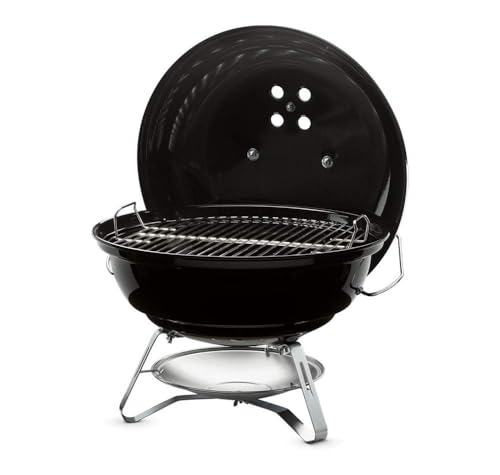
Where to buy
Every linked pick in this guide to the best charcoal grill for outdoor entertaining under $100 is sold on Amazon — check the latest price, availability and delivery there before you buy. Orders are placed on Amazon. We may earn a commission from qualifying purchases. One pick below is covered in prose only, with the reason stated in its review, because its current Amazon pricing sits outside this budget tier.
- Best for entertaining: Weber Jumbo Joe Charcoal Grill, 18-Inch, Black — Check on Amazon
- Char-Griller Patio Pro Charcoal Grill and Smoker, Model E1515 — prose only, see its review below for why
- Weber Go-Anywhere Charcoal Grill — Check on Amazon
- Weber Smokey Joe Portable Charcoal Grill, 14-Inch, Black — Check on Amazon
- Cuisinart 14-Inch Portable Charcoal Grill (CCG-190RB, Red) — Check on Amazon
- Gas One 14-Inch Portable Barbecue Grill (CG-14) — Check on Amazon
Read the full guide ↓
Disclosure: As an Amazon Associate, dailyhomedecorating.com earns from qualifying purchases. Links to Amazon on this page are affiliate links; they cost you nothing extra. Listing details such as price and availability change often, so check the current Amazon listing before you buy.
Entertaining is the hardest job a small grill can be given, which is why the best charcoal grill for outdoor entertaining under $100 is not simply the best small grill with guests imagined around it. A weeknight grill serves the people who live with it, on their schedule. An entertaining grill serves eight or ten people who arrived together, are hungry at the same time, and are watching. Under this ceiling there is no grill that swallows a party in one load — the honest formats top out at 18 inches — so entertaining at this budget is a discipline before it is a product: batch cooking planned like a set list, a hot zone that never sits empty, finished food held warm without drying, and a host who spends the party at the grill by choice rather than by backlog. The right grill makes that discipline easy. The wrong one — too small, too vague in its vents, too slow to refresh — turns it into an apology tour.
This guide therefore judges the familiar under-$100 field by entertaining evidence. Capacity is counted in party terms: burgers per load, skewers per row, how a second round behaves when the fire has already worked for an hour. Lid behaviour matters — a lid that hooks onto the bowl or locks out of the way keeps one of the host’s hands free and the workflow moving. Refresh-ability matters: how gracefully a grill accepts a second chimney of coals mid-party. And the two-grill strategy gets its due, because at this ceiling the smartest entertaining purchase is often not one bigger grill but a capable main grill plus a small second fire — an arrangement this guide’s picks support unusually well, since the compact Webers and tabletops pair like instruments. Our headline pick, the Jumbo Joe, is the strongest single-grill answer; the prose-only Char-Griller Patio Pro is the format hosts picture, currently priced above the tier; and the little Smokey Joe, reframed, may be the best party purchase of all — as the appetizer and dessert grill that keeps the main fire free.
One planning note before the picks: entertaining multiplies everything, including the setting around the grill. If the party is the point of the purchase, look at the whole picture in our Best Patio Dining Set Under $200 guide for the table your guests will actually eat at, and the Best Adirondack Chair Under $100 roundup for the chairs that migrate toward the fire as the evening cools.
In this guide
Quick Picks
In a hurry? This table matches each grill to its role at a gathering.
| Party role | Pick | Why it stands out | Link |
|---|---|---|---|
| Best main grill for entertaining | Weber Jumbo Joe Charcoal Grill, 18-Inch | 240 square inches, two-zone fire, lid hook for one-handed hosting | Check on Amazon |
| Best standing host station | Char-Griller Patio Pro E1515 | Cart, side shelf and 250 square inches of cast iron — but currently priced above this tier on Amazon | Prose only — see review |
| Best second grill / appetizer station | Weber Go-Anywhere Charcoal Grill | Rectangular grate runs skewer and sausage rows while the main grill works | Check on Amazon |
| Best appetizer and dessert grill | Weber Smokey Joe, 14-Inch | A small, fast fire for starters, sides and grilled fruit — frees the main grill entirely | Check on Amazon |
| Best budget overflow grill | Cuisinart 14-Inch Portable Charcoal Grill (CCG-190RB) | Dual vents and a latching lid; a second fire for very little money | Check on Amazon |
| Cheapest backup grill | Gas One 14-Inch Portable Barbecue Grill (CG-14) | The loaner and overflow grill — locking lid, ash catcher, minimal spend | Check on Amazon |
How These Picks Were Chosen
Entertaining criteria came first. Throughput: how much food a load holds without crowding, because crowded food steams instead of searing and a party notices. Zone discipline: whether the grill can hold a hot side and a holding side simultaneously, since the holding zone is where a host’s timing lives. Lid workflow: whether the lid parks itself — hooked, locked or held — because a host’s hands are spoken for. Fire refresh: whether fresh coals can be added cleanly mid-service, which separates grills that fade after round one from grills that run an evening. And pairing value: how the grill behaves as half of a two-grill setup, the realistic party configuration at this budget.
Specifications were verified against manufacturer data for every pick, and every linked pick had a price sighting at or under the tier ceiling on its exact Amazon listing at research time; sightings are recorded in the notes accompanying this guide, and listings should be rechecked before purchase because grill prices move with the season. The Char-Griller Patio Pro failed the price test — current Amazon and maker pricing sit above the ceiling — and appears in prose with the situation explained, because its cart-and-shelf format is the one many hosts are shopping for and they deserve to know its real position. The 18-inch Weber Original Kettle and a large budget barrel grill were excluded entirely on the same price grounds; they are covered where they belong, in the Best Charcoal Grill Under $200 guide. We also checked for CPSC recalls covering these grill models and found none for any grill reviewed here; the category’s recent recalls involve accessories such as wire-bristle brushes, which is why this guide recommends bristle-free grate cleaning throughout — at a party, with other people’s children eating, that caution doubles.
What we did not do is pretend a number of guests these grills cannot serve. Each review states its honest party arithmetic — the load size, the batch rhythm, the point at which a second grill or a second chimney stops being optional. A host who knows the arithmetic in advance looks effortless; a host who discovers it at seven o’clock does not, and the difference is information, not equipment.
The 6 Best Charcoal Grill for Outdoor Entertaining Under $100 — Reviewed
1. Weber Jumbo Joe Charcoal Grill, 18-Inch, Black — Best Main Grill for Entertaining
Who it suits: Hosts who entertain four to eight people regularly and want one grill under the ceiling that can run a party with planning rather than luck.
The Jumbo Joe’s party credentials start with the only number that matters at a gathering: 240 square inches of grate, enough for eight burgers in one uncrowded load or a full row of chicken pieces with a holding zone beside them. Its kettle bowl runs the two-zone fire that entertaining is built on — the hot side works, the cool side holds finished food warm and safe while the next batch cooks — and the porcelain-enamelled bowl and lid keep their composure through a long evening’s heat. The detail hosts feel most is the Tuck-N-Carry lid lock working as a lid hook: the lid parks on the bowl’s edge, one hand stays on the tongs, and the serve never breaks rhythm to find a place to put a hot lid down. Mid-party, the bowl accepts a refreshed bank of coals gracefully — lift the grate’s edge, add, settle — and the dampers give the control to bring a refreshed fire back to temperature without a smoke show in front of the guests. Set it on a sturdy heat-safe table at a comfortable height and it hosts like a grill twice its price.
Pros: the largest linked capacity here; genuine two-zone hosting; lid that parks itself; enamel that handles long, hot evenings. Honest limitation: eight burgers is a load, not a party — ten hungry guests still means two rounds for mains, planned as courses rather than discovered as delays. It also needs its table provided, and at a crowded party that table must be stable and out of the guest traffic lane.
Choose it if one grill must host. Skip it if your parties run past ten people regularly — that is two-grill territory, and this guide’s smaller picks are designed to stand beside it. Check on Amazon
2. Char-Griller Patio Pro Charcoal Grill and Smoker, Model E1515 — Prose Only
Who it suits: Hosts who entertain in one fixed spot and want the host station format — standing height, a shelf for the platter, cast-iron grates — and who are willing to shop patiently.
The Patio Pro is the grill hosts picture when they picture hosting, and it is unlinked for one stated reason: at verification, its Amazon pricing sat above this guide’s ceiling, as did the maker’s own store pricing, after years spent inside the tier. It remains in this guide because hosts will cross-shop it, and because its party specification is genuinely the class benchmark: 250 square inches of cast-iron grate that sears like a skillet and holds heat through a long service, a wooden side shelf that solves the host’s eternal problem — where the clean platter lives — a lower rack that keeps the charcoal bag at hand, and an ash pan that empties between parties without tipping anything. On wheels, it rolls out to its station and back to its corner. If you find it priced inside the tier from a seller you trust, it is a headline entertaining buy — check price on Amazon rather than assuming, because the gap between its old budget reputation and its current pricing is exactly the trap this guide exists to flag.
Pros: cast-iron searing through long services; the side shelf, a host feature no kettle matches; standing height; ash pan convenience. Honest limitation: current pricing above the tier, first and always. Then: powder-coat that wants chip care, the longest assembly here, and a fifty-pound presence that hosts in one place only.
Choose it if you catch it in tier and your parties have a permanent home. Skip it if the listing is above the ceiling — the two-grill Weber combination below hosts more food for similar total money.
3. Weber Go-Anywhere Charcoal Grill — Best Second Grill and Appetizer Station
Who it suits: Hosts running the two-grill strategy, and anyone whose parties travel — to the park pavilion, the lake, the rented house — where the entertaining happens away from a home grill.
As a party’s second fire, the Go-Anywhere is perfectly cast. Its rectangular grate, about 160 square inches, is shaped for the foods that start parties: skewers in rows, sausages in lines, corn rolled to char evenly, flatbreads and halved lemons at the edges. While the main grill runs mains in batches, the Go-Anywhere keeps appetizers flowing, which is the difference between guests grazing happily and guests watching a grill. Twin lid dampers steer heat along its length, the enamel body handles the work without complaint, and when the party moves — and entertaining households’ parties do move — the legs fold, the lid locks, and the second grill is a flat case in the car. It also plays a quieter party role beautifully: the dietary-requirements grill, where vegetarian mains or a kosher or allergy-conscious batch cooks on its own clean fire, unhurried and unmixed. Hosts who entertain mixed tables will use that more than any other feature in this guide.
Pros: a shape made for starter foods; travels to wherever the party is; enamel build; stores flat between parties. Honest limitation: as a solo main grill for a crowd it is out of its depth — the low lid and modest area mean batch discipline from the first minute — and it sits at the top of the tier’s pricing for a grill that plays a supporting role in this guide’s framing.
Choose it if you host with two fires or host away from home. Skip it if you need one grill to do everything — that is the Jumbo Joe’s job. Check on Amazon
4. Weber Smokey Joe Portable Charcoal Grill, 14-Inch, Black — Best Appetizer and Dessert Grill
Who it suits: Hosts who already own a main grill of any size and want the small fire that transforms how a party flows — plus couples whose “entertaining” means two friends and a long evening.
Reframed for parties, the Smokey Joe’s smallness becomes a schedule. Lit early on a small chimney of coals, it serves the first hour: grilled appetizers, warm bread, the corn that never fits beside the mains. While the main grill runs dinner, it idles at the edge; after dinner, with a handful of fresh coals, it returns for the course nobody plans and everybody remembers — grilled peaches and pineapple, bananas in their skins, marshmallow duty for the children. Its 147 square inches and quick, light fire make these small services effortless where lighting a big grill for six peach halves would be absurd. The build is the familiar Weber enamel with the Tuck-N-Carry lid lock on current production, light enough to carry to wherever the party’s second station makes sense, and cheap enough in fuel that running a second fire all evening costs a bag’s corner. For the couple-scale party it simply is the main grill, and a good one.
Pros: fast, light, fuel-sipping second fire; enamel longevity; transforms party flow for the least money of any strategy here. Honest limitation: as a main grill it caps a party at four batch-fed guests; beyond that it is a supporting instrument and should be bought as one. Ash is tip-out, so the party station needs its metal bin nearby.
Choose it if you host with a main grill already, or entertain at couple scale. Skip it if it must host eight alone. Check on Amazon
5. Cuisinart 14-Inch Portable Charcoal Grill, CCG-190RB — Best Budget Overflow Grill
Who it suits: Hosts on a firm budget who entertain a handful of times a year and want a second fire — or a first grill — without diverting the party budget from the food.
The Cuisinart’s party value is arithmetic: for a fraction of a Weber’s price it puts a second, controllable fire on the patio. Dual vents — the feature cheap grills omit — mean its 14-inch grate can hold appetizers at a managed heat rather than scorching them over an open blaze, and its latching lid lets it be carried, still set up, from garage to patio station as the party assembles. In service it does what overflow grills do: sausages and sides in steady batches, vegetarian food on its own fire, a warming station with the vents nearly closed. The maker’s stated area flatters the 14-inch grate slightly; in party terms it is a four-burger fire, and hosts should plan it as such. Between parties it stores on a shelf, latched and clean, asking nothing.
Pros: the cheapest controllable second fire here; latching lid for moving mid-setup; light and shelf-stored. Honest limitation: thin steel fades fastest in long services — by hour three of a big party its fire needs more tending than a kettle’s — and its realistic life is seasons, not years of heavy hosting.
Choose it if the party budget is real and the hosting is occasional. Skip it if you host monthly — the Smokey Joe is the durable version of the same idea. Check on Amazon
6. Gas One 14-Inch Portable Barbecue Grill, CG-14 — Cheapest Backup Grill
Who it suits: The host who needs insurance: a backup fire for the one big annual gathering, a loaner for a neighbour’s party, a dedicated kids’-table or allergen-separate grill bought for a single event and kept for the next.
The CG-14’s party specification is its price and its sealing lid. At the lowest cost in this guide, it adds a genuine second fire — about 150 square inches by the maker’s statement, dual vents, an ash catcher — to a party plan, and its three-point locking lid means it can be set up in advance, stored loaded with its grate and tools, and carried out when the crowd outgrows the main grill. In service it is a hot, direct, batch grill: sausages, burgers in rounds, corn at the edges. Nobody should ask it to anchor a wedding; everybody who has watched a main grill hit its limit at the exact moment eight people sit down understands what a ready second fire is worth. Stored dry and empty, it waits on the shelf for its few annual outings without complaint.
Pros: the lowest price here; sealing lid for pre-staged storage; ash catcher; a second fire for the cost of the party’s drinks ice. Honest limitation: light-gauge build, the weakest heat retention in the guide, hardware at a price — an insurance appliance, not a weekly host.
Choose it if you need a backup or one-event grill. Skip it if it will host regularly — the Cuisinart is the minimum for a recurring role. Check on Amazon
Comparison Table
| Grill | Format | Cooking area | Party role | Load reality | Watch out for |
|---|---|---|---|---|---|
| Weber Jumbo Joe 18-Inch | Tabletop kettle | 240 sq in | Main grill | 8 burgers a load, two zones | Two rounds for ten guests |
| Char-Griller Patio Pro E1515 | Barrel on cart | 250 sq in | Host station | Largest load, with a shelf | Above this tier on Amazon — prose only |
| Weber Go-Anywhere | Rectangular portable | About 160 sq in | Second grill / starters | Skewer and sausage rows | Low lid; supporting role |
| Weber Smokey Joe 14-Inch | Tabletop kettle | 147 sq in | Appetizer / dessert grill | 4 burgers a load | Not a solo host past four |
| Cuisinart CCG-190RB | Tabletop | 14-inch grate | Budget overflow | 4 burgers a load | Fire fades in long services |
| Gas One CG-14 | Tabletop | About 150 sq in (maker-stated) | Backup grill | Batch rounds | Occasional-use build |
The Entertainer’s Playbook: Running a Party on a Compact Grill
Programme the menu like a set list
Successful small-grill parties are sequenced, not simultaneous. Open with foods that cook fast and hold gracefully — sausages, skewers, wings — served as guests arrive, from the main grill or the second fire. Follow with the hero course cooked in one or two deliberate batches: burgers to order, chicken already par-cooked by its time in the holding zone, steaks rested and sliced for sharing rather than plated whole. Close with the grill’s encore — fruit, bread, marshmallows — which needs five minutes of coals and gives the evening its ending. A menu that asks everything of the grill at 7 p.m. is a queue; a menu in movements is a party.
Run two zones and defend the holding zone
The holding zone is the host’s bank account: finished food rests there, warm and safe, while the hot zone earns. The discipline is to never let the holding zone become a second cooking zone in a moment of impatience — its whole value is that food there is done and waiting. On the Jumbo Joe this is a true half-and-half split; on the 14-inch grills it is a modest crescent at the grate’s edge, which is still enough for a batch of sausages while four burgers sear.
Refresh the fire before it fails
Light the second chimney when the first fire is at its peak, not when it is ash. Fresh coals added to a living fire settle in minutes and the service never pauses; a fire rebuilt from grey ash costs the party twenty minutes of hungry silence. Budget hosts should note the economics kindly: a second chimney of briquettes is the cheapest party upgrade in existence, and it is the difference between the grill fading at dessert and the grill taking a bow.
Station the grill like a stage
Put the grill where the host can work with guests nearby but not underfoot: a heat-safe table at comfortable height, the platter shelf or side table on the host’s strong side, the charcoal and chimney behind, a clear lane to the kitchen. Keep children and ball games routed around the station by furniture placement rather than by warnings, keep a spray bottle and a lidded metal ash bin at the station, and never set a tabletop grill on a surface that heat can harm — the party is not improved by a scorched rental table.
How to Choose the Best Charcoal Grill for Outdoor Entertaining Under $100
Count covers honestly
Write down your real party: the number who actually come, not the number invited in optimism. Six or fewer: the Jumbo Joe alone, run in movements, is a complete answer. Eight to ten: the Jumbo Joe plus any second fire in this guide. Beyond ten, regularly: buy the Jumbo Joe now and the second grill before the next party, or accept that your entertaining has outgrown this tier and read the Best Charcoal Grill Under $300 guide for the formats that host crowds natively.
Decide your hosting style: station or roaming
A station host cooks in one place and guests circulate — that style wants the biggest single fire and a shelf, which is the Jumbo Joe with a side table, or the Patio Pro if its pricing cooperates. A roaming host cooks where the party drifts — patio, then lawn, then fire pit — and that style wants the Go-Anywhere’s case-like portability and the Smokey Joe’s one-hand carry. Neither style is better; buying against your own style is the only error.
Value the lid hardware
At a party, lids are opened a hundred times. A lid that hooks to the bowl (the Webers) or locks and latches (the tabletops) keeps the workflow one-handed and the hot lid off the grass, the deck and guests’ shins. It reads as a small specification. In service, it is the specification hosts mention first.
Feed the party, not the grill
Resist buying capacity for the theoretical maximum party. The grill that serves your real eight, bought well and paired with a chimney and a plan, outperforms the strained purchase that tried to serve twenty and serves nothing well. Entertaining reputations are built on food that arrives hot in sequence — a thing of timing — far more than on the diameter of the firebox.
Common Buying Mistakes
Buying one small grill for a big annual party and nothing else
The grill is half the system; the other half is the second chimney, the holding plan and, for parties past eight, the second fire. Hosts who buy the system host calmly. Hosts who buy only the grill discover the system’s absence in front of an audience.
Putting every course on the grill at once
Crowded grates steam food, crash the fire’s temperature and guarantee that something is raw while something else is charcoal. Sequence the menu, use the holding zone, and let the oven indoors — set low — hold finished batches without shame. Professional caterers work exactly this way; the audience never knows and always eats better.
Lighting the grill when the guests arrive
Charcoal needs its lighting time plus its ash-over time before food should touch it, and a host lighting at arrival time serves the first course forty minutes late with smoke in every photo. Light early; a lidded kettle holds its fire patiently with vents trimmed, and an early fire can always be refreshed — a late one can only be apologised for.
Forgetting the non-grill guests
Every party has them: the vegetarian, the allergy, the child who eats only sausages cut lengthwise. The two-grill strategy solves it structurally — a clean second fire for the food that must not mingle — and even a single-grill host can sequence: vegetables and special-diet food first, on the clean grate, held aside, then the rest. Planning this in advance is hospitality; improvising it at the grill is stress.
Leaving the host station in the traffic lane
A grill at elbow height in the path between kitchen and garden will be bumped, and a bumped tabletop grill is the one genuinely dangerous moment in small-grill entertaining. Station it out of the lanes, on a stable surface, with its back to a wall or fence where possible — and brief the children once, early, kindly, about the hot zone’s borders.
Party Menus Matched to Grill Size
On the Jumbo Joe alone, for six: open with skewers — chicken and pepper, mushroom and halloumi for the vegetarians — cooked in two quick loads while guests settle. Mains in two movements: sausages and chicken thighs first, held in the cool zone and the low oven, then burgers cooked to order in a single eight-patty load that lands all at once, which is the moment the party remembers. Corn rides the grate’s edges throughout, husks charring at their own pace. Dessert, if the fire still glows, is pineapple spears; if it does not, nobody has ever mourned its absence at a table that ate well. On a 14-inch grill, for four: the same architecture at couple scale — one starter load, mains in two small batches eaten as they come, which suits an evening where the table is beside the grill and courses arriving is the entertainment. On two grills, for ten: the second fire owns starters and special-diet mains entirely, the Jumbo Joe owns the hero course, and the host’s only sequencing problem is dessert — a problem the Smokey Joe, relit with a handful of coals, was born to solve. The pattern underneath every version: the grill never cooks two courses at once, and the guests never wait for the first bite.
After the Party: The Ten-Minute Reset
The party grill’s next performance is decided the night of its last one. When the final food comes off, open the vents briefly and let the fire burn hot and clean for a few minutes — this burns the grate nearly bare — then brush it with the bristle-free brush while it is still hot, and close everything down. The next day, with the grill fully cold, the ash goes into the metal bin, the grate gets its wipe of oil, and the grill goes under its cover or back to its shelf, latched and clean. Charcoal stores sealed and dry; a half-open bag left in a damp garage will light reluctantly at the next party, which always seems to be the one that matters. Hosts who keep this ritual find that setup for the next gathering is a five-minute carry-out rather than an archaeological dig through last month’s ash — and that, more than any single feature, is what makes a household entertain often. Frequency is the real luxury in this tier, and it is bought with ten minutes of tidiness at a time.
The Grill’s Place in the Party Itself
A last consideration, easy to miss in a specification table: at an outdoor gathering, the grill is furniture and theatre as much as appliance. Guests gather where the fire is. A host station placed with intention — where the cook can see the table and the table can see the cooking, out of the traffic lanes but inside the conversation — turns the batch-cooking rhythm from a limitation into the evening’s entertainment, with courses arriving as events. This is one more reason the compact formats serve parties better than their numbers suggest: a small grill on a good table at the party’s edge invites an audience, while the host remains a participant rather than a exile at a distant cooker. Choose the grill that fits your party’s geography, give it its stage and its side table, and the under-$100 fire will carry evenings that guests talk about without ever asking what it cost.
Fuel and Weather: The Two Party Variables Nobody Puts in a Listing
Fuel planning. A party burns more charcoal than the same food cooked for family, because the fire works longer — lit early, refreshed once, held through dessert. As a planning rule for the grills in this guide, a single-grill party for six wants a full chimney to start and a second chimney’s worth in reserve; a two-grill party wants the reserve closer to a third. Briquettes earn their place at parties precisely because their burn is metronomic — a host sequencing courses needs to know what the fire will be doing in forty minutes, and lump’s hotter, faster, less even burn is a variable best saved for steak nights. Store the party charcoal sealed and dry, and stage it at the grill station before guests arrive: the host who disappears mid-service to hunt for the charcoal bag in the garage has misunderstood what the station is for. Finally, close the vents when the cooking ends and let the fire snuff itself; sound leftover briquettes, shaken free of ash the next day, can open the next party’s fire — a small economy that frequent hosts genuinely feel across a summer.
Weather contingencies. Wind is the party variable that rewrites menus: it fans fires hot, carries smoke sideways into the seating, and makes small grills burn through fuel at double pace. The defences are placement — the station sheltered at its sides by a fence or hedge, never roofed above — and menu flexibility, with the holding zone and the indoor oven absorbing the delays a gusty evening imposes. Rain is simpler: a lidded kettle cooks on through a shower that would end an open grill’s evening, which is one more quiet argument for the kettle formats in this guide, and the host who has positioned the station within a few steps of a doorway loses nothing but a little dignity to a downpour. Cold evenings, finally, are where charcoal entertaining beats every alternative hollow: the grill is the warmest object in the garden, guests orbit it willingly, and a small second fire lit for dessert extends the night by an hour. Plan for the weather you get rather than the weather you ordered, and the compact grill stops being the party’s risk and becomes its hearth.
What Guests Actually Remember (and What They Never Notice)
Hosts shop for grills; guests remember evenings. What they remember is whether the first food arrived while they were still hungry for it, whether the main course landed hot and together rather than in apologetic instalments, and whether the host was present — glass in hand, part of the conversation — or exiled to a smoky corner performing triage. They remember a dessert course nobody expected, grilled fruit over the last coals, far out of proportion to its cost. What they never notice is the grill’s brand, its grate material, or whether the chicken was cooked on 240 square inches or 363; nobody has ever gone home praising a specification. This is worth holding in mind at the moment of purchase, because it reverses the usual priorities: the entertaining value of a grill lives in its workflow — the lid that parks itself, the zone that holds food, the fire that refreshes without drama — and in the host’s system around it, the sequenced menu, the early lighting, the second chimney waiting. Every pick in this guide was judged on exactly that workflow evidence, which is why a modest kettle with a hooked lid outranks larger, vaguer equipment for party duty. Buy the workflow, plan the evening, and the guests will remember the party the way you hoped — as an evening, not as a grill with people around it.
Final Recommendation
Buy the Weber Jumbo Joe as the main fire: it is the only grill in this tier whose capacity, zones and lid manners let one host run a real party from a single station. Then, honestly assess your guest list — if eight or more is your normal, add the second fire in the same season: the Smokey Joe for appetizer-and-dessert duty if you want the durable instrument, the Go-Anywhere if your parties travel, the Cuisinart if the budget must stretch, the Gas One if the need is a single annual insurance policy. Keep an eye on the Char-Griller Patio Pro’s pricing if your parties live in one place and the host-station format calls to you; inside the tier it is a headline buy. Whatever combination you choose, spend the small extra on the second chimney and plan the menu in movements — at this budget, the host’s system is the luxury, and it is well within reach.
Frequently Asked Questions
How many people can a charcoal grill under $100 feed at a party?
Comfortably six from an 18-inch grill run in courses; eight to ten with a second small grill or disciplined batching and an indoor oven holding finished food. Beyond that, regularly, the honest answer is a bigger tier — these grills can stretch to a crowd occasionally, but they cannot make it their job.
Is two small grills really better than one bigger grill for parties?
At this budget, often yes. Two fires give you two temperatures, a clean grate for special-diet food, appetizers that flow while mains cook, and insurance if one fire misbehaves. A single bigger grill gives you one larger load. Hosts who entertain in courses usually prefer the pair; hosts who serve one big batch prefer the single load — and at this ceiling the single load tops out at 18 inches anyway.
How do I keep food warm while the next batch grills?
Three ways, used together: the grill’s own cool zone for the short term, a low indoor oven for holding finished batches, and menu sequencing that serves holding-friendly foods — sausages, chicken pieces — before the cook-to-order items like burgers and steaks.
What should I cook first when guests arrive?
Foods that are fast, forgiving and good at room temperature’s edge: sausages, skewers, wings, grilled bread and vegetables. They occupy the hungry first half hour, they hold without drying, and they buy the main course its unhurried time on the fire.
Can I entertain with only a 14-inch grill?
For four guests, yes — with a sequenced menu it can feel generous. For six, it becomes a performance of constant batching that keeps the host at the grill all evening. If your parties are six-plus and frequent, treat the 14-inch as the second grill it wants to be and put the Jumbo Joe in the main role.
What is the best party food to cook on a small charcoal grill?
Foods that cook in batches without resentment: sausages, skewers, wings and chicken thighs for the holding-friendly courses, then burgers and steaks cooked to order as the hero course, with corn and vegetables riding the grate’s edges throughout. The common thread is forgiveness — party food should taste good across a ten-minute serving window, because at a party, it will need to.
How far ahead should I light the grill before a party?
Early enough that the coals are fully ashed over and the grate is hot before the first food is expected — light the chimney as the first guests are due, or before, and trim the vents to hold the fire. A ready fire waits gracefully; a late fire makes the whole evening wait with it.


