Where to buy
Check the latest price, availability and delivery on Amazon. Orders are placed on Amazon. We may earn a commission from qualifying purchases.
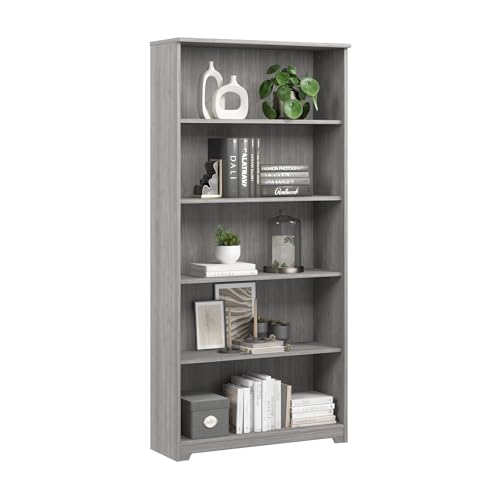
- Best overall: Bush Home Cabot Tall 5 Shelf Bookcase, Modern Gray — Check on Amazon
- Bush Business Furniture Studio C Tall 5 Shelf Bookcase, Platinum Gray — Check on Amazon
- Sauder Barrister Lane Bookcase, Scribed Oak (Model 414724) — Check on Amazon
- Bush Home Salinas 5 Shelf Bookcase, Cape Cod Gray — Check on Amazon
- Bush Home Key West Tall 5 Shelf Bookcase, Linen White Oak — Check on Amazon
See 1 more Amazon option
- Casual Home 100% Solid Wood 5-Shelf Ladder Bookcase — Check on Amazon
Read the full guide ↓
Disclosure: As an Amazon Associate, dailyhomedecorating.com earns from qualifying purchases. Links to Amazon on this page are affiliate links; they cost you nothing extra. Listing details such as price and availability change often, so check the current Amazon listing before you buy.
Choosing the best bookshelf for families under $1000 is a safety decision first and a storage decision second, and this guide treats it that way from the first paragraph. A family bookcase lives a harder life than any other case in the house: it is climbed toward, bumped by ride-on toys, loaded with a chaotic mix of board books, picture books, games, school projects and the household’s overflow, and unloaded by small hands pulling at the most reachable shelf. So the questions that matter are different from a general buyer’s. Does the maker include wall-attachment hardware, or is anchoring left as your homework? Are the shelves thick enough to survive a decade of heavy picture-book rows? Can low shelves be given to the children while the fragile and the heavy live higher up — and can the case be re-zoned as the children grow? With a $1000 ceiling, families can afford cases that answer those questions properly: thick shelving, included anchor hardware, standards-tested construction and formats — including one labeled cubby wall — that turn “tidy up” from a daily defeat into a system a five-year-old can actually operate.
Below you will find a quick picks table covering all six verified bookcases, an explanation of how the picks were chosen with family safety at the center, a detailed review of each one — who it suits, what it does well, its honest limitation, and a clear choose-or-skip verdict — followed by a side-by-side comparison table, a how-to-choose section written for households with children, the common mistakes families make in this category, a final recommendation, and answers to frequent questions. For the general version of this budget, see the Best Bookshelf Under $1000 guide; for tighter budgets, the Best Bookshelf For Families Under $700 guide applies the same safety rules at the step-down tier.
In this guide
Quick Picks: Best Bookshelf for Families Under $1000 at a Glance
Short on time? Each row names a family situation and the bookcase that suits it, with a direct link to the listing. Every product below was verified on Amazon during research for this guide — check price on Amazon for the current figure.
| Family situation | Pick | Why it stands out | Link |
|---|---|---|---|
| Best overall for families | Bush Home Cabot Tall 5 Shelf Bookcase, Modern Gray | Wall attachment hardware included in the box, 0.75 in shelves, two fixed and three adjustable shelves, tested to ANSI/SOHO quality standards | Check on Amazon |
| Best for a big family collection | Bush Business Furniture Studio C Tall 5 Shelf Bookcase, Platinum Gray | Commercial-line build, 36 in wide x 15 in deep x 73 in tall — the deepest shelves here for encyclopedias, games and storage boxes, two fixed and three adjustable shelves | Check on Amazon |
| Best for kids’ own organization | Sauder Barrister Lane Bookcase, Scribed Oak (Model 414724) | Ten cubbyholes with ID label tags at child-friendly height — 53.15 in wide x 47.52 in tall, low and wide, so children can reach, sort and tidy their own bins | Check on Amazon |
| Best mid-height option | Bush Home Salinas 5 Shelf Bookcase, Cape Cod Gray | 63 in tall — full storage with a lower profile than the 73 in cases — 32 in wide x 12 in deep, two fixed and three adjustable shelves, Mission-inspired farmhouse styling | Check on Amazon |
| Best bright, cheerful style | Bush Home Key West Tall 5 Shelf Bookcase, Linen White Oak | Light finish that suits family rooms and playrooms, X-pattern coastal detailing, two fixed and three adjustable shelves in a tall five-shelf format | Check on Amazon |
| Best solid wood | Casual Home 100% Solid Wood 5-Shelf Ladder Bookcase | Solid pine that shrugs off dents as character, about 72 in tall and 24.75 in wide with shelves deepening to a 16 in base, anti-tip straps included | Check on Amazon |
How the Picks Were Chosen
Family suitability was the filter, applied before style or capacity. First, verification: every pick is an identifiable model from a named manufacturer, with a confirmed ASIN and specifications cross-checked against the maker’s information or a second retailer record — no anonymous listings, because a family cannot chase a warranty or a replacement shelf from a brand that does not exist. Second, safety screening: we checked the shortlist against CPSC recall records, and no recalled bookcase appears here — the bookcase recalls on record involve other makers and models entirely. Because any tall case can tip if it is climbed or loaded top-heavy, we favored makers who include wall-attachment hardware or anti-tip straps in the box, and this guide treats anchoring as a non-negotiable step for every pick, included hardware or not.
Third, durability under family load: shelf thickness, fixed structural shelves and tested construction mattered more than silhouette. Family shelves carry picture books — which are deceptively heavy in a full row — plus games, bins and the occasional standing toddler’s grab at the edge. Fourth, zoning potential: the best family cases let you assign the bottom to the children and the top to the adults, and re-assign as they grow; adjustable shelves and the Barrister Lane’s cubbies scored heavily here. Finally, cleanability and repairability: finishes that wipe down, and in the ladder’s case solid pine that can be sanded when the inevitable marker incident happens. Prices are not printed because they change; every pick sits under the $1000 ceiling at research time, and the listing is where to confirm the current figure — check price on Amazon. Families shopping the lower tiers will find the same standards applied in our Best Bookshelf For Families Under $300 guide.
Detailed Reviews
Each review below is written for a household, not a showroom: who in the family the case serves, what it does well under real family load, the limitation you should hear before buying, and a choose-or-skip verdict. One instruction applies to all six before any of them is loaded: anchor the case to the wall first. It takes minutes, the hardware is often in the box, and it is the single most valuable step in this entire guide.
1. Bush Home Cabot Tall 5 Shelf Bookcase, Modern Gray — Best Overall for Families
Who it suits: Most families, most rooms. If you want one tall, handsome case for the family room that will hold the children’s books low and the adults’ books high for the next decade, start here.
The Cabot earns the top spot on family evidence rather than looks. Wall attachment hardware is included in the box — a small line on a specification sheet that matters enormously in practice, because the anchor that ships with the furniture is the anchor that actually gets fitted on assembly day, while the one that requires a separate hardware-store trip quietly never happens. The shelves are 0.75 inches thick, with two fixed for structure and three adjustable for zoning: picture books and bins on the low adjustable shelf, chapter books in the middle, breakables and heavy reference at the top. The case is tested to meet ANSI/SOHO quality standards and carries the Bush Furniture manufacturer’s warranty. Styling is transitional Modern Gray — neutral enough for a living room, forgiving of the scuffs family life delivers, and matched in height to other Cabot pieces if the room grows into a wall of storage later.
Pros: Wall attachment hardware included; thick 0.75 in shelves; three adjustable shelves make child/adult zoning easy; standards-tested with warranty; neutral finish hides family wear gracefully.
Honest limitation: It is a tall case at full height, so the top shelves are adult-only territory — plan on a step stool for retrieval, and never let the zoning drift until heavy items migrate upward. Assembly is a full two-person build.
Choose this if you want the safest default family bookcase in this guide. Skip it if your space or your children argue for a lower profile — the Salinas and Barrister Lane below keep everything closer to the ground.
2. Bush Business Furniture Studio C Tall 5 Shelf Bookcase, Platinum Gray — Best for a Big Family Collection
Who it suits: Families whose bookcase is really the household library — homeschool materials, reference sets, board games, photo albums, storage boxes — and who need depth and strength more than softness of style.
The Studio C comes from Bush’s commercial line, and for a family that is a compliment: 36 inches wide, 15 inches deep and 73 inches tall, with two fixed and three adjustable shelves built to office duty cycles. The 15-inch depth is the family feature nobody photographs — game boxes, curriculum binders and archive boxes sit fully on the shelf instead of cantilevering off it, and deep shelves keep the floor in front of the case clear of the overflow that becomes a trip hazard. An optional door kit is sold separately for the family that later wants the lower shelves concealed from toddlers and dust. Anchor it — Bush’s business line assumes professional installation discipline, so treat the wall fixing as part of the build, and load the heaviest boxes on the fixed bottom shelves.
Pros: Deepest shelves in this guide; commercial-grade construction for heavy family loads; three adjustable shelves; optional door kit for concealing lower shelves later; wide format consolidates a whole collection on one wall.
Honest limitation: The Platinum Gray office look is the least “homey” here, and the case is heavy — assembly and placement are firmly two-adult jobs, ideally finished before children are in the room.
Choose this if volume and strength are the family’s real problem. Skip it if the bookcase will live in a nursery or playroom where a warmer, lower piece belongs.
3. Sauder Barrister Lane Bookcase, Scribed Oak (Model 414724) — Best for Kids’ Own Organization
Who it suits: Families with children roughly three to ten, and any household tired of “tidy your books” meaning “make a pile.” This is the pick that turns storage into a system children can run themselves.
The Barrister Lane is wide and low — 53.15 inches wide, 47.52 inches tall, 12.13 inches deep — divided into ten cubbyholes, eight smaller and two larger, each designed to take an ID label tag, with a gallery top for display. For children, that geometry changes everything: every cubby is reachable, every category gets a labeled home, and a fabric bin in each cubby turns cleanup into a matching game instead of a shelving skill. The low, wide shape also has an inherently lower center of gravity than any tall case — the most forgiving profile in this guide around small children — though it should still be secured per Sauder’s instructions, because “lower risk” is not “no risk” and children are inventive. For parents, the cubbies swallow the awkward inventory of family life — craft kits, puzzles, library books in transit — better than open shelves ever will. The Scribed Oak finish keeps it warm enough for a living room, not just a playroom.
Pros: Ten labeled cubbies children can actually use; low wide profile is inherently steadier; every shelf is child-reachable, building independence; gallery top for family photos and display; bins hide visual clutter completely.
Honest limitation: Fixed cubbies set a hard size limit — tall picture books and big art volumes may not fit their assigned cell, and as children become teenagers the format’s usefulness fades faster than a conventional case’s.
Choose this if your children are young and organization is the daily battle. Skip it if your children are older and the load is mostly full-size books — a tall adjustable case will serve the next decade better.
4. Bush Home Salinas 5 Shelf Bookcase, Cape Cod Gray — Best Mid-Height Option
Who it suits: Families who want real five-shelf storage but flinch at 73 inches of height — for a shared kids’ bedroom, a family room with low ceilings or artwork above, or parents who simply prefer everything a step closer to the ground.
At 63 inches tall, 32 inches wide and 12 inches deep, the Salinas gives up ten inches of height to the tall cases and buys back a friendlier profile: the top shelf is reachable by most adults without a stool, the case reads as furniture rather than a tower, and its Mission-inspired detailing — tapered legs, curved base rails, Cape Cod Gray finish — suits the casual farmhouse look of many family homes. The shelving math is unchanged from its taller siblings: two fixed shelves for structure, three adjustable for zoning, so the family system of children low and adults high still works, just with a lower ceiling on the adult zone. It is wall-mount in installation type per the maker’s specification — plan the anchor as part of the purchase, as with every case here.
Pros: Lower 63 in profile feels safer and friendlier in kids’ spaces; same 2-fixed/3-adjustable flexibility as the tall cases; farmhouse styling suits family rooms; top shelf reachable without a stool; established maker with warranty support.
Honest limitation: Less total storage than the 73-inch cases — a fast-growing family library will fill it sooner — and the decorative legs and rails are one more surface for dust and toy cars to collect under.
Choose this if height is your hesitation and style matters. Skip it if you already know the collection will outgrow five standard shelves — buy the Cabot’s height now rather than a second case later.
5. Bush Home Key West Tall 5 Shelf Bookcase, Linen White Oak — Best Bright Family Style
Who it suits: Families furnishing a bright playroom, sunroom or coastal-styled family room, where a gray office-toned case would drain the cheer out of the space.
The Key West runs the same tall five-shelf chassis as the Cabot — two fixed, three adjustable — in a completely different mood: Linen White Oak finish with the collection’s X-pattern accents. In family spaces that brightness is functional, not just decorative: a pale case makes a small playroom feel larger, shows you at a glance which shelf the missing library book is hiding on, and pairs with the washable, light-toned furniture family rooms tend to accumulate. The zoning system works exactly as on its gray sibling — children low, adults high, heaviest on the fixed shelves — and the case anchors to the wall the same way. One family-specific note in the limitation below is worth reading before you fall for the finish.
Pros: Bright finish lifts playrooms and low-light family rooms; full tall-case adjustability for zoning; coastal styling matches family-room furniture; part of a wider matching collection; established maker backing.
Honest limitation: A near-white finish is a honest record of family life — crayon, shoe scuffs and sticky fingerprints all show sooner than on mid-gray. It wipes clean, but you will wipe it more often.
Choose this if the room is bright in spirit and you accept the housekeeping. Skip it if you know the case will live within crayon range of an unsupervised artist — the Cabot’s gray is the forgiving version of the same case.
6. Casual Home 100% Solid Wood 5-Shelf Ladder Bookcase — Best Solid Wood for Families
Who it suits: Families who want natural material in the children’s environment — a reading corner, a nursery that will become a bedroom — and who value a case that can be repaired rather than replaced after childhood happens to it.
This ladder case is 100% solid pine, about 72 inches tall and 24.75 inches wide, its five shelves deepening toward a base roughly 16 inches deep — deep lower shelves for the big picture books, board books and baskets of the early years, shallow upper shelves that naturally graduate to chapter books and display as the child grows. Solid pine’s family virtue is forgiveness: it dents rather than chips, and a dent can be steamed, sanded or simply accepted as patina, where a torn laminate edge is sharp, ugly and permanent. Anti-tipping straps are included — fit them; a ladder profile is stable by geometry but a climbing child defeats geometry. The open sides mean bookends are part of the system, and nothing is hidden, which for a child’s own shelves is arguably a feature: books face their reader instead of disappearing behind doors.
Pros: Real solid pine — repairable, sandable, no laminate to peel; graduated shelf depth matches children’s book sizes by age; anti-tip straps included; open design keeps books visible and inviting; narrow footprint suits bedrooms and reading corners.
Honest limitation: Pine is soft and will collect the dents of childhood — see them as a feature or choose another pick. The open ladder hides nothing, so it cannot swallow the clutter a cubby or doored case can.
Choose this if material and repairability matter and the case will serve one child’s space. Skip it if you need maximum shared storage or hidden organization — the Barrister Lane and Studio C are built for that war.
Side-by-Side Comparison
The table below compares the six cases on the measures a family should weigh first — height, format, and the family trait that should decide between them. Dimensions are the makers’ published figures.
| Pick | Dimensions (W x D x H) | Format | Deciding family trait | Link |
|---|---|---|---|---|
| Bush Cabot | Tall 5-shelf format | 5 shelves, 3 adjustable | Anchor hardware included, 0.75 in shelves | Check on Amazon |
| Bush Studio C | 36 x 15 x 73 in | 5 shelves, 3 adjustable | Deepest shelves, commercial build, door kit option | Check on Amazon |
| Sauder Barrister Lane 414724 | 53.15 x 12.13 x 47.52 in | 10 cubbies, gallery top | Child-height labeled organization | Check on Amazon |
| Bush Salinas | 32 x 12 x 63 in | 5 shelves, 3 adjustable | Lowest tall-case profile | Check on Amazon |
| Bush Key West | Tall 5-shelf format | 5 shelves, 3 adjustable | Bright playroom-friendly finish | Check on Amazon |
| Casual Home Ladder | 24.75 in wide, about 72 in tall, 16 in deep base | 5 ladder shelves | Solid pine, repairable, straps included | Check on Amazon |
How to Choose a Family Bookshelf Under $1000
Anchor first, argue later. Whatever you buy, the wall fixing is part of the product. Prefer cases with hardware in the box — the Cabot and the pine ladder both include theirs — and if your pick does not, buy the anchor kit in the same order, not “later.” Fit it during assembly, into studs where possible, and re-check its tension after the first loaded week and after any move. A bookcase that cannot be anchored where it will stand is the wrong bookcase for a family, full stop.
Zone the shelves by age and weight. The working family system is simple: the bottom shelves belong to the children — their books, their bins, nothing breakable and nothing heavy enough to hurt if pulled down; the middle belongs to shared family material; the top belongs to adults — heavy reference, fragile objects, anything with small parts. Adjustable shelves make re-zoning a ten-minute job as children grow, which is why five of the six picks here adjust. Set the zones on day one and defend them; a system that drifts becomes top-heavy, which is precisely the unsafe direction.
Match the format to the children’s ages. Under-tens organize by cubby and bin, not by shelf — the Barrister Lane’s labeled cells are genuinely the best tool for that age. Teenagers organize by volume and need tall adjustable shelving. A family buying for the decade should weigh where its children will be in five years, not only where they are today; the tall cases in this guide span that whole arc, the cubby wall owns the early years outright. Our Best Bookshelf For Families Under $400 guide covers the same decision at the mid tier.
Buy shelf thickness like it matters — because it does. Family loads are heavy loads: a full row of picture books outweighs a row of novels, and games and binders concentrate weight in small footprints. Published shelf thickness, fixed structural shelves and standards testing are the specifications that predict a straight shelf in year five. Where a maker publishes a per-shelf limit, respect it, and put the densest material on the fixed shelves at the bottom.
Plan for the mess, not the photograph. Choose finishes that wipe down, expect the case nearest the children to collect artwork in every sense, and leave one low shelf deliberately under-filled — the “in transit” shelf for library books, school bags’ contents and the object nobody knows where belongs. Families who plan slack into the system keep the system; families who fill every inch on day one are shopping again by spring.
Common Mistakes Families Make When Buying a Bookshelf
Skipping the anchor because the case “feels solid.” Weight is not stability. A heavy case loaded top-high is more dangerous, not less, and children climb toward interesting things regardless of warnings. Every case in this guide gets anchored; the ones with hardware in the box simply make it easier to do the right thing on the day.
Storing the heavy and fragile up high “out of reach” — together. Out of reach is good for fragile, bad for heavy. A falling vase is a mess; a falling encyclopedia is an injury. Heavy goes low, fragile goes high and light, and the two categories should never share a top shelf.
Buying the cute kids’ case for a ten-year job. Small themed children’s bookcases are outgrown in three years and hold a fraction of a real collection. At this budget, buy the family case and zone it for the children you have; it will still be working when they are shelving their own novels.
Letting children “help” assemble. Flat-pack assembly involves cams, dowels, heavy panels and a case that is unstable until the back and anchor are on. Assemble with adults only, keep hardware and plastic wrapping away from small children, and invite the kids in for the satisfying part — labeling the cubbies and shelving the first books.
Filling every shelf on day one. A new family bookcase filled to capacity has nowhere to put the school year’s growth. Leave growth room, especially in the children’s zone, or the overflow returns to the floor — which is where this purchase started.
Setting Up the Family Zoning System, Shelf by Shelf
The zoning idea runs through this whole guide, so here is the working version, shelf by shelf, for a tall five-shelf case like the Cabot or Key West. The bottom shelf — fixed if your case has one there — takes the heaviest and the most child-proof load in the house: the big picture books, the board-book basket, the storage bin of blocks or train track. Nothing on this shelf can hurt a child who pulls it down, and its weight anchors the case’s center of gravity where you want it. The second shelf is the children’s library proper: picture books upright with a bookend, a bin for library books that must not migrate, and the current favorites at the front. This is the shelf a child should be able to strip and re-shelve alone, so keep it at two-thirds full at most — a shelf a child cannot put a book back onto is a shelf whose books live on the floor.
The middle shelf is shared territory: family games with their boxes stacked flat, photo albums, the puzzle stack. Games are the shelf-load most families underestimate — a stack of modern board games outweighs a row of novels and concentrates that weight in the middle of the span, so put the game stack over a fixed shelf or near the case’s sides rather than mid-span on an adjustable shelf. The fourth shelf is the adults’ working shelf: novels, cookbooks, the household binders. The top shelf is display and light storage only — framed photos, a plant in a saucer, the fragile things — and it should be the emptiest shelf in the case, because everything about a top shelf argues for less: less weight, less reach, less temptation. On the Barrister Lane, the same logic runs horizontally instead of vertically: children’s cubbies at their height across the middle row, family material in the larger cubbies, and the gallery top reserved for adult display, with the understanding that its 47-inch height puts it within a determined climber’s ambition — which is why it still gets anchored.
Two habits keep the system alive after setup day. The first is the two-minute reset: zones only survive if returning an item is easier than abandoning it, so bins should be lidless, labels should be pictures as well as words for pre-readers, and the “in transit” space should be a real, sanctioned place rather than a failure state. The second is the seasonal re-zone: once or twice a year, move the children’s zone up a shelf and promote last year’s favorites to storage, because a zoning system fitted to a four-year-old quietly becomes a frustration machine for the same child at six. Adjustable-shelf cases make this a ten-minute job with a measuring tape and a step stool; it is the maintenance that turns a bookcase purchase into a decade of order.
What This Budget Buys a Family That Cheaper Tiers Do Not
Families reasonably ask why a bookcase should cost anywhere near this ceiling when a plainer case holds books too. The family-specific answers are concrete. Included anchor hardware — as on the Cabot — converts a safety intention into a completed task. Published shelf thickness and standards testing convert “looks sturdy” into a specification you can hold the maker to. Adjustability converts a static case into a system that follows your children’s growth instead of expiring with each stage. Depth, on the Studio C, converts the floor in front of the case from a spill zone into clear, trip-free space. And an established maker’s warranty and parts channel convert the inevitable broken pin or damaged panel from a replacement purchase into a phone call. None of these show up in a product photograph, and all of them show up in year three of family life.
The honest limit deserves the same clarity: this budget does not buy childproofing by itself. No case in this guide — or any guide — is safe unanchored in a room with a climbing toddler, and no finish is immune to a determined marker. What the money buys is a case worth anchoring, zoning and maintaining: structure that rewards the effort instead of sagging under it. Families who would rather spend less and still keep the safety essentials will find the same rules applied at lower prices in our lower-tier family guides; the non-negotiables — anchor, zone, respect the load limits — cost nothing at any tier.
Delivery Day, Assembly and the First Loaded Week
Family bookcases arrive as heavy flat packs, and the logistics deserve adult planning. Schedule delivery for a day when two adults are home; the tall Bush cases are not one-person carries, and a box left in a hallway becomes both an obstacle and, to a child, a fort with staples. Open the cartons in the room of placement, inventory every panel and hardware bag against the manual before a single cam is turned, and keep screws, pins and plastic wrapping in a closed container on a high surface — small hardware and toddlers are a combination this guide will not stop warning about. Assemble the case where it will stand, because a built 73-inch bookcase does not enjoy being walked through doorways, and fit the wall anchor as the final step of the build, while the case is empty, square and easy to nudge the last inch into place.
Then load it in the right order and watch it for a week. Heaviest material first, onto the fixed bottom shelves; children’s zone next; display last and lightest. On carpet, expect the case to settle — check its level and the anchor’s tension after seven days of real load, and again after the first time the room is rearranged. Teach the zoning system in the same week you build it, while the labels are new and the novelty is working for you: children defend a system they helped inaugurate far longer than one announced at them. Photograph the model label, file the manual with the household documents, and register the product with the maker if a registration card is included — that registration is how a family hears about a parts notice or a safety update years later, and it costs four minutes today.
Finally, a word about the years after: the family bookcase that survives is the one that gets five minutes of attention twice a year. Tighten a cam, re-seat a shelf pin, wipe the sticky shelf before the stickiness becomes the finish, and re-zone as the children grow. None of the six cases in this guide asks for more than that — and each of them, anchored and zoned and given those five minutes, will still be standing straight when the board books have become exam revision guides.
Final Recommendation
For most families, the Bush Home Cabot Tall 5 Shelf Bookcase is the right buy at this budget: anchor hardware in the box, thick shelves, honest adjustability for zoning, and a finish that forgives family life. Families with a library-sized load should step up to the Studio C’s depth; families with young children and an organization problem should look hard at the Barrister Lane’s cubbies, the one pick a child can operate alone. Whatever you choose: anchor it before you load it, zone it heavy-low and light-high, and confirm the current figure on the listing — check price on Amazon — before you order. Households furnishing on a tighter footprint as well as a family brief should also read the Best Bookshelf For Small Apartments Under $1000 guide.
FAQ
How do I make a tall bookcase safe around children?
Anchor it to the wall — into studs where possible — using the maker’s hardware or a quality anti-tip kit, load the heaviest items on the lowest shelves, keep climbable temptations and heavy objects off the top, and teach children that shelves are not ladders. Re-check the anchor after moves and after the case settles into carpet.
Which of these is best for a playroom?
The Barrister Lane for young children — its ten labeled cubbies at child height turn tidying into a system they can run — or the Key West if the playroom needs full tall storage in a bright finish. Both should still be secured to the wall.
Are any of these bookcases recalled or unsafe?
No pick in this guide is subject to a CPSC recall; the bookcase recalls on record involve other brands and models. Safety with any tall furniture is about installation and loading, which is why this guide insists on anchoring and bottom-heavy zoning for every pick.
What shelf height works for children’s books?
Picture books and board books are taller and heavier than novels, so give the children’s zone a generous bay — adjustable shelves let you set one tall opening low in the case. The Barrister Lane’s cubbies are sized for bins and standard kids’ material; measure your largest picture books against any fixed format before buying.
Should a family buy one tall case or two smaller ones?
One tall, anchored case usually wins: it zones better, costs less per shelf and presents a single, securable piece of furniture. Two smaller cases make sense when children have separate rooms — the Salinas in one, the ladder in another — rather than as a substitute for one proper family case.
What about bookcases in a nursery?
In a nursery the rules tighten: choose the lowest, widest format that meets the need — the Barrister Lane’s profile is the model — anchor it before the baby is mobile rather than after, and keep the shelves’ contents entirely soft and light until the child is old enough for a zoned family case elsewhere in the house. A tall case has no place within unsupervised reach of a climbing toddler, however well anchored; put the tall storage in the parents’ room or the family room where supervision is the norm, and let the nursery case be low, boring and safe. As the child grows into a reader, the pine ladder — anchored, in a supervised corner — makes a natural graduation.
How do I stop the bookcase becoming a climbing frame?
You cannot make a bookcase uninteresting, but you can remove the rewards and the means: keep toys and coveted objects off the top shelves, where they advertise a climb; keep lower shelves full and flush so there are no shelf-edge footholds inviting a step up; anchor the case so that a failed climb is a scare and not a catastrophe; and give the climbing energy a legitimate outlet nearby. If a child persists, that is a supervision signal, not a furniture failure — move the case to a supervised room until the phase passes.
Can a family bookcase move rooms as children grow?
Yes, and planning for that is a reason to buy a proper case rather than a themed children’s piece. The Barrister Lane that organizes a playroom at age five becomes craft and game storage at ten and a low media case later; a tall Cabot zoned for children today becomes the household library when the children zone is no longer needed. When you move any case, empty it fully, lift rather than drag it, transport adjustable shelves and pins in a labeled bag, and re-anchor it in its new room before reloading — the anchor step belongs to every placement, not just the first.
How long will a family bookcase at this price last?
Properly anchored and loaded within its limits, a decade or more. The Cabot and Studio C are built and tested to recognized standards, and the pine ladder can be repaired indefinitely. The usual early killers are skipped anchors, overloaded top shelves and dragging instead of lifting when the case is moved.