Disclosure: As an Amazon Associate, dailyhomedecorating.com earns from qualifying purchases. Links to Amazon on this page are affiliate links; they cost you nothing extra. Prices and availability change often, so check the current Amazon listing before you buy.
Shopping for the best body pillows for back pain means sorting honest engineering from label language, and this guide does the sorting for you. We compared the strongest verified options for this exact need – their construction, their adjustability, and the positions and people they genuinely suit – and ranked six picks below, each with its trade-offs stated plainly. If you only read one section, make it the Quick Picks table; if you read two, add the buying guide, because fit matters more than brand in this category.
A body pillow earns its place in a back-aware sleep setup by controlling the legs and torso: hug one and the top leg stops dragging the pelvis into a twist, while the length supports the chest and keeps shoulders from rolling forward. But body pillows come in wildly different shapes – straight, U, C and J – and the right one depends on your bed size, whether you share it, and which position you actually sleep in. Choosing by photo alone is how people end up storing a five-foot pillow in a closet.
We compared shapes by what they hold in place – knees, belly, back, or all three – and by the honest costs: bed space, heat, and case-changing effort. Readers working through the wider topic often pair this guide with our coverage of Best Pillows For Acid Reflux, which approaches the same sleep setup from a different angle.
Where to Buy
Every linked pick in this guide is sold on Amazon, where you can check the current price, availability and delivery options on the listing itself. We do not print prices here because they change too often to stay honest. Prose-only picks – included where our verified pool has a genuine gap for this topic – are covered in full below but carry no purchase link, and they are flagged as prose picks wherever they appear.
- Snuggle-Pedic Body Pillow for Adults (20 x 54) – Best Overall. Check on Amazon
- Milliard Solid Foam Wedge Reading Pillow (X-Large) – Best Budget. Check on Amazon
- U-Shaped Full Body Pillow (Prose-Only Pick) – Best Premium. Prose-only pick: no purchase link (see review below).
- C-Shaped Body Pillow (Prose-Only Pick) – Best Compact Shape. Prose-only pick: no purchase link (see review below).
- J-Shaped Body Pillow (Prose-Only Pick) – Best Versatile. Prose-only pick: no purchase link (see review below).
- Contoured Knee Pillow (Prose-Only Pick) – Best Knee-Level Alignment. Prose-only pick: no purchase link (see review below).
In this guide
Quick Picks
| Pick | Badge | Why it earns its place |
|---|---|---|
| Snuggle-Pedic Body Pillow for Adults (20 x 54) | Best Overall | Full-length support for legs, belly and hips in one piece. |
| Milliard Solid Foam Wedge Reading Pillow (X-Large) | Best Budget | Solid foam holds a consistent incline without sagging. |
| U-Shaped Full Body Pillow (Prose-Only Pick) (prose pick) | Best Premium | Support on both sides – no flipping the pillow when you turn. |
| C-Shaped Body Pillow (Prose-Only Pick) (prose pick) | Best Compact Shape | Supports head, back or belly, and knees in one curve. |
| J-Shaped Body Pillow (Prose-Only Pick) (prose pick) | Best Versatile | Slim profile suits smaller beds. |
| Contoured Knee Pillow (Prose-Only Pick) (prose pick) | Best Knee-Level Alignment | Keeps hips stacked and the top leg level. |
Key Takeaways
- Height fit matters more than firmness – measure your shoulder gap before buying
- Adjustable designs forgive wrong guesses; fixed contours reward right ones
- Judge any shaped pillow across two weeks of mornings, not one night
- The ridge goes under the neck and the dip under the head – setup is half the product
- Comfort framing only: persistent neck symptoms deserve professional assessment
How These Picks Were Chosen
We started from a verified product pool for this series – every linked pick below is a real, checkable listing with confirmed specifications – and scored candidates against the criteria that decide success for best body pillows for back pain. Products that could not explain their benefit in mechanical terms, or whose verified details contradicted their marketing, were cut. Our wider research notes on adjacent sleep topics, including Best Cushion Choice For Kincaid Sofas, informed the criteria but never the rankings.
- Positioning value: Each pick had to do a specific mechanical job – level the pelvis, support the lumbar curve, hold the knees apart, or tilt the torso – and do it reliably until morning.
- Staying power: A positioning pillow that migrates is a decoration. Size, weight, shape and straps or contours that keep the pillow where you placed it all counted.
- Comfort honesty: We framed everything as comfort and positioning support, not treatment, and we favored picks whose makers do the same. Persistent back pain needs professional assessment.
- Bed practicality: Size in a real bed, case availability, washability and partner impact – a support you banish to the closet supports nothing.
We excluded ordinary head pillows with back-pain marketing but no positioning role, and anything promising to treat, cure or correct a back condition. Every pick below has a defined job in a sleep position, and the reviews state that job – and its limits – in plain language.
The 6 Best Body Pillows For Back Pain – Reviewed
Snuggle-Pedic Body Pillow for Adults (20 x 54)
Our badge: Best Overall
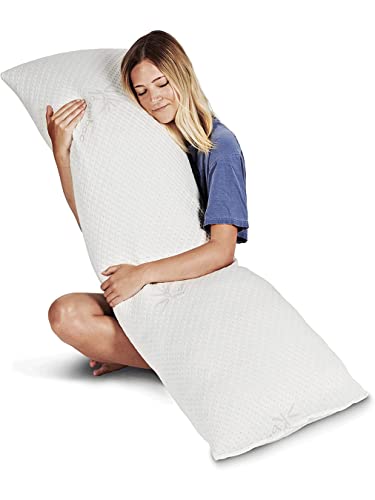
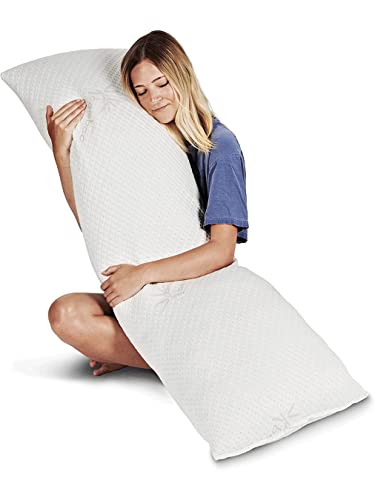
The Snuggle-Pedic Body Pillow for Adults (20 x 54) is a full-length body pillow filled with shredded memory foam and gel, in a breathable cover – made to support legs, belly and hips for side sleepers who want something to align against all night.
A body pillow changes side sleeping mechanically: hug the top and rest the upper leg over the length, and your hips and shoulders stop rolling toward the mattress. The shredded fill contours to your shape rather than pushing back like a solid foam block, and it can be fluffed and redistributed toward wherever you want more support – knees, belly, or chest. The breathable fill and cover help it sleep cooler than dense foam alternatives. It is made in the USA, hypoallergenic, and built to hold its shape over years rather than a season. The obvious cost is bed real estate: a 54-inch pillow is a commitment in a shared or smaller bed, and it needs a body pillow case and occasional full fluffing to stay even. For pregnancy, recovery, and habitual side sleeping, that trade is usually worth it – it replaces the pile of spare pillows people otherwise arrange and lose during the night.
Living with a body pillow is a routine as much as a product: a weekly full-length fluff keeps the shredded fill distributed, and rotating it end-for-end evens the wear where your knees do the most work. The length also makes it a genuine multi-tool – a backrest for reading when folded against the headboard, a barrier that keeps a restless sleeper on their side, a support for elevating legs after long days. In smaller beds, expect negotiation; in pregnancy and recovery, expect gratitude. A quality body pillow case with a zipper, rather than an envelope fold, keeps the whole arrangement together through the night.
For best body pillows for back pain, Snuggle-Pedic Body Pillow for Adults has a defined job in the sleep position – and it does that job without migrating, collapsing or demanding nightly negotiation. Positioning tools earn trust by being boringly reliable, and that is the standard applied here.
The daily reality of Snuggle-Pedic Body Pillow for Adults is placement becoming habit: within a week, positioning it takes seconds and no thought, which is precisely when positioning tools start paying off – consistency beats intensity in this category. For best body pillows for back pain, judge the pick by whether the habit sticks and whether mornings trend better across a fortnight, not by any single night’s novelty.
Strengths
- Full-length support for legs, belly and hips in one piece
- Shredded fill contours and can be redistributed where you need it
- Breathable, hypoallergenic, and made to hold its shape
Trade-offs
- Takes up significant space in a shared bed
- Needs a body-pillow case and regular fluffing
- Too much pillow for back-only or stomach-only sleepers
| Color | White |
| Size | Body Pillow |
| Dimensions | 16.4 x 8 x 8 inches |
| Weight | 4 pounds |
| Product Group | Home |
| Binding | Kitchen |
Best for: Side sleepers, pregnancy support, and anyone who builds a nest of spare pillows / Not suited for: Small beds, bed-sharers short on space, and stomach sleepers
Choose this pick if its strengths match your situation above; skip it if its trade-offs touch your deal-breakers. Check on Amazon

Milliard Solid Foam Wedge Reading Pillow (X-Large)
Our badge: Best Budget
The Milliard Solid Foam Wedge Reading Pillow (X-Large) is a solid foam wedge-shaped back rest with arms and a bonus neck roll, covered in plush removable velour – built for sitting up in bed, bed rest, and sleeping on an incline.
Solid foam is the right material for a wedge: it keeps its angle under body weight instead of springing back or sagging, so the incline you set up at bedtime is the incline you wake up on. The wedge supports the neck, shoulders, back and arms while reading or watching television, and the included neck roll fills the gap behind the head. The velour cover removes for washing, which matters for something you lean against nightly. Milliard positions this wedge for bed rest and for sleeping elevated, including for reflux and GERD comfort, and it doubles as a leg or arm elevator. It arrives vacuum-packed and needs 24 to 48 hours to expand fully, and the foam is CertiPUR certified. It is a big, single-purpose piece – it lives on the bed or beside it, not in a closet – and the fixed angle will not suit everyone, so think of it as furniture-grade support rather than a pillow replacement.
Treat this wedge as the bed’s reading chair and it earns its footprint daily, not just on difficult nights. The arms change the ergonomics of sitting up: elbows rest instead of digging, shoulders drop, and the neck roll means your head is supported at the top rather than hanging off it. For incline sleeping, slide it so the slope begins at the hips and pair it with a low pillow or none. The velour cover will pick up lint and pet hair – a lint roller lives nearby in most owners’ bedrooms – and washing it on the sheet rhythm keeps the foam’s surface fresh against skin and pajamas.
What Milliard Solid Foam Wedge Reading Pillow contributes to best body pillows for back pain is mechanical, not magical: it holds a body part where flat bedding lets it drift, and it keeps holding it at 4 a.m. Judge it by your mornings after a week, not by the first night’s novelty.
Consider also where Milliard Solid Foam Wedge Reading Pillow sits in your wider setup: it is one piece of a sleep system, and the picks here were chosen to cooperate with your existing head pillow and mattress. Change one piece at a time, a week apart, so the morning log can actually attribute improvements to causes.
Strengths
- Solid foam holds a consistent incline without sagging
- Arms and included neck roll make upright time genuinely comfortable
- Removable washable velour cover; CertiPUR certified foam
Trade-offs
- Bulky – storage in small bedrooms is a real consideration
- Fixed angle cannot be raised or lowered
- Needs 24-48 hours to expand after unpacking
| Color | Grey |
| Size | X-Large |
| Dimensions | 24 x 18 x 0.0393700787 inches |
| Weight | 7.25982228766 pounds |
| Product Group | Home |
| Binding | Kitchen |
Best for: Reading and bed rest, incline sleeping, and elevated rest at home / Not suited for: Small bedrooms and anyone wanting a subtle, standard-size pillow
Choose this pick if its strengths match your situation above; skip it if its trade-offs touch your deal-breakers. Check on Amazon
U-Shaped Full Body Pillow (Prose-Only Pick)
Our badge: Best Premium
A full-body pillow that wraps down both sides of the body and joins at the head, so support surrounds you on either side without repositioning.
Prose-only pick: this type is not in our verified product pool for this series, so it is covered honestly without a purchase link, invented specifications or a spec box.
The U-shape’s advantage is symmetry: roll left or right and there is a supportive arm of pillow waiting, with the top section doubling as your head pillow. For pregnancy and for back-discomfort-prone side sleeping, that surround support keeps the belly, knees and back cushioned through position changes, and many sleepers find they stop waking to rebuild their pillow arrangement. The costs are real – it dominates a queen bed, annoys partners, and the case is a wrestling match to change. If your bed and household can absorb it, it is the most complete body-pillow format.
Budget for the case ecosystem: U-shaped cases are larger, pricier and slower to change, so owning two is the difference between laundry day being trivial and being a wrestling broadcast. Also consider your bedroom’s temperature honestly – a surround pillow in a warm room can tip a warm sleeper from cozy to cooked.
In a guide about best body pillows for back pain, This pillow represents the system piece many sleepers skip. Head pillows get the attention, but this is the support that stabilizes the position itself – the difference between a good angle and a held angle.
The daily reality of This pick is placement becoming habit: within a week, positioning it takes seconds and no thought, which is precisely when positioning tools start paying off – consistency beats intensity in this category. For best body pillows for back pain, judge the pick by whether the habit sticks and whether mornings trend better across a fortnight, not by any single night’s novelty.
Strengths
- Support on both sides – no flipping the pillow when you turn
- Head section built in, so one piece does everything
- Excellent for pregnancy and restless side sleepers
Trade-offs
- Consumes a large share of a shared bed
- Cases are bulky to wash and change
- Too enclosing for warm sleepers and minimalists
Best for: Pregnancy, restless side sleepers, and solo sleepers with bed space / Not suited for: Couples in smaller beds and anyone who sleeps hot
Choose this type if its strengths match your situation above; skip it if its trade-offs touch your deal-breakers. It is covered in prose only, so compare models carefully wherever you shop.
C-Shaped Body Pillow (Prose-Only Pick)
Our badge: Best Compact Shape
A curved body pillow shaped like a C, supporting the head at the top, the back or belly along the curve, and the knees at the bottom hook.
Prose-only pick: this type is not in our verified product pool for this series, so it is covered honestly without a purchase link, invented specifications or a spec box.
The C-shape is the body pillow for people who found the U-shape too much. One curve supports the head, runs down behind the back (or in front of the belly), and hooks between the knees, aligning three zones with a single, smaller footprint. It is easier to get in and out of bed around, easier to store, and less likely to start an argument with a partner. The compromise is one-sidedness: turn over and the support is on the wrong side, so restless sleepers may still prefer the U. For pregnancy side sleeping and back-aware rest, it hits a practical middle.
The C is the shape most often recommended by friends because it disappoints least: enough support to matter, little enough bulk to forgive. It also works beautifully on a sofa for reading and recovery rest, which quietly doubles its value in smaller homes where single-purpose gear must justify itself.
For best body pillows for back pain, This pillow has a defined job in the sleep position – and it does that job without migrating, collapsing or demanding nightly negotiation. Positioning tools earn trust by being boringly reliable, and that is the standard applied here.
Consider also where This pick sits in your wider setup: it is one piece of a sleep system, and the picks here were chosen to cooperate with your existing head pillow and mattress. Change one piece at a time, a week apart, so the morning log can actually attribute improvements to causes.
Strengths
- Supports head, back or belly, and knees in one curve
- Smaller footprint than a U-shaped pillow
- Easier to store, wash and maneuver
Trade-offs
- Support sits on one side only
- Less enveloping for very restless sleepers
- Curve sizing varies – check it against your height
Best for: Pregnancy and side sleepers who want full support without the bulk / Not suited for: Frequent turners who need support waiting on both sides
Choose this type if its strengths match your situation above; skip it if its trade-offs touch your deal-breakers. It is covered in prose only, so compare models carefully wherever you shop.
J-Shaped Body Pillow (Prose-Only Pick)
Our badge: Best Versatile
A long body pillow with a hooked end, giving head and knee support in a slimmer profile than full wrap-around shapes.
Prose-only pick: this type is not in our verified product pool for this series, so it is covered honestly without a purchase link, invented specifications or a spec box.
Think of the J as the minimalist body pillow: the straight length hugs like a classic body pillow while the hook cradles the head or anchors between the knees so the pillow stays where you put it. It suits smaller beds and sleepers who want alignment help without being surrounded. It will not prop your back and belly simultaneously, and it lacks the head-end width of the bigger shapes, but as a first body pillow – or a travel-friendly one – it covers the side-sleeper essentials at a friendlier size and usually a friendlier tier.
J-pillows are the gateway body pillow: if the shape proves the concept, households graduate to a C or U with confidence; if not, the J retires to the guest bed without resentment. Its slim profile also makes it the body pillow most likely to survive a partner referendum in a double bed.
What This pillow contributes to best body pillows for back pain is mechanical, not magical: it holds a body part where flat bedding lets it drift, and it keeps holding it at 4 a.m. Judge it by your mornings after a week, not by the first night’s novelty.
The daily reality of This pick is placement becoming habit: within a week, positioning it takes seconds and no thought, which is precisely when positioning tools start paying off – consistency beats intensity in this category. For best body pillows for back pain, judge the pick by whether the habit sticks and whether mornings trend better across a fortnight, not by any single night’s novelty.
Strengths
- Slim profile suits smaller beds
- Hook end anchors the pillow between the knees
- Good first body pillow without the commitment of a U
Trade-offs
- Cannot support back and belly at the same time
- Less head support than U and C shapes
- Determined huggers may still want more pillow
Best for: Smaller beds and first-time body pillow buyers / Not suited for: Sleepers who want surround support on both sides
Choose this type if its strengths match your situation above; skip it if its trade-offs touch your deal-breakers. It is covered in prose only, so compare models carefully wherever you shop.
Contoured Knee Pillow (Prose-Only Pick)
Our badge: Best Knee-Level Alignment
A small hourglass-shaped pillow that sits between the knees, keeping the upper leg level so the hips stay stacked during side sleeping.
Prose-only pick: this type is not in our verified product pool for this series, so it is covered honestly without a purchase link, invented specifications or a spec box.
Side sleepers often blame the head pillow for discomfort that actually starts at the knees: when the top leg drops, the pelvis rotates and the lower back twists quietly all night. A contoured knee pillow holds the leg at hip height, and the hourglass shape plus, on some models, a strap keeps it in place through position changes. It is small, inexpensive, and easy to trial alongside your existing setup. Foam density matters – too soft collapses to nothing by midnight. It is a complement to a good head pillow, never a substitute for one.
A knee pillow is also the cheapest experiment in this entire guide series: one small purchase tests whether your discomfort is positional before you rebuild the whole bed. Keep it in the bed rather than the nightstand – a support that requires fetching is a support that gets skipped on tired nights.
In a guide about best body pillows for back pain, This pillow represents the system piece many sleepers skip. Head pillows get the attention, but this is the support that stabilizes the position itself – the difference between a good angle and a held angle.
Consider also where This pick sits in your wider setup: it is one piece of a sleep system, and the picks here were chosen to cooperate with your existing head pillow and mattress. Change one piece at a time, a week apart, so the morning log can actually attribute improvements to causes.
Strengths
- Keeps hips stacked and the top leg level
- Small, affordable and easy to trial
- Contoured shape stays in place better than a spare pillow
Trade-offs
- Only solves the knee-and-hip part of alignment
- Can slip out on restless nights without a strap
- Firm foam takes a few nights to get used to
Best for: Side sleepers whose discomfort starts at the hips and lower back / Not suited for: Back and stomach sleepers, who gain little from one
Choose this type if its strengths match your situation above; skip it if its trade-offs touch your deal-breakers. It is covered in prose only, so compare models carefully wherever you shop.
Consider also where Snuggle-Pedic Body Pillow for Adults sits in your wider setup: it is one piece of a sleep system, and the picks here were chosen to cooperate with your existing head pillow and mattress. Change one piece at a time, a week apart, so the morning log can actually attribute improvements to causes.
The daily reality of Milliard Solid Foam Wedge Reading Pillow is placement becoming habit: within a week, positioning it takes seconds and no thought, which is precisely when positioning tools start paying off – consistency beats intensity in this category. For best body pillows for back pain, judge the pick by whether the habit sticks and whether mornings trend better across a fortnight, not by any single night’s novelty.
Comparison Table
Side by side, the six picks differ less in quality than in job description. Readers comparing across this series may also find our guide to Best Bed Pillows For Side Sleepers useful, since the two topics share several of the same products with different rankings.
| Pick | Badge | Size | Color | Weight | Check price on Amazon |
|---|---|---|---|---|---|
| Snuggle-Pedic Body Pillow for Adults (20 x 54) | Best Overall | Body Pillow | White | 4 pounds | Check price on Amazon |
| Milliard Solid Foam Wedge Reading Pillow (X-Large) | Best Budget | X-Large | Grey | 7.25982228766 pounds | Check price on Amazon |
| U-Shaped Full Body Pillow (Prose-Only Pick) | Best Premium | Varies by model | Varies by model | Varies by model | Check price on Amazon |
| C-Shaped Body Pillow (Prose-Only Pick) | Best Compact Shape | Varies by model | Varies by model | Varies by model | Check price on Amazon |
| J-Shaped Body Pillow (Prose-Only Pick) | Best Versatile | Varies by model | Varies by model | Varies by model | Check price on Amazon |
| Contoured Knee Pillow (Prose-Only Pick) | Best Knee-Level Alignment | Varies by model | Varies by model | Varies by model | Check price on Amazon |
How to Choose the Best Body Pillows For Back Pain
The buying decisions below decide whether any pillow – including the six above – actually works for you. Work through them in order; each one narrows the field more honestly than brand or price tier does. Our guide to Best Pillows For Sore Neck covers a neighboring version of the same decision process.
Start With Your Sleep Position
Back sleepers need a moderate height with a dip for the head and a rise under the neck. Side sleepers need more height – enough to span the shoulder – plus an edge that does not push the shoulder forward. Stomach sleepers should go as low as possible or reconsider the position for their neck’s sake. Buy for the position you actually sleep in, not the one you intend to adopt, and if you split the night, prioritize the position you fall asleep in, since that is where you spend the deepest early hours.
Measure Your Shoulder Gap
For side sleeping, the target loft is roughly the distance from the side of your head to the tip of your shoulder, minus how much your shoulder sinks into the mattress. Narrow frames often land near four inches of effective loft; broad shoulders can need six or more. Soft mattresses shrink the gap because the shoulder sinks; firm mattresses keep it honest. Measuring beats guessing, and it explains why a pillow that transformed a friend’s sleep does nothing for you.
Understand Contour Versus Adjustable
A fixed contour is a bet on one geometry: wonderful when it matches you, useless when it does not. Adjustable designs – removable layers, add-or-remove fill, water levels – trade a little elegance for forgiveness, letting you close the last centimeter yourself. First-time shaped-pillow buyers, and anyone whose neck has rejected pillows before, should usually start adjustable. Committed contour fans who already know their height can buy fixed with confidence.
Give Any Shaped Pillow Two Weeks
Your neck has habits, and a new alignment can feel strange before it feels right. Judge a contour or adjustable pillow across ten to fourteen nights, changing only one variable at a time – height first, then position – and keep notes each morning. Discomfort that steadily decreases is adjustment; discomfort that grows, or any numbness or radiating symptoms, is a stop signal, not a perseverance test.
Plan Care Before You Buy
Foam cores generally cannot be washed, so a removable washable cover – and ideally a protector – is part of the support system, because a pillow you cannot keep clean gets replaced or endured. Shredded fills need fluffing; solid foams need airing. Match the maintenance to the effort you will honestly sustain, and check the return or trial terms before the first night, not after the fourteenth.
How to Set Up a Cervical Pillow Correctly
Placement is half the product. For a contour pillow, the higher ridge goes under your neck and the dip cradles your head – reversed, the same pillow feels like a doorstop. On your side, pull the pillow so its edge meets your shoulder, letting the shoulder rest against or into the pillow’s edge rather than on top of it; on your back, center the head in the cradle and check that your chin is neither tipped to your chest nor pointed at the ceiling.
Set the height before the first night if your pillow adjusts. Side sleepers start at the higher setting, back sleepers at the lower, and everyone changes one step at a time across nights rather than rebuilding the pillow hourly. A mirror or a partner’s eyes help: from the side, your ear, shoulder and hip should form a roughly straight line when side sleeping, and your forehead and chin should sit level when on your back. For a related setup walkthrough, see Best Bench Cushion Sofas.
Protect the setup. Use a smooth, not-too-thick pillowcase so the contour’s shape reaches your neck instead of being bridged by fabric, keep a protector under it for foam cores you cannot wash, and fluff or redistribute adjustable fills weekly so the support you tuned stays tuned. Replace the pillow when the fill no longer recovers its shape after a night off – support materials age even when covers look new.
Back sleepers have the mirror-image issue: flat legs pull the pelvis and flatten the lumbar curve, and a pillow under the knees releases that pull. Both fixes are cheap, reversible experiments – try each for a week before concluding anything about your back.
Keep notes. Back comfort has good and bad weeks for reasons unrelated to pillows – activity, stress, sitting hours – and a simple morning log separates the pillow’s contribution from the noise. And keep perspective: pillows tune comfort at the margins of a condition that deserves professional guidance when it persists.
A final practical note on trialing any pillow in this guide: change one thing at a time, and give each change several nights. Sleep is noisy data – stress, room temperature, a late meal and a hard workout all move the needle – so a pillow judged on a single night is a pillow judged on noise. A week of mornings, briefly noted, is the smallest sample worth trusting, and it is the method behind every ranking on this page.
Pillowcases deserve more credit than they get. A thick or rough case can blunt a pillow’s designed feel, bridge over a contour, or trap heat against your face; a smooth, breathable case lets the pillow work as engineered. Whatever you buy from this guide, pair it with a case that matches its job – and keep a spare, because laundry day should never dictate your sleep setup.
Sizing is a quiet source of returns. Standard, queen and king pillows differ by inches that matter for fit in your cases and for how the pillow behaves on your bed; a pillow compressed by an undersized case sleeps firmer and taller than designed. Check your existing cases before ordering, and when in doubt match the pillow size to the bed size – queen pillows on a queen bed is the combination most bedding is designed around.
If you share a bed, treat pillow buying as a two-person decision even when the pillows differ. Partners wake each other with restless rearranging, and a pillow that one of you fights all night becomes both of your problems. Buying different pillows for each side is normal and sensible; buying matched trial periods – and keeping both sets of packaging until both verdicts are in – is the professional move.
Budget honestly across the whole setup. A protector, a spare case and, for adjustable pillows, a storage bag for removed fill are part of the real cost, and they protect the main purchase. Readers who plan the full setup in one order consistently report fewer returns than readers who buy the pillow alone and improvise the rest – the accessories are where good pillows go to succeed or fail.
When a pillow in this guide tempts you, read its trade-offs list twice. Strengths are what you are buying; trade-offs are what you are agreeing to live with – the adjustment period, the care routine, the bed space, the fixed loft. Most pillow regret is not a bad product but an unread trade-off, and every pick here states its costs in plain language precisely so you can agree with your eyes open.
Problem: The contour feels too high – Remove a layer or some fill, or rotate the pillow to its lower edge for a few nights while your neck adapts; height complaints are the most common and the most fixable.
Problem: You wake with the pillow pushed away – Your body is voting against the setup – usually height or firmness. Change one variable, and check that the pillow is not sliding on a satin case or an undersized pillow sham.
Problem: Your arm keeps going numb on your side – The shoulder is bearing weight it should not. Raise the loft slightly, use a design with arm space, or place a thin pillow under the forearm so the shoulder can relax.
Problem: The new-pillow smell lingers – Air foam pillows in a ventilated room for a day or two before first use, and wash the cover; certified low-odor foams fade fastest.
The Pelvis Is the Plot: Leg Position and the Sleeping Back
For side sleepers, the back’s nighttime story is written at the pelvis. When the top leg slides forward and down, the pelvis rotates, and the lower spine spends hours in a gentle twist. A pillow that keeps the top leg level – between the knees or along a body pillow – removes the twist at its source. It is unglamorous mechanics, and it is why leg support outperforms almost every head-pillow change for this audience.
Building a Sleep System Instead of Buying a Pillow
Back-aware sleepers get the best results from systems: a head pillow matched to position, a leg strategy, and a mattress that is not actively sabotaging both. The order of operations matters – fix the head pillow’s height first, add leg positioning second, and change one variable per week so you know what helped.
Common Buying Mistakes
Buying the tallest, firmest option ‘for maximum support’
Support is alignment, not altitude. An over-tall pillow cranks the neck sideways all night; match height to your frame and position instead.
Judging a shaped pillow on night one
Contours need an adjustment period. Decide across two weeks of mornings, adjusting one variable at a time, unless symptoms escalate – then stop.
Sleeping on a contour backwards
The ridge belongs under the neck, the dip under the head. Reversed placement is the most common setup error and the easiest to fix.
Stacking a second pillow ‘just in case’
Two pillows destroy the geometry one good pillow creates. If you need height, raise the pillow’s own setting rather than adding a wobbling layer.
Ignoring the mattress
A shoulder that sinks deep into a soft mattress needs less pillow; the same sleeper on a firm mattress needs more. Change one and you may need to re-tune the other.
Final Recommendation
Start with the Snuggle-Pedic Body Pillow for Adults (20 x 54): it is the pick we would buy first for best body pillows for back pain, because it answers the topic’s central problem with the fewest compromises. If its trade-offs hit your deal-breakers, the runner-up is one click away – Check on Amazon – and the reviews above explain exactly who should choose which. If your neck has rejected pillows before, choose the most adjustable pick first – a pillow you can tune beats a pillow you must obey. Keep the packaging until two weeks of mornings have voted. For the neighboring question most readers ask next, see Best Cushion Choice For Kincaid Sofas.
Frequently Asked Questions
Where should I put a pillow for lower back comfort at night?
Back sleepers: under the knees, to release the pull that flattens the lumbar curve. Side sleepers: between the knees or along a body pillow, to keep the top leg level and the pelvis untwisted. Both are positioning comfort measures worth trialing for a week each.
Can a pillow fix my back pain?
No – and be wary of any product that says otherwise. Pillows can remove positioning aggravations and improve sleep comfort, which matters, but persistent or severe back pain needs professional assessment and a management plan beyond bedding.
Are body pillows actually useful, or just big?
Useful, mechanically: they give the top leg and arm a level place to rest, which stabilizes the pelvis and shoulders through the night. Their costs are space and heat, which is why shape choice – straight, C, J or U – matters.
Should I sleep without a pillow for my back?
For the head, almost never – the neck pays for that experiment. The productive changes are at the knees and hips. If you trial any no-pillow variation, keep it brief and stop if neck symptoms appear.
How firm should a positioning pillow be?
Firm enough to hold its working height under your legs or torso until morning. Knee and lumbar supports that collapse by midnight are the most common disappointment in this category – density is the feature.
When should I stop experimenting and see a professional?
Immediately for pain with numbness, weakness, bladder changes, fever, or after an injury – and promptly for pain that persists beyond a few weeks, keeps worsening, or disrupts most nights. Pillow experiments are for comfort, not for working around red flags.


