Disclosure: As an Amazon Associate, dailyhomedecorating.com earns from qualifying purchases. Links on this page are affiliate links; they cost you nothing extra. Prices and availability change often, so check the current Amazon listing before you buy.
The best beer koozie solves a problem so small it is easy to mock and so universal that everyone has lived it: the last third of a cold can, gone warm and flat in a hot hand on a hotter afternoon. A koozie — can cooler, can insulator, stubby holder depending on where you learned the word — is a sleeve of insulation between the drink, the hand and the weather. Four verified options anchor this guide, and they split the category cleanly in two. At one end stand YETI’s stainless-steel Rambler Colsters, rigid vacuum-insulated holders that treat a can like a piece of equipment. At the other stand soft neoprene sleeves from TahoeBay and a slim-can specialist pack, sold by the dozen, priced for parties, and ready to be printed, gifted and lost without heartbreak.
Neither end is the correct one; they are answers to different afternoons. The steel holder belongs to the person who drinks one good can slowly by the grill and wants it cold at the last sip. The dozen sleeves belong to the host whose cooler serves a crowd, whose guests need their drinks told apart, and whose koozies will migrate home in other people’s pockets. Most households, if they are honest, need a little of both — which is why this guide reviews the steel pair and the sleeve pair with equal seriousness, and spends as much time on can sizes and sweat rings as on insulation, because those are the details that decide whether a koozie gets used or gets drawer-bound.
Key Takeaways
- The YETI Rambler Colster for standard twelve-ounce cans is the keep-it-cold champion: double-wall vacuum insulation in a rigid stainless holder.
- The Colster Slim answers the hard seltzer era, sized for skinny cans that wobble in standard holders.
- TahoeBay’s neoprene sleeves come in a multicolour twelve-pack, ready for parties and for custom printing with sublimation or heat-transfer vinyl.
- The slim-can neoprene twelve-pack covers skinny drinks for a crowd at sleeve economics.
- Fit is the whole game: a koozie that does not match the can — standard, slim, bottle or tallboy — insulates badly and annoys constantly.
- Steel holders stop condensation rings on furniture; soft sleeves win on portability, quantity and price per drink.
In this guide
Quick Picks: Best Beer Koozie at a Glance
| Pick | Fits | Material | Known for |
|---|---|---|---|
| YETI Rambler Colster 12 oz | Standard cans | Stainless steel, vacuum insulated | Maximum cold retention |
| YETI Rambler Colster Slim | Slim seltzer cans | Stainless steel, vacuum insulated | Proper fit for skinny cans |
| TahoeBay Can Cooler Sleeves 12-Pack | Standard cans and bottles | Neoprene | Party quantity, printable blanks |
| Slim Can Cooler Sleeves 12-Pack | Slim cans | Neoprene, foldable | Crowd cover for seltzer drinkers |
The table’s real message is that can shape now decides the purchase before brand does. The drinks market split itself into standard cans, slim cans, bottles and tallboys, and a koozie drawer that ignores that split fills up with almost-right holders. Start from the can your household actually drinks, then choose your material philosophy: steel for the one perfect holder, neoprene dozens for the social mathematics of guests. The reviews below follow that order, steel first, sleeves second, with the buying guide afterwards to settle mixed households.
Each product links to its Amazon listing, where colours and pack variants can be confirmed before ordering — the YETI listings in particular gather several colours, and the verified standard Colster listing notes it ships with no can insert, a detail worth knowing. All four products were verified against catalogue data, and each appears with its official product image beside its review.
How Did We Choose These Can Coolers?
Five criteria shaped the shortlist. Insulation performance came first, judged by construction: vacuum-insulated double-wall steel at the summit, foam and neoprene sleeves below it, with honest acknowledgement that the gap matters most over a long, hot drink rather than a quick cold one. Fit came second, because insulation with an air gap around a rattling can is a theory rather than a result, and because the modern can zoo demands specific sizes. Third was grip and handling — how the holder feels in a wet hand, whether it sweats onto furniture, and whether it survives being dropped on a patio. Fourth, quantity economics: what a household actually needs for its real gatherings, from one holder to a dozen. Fifth, customisation and occasion value, since blank sleeves that accept printing serve weddings, teams, businesses and family reunions in ways a finished steel holder cannot.
A word on what a koozie cannot do is owed early. No sleeve chills a warm can; insulation only slows warming, so the koozie’s partner is a cold drink and, ideally, a cold hand-off from the fridge or cooler. Claims beyond that are marketing weather. What a good koozie genuinely delivers — a drink that stays worth finishing, a hand that stays dry, a table without rings, and a can you can identify as yours at a party — is quite enough to justify the small science in this guide.

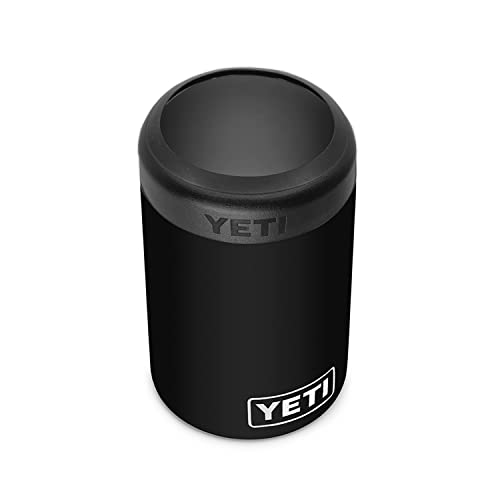
YETI Rambler 12 oz Colster — the Cold Keeper
Badge: Best for maximum chill
| Spec | Detail |
|---|---|
| Fits | Standard 12 oz cans |
| Build | Stainless steel, double-wall vacuum insulation |
| Colour | Black (other colours on the listing) |
| Note | Listing states no can insert included |
The Colster is what happens when a company known for expedition coolers turns its attention to a single can. The double-wall vacuum construction that keeps ice frozen in YETI’s larger gear is shrunk around a standard twelve-ounce can, and the effect over a slow drink is the category’s benchmark: the last mouthful arrives at a temperature the first mouthful would respect. The stainless body shrugs off drops, sand, boat decks and dishwasher cycles, and its weight in the hand reads as substance rather than burden. A gasket-style collar holds the can in place, so the holder and the drink move as one object rather than two in negotiation.
Condensation is the second, quieter victory. A steel vacuum holder does not sweat, which means no rings on the wooden table, no wet hand, and no coaster diplomacy at a friend’s house. The trade-offs are equally clear: this is a one-can, one-person object at a premium tier, rigid in a pocket and overqualified for a drink finished in ten minutes. It suits the deliberate drinker — the grill keeper, the fishing chair, the porch at sunset — and it will outlast many summers of all three. Buy it for yourself or as the gift version of the category; it is not the answer for a crowd.
Strengths
- Vacuum insulation keeps the last sip properly cold
- No condensation, so furniture and hands stay dry
- Stainless build tolerates drops, decks and dishwashers
Trade-offs
- Premium single-can purchase, not a party solution
- Rigid and weighty compared with a sleeve
- Sized for standard cans only; slim cans need its sibling
Best for: solo drinkers who nurse one good can at a time. / Not suited for: hosts equipping a whole party.
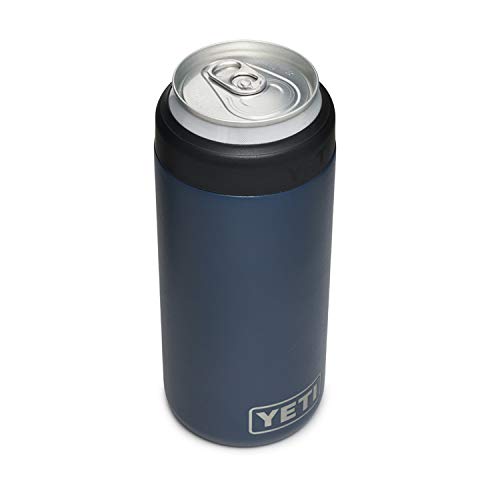
YETI Rambler Colster Slim — the Seltzer Specialist
Badge: Best for slim cans
| Spec | Detail |
|---|---|
| Fits | Slim hard seltzer cans |
| Build | Stainless steel, double-wall vacuum insulation |
| Colour | Navy (other colours on the listing) |
| Use | Skinny beer, seltzer and energy cans of the slim format |
Hard seltzer changed the shape of the drinks fridge, and slim cans in standard holders were the small daily casualty: rattling in a loose sleeve, warming through the air gap, sliding when lifted. The Colster Slim exists to end that negotiation. It applies the same vacuum-insulated stainless construction as its standard sibling to the skinny format, so the can sits snugly, stays cold to the end and lifts as one piece with its holder. For the drinker whose fridge is stocked with seltzers, slim beers and skinny energy cans, this is not a variant purchase; it is the correct tool finally shaped like the job.
Everything said about the standard Colster’s manners applies here — no sweat, no rings, dishwasher indifference, a satisfying heft — with the additional virtue that guests offered a slim holder that actually fits tend to remember the host kindly. Its limitation is the mirror of its precision: standard cans do not fit, so a mixed-drink household needs both siblings or a sleeve strategy for the standard cans. As the slim format shows no sign of leaving the fridge, most seltzer households will consider this the primary holder and improvise for the rest.
Strengths
- Snug, correct fit for slim cans transforms their insulation
- Same vacuum-steel cold keeping as the standard Colster
- Sweat-free grip protects tables and keeps hands dry
Trade-offs
- Standard cans need the other Colster or a sleeve
- Single-can premium purchase like its sibling
- Rigid body is a cupholder-or-hand object, not a pocket one
Best for: seltzer and slim-can drinkers who want the steel standard. / Not suited for: mixed crowds on a sleeve budget.
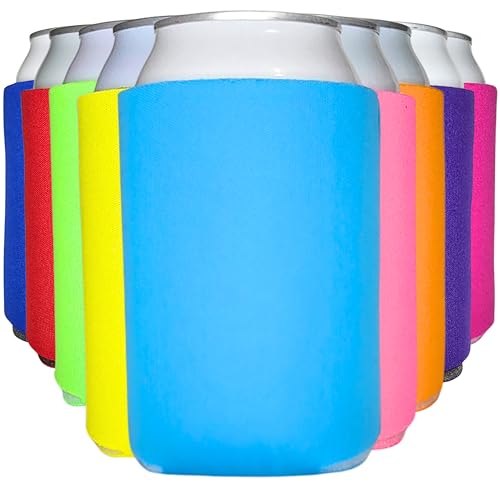
TahoeBay Blank Can Cooler Sleeves 12-Pack — the Party Dozen
Badge: Best for parties and printing
| Spec | Detail |
|---|---|
| Fits | 12 oz cans and bottles |
| Material | Soft neoprene-style sleeve |
| Quantity | 12-pack, multicolour |
| Custom use | Blanks for sublimation, DTF and heat-transfer vinyl |
Every party has a moment when twelve identical silver cans sweat on a table and nobody knows whose is whose. This twelve-pack is the cheerful answer: soft insulating sleeves in multiple colours that give each drink an identity, keep hands dry, slow the warming honestly, and cost little enough per sleeve that a guest wandering home with one is a souvenir rather than a loss. The neoprene-style material folds flat, so the dozen lives in a kitchen drawer without a negotiation, and travels to picnics, beaches and tailgates in a way rigid holders never will.
The blank in the name is a second product hiding inside the first. These sleeves are sold as printable blanks for sublimation, direct-to-film and heat-transfer vinyl, which makes them the raw material of wedding favours, team parties, business promotions and family-reunion jokes. A household with a craft press can turn the dozen into personalised gifts; a household without one still gets the multicolour party function in full. Insulation is sleeve-class rather than steel-class — a drink finished in a normal party interval stays pleasant, while a can nursed for an hour will still drift warm — and that honest limit is exactly what the price per sleeve is telling you.
Strengths
- Twelve colours end the whose-can-is-this problem
- Printable blanks serve events, teams and small businesses
- Fold flat for drawers, bags and travel
Trade-offs
- Insulation is good, not Colster-class, over long drinks
- Soft sleeves can sweat slightly in extreme heat
- Fit suits standard cans and bottles, not slim cans
Best for: hosts, events and crafters who need a dozen at once. / Not suited for: the slow solo drinker chasing maximum chill.

Slim Can Cooler Sleeves 12-Pack — Seltzer Cover for a Crowd
Badge: Best slim sleeves in bulk
| Spec | Detail |
|---|---|
| Fits | Slim 12 oz cans |
| Material | Foldable neoprene |
| Quantity | 12-pack |
| Custom use | Sublimation-ready blank sleeves, black |
This pack applies the TahoeBay logic to the slim-can world: a dozen foldable neoprene sleeves shaped for skinny seltzer and beer cans, so a crowd of seltzer drinkers gets the same colour-coded, hand-drying, table-protecting service that standard cans have always enjoyed. The black finish keeps them looking tidy at adult gatherings, and their sublimation-ready surface means the dozen can become a printed set for a birthday, a bachelorette weekend or a brand’s giveaway table with a home press and an afternoon.
Fit is the headline again. A slim can in a standard sleeve is a small daily failure — sliding, tilting, warming through the gap — while a slim can in a sleeve cut for it sits upright and insulated as intended. Hosts whose coolers now run majority-seltzer will find this pack quietly transforms their parties, and the foldable format means the whole dozen occupies the space of one rigid holder in a drawer. Like all sleeves, they serve the normal length of a party drink rather than an hour-long nursing session, and within that honest brief they are the right tool at the right quantity.
Strengths
- Correct slim fit for the whole seltzer-drinking crowd
- Twelve-pack economics suit parties and events
- Foldable neoprene stores and travels effortlessly
Trade-offs
- Black-only pack offers less colour-coding than multicolour sets
- Sleeve-class insulation rather than steel-class
- Useless for standard cans, which need their own sleeves
Best for: hosts whose cooler is mostly slim cans. / Not suited for: standard-can households or maximum-chill seekers.
How Do You Choose Between Steel Holders and Soft Sleeves?
Count drinkers and minutes. One or two people drinking slowly — a can lasting the length of a grill session or a fishing drift — is steel territory, where vacuum insulation earns its tier sip by sip. A gathering of six or more drinking at conversational speed is sleeve territory, where the koozie’s real jobs are identification, dry hands and basic insulation, all delivered at a per-guest cost that makes loss painless. The mixed household, which is most households, lands on the hybrid drawer: a Colster or two for the residents, a dozen sleeves for the guests, and no further thought required for years.
Setting refines the answer further. Boats, pools and patios favour unbreakable, non-sweating holders and sleeves that cannot shatter — everything in this guide qualifies, which cannot be said for novelty glass or ceramic holders. Formal tables favour the steel pair’s clean lines and ring-free manners. Festivals, camping and travel favour sleeves that fold into a pocket and can be sacrificed to the day without regret. Choose by the afternoon you actually have, and the category’s apparent silliness resolves into simple logistics.
How Do You Use a Koozie Well?
Start with a cold can, because insulation preserves temperature rather than creating it; a koozie slipped over a fridge-cold drink at the moment of opening delivers the full benefit, while one applied twenty minutes later is closing the gate thoughtfully but late. Keep the holder out of direct sun where possible, since radiant heat defeats insulation faster than warm air does, and avoid the classic error of leaving the sleeved can on a hot grill shelf or car roof. Hands matter too: a koozie’s hidden function is replacing your warm palm as the can’s main environment, so hold the sleeved can rather than cupping the exposed top.
Care is brief. Neoprene sleeves rinse with mild soap and air-dry, and should be stored flat or loosely rolled rather than creased for months, which can set a fold. Steel holders wash like any quality drinkware, with the collar gasket given an occasional rinse to keep its grip honest. At parties, the colour system only works if it is announced — tell guests to remember their colour, and the dozen sleeves quietly run the evening’s lost-drink prevention without a single label or marker.
What Mistakes Do Koozie Buyers Make?
The first is buying the wrong can size, the category’s eternal own goal: measure the drinks your household actually buys, because slim and standard are not interchangeable and tallboys are a third country entirely. The second is expecting a sleeve to chill a warm can, then blaming the product for physics. Third, hosts buy exactly as many holders as guests, forgetting that koozies wander, tear and emigrate; sleeves are sold by the dozen for a reason. Fourth, gift buyers choose novelty shapes that insulate badly and fit worse, when the recipient would have used a proper holder weekly. Fifth, steel buyers forget the mixed fridge: a Colster household that also drinks standard and slim needs a plan for both, or the expensive holder sits idle on the nights that matter.
Final Recommendation: Which Koozie Should You Buy?
Buy the YETI Colster if your pleasure is one cold can, slowly, outdoors — it is the finest expression of the category and will serve for years. Add the Colster Slim if seltzers rule your fridge. Buy the TahoeBay dozen if you host, celebrate or craft, and the slim dozen if your crowd drinks skinny. Most homes will end with one steel holder and one sleeve pack, a drawer that answers every afternoon the year contains. For the rest of the gathering, our entertaining readers continue to blankets for film nights on the sofa, living room blankets for guests and sheets for the guest bedroom, while grill-season hosts may also enjoy cooling sheets after long hot days.
The Science of a Warming Can, in Plain Terms
A cold can in a warm world is under attack from three directions. Warm air convects around it, sunlight radiates onto it, and — fastest of all — a warm hand conducts heat straight through the thin aluminium wall wherever it grips. Condensation is the visible symptom of the same process: moisture from the air gathering on the cold surface, dripping onto tables and making the can slippery precisely when its contents are getting warm. A koozie interrupts all three attacks at once. It wraps the can in a poor heat conductor, shades it from direct sun, replaces the hand as the can’s main contact, and absorbs or prevents the condensation layer entirely.
That is why material thickness and fit matter more than branding. A loose sleeve with an air gap insulates the gap, not the can; a snug neoprene sleeve couples to the can’s wall and starts working immediately. Vacuum steel removes the conduction path almost entirely, which is why its performance gap over foam is largest in the second half of a drink, when lesser insulation has already surrendered. Understanding the three attacks also explains the usage advice scattered through this guide — cold can first, out of the sun, held by the sleeve — as applications of one simple model rather than a list of superstitions.
A Short, Honest History of the Koozie
The insulated drink sleeve is an Australian-American collaboration in spirit: Australians wrapped stubby beer bottles in foam holders to survive their summers, while American tailgate and boating culture adopted foam can sleeves in the nineteen eighties and gave them a hundred regional names. The foam sleeve became a promotional canvas — every bank, radio station and wedding seemed to print one — which cemented its party role. Neoprene, borrowed from wetsuits, upgraded the sleeve’s feel and durability in the following decade. The steel era arrived when outdoor brands applied vacuum-insulation technology, proven in expedition drinkware, to the humble can, producing holders like the Colster that treat a beer with the seriousness of a summit attempt. The category’s history is a steady march from giveaway foam to engineered steel, with the soft sleeve keeping its crown wherever drinks are social and numerous.
Occasions Decoded: Which Holder for Which Afternoon?
The barbecue belongs to both camps: steel for the cook, who nurses one can across an hour of grill duty, sleeves for the guests circulating with theirs. The boat belongs to anything unbreakable and non-sweating, with sleeves favoured because they cannot dent the deck or sink with quite the same finality — though a Colster in a cupholder is a small luxury many boaters swear by. The wedding belongs to printed sleeves, personalised for the day and useful within it. The tailgate belongs to sleeves in team colours, with one steel holder for the driver of the grill. The fishing trip belongs to steel, full stop: hours are long, hands are wet, and the last sip matters. The picnic belongs to sleeves that folded into the basket at home and will fold home again, lighter by exactly the drinks they served.
Reading occasions this way turns koozie buying from a product choice into a calendar choice. List the six afternoons your household actually repeats each summer, assign each its holder class, and the drawer assembles itself — usually, as this guide has suggested, into a steel pair for the residents and a printed or plain dozen for everyone else life feeds.
Tallboys, Bottles and the Rest of the Fridge Zoo
Standard and slim cover most of the modern fridge, but not all of it, and a complete koozie education should name the outliers. Tallboy cans — the sixteen-ounce format beloved of craft beer — stand taller than standard sleeves, leaving an exposed band that warms and sweats; tall-specific sleeves exist in the wider market, and a standard sleeve worn low is a workable improvisation rather than a solution. Bottles vary by brewery, with longnecks asking for sleeves that grip the body and leave the neck free, which the TahoeBay pack accommodates by design. Crowlers, growlers and cans from other countries’ size conventions all reward the same habit: measure the drink, then buy the holder, never the reverse.
The practical household system that emerges is a small taxonomy in a drawer: steel for the residents’ favourite format, sleeves for the standard crowd, sleeves for the slim crowd, and one forgiving neoprene sleeve that stretches over odd bottles and tallboys on the nights they appear. That is the whole science. Households that build it once stop thinking about koozies for years, which is the correct amount of thought for the category to occupy in a well-run home.
Gifting Koozies Without Embarrassment
The koozie occupies a rare gift niche: inexpensive enough for a stocking or a party favour, useful enough to survive the journey home. Steel holders make the grown-up version of the gift — a Colster for the grill enthusiast, the angler, the new homeowner with a first patio — especially in the black and navy finishes verified here, which read as equipment rather than novelty. Sleeve dozens make the collective version: printed for a reunion, a team or a business, they distribute the giver’s thought across a whole gathering. The gift mistakes are consistent — novelty shapes that fit nothing, sizes guessed rather than checked, and jokes printed at a size nobody can read — and all are avoided by the same discipline as buying for yourself: format first, function second, decoration last.
Listing Details Worth a Second Look Before Checkout
Confirm the can format in the listing title against your fridge, because standard and slim variants of the same product sit one click apart. Check whether the pack is blank or printed if you are buying for an event, and whether the material is stated as sublimation-ready if you plan to print. On the steel listings, note the colour in the cart and any note about inserts or accessories — the verified standard Colster listing, for instance, states plainly that no can insert is included. Finally, count your real crowd and order the dozen rather than the half-dozen your optimism suggests; sleeves are the one party supply where surplus is a strategy, not waste.
The Koozie Drawer, Organised Once and for All
Every home has the drawer where sleeves go to tangle, and a ten-minute system ends the chaos permanently. Sort by format first — standard sleeves together, slim sleeves together, the steel holders standing at the back where their weight does no harm. Roll soft sleeves rather than folding them, because a permanent crease is a small insult the material remembers. Keep the party dozen in its own bag so an event does not require a drawer excavation, and let one sleeve live permanently in the car and one in the picnic basket, where they will be needed without warning. Retire sleeves whose material has gone slack or cracked, since a loose sleeve insulates the air and annoys the hand, and the dozen-pack economics make replacement painless.
There is a small social dividend to this order: the host who can produce the right holder for any can a guest arrives with — standard, slim or bottle — runs a smoother party than the host with a drawer of almost-right options. Hospitality is mostly the absence of small frictions, and few frictions are smaller, or more entirely avoidable, than a cold can in the wrong sleeve.
Soft Drinks, Energy Cans and the Koozie’s Second Career
Nothing in this guide’s physics is specific to beer. Soda drinkers at a summer desk, energy cans on a workbench, sparkling water at a picnic and iced tea on a porch all benefit identically, and households often find their koozies working harder on soft drinks than on the beverages that named them. Parents discover that a sleeve makes a can less slippery for small hands and a table safer from rings during homework. Drivers discover that a steel holder in a cupholder keeps a morning soda cold through a commute. The slim sleeves, bought for seltzer, turn out to fit the skinny energy and coffee cans that share the format.
This second career is worth remembering at purchase time: a holder chosen in a colour and style the whole household will use, in the formats the whole fridge stocks, earns its place daily rather than seasonally. The koozie began as a beer accessory and became, quietly, a general instrument of civilised drinking — which is why a guide on a home site can treat it at this length without apology.
Steel Versus Sleeve: an Honest Side-by-Side Over One Long Afternoon
Imagine the same lager, opened at noon on a hot patio, drunk at the pace of a long conversation. In the first ten minutes the two holders in this guide are indistinguishable in the hand — both drinks are fridge-cold, both hands are dry, and the sleeve’s modest insulation is entirely sufficient. By the half hour, separation begins: the sleeved can has drifted from cold to cool, pleasant and entirely drinkable, while the Colster’s can remains at something close to its opening temperature, because the vacuum wall has simply refused the afternoon’s heat. By the hour — the grill keeper’s timescale, the angler’s, the reader-in-a-hammock’s — the sleeve’s drink is approaching the ambient mood of the day, while the steel holder is still serving a cold beer.
Now run the same afternoon with twelve guests instead of one reader. The steel holder serves its owner superbly and the other eleven not at all, while the dozen sleeves have kept every guest’s drink identified, dry-handed and pleasantly cool through the normal lifespan of a party can, which is measured in tens of minutes rather than hours. The comparison therefore has no winner — it has a timescale and a headcount, and the two variables together pick the product with no further argument. Guides that crown a single best koozie without asking those two questions are answering a simpler question than the one your summer is asking.
Printing on Blank Sleeves: a Starter’s Briefing
Because two of this guide’s picks are sold as printable blanks, a short briefing serves the crafters. Sublimation gives the most durable, full-colour result on suitable sleeve material and rewards bold designs that wrap the small canvas completely. Heat-transfer vinyl suits simple lettering and logos — names, dates, a team crest — and forgives beginners more readily. Direct-to-film sits between the two for detail and durability. Whichever method you choose, test on one sleeve before committing the dozen, keep type large enough to read across a garden, and remember that the sleeve will be seen wet, in sunlight, at an angle — conditions that flatter simple designs and humble intricate ones. A printed dozen for a wedding or reunion takes an afternoon and produces the rare favour that is used at the event itself, which is the highest achievement available to the genre.
Beyond the Garden: Koozies at Work, Sport and Play
The workbench and the garage are the koozie’s unglamorous strongholds. A sleeved soda on a bench does not ring the wood, does not slip in a dusty hand, and stays cold through a long job in a way that keeps the worker at the bench rather than wandering to the fridge. Steel holders serve the same stations with even better manners, and their weight keeps them planted where a sleeve might skate. At youth sports, sleeves in team colours identify a sideline of identical water and sports cans — the whose-is-whose problem in its most chaotic form — and parents who have run one tournament with a labelled dozen rarely run another without one.
On the water and the trail, the calculus adds flotation and loss. A neoprene sleeve gives a dropped can a chance of floating and a bright colour to be spotted by, while a steel holder sinks with dignity and should be cupholder-bound on boats. Hikers carry sleeves because they weigh almost nothing and fold into a pocket at the summit; anglers carry steel because the drink must last the drift. None of these uses was in the original design brief of the foam sleeve’s inventors, and all of them follow from the same three properties — insulation, grip and identity — that this guide has used as its criteria from the first page.
Why a Small Object Deserves This Much Thought
It is fair to ask why a guide should spend this long on a can sleeve, and the answer is that small objects set the tone of a home’s hospitality more than large ones do. Guests do not remember the square footage of a garden; they remember that their drink stayed cold, that they always knew which can was theirs, and that nobody’s glass table collected rings. Hosts remember whether the evening required vigilance or allowed conversation. The koozie, in both its steel and sleeve forms, is one of the cheapest instruments ever devised for moving an afternoon from the first category to the second, and choosing it well — right format, right quantity, right material for the household’s real calendar — is a tiny act of domestic competence with an outsized return.
There is also a modest sustainability note to close on. A durable steel holder displaces years of disposable foam novelties; a dozen neoprene sleeves, used for a decade of gatherings, displace the single-use alternatives party after party. Neither purchase will save the planet, and this guide will not pretend otherwise, but buying the considered version of a small thing, once, is a habit that scales across a household — and it begins, as most good habits do, with paying attention to an object everyone else assumed was beneath attention.
Koozie Etiquette: the Unwritten Rules
Every party technology develops manners, and the koozie is no exception. A guest who accepts a sleeve accepts its colour as their identity for the evening and should resist trading mid-party, which collapses the identification system the host built. A sleeve borrowed is a sleeve returned to the drawer or the host’s hand, unless the host waves it away as a souvenir — a common and charming convention with printed event sleeves, which are often produced in surplus precisely so they can emigrate. Steel holders follow stricter law: they are personal equipment, admired, asked about, and never pocketed, in the same category as a good pocketknife lent for a job.
Hosts have duties too. Offer the holder with the drink rather than as an afterthought, keep a few unprinted sleeves for guests who decline the themed ones, and never hand a slim-can drinker a standard sleeve with a shrug when the correct dozen was the price of a pizza. These are tiny courtesies, and like most tiny courtesies they are remembered entirely out of proportion to their cost — which is, in the end, the whole thesis of this guide.
Regional Names and a World Tour of the Cold Can
The object in this guide answers to koozie in much of America, to can cooler in Britain, to stubby holder in Australia — where the stubby is a short beer bottle and the holder is near-mandatory equipment — and to a dozen local coinages elsewhere. The names differ; the physics and the social function do not. In every hot country, drinkers independently reached the same conclusion: a layer of something insulating between the hand and the can, decorated with whatever the occasion demands. That convergence is worth a moment’s respect. Products that evolve in parallel across cultures usually answer a real need, and the cold can’s slow surrender to a summer afternoon is as real as needs get.
The naming carries one practical warning for shoppers: search terms matter when buying sleeves for specific formats, and the same object may hide under cooler, holder, hugger or sleeve in different listings. Buy by measurements and stated can format rather than by name, and the taxonomy of the world’s koozies becomes a pleasure rather than a trap.
Frequently Asked Questions
Do koozies actually keep drinks cold, or is it a gimmick?
They work, within honest limits. Insulation slows heat transfer from the air and, more importantly, from your hand, which is the warmest thing touching the can. Vacuum-insulated steel slows it dramatically, keeping a can cold across a long drink; neoprene sleeves slow it usefully across a normal one. No koozie refrigerates, and none rescues a can left in the sun, but the difference between a sleeved and unsleeved can at the half-hour mark is obvious to anyone who has compared the last sips of each.
Can I put bottles in a can koozie?
Often, yes. The TahoeBay sleeves are sized for standard cans and bottles alike, since a twelve-ounce bottle’s body is close to a can’s diameter, though the sleeve will sit lower on the bottle’s shoulder. Steel Colsters are can-specific and should not be forced onto bottles. When in doubt, the soft sleeve’s flexibility forgives shape differences that rigid holders cannot, which is one more reason party drawers lean neoprene.
How do I clean neoprene sleeves and steel holders?
Sleeves want a hand wash or gentle rinse with mild soap, then air drying away from direct heat, which keeps the material supple and any printing intact. Steel holders wash with ordinary dish soap or in a dishwasher, with the collar area rinsed so its grip stays clean. Both materials punish neglect mildly — a sleeve stored damp will smell of it, a gasket never rinsed will grip less kindly — and reward thirty seconds of care with years of service.
What is the difference between a koozie for standard and slim cans?
Diameter, and therefore everything. Slim cans are noticeably narrower, so a standard holder leaves an insulating air gap that defeats the purpose and lets the can slide and tilt. Slim-specific holders and sleeves close that gap. The modern fridge usually contains both formats, which is why this guide pairs a standard and a slim option in each material class rather than pretending one size still fits all.
Are personalised koozies a good party favour?
They are among the few favours guests actually keep, precisely because a koozie is useful the day it is given. The blank sleeve packs here are made for sublimation, film and vinyl printing, so a home crafter can produce a wedding, reunion or team set in an afternoon. Choose the sleeve size that matches the drinks being served, print a design that survives the dishwasher of life — simple, bold, one colour travels best — and the favour budget turns into a drawer of memories that still keep drinks cold.
How many koozies should a household own?
Count your largest regular gathering and add a margin for emigration, because sleeves leave with guests as reliably as umbrellas. A household that hosts eight should own a dozen sleeves; a couple that rarely hosts needs only their own holders and a spare pair. Steel holders follow the residents rather than the guests: one per regular drinker, in the format each actually drinks. The drawer described earlier in this guide — steel for residents, a dozen sleeves for the crowd — covers nearly every household’s arithmetic.
Do koozies work on cans in a cooler, or only in the hand?
They work in both places, differently. In the hand, the koozie’s main enemy is your palm’s warmth, and it wins that fight completely. In a cooler, a sleeve adds little while the can sits in ice, but it pays the moment the can comes out — and it prevents the lesser-known problem of cans freezing against ice packs or each other in an over-chilled cooler. Most experienced hosts sleeve drinks as they are served rather than in storage, which captures the benefit where it matters.
Can a koozie keep a drink from freezing in winter?
Yes, within the same physics: insulation slows temperature change in both directions, so a sleeved can at a winter tailgate or a bonfire resists freezing noticeably longer than a bare one, and a steel holder resists it longest of all. Hunters, skiers and winter anglers have used holders this way for years. The limit is the same as in summer — time and exposure win eventually — but for the length of an outdoor drink, the protection is real.
So the final advice compresses to a sentence per drinker. Nurse your drinks outdoors and the Colster, in whichever can size your fridge demands, is the last koozie you will ever need to research. Host crowds and the printed, colour-coded dozen — standard or slim to match your cooler — will run your parties quietly for years. Do both, as most households do, and one modest drawer becomes the most efficient hospitality equipment you own, ready for the barbecue, the boat, the wedding and the ordinary Tuesday soda alike.
One more scenario deserves its sentence, because it converts more sceptics than any other: the working lunch outdoors, in high summer, with a can of something cold and an hour of jobs to finish. The unsleeved can is warm by the second task and abandoned by the third; the sleeved can is still worth drinking when the tools go back in the box, and the steel-held can is a small celebration at the end of the work. Multiply that difference by every garden day, beach day, boat day and build day in a year, and the koozie stops being a novelty and becomes what this guide has treated it as throughout — minor equipment, honestly chosen, in a home that sweats the small stuff so the big stuff can take care of itself.
Buy for the cans in your fridge, the crowd at your table and the pace of your drinking, and whichever of these four you choose will justify its drawer space within a single summer. The steel will still be gleaming when the decade turns; the sleeves will carry the printed memory of every good party they served. Between the two, the warm last sip — the small disappointment that started this entire category — becomes a problem your household simply no longer has.
If you are still deciding between the two philosophies, let a single question arbitrate: when you picture the best drink of last summer, were you alone with it or surrounded? The solitary perfect can — cold from first sip to last, in a hand that stayed dry — is the steel holder’s portrait, and the drinker who recognises it should buy the Colster in their format without another moment’s research. The crowded portrait — a table of colours, laughter, somebody asking whose blue one this is — belongs to the sleeve dozens, and the host who recognises it should order the pack that matches their cooler and spend the saved deliberation on the guest list instead. Both portraits are the same summer, seen from different chairs, and this guide’s four picks exist so that whichever chair is yours, the drink in your hand stays cold to the end of the story.
Stock the drawer before the season asks for it, and the first hot Saturday will find you ready: a steel holder cold from the cupboard’s cool, a dozen sleeves fanned like playing cards, and not one warm last sip anywhere in the garden. That readiness, small as it sounds, is the entire destination of this guide — and it is reached, happily, for less effort than almost any other improvement a host can make.