Where to buy
Shopping for the best baby security camera for apartments under $200? Check the latest price, availability and delivery on Amazon. Orders are placed on Amazon. We may earn a commission from qualifying purchases. Every set below is a complete purchase with no subscription required; check price on Amazon before you buy, because listing prices change often.
- Best first look: eufy SpaceView Baby Monitor E110 — Check on Amazon
- Infant Optics DXR-8 PRO Video Baby Monitor — Check on Amazon
- HelloBaby HB6550-2 Baby Monitor with 2 Cameras — Check on Amazon
- Motorola VM50G-2 Baby Monitor with 2 Cameras — Check on Amazon
- Babysense HDS2 5-Inch HD Split-Screen Baby Monitor with 2 Cameras — Check on Amazon
- VTech VM350-2 Baby Monitor with 2 Cameras — Check on Amazon
Step-up above this budget, covered prose-only in this guide: the Nanit Pro Wi-Fi app camera (premium tier, paid subscription for its insights features) — discussed honestly in its own section below, with no link, so its full cost is visible.
Read the full guide ↓
Disclosure: As an Amazon Associate, dailyhomedecorating.com earns from qualifying purchases. Links to Amazon on this page are affiliate links; they cost you nothing extra. Listing details such as price and availability change often, so check the current Amazon listing before you buy.
Shopping for the best baby security camera for apartments under $200 starts with a truth about rented space: your nursery is probably not a room. It is a corner of your bedroom, a sectioned-off living room, or a small second bedroom that also holds the laundry rack — and the camera has to serve that geometry without drilling the landlord’s walls, joining a network you may not control, or taking shelf space you do not have. The six sets in this guide are all non-Wi-Fi parent-unit systems chosen for exactly that life: self-contained, movable on moving day, and capable of framing wide, shared spaces from a single corner.
Apartments also change which features earn their money. A wide-angle lens stops being a luxury and becomes the way one camera covers a multi-use room. Motorised pan and tilt forgives the imperfect shelf you are stuck with. Two cameras cover a sleep corner and a play area in a home where both are steps apart. And through all of it, the apartment non-negotiables hold: no installation a lease would object to, cords routed safely at least three feet from the crib, and nothing — at any price — standing in for an awake caregiver in the home.
Three honest framings before the picks, apartment edition. First, architecture: every linked pick here is a non-Wi-Fi set with a dedicated parent unit, which suits rented homes especially well — nothing joins a landlord’s network, nothing needs a router you control, and the famous Wi-Fi step-up, the Nanit Pro, sits above this budget and is covered prose-only below with its app subscription stated plainly. Second, storage: these sets record nothing, locally or in a cloud, so there are no plans to pay and no footage to review later. Third, tracking claims: any sleep or breathing-motion language from any maker is a manufacturer claim, not a medical measurement, and no camera replaces an awake caregiver in the home.
One rule applies to every camera in this guide and matters more than any feature: keep the camera and its power cord at least three feet from the crib, fixed so a child who can stand and reach cannot touch either. Cords within reach of a crib are a strangulation hazard. And no monitor — at any price — replaces an awake caregiver in the home, safe-sleep practice, or checking your child in person.
In this guide
Quick Picks
In a hurry? This table matches each set to the household it serves best in this guide.
| Buyer type | Pick | Why it stands out | Link |
|---|---|---|---|
| Best wide view | eufy SpaceView Baby Monitor E110 | 720p HD, 5-inch display, no Wi-Fi, 110-degree wide-angle lens included, pan and tilt, lullaby player, sound alert | Check on Amazon |
| Best overall | Infant Optics DXR-8 PRO Video Baby Monitor | 720p HD, 5-inch display, no Wi-Fi FHSS link, Active Noise Reduction, pan-tilt-zoom, interchangeable lens system | Check on Amazon |
| Best two-camera value | HelloBaby HB6550-2 Baby Monitor with 2 Cameras | 5-inch screen, 2 cameras, pan-tilt-zoom, VOX mode, night vision, two-way talk, room temperature display, no Wi-Fi | Check on Amazon |
| Best remote camera movement | Motorola VM50G-2 Baby Monitor with 2 Cameras | 5-inch screen, 2 cameras, remote pan tilt and zoom, room temperature sensor, two-way audio, lullabies, night vision, no Wi-Fi | Check on Amazon |
| Best split screen | Babysense HDS2 5-Inch HD Split-Screen Baby Monitor with 2 Cameras | 5-inch HD split-screen display, 2 cameras, night light on camera, 4x zoom, two-way audio, expandable to 4 cameras, no Wi-Fi | Check on Amazon |
| Best established-brand two-camera set | VTech VM350-2 Baby Monitor with 2 Cameras | 5-inch screen, 2 cameras, night vision, two-way talk, lullabies, sound-activated screen, secure FHSS transmission, no Wi-Fi | Check on Amazon |
How These Picks Were Chosen
We chose for rental reality first. Every linked pick is freestanding or shelf-placed, needs no wall fixing, joins no network — a decisive advantage where Wi-Fi is shared, landlord-supplied or simply crowded — and packs up completely when the lease ends. The leading Wi-Fi alternative is covered prose-only: above this budget, app-dependent, and its wall mount raises exactly the permission question renters try to avoid.
We then ranked on small-space usefulness: wide framing for multi-use rooms, camera movement to redeem awkward placement, two-camera coverage for sleep-corner-plus-play-area layouts, and parent units that move around a compact home all day. Maker range and battery figures were treated as claims to test in your own unit, not facts — in apartments the obstacles are walls and neighbouring networks, not distance. As everywhere in this guide, no fixed reader scores or review tallies were used as evidence.
We did not hands-on test these monitors. Picks were compared on manufacturer specifications and listing evidence — connection type, screen size, camera movement, included cameras, storage and subscription terms — verified against the sources recorded with this article, and every figure a maker quotes about its own product (range, battery life, tracking features) is presented in this guide as a maker claim, not as a measured fact.
Two verification passes deserve explicit mention, because baby cameras attract more marketing fog than most nursery products. The first is the money pass: for every candidate we confirmed whether the purchase is complete in the box or merely the entry fee — whether an app is required, whether features sit behind a subscription, whether the wide lens or the second camera is included or sold separately, and whether any storage exists at all. Candidates whose real first-year cost quietly exceeded this guide’s budget were either excluded or, in the one prominent case, demoted to a clearly labelled prose-only step-up with no purchase link. The second is the claims pass: any language about sleep tracking, breathing motion, safety or security was rewritten to say exactly what the maker says and nothing more. A monitor that reports a room temperature is reporting a sensor reading; a system that describes breathing-motion tracking is describing its own algorithm, not certifying an outcome. Where a claim could not be tied to the maker’s own published specification, it did not enter this guide. That discipline costs some exciting adjectives. It is also the reason you can trust the boring sentences — the ones about cords, subscriptions and storage — completely.
The 6 Best Baby Security Cameras for This Guide
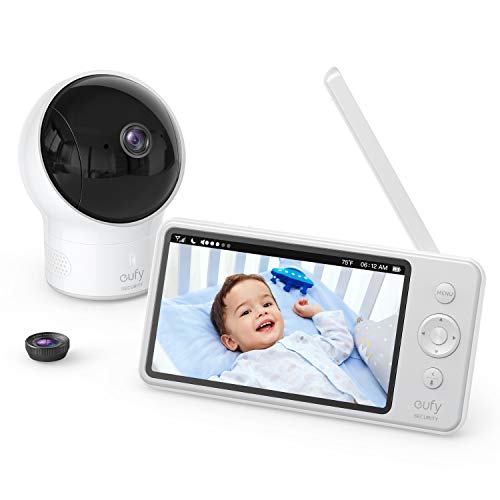
eufy SpaceView Baby Monitor E110
Who it suits: Parents whose nursery is wide, shared or awkwardly shaped, and who want the whole room in frame from day one without buying an extra lens.
The SpaceView E110 earns its place on a single generous decision: the wide-angle lens is in the box. Where the Infant Optics design sells width as an accessory, eufy includes a 110-degree wide-angle lens alongside the standard view, so a camera placed in a corner can take in the crib, the changing table and the door in one frame. The camera pans and tilts from the parent unit, the 5-inch display shows a 720p picture, and a built-in lullaby player plus a sound alert round out a spec that is deliberately focused on the nursery rather than the phone in your pocket.
Like most of this guide, the SpaceView is a non-Wi-Fi system. There is no eufy app account for this model, no cloud plan and no subscription; the camera links directly to its parent unit. That also means no remote viewing from outside the home and no saved video — the recording question simply does not arise, because the system is live-only. Families who want phone access should look honestly at the hybrid and Wi-Fi designs discussed in the how-to-choose section, including their subscription and privacy trade-offs, rather than expecting this set to grow an app later. It will not.
Battery and range figures for this class are maker claims measured in open conditions; walls, floors and neighbouring networks shorten real range in every home, so treat headline numbers as a best case and test the link from the rooms you actually use during the return window. Placement safety is the same rule as every mains-powered camera here: mount or set the camera so neither it nor its power cord can be reached from the crib — at least three feet away, cord fixed to the wall — because a pulled cord is a strangulation hazard, not a tidiness issue.
Apartment nurseries are rarely nurseries: they are a corner of a bedroom, half of a living room, or a one-bed where the crib shares air with the sofa. That is precisely the geometry a wide-angle lens exists for. One corner-mounted SpaceView can frame the crib corner and the room around it, so a single camera does the work an apartment has no space to do with two.
- Wide-angle lens included in the box — whole-room framing without accessories
- 5-inch 720p display with pan and tilt from the parent unit
- No Wi-Fi, no account and no subscription to manage
Honest limitation: Live view only: no recording, no phone access, and the wide view is a lens swap rather than a second camera, so two rooms need a second camera unit.
Choose it if your room is wide or shared and a corner camera must see all of it from the first night. Skip it if you need two rooms covered, or any form of recording or phone check-in.
Infant Optics DXR-8 PRO Video Baby Monitor
Who it suits: Parents who want the most adaptable non-Wi-Fi picture in this price tier — one camera that can be reframed with lenses as the nursery changes, on a private radio link that never touches the home network.
The DXR-8 PRO is built around two ideas that still separate it from cheaper monitors. The first is its interchangeable lens system. The standard lens handles a normal crib view; a wide-angle lens and a zoom lens are available separately from the maker, so the same camera can cover a whole toddler room later or tighten in on a small crib now, without replacing the monitor. The second is Active Noise Reduction, the maker’s patented filtering that cuts the background hiss, fan hum and white-noise-machine wash that make overnight listening so tiring on basic monitors. The maker presents both as its own technology, and the practical effect parents describe is simple: a cleaner picture framing and cleaner sound on a 5-inch, 720p display.
Connection honesty matters with this pick. There is no Wi-Fi, no app and no cloud account. The camera talks only to its dedicated parent unit over a secured FHSS radio link, so there is no subscription, no cloud storage and also no recording at all — this is a live-view and live-listen monitor, and if saving clips matters to you, a different architecture is the honest answer. The trade is privacy and simplicity: nothing leaves the house, nothing depends on your router, and the monitor keeps working when the internet does not.
Safety placement is part of owning any camera, and this one is no exception. The camera is mains-powered, so its cord must be routed completely out of reach — camera and cord at least three feet from the crib, cord secured along the wall, never draped over the crib rail. A monitor camera is a watching aid for a caregiver who is awake and nearby in the home; it does not watch the baby for you and it never replaces direct supervision or safe-sleep practice.
For renters, the DXR-8 PRO’s lens system solves a moving problem: apartments change. The crib corner in this lease becomes a full small bedroom in the next, and a monitor whose framing adapts with a lens swap does not need replacing at every move. Its non-Wi-Fi link also sidesteps shared-building network headaches — no router permissions, no landlord’s Wi-Fi password, no crowded network negotiation.
- Interchangeable lenses adapt one camera from crib close-up to whole-room view
- Active Noise Reduction cleans up overnight listening (maker technology)
- No Wi-Fi, no app, no subscription — a private link to its parent unit only
Honest limitation: It sits at the top of this budget tier — check the current price on Amazon before you buy — the extra lenses are separate purchases, and there is no recording of any kind.
Choose it if your nursery will change — crib, then toddler bed, then playroom — and you want one camera system that reframes instead of being replaced. Skip it if you need saved video, phone viewing, or a second room covered from the same box.
HelloBaby HB6550-2 Baby Monitor with 2 Cameras
Who it suits: Parents who need two rooms covered — siblings, a nursery plus a play space, or a crib plus a toddler bed — and who value a parent unit that lasts through the night without living on its charger.
The HB6550-2 bundles two pan-tilt-zoom cameras with one 5-inch parent unit. The maker rates the parent unit battery for up to 30 hours in its power-saving VOX mode, which wakes the screen when sound is detected; continuous video streaming uses far more power, as it does on every monitor, so read that figure as a maker claim about light-duty overnight use rather than a promise of a day and a half of full video. VOX, two-way talk, automatic night vision, a room-temperature readout and a set of lullabies cover the everyday checklist, and the cameras take turns or are selected from the parent unit rather than shown simultaneously — if true side-by-side viewing matters, the Babysense split-screen pick below is the honest alternative.
This is another fully non-Wi-Fi design: no app, no account, no cloud storage, no subscription and no recording. The feed exists only on the parent unit, inside the home, over the maker’s quoted range of up to 1,000 feet in open space — a maker claim that real walls will reduce substantially. What you give up in phone access you gain back in predictability: the system behaves the same during an internet outage as it does on a normal evening, and there is no password or cloud service to manage.
Two cameras double the placement discipline. Each camera is mains-powered, each cord must be fixed at least three feet from any crib or bed a child can reach from, and each camera needs a stable mount or shelf that a standing toddler cannot pull down. Set both cameras up before the baby arrives if you can; threading cords safely behind furniture is much easier without a newborn’s schedule running the house.
Two cameras sound like a big-home feature until an apartment rearranges your thinking: camera one on the crib corner in the bedroom, camera two on the play area in the living room, one parent unit on the kitchen counter. In a small footprint the maker’s open-space range figure is more than enough — the real apartment limit is walls, not distance, and this link handles a typical flat’s layout comfortably.
- Two pan-tilt-zoom cameras in one box for siblings or two rooms
- Maker-rated long parent-unit battery in VOX power-saving mode
- Temperature display, two-way talk and lullabies cover the daily checklist
Honest limitation: The two cameras are viewed by switching or scanning, not side by side, and the long battery figure is a maker claim for VOX mode, not continuous video.
Choose it if two rooms must be covered on a budget and overnight battery life matters more than split-screen viewing. Skip it if simultaneous side-by-side viewing is the point — choose the Babysense instead.
Motorola VM50G-2 Baby Monitor with 2 Cameras
Who it suits: Parents who reposition the camera view constantly — following a rolling baby, a climbing toddler or a pet that shares the nursery — and want that movement motorised, quiet and done from the sofa.
The VM50G-2’s strength is its remote pan, tilt and zoom across two cameras on a 5-inch parent unit. Instead of a fixed wide shot, you steer the view: across the crib at bedtime, toward the play mat in the morning, down the length of a toddler bed at nap time. A room-temperature sensor on the camera reports back to the parent unit, two-way audio lets you speak into the room, and lullabies and night vision cover the standard overnight list. Motorola’s nursery line is a familiar name in this category, and the controls follow the conventional layout most parents can run half-asleep at 3 a.m., which is a genuine feature.
Connection, storage and cost are the familiar non-Wi-Fi settlement: a direct FHSS link to the dedicated parent unit, no app, no cloud, no recording and no subscription. The maker’s range claim for this class is an open-space figure; brick, concrete and multiple floors will cut it, so buy from a retailer whose returns let you test your own walls. If phone viewing or saved clips are on your must-have list, this is the wrong architecture, however good its camera movement is.
Motorised cameras invite one specific placement mistake: setting the camera close because the zoom feels powerful. Resist it. The camera and its mains cord still belong at least three feet from the crib, fixed so a standing child cannot reach or pull either. Zoom exists precisely so the camera can stay safely far away while the picture comes close — use it that way, and re-check cord routing whenever furniture moves.
Apartments reward the VM50G-2’s steering for a specific reason: you cannot always put the camera where the perfect view is, because that shelf is the landlord’s, that wall cannot take a screw, that corner holds the radiator. A motorised camera forgives imperfect placement — set it on the furniture you have, then pan and tilt your way to the crib view you wanted.
- Motorised pan, tilt and zoom follows a moving child from the parent unit
- Room-temperature sensor reported on the parent unit
- Two cameras included, from a familiar nursery brand
Honest limitation: Camera resolution is modest next to the sharpest picks here, there is no recording, and motorised movement is wasted if your nursery view never changes.
Choose it if your child’s sleep position roams and you re-aim the camera nightly from your own bed. Skip it if your camera view is fixed on one crib — a simpler, sharper pick serves you better.
Babysense HDS2 5-Inch HD Split-Screen Baby Monitor with 2 Cameras
Who it suits: Parents of two children — twins above all — who want both rooms visible on one screen at the same time, not alternating on a scan cycle.
Split-screen viewing is the HDS2’s defining feature, and it changes how a two-child night feels. Both camera feeds sit side by side on the 5-inch HD display continuously; audio follows the camera you select, which is the honest limitation of every split-screen design, but visually nothing is ever hidden while the other room is on screen. The set can expand to four cameras as the maker describes, each camera carries a soft night light, and the parent unit’s 4,000 mAh battery is the maker’s basis for its overnight endurance claims. Zoom is digital at 4x, useful for checking a face, softer than an optical zoom lens — a fair trade at this tier.
The connection is a private non-Wi-Fi link to the dedicated parent unit. There is no app, no cloud recording, no subscription and no way to check the feed from outside the home. For many families that is the point: the picture of their children exists on one handheld screen in their house and nowhere else. Families who need a grandparent across town to peek in, or who want clips saved, need a Wi-Fi or hybrid architecture instead — and should budget for the subscription and storage questions that come with it, covered plainly in this guide’s how-to-choose section.
With two cameras in two rooms, cord discipline is the main safety work. Route every power cord at least three feet from crib or bed reach, fix it along the wall or behind furniture a child cannot move, and re-check the routing when a baby starts standing and reaching — the safe setup for a newborn’s room is not automatically safe for a nine-month-old who pulls to stand. The monitor helps an awake caregiver keep watch; it is not a safety device and never a substitute for being in the home and checking in person.
Split screen in an apartment is about attention, not size: the crib in the bedroom and the toddler on the living-room rug, both visible while you cook in a kitchen that is also the hallway. The HDS2’s two feeds on one handheld screen suit open-plan living where a caregiver is always mid-task in another zone of the same space.
- True split screen — both rooms visible at once, not on a scan cycle
- Expandable to up to four cameras as the maker describes
- Built-in camera night light and a large parent-unit battery
Honest limitation: Audio follows only the camera you select even in split screen, zoom is digital rather than optical, and the set is live-only with no recording.
Choose it if two children sleep in two rooms and you refuse to guess what the off-screen room is doing. Skip it if you have one child in one room — a single-camera pick spends the budget better.
VTech VM350-2 Baby Monitor with 2 Cameras
Who it suits: Parents who prefer a long-established nursery brand with straightforward controls, covering two rooms without apps, accounts or monthly anything.
VTech’s VM350-2 pairs two cameras with a 5-inch parent-unit screen, automatic night vision, two-way talk and a set of lullabies, on a secure FHSS radio link the maker describes as private and hack-resistant in the ordinary sense that it never joins your network at all. The cameras are viewed one at a time from the parent unit — this is not a split-screen set — and a sound-activated mode wakes the screen when a room gets loud, which stretches battery life overnight. The maker’s range figure for this class is quoted for open space; in a real home, expect the link to be a whole-home tool in most layouts and a same-floor tool in dense construction, and verify yours during the return period.
The storage and subscription answer here is the simplest in the guide: there is none of either. No cloud, no memory card, no app, no recording, no plan. The VM350-2 is a live window into two rooms and nothing more, which is either exactly right or clearly wrong for your family — and knowing which is the real buying decision. Parents who travel for work and want phone check-ins should not buy this set hoping to add access later; they should buy a Wi-Fi or hybrid design from the start.
Brand familiarity does not change the physical rules. Both cameras are mains-powered: place each at least three feet from the crib or bed it watches, fix cords to the wall out of reach, and never run a cord across or inside the crib. A camera that can be grabbed will eventually be grabbed by a standing child, so mount high, route behind furniture, and revisit the setup at every mobility milestone.
The VM350-2 is the apartment pragmatist’s pick: compact cameras, no network involvement at all — a real virtue on shared or landlord-controlled Wi-Fi — and a parent unit that moves from room to room in a home where no room is far from any other. Nothing about it needs the building’s infrastructure, the landlord’s permission or a drill.
- Established nursery brand, simple half-asleep controls
- Two cameras with sound-activated screen to save battery overnight
- No app, no cloud and no subscription — live viewing only
Honest limitation: No split screen and no recording; the picture is functional rather than the sharpest here, and extra cameras are a separate purchase.
Choose it if you want a known brand, two rooms and controls a grandparent can run without a tutorial. Skip it if you want the sharpest picture, split screen, or any smart features at all.
Nanit Pro — the Wi-Fi step-up, prose-only
Apartment readers ask about the Nanit Pro because its wall or floor-stand mounts promise a tidy overhead view in a small nursery corner. It is covered here without a link because its bundles sit in a premium tier above this guide’s budget. Renters should weigh two apartment-specific facts: the wall mount expects a fixed installation your lease may not allow (the floor stand avoids screws but costs more and takes floor space), and the system is app-only over your Wi-Fi — there is no parent-unit screen. The maker’s breathing-motion tracking, used with its band, is a manufacturer claim, not a medical measurement, and its sleep insights and history run on a paid subscription after any trial, with video held in the maker’s cloud. If your building’s Wi-Fi is shared or landlord-controlled, that dependency alone may settle the question in favour of the self-contained sets above.
Comparison Table
| Product | Type | Best use | Link |
|---|---|---|---|
| eufy SpaceView E110 | Non-Wi-Fi, dedicated parent unit | Best wide view — wide-angle lens included in the box | Check on Amazon |
| Infant Optics DXR-8 PRO | Non-Wi-Fi, dedicated parent unit | Best overall — interchangeable lenses, no Wi-Fi | Check on Amazon |
| HelloBaby HB6550-2 | Non-Wi-Fi, dedicated parent unit, 2 cameras | Best two-camera value — long parent-unit battery | Check on Amazon |
| Motorola VM50G-2 | Non-Wi-Fi, dedicated parent unit, 2 cameras | Best remote camera movement — motorised pan, tilt and zoom | Check on Amazon |
| Babysense HDS2 | Non-Wi-Fi, dedicated parent unit, split screen | Best split screen — two rooms on one display at once | Check on Amazon |
| VTech VM350-2 | Non-Wi-Fi, dedicated parent unit, 2 cameras | Best established-brand two-camera set | Check on Amazon |
The Nanit Pro step-up does not appear in this table because it has no link in this guide: it is a Wi-Fi, app-only camera in a premium tier above this budget, with cloud video and a paid subscription for its insights features — a different architecture, summarised in its prose-only section above.
How to Choose: Best baby security camera for apartments under $200
- Decide the architecture before the brand. Parent-unit set or phone app is the real first choice: local, private and subscription-free, or remote, recorded and plan-dependent. Every linked pick here is the first kind; buy the second kind only on purpose.
- Count your sleep and play zones. One zone needs one good camera; two zones justify a two-camera box; two zones you must see simultaneously justify split screen. Camera count is a layout decision, not a status symbol.
- Treat range and battery as claims to test. Maker figures assume open space and power-saving modes. Your walls decide the truth — buy where returns are easy and test from your bed, sofa and kitchen in the first week.
- Ask the recording question out loud. These sets record nothing. If clips, history or phone check-ins matter, say so before buying and choose a Wi-Fi or hybrid design with its storage costs in the open.
- Price the whole ownership. Subscriptions, extra cameras, add-on lenses and replacement parent units are the real budget. A set with no monthly cost and the second camera in the box is often cheaper over two years than a cheaper box with a plan.
- Plan placement before purchase. The camera needs a stable spot at least three feet from the crib with a cord route along the wall. If your room cannot offer that spot to a fixed camera, a wide lens or a steerable camera is not a luxury — it is the fix.
- Read tracking language correctly. Sleep scores and breathing-motion features are maker-described conveniences on the products that offer them. They inform; they do not protect. Safe-sleep practice and your own checks protect.
- Check what is in the box. Lenses, second cameras, mounts and chargers vary. A pick that looks cheaper can cost more once its wide lens or extra camera is added — compare complete setups, not headline boxes.
Renting With a Camera: Leases, Landlords and Shared Wi-Fi
A freestanding baby camera is furniture, not a fixture: it plugs into an existing outlet, attaches to nothing and leaves with you, so in an ordinary lease it needs no permission — the same logic that makes floor lamps the renter’s best friend. Wall-mounted cameras change that conversation, which is why every linked pick here can live on a shelf, dresser or bookcase. If you do mount anything, use fixings your lease allows and fill nothing you cannot restore.
Shared and landlord-controlled Wi-Fi is the second rental trap, and the non-Wi-Fi architecture of these sets walks around it entirely: no router password to request, no network of strangers’ devices sharing airtime with your baby’s feed, no camera stranded when the building changes provider. Your feed exists between camera and parent unit inside your unit. In a housing type defined by other people’s infrastructure, a monitor that needs none of it is not a compromise — it is the fit.
Setup in a Rented Nursery Corner
Apartment setup starts with permission-free placement: a bookcase top, a dresser, a shelf you already own — never a fresh hole in the landlord’s wall for a product that works freestanding. Position the camera at least three feet from the crib, run its cord along the skirting or behind furniture the child cannot move, and fix it with removable clips rather than anything that marks paint. Then walk the parent unit through the flat: kitchen while dinner cooks, bathroom door during a shower, the sofa corner where evenings actually happen. In most flats the link will be strong everywhere; where it flickers, the culprit is usually a metal-heavy run — fridge, oven, boiler — between camera and screen, and shifting the parent unit’s home spot a few feet fixes it.
Check the after-dark picture on the first night, not the first month. Small rooms bounce infrared light, and a camera close to a pale wall can produce a washed-out crib image that a slight re-aim cures. Revisit the setup when the baby starts standing: reach grows faster than parents expect, and the cord route that was safe in the newborn corner must still be safe for a child who pulls up on everything in it — including, eventually, the furniture the camera sits on. Choose furniture that cannot be pulled over, or move the camera higher.
Common Buying Mistakes
- Drilling a camera mount into a rented wall before checking the lease — every pick here works freestanding; keep the deposit out of it.
- Buying a Wi-Fi camera for a home whose Wi-Fi you do not control. If the network is the landlord’s or the building’s, a self-contained set is the honest answer.
- Aiming a narrow camera at a crib corner and losing the rest of a multi-use room. In shared spaces, width is coverage.
- Routing the camera cord behind the crib because the outlet is there. Move the camera, use a different shelf, fix the cord along the wall — the three-foot rule outranks outlet convenience.
- Assuming range will fail in a small flat. It will not — but walls and metal appliances still matter, so test the link from kitchen and bathroom, not just beside the crib.
- Forgetting moving day. Favour sets you can pack in minutes with no brackets left behind and no holes to fill.
- Letting the parent unit live wherever it lands. In a compact home it will be carried constantly; a set with sound-activated VOX and decent battery suits that life better than one that needs its charger hourly.
- Treating a camera in the next room as supervision. In an apartment the rooms are close, which makes in-person checks easy — keep doing them.
- Buying two single cameras from different brands for two zones. One two-camera set means one parent unit, one charger routine and one system to learn.
Final Recommendation
- Best wide view: eufy SpaceView Baby Monitor E110.
- Best overall: Infant Optics DXR-8 PRO Video Baby Monitor.
- Best two-camera value: HelloBaby HB6550-2 Baby Monitor with 2 Cameras.
- Best remote camera movement: Motorola VM50G-2 Baby Monitor with 2 Cameras.
- Best split screen: Babysense HDS2 5-Inch HD Split-Screen Baby Monitor with 2 Cameras.
- Best established-brand two-camera set: VTech VM350-2 Baby Monitor with 2 Cameras.
For most apartments the eufy SpaceView leads: one wide lens, one corner, the whole shared room — no installation, no network, no plan. The Infant Optics follows for renters who expect to move and reframe, and the two-camera sets serve the classic flat layout of sleep corner plus play area. Check the current price on Amazon, place the camera at least three feet from the crib with its cord fixed to the wall, and keep the box — your monitor should move as easily as you do.
Frequently Asked Questions
Do I need my landlord’s permission for these cameras?
For the linked picks, in an ordinary lease, no: they are freestanding, plug into existing outlets and attach to nothing. Wall-mounting any camera is a different matter — check your lease first, and prefer the shelf placement every set here supports.
Will these work if my Wi-Fi is shared or provided by the building?
Yes — they do not use Wi-Fi at all. Each camera links privately to its own parent unit, so building networks, router passwords and neighbours’ devices are irrelevant to your baby’s feed.
Can one camera really cover a nursery corner in a shared room?
With the right framing, yes. A wide-angle lens from a corner, or a motorised camera you can steer, covers a crib corner and the room around it. The eufy and Infant Optics picks lead this guide for exactly that geometry.
How should I route the power cord in a small nursery corner?
Camera and cord at least three feet from the crib, cord fixed along the wall or behind furniture the child cannot move. Never drape a cord over a crib rail or run it where a standing child can grab it — cords near cribs are a strangulation hazard.
Do these sets record, in case I want to check what happened overnight?
No. They are live-only, with no cloud or local recording and no subscription. If playback matters, that is a Wi-Fi architecture purchase — made knowingly, with its plan costs — not an add-on these sets can grow later.
What happens to the monitor when we move apartments?
It packs like any small appliance: cameras, parent unit, chargers. No brackets, no holes, no re-pairing to a new network — one more reason the non-Wi-Fi design suits renters who move every year or two.


