Disclosure: As an Amazon Associate, dailyhomedecorating.com earns from qualifying purchases. Links to Amazon on this page are affiliate links; they cost you nothing extra. Prices and availability change often, so check the current Amazon listing before you buy.
The best hot tubs for colorado are chosen by a climate with four personalities: altitude that thins the air and intensifies the sun, freeze-thaw cycles that work on every seam and fitting, dry air that drinks water from an uncovered spa, and mountain weather that can deliver a powder day and a patio day in the same week. The best hot tubs for colorado answer all four: insulation and freeze protection for the cold snaps, covers and materials that stand up to ultraviolet at a mile or more above the sea, and construction that tolerates the daily expansion and contraction of a high-desert temperature swing. This guide ranks the verified freeze-protected inflatables in the pool for this site, with their cold systems front and center, and adds the permanent types in prose, because the pool contains inflatables only, for the mountain properties where permanence is the honest answer.
Colorado also splits into spa countries that a single ranking must respect. The Front Range, Denver, Boulder, Colorado Springs, enjoys a milder, sunnier winter where a well-insulated inflatable can run all year with discipline and a south-facing deck is a genuine asset. The high country, Aspen, Vail, Breckenridge, Steamboat, Telluride, is Minnesota’s cousin with better marketing: deeper cold, heavier snow, stronger sun, and second homes that sit empty between ski weeks, which changes the entire ownership equation toward permanence, service contracts, and freeze doctrines. The western slope and the southern valleys add heat and dust to the mixture. This guide names which recommendation belongs to which Colorado as it goes, because a spa verdict that does not know its elevation is not a verdict at all. The general cold-climate foundation is laid in Best Inflatable Hot Tubs For Cold Weather; what follows is the altitude application.
Read the Quick Picks for the shortlist, then the reviews for the Colorado-specific behavior of each option, sun, freeze-thaw, evaporation, and absence. The buying guide converts the state’s conditions into checks, and the how-to sections cover siting at altitude, running through freeze-thaw season, and protecting a spa from the strongest everyday sun in the country.
Where to Buy
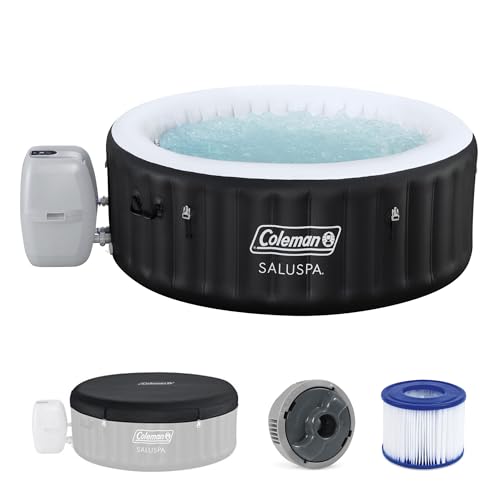
The linked inflatable picks are sold on Amazon with current pricing and availability: the Coleman SaluSpa Miami Energy-Efficient AirJet Inflatable Hot Tub leads with Freeze Shield protection and insulation, confirmed via its Check on Amazon link, alongside the Bestway SaluSpa Cancun Energy-Efficient Inflatable Hot Tub — Check on Amazon — and the INTEX 28425EH PureSpa Bubble Massage Spa Set — Check on Amazon, whose freeze boundary is marked in its review. Permanent types are best bought through Colorado dealers, especially in the high country, where delivery over mountain roads and winter service are part of the product being purchased. At altitude, buy the insulated base and a UV-serious cover in the same transaction as any spa.
In this guide
Quick Picks
| Pick | Badge | Why it earns its place |
|---|---|---|
| Coleman SaluSpa Miami Energy-Efficient AirJet Inflatable Hot Tub | Best Overall | Freeze Shield, EnergySense insulation, and 120 AirJets for the state’s freeze-thaw winters. |
| Fully Insulated Hard-Shell Spa (Type) | Best for High Country | Permanent insulation architecture and dealer service for mountain homes and second properties. |
| Bestway SaluSpa Cancun Energy-Efficient Inflatable Hot Tub | Best Value | The complete Freeze Shield package at a gentler point in the range. |
| Rotomolded Spa (Type) | Best for Second Homes | One-piece durability for properties that sit empty between visits. |
| INTEX 28425EH PureSpa Bubble Massage Spa Set | Best for Front Range | Superb insulated cover and gentle water for milder metro winters, with its freeze limit respected. |
| UV-Rated Cover and Shade Setup (Type) | Best Supporting System | At altitude the cover is a consumable under ultraviolet assault; buy and shade it accordingly. |
Key Takeaways
- Freeze protection and insulation remain the entry ticket anywhere in Colorado that freezes, which is most of it.
- Ultraviolet at altitude ages covers, shells, and fittings faster than lowland owners expect; shade and cover quality are specifications.
- Dry air evaporates uncovered water relentlessly; cover discipline is also water and chemical discipline.
- Second homes need a winter doctrine, running with monitoring or properly drained, decided before the first empty freeze.
- Freeze-thaw works on bases and fittings; a stable, drained site protects the spa between seasons of extremes.
- Match the recommendation to your Colorado: Front Range mild, high country severe, and the two are different purchases.
How These Picks Were Chosen
Linked picks come from the verified supplement pool, with manufacturer specifications in the spec boxes, filtered through Colorado’s conditions: freeze-protection systems, insulation packages, cover construction, and material resilience. Permanent types are prose-only because the pool contains no such models, and they are included because high-country and second-home buyers are honestly served by permanence and dealer service in ways no inflatable matches. The accessory pick reflects a Colorado truth lowland guides miss, that the cover is a wear item under altitude sun and should be bought and budgeted as one.
Excluded were unprotected inflatables for any Colorado wintering outdoors, spas whose covers are unshaped summer lids, and advice that treats Denver and Aspen as the same climate. The pool’s cold-plunge entry was excluded as a non-hot-tub, though Colorado’s reservoir plungers are again noted with respect. No static prices or invented specifications appear; altitude effects are described qualitatively from established physics, and model-specific limits should be confirmed in each manual.
The standard is a full Colorado year: January freeze-thaw, March sun, July evaporation, and October’s first hard frost, all survived under the routines this guide describes.
The 6 Best Hot Tubs for Colorado — Reviewed

Coleman SaluSpa Miami Energy-Efficient AirJet Inflatable Hot Tub
Our badge: Best Overall
The Coleman SaluSpa Miami Energy-Efficient AirJet Inflatable Hot Tub leads this guide because its systems answer Colorado’s winter directly. Freeze Shield automatic heating protects the pump and liner in cold weather, EnergySense insulated walls and cover hold temperature against freeze-thaw nights, MaxHold beams and a three-layer Tritech shell keep the structure firm as temperatures swing, and the 120 AirJets, ChemConnect dispenser, and far-scheduling power-saving timer complete a package that can be left to run a Front Range winter or a sheltered mountain one with the discipline this guide prescribes. It is the inflatable a Colorado buyer can defend in February and enjoy in July.
Strengths
- Freeze Shield protection for the state’s freeze-thaw winters.
- Insulation package that fights both cold nights and dry-air losses.
- Sturdy construction for daily temperature cycling.
Trade-offs
- High-country extremes and empty second homes still demand the doctrines in this guide.
- Cover will age under altitude ultraviolet; shade it and budget its replacement.
- Two-adult comfort capacity, as with the class.
| Color | Black |
|---|---|
| Size | Energy Efficient 2.0 |
| Dimensions | 71 x 71 x 26 inches |
| Weight | 101.2 pounds |
Site it in sun for the soak and shade for the cover’s idle hours if your deck allows both, on an insulated base that also isolates it from a deck’s freeze-thaw movement, and keep the path short for the mornings when the thermometer is showing off. In the metro counties the Coleman is a four-season spa under ordinary discipline. In the high country it is a three-and-a-half-season spa with a written plan for the deepest weeks, which is a respectable and honest identity.
Best for: Front Range households and sheltered mountain sites / Not suited for: unattended high-country properties through winter
Choose the Coleman as Colorado’s inflatable default. Skip it where absence and altitude combine, and read the second-home picks below. Check on Amazon
Fully Insulated Hard-Shell Spa (Type)
Our badge: Best for High Country
The fully insulated hard-shell spa is the high country’s benchmark for the same architectural reasons it leads in Minnesota, with a Colorado addition: dealer networks in the mountain towns that understand altitude, snow load, and second-home service. A cabinet insulated to the shell keeps plumbing inside the thermal envelope through freeze-thaw cycles, molded seats and jets deliver the post-ski soak that is practically a local institution, and a snow-capable, UV-serious cover caps the system. Described as a type because the pool holds no hard-shell model, it is the recommendation for mountain primary homes and for second homes whose owners will fund monitoring or a service contract.
Strengths
- Freeze-safe insulation architecture for sustained mountain cold.
- Dealer delivery and service over mountain roads and through winter.
- The post-ski soak, perfected: capacity, heat, and durability.
Trade-offs
- The largest investment in this guide, with mountain delivery premiums.
- Empty properties still need a doctrine: monitored running or proper drainage.
- Repairs at altitude are scheduled in mountain time.
Buy it on insulation stated in writing, cover construction, and the dealer’s second-home service offering, which in the high country is a product feature as real as any jet. Ask specifically how the dealer handles a January failure at an unoccupied property, because the answer distinguishes mountain dealers from metro ones more than any showroom conversation.
Best for: mountain primary homes and serviced second homes / Not suited for: unmonitored properties or unproven habits
Choose the hard-shell where altitude and winter are both serious. Skip it on the mild Front Range if the inflatable system meets your life.

Bestway SaluSpa Cancun Energy-Efficient Inflatable Hot Tub
Our badge: Best Value
The Bestway SaluSpa Cancun Energy-Efficient Inflatable Hot Tub carries the same cold essentials as the Coleman, Freeze Shield protection, insulated energy-efficient construction, MaxHold and Tritech build, 120 bubble jets, and ChemConnect dispensing, at the gentler point in the range and in a grey wicker finish that sits well against Colorado’s stone and timber decks. Its savings fund the altitude extras this guide insists on, the insulated base, the shade or cover protection, and the spare filters that a dusty, sunny climate consumes.
Strengths
- Complete Freeze Shield package at a value position.
- Savings convert directly into the altitude system around the spa.
- Simple, schedulable controls for part-time residences.
Trade-offs
- Couples-scale in honest capacity.
- No usable dimensions or weight in the pool data; verify on the listing.
- Same absence and extreme-cold doctrines as every inflatable.
| Color | Grey Wicker |
|---|---|
| Size | Energy Efficient 2.0 |
For a Front Range family or a foothills weekend place that is visited most weeks, the Cancun is the value expression of the correct Colorado system. Keep its cover shaded when idle, its base insulated, and its water tested on arrival days, and it will deliver the state’s signature evening, sunset on the peaks, steam on the water, at a fraction of the permanent cost.
Best for: value buyers on the Front Range and visited foothills properties / Not suited for: empty high-country winters
Choose the Cancun for the system on a budget. Skip it where the property’s emptiness is the dominant fact. Check on Amazon
Rotomolded Spa (Type)
Our badge: Best for Second Homes
The rotomolded spa’s one-piece toughness makes it Colorado’s second-home specialist: permanent insulation and capacity, simple systems, and a shell that tolerates the property’s real life, long empty stretches, enthusiastic guest weekends, and service that happens when the roads allow. Described as a type, it fits the cabin and condo-adjacent properties where a flagship’s complexity would be a liability and an inflatable’s winter conditions cannot be guaranteed by absent owners. Its winter doctrine must still be chosen, monitored running or proper drainage, but its simplicity makes either doctrine easier to keep.
Strengths
- Durability and simplicity for intermittently occupied properties.
- Permanent insulation without flagship service needs.
- Tolerates hard guest use in rental-adjacent settings.
Trade-offs
- Functional seats and finishes rather than luxury.
- Absence still requires a doctrine and, ideally, a local checker.
- Mountain delivery is a project in itself.
Second-home owners should pair this type with the unglamorous technologies of absence: a monitored power supply, a neighbor or service on call, and water care simplified to what a checker can execute. So supported, the rotomolded spa is the mountain property’s faithful appliance, hot when you arrive and unbothered when you leave, which is the entire brief.
Best for: cabins and second homes with a winter doctrine / Not suited for: luxury-primary-residence briefs
Choose rotomolded for the visited property. Skip it if nobody can ever check on the place in January.

INTEX 28425EH PureSpa Bubble Massage Spa Set
Our badge: Best for Front Range
The INTEX 28425EH PureSpa Bubble Massage Spa Set is the Front Range’s inflatable of choice where winters are sunny, cold at night, and rarely arctic for long. Its included cover with high-density thermal foam defends the water against both night cold and dry-air evaporation, its hard water treatment suits the metro’s supply, its saltwater readiness calms the care routine, and its Fiber-Tech interior is the class’s most generous. Its stated boundary applies in Colorado as elsewhere: no freeze-protection system is claimed, so a metro owner runs it through winter with a weather eye and a drain plan for genuine arctic spells, and a mountain owner treats it as a three-season spa or houses it in a protected setting per the manual.
Strengths
- Best insulated cover in the class for cold nights and dry air.
- Gentle water systems and a generous interior.
- Excellent value across the long Front Range season.
Trade-offs
- No freeze protection; arctic spells require the drain plan or shelter.
- Cover needs UV discipline at altitude like every cover here.
- Calm bubble action rather than vigorous.
| Color | Tan |
|---|---|
| Size | 4-Person |
| Weight | 99.66 pounds |
Denver and Boulder owners will find the Intex’s rhythm natural: covered against the sun and the evaporation by day, steaming under a cold clear night, and drained without drama in the one week a year when the plains turn genuinely arctic. That is not a failure mode; it is the correct operation of a superb three-and-a-half-season spa in a state whose winters are mostly kinder than their reputation.
Best for: Front Range and mild-valley households / Not suited for: high-country outdoor wintering
Choose the Intex where Colorado is sunny and moderate. Skip it above the passes in winter. Check on Amazon
UV-Rated Cover and Shade Setup (Type)
Our badge: Best Supporting System
At Colorado elevations the sun is a maintenance schedule. Ultraviolet at altitude is measurably more intense than at sea level, and it works on covers, inflatable shells, headrests, and fittings every clear day, which in Colorado is most of them. The UV-rated cover and shade setup, a replacement-grade insulated cover with UV-resistant materials, used with a shade sail, pergola, or simple cover-storage discipline that keeps the cover out of direct sun when the spa is in use, is described as a type because it is bought as a system across brands. It protects the single most expensive wear item in spa ownership and the water beneath it.
Strengths
- Extends cover and shell life under the country’s strongest everyday sun.
- Shade makes summer daytime soaking and the walk to the spa civilized.
- Protects water from debris and evaporation between soaks.
Trade-offs
- Covers remain consumables at altitude, merely longer-lived ones.
- Shade structures add cost and, in some areas, permitting or HOA review.
- A shade sail in mountain wind must be engineered, not improvised.
Budget the cover’s replacement into ownership from the first year, inspect its underside and seams each spring, and treat any cover that has gone brittle or waterlogged as a safety and efficiency item due for replacement rather than a cosmetic one. Colorado owners who internalize that the sun is a slow second winter, working the top of the spa while the cold works the bottom, keep their spas years longer than those who do not.
Best for: every Colorado spa at altitude / Not suited for: shaded forest sites where UV is already filtered
Choose the UV system with the spa. Skip elaborate shade only where the trees already provide it.
Comparison Table
| Pick | Format | Colorado Brief | Watch Item | Check price on Amazon |
|---|---|---|---|---|
| Coleman SaluSpa Miami | Inflatable | Front Range and sheltered mountains | Cover UV aging | Check price on Amazon |
| Fully Insulated Hard-Shell (Type) | Permanent | High country benchmark | Second-home doctrine | Check price on Amazon |
| Bestway SaluSpa Cancun | Inflatable | Value system buy | Absence planning | Check price on Amazon |
| Rotomolded Spa (Type) | Permanent | Second homes and cabins | Monitoring or drainage | Check price on Amazon |
| INTEX PureSpa | Inflatable | Front Range three-and-a-half seasons | No freeze protection | Check price on Amazon |
| UV Cover and Shade (Type) | System | Statewide at altitude | Covers are consumables | Check price on Amazon |
How to Choose the Best Hot Tubs for Colorado
Name Your Colorado First
Write your elevation and your winter’s true character at the top of the shopping list. Below the foothills, insulated freeze-protected inflatables are four-season tools; in the high country, permanence, service, and doctrines govern. A buyer who shops for the wrong Colorado will be re-shopping within two winters, and the state’s spa dealers can recite the story by heart.
Interrogate the Cover as a Colorado Component
Ask the cover’s core, seal, and UV story, and plan its shade and its eventual replacement in the same conversation. At altitude the cover is simultaneously the insulation’s top half, the evaporation barrier, and the sun’s primary target, which makes it the hardest-working component in the state and the worst one to cheapen.
Design the Base for Freeze-Thaw
Ground that heaves will walk a spa out of level across a few winters. A stable, drained, insulated base, gravel and pavers or a proper pad, sited so meltwater leaves rather than ponds and refreezes, protects the shell, the fittings, and the owner’s ankles. In the mountains this is not landscaping; it is foundation work, and it should be budgeted as such.
Write the Absence Doctrine
Colorado’s second homes are empty during exactly the weather that tests spas. Decide whether the spa runs under monitoring, with power verified and a human able to attend, or is drained and secured before the empty weeks, and equip the choice: monitors, checkers, or a flawless drain routine. The doctrine you cannot execute is not a doctrine, so let the property’s real winter life choose it.
Running a Spa Through Colorado’s Year
Autumn is preparation: fresh water, clean filters and a spare, cover inspected for UV damage and seam fatigue, base drainage checked before the freeze makes it geology. Winter is discipline: cover sealed, snow brushed rather than loaded, power uninterrupted to any water-filled spa, and water tested weekly with the shock reset from Best Shock For Hot Tubs after ski-weekend crowds. Spring is the UV audit and the thaw inspection, when bases are re-leveled and covers judged honestly. Summer is evaporation management, which means the cover on whenever the spa is empty, the water level watched, and shade earning its keep at midday.
Altitude adds one small ritual of its own: after any long absence, run the system, test the water, and inspect for freeze-thaw’s calling cards, drips at unions, a cover sitting crooked, a base edge heaved, before the first soak of the visit. Five minutes of inspection is the entire difference between a second home’s spa and its recurring surprise.
Problem: The cover is cracking and fading fast — That is altitude ultraviolet doing its documented work; replace with a UV-rated insulated cover, add shade or storage discipline, and budget covers as consumables from now on.
Problem: Water level drops between visits — In dry Colorado air, evaporation from any uncovered hour is significant; audit cover discipline first, then inspect for a genuine leak at unions and the drain while the system runs.
Problem: The spa sits slightly out of level each spring — Freeze-thaw has moved the base; drain, rebuild the base properly with drainage, and re-level once, rather than shimming a spa annually.
Problem: A cold snap is forecast while the house is empty — Execute the absence doctrine: monitored spas get their checker’s visit, drained spas get verified empty, and no spa gets left full, powered by hope, at altitude.
Sun, Snow, and the Colorado Soak
Colorado’s spa pleasure is doubled by its contrasts: powder mornings and patio afternoons, a soak under falling snow at dusk and under fierce stars an hour later. The same contrasts are the ownership curriculum. The state rewards owners who think in systems, insulation below, sealing above, shade against the sun, shelter against the wind, and punishes owners who think a spa is a single object that either works or does not. It is also, not incidentally, the state where a hot tub most obviously improves a property’s life and value, because the ritual fits the landscape and the culture of mountains, skiing, and outdoor work. Buy the system and Colorado gives you the finest soaking between the plains and the Pacific; buy only the object and the state will spend a few winters explaining the difference.
Decks at Altitude: Structure, Snow, and Sense
Many Colorado spas live on decks, and decks at altitude carry a triple load: the spa’s thousands of pounds, the snow the season adds, and the freeze-thaw working on every footing. Have the structure verified for the combined reality before filling anything, keep the spa’s weight over the deck’s strongest span, and maintain a drainage path so meltwater never ponds against the house or refreezes on the walking route. A deck that passes that audit is a magnificent spa platform, elevated into the view and the sunset; a deck that was never asked the question is a liability with a hot tub on it. The five minutes with a structural professional is the cheapest line in this entire guide.
Common Buying Mistakes
Shopping for Denver and Living in Aspen
Or the reverse. Elevation is destiny in this category; name yours and buy for it, not for the state’s average, which exists nowhere.
Treating the Cover as an Accessory
At altitude the cover is insulation, evaporation control, and a UV consumable in one. Underbuying it is underbuying the spa.
Leaving a Second Home’s Spa to Chance
Full, powered by hope, and unvisited is the losing combination in every mountain state. Doctrine, monitoring, or drainage: choose one and equip it.
Ignoring the Base’s Drainage
Freeze-thaw moves undrained ground with geological patience. A spa re-leveled every spring is a base asking to be built properly once.
Forgetting the Sun in Winter Planning
Owners prepare for cold and are ambushed by a brittle cover in March. The sun works all year at altitude; plan for both winters, the frozen one and the bright one.
Water in a Dry State: Conservation and the Spa
Colorado households hold a legitimate question the wetter states do not: what does a few hundred gallons of recreational water mean where water is law, landscape, and argument? The honest accounting favors the spa more than intuition suggests. A hot tub is filled a handful of times a year and then keeps its water for months under a cover, losing a trickle to evaporation and splash; the same household’s lawn, shower habits, or a single leaking flapper will move more water in a month than the spa does in a season. Drain water, when its chemistry has settled and local rules allow, can often be directed to landscape use after the sanitizer has dissipated, a practice to confirm with the local utility rather than assume. The conservation-minded owner’s real disciplines are the cover, kept on and sealed, the leaks fixed promptly, and the drain interval extended by good water care rather than shortened by neglect, since every avoided refill is the spa’s largest water saving. Practiced so, the Colorado spa is a modest and honest water citizen, and owners can soak through a drought-conscious decade with the arithmetic on their side.
High-Altitude Soaking Sense
Altitude changes the soaker as well as the spa, and visitors earn a gentle warning residents have internalized. At elevation the air is dry, the sun is strong even in winter, and alcohol, which finds its way to many a vacation soak, hits harder and dehydrates faster. The household rules that keep Colorado soaking pleasant are simple: water beside the tub and the habit of drinking it, sessions a touch shorter for guests fresh off the plane, shade or a hat for the midday soak, and extra respect for the exit, since the combination of heat, altitude, and a fast stand is the dizziness trifecta. None of this dims the experience; the mountain soak, stars at altitude, cold air, hot water, remains the state’s signature pleasure. It merely asks the host to run the spa the way Coloradans run a trailhead, with the conditions acknowledged in advance and the water bottle treated as equipment. Hosts who brief guests warmly, hydrate, take your time standing, find that the briefing itself becomes part of the hospitality, and the spa’s reputation survives its visitors intact.
Freeze-Thaw and the Spring Inspection at Altitude
Colorado’s signature weather violence is not the deep freeze but the cycle: fifty-degree afternoons melting into twenty-degree nights, dozens of times a season, working water into every seam and joint and then expanding it there. The spa’s spring inspection in Colorado is therefore a freeze-thaw audit rather than a winter-damage one. Walk the cabinet and the pad for the cycle’s signatures, grout and sealant lines at the spa’s base that have opened, pavers or deck boards heaved by the ground’s breathing, the cover’s hinge and seals fatigued by being frozen shut and persuaded open on the season’s impatient mornings. Check the equipment bay for the slow weep that freeze-thaw starts at a fitting, visible as mineral tracing long before it becomes a drip a homeowner notices. Test the cover’s seal on a windy night with a hand at its edge, since the same cycles that open seams open the spa’s thermal envelope. None of the findings are emergencies in April; all of them are October’s emergencies wearing a discount, and the Colorado owner who spends the spring hour buys the winter cheap. Log it beside the water records, because at altitude the spa’s two enemies, sun and cycling, both keep calendars, and the owner who keeps one too stays ahead of them.
Renting in the Mountains: The Colorado Vacation Spa
A large share of Colorado spas serve the vacation rental market, ski condos, mountain cabins, high-country second homes that host strangers weekly, and their ownership adds a layer this guide should address honestly. The rental spa’s water is a turnover product, tested and reset between parties by a cleaner or a management company whose instructions must be written, laminated, and staged with the products, because a vacation spa cannot depend on any individual’s memory. Its hardware choices skew toward the indestructible and the lockable: covers that lock against unsupervised children and curious bears alike, controls with their delicate settings behind whatever lockout the model offers, and temperatures preset so a guest’s enthusiasm cannot cook the next party’s water bill. The guest-facing rules, shower first, no glass, children supervised, the maximum the spa holds comfortably, work best as hospitality language in the house book and on a small, handsome sign at the station, because renters comply with customs they are welcomed into. Owners who run the rental spa professionally, with the checklist culture of this lot’s Airbnb guide, find it the property’s most-reviewed amenity in the best sense; owners who treat it as a residential spa with strangers in it learn the difference at the cost of a season’s reviews.
Bears, Bees, and Other Colorado Critics of the Open Spa
A Colorado spa operates in wildlife country, and its management includes a menagerie the lower states meet less often. Bears read an uncovered spa as a warm, interesting pond and a food-scented one, if bath products or drinks have sweetened its rim, as an invitation, so the mountain household’s rules are the safety rules with fur on them: the cover on and latched whenever the spa is idle, no scented products left at the station, and the area kept free of the food and drink debris that teaches animals the address. Wasps and bees in the dry months find the spa’s moisture irresistible and gather at its edges in the heat of the day; the management is water discipline, a separate shallow water source placed away from the spa can draw their interest off, and the calm knowledge that a covered spa is a closed argument. Deer and elk contribute hoofprints and curiosity, and the occasional mountain lion rumor contributes mostly to the storytelling. None of this should deter a purchase; it should season the siting and the habits, since a Colorado spa run with its latches and its cleanliness is simply a well-run spa, and the wildlife becomes what it is for most owners, the audience for the best seat in the yard.
The Four-Season Deck: Designing the Spa’s Colorado Setting
A Colorado spa lives outdoors in a state that uses all four seasons enthusiastically, and its setting deserves design attention equal to the spa itself. The deck or patio that hosts it should be planned as a four-season room without walls: a surface that sheds the spring melt away from the cabinet, footing that grips in January’s ice and July’s thunderstorm alike, and a windbreak, fence, planting, or the house’s own corner, that takes the prevailing weather off the soakers’ shoulders without stealing the view that justified the address. Plantings near a Colorado spa must survive both the climate and the splash zone’s chemistry, and the honest palette is the region’s own, the junipers, grasses, and stone that read as landscape rather than as garden casualties. Lighting completes the setting’s work after dark, low, warm, and shielded, enough to navigate by and never enough to argue with the stars, which at altitude are a feature of the property no fixture should compete with. Owners who design the setting with the same care as the purchase find the spa used in months a bare installation would have surrendered, because the difference between a spa and a destination is everything around the water. In Colorado, of all places, the room without walls may be the finest room in the house.
Ski Town Versus Front Range: Two Colorados, Two Spas
Colorado contains two spa markets wearing one name, and a buyer served by distinguishing them will shop better in both. The high-country town, Aspen’s and Breckenridge’s and the hundred smaller versions, runs its spas hard and socially, rental fleets and second homes and locals who treat the tub as winter infrastructure, in a climate of deep snow, serious UV, and water that arrives cold and mineral-interested; its correct spa is the durable, well-insulated, lockable workhorse with a service contract in its life, and its correct owner is a manager of systems, whether the system is a household or a property portfolio. The Front Range, Denver’s suburbs to Fort Collins, runs a gentler experiment, backyard spas in a milder winter and a hotter summer, where the season’s challenges are the sun’s work on covers, the hail that arrives like a rumor with fists, and the freeze-thaw cycling of the shoulder months; its correct spa can be lighter in insulation and heavier in shade planning, its owner a gardener of a four-season yard. Both Colorados agree on the altitude disciplines and the water honesty this guide has taught, and both reward the buyer who names which state they actually live in before the showroom names it for them.
The Long View: A Colorado Spa at Year Ten
A closing look down the decade serves the Colorado buyer as it has served this lot’s other guides, because a spa bought for this state is bought against ten winters of sun, cycling cold, and dry air, and the survivors share a recognizable profile. The shell and cabinet that were chosen for UV honesty still read as handsome rather than bleached, because their materials were specified for the light they would live in. The cover, replaced on its honest schedule rather than nursed past its evidence, still seals like a roof. The equipment has had its mid-life attentions, a pump, a heater element, each logged and budgeted rather than met as betrayals, because the owner understood from the first year that components are consumables with long fuses. And the water, the decade’s real achievement, has been kept by the same small rhythms the chemistry guides teach, unremarkable week by week and remarkable only in aggregate, thousands of clear evenings stacked into a property’s character. A buyer who wants that decade should buy the spa that can describe it, from a dealer who will still answer the telephone in it, and should treat this guide’s sections, altitude, sun, cycling, water honesty, as the specification the decade will be graded against.
The Invitation: Colorado’s Spa as a Way of Life
It is fitting to end a Colorado guide with the observation its owners make most often, which is that the spa stopped being an appliance somewhere in the first winter and became the household’s way of marking the state’s best moments: the first snow, the powder day, the summer storm rolling off the peaks, the night the Milky Way does its altitude work overhead. A purchase that begins as plumbing ends as a calendar of small ceremonies, and the care this guide has prescribed, the UV discipline, the freeze-thaw audits, the water honesty, is simply the maintenance those ceremonies require. Buy the spa that fits your Colorado, keep it like a Coloradan, and let it do what it has done for a generation of mountain households, which is to turn the state’s famous hardships, the cold, the height, the brilliant pitiless sun, into the very reasons the water feels so good.
Final Recommendation
Colorado’s top pick for most households is the Coleman SaluSpa Miami Energy-Efficient AirJet Inflatable Hot Tub: Freeze Shield protection, real insulation, and complete, schedulable ownership for the state’s freeze-thaw winters. The runner-up is the Bestway SaluSpa Cancun, the same system at a value point, through its Check on Amazon link. High-country and primary mountain homes should buy the fully insulated hard-shell type through a mountain dealer, second homes the rotomolded type with a written absence doctrine, Front Range households may choose the INTEX PureSpa for its cover and water with its freeze boundary honored, and every Colorado owner should budget the UV-rated cover system from day one. Match the spa to your elevation and the state will reward you in every season it has, which is all of them, sometimes in one week.
Frequently Asked Questions
Can an inflatable hot tub handle a Colorado winter?
On the Front Range and in sheltered foothill sites, a freeze-protected, insulated model like the Coleman or Bestway here handles winter under the system discipline this guide describes. In the high country, or at properties left empty, permanence and a written doctrine are the safer answers.
Why do covers wear out faster in Colorado?
Ultraviolet intensity increases with altitude, and Colorado adds exceptional sunshine hours to its elevation. Covers, shells, and fittings age faster, so UV-rated materials, shade, and budgeting the cover as a consumable are standard Colorado practice rather than pessimism.
Does altitude change how a hot tub runs?
The spa’s systems work as designed, but the environment changes around them: stronger sun, drier air and faster evaporation, and freeze-thaw cycling of ground and fittings. Owners adapt with cover discipline, base drainage, and seasonal audits, all covered in this guide’s how-to sections.
What is the best setup for a Colorado second home?
A durable permanent spa, rotomolded or hard-shell, with a written winter doctrine: monitored running with verified power and a local checker, or complete drainage before empty periods. The worst setup is any spa left full and unattended on optimism.
Should I put a hot tub on my deck in the mountains?
Only after the deck’s structure is verified for the combined load of a filled spa, its bathers, and snow, with drainage planned so meltwater never ponds or refreezes on the route. Verified decks are wonderful spa platforms; unverified ones are the risk this guide most wants you to retire.
How do I stop evaporation in Colorado’s dry air?
Keep the insulated cover on whenever the spa is empty, which is also the energy and debris rule, maintain the cover’s seal, and top up on a schedule while testing water after significant refills. In this state the cover is a water-conservation device as much as a thermal one.


