Disclosure: As an Amazon Associate, dailyhomedecorating.com earns from qualifying purchases. Links to Amazon on this page are affiliate links; they cost you nothing extra. Prices and availability change often, so check the current Amazon listing before you buy.
Bromine is the sanitizer that hot tubs seem designed for, and finding the best bromine for hot tubs starts with why: bromine stays effective at the high temperatures where chlorine gasses off and struggles, it holds its temper in the pH range spa water actually lives in, and its waste products, bromamines, remain far less irritating and far less odorous than chlorine’s chloramines while still doing sanitizing work. The best bromine for hot tubs is therefore not a single bottle but a small system, tablets or granules to feed the water, a bank of bromide for the oxidizer to activate, and testing that reads on the bromine scale, and this guide ranks three verified products you can buy today that anchor that system, then describes three prose-only delivery types that complete it, because bromine rewards owners who run it as the system it is and quietly punishes those who dose it like chlorine with a different label.
The audience divides into converts and natives. Converts arrive from chlorine tired of the smell, the sting, and the level that will not sit still at a hundred degrees, and they need the conversion handled honestly: bromine is established at a drain and refill, not blended into chlorinated water. Natives need the refinement layer, which delivery form suits their spa, how the oxidizer rhythm really works, and how to test without translating from chlorine charts. Both audiences meet in the sibling guides: Best Non Chlorine Shock For Hot Tubs for the oxidizer that activates the bank, Best Shock For Hot Tubs for the wider shock picture, and Best Filtration System For Hot Tubs for the mechanical half of clear water.
Read the Quick Picks for the system’s anchors, then the reviews for how each piece works and what it demands. The buying guide compares delivery forms, and the how-to sections give the start-up sequence and the weekly rhythm in full, because with bromine the routine is the product.
Where to Buy
The linked picks are sold on Amazon, where you can check current price, availability, and complete label directions, which govern all dosing. Start with the Leisure Time Brom Tabs, the slow-dissolving tablet feed at this guide’s head, and confirm them through their Check on Amazon link. The other linked picks are the Leisure Time Reserve — Check on Amazon — which establishes the bromine bank, and the AquaDoc 7-in-1 Test Strips — Check on Amazon — which read bromine directly. The prose-only types, granules, floaters, and generator systems, are sold through spa retailers and online; buy them by their bromine chemistry and your spa maker’s compatibility, never by analogy to chlorine products.
In this guide
Quick Picks
| Pick | Badge | Why it earns its place |
|---|---|---|
| Leisure Time Brom Tabs | Best Overall | Slow-dissolving bromine tablets that feed a floater or feeder steadily for hands-off sanitation. |
| Leisure Time Reserve | Best System Foundation | The liquid bromine bank builder, dosed at fill and weekly, that the oxidizer shock activates. |
| AquaDoc 7-in-1 Test Strips | Best Testing Partner | Two hundred strips that read bromine alongside pH, alkalinity, and hardness, no chlorine-chart translation. |
| Bromine Granules (Type) | Best Fast Correction | Fast-dissolving bromine for start-up boosts and quick level recovery. |
| Bromine Floater Dispenser (Type) | Best Delivery Hardware | The adjustable floating feeder that turns tablets into a steady, settable dose. |
| Bromine Generator System (Type) | Best Automated Route | Equipment that generates bromine from bromide salt in the water for the lowest-touch routine of all. |
Key Takeaways
- Bromine suits hot tubs specifically: stable at heat, effective across spa pH, and gentler in its waste products than chlorine.
- The system is bank plus feed plus oxidizer plus testing; omitting any leg collapses the routine.
- Tablets feed steadily through a floater; granules correct quickly; the bank makes both work better.
- Convert from chlorine at a drain and refill, never by blending products into the same water.
- Test on the bromine scale with bromine-reading strips, and keep balance in range so the sanitizer can work.
- Bromine is not compatible with biguanide systems; system loyalty is a safety rule, not a preference.
How These Picks Were Chosen
Linked picks come from the verified supplement pool, with features and specifications reported from the manufacturers’ listings. The three linked products were chosen as the bromine system’s load-bearing pieces: the tablet feed most owners will live on, the bank builder the oxidizer activates, and the testing that reads bromine natively. The prose-only types cover the delivery hardware and automation routes, a floater, fast granules, and generator equipment, which are bought by fit and spa-maker compatibility rather than by a single verified listing.
Excluded were chlorine products wearing spa labels, which belong to the sibling guides, and any implication that bromine can be poured into a biguanide or chlorine spa mid-water. Conversion guidance in this guide follows the manufacturers’ own choreography: drain, rinse, refill, establish the bank, feed, oxidize, test. Water-care claims stay within the products’ labeled sanitation purposes, and the comfort character of bromine water is described as owners experience it, without medical promises of any kind.
The evaluation standard is system steadiness: bromine’s entire case is water that stays in range with less drama, so picks are ranked by how completely and simply they deliver that steadiness.
The 6 Best Bromine for Hot Tubs — Reviewed

Leisure Time Brom Tabs
Our badge: Best Overall
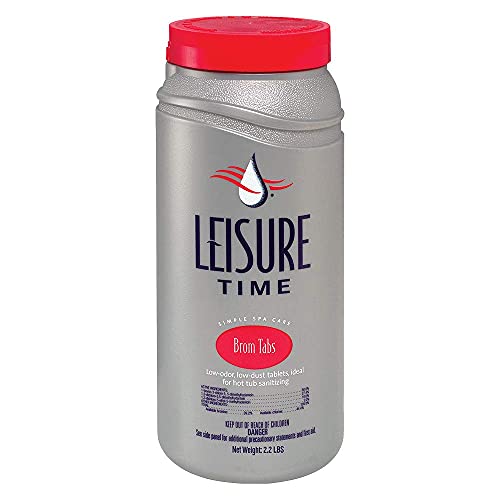
The Leisure Time Brom Tabs are the feed most bromine spas will live on, and they lead for the virtue the whole system promises: steadiness. The tablets are a concentrated bromine sanitizer in slow-dissolving form, designed to be dosed through a floating dispenser or feeder, where they erode gradually and hold the water’s bromine level in range across days rather than spiking and crashing with each manual dose. Leisure Time notes they fit all floaters, and the two-point-two-pound container is sized for a season’s rhythm of refills rather than a single rescue. For owners whose spa sits at a second home, or whose weeks are simply full, the tablet-and-floater routine is the closest thing spa sanitation has to cruise control.
Strengths
- Slow, steady feed flattens the level swings that plague hand-dosed spas.
- Universal floater fit per the maker, so the hardware choice stays open.
- Container size matches a season of routine rather than a single event.
Trade-offs
- Tablets are a feed, not a start-up: the bank and an initial boost still come first.
- Feed rate depends on the floater’s setting and water temperature, so early weeks need testing while you calibrate.
- Never place tablets directly in the spa or skimmer unless the label and spa maker allow it; concentrated contact can mark surfaces.
| Size | 2.2 lb (Pack of 1) |
|---|---|
| Dimensions | 3.4 x 3.4 x 6.5 inches |
Calibration is the honest first fortnight: set the floater mid-range, test every couple of days, and adjust the vents until the reading holds in the label’s range through your household’s use pattern. Once dialed, the routine compresses to a weekly glance, an oxidizer dose, and a floater refill when the tablets run low. That compression is what owners are actually buying, and these tabs, in a well-set floater over an established bank, deliver it as reliably as anything in spa care.
Best for: steady, low-touch bromine sanitation in floater-fed spas / Not suited for: start-up dosing or biguanide systems
Choose Brom Tabs as the standing feed. Skip them only if your spa maker specifies a different feeder system. Check on Amazon

Leisure Time Reserve
Our badge: Best System Foundation
The Leisure Time Reserve is the bank, and the bank is bromine’s foundation. Leisure Time describes it as a liquid bromine sanitizer that creates a chlorine-free sanitation system: added when the spa is filled and weekly thereafter, it establishes a reservoir of bromide in the water, and it is designed to work with an oxidizer, the maker’s Renew, as the system’s shock. The oxidizer converts bank into active bromine on demand, and active bromine, its work finished, partly returns to the bank, so the foundation is continually recycled rather than consumed. Every other pick in this guide performs better on top of this reservoir, which is why a foundation product outranks flashier hardware here.
Strengths
- Establishes the bromide bank the whole bromine cycle depends on.
- Liquid form acts immediately at fill, before tablets can build a level.
- Weekly rhythm integrates with the oxidizer schedule into one routine.
Trade-offs
- A system commitment: bank, feed, and oxidizer are three coordinated purchases.
- Skipping weekly bank doses silently starves the oxidizer of anything to activate.
- Bromine-specific testing is required to see the system you are running.
| Size | 1-Pack |
|---|---|
| Dimensions | 3.12 x 3.12 x 9.38 inches |
| Weight | 2.5 pounds |
Start-ups show the foundation’s value most clearly: a fresh fill dosed with Reserve has an activatable sanitizer reservoir from the first hour, so the first oxidizer dose produces real sanitation instead of chasing a level that tablets alone would take days to build. Converts from chlorine should establish the bank only in fresh water, after the drain and rinse the conversion section describes, because the bank’s chemistry presumes a clean start.
Best for: every bromine start-up and the weekly rhythm that sustains it / Not suited for: chlorine or biguanide water
Choose Reserve at every fill and weekly. Skip it, and the rest of the bromine system is improvisation. Check on Amazon

AquaDoc 7-in-1 Test Strips
Our badge: Best Testing Partner
The AquaDoc 7-in-1 Test Strips read bromine directly, which is why they anchor this guide’s testing. The two-hundred-strip pack covers total chlorine, free chlorine, bromine, pH, total alkalinity, total hardness, and cyanuric acid by dip, wait, and color-chart comparison, with an optional digital reader in the maker’s range. Bromine owners converting from chlorine are often surprised how much friction disappears when the strip speaks bromine natively: the target range is the label’s bromine range, read as itself, with no conversion arithmetic and no borrowing of chlorine intuitions that do not transfer.
Strengths
- Native bromine reading plus the balance parameters bromine efficiency depends on.
- Two hundred strips fund the frequent testing a new bromine routine needs while it calibrates.
- Simple enough for the whole household, which is how testing survives busy weeks.
Trade-offs
- Comparative color reading has precision limits the digital reader or a liquid kit can narrow.
- Strips expire and dislike humidity; storage discipline is part of accuracy.
- A reading guides dosing; each product’s label still sets its dose.
| Size | Digital Water Test Kit |
|---|
Test most in the first month: at start-up, after the first oxidizer, through the floater’s calibration, and after the first heavy-use weekend, because those readings are the spa’s autobiography and every later decision quotes them. Thereafter the bromine rhythm needs only its weekly confirmation and a test after anything unusual, a storm’s debris, a party, a long absence. The strips make both phases cheap enough to actually happen.
Best for: bromine households calibrating and then cruising / Not suited for: laboratory-grade precision demands
Choose AquaDoc for bromine-native testing. Skip it only behind a faithful liquid kit habit. Check on Amazon
Bromine Granules (Type)
Our badge: Best Fast Correction
Bromine granules, described as a type, are the fast form of the same chemistry the tablets feed slowly: a quick-dissolving granular bromine, typically a bromine-and-oxidizer blend, broadcast over the water with the pump running to raise the level within the hour. Their moments are start-up day, when the spa should not wait for tablets to erode, and recovery, when a heavy weekend has drawn the level down and the floater’s steady pace cannot restore it before the next soak. Every bromine household ends up owning both forms, tablets for the cruise and granules for the corrections, and pretending one form does both jobs is how levels seesaw.
Strengths
- Fast level recovery for start-ups and post-party corrections.
- Precise manual dosing when a test gives a specific deficit.
- Same chemistry family as the tablet feed, so no system conflict.
Trade-offs
- Manual dosing is a habit; granules alone will not hold a level across a busy week.
- Easy to overshoot with enthusiastic scooping; dose to the label and retest.
- Must be stored dry and never mixed with other chemicals.
Keep the granules at the spa with the test strips, because their use case is always discovered by a reading: level low, guests coming, granules dosed, circulation run, retest green. That ten-minute loop, available only to households that stocked the fast form in advance, is the difference between a bromine spa that feels managed and one that feels moody.
Best for: start-ups and rapid corrections / Not suited for: sole long-term feeding
Choose granules as the tablet system’s partner. Skip them, and every correction becomes a wait.
Bromine Floater Dispenser (Type)
Our badge: Best Delivery Hardware
The bromine floater, described as a type, is the unglamorous hardware that makes the Best Overall pick possible: a floating dispenser with adjustable vents that holds the tablets and meters their erosion into the water as it drifts. Its virtues are adjustability and indifference, since it feeds at three in the morning and during the holiday week with the same patience. Better floaters hold enough tablets for weeks, keep them off the spa’s surfaces, and let the owner dial the feed up for a party weekend and down for a quiet month, which is the entire control surface a tablet routine needs.
Strengths
- Turns tablets into a settable, continuous dose.
- Keeps concentrated tablets off acrylic and vinyl surfaces.
- Size options match spa volume and absence length.
Trade-offs
- A floater is only as good as its setting; calibration testing is still required.
- Some owners remove floaters while soaking, a habit each household can decide with the spa maker’s guidance.
- Cheap floaters crack and stick; the hardware deserves a modest quality bar.
Buy it sized for your spa and tablets, set it mid-range, and let the test strips arbitrate the adjustment over the first fortnight. The floater’s low status in spa marketing is inversely related to its importance in spa reality, and bromine households that respect it stop thinking about sanitation between refills, which is the system’s whole promise.
Best for: every tablet-fed bromine spa / Not suited for: spas whose makers specify in-line feeders instead
Choose the floater as essential hardware. Skip it, and tablets have no honest way to work.
Bromine Generator System (Type)
Our badge: Best Automated Route
A bromine generator, described as a type, is equipment that manufactures bromine in the water from a bromide salt reserve, electrolytically, at a rate the owner sets on a control. The spa is filled with the salt bank dissolved in it, and the generator converts bank to active bromine continuously as water circulates, which collapses the feed half of the routine into a dial. Owners who travel, or whose spas sit at properties they visit monthly, find in the generator the lowest-touch bromine routine available, with testing and balance remaining, as always, the owner’s irreducible job.
Strengths
- Continuous generation replaces tablet feeding and most manual dosing.
- Output is adjustable to use patterns and seasons.
- Pairs naturally with the bank concept the whole system already teaches.
Trade-offs
- Equipment cost, installation, and a cell with a service life.
- Compatibility and fitting belong to the spa and generator makers’ instructions.
- Automation reduces dosing work, not testing, balancing, or filtration duties.
Treat the generator as the graduation route: owners who have run tablets for a season know their water’s appetite, and that knowledge is what makes the generator’s dial meaningful rather than mysterious. New owners are usually better served by the tablet system’s transparency while they learn, then by automation once the learning is theirs.
Best for: experienced bromine owners and remote spas / Not suited for: first-season owners still learning their water
Choose the generator as the automation upgrade. Skip it until the manual system has taught you your spa.
Comparison Table
| Pick | Form | Role | Touch Level | Check price on Amazon |
|---|---|---|---|---|
| Leisure Time Brom Tabs | Tablets | Steady feed | Low | Check price on Amazon |
| Leisure Time Reserve | Liquid | Bank foundation | Weekly dose | Check price on Amazon |
| AquaDoc 7-in-1 Test Strips | Strips | Testing | Minutes weekly | Check price on Amazon |
| Bromine Granules (Type) | Granular | Fast correction | As needed | Check price on Amazon |
| Bromine Floater (Type) | Hardware | Tablet delivery | Set and refill | Check price on Amazon |
| Bromine Generator (Type) | Equipment | Automated generation | Lowest | Check price on Amazon |
How to Choose the Best Bromine for Hot Tubs
Decide Your Touch Level First
Tablets in a floater for the cruise-control household, granules in hand for the attentive owner, a generator for the remote spa. Bromine forgives all three styles because the chemistry underneath, bank plus oxidizer plus testing, is identical; only the feeding differs. Choose the feed that matches your calendar honestly, since the best system is the one that survives your busiest month.
Budget the Whole System, Not the First Bottle
Bank builder, feed, oxidizer, floater, strips: the bromine shelf is five modest items, and pricing only the tablets understates the routine while overstating nothing. The system’s economy appears across the season, in stability and in the recycling bank, so judge it as a season’s water care rather than a checkout total.
Confirm Compatibility Before Converting
Bromine suits most spas, but the spa maker’s guidance governs, and biguanide water must never meet it. If your spa currently runs chlorine, conversion is a planned drain-day project from the how-to below. If it runs biguanide, conversion is a bigger project involving thorough rinsing, and some owners reasonably choose to stay; the guide’s loyalty is to correct systems, not to bromine at any cost.
Respect Bromine’s Own Numbers
Bromine’s target ranges, dosing, and behavior differ from chlorine’s, and its comfort advantages come from running it as itself. Buy bromine-reading tests, follow bromine labels, and retire chlorine intuitions at the conversion drain; half-translated routines are the ones that disappoint.
How to Start and Run a Bromine Hot Tub, Step by Step
Begin at a drain: empty the spa, rinse surfaces and plumbing as the spa maker directs, and refill with fresh water, because bromine is established in clean water, never blended into another system’s. Balance alkalinity, then pH, into their ranges. Establish the bank with the Reserve pick at its label’s fill dose. Add the oxidizer per its label to activate the first active bromine, and load the floater with the Brom Tabs pick, vents mid-range. Test after circulation: bromine should read in the label’s range; correct with granules if it lags. Through the first fortnight, test every few days and adjust the floater until the level holds through your household’s actual use. Thereafter the rhythm is weekly: test, oxidizer dose, bank dose, floater check, and a filter rinse on the filtration guide’s schedule.
After heavy use, a party, or a storm’s debris, insert an extra oxidizer dose and a test rather than waiting for the weekly slot. After an absence, test before soaking and correct in the granules loop if needed. Every few months, the water itself is retired at a drain and the start-up repeats, shorter each time because the routine is now the household’s habit rather than its project.
Problem: Bromine reading will not rise — Check the bank first, since oxidizer cannot activate an empty reservoir; then balance, then feed setting, in that order, testing after each correction rather than stacking changes.
Problem: The water smells faintly sweet or chemical — Bromamines and imbalance both speak this way; oxidize on schedule, verify pH, and confirm the floater is actually feeding rather than bridged or empty.
Problem: Level swings between visits — The floater’s setting or tablet load is mismatched to the interval; enlarge the reserve of tablets, adjust vents by test evidence, and consider the generator route if absences are the household’s normal.
Problem: Cloudy water in a bromine spa with a good reading — Look mechanical: filter age and rinse state, circulation hours, and water age, because sanitation in range plus cloudiness is filtration’s signature, addressed in the filtration guide.
Bromine Versus Chlorine, Without the Holy War
The honest comparison is short. Chlorine is cheaper per dose, faster to correct with, universally understood, and at its best in cooler water and pools; it gasses off at spa temperatures, its waste products announce themselves in smell and sting, and its level demands more frequent attention in a hot tub. Bromine costs more per unit, corrects more slowly, and asks for a system owner’s mindset; in return it holds at heat, tolerates the spa’s pH wanderings, recycles through its bank, and produces water whose character owners consistently describe as gentler and quieter. Neither is virtuous. Households that soak daily and hate fuss usually land on bromine; households that soak rarely and prefer the cheapest simple chemistry often stay on chlorine and are right to. This guide’s job is to make the bromine landing succeed for those who choose it, and its sibling guides give chlorine the same respect.
Bromine in Inflatable and Portable Spas
Owners of the inflatable spas elsewhere in this lot ask whether bromine suits them, and the answer is a qualified yes that follows the spa maker’s word first, since some inflatable makers specify their own care products and materials vary. Where the maker permits bromine, the system scales down gracefully: bank at fill in the small volume, a mini floater sized for portable spas, oxidizer on the same weekly logic, and strips reading the same ranges. The cautions scale too: small volumes swing faster, so test more often, and materials should be rinsed at the seasonal drain with the maker’s care instructions in hand. Chemistry is chemistry at any size; only the margins shrink.
Common Buying Mistakes
Pouring Bromine Into Chlorinated Water and Calling It Converted
Conversion is a drain-day event. Blended water gives unstable readings and the worst of both systems, and every manufacturer’s choreography says so in plainer language than this guide’s.
Buying Tablets Without the Bank or the Oxidizer
Tablets alone build a level slowly and leave it unactivated in spirit. The system’s three legs are sold separately because they are used at different rates, not because two of them are optional.
Testing Bromine With Chlorine Habits
Chlorine ranges, chlorine timing, chlorine intuition: none transfer. Bromine-native strips and bromine labels are the conversion’s final step, and skipping it leaves owners fluent in a language their water no longer speaks.
Dropping Tablets Loose Into the Spa
Concentrated sanitizer resting on acrylic or vinyl can mark and damage it. Tablets belong in the floater or feeder the system prescribes, full stop.
Storing Bromine With the Pool Chemicals in a Damp Shed
Dry, separated, original containers, away from children: the storage rules are the same as every spa chemical’s and are repeated here because bromine’s gentleness in water invites a carelessness its concentrated forms do not deserve.
Bromine and the Cover: The Chemistry Nobody Mentions
The spa cover lives in the sanitizer’s weather, and bromine writes a specific chapter there. Bromine vapor, like chlorine’s, works on the cover’s underside and stitching across the years, and bromine’s steadiness at temperature means the cover breathes it constantly rather than in spikes. The care that answers is simple and often skipped: leave the cover open for a while after an oxidizer dose, as the shock sections already direct, so the strongest vapor leaves by the sky rather than by the cover; rinse the underside occasionally in the cover’s own cleaning rhythm; and when the cover eventually ages, judge it by its weight and its seal rather than its looks, since a waterlogged cover is an insulation failure and a handling hazard in one. None of this is an argument against bromine, whose cover story is no worse than chlorine’s and arguably gentler, but the owner who knows the cover is part of the chemical system will keep both longer, and will not be surprised, as many are, that the spa’s most expensive accessory ages from the inside out.
Troubleshooting the Bromine Year: A Seasonal Audit
Bromine systems reward an annual honest audit, and the turning of the year is its natural date. Walk the system as a stranger would: the floater’s plastic fatigued or sound, its vents moving freely; the bank and oxidizer products within their dates and stored dry; the strips fresh enough to trust; the filter on its own guide’s rhythm; the log complete enough to answer what the spa consumed and how the levels ran. Read the year’s readings for drift, the slow creep that weekly familiarity hides: if oxidizer doses have been growing, the load or the water’s age is speaking; if the bank’s appetite changed, the household’s use changed with it. Plan the year’s drains rather than meeting them as emergencies, and price the season whole, bank, feed, oxidizer, strips, filters, so bromine’s true cost stands in the open next to chlorine’s, where in most households it justifies itself in steadiness rather than in savings. The audit takes an hour and returns a system the owner understands as a system, which was this guide’s thesis from its first paragraph: bromine is not a bottle, and the owners who keep it as a system are the ones still praising it in year five.
Bromine for the Beginner: The First Month, Week by Week
New bromine owners deserve a calendar for the bewildering first month, when every reading feels like a verdict. Week one is establishment: the fresh fill balanced, the bank dosed, the floater loaded and set mid-range, the oxidizer introduced, and readings taken daily without panic, since a new system hunting for its level is a system learning, not failing, and the keeper’s job is notes rather than corrections. Week two is calibration: the floater’s vents adjusted by the readings’ trend, a notch at a time with days between changes, because bromine’s steadiness can only be tuned slowly and the owner who adjusts daily is chasing their own wake. Week three is the first real test, a normal week of household use with its parties or its quiet, and the readings through it tell the owner what their spa’s appetite actually is, the number every later decision quotes. Week four is the audit: bank, feed, oxidizer, and strips all checked against the log, the first filter rinse performed, and the routine compressed into the weekly rhythm the rest of the year will follow. Owners who survive the month with their log intact consistently report the same surprise, that the system they feared was complicated was merely new, and that bromine’s reputation for calm is earned precisely by the patience of these four weeks.
Two-Part Harmony: Teaching a Household the Bromine Routine
A bromine system kept by one expert and three improvisers will fail at the household’s seams, and the routine’s teachability is a genuine selection criterion this guide should honor. The system compresses, fortunately, into a teachable card: test before soaking if the week has been busy, oxidizer after the big soak nights and on the week’s fixed day, bank on its day, floater checked whenever the cover is open, and anything that looks or smells wrong gets a strip before it gets a dose. Written on the card that lives with the strips, that paragraph has carried households of teenagers, guests, and rotating grandparents through seasons of clear water, because bromine’s forgiveness, its wide effective range and its recycling bank, tolerates the small inconsistencies a household inevitably produces better than a twitchier chemistry would. The expert’s remaining jobs are the monthly audit and the seasonal drain, and even those can be taught. Choose bromine, in other words, not only for the water it makes but for the household it fits: one whose care will be shared, approximated, and occasionally forgotten, and whose spa must stay kind through all of it.
Bromine Costs Across a Year: The Honest Ledger
Bromine’s reputation for costing more than chlorine deserves an audit rather than an argument, and the audit’s shape will help any household deciding between the systems. The bromine ledger has more lines: the bank product on its weekly rhythm, the tablet feed, the oxidizer, and bromine-reading tests, where the chlorine ledger concentrates its cost in the sanitizer itself and its more frequent corrections. Against those lines stand bromine’s quieter savings, which never appear on a receipt: fewer rescue interventions in a system that holds its level, fewer balance corrections in water that tolerates the spa’s natural pH drift, and, hardest to price and easiest to feel, the soaks not ruined by a level that crashed between visits. The honest total for most households lands modestly above chlorine’s, a premium measured in a season’s small money, and the households that pay it knowingly describe it as buying steadiness rather than chemistry. Households for whom the premium genuinely matters should run chlorine well rather than bromine resentfully, since a system kept gladly outperforms a system kept grudgingly in every chemistry known to this lot. The ledger’s purpose is not to crown a winner but to make the choice a purchase instead of a surprise, which is the service this guide has tried to perform for every product it contains.
Bromine and Hot Climates: The System Where the Sun Is the Enemy
This guide has praised bromine’s behavior at heat from the water’s side; a closing section should honor its behavior in hot places, where the spa itself lives at the climate’s mercy. Bromine’s stability in warm water extends to warm weather, and spas in hot regions, where an uncovered afternoon can push water temperatures toward the uncomfortable and a chlorine residual can fall apart between morning and evening, benefit from a sanitizer that does not evaporate its effectiveness into the sunlight. The hot-climate bromine household’s adaptations are mostly about the cover and the calendar: the cover as a sunshade as much as an insulator, vented or propped in the stillest heat so the water does not cook past soaking range; oxidizer timed for the evening, when the day’s bathers and the day’s heat have both done their work; and the floater’s setting reviewed at the season’s turns, since a spa whose water runs warm consumes its feed at a different rate than the same spa in October. Owners in the desert and the Gulf states who run bromine often cite the same virtue as their northern cousins, steadiness, discovered from the opposite thermometer, which is perhaps the strongest testimony a sanitizer system can earn: it is the calm choice at both ends of the map.
The Quiet Virtue: Bromine and the Unattended Week
One scenario deserves a final section because it decides more purchases than any other and is rarely dramatized in showrooms: the week nobody comes. Work travel, a family emergency, the holiday fortnight, the spa will spend real portions of its life unattended, and the sanitizer systems part company precisely there. A chemistry that depends on frequent manual dosing returns to a spa that has drifted, sometimes past the point where a simple correction suffices, while the bromine system’s architecture, a bank in the water, a floater feeding at its erosion’s pace, an oxidizer debt that a single dose on return can settle, was practically designed for the unattended interval. The returning owner’s ritual is short, test, oxidize, circulate, retest, and the water is usually ready before the suitcases are unpacked, a small domestic miracle that owners of less forgiving systems regard with open envy. Households whose lives include regular absence should weight this section heavily, because a spa’s true cost includes the rescues it demands, and the system that waits patiently is, across a decade of real life, the system that gets used. Bromine’s steadiness has been this guide’s theme in the water, at the thermometer, and across the calendar; the unattended week is simply where the theme becomes a verdict.
Converting a Skeptical Household: The Two-Week Trial Mindset
Many bromine purchases are really household negotiations, one partner converted by a friend’s spa, the other loyal to the chlorine they understand, and the conversion deserves a fair procedure rather than a sales pitch. The honest trial is a season, not a soak, since bromine’s virtues are statistical, steadiness across weeks, and its first fortnight is its least representative, all calibration and new habits. Agree the trial’s terms in advance: the system installed whole, bank, feed, oxidizer, strips, at the drain that conversion requires anyway; the log kept by the skeptic as well as the advocate, since shared data ends more arguments than shared enthusiasm; and the verdict deferred to the season’s evidence, levels held, interventions counted, evenings enjoyed. Households that run the trial fairly usually keep the system, and the ones that return to chlorine do so with a respect for what they tried and a clearer knowledge of their own preferences, which is also a successful outcome. What neither partner should accept is the blended half-conversion, bromine products drifting into chlorinated water on a whim, since that is the one version of the experiment guaranteed to disappoint both sides and to be quoted, unfairly, as bromine’s fault at family gatherings for years.
A Final Word on Steadiness
Every guide in this lot has a virtue it keeps circling, and bromine’s is steadiness: steady at temperature, steady across the pH’s wanderings, steady through the unattended week, steady in the hands of a household that shares the work imperfectly. Owners do not write poems about steadiness, but they renew it, season after season, in the only currency that counts, which is the next purchase of the same system. If the water in your life has been a series of small emergencies, that renewal is the sound this guide has been describing all along, and the system in these pages, bank, feed, oxidizer, and honest testing, is how it is earned.
Final Recommendation
Build the system in this order: the Leisure Time Reserve to establish the bank at every fill, the Leisure Time Brom Tabs as the standing feed, reached through their Check on Amazon link, a floater to deliver them, monopersulfate as the oxidizer rhythm from the non-chlorine guide, and the AquaDoc strips reading bromine natively over all of it. Run that system for one season and the hot tub’s water will make bromine’s argument better than this page can: steady, quiet, and ready whenever the cover lifts.
Frequently Asked Questions
Is bromine better than chlorine for a hot tub?
For many hot tub households, yes, for structural reasons: bromine remains effective at spa temperatures, tolerates the pH range spa water lives in, and its byproducts are less odorous and irritating while still working. Chlorine remains cheaper and faster to correct. The better system is the one whose routine your household will actually run, run correctly.
Can I switch my hot tub from chlorine to bromine?
Yes, at a drain: empty, rinse as the spa maker directs, refill, balance, establish the bromine bank, and start the bromine routine in the fresh water. Do not blend bromine products into chlorinated water and call it a conversion; the unstable middle state is what gives conversions a bad name.
Do I still need shock with bromine?
Yes, and in the bromine system the oxidizer is essential rather than occasional, because it converts the bromide bank into active bromine. The non-chlorine shock guide covers that oxidizer in depth; in a bromine spa it is dosed weekly and after heavy use, on the bromine labels’ rhythm.
What bromine level should my hot tub hold?
Follow your products’ labels and the spa maker’s guidance, which specify the target range for bromine in spa water, and test with bromine-reading strips to confirm you are in it. This guide deliberately points to the labels for numbers, because the correct range is a property of your system and products, and they are the authority at your spa’s edge.
Can bromine be used in an inflatable hot tub?
Where the inflatable’s maker permits it, yes, with the system scaled to the small volume and testing done more often because small water swings faster. Some inflatable makers specify their own care products, and their word governs their materials; check the manual before the first dose.
Why does my bromine level keep dropping?
Work the checklist in order: bank depleted, balance out of range, floater empty or vents closed down, heavy recent use, or water old enough to retire. Test after each single correction. A level that falls despite all five points addressed is a conversation for the spa’s maker or a water-care professional, with your test log in hand.


