Disclosure: As an Amazon Associate, dailyhomedecorating.com earns from qualifying purchases. Links to Amazon on this page are affiliate links; they cost you nothing extra. Prices and availability change often, so check the current Amazon listing before you buy.
Finding the best cleaner for fiberglass tubs and showers is a search for a narrow balance, because fiberglass is a strong material wearing a delicate face. The gelcoat surface that gives a fiberglass tub-shower its gloss scratches under abrasives, dulls under harsh solvents, and can be stained by the very products meant to clean it if they are left sitting or chosen carelessly. The best cleaner for fiberglass tubs and showers therefore works by chemistry and dwell time rather than by force, is explicitly safe for fiberglass on its label, and matches the soil in front of you: soap scum, hard-water scale, mildew in the seams, or the gray film of everyday use. This guide ranks three verified cleaners you can buy today, each with fiberglass named among its intended surfaces, and adds three prose-only cleaner types that complete a fiberglass-safe system, because no single bottle honestly does every job in a tub-shower.
The cost of getting this wrong is cumulative and mostly invisible until it is not. Every scouring pad pass cuts microscopic valleys into the gelcoat, and those valleys hold the next month’s scum more tightly, so the tub gets harder to clean in direct proportion to how hard it has been cleaned. Fiberglass owners who thrive follow the opposite law: the gentlest effective cleaner, given its full dwell, rinsed completely, on a short interval. The companion guide to Best Soap Scum Remover For Fiberglass Tubs goes deeper on the single most common fiberglass enemy, and the plastic-tub guide in this lot, Best Cleaner For Plastic Tubs, covers the sister material whose rules rhyme with these.
Read the Quick Picks for a fast match to your soil, then the reviews for how each cleaner behaves on gelcoat specifically, including the cautions that the front of the bottle understates. The buying guide teaches label reading for fiberglass, the how-to section gives a complete safe cleaning sequence for a tub-shower unit, and two deeper sections cover gelcoat repair thinking and the hard-water reality that shapes most fiberglass cleaning lives.
Where to Buy
All three linked picks are sold on Amazon, where you can check the current price and availability and read the full label details before buying. Start with the Wet & Forget Shower Cleaner Spray as the weekly no-scrub foundation, and confirm it through its Check on Amazon link. The other linked picks are the Scrubbing Bubbles Grime Fighter Disinfectant Bathroom Cleaner Spray — Check on Amazon — and the Zep Shower Tub and Tile Cleaner — Check on Amazon, included for mineral scale with the acid cautions its review explains. The prose-only types are sold everywhere bathroom cleaners are sold; whatever you buy, the label must name fiberglass or gelcoat among its safe surfaces.
In this guide
Quick Picks
| Pick | Badge | Why it earns its place |
|---|---|---|
| Wet & Forget Shower Cleaner Spray | Best Overall | A bleach-free, no-scrub weekly spray that works on fiberglass and prevents soap scum and grime from ever curing. |
| Scrubbing Bubbles Grime Fighter Disinfectant Bathroom Cleaner Spray | Best for Soap Scum | A foaming disinfectant cleaner formulated to remove soap scum, with fiberglass among its listed surfaces. |
| Zep Shower Tub and Tile Cleaner | Best for Mineral Scale | An acidic, scrub-free formula that dissolves water-related stains and scale, used briefly and carefully on fiberglass. |
| Gelcoat-Safe Enzyme Cleaner (Type) | Best for Everyday Film | Enzyme and surfactant cleaning for the weekly gray film, with dwell doing the work. |
| Non-Abrasive Cream Cleanser (Type) | Best for Spot Stains | Hand-controlled cleaning for waterline rings, dye marks, and rust freckles. |
| Oxygen-Powder Soak Method (Type) | Best for the Tub Base | A filled-tub soak that resets the base and textured floor with zero contact cleaning. |
Key Takeaways
- Fiberglass means gelcoat, and gelcoat’s first law is non-abrasive: soft cloths and sponges only, forever.
- The label must name fiberglass among safe surfaces; silence on the label is a no.
- Weekly no-scrub prevention beats monthly rescue, because scum that never cures never needs force.
- Acidic scale removers work on fiberglass only briefly, spot-tested, and rinsed completely; never let them dwell like a tile cleaner on tile.
- Match chemistry to soil: surfactants and enzymes for film, foam for scum, careful acid for mineral scale.
- Rinse everything thoroughly; dried cleaner residue is the next film you will be cleaning.
How These Picks Were Chosen
Linked picks come from the verified supplement pool for this site, chosen because each product’s own listing names fiberglass among the surfaces it serves, and each fills a distinct role: weekly prevention, soap scum removal with disinfection, and mineral scale treatment. Their features are reported from the manufacturers’ listings and shown in the spec boxes. The prose-only types complete the system with methods every fiberglass owner needs, an enzyme cleaner for film, a cream cleanser for spots, and an oxygen soak for the base, described qualitatively with no invented specifications.
Excluded were abrasive powders and pads, scouring products, strong solvent degreasers, and any cleaner whose label omits fiberglass, however famous its brand. Also excluded as a routine recommendation is prolonged bleach soaking on gelcoat, which risks yellowing and dulling; disinfection, where wanted, is better served by a labeled disinfectant cleaner used as directed, as one of the linked picks provides. Zep’s acidic formula is included with explicit cautions rather than excluded, because mineral scale is a real fiberglass problem and an honestly caveated tool serves readers better than silence, provided the cautions travel with it everywhere it is mentioned.
The method is label- and material-based: gelcoat’s known sensitivities, each product’s stated surfaces and directions, and the conservative sequence of test, dwell, rinse that protects finishes. Where a claim belongs to a manufacturer, it is reported as the manufacturer’s, and your own spot test remains the final authority on your specific tub, especially if it is older or refinished.
The 6 Best Cleaner for Fiberglass Tubs and Showers — Reviewed

Wet & Forget Shower Cleaner Spray
Our badge: Best Overall
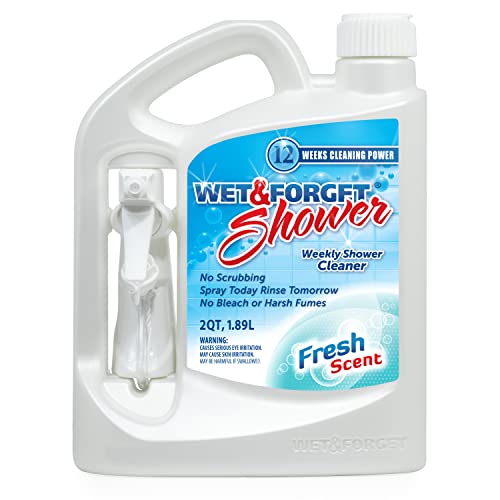
The Wet & Forget Shower Cleaner Spray earns the top badge by changing the fiberglass cleaning problem from scrubbing to scheduling. Its no-scrub, no-rinse weekly formula is sprayed on, left for eight to twelve hours, and rinsed with warm water at the next use, cleaning and preventing soap scum, grime, and body oils on fiberglass, acrylic, tile, and glass. It is bleach-free, with no ammonia or dyes, in a fresh scent, and the maker notes a bottle provides up to twelve weeks of weekly cleaning. For gelcoat, the absence of contact is the entire virtue: nothing rubs the surface, nothing can scratch it, and the interval is short enough that soil never becomes a project.
Strengths
- True no-scrub method eliminates abrasion risk on gelcoat entirely.
- Weekly prevention keeps soap scum and grime from curing on fiberglass.
- Bleach-free formula avoids the yellowing risk of bleach routines.
Trade-offs
- It is a prevention and maintenance system; heavy existing buildup needs a pre-clean first, as the maker itself advises.
- The eight-to-twelve-hour dwell requires planning around the household’s showers.
- It prevents hard-water staining but is not a heavy scale remover.
| Color | Fresh Scent |
|---|---|
| Size | 64 Fl Oz (Pack of 1) |
| Dimensions | 7.75 x 4.1 x 9 inches |
| Weight | 4.94 pounds |
The ownership rhythm is simple enough to survive real life: spray after the week’s last shower, rinse at the next, and watch the fiberglass stay at a baseline that makes every other cleaner in this guide an occasional guest. Households with severe existing buildup should do one honest rescue clean first, with the Scrubbing Bubbles pick below, then hand the tub to Wet & Forget for keeping. That division of labor, rescue once, prevent forever, is the most gelcoat-friendly strategy in this entire lot of cleaning guides.
Best for: weekly prevention on fiberglass tub-showers in regular use / Not suited for: rescuing a neglected unit on its own
Choose Wet & Forget as the system’s foundation. Skip it as a rescue product; rescue first, then prevent. Check on Amazon

Scrubbing Bubbles Grime Fighter Disinfectant Bathroom Cleaner Spray
Our badge: Best for Soap Scum
The Scrubbing Bubbles Grime Fighter Disinfectant Bathroom Cleaner Spray is the rescue and deep-clean pick: a foaming bathroom cleaner formulated to remove soap scum and bathroom grime, with disinfectant action when used as directed, and with fiberglass explicitly among its listed surfaces alongside tile, tubs, shower walls and doors, sinks, and fixtures. The foam clings long enough to dwell on vertical fiberglass, which is where tub-shower soil lives, and the spray format makes a full-unit clean a matter of minutes of application plus patience.
Strengths
- Formulated for soap scum, the defining fiberglass soil, with fiberglass a listed surface.
- Foam dwell works on walls and surrounds without running off.
- Disinfectant action for households that want it, used as directed.
Trade-offs
- A stronger cleaner than the weekly pick; respect dwell times and rinse completely.
- Scented and active in a small steamy bathroom; ventilate while it works.
- Not the tool for heavy mineral scale, which is the Zep pick’s narrow job.
| Size | 32 Fl Oz (Pack of 1) |
|---|
Use it as the periodic deep clean and the pre-clean before starting a Wet & Forget routine: spray, let the foam work for the label’s time, wipe with a soft cloth or sponge only, and rinse until the surface runs clean, because a disinfectant cleaner left to dry on gelcoat becomes residue with ambitions. On textured fiberglass floors, work the foam in with a soft brush in small circles. Between deep cleans it is also the spot answer for a scum bloom after a houseful of guests, the moment when fiberglass most often gets scrubbed in panic with whatever is under the sink; having the right bottle there is a gelcoat protection strategy in itself.
Best for: periodic deep cleans and soap scum rescue on fiberglass / Not suited for: daily use or mineral scale removal
Choose Scrubbing Bubbles for the rescue and the monthly reset. Skip it as your only cleaner if prevention appeals more. Check on Amazon

Zep Shower Tub and Tile Cleaner
Our badge: Best for Mineral Scale
The Zep Shower Tub and Tile Cleaner is included for the one job the gentler picks cannot do: dissolving mineral scale and water-related stains. Zep describes it as an acid-based, scrub-free formula that removes soap scum and scale from shower, tub, and tile surfaces, ready to use from the bottle. On fiberglass, acid is a tool with a narrow license, and this review grants it explicitly: spot-test in a hidden area first, apply briefly and never let it sit beyond the label’s direction, keep it away from refinished or reglazed surfaces unless their maker approves it, rinse exhaustively, and never mix it with any other cleaner, above all nothing containing bleach. Used inside those lines, it rescues fiberglass that hard water has armored in scale no surfactant can move.
Strengths
- Dissolves mineral scale and water stains that gentle cleaners cannot touch.
- Scrub-free action means no abrasion is added to the chemistry.
- Ready-to-use bottle keeps the strong tool controlled and occasional.
Trade-offs
- Acidic: the highest-caution product in this guide on gelcoat, demanding spot tests and brief contact.
- Not for routine cleaning, and not for refinished surfaces without their maker’s approval.
- Ventilation and gloves are part of the method, not optional extras.
| Size | 32 Fl Oz (Pack of 1) |
|---|---|
| Dimensions | 3 x 11.2 x 4.4 inches |
| Weight | 2.01 pounds |
The households that need this pick know who they are: the ones whose fiberglass has gone rough and white at the waterline and around the fixtures despite faithful gentle cleaning, because their water deposits stone faster than soap. For them the choice is not between Zep and gentleness but between brief, careful acid and permanent scale, and this guide’s answer is to use the acid like a professional: small area, short dwell, full rinse, gloves on, window open, bottle back on the high shelf afterward. If your water is soft, you will likely never need it, and your gelcoat will be glad of the fact.
Best for: hard-water scale on sound, factory fiberglass, used briefly and carefully / Not suited for: routine cleaning, refinished tubs, or anyone unwilling to spot-test
Choose Zep for the scale rescue and nothing else. Skip it entirely if your water is soft. Check on Amazon
Gelcoat-Safe Enzyme Cleaner (Type)
Our badge: Best for Everyday Film
A gelcoat-safe enzyme cleaner, described as a type, handles the weekly gray film that is most of fiberglass cleaning: body oils, soap residue, and the organic fraction of shower grime, broken down by enzymes and surfactants during dwell rather than removed by rubbing. It is the natural partner to Wet & Forget for households that prefer a wipe-on routine to a spray-and-wait one, and the safest first attempt on any new mark, because it cannot harm the surface while you learn what the mark is.
Strengths
- Gentle, dwell-based cleaning that protects gloss.
- Ideal for the weekly film between deeper cleans.
- Safe first response to unfamiliar stains.
Trade-offs
- No power against mineral scale.
- Requires its full dwell to perform; hurried wiping wastes it.
- Labels vary, so the fiberglass-safe promise must be verified per product.
Build the routine around it if your household cleans in the shower’s own rhythm: apply to the damp unit, let it dwell while you clean the mirror and fixtures with separate cloths, wipe softly, and rinse completely. On textured floors give it a soft brush and patience. It is unglamorous, inexpensive per use, and, across a decade, the difference between gelcoat that still shines and gelcoat that has been managed into dullness by stronger habits.
Best for: weekly film on all fiberglass tub-showers / Not suited for: scale or heavy scum rescue
Choose the enzyme type as the everyday workhorse. Skip it as a rescue tool.
Non-Abrasive Cream Cleanser (Type)
Our badge: Best for Spot Stains
A non-abrasive cream cleanser is the fiberglass spot specialist: a smooth, grit-free cream applied by hand on a soft cloth to the waterline ring, the dye transfer from a bath product, the rust freckle under a tap, or the gray shadow where bathers sit. Described as a type, its virtue is control: the least chemistry, on the smallest area, for the shortest time, which is exactly how a delicate surface should meet a stubborn mark.
Strengths
- Precise, minimal-contact treatment of individual marks.
- Grit-free formulas clean without dulling gelcoat.
- Economical; a bottle serves for years of spots.
Trade-offs
- Whole-unit cleaning with it is slow and wasteful.
- Some cream cleansers do contain abrasives; the label must promise otherwise.
- Needs thorough rinsing to avoid haze on glossy areas.
Verify the non-abrasive, fiberglass-safe label, test near the drain, and work in small circles, stopping the moment the mark lifts. Repeated gentle sessions beat one determined one, on gelcoat as on every delicate surface in this lot. Keep the bottle with the tub’s kit so the spot gets the right product rather than the nearest one.
Best for: rings, dye, and rust spots on fiberglass / Not suited for: general cleaning or unverified labels
Choose the cream for targeted work. Skip any version vague about abrasives.
Oxygen-Powder Soak Method (Type)
Our badge: Best for the Tub Base
The oxygen-powder soak method turns the tub half of a fiberglass unit into its own cleaning bath: fill with warm water, dissolve an oxygen-based powder per its label, soak for an extended period, drain, and wipe. Described as a type, it cleans every submerged surface at once, including the textured floor where film hides beyond a cloth’s reach, with zero abrasion risk, because nothing touches the gelcoat but water and chemistry. It is the gentlest full reset a fiberglass base can receive.
Strengths
- Contact-free cleaning of the base and textured floor.
- Resets a neglected base before a prevention routine begins.
- Reaches curves and textures that cloths skip.
Trade-offs
- Cleans only below the waterline; walls need the other picks.
- Takes time and a tub of water, so it is a planned clean.
- Powder must dissolve fully and the base must be rinsed well.
Run it quarterly, or whenever the base’s texture starts holding gray, and follow it by handing the whole unit to the weekly prevention system. Fiberglass bases that are soaked rather than scrubbed keep their texture’s grip and their gelcoat’s gloss for years longer than bases that meet brushes, which is the entire philosophy of this guide expressed in one method.
Best for: periodic base resets and textured fiberglass floors / Not suited for: walls, surrounds, or quick cleans
Choose the soak for the base. Skip it when the whole unit needs attention at once; combine methods instead.
Comparison Table
| Pick | Primary Soil | Method | Gelcoat Caution | Check price on Amazon |
|---|---|---|---|---|
| Wet & Forget Shower Cleaner | Prevention of scum and grime | Spray weekly, rinse later | Lowest: no contact at all | Check price on Amazon |
| Scrubbing Bubbles Grime Fighter | Soap scum, grime | Foam, dwell, soft wipe | Respect dwell, rinse fully | Check price on Amazon |
| Zep Shower Tub and Tile | Mineral scale | Brief acidic application | Highest: spot-test, short dwell | Check price on Amazon |
| Enzyme Cleaner (Type) | Everyday film | Apply, dwell, wipe | Verify fiberglass-safe label | Check price on Amazon |
| Cream Cleanser (Type) | Spot stains | Hand-applied | Verify grit-free formula | Check price on Amazon |
| Oxygen Soak (Type) | Base grime, texture | Filled-tub soak | None from contact | Check price on Amazon |
How to Choose the Best Cleaner for Fiberglass Tubs and Showers
Start With the Label’s Surface List
The first and most important filter is whether the manufacturer names fiberglass or gelcoat among the product’s intended surfaces. All three linked picks pass that test, which is why they are linked. A cleaner that lists only tile, porcelain, and enamel was formulated for harder faces and may carry acids or abrasives at levels gelcoat tolerates poorly. When the bottle is silent, the manufacturer’s website usually is not; check before the tub pays for the ambiguity.
Identify Your Soil Before Your Product
Soap scum is a waxy, gray-white film that smears; mineral scale is a rough, crusty deposit that catches a fingernail; everyday film is a slippery dullness; mildew lives in seams and caulk lines. Each has a chemistry in this guide, and using the wrong one wastes effort and tempts scrubbing. Diagnose on a small patch, with the gentlest candidate first, and escalate only on evidence.
Choose Your Interval, Then Your Strength
A household willing to spray weekly can run the gentlest system in this guide indefinitely. A household cleaning monthly needs the foam rescue and should expect a longer session. Neither is a moral position, but buying a prevention product for a monthly reality, or a rescue product for a weekly one, mismatches chemistry to life in both directions, and gelcoat pays for the mismatch.
Respect the Refinished Exception
Everything in this guide assumes factory gelcoat. A refinished or reglazed fiberglass tub lives under its coating maker’s rules, which are stricter: milder products, no acids without explicit approval, and nothing abrasive ever. If your tub has been refinished, read Best Bath Mat For Reglazed Tubs for the same philosophy applied to contact, and let the refinisher’s instructions outrank this guide wherever they differ.
How to Clean a Fiberglass Tub-Shower Without Damaging the Gelcoat
Begin by rinsing the whole unit with warm water and removing loose hair and grit, because grit under a cloth is the one abrasive you might introduce yourself. For a routine clean, apply the enzyme cleaner or spray the Wet & Forget if this is its scheduled day, working from the top of the surround downward so loosened soil never crosses cleaned gelcoat. Let the product dwell for its full stated time, using the interval to clean fixtures and glass with separate cloths. Wipe with a soft sponge or microfiber in long strokes, giving textured areas a soft brush in small circles, then rinse the entire unit thoroughly with the showerhead, top to bottom, until the water sheets cleanly. Dry the base if you want the gloss to read as finished.
For a rescue clean, reverse the escalation: oxygen soak the base first if it is part of the problem, foam the walls and scum with the Scrubbing Bubbles pick, spot-treat what remains with the cream cleanser, and reserve the Zep for verified mineral scale only, brief and spot-tested. Ventilate throughout, wear gloves for the stronger products, and never let two different cleaners meet on the surface at once; sequential and rinsed is the only safe choreography. Finish by handing the unit to the weekly prevention system so the rescue does not become the routine.
Problem: The gelcoat looks dull even when clean — Dullness is usually micro-scratching or dried residue; rinse exhaustively first, then commit to the non-abrasive system and accept that existing scratch dullness is managed, not reversed, by cleaning.
Problem: White crust at the waterline will not move — That is mineral scale; after confirming with a fingernail test, use the acidic pick briefly and carefully as its review directs, or call a professional if the deposit is extensive.
Problem: The textured floor stays gray — Soak it with the oxygen method, then work the enzyme cleaner in with a soft brush; texture hides film that flat gelcoat surrenders to a cloth.
Problem: Pink or black marks keep returning in the seams — That is a moisture and caulk problem as much as a cleaning one; dry the unit after use, improve ventilation, and replace failed caulk, because cleaner cannot evict growth from inside a seam.
Problem: A refinished tub needs cleaning and you are unsure — Default to the mildest enzyme method and the refinisher’s written instructions, and skip the acidic pick entirely unless they approve it by name.
Gelcoat: What It Is and Why It Ages the Way It Does
A fiberglass tub is a composite: glass fibers in resin give it structure, and a pigmented gelcoat layer gives it the colored, glossy skin you actually touch and clean. Gelcoat is durable but not immortal. Ultraviolet is rarely its enemy indoors; its enemies are abrasion, which thins and scratches it, strong chemistry left sitting, which can soften or stain it, and time at stress points, where hairline crazing can appear around drains and seat edges. Understanding that the gloss is a skin explains every rule in this guide: you are not cleaning a rock, you are caring for a finish, closer in spirit to a car’s paint than to a tile wall. It also explains the good news, that gelcoat cared for gently keeps its gloss for decades, and that minor dullness can sometimes be polished by specialists, while the scratches from a single season of scouring pads are effectively permanent. Clean like the surface is borrowed, and it will look owned for years.
Hard Water and Fiberglass: Managing the Mineral Reality
In hard-water regions, fiberglass cleaning is mineral management with occasional soap. Scale builds at the waterline, around fixtures, and anywhere water stands and evaporates, and it bonds to gelcoat’s microscopic texture more eagerly than to glazed porcelain. The counters are rhythm and drying: shorter intervals so scale never armors, a squeegee or towel pass on the surround after showers in the hardest water, and the careful acidic rescue reserved for what prevention missed. Households with softeners live a different, easier cleaning life and often never meet the Zep pick at all. For the rest, the honest goal is a tub where scale is a quarterly event measured in minutes, not a geology project, and that goal is achieved by the prevention system far more than by any strength of rescue.
Common Buying Mistakes
Using Tile-Strength Products on Gelcoat
Tile tolerates what fiberglass cannot. If fiberglass is not on the label’s surface list, the product does not touch the tub, whatever its reputation elsewhere in the bathroom.
Scrubbing With the Wrong Side of the Sponge
The scouring face of a kitchen sponge is a gelcoat-cutting tool. Keep dedicated soft cloths and non-scratch sponges for the unit and defend them from helpful housemates.
Letting Strong Cleaners Dwell Like Tile Cleaners
Dwell times written for ceramic do not transfer to gelcoat. Follow the shortest effective contact, rinse completely, and never let an acidic product sit while you do other chores.
Mixing or Layering Cleaners
Products meet on the surface only in emergencies of chemistry. One cleaner at a time, rinsed away before the next, and never anything mixed with bleach.
Cleaning a Refinished Tub by Factory Rules
A reglazed surface lives under stricter law. The refinisher’s instructions outrank every general guide, including this one.
Renters and New Owners: Fiberglass Without the History
Two audiences inherit fiberglass without a manual, and this guide owes them a section. Renters move into a unit whose previous care is unknown and whose deposit depends on returning it undamaged: their program is the gentle core of this guide, the weekly no-scrub rhythm and the soft-cloth rule, with the acidic pick left on the shelf entirely, since a renter’s job is to leave the gelcoat exactly as found and the deposit conversation never rewards ambition. Photograph the unit’s condition at move-in, under the same low light the inspection sections teach, and the renter owns the evidence that the dull patch predates them. New owners of a home with fiberglass face the opposite opportunity: the unit’s whole future is theirs, and the first month sets it, a full diagnosis, one honest rescue clean at the level the deposits demand, and the prevention system installed the same week, before the household’s habits harden around the old owner’s neglect. Both audiences should find the water’s hardness early, through the utility’s published figure or a test strip, because hardness is the invisible co-author of every fiberglass story and knowing it converts the guide’s general rhythms into a personal schedule.
The Five-Year View: What Good Care Buys a Gelcoat
Fiberglass units are often discussed as the temporary option, and well-kept ones keep embarrassing that assumption. A gelcoat cleaned gently, protected from abrasion, and defended by prevention chemistry holds its gloss and color across years that surprise owners who expected to be shopping for a replacement, and the tub’s eventual renewal, when it comes, is a refinishing conversation from this lot’s paint guide rather than a demolition. The economics compound quietly: the weekly spray costs little, the rescue products stay sealed, and the unit never enters the scarred-gelcoat spiral where each cleaning must be stronger than the last. Owners who adopt this guide’s system in a unit’s first year in their care are, in effect, buying the next decade’s bathroom at the price of a spray bottle’s rhythm, which is why the article ends where the prevention pick began: on fiberglass, the future is not cleaned into existence, it is simply never allowed to get dirty in the ways that matter.
Fixtures, Caulk, and Glass: The Rest of the Fiberglass Shower
A fiberglass unit does not end at its gelcoat, and a complete cleaning guide owes a section to the supporting cast that shares the enclosure. The caulk and sealant lines are the unit’s soft tissue: they mildew where the gelcoat cannot, they lift where water works behind them, and they respond to the gentle end of this guide’s chemistry, wiped in the weekly rhythm, dried by the room’s ventilation, and replaced on the seasons when they finally fail, since no cleaner restores a seal that has let go. The fixtures, chrome and brushed metals alike, water-spot in hard-water homes and ask for the soft cloth and the mildest cleaner in the cupboard, never the tub’s stronger rescues, because a fixture’s finish is thinner and less forgiving than the gelcoat beneath it. Shower doors and glass panels carry the soap film story of the soap scum guide in transparent form, and the squeegee habit that protects them is the same one that protects the walls. Treating the enclosure as one system, gelcoat, seals, metal, and glass, each with its gentlest effective method, is what separates a bathroom that is cleaned as a whole from one that is rescued in parts, and the weekly rhythm this guide prescribes was always, quietly, a whole-room rhythm wearing a tub’s name.
Ventilation: The Cleaner That Runs on a Fan
The most effective fiberglass product in the house is not in a bottle; it is the bathroom fan, and its role deserves the dignity of a section. Every soil in this guide, soap film, mildew’s first foothold, the moisture that dulls gelcoat and feeds the waterline’s biology, is accelerated by a room that stays wet, and retarded by a room that dries. The discipline is mechanical sympathy: run the fan during the shower and for a real interval after it, long enough for the mirror to clear and the walls to dry, leave the door or a window cracked where the house’s design asks for makeup air, and treat a fan that rattles, weakens, or vents into an attic’s insulation as a maintenance item rather than a personality trait. In homes without a fan, the window’s cracked inch and the door’s open hour do the same work more slowly. Owners who fix the room’s drying find their cleaning intervals stretching without any product changing, because they have removed the condition the products were fighting. It is the least purchasable advice in this entire lot and, for a great many fiberglass bathrooms, the most valuable.
Teaching Kids to Clean Fiberglass Without Wrecking It
Households that share cleaning duty with children hold the gelcoat’s fate in small, enthusiastic hands, and the teaching deserves a paragraph of design rather than a list of prohibitions. The system that works assigns the child the prevention layer as their own domain: the weekly spray, applied to the schedule on the bathroom mirror, is a job a careful ten-year-old can own completely, with the soft cloth as the issued tool and the scouring pad simply absent from the house’s cupboards, since the surest way to protect a finish from the wrong tool is for the wrong tool not to exist in the building. Stains and rescues remain adult work, announced as such without mystery, the way oven cleaning and drain chemicals are adult work, and children who grow up inside that division absorb the deeper lesson this whole guide teaches, that surfaces have natures and cleaning is the art of respecting them. The child who learns it on fiberglass will not, at thirty, attack a cast-iron pan with a steel scourge or a wooden table with a bleach wipe, which makes the fiberglass bathroom, improbably, one of the house’s better classrooms.
A Note on Smells: Fragrance, Ventilation, and the Clean That Smells Clean
Clean has a smell in the popular imagination, pine, lemon, bleach, and fiberglass owners should be gently disabused of trusting it, because on gelcoat the fragrance is the least reliable instrument in the bathroom. A strongly scented product can perfume a film rather than remove it, and a neutral-smelling surface that sheets water cleanly is cleaner than a fragrant one that beads. The weekly pick in this guide carries a light scent of its own, pleasant and brief, and the household’s standard should be set by the inspection methods, the low-angle light and the sheeting rinse, rather than by the nose. Ventilation, the previous section’s hero, completes the picture by removing the bathroom’s ambient odors at their source, moisture and its biology, so that the room’s resting smell is nothing at all, which is the true odor of clean. Owners who recalibrate their noses to that standard stop buying fragrance as a cleaning category, and their gelcoat, spared the scented experiments, keeps the gloss that was the point all along.
The Ten-Minute Weekly Audit: Reading the Unit Like an Inspector
Once a week, in the minute after the prevention spray goes on, the fiberglass unit deserves an inspector’s glance rather than a user’s, and the habit will repay itself the first time it catches a caulk line lifting or a chip beginning at the drain while both are still small conversations. Run the route in the same order every time so nothing is skipped by familiarity: the waterline’s full circuit for film that survived the week, the fixture bases for the mineral freckles that announce hard water’s intentions, the caulk’s corners for the darkening that precedes mildew’s visible arrival, the drain’s surround for the roughness a fingertip finds before an eye does, and the floor’s traffic lanes for the first dulling that says a tool or a habit has gone wrong somewhere. Anything found gets its remedy from this guide’s matching section while the finding is fresh, and anything not found is the week’s certificate that the system, spray, cloth, fan, and rinse, is doing the work it was designed to do. Ten minutes is a generous allowance for the whole audit; most weeks it takes three, and those three minutes are the difference between a bathroom that is maintained and a bathroom that is periodically rescued, which is the difference this entire guide exists to make.
The Quiet Payoff: A Bathroom That Stops Being a Project
There is a particular satisfaction this guide has been aiming at from its first paragraph, and it is worth naming as the work ends: the bathroom that leaves the household’s mental list of projects. A fiberglass unit on the prevention system does not generate the low-grade dread of the coming deep clean, does not embarrass its owners when guests ask to wash up, and does not consume a Saturday per season in penance for the Saturdays skipped. It simply stays clean, in the unremarkable way of things that are maintained rather than rescued, and the energy it returns to the household is out of all proportion to the spray bottle that purchased it. That is the honest promise underneath every product and method ranked here, and it is the standard against which the reader should judge the system after a season: not whether the gelcoat gleams for a photograph, but whether the bathroom has gone quiet in the mind. When it has, the guide has done its work.
Final Recommendation
The top pick for most fiberglass owners is the Wet & Forget Shower Cleaner Spray: a bleach-free, no-scrub weekly system that keeps fiberglass clean by never letting soil cure and never touching the gelcoat at all. The runner-up is the Scrubbing Bubbles Grime Fighter, the fiberglass-listed foam for rescue cleans and periodic resets, through its Check on Amazon link. Keep the Zep for verified scale and nothing else, an enzyme cleaner for weekly film if you prefer a wipe routine, a cream cleanser for spots, and the oxygen soak for the base, and you own the complete gelcoat-safe system this guide set out to build.
Frequently Asked Questions
What cleaners are safe for fiberglass tubs?
Cleaners whose labels name fiberglass or gelcoat as intended surfaces, used as directed: the three linked picks in this guide all qualify, as do gelcoat-safe enzyme cleaners and verified non-abrasive cream cleansers. The unsafe list is shorter to memorize: abrasives, scouring tools, strong solvents, and any product whose label omits fiberglass.
Can I use bleach on a fiberglass shower?
Routine bleach soaking is not recommended on gelcoat, because it can yellow and dull the finish over time. Where disinfection is wanted, a labeled disinfectant bathroom cleaner that lists fiberglass, used exactly as directed and rinsed well, is the controlled way to get it.
How do I remove hard-water scale from fiberglass?
Confirm it is scale, rough and crusty rather than waxy, then use an acidic tub cleaner briefly and carefully: spot-test, short contact, gloves and ventilation, exhaustive rinse. The Zep review in this guide gives the full protocol. Extensive scale on older gelcoat is a reasonable job to hand to a professional.
Why does my fiberglass tub scratch so easily?
Because the visible surface is gelcoat, a finish layer rather than a through-material like porcelain enamel. It is tough against impact and water but vulnerable to abrasion, which is why this guide’s entire method is dwell, chemistry, and soft cloths instead of pressure.
How often should a fiberglass tub-shower be cleaned?
A weekly prevention spray or enzyme wipe, a periodic deeper clean monthly or as soil demands, and a quarterly base soak suit most households. Hard water shortens the intervals; the moment scum or scale is visible at a glance, the interval was too long.
Can a dull, scratched fiberglass tub be restored?
Cleaning cannot reverse scratches or deep dullness, though it can remove the residue that exaggerates them. Beyond cleaning, options are professional polishing for minor cases and refinishing for major ones, covered in this lot’s guide to Best Paint For Tubs. Prevention, as ever, is the cheaper restoration.


