Disclosure: As an Amazon Associate, dailyhomedecorating.com earns from qualifying purchases. Links to Amazon on this page are affiliate links; they cost you nothing extra. Prices and availability change often, so check the current Amazon listing before you buy.
The best weighted blankets for sleep are the ones matched so precisely to the sleeper — weight, size, temperature — that after the first week you stop noticing the blanket and start noticing the sleep. A weighted blanket delivers steady, evenly distributed pressure across the body, and many sleepers find that sensation deeply cozy: the feeling of being tucked in, held, settled. Choosing well is mostly a matter of fit. Too light and the effect is a shrug; too heavy and the night becomes work. Too hot and the blanket is exiled by June; too large and it migrates off the bed, dragging its weight with it. This guide works through those fits with the three verified weighted blankets in our pool, plus three prose-only formats that round out real sleep needs.
Our framing is deliberately honest: a weighted blanket is a comfort product, not a medical device. We claim nothing about treating insomnia, anxiety, or any condition — persistent sleep problems deserve a clinician, not a blanket. What we can evaluate rigorously is construction: how evenly the weight distributes, how the blanket breathes, how it washes, and how it behaves across a year of nights. Readers sizing for younger users should start with Best Weighted Blankets For Teens; everyone should review the laundry reality in Best Washing Machine For Heavy Blankets before falling for any heavy blanket.
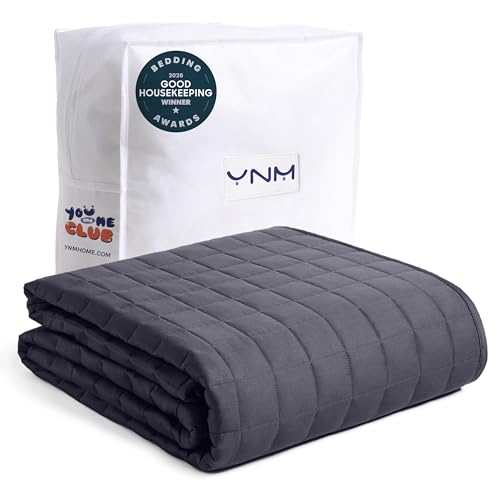
Where to Buy
The three linked picks are sold on Amazon, where you can check the current price and — crucially for this category — the available weight and size variants on each listing. Start with the most even-distributing design, the YnM Weighted Blanket — Check on Amazon. The other linked picks: Gravity Weighted Blanket — Check on Amazon; Bearaby Cotton Hand-Knit Weighted Blanket — Check on Amazon. The three prose-only formats are described in their review blocks so you can shop them knowledgeably anywhere.
In this guide
Quick Picks
| Pick | Badge | Why it earns its place |
|---|---|---|
| YnM Weighted Blanket | Best Overall | 2×2-inch compartments and a cooler bead-forward build for even, breathable pressure. |
| Bearaby Cotton Hand-Knit Weighted Blanket | Best for Hot Sleepers | Open organic-cotton knit: full weight with airflow no filled blanket can match. |
| Gravity Weighted Blankets for Adults | Best for Cold Sleepers | Gridded glass beads under a plush washable cover — maximum cozy for cool rooms. |
| Weighted Blanket for Couples, Dual-Weight Design (prose-only) | Best for Couples | Split-weight or two-person formats that end the one-weight-fits-both fiction. |
| Lightweight Weighted Blanket, 10-12 lb Class (prose-only) | Best for Petite Sleepers | Correct scale for smaller adults the 15 lb standard would overwhelm. |
| Cooling Weighted Blanket with Washable Cover (prose-only) | Best for Summer Sleep | Breathable shell plus cover system for year-round weighted sleep in warm homes. |
Key Takeaways
- Weight follows the sleeper: roughly ten percent of body weight is the standard starting guide, confirmed per maker.
- Size follows the body, not the bed: personal coverage stays put; oversized weighted blankets slide off.
- Even distribution — small compartments or knit construction — is the quality that separates good from lumpy.
- Temperature decides longevity of use: breathable builds sleep year-round, plush builds are seasonal in warm homes.
- Comfort framing only: enjoy the pressure as a preference, and take real sleep disorders to a clinician.
How These Picks Were Chosen
Our verified pool contains three weighted blankets, each a distinct construction philosophy: fine-compartment glass beads with reduced fiberfill (YnM), classic gridded beads with a plush cover (Gravity), and filler-free hand-knit cotton (Bearaby). We review those three as linked picks with verified specifications, and complete the six with prose-only formats for couples, petite sleepers, and summer — needs the pool’s 15-pound, single-person variants do not cover — with no links and no invented specifications. Criteria throughout: distribution evenness, breathability, size-to-body logic, care practicality, and construction durability. Ratings and prices played no part.
The 6 Best Best Weighted Blankets for Sleep — Reviewed
YnM Weighted Blanket
Our badge: Best Overall
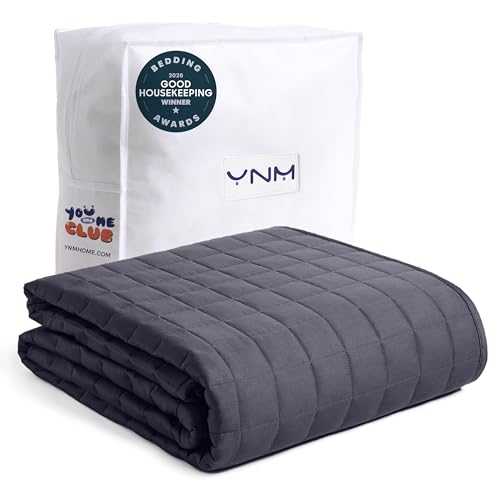
The YnM Weighted Blanket, in its 15-pound 60 by 80 inch version, is engineered around distribution. Its 2×2-inch compartments — described by the maker as the smallest in its line — partition the glass beads so finely that the pressure field feels continuous rather than pooled, and its seven-layer build uses more glass beads and less fiberfill, which trims the insulation that makes lesser weighted blankets stifling. Sixteen loops anchor an optional duvet cover, turning a heavy, awkward wash into a light, easy one.
Strengths
- Finest compartment grid: the most even pressure of any filled blanket here.
- Bead-forward, fill-light build sleeps noticeably cooler than plush rivals.
- Cover-compatible with a full loop system for practical hygiene.
Trade-offs
- 60 by 80 inches is generous for one sleeper and will overhang twin beds.
- 15 pounds is one point in the range; match your body weight using the maker’s guide and the listing’s variants.
- The inner blanket’s wash requires a capable machine or a laundromat trip.
| Color | Exclusive Microfiber Dark Grey |
| Size | 60 in x 80 in 15 lb |
| Weight | 15 pounds |
The maker’s sizing guidance — about ten percent of body weight plus a pound for a single adult, with larger sizes specified for sharing — is the right framework, and the first week should be treated as calibration: use it over a top sheet, keep the rest of the bed light, and notice whether you wake less aware of the blanket over successive nights. YnM’s evenness also makes it the best filled option for restless sleepers, whose position changes punish coarse compartment grids. Choose YnM as the default weighted blanket for sleep. Skip it if you are a very hot sleeper with a warm room — the knit below exists for you.
Best for: Most adults wanting even, cooler weighted sleep / Not suited for: Very hot sleepers or petite users below this weight class
Choose it for even distribution; skip it for extreme heat. Check on Amazon
Bearaby Cotton Hand-Knit Weighted Blanket
Our badge: Best for Hot Sleepers
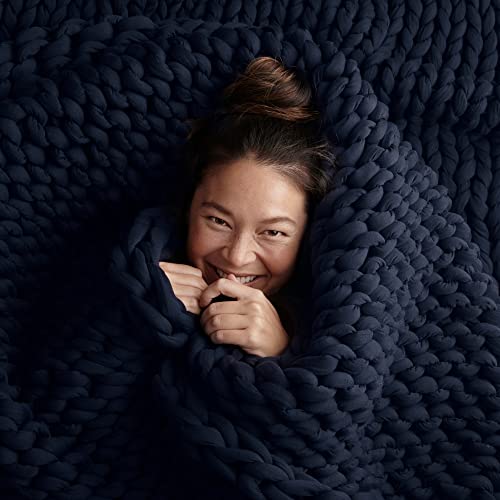
The Bearaby Cotton Hand-Knit Weighted Blanket achieves weight without fill: thick organic cotton yarn, hand-knit into chunky open loops, provides all 15 pounds across a 40 by 72 inch personal blanket in Midnight Blue. Air moves through the knit continuously, so the pressure arrives without the thermal blanket that accompanies bead-and-fill designs. It is OEKO-TEX certified cotton, machine washable as one piece, and beautiful enough to live on top of the bed rather than under a duvet.
Strengths
- Unmatched breathability for a weighted blanket — the summer and hot-sleeper answer.
- No fill to shift, pool, leak, or clump across years of use.
- Single-piece machine washability within its care guidance.
Trade-offs
- Premium tier, reflecting hand-knit organic construction.
- 40-inch width is strictly personal; couples need another solution.
- Open knit provides pressure without insulation — cold sleepers will layer a duvet over it.
| Color | Midnight Blue |
| Size | 15 lbs (40″x72″) |
| Weight | 15 pounds |
Bearaby’s own guidance mirrors the category rule — around ten percent of body weight, rounding up when between options — and the drape of the knit makes that weight feel enveloping rather than pressing. Hot sleepers who tried and abandoned bead blankets in July routinely find this construction is the one that survives August. It also anchors the summer discussion in Best Weighted Blankets For Summer, where it is the benchmark. Store it folded flat; knits stretch if hung. Choose Bearaby for breathable, filler-free weighted sleep. Skip it for shared use or tight budgets.
Best for: Hot sleepers and natural-fiber fans in the 15 lb class / Not suited for: Couples or cold sleepers wanting insulation included
Choose it for cool weighted sleep; skip it for sharing. Check on Amazon

Gravity Weighted Blankets for Adults
Our badge: Best for Cold Sleepers
The Gravity Weighted Blanket pairs a cotton weighted inner piece — fine glass beads held in precise gridded stitching — with a premium micro-plush duvet cover, in a 15-pound twin at 48 by 72 inches. This is the cozy maximalist of the group: the plush cover adds real insulation and a soft, upholstered feel, making it the weighted blanket for cold bedrooms, winter climates, and sleepers who want their pressure served warm.
Strengths
- Plush cover plus even gridded beads: the most cocoon-like sleep here.
- Removable, washable cover keeps the heavy core clean with light effort.
- Twin personal sizing stays on the sleeper and the bed.
Trade-offs
- Warmest build here — a liability in summer and heated bedrooms.
- Cover systems need re-tying after washes; a small recurring chore.
- Bead construction requires suitable machines or commercial washing for the inner piece.
| Color | Grey |
| Size | 15 lbs 48″x72″ Twin/Throw |
| Weight | 15 pounds |
Gravity’s range spans multiple weights, so a household can match partners and family members within one design. In a cool room, with cotton sheets and the plush cover doing thermal duty, this blanket delivers the full weighted-sleep experience its category promises. In a warm room, be honest: remove the plush cover if the design allows a lighter configuration, or rotate to a breathable option seasonally. Choose Gravity for cold sleepers and winter-first use. Skip it as a year-round blanket in a warm home.
Best for: Cold sleepers, winter climates, and twin beds / Not suited for: Hot sleepers or summer-first use
Choose it for warm, plush pressure; skip it for heat. Check on Amazon
Weighted Blanket for Couples, Dual-Weight Design
Our badge: Best for Couples
Partners rarely share a body weight, a temperature preference, or a enthusiasm for weighted sleep — which makes the standard one-blanket solution a compromise machine. The couples formats solve it properly: oversized weighted blankets built for two with weight distributed for a shared bed, or dual designs with different weights per side. This format is prose-only in our guide because the pool’s weighted picks are personal sizes; shop it by confirming total size against your mattress, per-side weight logic against each partner, and a return path, because couples’ fit is the hardest to predict.
Strengths
- One shared bed layer that respects two different bodies.
- Bed-sized coverage stays centered instead of migrating to the heavier sleeper.
- Preserves the shared-blanket ritual many couples refuse to give up.
Trade-offs
- Very heavy overall — washing is a commercial-machine event, full stop.
- If one partner dislikes weight, the whole purchase fails; trial matters.
- Premium tier across the category.
The pragmatic alternative many couples land on: two personal weighted blankets, one per side, over a shared light sheet — each partner perfectly weighted, each free to kick theirs off. It looks unconventional and sleeps brilliantly. Choose a couples format for a genuinely shared layer. Skip it if either partner is a weighted skeptic; solve that with a personal trial first.
Best for: Couples committed to weighted sleep together / Not suited for: Mixed couples where one partner is unsure
Choose it for shared weighted sleep; skip it for mixed enthusiasm.
Lightweight Weighted Blanket, 10-12 lb Class
Our badge: Best for Petite Sleepers
The ten-percent guide means smaller adults are badly served by a market standardized on fifteen pounds. The 10-to-12-pound class — personal twin sizes with the same compartment quality as heavier models — is the correct product for petite sleepers, and this prose-only pick exists to say so plainly, since our pool’s linked options are all 15-pound variants. Shop the class by compartment fineness and shell breathability exactly as you would a heavier blanket; lighter must not mean cruder.
Strengths
- Correct pressure scale for smaller bodies — comfort without being pinned.
- Easier to move, wash, and manage in every dimension.
- The entry point for the weighted-curious to test the sensation honestly.
Trade-offs
- Larger sleepers will find the class imperceptible and pointless.
- Fewer fabric and cover options than the mainstream 15 lb class.
- Still bound by all weighted-blanket rules: free removal, no face coverage.
If you are between classes, the tie-breaker is a week’s trial where possible: the right weight disappears into the background of sleep, while too much announces itself at every turn. Choose the light class whenever the ten-percent guide says so. Skip the standard class out of bargain-hunting; a wrong-weight blanket on sale is still the wrong blanket.
Best for: Petite adults and first-time weighted sleepers / Not suited for: Larger adults needing full standard weight
Choose it for correct petite sizing; skip it for larger bodies.
Cooling Weighted Blanket with Washable Cover
Our badge: Best for Summer Sleep
The final format targets the weighted blanket’s seasonal failure mode: a breathable shell — cotton or bamboo-derived, minimal fiberfill, glass beads — paired with a removable washable cover in a light fabric. It is the architecture for warm homes that want one weighted blanket all year, and it overlaps the dedicated discussion in our summer weighted guide. Prose-only here as a format; the YnM’s bead-forward build is the closest linked expression of the same philosophy.
Strengths
- Year-round weighted sleep in warm climates and heated homes.
- Cover system keeps hygiene easy through sweaty months.
- Shell breathability reduces the sealed, clammy feeling of plush builds.
Trade-offs
- Less cozy in cold rooms; winter may still want a duvet partner.
- Cooling is construction-dependent — labels vary, materials lists tell the truth.
- Two-piece care system with the usual reassembly minutes.
Pair it with cotton sheets and the lightest duvet you own, or none, and the weighted bed becomes season-proof for most sleepers. Choose the cooling-cover format for warm-home year-round use. Skip it if your bedroom is cold and plush is the point.
Best for: Warm homes wanting one weighted blanket all year / Not suited for: Cold rooms seeking maximum cocoon
Choose it for summer-proof weight; skip it for winter cocoons.
Comparison Table
| Pick | Size | Weight | Color | Check price on Amazon | |
|---|---|---|---|---|---|
| YnM Weighted Blanket | 60 in x 80 in 15 lb | 15 pounds | Exclusive Microfiber Dark Grey | Check price on Amazon | |
| Bearaby Cotton Hand-Knit Weighted Blanket | 15 lbs (40″x72″) | 15 pounds | Midnight Blue | Check price on Amazon | |
| Gravity Weighted Blankets for Adults | 15 lbs 48″x72″ Twin/Throw | 15 pounds | Grey | Check price on Amazon | |
| Weighted Blanket for Couples, Dual-Weight Design (prose-only) | — | — | — | Check price on Amazon | |
| Lightweight Weighted Blanket, 10-12 lb Class (prose-only) | — | — | — | — | Check price on Amazon |
| Cooling Weighted Blanket with Washable Cover (prose-only) | — | — | — | — | Check price on Amazon |
How to Choose the Best Weighted Blanket for Sleep
Weight: The Ten-Percent Starting Point
Begin near ten percent of your body weight, confirm with the specific maker’s chart, and treat the first nights as calibration. Between sizes, lighter is the safer error for sleep — you are resting under this for eight hours, not testing strength. Anyone who cannot move or remove the blanket freely should not use one, and weighted blankets are for adults and appropriately sized older teens, never infants or small children.
Size: Cover the Sleeper, Not the Mattress
Personal dimensions near 48 by 72 inches suit most adults; larger personal throws suit taller sleepers. Weighted blankets sized like bedding hang off the edges, and gravity spends the night pulling them floorward, concentrating weight at the border instead of across your body. If you share a bed, solve sharing deliberately — couples formats or two personal blankets — rather than by oversizing one.
Distribution: Compartments or Knit
Judge how the weight is partitioned. Small, well-stitched compartments keep glass beads in a continuous field; coarse grids pool and lump. Knit construction eliminates the question entirely. Run your hands across a candidate blanket: you are feeling for uniformity, the single best predictor of whether the pressure will feel like a hug or like luggage.
Temperature: The Seasonal Truth
Filled blankets insulate; plush-covered ones insulate more. If your room runs warm or you sleep hot, only breathable architectures — bead-forward minimal fill, cooling shells, open knits — will survive your summer. Cold sleepers can enjoy the full plush experience. Match the blanket to your warmest month, because that is when weighted blankets get abandoned.
Care: Plan the Wash Before the Purchase
Decide between cover systems (wash the light part often), whole-blanket washing in a capable machine, or commercial machines for heavy models. A weighted blanket you cannot clean is a purchase with an expiry date. Read both the blanket’s care label and your machine’s limits before the first night, not the first spill.
Cover Systems: The Hygiene Decision That Decides Everything
A weighted blanket lives closer to the sleeper than any other bedding: it sits on top of the sheet, against pajamas and skin, night after night, absorbing the same sweat and skin oils as the sheet itself — yet it is the hardest item in the bed to wash. That mismatch is why the cover question deserves to be settled before purchase rather than after the first spill. A duvet-style cover with a real fastening system — the sixteen loops on the YnM, ties or internal clips on other designs — converts the whole hygiene problem into an ordinary light wash you can run weekly alongside the sheets. Without a cover, you are committed to washing fifteen pounds of glass beads whenever life happens, which in practice means the blanket gets washed far less often than it should. Judge any cover system by three things: whether the fastenings genuinely prevent the inner blanket from bunching into one corner, whether the cover fabric itself suits your temperature (a plush cover on a breathable blanket quietly cancels the breathability you paid for), and whether you can refasten it alone in under five minutes, because a cover that needs two people and a free afternoon will be skipped. Households working through the same hygiene logic for an older family member will find the parallel discussion in Best Blankets For Elderly useful, since easy washing matters even more when laundry help is part of the routine.
One Bed, Two Sleepers: Solving the Shared-Bed Problem Honestly
The most common weighted-blanket failure is not a bad blanket; it is a shared bed where only one partner wants the weight. The workable arrangements are few and worth naming plainly. Two personal blankets, one per side, remains the most successful pattern: each sleeper gets a correct weight class, the weighted partner is fully covered, and the unweighted partner sleeps under the ordinary duvet undisturbed — the visual oddity disappears within a week. A single personal blanket on one side only works if it is narrow enough not to creep across the center line; the 40-inch knit format does this best. A bed-sized couples blanket is the right answer only when both partners have genuinely trialed weighted sleep and liked it, because it is the most expensive and least returnable configuration in the category. What rarely works is compromise weight: a blanket chosen halfway between two bodies ends up too heavy for one and pointless for the other. Trial the sensation individually first — a weighted throw over the legs during evening reading tells each partner most of what they need to know — and let the bed arrangement follow the verdict rather than the other way around.
How to Sleep With a Weighted Blanket: The First Two Weeks
Introduce the blanket in stages: drape it over your legs for the first evenings’ reading, then sleep with it over a top sheet for partial nights, then full nights as comfort dictates. Keep the rest of the bedding lighter than usual — the weighted blanket replaces a layer rather than joining all of them. Expect an adjustment curve: many sleepers report the first nights feel unusual and the second week feels indispensable, while others conclude within days that the sensation is not for them, which is also a successful trial. Position it to cover torso and legs without riding near the face, and let children and pets sleep elsewhere — weighted blankets are single-user equipment sized to one body. If you wake with soreness or a sense of restriction, the weight is too much or the fit is wrong; adjust down rather than pushing through. Comfort is the entire mechanism here, so discomfort is data, not a phase to endure.
Problem: The blanket slides off during the night — It is oversized for the bed or sleeper. Size toward body coverage, and sandwich it between the top sheet and a light duvet to anchor it.
Problem: You wake up too hot — Remove other layers first, then consider a breathable build or reserving the weighted blanket for the wind-down hour in summer.
Problem: The weight feels uneven or lumpy — Lay the blanket flat and redistribute the fill through its compartments by hand; persistent pooling suggests coarse compartments or a torn partition, which is a quality verdict on that blanket.
Problem: You feel restricted rather than settled — The weight class is likely too high for your body. Step down a class; the ten-percent guide is a ceiling for many sleepers, not a target.
Problem: The blanket is too heavy for your washer — Wash the cover only, and take the inner blanket to a commercial machine, exactly as its maker directs. Forcing a home machine risks both.
Weekly Care Rhythm: Keeping Fifteen Pounds Fresh Without Drama
The care routine that keeps a weighted blanket in service for years is undramatic by design. Shake and air the blanket weekly — draped over a door or the foot of the bed for a morning — because most of what accumulates in bedding is moisture, and moisture aired out weekly never becomes odor. Wash the cover on the same cadence as the sheets; it is doing the sheet’s job against skin and should be treated like one. The inner blanket needs washing only a few times a year for most sleepers, plus spot cleaning for spills, and each wash should be cold, gentle, and followed by thorough low-heat or line drying, since a fifteen-pound blanket put away damp will smell like it within days. Before every wash, run a slow hand-check across the compartments: you are feeling for a torn partition, a cluster of beads pooled where they should not be, or stitching gone slack at a corner. Catching a small tear early means a few stitches save the blanket; catching it after a wash cycle has pumped beads through the shell usually ends it. Rotate the blanket head-to-foot monthly so the same fold lines and the same shoulder zone do not take every night’s wear — textiles age where they are stressed, and rotation is the cheapest lifespan extension in bedding. Finally, store any off-season weighted blanket flat or loosely rolled in a breathable bag, never compressed in a vacuum bag and never hung: hanging stretches knit constructions and stresses compartment stitching on filled ones, and vacuum compression crushes the loft that makes the shell feel like bedding rather than ballast.
One more habit separates owners who love these blankets in year three from owners who replaced theirs in year one: keeping the blanket on the bed. Dragging fifteen pounds across the floor to the couch every evening abrades the shell, snags stitching on furniture edges, and grinds household grit into the fabric. If you want weighted comfort in the living room, the honest solution is a second, lighter weighted throw that lives there — sized for laps and shoulders rather than full-body sleep — instead of commuting the bed blanket twice a day. The bed blanket stays clean longer, the seams stop taking transit damage, and each blanket does the one job its size suits.
Weighted Blankets in a Complete Sleep Routine
A blanket, weighted or not, is one variable in a system: a cool, dark, quiet room; consistent sleep and wake times; light and screens managed in the last hour; caffeine and heavy meals given their distance. Within that system, a weighted blanket’s role is tactile comfort — the settled, tucked-in feeling that helps some people look forward to bed and relax into their routine. That is a worthwhile role, honestly stated. It is not a treatment for insomnia or any sleep disorder, and this guide’s position is that any product implying otherwise should be trusted less, not more. If sleep is genuinely broken — loud snoring with pauses, severe daytime sleepiness, months of insomnia — the next step is a clinician, who can find causes no bedding can address. Buy the weighted blanket the way you would buy the perfect pillow: sized to you, suited to your temperature, and chosen because your body likes it.
Durability: What Wears Out and What Lasts
Weighted blankets fail in characteristic ways: compartment stitching loosens and beads migrate, shells abrade at fold lines, covers pill, and knits stretch if stored hanging. You can extend life substantially with boring habits — use a cover, wash gently and rarely (the inner), store flat or loosely rolled, and keep the blanket on the bed rather than dragging it across floors where seams snag. Glass beads themselves are effectively immortal; it is the textile engineering around them that ages, which is why construction quality — stitch density, shell fabric, compartment size — predicts lifespan better than any feature list. Expect a quality weighted blanket to serve for years of nightly use, and judge cost across those nights rather than at the checkout. When a compartment tears and beads escape, retire or professionally repair the blanket; loose beads and pets or children are a bad combination, and a leaking blanket has told you its service is over.
Weighted Blankets Across the Household: Partners, Guests, and the Spare Room
A weighted blanket bought for one sleeper tends to get borrowed, and the borrowing exposes fit questions the original purchase never faced. A partner twenty pounds lighter who naps under your fifteen-pound blanket is not in danger — any adult who can move and remove a blanket freely can trial it — but they will likely find it more load than comfort, and their verdict on the category will be unfairly negative. Keep the household’s expectations straight: the blanket is fitted equipment, like a pillow chosen for one person’s neck, and a second sleeper who wants in should be sized for their own class rather than inheriting yours. Guest rooms are the other quiet trap. A weighted blanket reads as a thoughtful luxury to the host and as an unexplained heavy object to a guest who has never used one; if you stock the guest bed with one, leave the ordinary duvet folded visibly at the foot so the choice is obvious, and never place weighted blankets on beds intended for children visiting the house. Older relatives visiting overnight raise the same sizing question with higher stakes around mobility, which is exactly the scenario worked through in Best Blankets For Elderly: anyone who cannot push the blanket off unaided should not sleep under it, full stop.
There is also a seasonal household pattern worth planning for. Many owners discover their weighted blanket is a three-season product: adored from October through April, tolerated in May, and quietly folded away when the first hot nights arrive — unless the construction is one of the breathable architectures. That is not a failure of the purchase; it is the normal physics of sleeping under fifteen pounds of anything. Households that want the pressure sensation to survive the summer should plan the rotation deliberately, pairing a plush or standard build for the cold months with an open-knit or bead-forward build for the warm ones, the system laid out in Best Blankets For All Seasons. Budgeted as a two-blanket system from the start, weighted sleep becomes a genuinely year-round habit instead of a winter enthusiasm that evaporates — and evaporated enthusiasm, not construction quality, is what fills the secondhand market with barely used weighted blankets every September.
What the First Month Actually Feels Like: A Night-by-Night Calibration Guide
Because the sensation is unfamiliar, the first nights deserve interpretation, or sleepers abandon good blankets for bad reasons. Nights one to three commonly feel strange in a specific way: the pressure is noticeable at every position change, and many people wake once or twice simply aware of the blanket. That awareness is novelty, not incompatibility. By the end of the first week, position changes stop registering for most sleepers, and the blanket’s presence is felt mainly at the moment of getting into bed — the settling-in sensation people buy it for. The second week is the honest verdict window: if you are sleeping through with the blanket unnoticed, the fit is right; if you are still waking aware of weight on your chest or hips, the class is too heavy, and stepping down produces a disproportionate improvement. Heat follows its own curve — a blanket that feels perfect in a cool bedroom in week one reveals its true thermal character only when the room warms, so judge summer suitability by your warmest nights, not your average ones. Keep a simple note for the first fortnight — hours slept, times woken, too hot or just right — because memory flattens the trend and the note does not. If the note trends the wrong way on weight, exchange within the return window rather than adapting yourself to the wrong equipment; the category’s whole premise is that the blanket adapts to you.
Common Buying Mistakes
Buying by Bed Size
A king weighted blanket for a queen bed and one sleeper spends the night sliding off and pooling at the edges. Weighted blankets fit bodies. The consequence of bedding logic is a blanket that feels both heavier and less even than it should.
Going Heavier for More Effect
More weight is not more benefit; past your fit it is just load. Sleepers who overshoot wake sore and abandon the category. Trust the ten-percent starting point and calibrate down if anything.
Ignoring Temperature Until Summer
The plush December purchase becomes July’s closet resident. Buy for your warmest sleeping conditions, or accept a two-blanket seasonal system from the start.
Skipping the Wash Plan
Fifteen pounds of blanket meets a small washer and loses. Know your machine’s answer — cover system, capable drum, or laundromat — before the blanket comes home.
Expecting a Medical Result
Buying a blanket to treat a sleep disorder delays real care and guarantees disappointment with a good product. Comfort is the promise; keep health questions with clinicians.
Buying the Display Size Instead of Your Size
Listings lead with their largest, most photogenic configuration, and shoppers routinely order the size in the picture rather than the size in the sizing chart. With weighted blankets the error is doubled, because the bigger variant is usually also the heavier one: the sleeper ends up with a blanket that is simultaneously too wide for their body and too heavy for their frame, then concludes the whole category is uncomfortable. The better move is unglamorous — weigh yourself, open the maker’s chart, order the variant the chart names, and let the photograph sell to someone else. If your correct variant looks small in the product images, remember it is supposed to: it fits a person, not a showroom bed.
Final Recommendation
Start with the YnM Weighted Blanket in the weight class your body dictates: the finest distribution, a cooler build, and cover-friendly care make it the most forgiving first weighted blanket for sleep. Hot sleepers should go straight to the Bearaby knit — compare it here: Check on Amazon — and cold sleepers will find their cocoon in the Gravity. Petite sleepers, choose the lighter classes without apology, and couples, solve sharing deliberately. Size to the body, breathe for your climate, wash by plan, and keep the health framing honest — that is weighted sleep done right.
One last calibration note: give whichever pick you choose a genuine two weeks before judging it, and judge it by your sleep notes rather than by the first night’s novelty. The blankets above reward correct sizing more than any other bedding purchase you will make — an evening spent on the sizing chart and the wash plan is worth more than a month of adapting to the wrong blanket. Buyers who do that homework almost always land in the right weight class on the first attempt, and the blanket disappears into their routine exactly as it should — present at bedtime, unnoticed by morning, and still in service years later. That quiet disappearance into the routine is the real product being sold in this category — not pressure, not beads, not knit loops, but a bed that feels finished the moment you get into it, night after night, in every season your construction choice honestly supports.
Frequently Asked Questions
Can I use a weighted blanket every night, all year?
Yes, if the fit and temperature are right — there is no need to ration a comfort product that suits you. The practical limit is seasonal: sleepers in warm homes often rotate to a breathable build or pause during the hottest weeks, which is a comfort decision, not a safety schedule. If you find you only enjoy yours in winter, that is useful information about construction, and a lighter summer partner blanket solves it better than forcing the plush one through August.
Will a weighted blanket make me too dependent on it to sleep without one?
What develops is preference, not dependence: the settled sensation becomes part of your wind-down routine the way a favorite pillow does, and traveling without it feels like traveling without that pillow — mildly less comfortable, entirely manageable. Many owners keep a lighter travel throw for trips for exactly this reason. If needing a specific blanket to sleep ever became distressing rather than merely preferable, that would be a conversation for a clinician about the sleep itself, not about the blanket.
Can my partner and I share one weighted blanket if we are similar weights?
Similar weights remove the biggest obstacle, but coverage is the second one: a personal-size blanket shared by two people covers neither properly and migrates toward whoever moves less. If you are genuinely similar in build and both enjoy the sensation, choose a purpose-built couples size with bed-scale dimensions rather than stretching a personal blanket across two sleepers, and confirm the combined laundry plan first — couples sizes are commercial-machine territory.
What should a weighted blanket never be used for?
Never for infants or small children, never on anyone who cannot move or remove it freely, never over the face or head, and never as a restraint or a way to keep a restless sleeper in bed — that framing crosses from comfort into something the product is not for. Pets should not sleep under one either; a small animal under fifteen pounds of blanket cannot reliably free itself. Used as fitted personal comfort equipment for a capable adult, it stays in its lane.
How heavy should a weighted blanket be for sleep?
The standard starting guide is around ten percent of your body weight, confirmed against the maker’s chart for the specific model. When between sizes, lighter is usually the better sleep choice.
Can a weighted blanket be too heavy?
Yes. Signs include waking sore, feeling restricted, overheating, and the blanket migrating off the bed. Step down a weight class. Users must always be able to move and remove the blanket freely.
Do weighted blankets help you sleep better?
Many sleepers find the even pressure genuinely cozy and settling as part of their routine, which is the comfort claim this guide stands behind. They are not treatments for insomnia or other conditions; persistent sleep problems need a clinician.
Should a weighted blanket cover the whole bed?
No — it should cover the sleeper. Bed-sized weighted blankets slide off and distribute badly. Couples should use a couples format or two personal blankets.
How do you wash a weighted blanket?
Prefer a removable cover for regular washing. Wash the inner blanket rarely and gently, only in a machine rated for its wet weight, or use a commercial laundromat machine for heavy models.
Are weighted blankets safe for everyone?
No. They are for adults and appropriately sized older teens who can remove them freely. Never for infants or small children, and anyone with health conditions affecting breathing, circulation, or mobility should consult their clinician first.


